

Financially knowledgeable individuals accumulate more retirement wealth, as we found in our recent literature overview (Lusardi and Mitchell, Reference Lusardi and Mitchell2014). Nevertheless, since little is known about how this association arises, a further exploration of the mechanism could be relevant to plan sponsors and, possibly, policymakers. For instance, if we could show that financial knowledge enables people to do a better job investing their retirement savings, then this could motivate private and public efforts to enhance financial knowledge in the population at large.Footnote 1
In what follows, we examine the link between financial literacy and investment outcomes using a novel dataset linking administrative records on retirement plan investment performance with an employee survey measuring employees’ financial knowledge. Since our findings draw from a single firm, our results are suggestive rather than probative. Nevertheless, they do imply that the most financially knowledgeable individuals invest differently and can expect higher returns on their retirement savings. Results show that the most financially knowledgeable investors: (a) held 18 percentage points more stock than their least knowledgeable counterparts; (b) could anticipate earning 8 basis points per month more in excess returns; (c) had 40% higher portfolio volatility; and (d) held portfolios with about 38% less idiosyncratic risk, as compared with their least savvy counterparts. A return advantage due to more equity exposure does, of course, imply more portfolio volatility, yet it could also help generate a larger nest egg over a lifetime of retirement saving. It might also produce greater retirement wealth inequality across the most and least sophisticated, consistent with recent theoretical work (Lusardi et al., Reference Lusardi, Michaud and Mitchellforthcoming).
1 Prior research
People who are more financially savvy have been demonstrated to have more retirement wealth (Lusardi and Mitchell, Reference Lusardi, Mitchell, Mitchell and Lusardi2011a , Reference Lusardi and Mitchell2014). Several possible explanations for this observation have been suggested. One is that more financially literate individuals are wealthier because they plan and save more. This has been confirmed empirically in several studies, even after controlling for education, age, sex, marital status, IQ, and other factors (c.f., Lusardi and Mitchell, Reference Lusardi and Mitchell2007, Reference Lusardi and Mitchell2008, Reference Lusardi, Mitchell, Mitchell and Lusardi2011a ; Behrman et al., Reference Behrman, Mitchell, Soo and Bravo2012). Another explanation is that more sophisticated investors hold riskier assets, and hence they tend to benefit from higher excess returns. In one study of Dutch respondents’ self-reports on stock and mutual fund holdings, van Rooij et al. (Reference van Rooij, Lusardi and Alessie2011) did find a positive correlation between financial knowledge and self-reported stockholding. In a dataset from the US American Life Panel, Yoong (Reference Yoong, Mitchell and Lusardi2011) again confirmed that the more financially sophisticated were more likely to self-report they held stocks and mutual funds. Nevertheless, neither of those studies had administrative information linking actual investment patterns and financial knowledge.
In related research, better-educated households have been found to hold more stock than their less-educated counterparts (Haliassos and Bertaut, Reference Haliassos and Bertaut1995; Calvet et al. Reference Calvet, Campbell and Sodini2007, Reference Calvet, Campbell and Sodini2009a , Reference Calvet, Campbell and Sodini b ; Calvet and Sodini, Reference Calvet and Sodini2014). Nevertheless, those authors had no information on financial knowledge. This is important, since education and financial literacy measure somewhat different things (Behrman et al., Reference Behrman, Mitchell, Soo and Bravo2012). Bodnaruk and Simonov (Reference Bodnaruk and Simonov2014) examined the portfolios of private mutual fund managers and concluded that financial experts’ investment decisions were no better than those of their less-savvy counterparts; here too, however, the dataset used had no direct measures of investors’ financial knowledge. Christelis et al. (Reference Christelis, Jappelli and Padula2010) and Jappelli and Padula (Reference Jappelli and Padula2013a , Reference Jappelli and Padula b ) found that respondents’ mathematics scores in grade school were associated with more stock market participation later in life. Nevertheless, school IQ and math scores are not identical to financial sophistication (Lusardi et al., Reference Lusardi, Mitchell and Curto2010), suggesting that there is room for a new evaluation of financial literacy effects on portfolio investment behaviors.
Yet a different explanation for how financial literacy could contribute to greater wealth accumulation is that sophisticated individuals may earn higher returns on their investments. There are hints of this in the literature: for instance, Deuflhard et al. (Reference Deuflhard, Georgarakos and Inderst2014) linked saving account returns of Dutch survey respondents to a set of financial literacy questions and to information on bank interest rates. That study concluded that financial knowledge was associated with higher returns on saving accounts; interestingly, some of this impact was attributable to people's willingness to use self-managed online banking. Nevertheless, their dataset lacked information on any more-sophisticated investments.Footnote 2 Also in the Netherlands, von Gaudecker (Reference von Gaudecker2015) showed that more knowledgeable respondents reported holding more diversified funds; again, however, his analysis relied on self-reported portfolios rather than arguably more accurate administrative records.
Related to this point is the possibility that sophisticated investors could possibly pick less costly mutual funds, thereby enhancing net returns. Grinblatt et al. (Reference Grinblatt, Keloharju and Linnainmaa2011) examined how Finnish investors’ performance tied to measured IQ scores and business education, and they concluded that higher-IQ investors and those with business education did pay lower fund fees. Laboratory experiments by Choi et al. (Reference Choi, Laibson and Madrian2010) reported that people who deemed themselves more financially knowledgeable also selected somewhat lower-fee investment options than their counterparts. In fact, the last set of authors concluded (p. 1408): ‘mistakes driven by financial illiteracy are the primary source of the demand for high-fee index funds.’ In a field experiment, Hastings et al. (Reference Hastings, Mitchell, Chyn, Mitchell and Lusardi2011) designed a financial literacy module administered by a Chilean national survey to examine whether less financially knowledgeable respondents were differentially sensitive to how pension plan fee information was framed. They reported that the less savvy were, in fact, much more sensitive to the way in which fund fees were framed. Moreover, they reported that financial knowledge played an independent role, separate from that of education. This evidence, while suggestive, stopped short of assessing how financial knowledge affected investment performance in retirement plans, net of fees.
A final reason that the more financially sophisticated may be wealthier is that they may select better-diversified investments, thereby being less exposed to nonmarket or idiosyncratic risk. There is only indirect evidence on this point to date. Tang et al. (Reference Tang, Mitchell, Mottola and Utkus2010) reported that 401(k) plan participants tended to be offered efficient menus of investment funds, but many constructed quite inefficient portfolios given the choices. That study, however, lacked direct information on participants’ financial capabilities.
In sum, previous research has been unable to determine directly whether more financially savvy investors accumulate more assets because they manage their retirement investments more effectively than their less-savvy counterparts. In what follows, we evaluate the links between financial knowledge, investment behavior, and investment performance, using a new employer-based administrative data linked to survey evidence.
2 Data and methods
Under confidentiality conditions, we gained access to a unique dataset from the Office of Employee Benefits of the Federal Reserve System (OEB Fed) which has multiple locations across the USA. The Fed offers its employees a defined benefit (DB) plan of the conventional variety. In addition, it has a defined contribution (DC) pension with a fund menu that includes stock and bond index choices, target date funds, lifestyle funds (conservative, moderate, and aggressive), international and emerging market funds, and a real estate fund. The OEB Fed provided us with administrative records on each employee's contributions and investment allocations across the DC plan fund menu, which we then linked to fund returns data as detailed below.
Accordingly, we were able to learn which of the funds offered by the plan sponsor each participant selected at two points in time, and what each participant earned on his individual retirement portfolio.Footnote 3 Using this linkage and a decade of historical net returns for each fund in the employer's investment menu, we have computed each participant's equity allocation and own portfolio performance metrics as of April and December 2013. Additionally, in cooperation with the OEB, we fielded an internet survey on financial knowledge via email in October of 2013. Responses to this survey were then linked to the administrative records on respondents’ investment allocations immediately prior to and after the survey, along with controls for respondents’ personal characteristics (sex, age, marital status, job tenure, salary, and 401(k) plan balances).Footnote 4 Next we turn to an overview of the dataset and our analysis methods.
2.1 The financial literacy survey
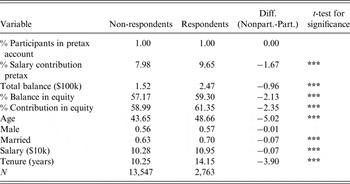
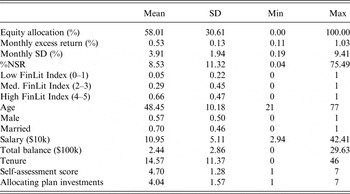
The Institution's employee benefits office distributed to approximately 16,000 active employees an online survey on financial literacy (FinLit), followed by a short informational webinar explaining key aspects of the firm's retirement saving plan.Footnote 5 About 17% of the active workforce responded to the invitation to take the survey, a response rate similar to other voluntary and non-incentivized surveys.Footnote 6 Our respondent sample differs from the non-respondent sample in some unsurprising ways: for instance, Table 1 shows that FinLit survey respondents contributed 1.7 percentage points more of their pretax salaries; had significantly higher plan balances of almost $100,000; held about two percentage points more equity; were about 5 years older; and had worked for the Fed about 4 years longer than their counterparts. To the extent that FinLit survey participants were more financially sophisticated than those who did not, the effects we report below may underestimate the extent to which the entire workforce could benefit from additional financial education.
Comparison of characteristics for survey respondents and non-respondents

This table summarizes key variables for 401(k) plan participants who did and did not take the FinLit survey. All data derived from the Fed's administrative records and refer to active employees (i.e., not retired, vested terminated, or deceased).
Note: *** Significant at the 0.01 level; ** Significant at the 0.05 level; * Significant at the 0.10 level.
We measured respondents’ financial knowledge in the online FinLit survey using five questions we have developed and field-tested in prior research (correct answers are provided in bold):
-
• Interest rate: Suppose you had $100 in a savings account and the interest rate was 2% per year. After 5 years, how much do you think you would have in the account if you left the money to grow? More than $110 , Exactly $110, Less than $110, DK, RF.Footnote 7
-
• Inflation: Imagine that the interest rate on your savings account was 1% per year and inflation was 2% per year. After 1 year, how much would you be able to buy with the money in this account? More than today, Exactly the same, Less than today, DK, RF.
-
• Risk: Is this statement True or False? Buying a single company's stock usually provides a safer return than a stock mutual fund. True, False, DK, RF.
-
• Tax offset: Assume that you were in the 25% tax bracket (you pay $0.25 in tax for each dollar earned) and you contributed $100 pretax to an employer's 401(k) plan. Your take-home pay (what's in your paycheck after all taxes and other payments are taken out) will then: Decline by $100, Decline by $75 , Decline by $50, Remain the same, DK, RF.
-
• Match: Assume that an employer matched employee contributions dollar for dollar. If the employee contributed $100 to the 401(k) plan, his account balance in the plan including his contribution would: Increase by $50, Increase by $100, Increase by $200, Remain the same, DK, RF.
The first three questions, devised by Lusardi and Mitchell (Reference Lusardi and Mitchell2008, Reference Lusardi, Mitchell, Mitchell and Lusardi2011a ), are known as ‘the Big Three.’Footnote 8 The first measures people's ability to do a simple interest rate calculation; the second tests people's understanding of inflation; and the third is a joint test of knowledge about ‘stocks’ and ‘stock mutual funds’ as well as risk diversification, since the correct response requires the respondent to know what a stock is and that a mutual fund is comprised of many stocks.
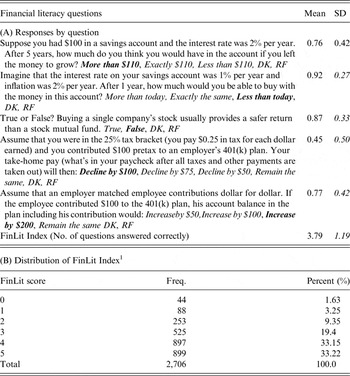
Our prior research has demonstrated that few Americans can answer all of the first three questions correctly (with similar results in other countries), and not many more know the correct answers to two of them. By contrast, this firm's workforce proved to be substantially more financially knowledgeable (as measured by the Big Three) compared with the general population, a predictable result given that the group consists of financial sector employees (see Table 2). Specifically, 76% of the respondents responded correctly to the Interest Rate question, 92% to the Inflation question, and 88% to the Risk question. This can be compared with 75%, 61%, and 48% correct answers in the nationally representative 2012 National Financial Capability Study, which is also an online survey (FINRA Investor Education Foundation, 2013).Footnote 9
Results of financial literacy assessment

This table summarizes responses to the five-item financial literacy questions by survey respondents. Correct answers are bolded. N = 2,763.
1 Number of financial literacy questions answered correctly.
The last two questions were devised and implemented in surveys fielded in large US firms by Clark et al. (Reference Clark, Maki and Morrill2014). Answering these questions proved more difficult, even for this relatively sophisticated group. Both queries required respondents to understand how employer and employee contributions influence retirement plan accumulations, taking into account the tax implications of worker pre-tax contributions. In the Tax Offset question, for instance, the employee had to understand that the tax-deferred aspect of his own contributions reduced the net cost of payments into the plan: only 45% of respondents answered this item correctly. The Match question required the employee to know that a dollar-for-dollar match meant that $100 of own contributions would generate an equal employer contribution; moreover employer match dollars are not taxed when contributed to the plan. The Match question was easier to answer for this group, and 78% answered this question correctly.
As is conventional,Footnote 10 we sum the correct answers to all of the questions to produce a FinLit Index for each person. In this sample, the Index values ranged from 0 to 5, with a mean of 3.8 and a standard deviation (SD) of 1.2. One-third of the respondents answered all five questions correctly, while fewer than 2% (44 respondents) got all questions wrong.
2.2 Investment metrics
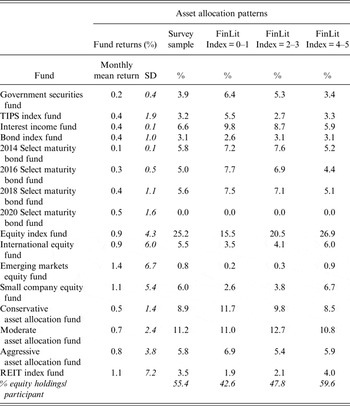
The Fed includes 16 mutual funds in its 401(k) plan including a government securities fund, a TIPS fund, several bond funds, several equity funds, and a Real Estate Investment Trust (REIT) Index Fund. Table 3 summarizes descriptive statistics regarding monthly fund returns (net of expenses, measured over the 10-year period ending in April 2013) and asset allocation patterns. The first two columns show that, over this period, bond funds generally earned returns below those of the equity and REIT funds, and they also generally experienced lower volatility.
Fund returns and participant assets by fund

This table summarizes monthly returns and SD by fund; it also reports asset allocation patterns for participants who responded to the FinLit survey and contributed to the 401(k) plan. The FinLit Index is derived from summing correct answers to questions in Table 2. The monthly mean return (SD) refers to each fund's mean monthly return (SD) over the period Jan 2003–April 2013.
The next four columns report the share of assets held by employees in April of 2013, prior to responding to the financial literacy module, along with results sorted by their FinLit Index scores (the number of correct answers to the survey). Interestingly, the least knowledgeable employees were substantially less likely to hold equity index, international equity, and small company equity funds. And when they did invest in stock funds, they were more likely to invest in the conservative asset allocation fund. Overall, the less savvy were much more likely to be holding bonds than not. Conversely, the more financially sophisticated employees held 17 percentage points or close to 40% (39.9% = (59.6–42.6)/42.6) more of their assets in equity, compared with the least financially sophisticated group.Footnote 11
To analyze the results in more detail, we have generated four measures to evaluate participants’ investment behavior and performance across the firm's DC plan options (all as of April 2013 before the financial literacy survey was conducted). First, we computed the equity fraction in participants’ retirement portfolios. While financial sophistication need not imply that savvier participants hold more equity, we wish to test whether more knowledgeable individuals did in fact invest more in equities, controlling for other factors (to be described below).
Second, we computed participants’ monthly expected excess returns
 ${r_j}^e $
, using each participant j's contribution allocations to the available funds on offer in month t. To do so, we estimate a 6-factor model for all the funds i = 1,…,I using net return data for the 60 months (t − 60 to t − 1) prior to contribution month t:
 $$\eqalign{{\tilde R_{it}} - {R_{Ft}} & = \alpha + {\beta _1}({\tilde R_{Mt}} - {R_{Ft}}) + {\beta _2}Sm{B_t} + {\beta _3}Hm{L_t} + {\beta _4}Wm{L_t} + {\beta _5}Ter{m_t} \cr & \quad + {\beta _6}De{\,f_t} + {\tilde e_{it}}.}$$
Following Fama and French (Reference Fama and French1993), here
 ${\tilde R_{it}} - {R_{Ft}}$
refers to the excess return of fund i over the risk-free rate (the 1-month Treasury bill rate from Ibbotson Associates);
 ${\tilde R_{Mt}} - {R_{Ft}}$
refers to the value-weighted return on all NYSE, AMEX, and NASDAQ stocks (from the Center for Research in Security Prices (CRSP)) minus the risk-free rate; SmB refers to the difference in the performance of small relative to big stocks; HmL to the difference in performance of value stocks to growth stocks; WmL is the Fama-French up-minus-down factor; Term measures the difference between the return on a market portfolio of long-term corporate bonds (the composite portfolio in the corporate bond module of Ibbotson Associates) and the 1-month Treasury bill rate measured at the end of the previous month (from CRSP); and Def measures the difference between the monthly long-term government bond return (from Ibbotson Associates) and the 1-month Treasury bill rate measured at the end of the previous month (from CRSP).
Next we used the estimated coefficients from equation (1) and multiplied these by the average values of the respective factors over the prior 60 months (called
 ${\bar f_{kt}}$
for k = 1,…,6):
 $$r_i^e = E{(R)_{it + 1}} - {F_{Ft + 1}} = \mathop {\alpha}^\frown + {\hat \beta _1}({\bar f_1}) + {\hat \beta _2}({\bar f_2}) + {\hat \beta _3}({\bar f_3}) + \hat \beta _4({\bar f_4}) + {\hat \beta _5}({\bar f_5}) + {\hat \beta _6}({\bar f_6}).$$
This approach assumes that investors could expect the future paths of each factor to track their historical averages. The systematic return associated with the ith fund is then its factor exposure times the average factor returns for that factor. Finally, to generate each participant's expected excess return for fund i, we computed:
 $${r_j}^e = \sum\limits_{i = 1}^I {{\omega _{i,t}}{r_i}^e } ,$$
where ω i,t is the weight of the ith fund in the jth participant's contributions in month t. We also report the SD of participants’ expected excess returns derived from these computations.
Our fourth performance measure examines how much of the participant's portfolio variance can be attributed to non-systematic (or idiosyncratic) risk. Following Calvet et al. (Reference Calvet, Campbell and Sodini2007), we used the variance-covariance matrixFootnote
12
for all assets,
 $\hat \Sigma $
, to estimate the total portfolio variance for the jth participant,
 ${\hat \Sigma _j}$
. This individual portfolio variance can then be decomposed into its systematic and idiosyncratic components as follows:
 $${\hat \Sigma _j} = \omega _{i,t}^{\prime} \hat \Sigma {\omega _{i,t}} = \omega _{i,t}^{\prime} ({\hat \Sigma ^{sys}} + {\hat D^{idio}}){\omega _{i,t}} = \hat \Sigma _j^{sys} + \hat \Sigma _j^{idio} .$$
As in Tang et al. (Reference Tang, Mitchell, Mottola and Utkus2010), equation (4) is used to derive the ratio of the participant's non-systematic risk to his total portfolio variance,
 $\% NS{R_j} = \hat \Sigma _j^{idio} /{\hat \Sigma _j}.$
The lower is this ratio, the better-diversified is the participant against non-market risk. One could anticipate that the portfolios of the more financially knowledgeable might incorporate lower relative levels of non-systematic risk.
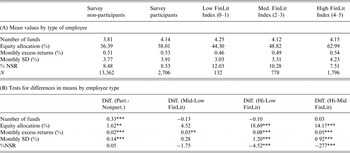
Information on these four investor performance measures along with the number of funds held by participants prior to the FinLit survey appears in Table 4. In the first column of Panel (A) we report investment patterns for those who did not take the survey. The second column focuses on all those who did take the survey, and subsequent columns array outcome measures by respondents’ FinLit Index scores. Looking at the first row in Panel A, we see that, on average, nonparticipants held fewer funds compared with those who took the survey, 3.81 versus 4.14, and the difference is statistically significant (Panel B). Moreover, those who answered the survey held 1.62 percentage points more equity resulting in a higher expected monthly return of 2 basis points, 14 basis points higher monthly SD, and no significant difference in non-systematic risk.
Descriptive statistics: participants’ number of funds held and pension performance

This table reports the average number of funds held, equity fraction, monthly excess return, SD, and non-systematic risk share (%NSR; see text) across participants of different types, as of April 2013. Survey non-respondents were employees who contributed to their 401(k) plan but did not respond to the survey. Survey respondents contributed to their 401(k) plan and responded to the FinLit survey. FinLit Index is derived by summing correct answers in Table 2.
Note: *Significant at 0.10 level, **Significant at 0.05 level, ***Significant at 0.01 level.
The last three columns of Panel (A) reveal a strong positive relationship between financial literacy and allocation to equity. That is, participants who scored the lowest on the FinLit Index had the smallest proportion of their portfolios allocated to stocks (44.30 percentage points), whereas the most sophisticated held over 40% more equity (the difference in Panel (B) of 42.2% = (62.99–44.30)/44.30 is statistically significant at the 1% level). This accounts for the finding in the second row, namely that the sophisticated group averaged a monthly 8 basis points higher expected excess return, compared with the least knowledgeable employees (the difference of 17.4% = (0.54–0.46)/0.46 is significant at the 1% level).Footnote 13
Our finding is thus supportive of Calvet et al. (Reference Calvet, Campbell and Sodini2007) who surmise that higher expected returns are positively correlated with financial sophistication (though that study lacked direct measures of financial knowledge). Patterns of SD correspond to the greater equity holdings: that is, SDs are larger (by almost 40%) for the most versus the least knowledgeable (39.6% = (4.23–3.03)/3.03). It is also worth noting that the portfolios held by the most sophisticated displayed much less idiosyncratic risk, 7.51 percentage points, versus the least-savvy respondents, 12.03 (the 38% difference is significant at the 1% level). In other words, more financially knowledgeable participants hold more equity and anticipate earning higher excess returns with higher volatility, but their portfolios embody less non-systematic risk than those of their less financially literate peers. Interestingly, the group scoring in the mid-range on the financial literacy test looks like the least savvy group; that is, few differences between them are statistically significant in Panel (B) at conventional levels. Below we evaluate whether these differences persist after controlling for other factors.
3 A multivariate analysis of participant portfolios and financial literacy
To test whether the findings above are robust to a set of control variables, next we estimate a series of multivariate regression models of the following form:
 $$PORTFOLI{O_i} = c + {\rm \alpha }FinLit + {\rm \beta }{X_i} + {\varepsilon _i}.$$
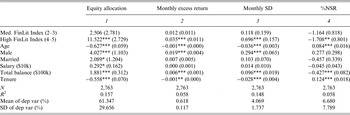
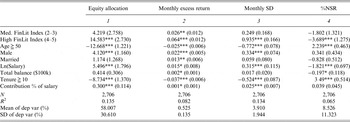
Here PORTFOLIO i refers to the four participant investment outcomes just discussed, i.e., the portfolio equity share, expected excess return, SD, and non-systematic risk share. In each case, α is the coefficient of interest on the FinLit Index. Results shown in Table 5 differentiate the three knowledge groups (the least knowledgeable group is the reference category, with Index = 0–1; the middle group has Index = 2–3; and the most knowledgeable Index = 4–5) as in Table 4. We also control on participant characteristics including age, sex, whether married, salary (in $10K), plan balance (in $100K), and years of tenure at the institution.Footnote 14
Multivariate models of portfolio outcomes and financial knowledge

This table reports linear regression estimates of factors associated with the average fraction of retirement assets each participant held in equity, monthly expected excess returns and SD, and idiosyncratic risk shares, as of April 2013 (standard errors in brackets). The sample consists of 401(k) plan contributors with a FinLit Index derived from correct answers as in Table 2; the reference category is Low FinLit (=0–1 correct). All models also control for region-specific fixed effects and missing data dummies; N = 2,763. (For variable descriptions see Appendix Table A1.)
Note: *Significant at 0.10 level, **Significant at 0.05 level, ***Significant at 0.01 level.
A first finding from Table 5 is that, even after including the controls, the most financially knowledgeable plan contributors still held more equity in their portfolios and could expect higher excess returns (and volatility).Footnote 15 The FinLit coefficients indicate that the most knowledgeable held 11.52 percentage points more stock than their least knowledgeable counterparts and they could anticipate earning 3.5 basis points per month more in excess returns (versus 18.69 and 8 bps in Table 4, respectively, when no other controls were included). Though the financial literacy effects were slightly smaller than without the control variables, they remain statistically significant and economically large. Indeed, it is remarkable that the strong positive association between excess returns and the financial index remains, even after netting out past investment success (since we control on respondents’ 401(k) balances) and fees (since we use net returns).Footnote 16
Due in part to their higher equity fraction, the portfolios of the most financially knowledgeable were also more volatile, by 70 basis points, compared with the least knowledgeable (versus 1.2 without controls, from Table 4). Nevertheless, portfolios of the savvier group exhibited a statistically significant 1.71 percentage points less idiosyncratic risk (versus -4.52 without controls, in Table 4). In other words, despite adding controls for key demographics and fund balances, the most financially sophisticated still held more equity and diversified their investment portfolios more efficiently, compared with their unsophisticated peers.
4 Additional findings
We have established that those who subsequently responded to the financial knowledge survey earned more, held higher plan balances, and contributed more of their salaries to their retirement accounts compared with their non-respondent counterparts. Yet we are aware of the possibility that the observed association between financial knowledge and better investment performance may not be causal. That is, employees who do a poor job investing might be financially illiterate due to some unobservable factor such as IQ or inattention, which could make it difficult to assess whether boosting financial knowledge for those individuals would, in fact, actually enhance their investment outcomes.Footnote 17
Whether the linkage between financial knowledge and returns is larger or smaller when financial knowledge is provided to the entire workforce rather than taken by just a few is obviously interesting from a policy perspective. Nevertheless, as we have access only to administrative records rather than results generated by a natural experiment, we are uncertain whether high-financial literacy respondents might differ in some unmeasured but systematic fashion from those who lack this sophistication. This makes it difficult to prove beyond a reasonable doubt that the less sophisticated would benefit from financial education if it were provided to them. An alternative econometric approach would be to use instrumental variables (IV) to control for unobserved factors that might influence portfolio outcomes,Footnote 18 but we also lack independent yet correlated variables that we could use to this end.
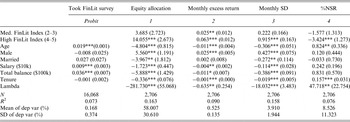
Instead, we have explored two alternative approaches which we anticipate will diminish potential bias due to sample selection. Table 6 reports results from a Heckman two-step model, where the first column provides estimates of a sample selection equation for those taking the financial literacy survey. The next four columns indicate the estimated impacts of financial literacy on portfolio performance after conditioning on this selection correction; the lambda term, which is the inverse Mills ratio, is constructed from Probit estimates of the first stage. The qualitative impacts of having high financial knowledge are similar, and in some cases ever larger (in absolute value). That is, those scoring high on the FinLit survey had even more equity and a higher expected excess return than without the correction, and the estimated coefficient on the non-systematic risk share is twice as large (in absolute value) than in Table 5. Accordingly, our conclusions are robust to this correction for sample selection.
Multivariate models of portfolio outcomes and financial literacy with Heckit sample selection correction

The first column reports coefficient estimates from a Probit sample selection model for responding to the FinLit survey. Subsequent columns replicate the multivariate regressions for the four dependent variables of interest in Table 5 (as of April 2013), along with the Lambda that corrects for sample selection (standard errors in brackets). The reference category in the last four columns is Low FinLit (=0–1 correct). All models also control for region-specific fixed effects and missing data dummies.
Note: *Significant at 0.10 level, **Significant at 0.05 level, ***Significant at 0.01 level.
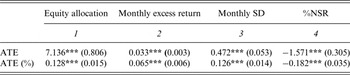
A different way to handle sample selection is to use a propensity matching model with inverse probability weights. While this approach is less susceptible to misspecification bias (Todd, Reference Todd2014), matching models do assume there is no systematic unobserved difference between those who were ‘treated’ – i.e., financially knowledgeable – versus others. We cannot test this directly in our dataset, but when we use this framework to estimate the impact of financial literacy on portfolio outcomes,Footnote 19 we continue to find that the estimated average treatment effect (ATE) of high financial literacy is strongly positive and significant for the equity share, monthly excess returns, and monthly volatility outcomes (see Table 7). Moreover, being in the high financial literacy group is again significantly associated with a lower non-systematic risk share. The magnitudes of the effects are somewhat smaller for the equity fraction compared with Table 5 (7.1 percentage points instead of 11.5), and for the monthly excess return (3.3 basis points versus 3.5 in Table 5). The coefficient of high financial literacy non-systematic risk is also smaller than before (−1.57 versus of −1.71) but still statistically significant and quantitatively large.
Inverse-probability weighting models of portfolio outcomes and financial knowledge

This table reports the estimated effects of the ATE for the High FinLit group for the four portfolio outcome variables of interest in Table 5 (as of April 2013). The inverse-probability weighting model computes the ATE level and percent for being in the High FinLit group (standard errors in brackets). Models also control for variables included in Table 5.
Note: *Significant at 0.10 level, **Significant at 0.05 level, ***Significant at 0.01 level.
In sum, across three different model specifications, our results appear quite robust. In particular, the most financially knowledgeable did invest more in equity, and hence they could anticipate higher excess returns, albeit with more volatility, compared with their less savvy counterparts. They also held portfolios that were significantly less exposed to non-systematic risk. And given that all the retirement funds offered in the plan were low-cost index funds, the reported differences were not due to differential charges on participants’ portfolios.
5 Financial literacy and longitudinal portfolio changes
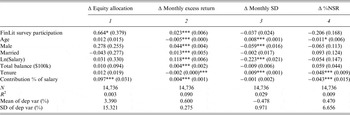
We are also able to compare changes in portfolio outcomes for a short period before and after the financial literacy survey was administered. To this end, we report in Table 8 the changes in equity allocations, excess returns, volatility, and non-systematic risk percentages comparing plan members’ April and December 2013 holdings.Footnote 20 The survey, it will be recalled, took place in October of that year.
Changes in portfolio outcomes pre-post financial literacy survey (April versus December 2013)

Average fund returns during prior 60 months used to predict expected returns.
Note: *Significant at 0.10 level, **Significant at 0.05 level, ***Significant at 0.01 level.
We use the entire sample for this analysis, with a dummy variable indicating who participated in the FinLit survey. Controlling on other factors, we see that those who elected to take survey boosted their equity allocations by 66 basis points (on a mean change of 3.90%) and their monthly expected excess returns rose by 2.3 basis points (on a mean of 60 bps). No significant difference in volatility or non-systematic risk was detected, before and after the FinLit survey.
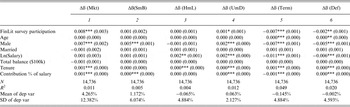
To further understand the reasons for these outcomes, in Table 9 we report how portfolio factor weightings changed, comparing portfolio allocations before and after the FinLit survey. Conditioning on other factors, participation in the survey was significantly associated with an increased exposure to market risk, a marginally significant rise in the Fama-French UmD factor,Footnote 21 and small but statistically significant declines in the exposure to bond term structuresFootnote 22 and bond default risk.Footnote 23 This pattern might be worth tracking over longer time periods to observe whether the changes persist, but additional data are not currently available to do so. Nevertheless, the main message is that those who took the FinLit survey changed their portfolios afterwards to exhibit less ‘tilt’ toward systematic sources of variation.Footnote 24
Changes in portfolio factor weightings pre-post financial literacy survey (April versus December 2013)

Coefficients on factors estimated using returns during prior 60 months. The portfolio factors are defined as follows (as per Fama French, Reference Fama and French1993):
Mkt, The excess return on the market, or the value-weighted return on all NYSE, AMEX, and NASDAQ stocks (from the CRSP) minus the 1-month Treasury bill rate (from Ibbotson Associates); SmB, the performance of small stocks relative to big stocks; HmL, the performance of value stocks relative to growth stocks; UmD, the Fama-French up-minus-down factor; Term, the difference between the monthly long-term government bond return (from Ibbotson Associates) and the one-month Treasury bill rate measured at the end of the previous month (from the CRSP); Def, the difference between the return on a market portfolio of long-term corporate bonds (the Composite portfolio on the corporate bond module of Ibbotson Associates) and the long-term government bond
Note: *Significant at 0.10 level, **Significant at 0.05 level, ***Significant at 0.01 level.
6 Conclusions
Now that 401(k) plans are the most common form of employer pension in the USA, employees are increasingly being asked to take on responsibility for managing their own retirement savings.Footnote 25 Yet recent research indicates that many Americans are financially illiterate, casting doubt on the chances that they will be up to the challenge of managing their own money successfully. Moreover, investors who are more financially savvy also save more and accumulate more retirement wealth than their less-knowledgeable counterparts.
This paper has explored whether this might be due to different investment portfolios, and if so, which particular elements differ across more versus less sophisticated investors. To do so we used high-quality administrative data on participants in a large US 401(k) retirement plan, along with a purpose-built survey on financial knowledge. We found that the most financially knowledgeable investors (a) held 18 percentage points more stock than their least knowledgeable counterparts; (b) could anticipate earning 8 basis points per month more in excess returns; (c) had 40% higher portfolio volatility; but (d) held portfolios with about 38% less idiosyncratic risk, compared with their least savvy counterparts. Our results are qualitatively similar after controlling on observables as well as modeling sample selection. Yet they also select portfolios with lower non-systematic risk, suggesting that they hold better diversified equity portfolios than their less sophisticated counterparts. This finding concords with prior studies showing that, even given an efficient fund menu, some plan participants will select better portfolios than others (Tang et al., Reference Tang, Mitchell, Mottola and Utkus2010). We also examined how the portfolio changed after the financial literacy intervention. Controlling on other factors, those who elected to take survey boosted their equity allocations by 66 basis points and their monthly expected excess returns rose by 2.3 basis points, while no significant difference in volatility or non-systematic risk was detected before versus after the FinLit survey.
Naturally, since this research reports on only one institution's 401(k) plan, our findings must be supplemented with additional quantitative evidence on the impact of financial literacy interventions. Nevertheless, the fact that more knowledge is associated with better 401(k) retirement plan outcomes is supportive of models that posit differences in financial sophistication as a driver of wealth inequality (e.g., Lusardi et al. Reference Lusardi, Michaud and Mitchellforthcoming). An additional point to consider is that, in our context, the investment choices available for participant investments were relatively few and all were quite inexpensive index funds. By contrast, in companies offering more complex investment menus and even brokerage accounts, the impact of high fees on the least financial knowledgeable could be important.Footnote 26 Moreover, such differences in financial sophistication could contribute to growing inequality in retirement outcomes. Undoubtedly, the ability to invest wisely and earn better returns is increasingly important for retirement wellbeing in an aging world.
Acknowledgements
Research support for the work reported herein was provided by the Pension Research Council/Boettner Center at the Wharton School of the University of Pennsylvania, as well as the Office of Employee Benefits at the Federal Reserve System that provided the data for the study and partial funding for the project. Without implicating them, we are grateful for useful comments provided by William Clark, Pierre-Carl Michaud, Ryan Peters, Petra Todd, Ning Tang, and Steven Utkus. We are also appreciative of excellent programming assistance from Yong Yu. Opinions and conclusions expressed herein are solely those of the authors and do not represent the opinions or policy of the funders or any other institutions with which the authors are affiliated.
Appendix

Multivariate models of portfolio outcomes and financial knowledge with dummies for age and tenure (instead of continuous variables)