Introduction
Olive (Olea europaea L. subsp. europaea) is one of the oldest Mediterranean crops (Zohary and Hopf, Reference Zohary and Hopf2000). Because of the nutritional value of its products, its economic importance and agroecological resilience, olive is cultivated under contrasting environmental conditions in more than 24 countries (Bartolini et al., Reference Bartolini, Prevost, Messeri and Carignani1998). In Morocco, olive cultivation is an ancient practice that was further developed during the Roman era (2nd and 3rd centuries AD; Lenoir and Akerraz, Reference Lenoir and Akerraz1984). With about 740,000 ha, olive represents more than 55% of Morocco's current fruit tree orchards, giving it a prominent socio-economic role. A single variety, ‘Picholine Marocaine’ (PM), prevails in traditional olive orchards and accounts for about 98% of the total olive cropping area (Boulouha et al., Reference Boulouha, Loussert and Saadi1992). Indeed, this variety is highly appreciated by farmers due to its wide array of favourable agronomic traits, i.e. high oil and canned fruit quality and high adaptability to local environmental conditions. However, it also has unwanted traits such as alternate bearing and susceptibility to peacock spot (Spilocaea oleagina Cast.) and verticillium wilt (Verticillium dahliae Kleb.; Barranco et al., Reference Barranco, Cimato, Fiorino, Rallo, Touzani, Castañeda, Serafini and Trujillo2000). A recent molecular study highlighted broad genetic diversity in Moroccan cultivated olives (Khadari et al., Reference Khadari, Charafi, Moukhli and Ater2008). The identification and characterization of local germplasm could therefore yield information on outstanding accessions that could then be used for the selection of olive trees with more useful agronomic traits, thus offering potential alternatives to PM cultivation.
Climate change, particularly drought risk, pests and diseases are all threatening olive production in Morocco as well as in the Mediterranean Basin. Local varieties represent an important gene pool that could serve as an allele source for improved adaptation and tolerance to many biotic and abiotic stresses. These genetic resources are continuously subject to genetic erosion due mainly to habitat degradation. Selection and conservation of local varieties, by applying local knowledge and farmers' preference criteria, is thus crucial. The results of many studies in several species have revealed the value of participatory varietal selection in maintaining a high level of genetic diversity (Almekinders and Elings, Reference Almekinders and Elings2001; Zhang et al., Reference Zhang, Arevalo Gardini, Motilal, Baligar, Bailey, Zuñiga-Cernades, Arevalo-Arevalo and Meinhardt2011). They indicated that farmers' knowledge-based approaches are efficient in identifying high-yielding genotypes with traits of interest for their specific cropping environment, therefore highlighting farmers' know-how in selecting and conserving local genetic resources (Fufa et al., Reference Fufa, Baum, Grando, Kafawin and Ceccarelli2007, Reference Fufa, Grando, Kafawin, Shakhatreh and Ceccarelli2010).
Here, we used SSR markers to study genetic diversity in a collection of olive trees from different traditional agroecosystems in Morocco, featuring interesting agronomic traits that had been selected in situ by local farmers on the basis of their preferred criteria. The estimated diversity was compared with the overall genetic diversity present in Moroccan traditional olive orchards, as previously studied by Khadari et al. (Reference Khadari, Charafi, Moukhli and Ater2008). We specifically aimed to: (i) test whether the olive tree samples, selected on the basis of local farmers' knowledge, represented the overall genetic diversity in Morocco; (ii) investigate the genetic relationship between the selected olive trees and the PM variety, and (iii) estimate the extent of genetic diversity within the selected olive trees.
Materials and methods
Plant material
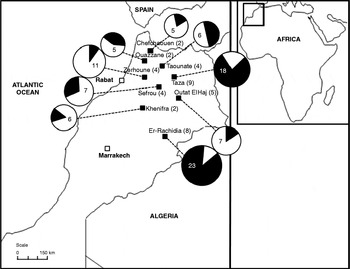
Olive tree sampling was conducted in different traditional orchards during the fruit ripening period (October–December). Trees were sampled in nine distinct geographical areas (Fig. 1 and Table 1): North West [Chefchaouen (5 trees) and Ouazzane (5)]; North Centre [Taounate (6), Sefrou (7) and Moulay Driss-Zerhoun (11)]; North East [Taza (18) and Outat El-Haj (7)]; Centre South [Er-Rachidia (23)]; Middle Atlas [Khenifra (6)].
Sampling areas. Numbers in brackets indicate the number of sampling sites within the area. The pie diagrams indicate the proportion of the PM variety (in black) and olive forms (in white) present at each sampling site. The number within the pie diagrams indicates the number of sampled trees.

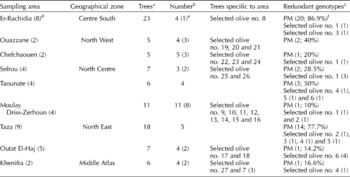
Olive forms within each of the sampling areas and geographical zones

PM, Picholine Marocaine.
a Number of studied trees.
b Number of trees genetically different per area.
c Genotypes observed in different sampling areas.
d Number of studied sites.
e Number of trees specific to one area.
f Number of accessions observed as PM within each geographical zone and proportion.
A total of 88 accessions (trees), for which the farmers had no denomination, were selected according to the main agronomic traits targeted in olive breeding and which fulfil local farmers' needs: low alternate bearing; high productivity; use for either oil or canned fruit; oil yield (% fresh matter); fruit size; pulp-to-pit ratio (Supplementary Table S1, available online only at http://journals.cambridge.org). Leaves sampled from each selected olive tree were lyophilized and stored at − 20°C for further DNA analysis.
In addition, a set of 57 genotypes previously identified by Khadari et al. (Reference Khadari, Charafi, Moukhli and Ater2008) representing the overall olive genetic diversity in Moroccan orchards was analysed using the same set of SSR loci. These genotypes included eight traditional varieties, namely PM, ‘Bouchouk’, ‘Bouchouika’, ‘Meslala’, ‘Hamrani’, ‘Bouchouk Rkik’, ‘Bouchouk Laghlid’ and ‘Fakhfoukha’, and 49 local genotypes without any specific denomination originating from limited areas often not exceeding the village scale. Moreover, a total of 474 Mediterranean olive genotypes, derived from 13 countries and maintained at the worldwide olive germplasm bank, Marrakech, Morocco (WOGB; Haouane et al., Reference Haouane, El Bakkali, Moukhli, Tollon, Santoni, Oukabli, El Modafar and Khadari2011), were used to compare local genotypes with foreign cultivars.
Molecular analysis
Total DNA was extracted from 40 mg of lyophilized leaves of the sampled trees following the modified Cetyl Trimethylammonium Bromide (CTAB) procedure, as described by Udupa et al. (Reference Udupa, Robertson, Weigand, Baum and Kahl1999). DNA quality was determined using 1% agarose gel stained with ethidium bromide. The extracted DNA was quantified using a spectrofluorometer (GENios Plus; Tecan, Grödig, Austria), and was diluted to 20 ng/μl.
Twelve nuclear SSR loci were used: ssrOeUA-DCA03; ssrOeUA-DCA04; ssrOeUA-DCA05; ssrOeUA-DCA08; ssrOeUA-DCA09; ssrOeUA-DCA11; ssrOeUA-DCA15; ssrOeUA-DCA18 (Sefc et al., Reference Sefc, Lopes, Mendonca, Rodrigues Dos Santos, Laimer Da Camara Machado and Da Camara Machado2000); ssrOe-GAPU59 and ssrOe-GAPU71B (Carriero et al., Reference Carriero, Fontanazza, Cellini and Giorio2002); UDO99–36 (Cipriani et al., Reference Cipriani, Marrazzo, Marconi and Cimato2002); EMO90 (De La Rosa et al., Reference De La Rosa, James and Tobutt2002). These SSR loci were selected on the basis of their clear amplification and high polymorphism observed in previous studies (Sarri et al., Reference Sarri, Baldoni, Porceddu, Cultrera, Contento, Frediani, Belaj, Trujillo and Cionini2006; Khadari et al., Reference Khadari, Charafi, Moukhli and Ater2008; Baldoni et al., Reference Baldoni, Cultrera, Mariotti, Ricciolini, Arcioni, Vendramin, Buonamici, Porceddu, Sarri, Ojeda, Trujillo, Rallo, Belaj, Perri, Salimonti, Muzzalupo, Casagrande, Lain, Messina and Testolin2009; Haouane et al., Reference Haouane, El Bakkali, Moukhli, Tollon, Santoni, Oukabli, El Modafar and Khadari2011). Six and eight among the 12 SSR loci are distributed throughout six and seven linkage groups, respectively (Khadari et al., Reference Khadari, Zine El Aabidine, Grout, Ben Sadok, Doligez, Moutier, Santoni and Costes2010; Zine El Aabidine et al., Reference Zine El Aabidine, Charafi, Grout, Doligez, Santoni, Moukhli, Jay-Allemand, El Modafar and Khadari2010). PCR amplification was carried out as described by Haouane et al. (Reference Haouane, El Bakkali, Moukhli, Tollon, Santoni, Oukabli, El Modafar and Khadari2011). The amplification products were separated using an automated capillary sequencer (ABI prism 3130XL Genetic Analyzer; Applied Biosystems, Foster City, CA, USA) and fragment analysis was performed using genemapper v3.7 software (Applied Biosystems).
Data analysis
The number of alleles per locus (N a), matching accessions, allelic frequencies (p i), expected (H e; Nei, Reference Nei1987) and observed heterozygosity (H o) were estimated using the excel microsatellite toolkit v3.1 (Park, 2001). The discrimination power of each SSR locus (D j) was calculated as defined by Tessier et al. (Reference Tessier, David, This, Boursiquot and Charrier1999):
 $$\begin{eqnarray} D _{ j } = 1 -- \Sigma p _{ i }[( N _{ g } p _{ i } - 1)/( N _{ g } - 1 )], \end{eqnarray}$$
where p i is the frequency of the ith molecular pattern revealed by locus j and N g is the number of genotypes. The genetic distance between genotypes was calculated based on the Nei and Li coefficient (Reference Nei and Li1979) and the dendrogram was drawn based on the UPGMA algorithm (Sneath and Sokal, Reference Sneath and Sokal1973) using the ntsys-pc v2.11 package (Rohlf, Reference Rohlf2000).
Model-based Bayesian clustering was implemented in structure v2.2 to assess the genetic structure (Pritchard et al., Reference Pritchard, Stephens and Donnelly2000). The program was run using the admixture model with correlated frequencies and ten trials of 1,000,000 repeats following an introduction period (burn-in/Markov Chain Monte Carlo) of 200,000 repeats for K= 1 to 10. The reliability of the number of K clusters was checked using the ad hoc measure ΔK of Evanno et al. (Reference Evanno, Regnaut and Goudet2005), with the R v2.13.0 program (R Development Core Team, 2011), and the similarity coefficient between runs (H′) for the same K clusters was calculated using the clumpp program (Jakobsson and Rosenberg, Reference Jakobsson and Rosenberg2007).
Results
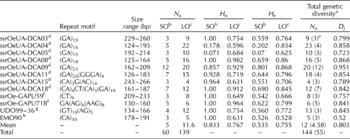
Using the 12 SSR loci, the 88 on-farm selected olive trees were classified into 28 distinct SSR profiles (Table 1). A total of 60 alleles were revealed, ranging from 3 to 12 per locus, with an average of five alleles per locus (Table 2). The analysis of the 57 local genotypes previously defined by Khadari et al. (Reference Khadari, Charafi, Moukhli and Ater2008) revealed 139 alleles, ranging from 4 to 22 per locus, with a mean of 11.6 alleles per locus (Table 2). Among the 60 alleles detected in the 28 selected genotypes, 55 alleles were observed in the 57 local genotypes. When examining the relationships between the 57 local genotypes and the 28 SSR profiles, two genotypes occurred in both datasets, i.e. the PM variety and selected olive no. 13 (similar to local olive no. 10). The comparison of the 83 identified genotypes, both local and selected genotypes, with Mediterranean genotypes indicated that all alleles revealed in the present study were present in WOGB Marrakech, and there was no full matching with respect to the 12 SSR loci when comparing the Moroccan genotypes and foreign cultivars.
Genetic parameters of the 12 SSR loci used in the study for on-farm selected olive (SO), local olive (LO) and total genetic diversity

N a, number of alleles observed; D j, power of discrimination; H e, expected heterozygosity; H o, observed heterozygosity.
a Genetic parameters calculated on 83 unique genotypes representative of the total genetic diversity.
b Genetic parameters calculated on selected olive (28 SSR profiles).
c Genetic parameters calculated on local olive (57 local genotypes identified by Khadari et al. (Reference Khadari, Charafi, Moukhli and Ater2008)).
d Sefc et al. (Reference Sefc, Lopes, Mendonca, Rodrigues Dos Santos, Laimer Da Camara Machado and Da Camara Machado2000).
e Number of shared alleles between the selected and local olive.
f Carriero et al. (Reference Carriero, Fontanazza, Cellini and Giorio2002).
g Cipriani et al. (Reference Cipriani, Marrazzo, Marconi and Cimato2002).
h De La Rosa et al. (Reference De La Rosa, James and Tobutt2002).
Among the 88 sampled trees, 45 (51.1%) were found to share the same profile, previously defined as the PM variety. The prevalence of this variety ranged from 10% in the Moulay Driss-Zerhoun area to 87% in Er-Rachidia (Fig. 1 and Table 1). All 27 genotypes differing from the PM variety were each found at only one sampling site, except for six genotypes that were found at different locations; selected olive no. 1, 2, 3, 4, 5 and 6 were noted six, two, two, three, two and five times, respectively (Table 1).
For the 28 on-farm selected genotypes, the observed heterozygosity (H o) ranged from 0.07 to 1 and the expected heterozygosity (H e) ranged from 0.07 to 0.8, with an average of 0.83 and 0.53, respectively, while for the 57 local genotypes, H o ranged from 0.59 to 0.98 and H e from 0.52 to 0.86, with an average of 0.76 and 0.75, respectively (Table 2). For each SSR locus, the discrimination power (D j) ranged from 0.52 at EMO90 to 0.95 at DCA9, with a mean of 0.8. Based on D j, eight out of the 12 SSR loci were able to discriminate total genetic diversity [selected olive (28) and local olive (57); Supplementary Table S2, available online only at http://journals.cambridge.org]. Allelic richness (A r), computed at 28 individuals of the standardized G value using the ADZE program (Szpiech et al., Reference Szpiech, Jakobsson and Rosenberg2008), was significantly higher in the 57 local genotypes than the value observed in the 28 on-farm selected genotypes (Mann–Whitney U test, P< 0.01, two-tailed; Supplementary Table S3, available online only at http://journals.cambridge.org).
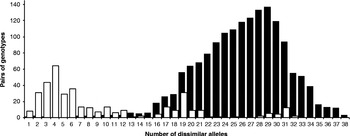
Two range sizes for dissimilar alleles were noted among the 378 pairwise comparisons obtained from the 28 selected genotypes (Fig. 2). The first ranged from 0 to 14, whereas the second had between 16 and 32 dissimilar alleles. Most pairwise comparisons were distinguished by less than 14 dissimilar alleles (275 pairwise SSR profiles; 72.7%), whereas only 103 pairwise profiles differed by 16 to 32 dissimilar alleles. Otherwise, among the 1596 pairwise comparisons of all 57 local genotypes, only four combinations revealed a difference of one to three alleles (local olive no. 10/PM; local olive no. 23/PM; local olive no. 42/local olive no. 39; local olive no. 10/local olive no. 23), while 99.7% (1592) displayed 7 to 38 dissimilar alleles (Fig. 2). The PM variety was distinct from the 27 selected olive genotypes by one to six dissimilar alleles, except for selected olive no. 8, 12, 14, 16, 22 and 24, which were distinct by 31, 19, 8, 10, 19 and 17 dissimilar alleles, respectively (Supplementary Figs S1 and S2, available online only at http://journals.cambridge.org). Assuming that no variation occurred in flanking sequences of microsatellites, most variations were observed by a gain or loss of dinucleotide repeat units (Supplementary Table S4, available online only at http://journals.cambridge.org), i.e. a gain of two dinucleotide units and a loss of six at the DCA09 locus for selected olive no. 2 and 26, respectively, and by a loss and gain of two dinucleotide repeat units for selected olive no. 25 at DCA08 and DCA18 loci, respectively. Two among the six highly distinct genotypes from PM, i.e. selected olive no. 22 and 24, were genetically close to the ‘Bouchouk’ variety (only three dissimilar alleles; Supplementary Fig. S3, available online only at http://journals.cambridge.org). Comparing both the PM variety and highly distinct genotypes from PM (six genotypes) with Mediterranean cultivars revealed that the closest foreign cultivars to these genotypes ranged from 8 to 18 dissimilar alleles, i.e. selected olive no. 8/‘Angellina’ and ‘Frantoio’ from Italy were distinct by eight dissimilar alleles and the closest cultivar to the PM variety was found to be ‘Negrillo de Estepa’ from Spain by ten dissimilar alleles (Supplementary Table S5, available online only at http://journals.cambridge.org).
Frequency distribution of dissimilar alleles for all pairwise combinations between the selected olive genotypes (28, in white) and the local genotypes (57, in black). For the 28 SSR profiles, most pairwise comparisons were distinguished by less than 14 dissimilar alleles (72.7%), while for the 57 genotypes, 98.1% of pairwise comparisons had more than 14 dissimilar alleles.

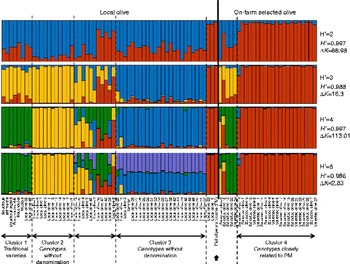
The results obtained through the structure program on 83 unique genotypes indicated that the K= 4 cluster was the best genetic structure model based on the ad hoc measure of Evanno et al. (Reference Evanno, Regnaut and Goudet2005; ΔK= 113.01) and the similarity coefficient between runs for each K (H′ = 0.997; Jakobsson and Rosenberg, Reference Jakobsson and Rosenberg2007; Supplementary Fig. S4, available online only at http://journals.cambridge.org). The first cluster included eight genotypes with six traditional varieties (‘Bouchouk’, ‘Bouchouk Rkik’, ‘Bouchouk Laghlid’, ‘Bouchouika’, ‘Fakhfoukha’ and ‘Meslala’), the second and third included 11 and 22 individuals, respectively, without specific names, whereas the fourth group included genotypes closely related to PM (Table 3; Fig. 3; Supplementary Table S6, available online only at http://journals.cambridge.org).
Number and proportion of genotypes of both datasets, selected olive (28 genotypes) and local olive (57 genotypes), assigned to the four clusters identified by structure

a Under the assignation probability P (qI) ≥ 80%.
Genetic structure plot for the total genetic diversity (83 olive genotypes) for K= 2 to K= 5. Each bar in the histogram-like graph represents a single individual and its inferred proportion of admixture (q value). H′ represents the similarity coefficient between runs for each K and ΔK represents the ad hoc measure of Evanno et al. (Reference Evanno, Regnaut and Goudet2005). The identification name of each genotype is indicated. Based on ΔK and H′, K= 4 clusters were revealed as being the best genetic structure model.

Discussion
A significant loss of genetic diversity was revealed to be likely due to the selection process performed using local farmers' knowledge when compared with the sampling approach used in Khadari et al. (Reference Khadari, Charafi, Moukhli and Ater2008). This loss of diversity could be explained by the selection pressure induced by past farming practices, and also by the sampling strategy adopted for collecting olive trees (i.e. selection for desired agronomic traits). Indeed, Padula et al. (Reference Padula, Giordani, Bellini, Rosati, Pandolfi, Paoletti, Pannelli, Ripa, De Rose, Perri, Buccoliero and Mennone2008) demonstrated a significant effect of environmental conditions on the major agronomic traits used in the present study (fruit size, pulp-to-pit ratio, fruit yield and oil content). Taking into account our experimental design (one tree per site, trait monitoring over 1–2 years) and the lack of quantitative assessment of the environmental versus genotypic effects on the used traits, we consider that, rather than selection pressure, this loss of diversity could be explained more by the prevalence of the PM variety and possible sampling-linked distortion.
When focusing on the selected olive trees, the results were quite similar (51.1 and 52%, respectively) to those obtained by Khadari et al. (Reference Khadari, Charafi, Moukhli and Ater2008) in terms of the number of trees displaying the same genetic profile as the PM variety, thus confirming its prevalence in Moroccan traditional orchards. A narrow genetic base within the on-farm selected olive trees was detected, with accessions being closely related or identical to the PM variety, clearly constituting a homogeneous subsample within the global olive diversity in traditional orchards. These genotypes can be considered as sports mutations of the PM variety and may have arisen as a result of an accumulation of somatic mutations in microsatellite motif repeats. As PM is considered to be a partially self-compatible variety (Barranco et al., Reference Barranco, Cimato, Fiorino, Rallo, Touzani, Castañeda, Serafini and Trujillo2000), a self-crossing hypothesis to explain the occurrence of closely related genotypes to PM is not excluded. However, a more plausible hypothesis of the clonal variation origin is proposed based on the following reasons: (i) the SSR profiles of the closely related genotypes do not reflect self-crossing segregation; (ii) olive tree is a highly heterozygous species (Green and Wickens, Reference Green, Wickens and Kit Tan1989) and very sensitive to inbreeding depression, probably leading to very limited fitness of self-crossed olive trees; (iii) the observed heterozygosity (H o) of the PM variety is 0.83, whereas the H o noted for closely related genotypes ranged from 0.75 to 0.91, indicating their high heterozygosity, but this level cannot have been the result of self-fertilization; (iv) most variations were noted for loci with dinucleotides and abundant GA repeat units; several studies have reported that such loci are more susceptible to mutation and slippage (Chakraborty et al., Reference Chakraborty, Kimmel, Stivers, Davison and Deka1997; Kruglyak et al., Reference Kruglyak, Durret, Schug and Aquadro1998; Schug et al., Reference Schug, Hutter, Wetterstrand, Gaudette, Mackay and Aquadro1998; Bachtrog et al., Reference Bachtrog, Agis, Imhof and Schlötterer2000).
Clonal variation was also observed for a local traditional variety, i.e. ‘Bouchouk’, and has already been reported in olive, including relict olive trees in the Hoggar Mountains (Cipriani et al., Reference Cipriani, Marrazzo, Marconi and Cimato2002; Lopes et al., Reference Lopes, Mendonça, Sefc, Gil and Machado2004; Baali-Cherif and Besnard, Reference Baali-Cherif and Besnard2005; Khadari et al., Reference Khadari, Charafi, Moukhli and Ater2008), and in other fruit crops such as grapevine (Ibanez et al., Reference Ibanez, Velez, De Andres and Borrego2009) and Fig. (Achak et al., Reference Achak, Ater, Oukabli, Santoni, Kjellberg and Khadari2010). Two key elements could explain the occurrence of sports mutations in the PM variety: (i) the prevalence of PM in Morocco and adjacent regions (PM is also known as ‘Sigoise’ in western Algeria and ‘Canivano Blanco’ in southern Spain; Besnard et al., Reference Besnard, Breton, Baradat, Khadari and Berville2001) probably linked to the ability of PM to adapt to a wide range of contrasting ecological and climatic conditions; (ii) the ancient planting of this variety in traditional orchards, as supported by the study of Charafi et al. (Reference Charafi, El Meziane, Moukhli, Boulouha, El Modafar and Khadari2007) in the Menara gardens, which was established during the 12th century in Morocco, and the extensive propagation of this variety for many centuries.
In contrast, the diversity observed in our study includes genotypes highly distinct from the PM variety. These may have originated from seedlings since the high observed polymorphism was quite similar to that noted within a F1 progeny (distinct by 8–40 dissimilar alleles; Zine El Aabidine et al., Reference Zine El Aabidine, Charafi, Grout, Doligez, Santoni, Moukhli, Jay-Allemand, El Modafar and Khadari2010). When comparing the allelic similarity for both the PM variety and highly distinct genotypes from PM with Mediterranean olive cultivars, the closest foreign cultivars were from Spain, Portugal or Italy. This finding could mainly be explained by the geographical proximity to Spain and Portugal and by the historical diffusion of olive cultivation from Italy. The exact origin of such genotypes could be determined by including local wild olives and using more molecular markers.
Participatory varietal selection has been advocated as an efficient approach to promote on-farm conservation and maintain a high level of genetic diversity for many annual crop species (Almekinders and Elings, Reference Almekinders and Elings2001; Zhang et al., Reference Zhang, Arevalo Gardini, Motilal, Baligar, Bailey, Zuñiga-Cernades, Arevalo-Arevalo and Meinhardt2011). However, studies have shown that genotypes identified by scientists rarely correspond to varieties as perceived by local farmers (Caillon et al., Reference Caillon, Quero-Garcia, Lescure and Lebot2006; Barnaud et al., Reference Barnaud, Monique, Garine, Mckey and Joly2007). Here, the approach used to select outstanding trees, by applying farmers' preference criteria, resulted in obtaining genotypes closely related or identical to the PM variety. Haouane et al. (unpublished data) showed that local farmers refer to visible features and agronomic criteria to distinguish between their olive trees but also to the cultural background, including specific community rituals and beliefs. The emphasis on suitable perceptual distinctiveness criteria (Boster, Reference Boster1985) with agro-morphological traits in breeding programmes and in situ conservation seems important to be able to recognize, manage and make effective use of the genetic resources, especially in low-input farming systems (Gibson et al., Reference Gibson2009).
Conclusion
The sampling strategy used in our survey was aimed at collecting trees on the basis of farmers' local knowledge through in situ observations of agronomic traits. This strategy allowed us to identify a subset of accessions closely related to the PM variety, probably reflecting somaclonal variations accumulated over time. This finding highlights the need for additional research to validate the somatic mutation hypothesis concerning the origin of genotypes closely related to the PM variety. Multidisciplinary approaches, combining genetic characterization, phenotypic description and ethnobotany analyses, should be used to select olive genotypes highly distinct from the PM variety. In addition, a set of genotypes with attractive agronomic characteristics was identified from locally selected trees, thus providing, for the first time, some evidence of farmers' active participation in fostering and preserving genetic diversity.
Acknowledgements
All molecular genotyping was performed in the ‘Atelier de Marquage Moléculaire’ UMR AGAP laboratory. The authors thank all members of the laboratory for their technical support, and particularly Ch. Tollon for her participation in microsatellite genotyping. Dr Ph. Chatelet is also thanked for his kind remarks on an earlier version of the manuscript. The authors are also grateful to Dr A. Bervillé for comments on the final version of the manuscript. This study was supported by PRAD 08-01, IDB Merit Scholarship Program for High Technology and Agropolis Fondation FruiMed No. 0901-007. A. El Bakkali was supported by fellowships from IDB 1430H/2009 and PRAD 08-01.