


Introduction
Marrs (Reference Marrs1995) defines self-help as “the use of written materials or computer programs. . .for the purpose of gaining understanding or solving problems relevant to a person's developmental or therapeutic needs” (p. 846). Self-help materials typically (1) provide the user with the means to identify their problem by offering information about the symptoms commonly experienced, and (2) offer advice on how to overcome problems, along with techniques for alleviating symptoms, and examples of how to use these techniques. Self-help can be delivered in many formats, including books (bibliotherapy) or via the Internet. Self-help can also be offered as either a guided or unguided intervention, where guided self-help involves the patient helping themselves with some form of support from another person (Lucock, Barber, Jones and Lovell, Reference Lucock, Barber, Jones and Lovell2007). Self-help treatments are currently recommended by the National Institute for Health and Clinical Excellence (NICE, 2009) for depression and meta-analyses show that self-help interventions for depression are more effective than no-treatment and comparable to psychotherapies and antidepressants (Cuijpers et al., Reference Cuijpers, Berking, Andersson, Quigley, Kleiboer and Dobson2013).
Although the evidence suggests that self-help treatments for depression are relatively effective, less is known about peoples’ attitudes toward self-help treatments; in particular, whether people deem self-help interventions to be an acceptable treatment approach and the extent to which self-help interventions are preferred to other treatment options. Research suggests that patients with depression show a preference for psychotherapy over antidepressants (Raue and Schulberg, Reference Raue, Schulberg and Henri2007) and that patients may benefit more from treatments that they show a preference for (e.g. Kocsis et al., Reference Kocsis, Leon, Markowitz, Manber, Arnow and Klein2009; Kwan, Dimidjian and Rizvi, Reference Kwan, Dimidjian and Rizvi2010; Lin et al., Reference Lin, Campbell, Chaney, Liu, Heagerty and Felker2005; Mergl et al., Reference Mergl, Henkel, Allgaier, Kramer, Hautzinger and Kohnen2011; Moradveisi, Huibers, Renner and Arntz, Reference Moradveisi, Huibers, Renner and Arntz2014). Other studies, however, have found no impact of patient preference on outcomes (e.g. Leykin et al., Reference Leykin, DeRubeis, Gallop, Amsterdam, Shelton and Hollon2007; Moradveisi et al., Reference Moradveisi, Huibers, Renner and Arntz2014; Raue, Schulberg, Heo, Klimstra and Bruce, Reference Raue, Schulberg, Heo, Klimstra and Bruce2009) and these discrepancies have led researchers to explore variables, such as beliefs about the cause of depression (Dunlop et al., Reference Dunlop, Kelley, Mletzko, Velasquez, Craighead and Mayberg2012; Khalsa, McCarthy, Sharpless, Barrett and Barber, Reference Khalsa, McCarthy, Sharpless, Barrett and Barber2011; Steidtmann et al., Reference Steidtmann, Manber, Arnow, Klein, Markowitz and Rothbaum2012), which may moderate the link between preference and treatment outcome. Preference has also been linked to engagement with treatment. Specifically, there is evidence that treatment preference influences initiation of treatment (King et al., Reference King, Nazareth, Lampe, Bower, Chandler and Morou2005; Raue et al., Reference Raue, Schulberg, Heo, Klimstra and Bruce2009; Raue and Schulberg, Reference Raue, Schulberg and Henri2007), adherence (Elkin et al., Reference Elkin, Yamaguchi, Arnkoff, Glass, Sotsky and Krupnick1999; Raue et al., Reference Raue, Schulberg, Heo, Klimstra and Bruce2009), attrition (Kwan et al., Reference Kwan, Dimidjian and Rizvi2010) and therapeutic alliance (Iacoviello et al., Reference Iacoviello, McCarthy, Barrett, Rynn, Gallop and Barber2007; Kwan et al., Reference Kwan, Dimidjian and Rizvi2010). In short, attitudes toward treatment are likely to influence treatment outcomes.
Although we know much about preferences for psychotherapy versus antidepressants little research has examined preferences towards self-help treatments and how they fare in relation to psychotherapy or antidepressants (Cooper-Patrick et al., Reference Cooper-Patrick, Powe, Jenckes, Gonzales, Levine and Ford1997). There are, however, some studies that can provide indicative evidence. Landreville, Landry, Baillargeon, Guérette and Matteau (Reference Landreville, Landry, Baillargeon, Guérette and Matteau2001) investigated attitudes towards treatments for depression. Participants aged 65 years and over were asked to read one of two descriptions of depression (either mild to moderate or severe depression) before reading descriptions of psychotherapy, bibliotherapy, and antidepressant treatments. Participants rated how acceptable they believed that they would find each of the treatments using the modified Treatment Evaluation Inventory (Landreville and Guérette, Reference Landreville and Guérette1998). Psychotherapy and bibliotherapy were both rated as more acceptable than antidepressants for treating mild to moderate levels of depression (but not for severe depression).
Mitchell and Gordon (Reference Mitchell and Gordon2007) explored attitudes towards computerized cognitive behavioural therapy (CCBT) amongst 122 university students, 65% of whom had prior or current experience of depression or anxiety. Participants were asked to read a brief description of CCBT before rating the treatment in terms of its credibility, the expectancy that its use would improve the symptoms of depression, and the perceived likelihood of using this form of treatment. The findings suggested that the sample rated CCBT as only “somewhat credible”, with moderately low expectations for improvement reported. In terms of the participants rating the likelihood of using the treatment, only 10% said that they would be likely to choose this form of treatment as their first choice, with nearly 55% of the sample saying they would prefer counselling.
Schneider, Foroushani, Grime and Thornicroft (Reference Schneider, Foroushani, Grime and Thornicroft2014) explored how acceptable self-help intervention for depression was deemed to be. N = 637 employees, with symptoms of depression, took part in an online CCBT intervention for 5 weeks. Prior to the intervention, participants were asked to rate how acceptable they would find using CCBT over going to see a GP or psychologist. At the end of the intervention they were also asked to rate how acceptable they found the treatment. Schneider et al. found that, at baseline, 65% of the sample rated CCBT to be equally acceptable to seeing a psychologist and 80% of the sample found CCBT as acceptable as seeing a GP. There were no significant changes in how acceptable participants found the treatments at the end of the study, suggesting that attitudes expressed in response to hypothetical scenarios (e.g. “How do you think you would feel. . .?”) reflect how people actually feel if they experience the treatment.
The present research
Although the studies described above provide insight into how acceptable people find different self-help treatments for depression, a number of important questions remain unanswered. First, no study to date has compared how acceptable people find different types of self-help. The present research will examine attitudes toward and preferences for guided self-help, unguided bibliotherapy, and unguided Internet-based self-help. The research will also investigate how acceptable people find traditional treatments (namely, psychotherapy and antidepressants), in order to provide a comparison. Second, research to date has focused on how acceptable people find different treatments, but has not yet explored treatment preferences. Specifically, if peoples’ first choice of treatment is unavailable (e.g. there is a long waiting list for psychotherapy), then it is currently unclear what treatment they might prefer instead. Pressures on health services mean that this question is significant. The present research, therefore, also asked participants to rank treatments in order of preference.We also measured current levels of depression and previous treatment experience to investigate whether they influence attitudes and preferences.
Method
Sample
Staff and students at a large university in the UK were e-mailed an invitation to take part in a study examining attitudes toward treatments for depression. As we were interested in attitudes towards treatments that are not clouded by actual help-seeking behaviour, we sought to recruit an analogue sample who were not actively seeking treatment for depression. No inclusion/exclusion criteria were set in terms of level of depression or diagnosis. N = 536 participants responded. Participants were aged between 17 and 76 years (M = 29.90, SD = 12.57) and 65.11% were female, 53.73% were students, and 57.46% were White British. Participants’ mean score on the Center for Epidemiologic Studies Depression Scale (CES-D; Radloff, Reference Radloff1977) was 26.75 (SD = 13.64), indicating relatively high levels of depression (Radloff, Reference Radloff1991).
Procedure
Participants who agreed to take part in the study were asked to read a brief description of depression and a personal account of how it feels to be depressed.Footnote 1 Participants were then randomly allocated to read a detailed description of one of five treatments for depression: psychological therapy, antidepressants, guided self-help, bibliotherapy, or Internet-based self-help. Each description contained information regarding what the treatment involved, what the different treatment subtypes were (e.g. examples of the different types of psychotherapy available), and how the treatment could be accessed.Footnote 2
Once participants had read the detailed treatment description, they rated how acceptable they found the treatment using a modified version of the Treatment Evaluation Inventory (TEI; Kazdin, Reference Kazdin1980; Landreville and Guérette, Reference Landreville and Guérette1998). The TEI was modified to measure how acceptable people find different treatments for depression and consisted of nine questions (e.g. “How acceptable would you find this treatment for treating your depression?” and “To what extent do you think there might be risks in undergoing this kind of treatment?”). In line with the findings of Landreville and Guérette (Reference Landreville and Guérette1998) principle components analysis with oblimin rotation, identified two components that accounted for 69.36% of the variance. The two factors were labelled “acceptability” (e.g. “How consistent is this treatment with your common sense or everyday notions about what a treatment for depression should be?”) (α = 0.92) and “side effects” (e.g. “To what extent do you think undesirable side effects are likely to result from this treatment?”) (α = 0.66). Factor scores were computed for each component. Landreville and Guérette (Reference Landreville and Guérette1998) noted good concurrent validity, internal consistency and test-retest reliability when using the scale to assess treatment acceptability and side effects in relation to treatments for depression.
All participants were then asked to read brief descriptions of all five treatments, which were developed by shortening the detailed treatment descriptions. Participants were asked to rank the five treatments in order of preference. Finally, participants completed a questionnaire, which measured current levels of depression (using the CES-D, Radloff, Reference Radloff1977) and treatment experience (e.g. “If you have suffered from depression, which treatments have you used?”), as well as demographic information (gender, age, ethnic origin, and occupation).
Analysis strategy
One-way between-groups multivariate analyses of variance (MANOVA) was used to investigate differences in ratings of acceptability and side effects between the five treatment descriptions, and to investigate the impact of current levels of depression and treatment experience on ratings of acceptability and side effects. A Friedman test was used to investigate differences in preference ratings, with Wilcoxon sign-ranks tests used for post-hoc comparison.
Results
How acceptable are treatments for depression?
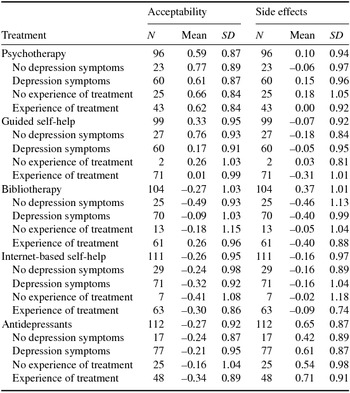
Table 1 shows the average levels of acceptability and side effects for each of the five treatment options. Perceptions of both acceptability, F (4, 531) = 18.97, p < .01, eta2 = 0.13, and side effects, F (4, 531) = 18.19, p < .01, eta2 = 0.12, differed between treatments. Pairwise comparisons with Bonferroni adjustment revealed that psychotherapy and guided self-help were rated as the most acceptable treatments. There was no significant difference in how acceptable participants rated psychotherapy and guided self-help (p = .30). Psychotherapy and guided self-help were, in turn, rated as significantly more acceptable than antidepressants, bibliotherapy, and Internet-based self-help (p < .01).
Mean levels of treatment acceptability and side effects by treatment condition for the whole sample and by symptoms of depression and treatment experience

In terms of perceived side effects, pairwise comparisons with Bonferroni adjustment revealed that antidepressants were rated as significantly (p < .01) more likely to have side effects than psychotherapy that, in turn, was deemed to have significantly more side effects than bibliotherapy, guided self-help and Internet-based self-help. There were no differences in perceived side effects between any of the other self-help interventions (ps < .05).
Does current depression or treatment experience influence how acceptable people find treatments?
Radloff (Reference Radloff1991) proposed that scores of 16 or higher on the CES-D scale indicate the presence of depression symptoms. In the present sample 64.74% of participants scored above this cut off point. Table 1 shows how acceptable participants found each of the five treatments separately for those with and without symptoms of depression. There was only a statistically significant difference in ratings between those with and without symptoms of depression for guided self-help, F(1, 85) = 7.72, p = .01, eta2 = 0.08. Depressed participants rated guided self-help as being significantly less acceptable than did participants without symptoms of depression. There were no differences in acceptability or side effects between participants with and without symptoms of depression for the remaining treatments (Fs < 2.99, ns).
Table 1 also shows levels of acceptability and side effects associated with each of the five treatments for participants who had previous experience of the treatments versus those who did not. A series of one-way between-groups MANOVAs revealed no statistically significant differences between those with and without treatment experience on the combined dependent variables (Fs < 2.61, ns).
Which treatments for depression do participants prefer?
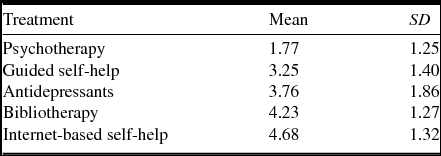
Table 2 shows participants preferences for the five different types of treatment. There were significant differences between the mean rank scores for the five brief treatment descriptions (X2 = 853.34, p < 0.001). Post-hoc comparisons showed that psychotherapy was preferred to all other treatments; guided self-help (z = −14.23, p <.01, antidepressants (z = −16.79, p < .01), bibliotherapy (z = −18.55, p < .01), and Internet-based self-help (z = −18.99, p < .01). Guided self-help was preferred to antidepressants (z = −4.53, p < .01), bibliotherapy (z = −10.79, p < .01), and Internet-based self-help (z = −14.77, p < .01). Antidepressants were preferred to bibliotherapy (z = −4.38, p < .01) and Internet-based self-help (z = −8.31, p < .01). Finally, bibliotherapy was preferred to Internet-based self-help (z = −6.09, p < .01).
Mean preference ratings for the whole sample

Discussion
To investigate peoples’ attitudes toward self-help treatments for depression, the present research compared perceptions of three types of self-help with psychotherapy and antidepressants. Consistent with the findings of other research (e.g. Raue and Schulberg, Reference Raue, Schulberg and Henri2007), psychotherapy was rated as more acceptable and preferable to antidepressants. Extant research had not, however, explored how acceptable people find different forms of self-help as an alternative to psychotherapy and antidepressants. Our findings suggest that psychotherapy remained the most preferred and most acceptable treatment option. However, guided self-help was deemed to be equally acceptable, with the caveat that participants with depression rated guided self-help as being less acceptable than non-depressed participants. Across the sample as a whole, psychotherapy and guided self-help were rated as more acceptable than bibliotherapy and Internet-based self-help.
The preference for guided over unguided forms of self-help is consistent with the findings of Mohr et al. (Reference Mohr, Siddique, Ho, Duffecy, Jin and Fokuo2010) who found that greater interest in receiving mental health treatment was associated with greater interest in receiving face-to-face contact. The findings are also consistent with findings in relation to anxiety. For example, Sharp, Power and Swanson (Reference Sharp, Power and Swanson2004) found that the majority of people on a waiting list for treatment for anxiety disorders chose to undertake individual therapy over unguided self-help. Antidepressants and bibliotherapy were found to be the least acceptable treatments, with antidepressants rated as the most likely to have side effects. This latter finding is consistent with previous research suggesting that antidepressants are an unpopular treatment option (Bedi et al., Reference Bedi, Lee, Harrison, Chilvers, Dewey and Fielding2000), possibly due to associated side effects (Khawam, Laurencic and Malone, Reference Khawam, Laurencic and Malone2006).
Limitations and future directions
One potential drawback to the present research is the use of a between sample design, where participants read just one of five detailed treatment descriptions before rating how acceptable they would find that treatment. Arguably, it may have been preferable to have participants read detailed descriptions of all treatments. However, this was deemed to be overly onerous and not an accurate reflection of how treatments are typically presented to people with depression. The other advantage of randomly allocating participants to treatment over, for example, examining how acceptable actual patients find a treatment that they have been offered, is that potential confounds such as past experience or demographic factors are controlled for. Moreover, the design enabled us to carefully control the amount and nature of information that participants received about each treatment. The present research did, however, also capitalize on a within sample design, where participants read brief descriptions of each treatment and then ranked them in order of preference. The preference data matched the acceptability data, in that both psychotherapy and guided self-help were viewed as the most acceptable and most preferred treatment options. It is, however, worth noting that the information provided in the brief treatment descriptions may not have been detailed enough to provide sufficient information for participants to make an informed decision on preference. In addition, the present research did not consider preferences for the use of combined treatments (e.g. antidepressant medication and psychotherapy) or the preference for no-treatment or watchful waiting (Dwight Johnson, Apesoa-Varano, Hay, Unutzer and Hinton, Reference Dwight Johnson, Apesoa-Varano, Hay, Unutzer and Hinton2013). These might be useful issues to explore in future research.
A second potential limitation is the use of an analogue design, recruiting participants who were not actively seeking treatment for depression. The advantage of this design is that attitudes towards treatments are not clouded by actual help-seeking behaviour. Indeed, no differences were found in ratings of acceptability and perceived side effects between participants with previous treatment experience and participants without. Furthermore, there were few differences between those who had current symptoms of depression and those who did not. Both these findings suggest that our analogue sample is likely to closely approximate the beliefs of a clinical sample, which is often the case in the literature that compares clinical and analogue attitudes towards treatments for mental health disorders (e.g. Feeny and Zoellner, Reference Feeny and Zoellner2004; McHugh, Whitton, Peckham, Welge and Otto, Reference McHugh, Whitton, Peckham, Welge and Otto2013). Having said this, further research could aim to replicate the present approach in a treatment-seeking sample.
Implications for research and clinical practice
One of the cornerstones of the stepped-care model is the assumption that the treatments that are offered are acceptable to patients (Bower and Gilbody, Reference Bower and Gilbody2005). As such, researchers have begun to explore treatment attitudes and preferences for a range of disorders (e.g. Sumner et al., Reference Sumner, Haddock, Hartley, Kilbride, McCuster and Pitt2014). Our findings suggest that unguided interventions are less acceptable and less preferable to interventions that contain an element of personal contact, such as psychotherapy or guided self-help. Researchers now need to further explore why interventions that contain personal contact are preferred to unguided interventions. Macdonald, Mead, Bower, Richards and Lovell (Reference Macdonald, Mead, Bower, Richards and Lovell2007) interviewed participants who had received guided self-help for depression and found that participants reported difficulties engaging with the intervention due to the symptoms of depression, such as low motivation, or poor concentration. It is possible that these issues are even more salient for those receiving unguided self-help as they have no-one to help them to overcome these barriers. In addition, treatments that incorporate personal contact may be perceived to provide more helpful and specific guidance/coaching around the implementation of self-help techniques.
Finally, given that research suggests that patients allocated their preferred treatment (out of psychotherapy or antidepressants) are more likely to engage with that treatment, potentially improving efficacy (e.g. Kwan et al., Reference Kwan, Dimidjian and Rizvi2010), future research might usefully assess whether this is also the case for unguided self-help interventions. Although less effective than guided self-help (Gellatly et al., Reference Gellatly, Bower, Hennessy, Richards, Gilbody and Lovell2007), unguided interventions have been found to be effective for depression (e.g. Cuijpers, Reference Cuijpers1997); however, there are often problems with poor engagement (e.g. Christensen, Griffiths and Farrer, Reference Christensen, Griffiths and Farrer2009). Future research needs to assess whether this is due to the patient feeling that the treatment is unacceptable and/or having a preference for another treatment. If this is the case, then possible solutions include: (1) providing extra funding to increase the availability of acceptable treatment options, namely psychotherapy and guided self-help; (2) investigating which forms of support are acceptable, as some forms of support are less costly to administer and equally effective (in comparison to face-to-face support) such as telephone support (Farrand and Woodford, Reference Farrand and Woodford2013); or (3) implementing protocols to boost the acceptability of unguided interventions. For example, a large-scale publicity campaign to educate the general public in the efficacy of such treatment approaches. The Department of Health (2013) announced £16 million pounds worth of funding over the next 4 years for a campaign against mental health stigma and within this campaign there could be scope to promote the use of unguided interventions.
Acknowledgements
This research was supported by the Howard Morton Foundation and the Les Robinson Endowment Fund, which funded the first author's PhD studies.




Comments
No Comments have been published for this article.