

Introduction
Social norms and cultural beliefs are important drivers of economic development outcomes, affecting behavior in domains as varied as health practices, energy conservation, labor force participation, tax payments, rule following and corruption, productivity and sanitation (Allcott & Rogers, Reference Allcott and Rogers2014; Datta & Mullainathan, Reference Datta and Mullainathan2014; Herbst & Mas, Reference Herbst and Mas2015; World Bank Group, 2015; Dixit, Reference Dixit2017; Hallsworth et al., Reference Hallsworth, List, Metcalfe and Vlaev2017; World Bank, 2018). For example, although antiretroviral therapy is life-saving for HIV/AIDS patients and often available free of cost, treatment adherence is challenging (Shubber et al., Reference Shubber, Mills, Nachega, Vreeman, Freitas, Bock, Nsanzimana, Penazzato, Appolo, Doherty and Ford2016). One reason for this is that people living with HIV/AIDS expect that others will judge them when they reveal their illness and live in fear of the stigma (Takeda et al., Reference Takada, Weiser, Kumbakumba, Muzoora, Martin, Hunt, Haberer, Kawuma, Bangsberg and Tsai2014; Shubber et al., Reference Shubber, Mills, Nachega, Vreeman, Freitas, Bock, Nsanzimana, Penazzato, Appolo, Doherty and Ford2016; Buregyeya et al., Reference Buregyeya, Naigino, Mukose, Makumbi, Esiru, Arinaitwe, Musinguzi and Wanyenze2017). Similarly, individuals might not provide sufficient protein to mothers and young children, enroll girls in school or purchase life insurance, even when those goods are free or low cost, because of the influence of social norms (Sunstein, Reference Sunstein1996; Jacoby & Mansuri, Reference Jacoby and Mansuri2011; LIMRA, 2016; Nguyen et al., Reference Nguyen, Sanghvi, Kim, Tran, Afsana, Mahmud, Aktar and Menon2017). Households in South Asia and Africa have been observed to acquire latrines but not use them, partly as a result of social norms and cultural practices entailed in their use, as well as the absence of a social norm proscribing open defecation (Coffey et al., Reference Coffey, Gupta, Hathi, Spears, Srivastav and Vyas2015; UNICEF, 2015; Coffey et al., Reference Coffey, Gupta and Spears2016; Bicchieri, Reference Bicchieri, Ashraf, Das, Kohler, Kuang, McNally, Shpenev and Thulin2017).
This research refines and implements, in the field, a technique for measuring social norms in the context of an important development challenge: reducing open defecation among rural households. The measurement approach disaggregates social norms into two types of beliefs: beliefs about what others do (social empirical expectations) and beliefs about what others believe to be normatively appropriate (social normative expectations). In this approach, social norms are understood to be socially conditional preferences to behave in a given way (|Bicchieri, Reference Bicchieri2012, Reference Bicchieri2016). We also draw on a conception in which social norms are more internalized and drive behavior through their incorporation into central cultural concepts (Brennan et al., Reference Brennan, Eriksson, Goodin and Southwood2013).
In rural Uttar Pradesh (UP), between January and March in 2017, we first measured the relevant cultural and normative barriers to latrine use, conditional on latrine ownership. We then developed and tested behavioral interventions aimed at weakening those social norms and beliefs to increase latrine use. Our data were gathered across three rounds: focus group discussions to inform the development of the relevant norms and belief measurement instrument; a baseline norms measurement survey; and an end-line survey following the pilot intervention.
Findings from the first two rounds confirmed our hypothesis that social normative and empirical expectations were, in fact, associated with individual behavior and influential elements of behavior change. People's, especially men's, normative beliefs were closely linked to what they expected others in their reference group to believe, even though they slightly underestimated the extent of pro-latrine norms (beliefs) among others. At the same time, narrative analysis revealed that reducing open defecation in the context of rural UP also requires direct confrontation with ‘dirtiness’ or ‘gandagi’ (Coffey et al., Reference Coffey, Gupta and Spears2016), and its subsequent associations with latrine use.
To address these barriers, we piloted two simple informational interventions and evaluated their impacts, at least in the short term, on changing people's behavior and beliefs around latrine use. The interventions were focused on rebranding latrine use by associating it with cleanliness and updating empirical expectations by making information about growing latrine use among other latrine owners salient. Our results suggest that targeting mental models and ‘marketing’ social norms can be an effective and low-cost means of increasing awareness of the number of people engaging in open defecation and correcting misperceptions about the frequency of a behavior.
Social and economic context
The adverse health effects of open defecation are well known: stunting and malnutrition, diarrhea and enteric parasite infection in young children, childhood death and lower human capital (Patil et al., Reference Patil, Arnold, Salvatore, Briceno, Ganguly, Colford and Gertler2014; Hammer & Spears, Reference Hammer and Spears2016; Mara, Reference Mara2017; Ayalew et al., Reference Ayalew, Mekonnen, Abaya and Mekonnen2018). Reducing open defecation requires access to improved sanitation facilities. Recent years have witnessed an increase in latrine construction and access among rural Indian households (National Annual Rural Sanitation Survey, 2017–2018; Swachh Bharat Mission, 2019).Footnote 1 However, the transition from defecating in the open to using latrines appears to have been slower, at least in four north Indian states (Gupta, Reference Gupta, Khalid, Desphande, Hathi, Kapur, Srivastav, Vyas, Spears and Coffey2019).Footnote 2
Among other factors, behavior change in the north Indian context may be influenced by social norms and cultural beliefs, especially those related to ritual purity and impurity (Coffey et al., Reference Coffey, Gupta, Hathi, Spears, Srivastav and Vyas2015, Reference Coffey, Gupta and Spears2016). These include the belief that open defecation is acceptable and harmless or that pits may require more frequent cleaning if all household members use the latrine, the cultural anxiety that building a latrine close to the house can make it ‘impure’, the social norm that pit cleaning is not only an unpleasant but also a demeaning (especially for higher-caste members) and socially threatening job or that open defecation is a ‘masculine’ activity (Coffey et al., Reference Coffey, Gupta and Spears2016). Similarly, when a sample of latrine owners in UP were asked why they defecated in the open, 27% indicated that they were simply used to it, 23% did so because it has been practiced for generations and 20% had simply never thought of defecating in latrines (Water and Sanitation Program, The World Bank, 2016). This suggests that behavior change in this context may also require changing people's mental models about how they think about defecation practices. Latrine access requires supplementation with behavior change communication. Ending open defecation likely requires addressing the social, cultural and normative barriers that may get in the way of improved sanitation practices vis-à-vis open defecation.
What forms should behavior change strategies take? The messages in communication strategies regarding open defecation and toilet use can take multiple forms, including efforts to highlight class aspirations, nationalism, ethnic or caste roles and pride, gender roles or urbanism and modernization, among others. In this paper, we test the content of two more generic messages: social empirical expectations and the rebranding of cleanliness. We also test two modalities: pamphlets and the use of individuals who sit in center of village-level social networks, whom we call ‘norm entrepreneurs’. More generally, we aim to provide an empirical foundation for behavior change strategies used in the field.
Social norms and cultural schema
It is important to understand whether or not a practice is motivated by social beliefs (i.e., whether or not people engage in a practice because of their beliefs about what others think and approve of). Social norms, which refer to widely shared beliefs about how others in our social group behave and how they ought to behave, are a product of human sociality. Arising from social interdependence, social norms involve both a rule for behavior and common knowledge of that rule. In other words, social norms consist of two parts: beliefs about what it is appropriate to do (normative expectations) and beliefs about what people in our reference group, in fact, do (empirical expectations). Empirical expectations are informed by first-order expectations of what others in a reference group, which could include social, caste, gender or religious groups, are engaging in. Normative expectations are second-order expectations or beliefs about what others approve or disapprove of. Both empirical and normative expectations affect personal behavior when people believe that sufficient others in their reference group behave in a certain way and are willing to sanction those who do not (|Bicchieri, Reference Bicchieri2012, Reference Bicchieri2016).
Individual behavior is also influenced by deeply internalized beliefs about how the world works, also known as schemata or mental models. These beliefs draw on shared, intersubjective concepts and understandings (Gauri et al., Reference Gauri, Woolcock and Desai2013). The concepts are almost like the ‘operating system’ for how people approach the world, affecting their interpretations of behavior often automatically and without deliberation (World Bank Group, 2015).
Cultural schemas are developed through repeated interactions with people of the same culture within the same environment, and they can shape perceptions and filter the ‘facts’ people believe and are able to understand (Mandler, Reference Mandler1984). Cultural beliefs that are so internalized that they affect emotional responses, filter out dissonant information and shape social practices are sometimes referred to as ‘schemata’ (DiMaggio, Reference DiMaggio1997). These schemata, or more loosely ‘mental models’, are used as tools to extract information from a given situation while exerting low effort (Rosch, Reference Rosch1978). Schemata filter out incoming information to aid interpretation, guide attention, fill in missing information and provide default assumptions (World Bank Group, 2015).
Social norms are closely tied to schemas. To explain how norms are activated, Bicchieri and McNally (Reference Bicchieri and McNally2016) posit that when people encounter a given situation, they categorize the particular type of situation they are in, which, subsequently, triggers schemas or behavioral rules that are pertinent to that situation. When it comes to open defecation in India, schemas and norms can be influential. In India, the words ‘clean’ and ‘dirty’ have both ritualistic and physical meanings. Certain actions or objects can be both ritually and physically polluting or dirty, or ritually polluting but physically clean, or even ritually clean but physically polluting (Khare, Reference Khare1962). In the case of latrines, Coffey et al. (Reference Coffey, Gupta and Spears2016) find that they are viewed by many as ritually polluting, regardless of their physical state (i.e., clean or dirty). These schemas of latrines can activate detrimental norms, which, in turn, can negatively influence people's decisions regarding whether or not to defecate in latrines.
In order to change any harmful practice, the first step is to understand what kinds of beliefs reinforce that particular practice. If practices are motivated by social beliefs, changing empirical and/or normative expectations can shift people away from engaging in the practice. If information about the positive practices and behaviors of others in one's reference group can be highlighted (i.e., made salient), it can induce positive behavior change by updating people's perceptions of what others do and what the social norms are within their reference group.
Similarly, when intersubjective concepts and associations underlie behaviors, inducing behavior change might require targeting those concepts and associations. An example from the battle against female genital cutting (FGC) may be instructive. In Sudan, the term for an uncut woman was ghalfa, which suggested prostitution, promiscuity and impurity. The deeply internalized cultural belief prevented parents from assimilating and accepting information presented in the numerous campaigns about the negative health consequences of FGC. They continued to cut their daughters because, for the girls and their families, becoming ghalfa was socially devastating. The term promoted a variety of cognitive processes, including confirmation bias, which made beliefs and behavior resistant to scientific communication. To address this, a social campaign was launched to rebrand uncut girls as saleema, an Arabic term that means whole, intact, healthy, pure and in a God-given condition. The campaign successfully weakened a deeply internalized cultural belief by creating a new way of thinking about purity and impurity (Helmore, Reference Helmore2012; Bicchieri & McNally, Reference Bicchieri and McNally2016).
Measuring social norms and cultural schema
If normative and empirical expectations are consistently reported in a social group, there is strong prima facie evidence that a social norm exists (Bicchieri et al., Reference Bicchieri, Lindemans and Jiang2014). Similarly, if a sufficient number of respondents express mutually consistent views about what others should do, normative expectations are strong. Identifying the existence of widely shared social and normative expectations is necessary, but not sufficient, for demonstrating the existence of a strong social norm. A strong social norm must also be shown to cause conformity, or change behavior, in sufficiently large numbers. To demonstrate the causal efficacy of the norm and to see whether individuals, in fact, do conform to the social norm, it is necessary to measure individual behavior in the presence of and in the absence of the norm. (The last is difficult, and counterfactual vignettes are sometimes used.)
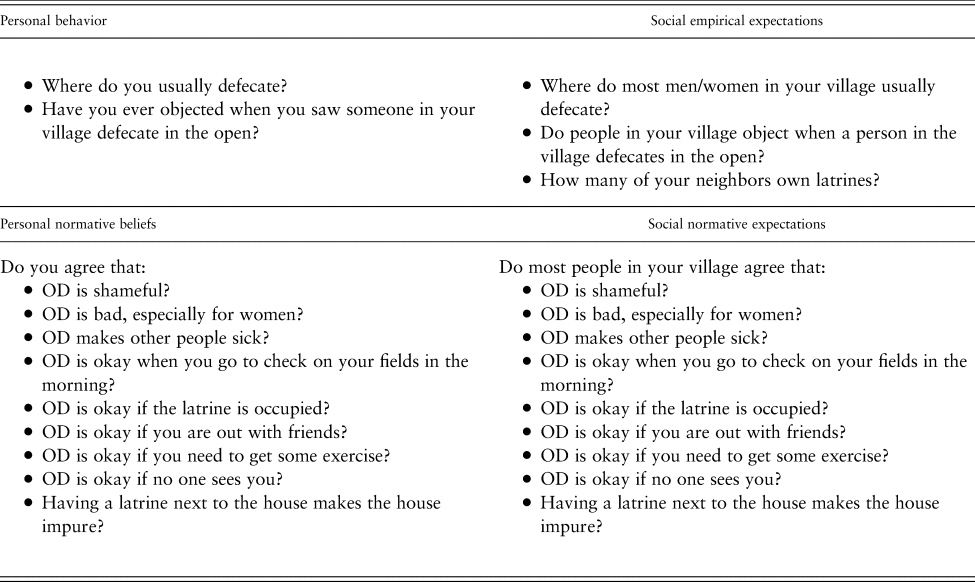
Our study in UP roughly follows this framework and focuses on four key aspects of open defecation: customary or prevailing defecation practices (latrine use or open defecation); acceptability of open defecation (including exceptions to latrine use that are considered acceptable); enforcement of latrine use; and ritual notions of purity/impurity that may prevent the construction of latrines (see Table 1). This structure allows us to examine, for example, how closely associated our main outcome of interest – latrine use – is to first-order expectations of where others in one's social group defecate and to second-order expectations of the acceptability of open defecation among others.
Measurement framework.

OD = open defecation.
Because social norms are driven by both empirical and normative expectations of what others in one's social group do and believe, it is important to identify the relevant social network for the population in question when measuring norms (Mackie et al., Reference Mackie, Moneti, Denny and Shakya2015). This can be challenging. For example, when immigrants living in multicultural societies talk about others, their reference group of people whose expectations matter may include immigrants from the same country as well as communities in their ‘home country’ (in addition to, possibly, other immigrants and even communities in the host country). Identifying these informal networks is thus essential to understanding who the target group is whose expectations matter when it comes to behavior supported by a social norm. In the context of rural India, where caste distinctions can often determine who individuals interact with on a daily basis and where they live, identifying the right social network can be very important. In addition to measuring social norms, our survey also includes a brief social network mapping module to understand who the ‘others’ for our respondents might be.
Social desirability bias – the tendency of respondents to answer questions in a way that is ‘appropriate’ or ‘correct’, rather than a true reflection of their beliefs – can be an issue in measuring sensitive beliefs. Our survey instrument utilizes two approaches to overcome social desirability bias and elicit accurate responses: incentivizing survey responses about empirical and normative expectationsFootnote 3 and posing vignettes, in addition to straightforward questions about one's own beliefs or behavior, where respondents are asked indirectly about their preferences through short stories about hypothetical situations (very similar to their own) and then being asked what the fictitious character would do in that situation.
While there is no standard framework to measure cultural schemata or mental models, we rely on two types of measurements for this. The first are the set of normative and empirical questions that are reflective of one's experiences in relation to one's environment with regards to the utilization and importance of latrines. The second is through analysis of freeform narrative responses. These implicitly rely on people's own concepts and associations to interpret the world around them (Bruner, Reference Bruner1990; Crossley, Reference Crossley, Horrocks, Kelly, Roberts and Robinson2002). Narrative responses can evoke the mental models that organize principles for choice and action (Sarbin, Reference Sarbin and Sarbin1986).
After measuring social norms and mental models at baseline, we develop a pilot intervention inspired by both studies that examine the effects of descriptive social norm messaging (e.g., Hallsworth et al., Reference Hallsworth, List, Metcalfe and Vlaev2017) and that use media messaging to change mental models (e.g., La Ferrara et al., Reference La Ferrara, Chong and Duryea2012).
Data
Data for this study come from two rounds of survey data – baseline and end-line – that were preceded by a qualitative diagnostic round composed of focus-group discussions with two groups of latrine owners – users and nonusers – split by gender. Because the objective of this study was to examine how social norms and cultural schemata influence latrine usage among rural latrine owners, we sampled a cluster of villages where latrine penetration was higher than average (based on data from Water and Sanitation Program, The World Bank, 2016). Our survey sample came from five villages in the Ghazipur District of UP: Adelabad, Gauspur, Jhakrauli, Keshopur and Saleempur. Latrine penetration rates in the sample villages ranged from 31.5% in Saleempur to 66.7% in Gauspur, with slightly over 50% of households owning improved structures with septic tanks. A total of 34.7% households had pits with lining and slab, while 11.4% had simple pit latrines. A total of 12% of the households in the sample received some amount of Swachh Bharat Mission subsidy to cover the cost of latrine construction.
We conducted multiple focus-group discussions with four distinct groups of latrine owners: female users, female nonusers, male users and male nonusers. Each focus-group discussion was conducted with a group of six to eight individuals from a particular village or tola (neighborhood within the village), and they discussed the current state of latrine access and use, barriers – structural, attitudinal and normative – that influence or impede latrine use (own and for others) and notions of cleanliness (and its importance) and gandagi.
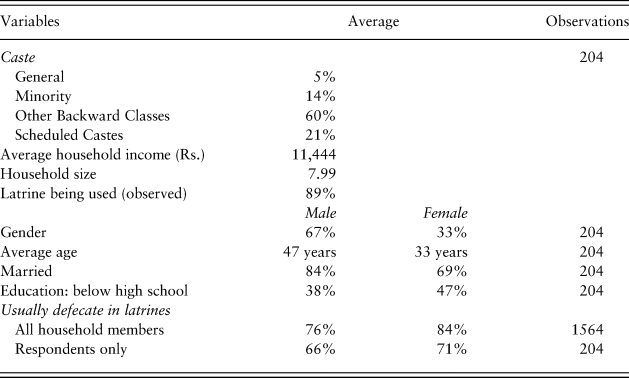
The baseline survey was administered at the household level, across 204 households that owned latrines, between January and February in 2017. Households were identified by enumerators with the help of key individuals in the village and through a snowball sampling method. Standard in-field randomization (following a ‘right-hand’ rule) was initially used to select a sample of eligible households for the survey. However, given the difficulty in finding households with latrines where at least one male or female adult was available, this method of selection was adapted when necessary. Table 2 summarizes key demographic characteristics of the households and respondents (one from each household) at baseline.
Demographic characteristics.

The baseline survey measured socioeconomic characteristics, latrine access and use, structural barriers, beliefs and social norms regarding open defecation, narratives around cleanliness and purity/impurity and the social reference network of respondents in each village. The last involved asking respondents about specific individuals with whom they interacted on a regular basis, as well as about individuals in the village who they considered influential. To elicit the relevant reference groups in the area, respondents were also asked about the frequency with which they interacted with people from their own tola, village and caste group. In addition to self-reported data on latrine use (which also included place and time of last defecation to capture variability), visual inspections by enumerators, including photographs, were also used to gauge the functionality, use and cleanliness of latrines.
The end-line survey was conducted immediately following the pilot intervention (in March 2017). While the baseline survey had both qualitative and quantitative elements to gauge beliefs and behaviors around latrine use, the end-line survey used primarily quantitative measures to identify changes in individual behavior and beliefs, as well as changes in social empirical and normative expectations. A total of 252 households were surveyed at end-line. However, only 156 of these respondents were common across both rounds, as respondents from some baseline households could not be reached or located at end-line. Analysis of attrition shows that respondents who could not be reached for the end-line survey have some statistically significant demographic differences in terms of gender (mostly male), age (older), household size (larger) and household income (higher). However, no significant differences are observed across their latrine use behavior and norms (see Supplementary Appendix S1 for details). The analysis of the pilot intervention results is restricted to the 156 households that are present across both rounds.
Respondents were asked to answer questions using Likert scales – answers to questions about where people defecate ranged from ‘Always defecate in the latrine’ to ‘Always defecate in the open’ (five options), while questions about beliefs were posed as agree/disagree statements (agree; neither agree nor disagree; disagree). Scores were coded on a scale of 0–1, with 1 being the most pro-latrine answer in each case and 0 being the least. For example, when asked where respondents usually defecate, those answering ‘Always defecate in the latrine’ were given a score of 1 and those answering ‘Always defecate in the open’ were given a score of 0. Answers in between – ‘Usually defecate in the latrine’, ‘Sometimes defecate in the latrine, sometimes defecate in the open’ and ‘Usually defecate in the open’ – received a score of 0.75, 0.50 and 0.25, respectively. Negative statements (e.g., ‘It is okay to defecate in the open if no one sees you’) were reverse-coded using the same Likert scale coding method to ensure all pro-latrine behaviors or beliefs were similarly coded. Questions regarding norm enforcement were binary variables, with positive enforcement behavior receiving a score of 1.
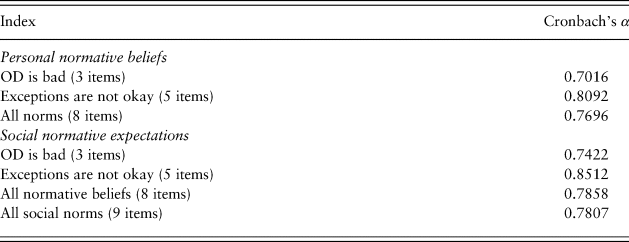
Normative statements (both about respondents’ own beliefs and social normative expectations) were grouped together into three indices: whether open defecation is bad (bad, harmful and shameful); whether exceptions are not okay; and a combination of both to reflect the overall favorability of latrines over open defecation. An additional index was created for all social norms (inclusive of both social normative and social empirical expectations). Indices reflect the average of scores across all relevant questions. All indices report relatively high internal consistency within their respective scales, with Cronbach's α values ranging from 0.70 to 0.85 (see Table 3).
Cronbach's α scores.

OD = open defecation.
Baseline findings
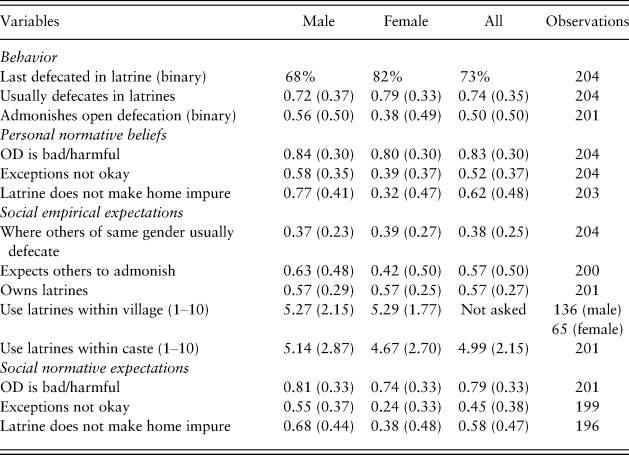
Our baseline survey closely follows the framework of social norms measurement outlined above to elicit four key aspects of latrine use: what respondents do, what they think others do, what respondents believe is appropriate behavior and what respondents think others believe is appropriate behavior. The reported levels of latrine usage at baseline are slightly higher for our respondents compared to the average across UP (which is not surprising given that the latrine penetration in these villages is also higher than average), with 76% of male respondents and 84% of female respondents reporting that they usually defecate in latrines and 68% and 82%, respectively, reporting that they last defecated in a latrine. However, to account for nuances in the frequency of latrine use, our key outcome variable (where respondents usually defecate), which we use for the remainder of the section, provides a wider range of frequency options (always, usually or sometimes).
Table 4 summarizes the key findings from the baseline survey. The average latrine use score across our survey sample was 0.74, with men scoring slightly higher (0.79) than women (0.72) on average. This indicates that while latrine use is fairly common among this group, some deviation is likely. Normative beliefs of respondents, however, show much more variation. While beliefs about the negative aspects of open defecation – whether it is bad, harmful or shameful – are strong, with a score of 0.83 on average across all respondents, latrine use is not considered essential. Both men and women believe that it is acceptable to engage in open defecation under various extenuating circumstances. Scores on the ‘exceptions not okay’ index were 0.58 for men and only 0.39 for women. The low score for women is especially surprising when one takes into consideration that women, across studies, tend to report lower rates of open defecation relative to men. However, given the mobility restrictions women face in rural UP, as well as the risk and shame associated with the lack of privacy when defecating in the open, their choice of using latrines may be more a product of convenience than conviction about the normative importance of latrine use. Women similarly tend to associate latrines with impurity, and score lower (0.32) than men (0.77) on questions about whether latrines make the house impure (reverse-scored), once again suggesting that their beliefs may not be the main driver of their behavior.
Baseline findings (standard deviations in parentheses).

OD = open defecation.
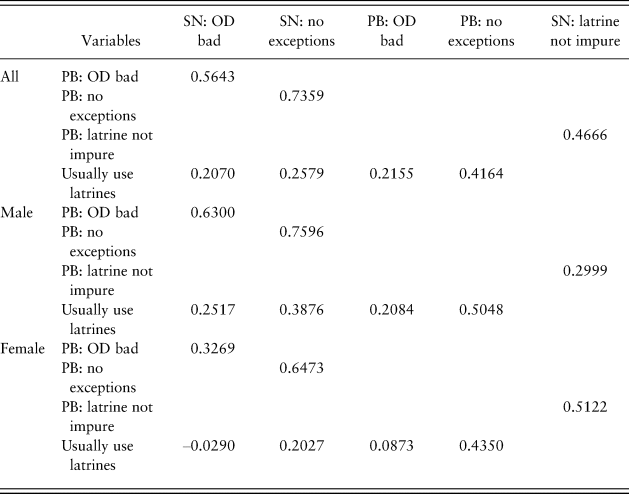
So how well do people's behaviors and beliefs correlate with social empirical and social normative expectations? With regard to social normative expectations, our data suggest one main finding. People's normative beliefs tend to be closely linked to perceived beliefs of others in their reference group, indicating that social normative expectations may be powerful determinants of people's own beliefs. But correlations between personal normative beliefs and social normative expectations appear to vary substantially between men and women. While for men, both open defecation indices show a strong correlation between personal and social normative beliefs, for women, the association is much weaker for the ‘Open defecation is bad/harmful’ index. On the other hand, women's beliefs about latrines making the house impure appear to be more correlated with their social normative expectations than those of men, even though the average difference between the two (as seen in Table 5) was large. Across both groups, we find no strong correlation between actual behavior and perceived pro-latrine normative beliefs of others.
Correlations.

OD = open defecation; PB = personal normative beliefs; SN = social normative expectations.
With regard to social empirical expectations, individuals sharply underestimate latrine use among others in their reference group, among both men and women (estimated frequencies of 0.37 and 0.39 for men and women, respectively). It is important to recall that the reference group includes both latrine owners and non-owners, which may explain why people sharply underestimate actual latrine use in their reference group. Nevertheless, we believe that this may be indicative of a situation of pluralistic ignorance, where private beliefs or behaviors (in this case, latrine use) are underestimated, leading to misperceived social norms. In situations of pluralistic ignorance, revealing private behaviors or beliefs can change behavior. That is the intervention we designed in this study. We based the intervention on the suspicion that people project the wider open defecation behavior in the village even onto those who do own latrines because open defecation is, quite literally, a more visible and salient action compared with latrine use, which takes place behind a closed door.
Enforcement behavior (how often others admonish open defecation) also appears to be associated with social empirical expectations, with a correlation coefficient of 0.43. This is further evidence that an incipient social norm against open defecation in the villages may exist but is not yet widely perceived or shared.
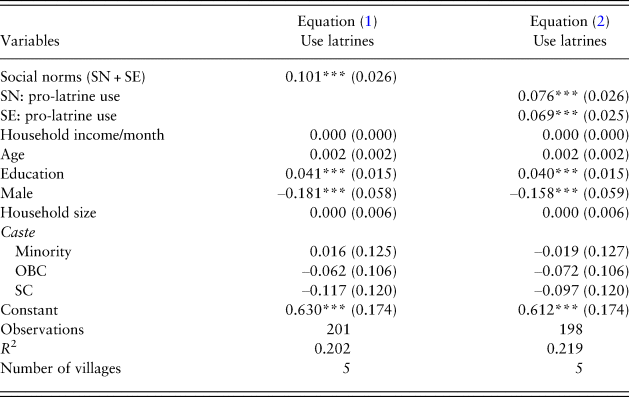
What about the relationship between perceived social norms and behavior? Our social norms framework hypothesizes a positive relationship between personal behavior (latrine use) and social expectations (both empirical and normative). Equation (1) regresses reported latrine use behavior on social norms (i.e., combined index of both social empirical and social normative expectations regarding latrine use), while Equation (2) splits social norms into its component parts and regresses latrine use behavior on indices of social empirical expectations of latrine use and social normative expectations of the unacceptability of open defecation. Both specifications control for gender, education, income, age, household size and caste, and both include village-level fixed effects.
 $$ \hskip-6pc{\rm Latrine\ use\ } = \beta _0 + \beta _1social\_norms\_index + \beta _{\rm i}X_{\rm i} + \varepsilon _{\rm i}$$
 $$\eqalign{ {\rm Latrine\ use\ } & = \beta _0 + \beta _1social\_empirical\_expectations\_index \cr & \quad + \beta _2social\_normative\_expecations\_index + \beta _{\rm i}X_{\rm i} + \varepsilon _{\rm i}} $$
Standardized independent variables and indices were used in the regression analysis to produce standardized coefficients for simpler interpretation. Our results show a statistically significant positive relationship between latrine use behavior and social norms (see Table 6). Pro-latrine norms, which include both social and empirical expectations, are strong predictors of pro-latrine behavior, with a 1 SD increase in the pro-latrine norms score increasing the personal latrine usage score by 10.1% on average (column 1 in Table 6). This relationship holds when social norms are broken down into social normative and social empirical expectations (column 2 in Table 6). A 1 SD increase in the social normative expectation score is associated with an average 7.6% increase in the latrine usage score on average, while the same increase in the social empirical expectation score is associated with an average 6.9% increase in the latrine usage score. All of this strongly supports our hypothesis that social norms do matter in the context of latrine use (over open defecation) – latrine use behavior is closely linked to social expectations of whether others in one's reference group use or own latrines and to what extent one believes that others find open defecation to be acceptable. Lastly, education and gender appear to be important predictors of latrine use behavior. While being male is linked to lower latrine use, education consistently shows a positive relationship with pro-latrine behavior.
Regression: latrine use behavior (standard errors in parentheses).

***p < 0.01.
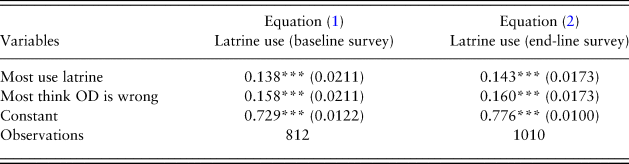
Each respondent was also presented with four vignettes. The situations depict a typical village and varied either social empirical expectations (most people in the village defecated in the open or used a latrine) or social normative expectations (most people found it acceptable to defecate in the open or found this to be wrong). The vignette then asked where a typical resident (matched to the gender of the respondent), who had access to a latrine, would defecate. Vignettes, in this case, were used to test a counterfactual: norms of latrine use versus norms of open defecation. This survey experiment is used to measure how social empirical and social normative expectations affect behavior. In this case, the behavior is that of another villager, rather than that of the respondent him or herself, in order to mitigate social desirability bias in the responses. The survey experiment with vignettes provides further evidence on the existence of a social norm beyond the correlations in Table 6.
We conduct simple factorial analysis without interaction effects, representing each of the above factors with a dummy variable. Simple regression results are shown in Table 7. The results suggest that the likelihood of latrine use on the part of a villager would increase by 18.9% if he or she moved to a village where most people used latrines, and they would increase by 21.7% if most people in the village found it wrong to defecate in the open. We also test for robustness using a multilevel model with a random intercept, since each individual is asked to respond to four vignettes. The results were similar. Overall, the analysis of the vignettes confirms the importance of both social normative and social empirical expectations for individual behavior.
Regression: vignettes (standard errors in parentheses).

***p < 0.01.
OD = open defecation.
We also explored mental models by asking narrative questions, such as associations that respondents made with the word ‘ganda’ (dirty). Analysis at baseline suggest a strong association of the word ‘ganda’ with latrines. For example, a word frequency count showed that ‘latrine’ was the third most mentioned word, after ‘feces’ and ‘drainage’, when people were asked to talk about things that they considered ‘ganda’. Topic modeling using latent Dirichlet allocation showed that the word ‘latrine’ appeared frequently in three of the top five topics, along with words such as ‘feces’, ‘garbage’, ‘drains’, etc.
This demonstrates the importance of changing social norms but also mental models regarding latrine use.
Intervention
Social norms appear to matter when it comes to beliefs and behaviors regarding open defecation in rural UP. While the majority of latrine owners use latrines, and do so frequently, individuals do not necessarily know this (perhaps because latrine use is a less visible practice than open defecation). They may also be making inferences about latrine use on the part of latrine owners from the observed behavior of latrine non-owners. This points to a potential mismatch between empirical expectations and reality, where updating the former could have the effect of communicating to people who continue to defecate in the open that they are, in fact, deviating from the norm. Similarly, our findings confirm that weakening social norms and changing mental models that get in the way of a permanent shift away from open defecation require direct confrontation with ‘gandagi’ and related terms regarding impurity and dirtiness, insofar as they relate to latrines. To address these behavioral barriers, we piloted two simple informational interventions and evaluated their short-term impacts on people's behaviors and beliefs around latrine use.
The goals of the interventions were to: (1) rebrand latrine use by associating it with cleanliness; and (2) make information about growing latrine use among latrine owners salient. Three types of messages were delivered: the first cued empirical expectations about open defecation and latrine use by informing people about prevalent norms among latrine owners in order to update their beliefs about latrine use within their appropriate reference groups; the second and third challenged existing mental models that automatically associate latrines with gandagi by highlighting the relative desirability of latrines vis-à-vis open defecation through direct association of latrine use with cleanliness and other ‘clean’ practices.
These messages were delivered via two outreach channels over a period of 1 week: (1) individually delivered pamphlets by key individuals in the community, or ‘norm entrepreneurs’ (NEs) (Treatment 1); or (2) a mass communication campaign involving community events, posters at key locations around the village (entry, exit, schools, community halls and markets) and NE-delivered pamphlets (Treatment 2). While Treatment 2 ensured maximum outreach, Treatment 1 utilized personalized delivery through individuals who are well connected or highly central to the village social network and who could play an influential role in the creation of a new social norm around latrine use and act as the positive norm enforcers within their respective communities (see Appendix 2 for detailed theory of change).
Treatment was randomly assigned at the village level. Two of the five baseline villages were assigned to Treatment 1 and the remaining three to Treatment 2, covering a total of 225 households with latrines across all five villages. In addition, 10% of the households (25) in the Treatment 1 villages were randomly selected to receive no intervention (and serve as a control group).
Results
The interventions targeted change in latrine use behavior through two pathways: change in beliefs about the importance of using latrines via its association with cleanliness; and updating empirical expectations about the norms of latrine use in the community. A follow-up survey was conducted in all of the baseline villages following the week-long interventions to evaluate the impacts of the interventions on latrine use behavior and related personal and normative beliefs. Of 204 households surveyed at baseline, 156 (76%) were included in the follow-up survey. The attrition was due to the enumerators inability to resurvey the baseline respondents within the short follow-up survey period. (Since beliefs and behaviors are subjective, baseline respondents could not be replaced with other members of the household.) The control group for this pilot was also very small given the small sample size of the overall study. In addition, because control group households were sampled from Treatment 1 villages, there was high risk of spillover due to information diffusion from treatment to control households and due to the presence and activity of NEs in the villages. As a result, comparisons between the treatment and control groups could not be made in our analysis.
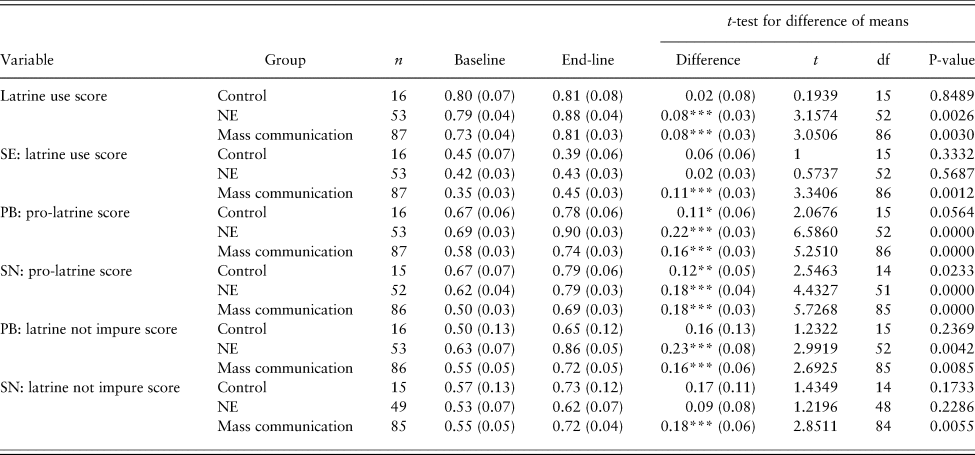
The end-line data show relatively large changes in both behavior and attitudes in favor of latrine use relative to the baseline data. Given the small sample size, our study was underpowered to detect significant effects, but a simple difference in means test between the baseline and end-line outcomes shows large and statistically significant differences in both behavior and beliefs related to latrines across both treatment arms (see Appendix 3 for detailed results).
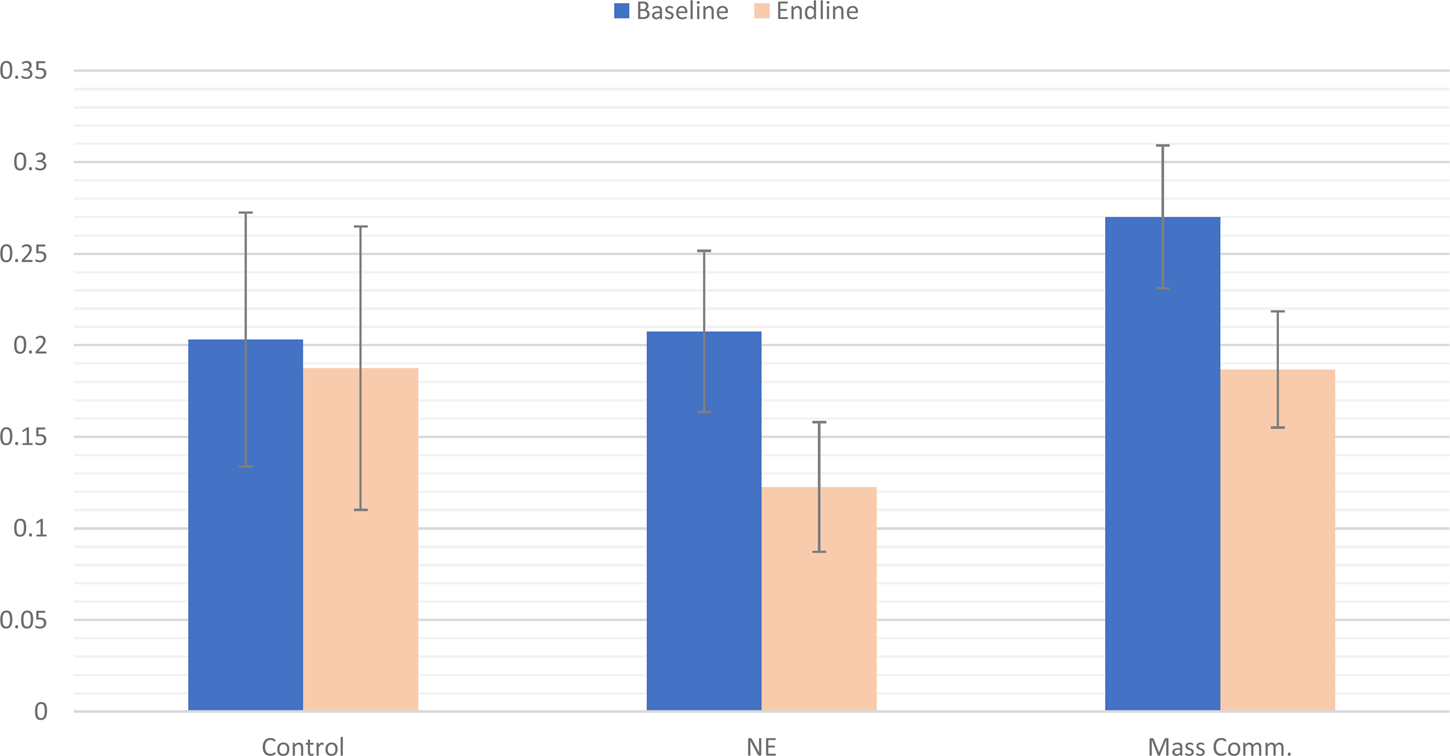
Figure 1 shows that, following the intervention, latrine use scores went up by 0.08 on average (p < 0.01) in both treatment villages relative to baseline (which represents a 10% increase in average latrine use score in Treatment 1 villages and an 11% increase in Treatment 2 villages). This indicates that latrine owners in treatment villages either started using latrines if they were not previously doing so or increased their frequency of latrine use over open defecation during this period. Personal normative beliefs also moved in a more pro-latrine direction relative to baseline, with scores increasing by 0.22 (32%) and 0.16 (28%) on average in Treatment 1 and Treatment 2 villages, respectively, relative to baseline (see Table 8). We also observe evidence of a shift in mental models vis-à-vis the association of latrines with impurity. In addition to changes in personal normative beliefs in favor of latrine use, respondents’ score on the item ‘Having a latrine next to the house makes the house impure’ improved in the pro-latrine direction by as much as 0.23 points (37%) on average in Treatment 1 villages and 0.16 points (29%) on average in Treatment 2 villages.
Latrine use score (reversed to show frequency of open defecation). Mass Comm. = mass communication; NE = norm entrepreneur.

Difference in means (standard errors in parentheses).

*p < 0.1, **p < 0.05, ***p < 0.01.
NE = norm entrepreneur; PB = personal normative beliefs; SE = social empirical expectations; SN = social normative expectations.
These results are consistent with our hypothesis that one of the pathways through which latrine use can be increased is by challenging the mental models around the association of latrines and cleanliness. However, the role of the second mechanism we identified – updating empirical expectations about norms of latrine use in the community – is less clear. Empirical expectations of the extent to which others in one's community use latrines showed significant improvements in Treatment 2 villages, but the change was small and statistically insignificant in the Treatment 1 villages, despite improvements in latrine use practices. There could be two factors to consider here. The first has to do with the measurement itself. While at baseline we only asked respondents where others in their village usually defecate, at end-line we introduced a more nuanced measure by asking directly about practices of other latrine owners as well. This may have influenced the reference group considered by respondents in answering this question, making the comparison between baseline and end-line outcomes less valid. However, since we did see significant changes in one treatment group and not the other, a potential explanation could be related to the differences between these two groups at baseline. Treatment 2 households were worse off on average across most variables, including empirical expectations and normative expectations about pro-latrine beliefs, compared to both Treatment 1 and control group households at baseline. As a result, updating empirical expectations in these villages may have led to larger changes because the difference between expectations and reality was more pronounced, and hence more impactful.
Though improvements are observed across both treatment groups, the effectiveness of the delivery channel (NE versus mass communication) seemed to vary between personal and social outcomes. The mass communication treatment was associated with larger changes in social empirical and normative expectations, while the norm entrepreneur-delivered treatment was more effective at influencing personal beliefs. This suggests that while personalized delivery might allow for quicker internalization of positive beliefs, mass communication methods, which target the community as a whole, might be more effective at changing normative expectations because people believe others to have internalized the same views that they have (as a result of being exposed to the same information through the intervention). Mass communication may be more likely to change not only personal beliefs, but also common knowledge of personal beliefs.
Discussion and conclusion
Our study points to two important aspects of latrine use behavior. The first is that the decision to use latrines for defecation and, relatedly, attitudes towards open defecation are influenced by a range of factors. Clearly, high rates of latrine construction and latrine ownership are not sufficient conditions to eliminate open defecation among members of latrine-owning households. In the context of rural India, where people's identities are closely tied to their community identity and where cultural practices and beliefs potentially exert powerful influences on their own beliefs and practices, tackling collective practice problems such as open defecation could benefit from an understanding of the underlying psychological and social barriers as well. Our measurement tool, which was designed to identify such barriers, demonstrates that to reduce open defecation in rural India, it is might be necessary to change cultural schema or mental models that associate latrines with ‘gandagi’, as well as to change social expectations of prevalent norms and behavior around latrine use.
The second, based on findings from our pilot study, is that mental models and social norms are malleable, and, when challenged, can lead to behavior change. Our study shows that measurable behavior change can be achieved relatively quickly and at low cost using behaviorally informed information interventions. Our study tested two low-cost delivery channels, both utilizing local resources and personnel. Both interventions were relatively successful at influencing practices and beliefs around latrine use. It is worth noting that both delivery channels were relatively low cost. Posters (used in the mass communication treatment villages) have very low marginal cost and can be scaled up easily to reach a wide audience. NEs, once recruited, can deliver in-person messages to additional households at low marginal cost. In our intervention, the NEs were unpaid. Community events may have relatively high marginal costs, but they offer greater visibility and diffusion potential to reach a wider audience and spark conversations. Our results suggest that community-level delivery methods may be more effective at changing norms relative to individual delivery methods, but the latter are more influential at changing personal beliefs.
Our study had some important limitations in terms of its ability to measure and detect significant effects and to attribute observed impacts to the treatments. The sample size was relatively small. The restricted timeline limited our ability to measure the impacts of these interventions over the longer term in order to determine whether the changes were sustained over time. Our measures of social norms could be improved by improving the specification of the relevant reference groups. The government of UP was, at around the same time, implementing Community-Led Total Sanitation and other anti-open defecation campaigns and triggering exercises; these may have prepared the ground for the social norm pilot we conducted.
However, the systematic approach to measuring behavior that we introduce in this study can be utilized to effectively diagnose barriers to latrine use as well as to design and evaluate larger-scale studies that measure the actual impacts of such interventions. Some of these interventions might use social norm and mental model interventions of the kind that this study implemented; others might explore more cost-effective and scalable interventions, such as mass media. Given the massive effort that the government of India is undertaking to tackle the problem, a systematic approach to measuring and addressing social norms could contribute significantly to completely and sustainably eliminating the practice of open defecation.
Supplementary material
To view supplementary material for this article, please visit https://doi.org/10.1017/bpp.2020.46
Acknowledgments
We thank Ganesh Iyer and Przemek Jeziorski of the University of California, Berkeley, Deepa Karthykeyan, Ankit Chatri and Sanjana Singh of Athena Economics and Nivedita Mani of Gorakhpur Environmental Action Group (GEAG) for collaboration on the project. We are grateful to Athena and GEAG for the design and implementation of the intervention and all data collection. We appreciate helpful comments from the r.i.c.e. Institute on project design.
Disclaimer
All errors remain our own. The views and findings in this paper do not necessarily represent those of the World Bank or its Executive Directors.
Financial support
We are grateful for financial support from the International Initiative for Impact Evaluation (3ie) and the Mind, Behavior, and Development Unit (eMBeD) of the World Bank.