INTRODUCTION
Keloids are benign dermal fibroproliferative tumour that form on the site of surgical incision or trauma and extends beyond the boundaries of original site of injury. Keloids have the tendency to invade normal adjacent tissue which lead to the aesthetic disfigurement and also causes redness and itching sensation.Reference Kelly 1 – Reference Duan, Liu, Luo and Hu 3 There have been many treatment modalities described by various researchers with a highly varying rate of success.Reference Ragoowansi, Powell, Moss, Cornes and Glees 4 – Reference Brent 10 A simple excision is an undesirable treatment option with a high recurrence rate upto 80%.Reference Aköz, Gideroğlu and Akan 11 , Reference Narkwong and Thirakhupt 12 Surgical excision or keloidectomy, followed by radiation therapy is one of the most effective treatment modality in the management of keloid with a success rate of 67–98%.Reference Sobec, Dobreanu, Fodor, Şomcutean, Ţichil and Cosgarea 13 , Reference Klumpar, Murray and Anscher 14 However, the issue is still controversial, because the radiation therapy community is not in total agreement about the optimal dose, time and fractionation.Reference Song, Wu, Chang, Kim and Ha 2 , Reference Duan, Liu, Luo and Hu 3 Furthermore plastic surgeons and dermatologists also hesitate to refer patients for radiation therapy of keloid due to the risk of carcinogenesis; although the risk of reported doubtful radiation induced malignancy is 0·074%, only in five cases out of 6,741 treated patients.Reference Botwood, Lewanski and Lowdell 15 – Reference Recalcati, Caccialanza and Piccinno 17 The role of radiation therapy for the treatment of keloid began in the early 1900s. Initially it was only treated with external beam radiotherapy but later on in 1970s; brachytherapy was used for the treatment of keloid, nowadays available in the form of low-dose rate (LDR) and high-dose rate (HDR) brachytherapy. HDR brachytherapy has proven itself as a superior treatment modality than external beam radiotherapy because of the better dose distribution; less normal tissue exposure and rapid dose fall off. Other advantage of HDR over LDR brachytherapy is that there is no need of hospitalisation of patient for 2–3 days in a shielded room and hence can be performed on outpatient basis.Reference van Leeuwen, Stokmans and Bulstra 18 , Reference Guix, Henrı́quez, Andrés, Finestres, Tello and Martı́nez 19
For developing countries like Pakistan where the per capita income is very low, the patient convenience and cost effectiveness of any treatment without compromising the control rate is a question of major concern. There have been many studies with postoperative HDR iridium-192 brachytherapy published by various researchers. But to the best of our knowledge there is no study ever been published on the comparison of single versus multiple fractions iridium-192 surface mould HDR brachytherapy regarding postoperative keloid treatment. The purpose of this study was two-fold; first to report our experience with a HDR iridium-192 surface mould brachytherapy of keloid scars after surgical excision, using different radiation treatment regimen and second to establish the most convenient and cost effective treatment protocol, having no compromise on the treatment outcomes.
MATERIALS AND METHODS
Patient information
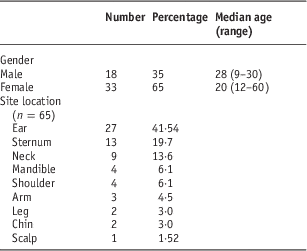
From January 2012 to April 2015 a total of 51 patients with 65 keloid lesions underwent postoperative iridium-192 HDR surface mould brachytherapy at Institute of Radiotherapy and Nuclear Medicine (IRNUM), Peshawar, KPK, Pakistan. Out of 51 patients, 12 presented with two lesions and one with three lesions; 18 patients were male (35%) and 33 patients were female (65%). The median age of male patients was 28 years ranging from 9 to 30 years, while that of female patients was 22 years ranging from 12 to 60 years. The characteristics of patients and keloid lesions are summarised in Table 1.
Patients (n=51) and lesions (n=65) characteristics

Treatment technique
All the patients were treated with HDR surface mould brachytherapy using iridium-192 source. Surface moulds for patients were prepared from flaps attached to the plastic tube applicators of 2-mm thickness for source loading. The mould was fixed with adhesive tape on patient skin with full coverage of target (surgical scar). The number of applicator tubes used, was according to the complexity and extent of keloid scar. The dose was prescribed at 0·5 cm from the centre of the catheter tube and optimisation was performed using Oncentra® (ELEKTA-Software Solutions, Veenendaal, The Netherlands) treatment planning system. The source was loaded into the tube applicator in close propinquity to the target lesion with the help of Flexitron® (ELEKTA-Brachytherapy, Veenendaal, The Netherlands) remote after loader.
Dose regimen
Different dose regimens were used for the treatment. Patients were randomly divided into four groups for comparison. First group with seven keloid lesions were treated with a single dose of 8 Gy. Second group containing 19 keloid lesions were treated with a dose of 10 Gy in a single fraction, third group of 20 keloid lesions were treated with a dose regimen of 15 Gy in three fractions (5 Gy/fraction) and fourth group of 19 keloid lesions with 18 Gy in three fractions (6 Gy/fraction). In the first two groups the dose was given within 24 hours of the surgery whereas in other two groups the treatment was completed in 3 consecutive days beginning within 24 hours of the surgery. The biological effective dose (BED10) of each scheme was calculated in order to compare the clinical outcomes using a linear quadratic model:
 $${\mib{ }} BED_{{10}} {\equals}{\rm nd}[1{\plus}d/(\alpha /\beta )]$$
. The subscript in BED10 indicates that
 $\alpha /\beta {\equals}10\ Gy$
was considered for keloid being acute reacting tissues.Reference Kal and Veen
20
RESULTS
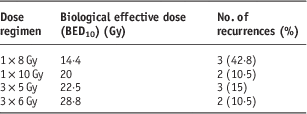
The results of therapeutic outcome of different treatment regimen are shown in Table 2. The median follow-up period was 33 months with a range of 15–53 months. Three out of seven keloid patients developed recurrence from the first group with a BED10=14·4 Gy. The recurrence rate was 42·8%. In the second group with a BED10=20 Gy two recurrences were observed with a rate of 10·5%. In the other two groups with BED10=22·5 Gy and BED10= 28·8 Gy the rate of recurrence was 15 and 10·5%, respectively. Out of a total of ten recurrences, four recurrences were observed in the stretch tension areas, that is sternum, in which two were from the first group and one each from the second and third groups. The grading system of National Cancer Institute Common Terminology Criteria of Adverse Effects version 4.03, 21 was adopted for radiation induced effects. Symptoms of grade-1 erythema and pruritus were observed in 15 patients while 3 patients complained about skin hyperpigmentation (grade 1). Grade 2 or above radiation induced toxicity was not observed in any single patient. In 94·64% (53 out of 56) of relapse free cases, there was no evidence of talangiectasias and hence the cosmetic results were graded as good.
Recurrence rate of different radiation regimen used in the study

DISCUSSION
The role of radiation therapy, either teletherapy or brachytherapy for the treatment of benign diseases as adjuvant treatment is an established fact. In many countries including Pakistan, the patient is charged for the course of radiotherapy on the basis of total number of fractions. The financial impact of treatment therefore increases with the number of fractions. So, the patient convenience and cost effectiveness of any treatment modality is a question of major concern. Therefore, the prime objective of this study was to evaluate our results of treating keloid lesions with different radiation dose regimes, to find out the most convenient and cost effective dose regime.
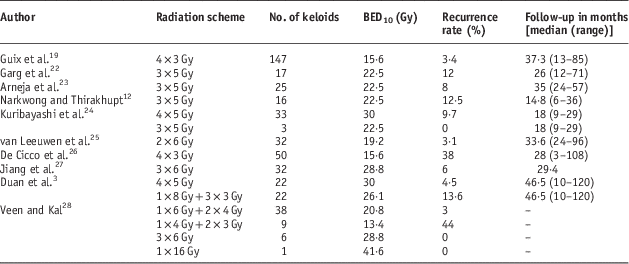
Guix et al.Reference Guix, Henrı́quez, Andrés, Finestres, Tello and Martı́nez 19 have reported 169 keloid lesions treated by HDR brachytherapy. They delivered a total dose of 12 Gy in three fractions (BED10= 15·6 Gy) as postoperative radiation to 147 keloid lesions within 24 hours and found 3·4% recurrence after a follow-up of 7 years. Garg et al.Reference Garg, Weiss and Sharma 22 and Arneja at al.Reference Arneja, Singh, Dolynchuk, Murray, Rozzelle and Jones 23 in their study used 15 Gy in three fractions (BED10=22·5 Gy) and achieved a success rate of 88 and 92%, respectively. Narkwong and ThirakhuptReference Narkwong and Thirakhupt 12 also used the same scheme. They evaluated 15 patients out of 22 treated patients and found a relapse free rate of 79·5%. Kuribayashi et al.Reference Kuribayashi, Miyashita and Ozawa 24 used two radiation schemes. In 33 keloid lesions treated with a scheme of 20 Gy in four fractions (BED10=30 Gy) the recurrence was 9·7% while in three keloid treated with 15 Gy in three fractions (BED10=22·5 Gy) no recurrence was observed. van Leeuwen et al.Reference van Leeuwen, Stokmans and Bulstra 25 found a recurrence rate of 3·1% using a scheme of 12 Gy in two fractions (BED10=19·2 Gy) in 32 patients. De Cicco et al.Reference De Cicco, Vischioni and Vavassori 26 achieved 62% success rate in 50 keloid lesions treated with a dose of 12 Gy in four fractions (BED10=15·6 Gy). Jiang et al.Reference Jiang, Baumann and Dunst 27 in their study on 32 patients used a scheme of 18 Gy in three fractions (BED10=28·8 Gy). The recurrence rate was only 6% after a median follow-up of 29·4 months. Duan et al.Reference Duan, Liu, Luo and Hu 3 described two groups each of 22 patients treated with HDR brachytherapy. The radiation scheme was 20 Gy in five fractions (BED10=30 Gy) or 8 Gy in a single fraction plus 9 Gy in three fractions (BED10= 26·1 Gy). The recurrence rates were 4·5 and 13·6%, respectively. Veen and KalReference Veen and Kal 28 in their study used several radiation schemes. In a scheme of 1×6 Gy plus 2×4 Gy (BED10=20·8 Gy) used on 38 patients they found 3% recurrence rate, while 44% recurrence was observed in a group of patients treated with a scheme of 1×4 Gy plus 2×3 Gy (BED10=13·4 Gy). In six patients, treated with 3×6 Gy (BED10=28·8 Gy) and one patient treated with 1×16 Gy (BED10=41·6 Gy) no recurrence was observed. The results of different HDR brachytherapy radiation schemes are summarised in Table 3.
Summary of postoperative iridium-192 high dose rate brachytherapy published studies

All of the above mentioned studies prove the efficacy and efficiency of postoperative HDR iridium-192 brachytherapy in the treatment of keloid. In the present study, we have attempted the comparison between different radiation dose regimens of HDR surface mould iridium-192 brachytherapy. The recurrence rate with 10 Gy in a single fraction was 10·5% which was comparable with other two schemes of 15 Gy in three fractions and 18 Gy in three fractions. The dose regimen of 8 Gy in a single fraction (BED10=14·4 Gy) resulted in 42·8% recurrence in agreement with other studies, therefore considered as suboptimal and discouraged in practice. The limitation in this present study was that most of the patients belong to a poor economical background and lived in remote areas. Because of financial constraints, most patients in the study were contacted through telephone for collecting follow-up information.
Kal and VeenReference Kal and Veen 20 reviewed the literature and have established the relation between BED10 and keloid recurrence rate. They recommended BED10>30 Gy as optimal dose, but still it is evident from the above-mentioned series that using a dose regimen of BED10<30 Gy has also resulted in a convincing success rate, although some of the studies included small number of patients. Nevertheless, the results of these studies cannot be ignored. Assessing whether, this may be due to the sway of some other variable factors such as surgical approach, plan optimisation, irradiation technique and target area is not easy.
It is generally believed that using the dose regimen with high BED10 value, the rate of success increases but having done so there is a likelihood of increasing the chances of late radiation induced malignancy. Although only five cases of radiation induced malignancy are reported in the literatureReference Apfelberg, Maser, Lash, White and Weston 8 but to further diminish the probability of late radiation induced malignancy we are now shifting towards radiation dose concept as economic, convenient and as low dose as possible. In this perspective, a dose scheme of 10 Gy in a single faction is considered to be the most convenient and cost effective scheme, with therapeutic results comparable with other multiple fractions HDR brachytherapy schemes.
CONCLUSION
In conclusion, the results of this study show that a dose regimen of 10 Gy (BED10=20 Gy) in a single fraction have comparable results with a dose regimen of 15 Gy in three fractions or 18 Gy in three fractions. Dose regimen of 10 Gy in a single fraction is therefore, considered to be the most convenient and cost effective dose regimen for the management of keloid scars in developing countries like Pakistan. Dose scheme of 8 Gy in a single fraction is considered suboptimal and discouraged in practice.
Acknowledgements
None.
Financial support
This research received no specific grant from any funding agency or from commercial or not-for-profit sectors.
Conflicts of Interest
The authors declare that there are no conflicts of interest.