Introduction
In terms of species diversity, Scaphopoda is a small class of shelled marine mollusc consisting of only two orders (Dentaliida and Gadilida), with a worldwide distribution ranging from the intertidal to depths exceeding 6000 m (Reynolds Reference Reynolds2002). Their tusk-shaped shells, varying in size from a few millimetres to several centimetres, are hollow, curved, conical tubes that are open at both ends. Although shell sculpture is absent in many scaphopods, a longitudinal sculpture in many dentaliids and a few gadilids is an important diagnostic characteristic for taxonomy (Palmer Reference Palmer1974, Reynolds Reference Reynolds2002). Scaphopods are the only class of exclusively infaunal marine molluscs, and they live near the sediment surface, feeding mainly on foraminifers that they select and manipulate with their captacula (feeding tentacles) and burrowing into soft sediments at a rate of up to 1 cm s-1 using a muscular foot (Shimek Reference Shimek1989, Reynolds Reference Reynolds2002).
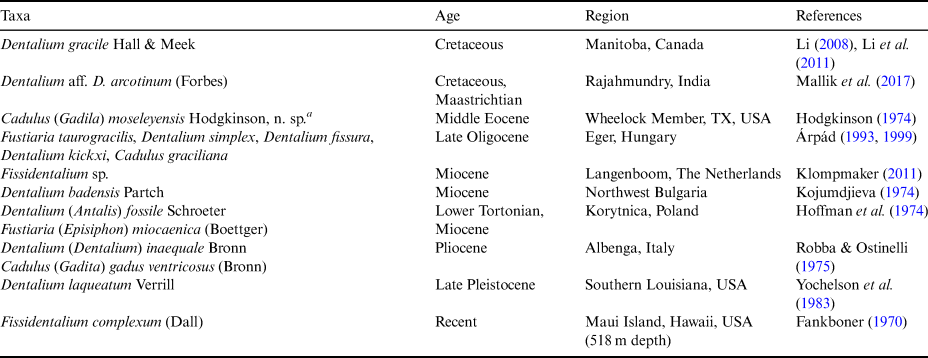
In modern environments, very little is known about the predators of scaphopods, but bottom-feeding fish (ratfish) and naticids have been recognized as predators (Shimek Reference Shimek1989, Reynolds Reference Reynolds2002), although no systematic studies are available on the latter. Fankboner (Reference Fankboner1970) mentioned the first and only bibliographical record of a naticid drillhole on a modern scaphopod shell from the Hawaiian Islands, and other reports correspond exclusively to fossil specimens (Table I).
Records of naticid drillholes on scaphopod shells.

aA drillhole probably produced by a naticid is illustrated in plate 3.2.
Scaphopods first appeared in the Palaeozoic, but evidence of naticid drilling predation on tusk shells has been reported from the Cretaceous onwards, with records almost entirely for the Northern Hemisphere (North America and Western Europe; see references in Table I). There is only one record of naticid predation on scaphopods in the Cretaceous of India, which was situated in the Southern Hemisphere at that time (Mallick et al. Reference Mallick, Bardhan, Paul, Goswami and Das2017).
Drillholes on mollusc shells are one of the few predation marks that have the potential to be preserved over deep time and can be relatively easy to identify in the fossil record. Most are produced by naticid and muricid gastropods (see Kowalewski Reference Kowalewski, Dulai and Fürsich1998, Kelley & Hansen Reference Kelley, Hansen, Kelley, Kowalewski and Hansen2003, Klompmaker et al. Reference Klompmaker, Portell and Karasawa2014, among many others), but octopuses, although much less studied, also have the ability to produce drillholes in modern and fossil calcium carbonate exoskeletons (Todd & Harper Reference Todd and Harper2011, Klompmaker et al. Reference Klompmaker, Portell and Karasawa2014, Hiemstra Reference Hiemstra2015).
Here, we describe the first modern record of naticid predation on Antarctic scaphopods in the Southern Hemisphere based on specimens belonging to two different species of both scaphopod orders recovered at depths between 246.5 and 454.0 m.
Material and methods
The specimens studied were collected in 2011 using a demersal bottom trawl pilot net in the area around the northern Antarctic Peninsula and the South Shetland and South Orkney Islands, West Antarctica.
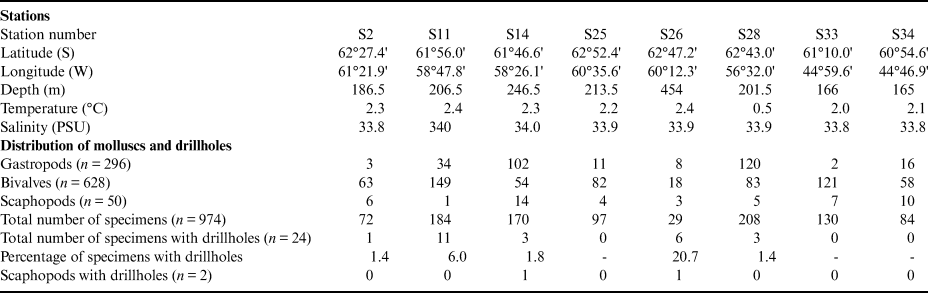
Scaphopods were recovered in 8 of the 17 sites analysed. Table II summarizes the physical data and provides general information on the mollusc specimens and their drillholes collected at the eight stations between depths of 165 and 454 m where scaphopods were found.
Distribution of scaphopods and other shelled molluscs (bivalves and gastropods) along with the presence of drillholes over the different stations.

A more detailed description of the sampling method and taxonomic/ecological information of the fauna recovered at these sites can be found in Gordillo et al. (Reference Gordillo, Malvé and Moran2017).
Different works were followed for the identification and taxonomic position of scaphopods (Dell Reference Dell1990, Steiner & Kabat Reference Steiner and Kabat2004, Aldea & Troncoso Reference Aldea and Troncoso2010). Similarly, several studies were used to identify and distinguish the different drillholes (Bromley Reference Bromley1981, Li et al. Reference Li, Young and Zhan2011, Hiemstra Reference Hiemstra2015, among others).
The shell length of each scaphopod specimen was measured to the nearest 0.01 mm using Vernier callipers. For the outer and the inner outlines of each drillhole, two diameters (one parallel and the other perpendicular to the shell length) were taken under a stereoscopic magnifying glass.
Description of the material
Preyed species
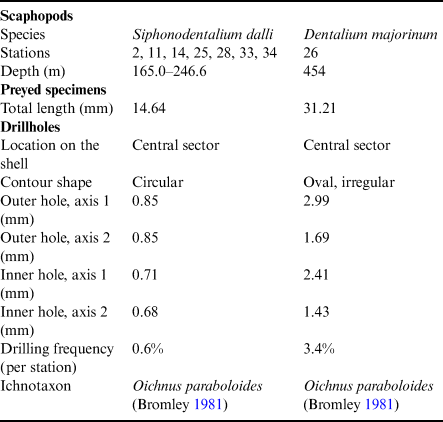
Scaphopods (n = 50) were collected from eight sites in West Antarctica (Table III). The Gadilidae Siphonodentalium dalli (Pilsbry & Sharp) was recovered from seven stations (n = 47) at depths of 165–247 m. The second species, the Dentaliidae Dentalium majorinum (Mabille & Rochebrune), was collected from only one station (n = 3) at 454 m.
Main characteristics of the material studied: scaphopods, preyed specimens and drillholes.

Drillholes
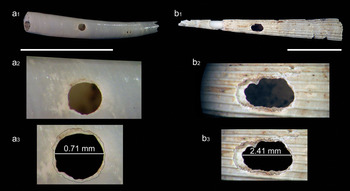
Both specimens analysed presented predation marks perpendicular to the shell surface that coincide with the icnogenus Oichnus (Bromley Reference Bromley1981). In S. dalli, the drillhole is circular in outline (Fig. 1a), while in D. majorinum, the hole is ovoid with the major axis parallel to the shell's long axis (Fig. 1b). These morphologies are comparable to naticid drillholes (Oichnus paraboloides; Bromley Reference Bromley1981). The measurements taken and other characteristics of the holes, shells and sampling sites are summarized in Table III.
Drillholes in Antarctic scaphopods. a. Siphonodentalium dalli. b. Dentalium majorinum. Scales in a1 and b1 are 10 mm.

Potential predators
Together with S. dalli, we recovered the naticid Pseudamauropsis aureolutea (n = 11) and the muricid Trophon coulmanensis (n = 1), while from the same station as D. majorinum, two naticid specimens were recovered, one of which was also identified as P. aureolutea.
Discussion
Numerous studies have reported naticid drilling predation mainly on bivalves and gastropods in both modern and fossil settings (Guerrero & Reyment Reference Guerrero and Reyment1988, Kelley & Hansen Reference Kelley, Hansen, Kelley, Kowalewski and Hansen2003, Gordillo et al. Reference Gordillo, Malvé, Morán and Boretto2020, among many others), but only a few records of drilling predation on fossil scaphopods have been reported from the Northern Hemisphere (e.g. Yochelson et al. Reference Yochelson, Dockery and Wolf1983, Klompmaker Reference Klompmaker2011, Li et al. Reference Li, Young and Zhan2011), and only one record is available from the Cretaceous-Palaeogene boundary sections in Rajahmundry, India, located in the Southern Hemisphere during that time (Mallick et al. Reference Mallick, Bardhan, Paul, Goswami and Das2017). Scaphopods are indeed far less abundant than gastropods and bivalves, and this situation probably reflects the scarcity of studies on their predator-prey interactions. Their infaunal mode of life and their bathymetric distribution (Reynolds Reference Reynolds2002) make scaphopods less likely to be collected and thoroughly studied. Thus, the dearth of reports appears to be a consequence of a real ecological pattern, implying that we are currently facing a bias in the record of these organisms.
In both preyed scaphopods, the drillholes are located in the middle part of the shell, which coincides with the area where most of the soft tissues are located. Scaphopods also have the ability to withdraw soft parts from both the anterior and posterior ends to the middle or upper middle part of the shell, and our results match with the region where most of the naticids' drillholes have been reported in the fossil record (Yochelson Reference Yochelson and Savazzi1999, Yochelson et al. Reference Yochelson, Dockery and Wolf1983).
Regarding the gastropods that could have produced the drillholes, and taking into account the infaunal mode of life of scaphopods (either fully buried or with an edge above the substrate) and the presence of P. aureolutea in the same assemblages where the scaphopods with drillholes were recovered, it is interpreted that naticids are the most plausible predators. In Antarctica, previous studies on naticid predation come from the Eocene (see Dietl et al. Reference Dietl, Nagel-Myers and Aronson2018, Harper et al. Reference Harper, Crame and Pullen2019), and there are no other references on extant communities.
It is worth noting that the drillhole on the shell of D. majoridum does not have the typical circular shape made by naticids, but these predators may sometimes produce holes that are not perfectly round. This may occur due to the interaction between the short, curved shell surface and a relatively large predator trying to select a drilling site. In addition, considering the size of the hole in this case, it appears that some deformation is probably caused because the D. majoridum shell is longitudinally ribbed, which makes the circular accessory boring organ distort to fit the ribbed shell surface. Overall, the cross-sections of both drillholes look very similar (i.e. a countersunk appearance), which argues for a single predator as the culprit, despite the difference in the outlines.
Scaphopods constitute < 4% of the shelled mollusc fauna treated in Gordillo et al. (Reference Gordillo, Malvé and Moran2017), and perhaps they are not the preferred prey of drilling naticid predators. Moreover, naticids have the ability to consume prey without making drillholes, such as by suffocating the prey with the aid of their foot (Kabat Reference Kabat1990, Visaggi et al. Reference Visaggi, Dietl and Kelley2013, Mallick et al. Reference Mallick, Bardhan, Paul, Goswami and Das2017), so the incidence of these predators could be underestimated.
Conclusions
Our study not only documents drilling predation on Antarctic scaphopods for the first time, but also describes the first record of drilling predation by gastropods on Recent scaphopods for the Southern Hemisphere.
In order to thoroughly evaluate the incidence of this kind of predation in benthic Antarctic communities in the near future, new studies should be carried out to determine whether these are isolated cases that represent a rare item of these predators' diets or are underrepresented events due to the different feeding techniques employed by these predators.
Acknowledgements
SG is grateful to CONICET for the opportunity to participate in the Antarctic Expedition CAV 2011 aboard the ARA Puerto Deseado. We are also grateful to the reviewers, Gregory P. Dietl and Elizabeth M. Harper, for their insightful comments and suggestions that greatly improved the manuscript.
Author contributions
SG and MEM conceived and designed the research. SG participated in sample collection, analysed the data, provided illustrations and wrote the manuscript. Both authors discussed the results and agreed upon the final version of the manuscript.
Financial support
This research was supported by Consejo Nacional de Investigaciones Científicas y Técnicas (CONICET; Project- PIP-114-201101-00238 to SG), Dirección Nacional del Antártico (DNA) and Instituto Antártico Argentino (IAA).
Details of data deposit
The material studied is housed in the collection of the Centro de Investigaciones en Ciencias de la Tierra (CICTERRA), Consejo Nacional de Investigaciones Científicas y Técnicas and Universidad Nacional de Córdoba.