Introduction
Infants with CHD have increased survival rates since the introduction of staged palliations. These infants are often exposed to multiple risk factors for venous thromboembolism which include having a structural heart abnormality, turbulent blood flow, exposure to cardiopulmonary bypass, increased use of central venous catheters, and the use bioprosthetic hardware. Reference Silvey and Brandão1–Reference Stein, Kayali and Olson3 Among hospitalised paediatric patients, the incidence of venous thromboembolisms more than doubled between 2008 and 2019 to 106 per 10,000 hospitalisations. Reference O’Brien, Stanek, Witmer and Raffini4 This rapid increase in incidence is likely multifactorial, including the presence of identified risk factors for venous thromboembolism, increased use of invasive vascular interventions, and a growing increase in surveillance. Reference Shoag, Davis and Corrales-Medina5 Patients who develop venous thromboembolism have a higher risk of mortality and increased length of hospital stay. Reference Kim and Sabharwal2–Reference Stein, Kayali and Olson3
The American College of Chest Physicians (CHEST) Evidence Based Clinical Practice Guidelines prefer low molecular weight heparin for the treatment of venous thromboembolism in paediatrics. Reference Monagle, Chan and Goldenberg6 It is favourable compared to unfractionated heparin for its presumed reduced risk of heparin induced thrombocytopenia, predictable pharmacokinetic profile, and long half-life. Reference Monagle, Chan and Goldenberg6–Reference Newall, Johnston, Ignjatovic and Monagle8 The American College of Chest Physicians’ guidelines recommend enoxaparin 1.5 mg/kg every 12 hours for infants less than 2 months of age and enoxaparin 1 mg/kg every 12 hours for infants greater than or equal to 2 months. Reference Monagle, Chan and Goldenberg6 Infants less than 1 year of age have rapid changes in their pharmacokinetics and pharmacodynamics along with dynamic changing developmental haemostasis which affects the predictability of obtaining therapeutic anti-Xa levels. Reference van den Anker, Reed, Allegaert and Kearns9 These differences include changes in renal function, increased intracellular water, weight, and plasma binding. Reference Newall, Johnston, Ignjatovic and Monagle8,Reference van den Anker, Reed, Allegaert and Kearns9 Specifically, antithrombin levels are reduced at birth and normalise around 1 year of age. Reference van den Anker, Reed, Allegaert and Kearns9 Antithrombin binds to low molecular weight heparin to allow for a conformational change, albeit less than unfractionated heparin given the higher affinity for factor Xa. This conformational change allows it to inhibit thrombin formation by inhibiting factor Xa. A delay in achieving therapeutic enoxaparin levels may potentiate the risk of thrombus formation, thrombus embolisation, increased lab draws, and increased length of hospitalisation. Reference Dinh, Moffett and Galati12–Reference Leung, Ho and Hamilton13
The optimal dosing of therapeutic enoxaparin in paediatrics is still unknown, with a paucity of available literature. The current therapeutic range of enoxaparin is extrapolated from adult data and provided by the American College of Chest Physicians to target anti-Xa levels between 0.5 and 1.0 unit/mL. Reference O’Brien, Stanek, Witmer and Raffini4 Recent studies suggest that infants greater than or equal to 2 months of age may require higher dosing of enoxaparin. Reference Toledo, Gunawardena and Munoz11–Reference Dinh, Moffett and Galati12,Reference Wiltrout, Lissick and Raschka14 At our institution’s heart centre, we adopted a dosing strategy using higher dosing in infants greater than or equal to 2 months of age based on empirical dosing approach using historical internal data. This study aims to evaluate the percentage of patients who achieved initial therapeutic anti-Xa levels on the American College of Chest Physicians-recommended dosing versus the dosing strategy at our centre.
Materials and methods
Inclusion/exclusion criteria
This was a single-centre, retrospective, quasi-experimental study conducted between January 2008 and June 2023 in patients greater than or equal to 2 months of age undergoing anticoagulation therapy with enoxaparin to target therapeutic anti-Xa levels. Patients were divided into pre (January 2008 to December 2014) and post (June 2020 to June 2023) intervention groups, with the pre-intervention group receiving an enoxaparin dosing regimen of 1 mg/kg every 12 hours (standard-dose) and the post-intervention group receiving an enoxaparin dosing regimen of 1.5 mg/kg every 12 hours (high-dose). Patients were included if they were between the ages of 2 and 12 months, admitted to the heart centre, and had at least one anti-Xa assay drawn 4–6 hours after a dose. Patients were excluded if they had thrombocytopenia, defined as platelets at baseline less than 100,000 plts/µL, poor renal function, defined as an estimated creatinine clearance less than 30 mL/min, or an anti-Xa goal other than 0.5–1 unit/mL.
Endpoints
The primary objective was to evaluate the percentage of patients who achieved initial target anti-Xa levels. Initial anti-Xa levels were drawn 4–6 hours after the second or third dose of enoxaparin was given. Secondary endpoints included time to target anti-Xa level, correlation of antithrombin level, and dose achieving therapeutic anti-Xa level. Safety endpoints included minor and major bleeding as defined by the International Society of Thrombosis and Haemostasis paediatric criteria. Major bleeding was defined as symptomatic bleeding in a critical organ, bleeding which required a blood transfusion, or that resulted in death. Minor bleeding was defined as all other bleedings or if the medication was held due to bleeding. Reference Schulman and Kearon15
Institutional protocol
Before 2015, the heart centre followed the 2012 American College of Chest Physicians’ guidelines recommendations for treatment of venous thromboembolism in paediatric patients. After 2015, the heart centre adopted a new dosing strategy for infants less than or equal to 12 months of age for initial therapeutic enoxaparin to be dosed at 1.5 mg/kg every 12 hours. We utilise a 100 mg/mL non-dilute enoxaparin concentration for all doses less than 30 mg delivered by subcutaneous needles. Doses must be rounded to the nearest mg amount (e.g. 2.4 → 2 mg and 2.5 → 3 mg). Standard dosing times of 08:00 and 20:00 are utilised for administration unless extenuating circumstances are present.
Statistical analysis
Statistical analysis was conducted using R version 4.4.0, with data collected via REDCap©. The study population was characterised using descriptive statistics, including mean ± standard deviation (SD) and median with interquartile range (IQR). For categorical variables, Pearson’s Chi-squared test was utilised, while the Wilcoxon rank sum test was applied to continuous, nonparametric variables. Fisher’s exact test was used for categorical variables with small sample sizes. Pearson’s correlation coefficient assessed the relationship between continuous variables, specifically antithrombin levels and dosing. The analysis compared baseline demographics, clinical outcomes, and dosing between the standard- and high-dose cohorts, identifying significant differences in racial distribution, baseline creatinine levels, creatinine clearance, and types of thrombosis. To evaluate the effectiveness of enoxaparin dosing, the analysis focused on the proportion of patients reaching initial target anti-Xa levels and the time required to achieve these levels. Correlations between antithrombin levels, age, and dosing were assessed using scatter plots, revealing no significant associations. p values less than 0.05 were considered statistically significant.
Results
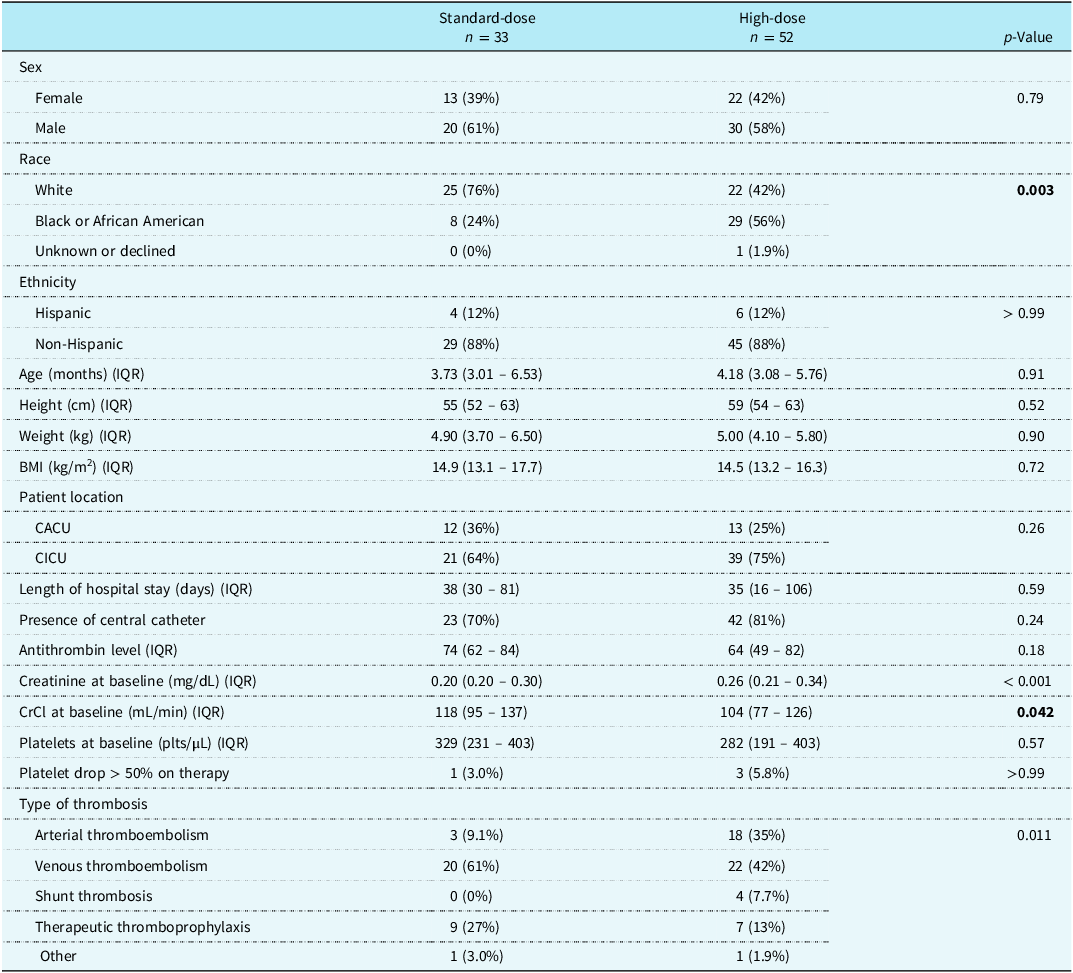
Ninety-six patients were evaluated, and eighty-five patients were included in this study. Of those excluded, 9 patients were not in the heart centre, 1 patient was on enoxaparin targeting anti-Xa goals lower than 0.5–1 units/mL, and 1 patient had already been included. Thirty-three patients were in the standard-dose group and fifty-two patients in the high-dose group. There were similar baseline demographics amongst the groups. The majority of patients in both groups were being treated for a venous thromboembolism, and a larger proportion of patients were African American in the high-dose group (Table 1).
Baseline demographics

Table 1 Long description
A table comparing baseline demographics of patients in standard-dose and high-dose groups. The table has 18 rows and 5 columns. Column headers are Standard-dose, Standard-dose n = 33, High-dose, High-dose n = 52, and p-Value. Row labels include Sex, Race, Ethnicity, Age (months), Height (cm), Weight (kg), BMI (kg/m^2), Patient location, Length of hospital stay (days), Presence of central catheter, Antithrombin level, Creatinine at baseline (mg/dL), CrCl at baseline (mL/min), Platelets at baseline (plts/μL), Platelet drop > 50% on therapy, and Type of thrombosis. Row 1: Sex, Female, 13 (39 percent), 22 (42 percent), 0.79. Row 2: Sex, Male, 20 (61 percent), 30 (58 percent), 0.79. Row 3: Race, White, 25 (76 percent), 22 (42 percent), 0.003. Row 4: Race, Black or African American, 8 (24 percent), 29 (56 percent), 0.003. Row 5: Race, Unknown or declined, 0 (0 percent), 1 (1.9 percent), 0.003. Row 6: Ethnicity, Hispanic, 4 (12 percent), 6 (12 percent), > 0.99. Row 7: Ethnicity, Non-Hispanic, 29 (88 percent), 45 (88 percent), > 0.99. Row 8: Age (months), 3.73 (3.01 – 6.53), 4.18 (3.08 – 5.76), 0.91. Row 9: Height (cm), 55 (52 – 63), 59 (54 – 63), 0.52. Row 10: Weight (kg), 4.90 (3.70 – 6.50), 5.00 (4.10 – 5.80), 0.90. Row 11: BMI (kg/m^2), 14.9 (13.1 – 17.7), 14.5 (13.2 – 16.3), 0.72. Row 12: Patient location, CACU, 12 (36 percent), 13 (25 percent), 0.26. Row 13: Patient location, CICU, 21 (64 percent), 39 (75 percent), 0.26. Row 14: Length of hospital stay (days), 38 (30 – 81), 35 (16 – 106), 0.59. Row 15: Presence of central catheter, 23 (70 percent), 42 (81 percent), 0.24. Row 16: Antithrombin level, 74 (62 – 84), 64 (49 – 82), 0.18. Row 17: Creatinine at baseline (mg/dL), 0.20 (0.20 – 0.30), 0.26 (0.21 – 0.34), < 0.001. Row 18: CrCl at baseline (mL/min), 118 (95 – 137), 104 (77 – 126), 0.042. Row 19: Platelets at baseline (plts/μL), 329 (231 – 403), 282 (191 – 403), 0.57. Row 20: Platelet drop > 50 percent on therapy, 1 (3.0 percent), 3 (5.8 percent), > 0.99. Row 21: Type of thrombosis, Arterial thromboembolism, 3 (9.1 percent), 18 (35 percent), 0.011. Row 22: Type of thrombosis, Venous thromboembolism, 20 (61 percent), 22 (42 percent), 0.011. Row 23: Type of thrombosis, Shunt thrombosis, 0 (0 percent), 4 (7.7 percent), 0.011. Row 24: Type of thrombosis, Therapeutic thromboprophylaxis, 9 (27 percent), 7 (13 percent), 0.011. Row 25: Type of thrombosis, Other, 1 (3.0 percent), 1 (1.9 percent), 0.011.
CACU = cardiac acute care unit, CICU = cardiac intensive care unit.
Note: Statistically significant p-values appear bold.
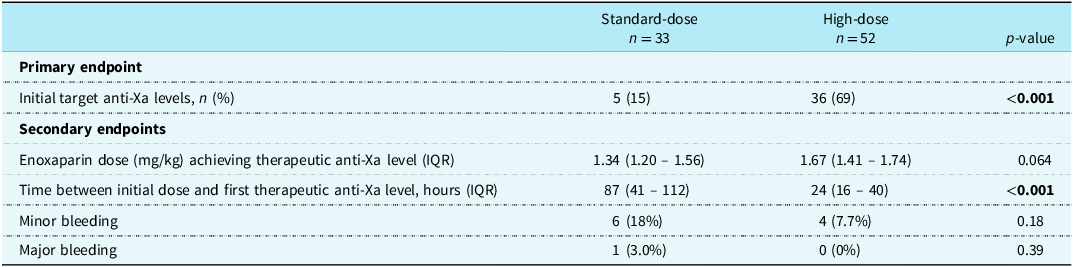
There were more patients in the high-dose group 36 (69%) who achieved initial target anti-Xa levels compared to the standard group (36 (69%) vs 5 (15%); p < 0.001). The time between the initial dose and first therapeutic anti-Xa level was longer in the standard-dose group (87 hrs (IQR 41 to 112) vs 24 hrs (IQR 16 to 40) p < 0.001). The median dose achieving therapeutic anti-Xa levels was similar between the standard- and high-dose groups, respectively (1.34 mg/kg (1.20–1.56) vs 1.67 mg/kg (1.41–1.74); p = 0.064) (Table 2). Minor bleeding (6 (18%) vs 4 (7.7%) p = 0.18) and major bleeding (1 (3%) vs 0 (0%) p = 0.39) occurred similarly between the standard- and high-dose groups, respectively. There was no correlation between the age (in months) and the enoxaparin dose achieving target anti-Xa levels. Nor was there a correlation found amongst antithrombin levels and the dose of enoxaparin that achieved target anti-Xa levels (Figures 1 and 2).
Correlation of antithrombin levels versus the dose of enoxaparin achieving therapeutic anti-Xa levels.

Age in months versus the dose of enoxaparin achieving therapeutic anti-Xa levels.

Results

Discussion
The American College of Chest Physicians’ guidelines regarding the dosing of enoxaparin were published in 2012. Reference O’Brien, Stanek, Witmer and Raffini4 Since then, studies suggest that infants less than 1 year of age may require higher dosing of enoxaparin to achieve target anti-Xa levels. Reference Newall, Johnston, Ignjatovic and Monagle8–Reference Risch, Huber and Schmugge10 The results of our study demonstrated similar findings that using a dosing strategy of 1.5 mg/kg every 12 hours initially provided quicker target levels of anti-Xa and a low incidence of bleeding.
The developmental changes that occur in infants affecting their pharmacokinetics and pharmacodynamics may contribute to the need for higher enoxaparin dosing in this population. Previous studies have reported initial target anti-Xa levels being achieved in 30–50% of children receiving enoxaparin 1 mg/kg every 12 hours. Reference Leung, Ho and Hamilton13 Our study demonstrated a lower percentage of patients achieving initial target anti-Xa levels in the standard-dose group than some previous studies; however, the high-dose group achieved a higher percentage of initial anti-Xa levels than previously reported.
A risk when using anticoagulants to treat venous thromboembolism, including enoxaparin, is the potential for bleeding. In this study, the rates of major and minor bleeding were similar among groups. One patient experienced major bleeding in the high-dose group. This patient was transferred on a high-dose of enoxaparin (2 mg/kg), experienced a decrease in their platelet count and received a transfusion. There were six patients in the standard-dose group who experienced minor bleeding, which included four patients with haematochezia, one patient who experienced post-operative bleeding, and one patient who had skin bruising. In the high-dose group, one patient had haematochezia, and three patients had skin bruising. There was no mortality in the groups related to bleeding events. The low rates of bleeding seen are similar to those in previous studies. Wiltrout et al. conducted a study to look at patient characteristics and risk factors associated with anti-Xa levels, with a safety outcome of bleeding assessment. The rate of bleeding among patients who were subtherapeutic, therapeutic, or supratherapeutic ranged from 4–8%. Reference Dinh, Moffett and Galati12 This was based on a bleeding criterion of a fall in haemoglobin of 2 g/dL or more, any bleeding located in a critical area or organ, any bleed requiring surgical intervention or transfusion, or any bleed resulting in death. This definition is similar to our major bleeding criteria, showing that a higher dosing strategy of enoxaparin is safe with a low to average bleeding risk.
To monitor the efficacy of enoxaparin, anti-Xa levels should be measured 4 to 6 hours after the second dose. Reference O’Brien, Stanek, Witmer and Raffini4 The paediatric therapeutic range of anti-Xa levels is extrapolated from adult data and is between 0.5 and 1.0 unit/mL. Reference O’Brien, Stanek, Witmer and Raffini4 Obtaining a supratherapeutic level can result in an increased risk of bleeding, and a subtherapeutic level can potentiate thrombus formation or thrombus embolisation. Monitoring of enoxaparin in infants may be difficult as antithrombin levels do not normalise until around 1 year of age. Reference Newall, Johnston, Ignjatovic and Monagle8,Reference van den Anker, Reed, Allegaert and Kearns9 The results of this study show there was no correlation between antithrombin levels and the enoxaparin dose that achieved target anti-Xa levels. A sub-analysis was conducted on the age of the patient, in months, and the dose that achieved therapeutic anti-Xa levels. This analysis showed no correlation between the two variables, indicating that infants 2 to 12 months of age can be dosed similarly.
Limitations of this study included a small sample size with limited external validity. Patients were from a single city heart centre. There were uneven group sizes with more patients being in the high-dose group. Although this may affect the power of the study, more patients being in the intervention group can affirm the results. Additionally, our lower-than-expected rate of initial target attainment in the standard-dose group may have affected the analysis between groups.
Based on our findings, infants 2 to 12 months of age with CHD had a decreased time to target anti-Xa levels with an initial higher dose of enoxaparin (1.5 mg/kg every 12 hours) for the treatment of venous thromboembolism. There was no difference in minor or major bleeding between the standard- and high-dose strategies. Our study suggests it may be safe and effective to dose enoxaparin higher in infants with CHD.
Acknowledgements
None.
Financial support
This research received no specific grant from any funding agency, commercial or not-for-profit sectors.
Competing interests
None.
Ethical standard
The authors assert that all procedures contributing to this work comply with the ethical standards of the relevant national guidelines on human experimentation and have been approved by the appropriate committees at our institution.