1 Introduction
This paper provides evidence which challenges previous descriptions that stress assignment in Gujarati is sonority-driven (Adenwala Reference Adenwala1965, Cardona Reference Cardona1965, Mistry Reference Mistry and Kaye1997, de Lacy Reference de Lacy2002, Reference de Lacy2006, Cardona & Suthar Reference Cardona, Suthar, Cardona and Jain2003, Doctor Reference Doctor2004, Schiering & van der Hulst Reference Schiering, van der Hulst, der Hulst, Goedemans and van Zanten2010, Campbell & King Reference Campbell and King2011, Modi Reference Modi2013). I will show, on the basis of acoustic evidence, that stress in Gujarati is not sensitive to vowel sonority. Specifically, I will argue that the highly sonorous vowel [a] does not attract stress away from the default position – rather, stress always falls on the penultimate syllable. This finding has various theoretical and methodological implications (see §5 for discussion). Most importantly, because Gujarati is the most extensively described case of a system with stress distinctions among peripheral vowels (de Lacy Reference de Lacy2002, Reference de Lacy2006, Reference de Lacy and de Lacy2007), the finding casts doubt on the existence of such systems.
A sonority-driven stress system is one where the relative sonority of syllabic nuclei is a factor in determining the position of metrical structure. The universal sonority hierarchy for vowels is given in (1) (Kenstowicz Reference Kenstowicz1997: 162, de Lacy Reference de Lacy2002: 55).
(1)


Peripheral vowels are more sonorous than central ones; within those groups lower vowels are more sonorous than higher ones.
Although the descriptions of Gujarati disagree in various ways, almost all agree that stress seeks out the most sonorous vowel [a], overriding the default penultimate position (see §2.2). Examples are given in (2), from de Lacy (Reference de Lacy2002: 72).
(2)

In (2a), stress falls on the penultimate syllable, the default position, when both vowels are [a]. However, stress falls on an [a] in the final syllable when the penult contains other vowels – all of which are less sonorous than [a] – as in (2b). If the final syllable contains a vowel other than [a], stress falls on the penult, as in (2c). In other words, since [a] is more sonorous than other vowels, it attracts stress away from the default position. This is a case of ‘sonority-driven stress’.
The goal of this work is to determine whether [a] in Gujarati does in fact attract stress. This study is one of the few to offer an extensive acoustic analysis of a putative case of sonority-driven stress (see also Lehiste et al. Reference Lehiste, Teras, Help, Lippus, Meister, Pajusalu and Viitso2005, Bowers Reference Bowersms).
I performed an experiment to determine whether stress always falls on [a]. One female and four male native Gujarati speakers participated in the experiment. Disyllabic words with the shape [Ca.Ca], [Ca.CV] or [CV.Ca] (where V ranges over [o u i]) were used, to allow multiple comparisons of [a] in both putatively stressed and unstressed states. Vowels other than [a] (i.e. [o u i]) in different positions were also examined in order to provide further evidence. Acoustic correlates of stressed/unstressed vowels were measured, namely intensity, duration, F0, F1 and F2.
It was found that the acoustic facts are consistent with Gujarati having regular penultimate stress, rather than stress being attracted to [a]. Of the five types of phonetic evidence examined, F1 provides clear evidence for regular penultimate stress. Specifically, vowels in the penult are more peripheral than vowels in the final syllable. Stress position is not clearly signalled by intensity, duration, F0 or F2. In particular, duration is confounded with phrase-final lengthening and F0 with a LH intonation contour. Results from comparing non-[a] vowels in different positions also support the claim that Gujarati has consistent penultimate stress.
The significance of this result potentially goes beyond Gujarati. Since Gujarati is the best-described case of sonority-driven stress, it raises the possibility that all sonority-driven stress cases, or at least those involving peripheral vowel distinctions, have been misreported. Motivations for potential misinterpretation of such systems are discussed in §5.2.
This paper is organised as follows: §2 presents the differences between metrical and non-metrical structure. §3 discusses the methodology, and §4 illustrates the acoustic evidence against sonority-driven stress in Gujarati, focusing on the stress-attracting properties of [a]. §5 discusses the theoretical and perceptual implications. §6 concludes the paper.
2 Background
This section considers the present study from the point of view of phonological theories of sonority-driven metrical structure and theories of the acoustic manifestation of metrical heads.
2.1 The phonology of sonority-driven stress
The theories developed in Kenstowicz (Reference Kenstowicz1997) and de Lacy (Reference de Lacy2002, Reference de Lacy2004, Reference de Lacy2006) allow the location of metrical structure to be influenced by segmental sonority. The universally invariant part of these theories relates to the sonority scale in (1): metrical heads prefer higher-sonority segments, and non-heads prefer lower-sonority segments. For example, the constraint *HdFt/ɨ bans the least sonorous vowels in head positions, while *Non-HdFt/a prohibits the most sonorous vowels in non-head positions (de Lacy Reference de Lacy2004, Reference de Lacy and de Lacy2007).
In de Lacy's theory, contiguous portions of the scale can be collapsed (‘conflated’) into single categories – a point that is crucial for the analysis of Gujarati, and illustrated in this section. In both Kenstowicz's and de Lacy's theories, the sonority-metrical constraints interact with standard metrical constraints on foot form and edge alignment – sonority-sensitivity is not an alternative to edge alignment, but is an additional factor.
Some background on Gujarati segments, and syllable and word structure, is necessary to understand stress assignment. Gujarati has the ten surface vowels in (3), eight of which are phonemic (the open-mid vowels /ε/ and /ɔ/ have a restricted distribution and low frequency of occurrence; Mistry Reference Mistry and Kaye1997: 660). Allophonic variation between [i u] and [ɪ ʊ], conditioned by stress, is discussed in §2.3. The syllable structure of the language is (C)(C)V((C)C) (de Lacy Reference de Lacy2002: 71). Onsets and codas are optional, as shown by [e.ɖi] ‘heel’.
(3)
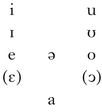
There are several descriptions of stress assignment in Gujarati, all impressionistic. While there are non-trivial differences between the descriptions, three themes emerge: (a) the default position for stress is the penult, (b) stress is attracted to [a] and (c) stress avoids [ə]. The descriptions focus almost exclusively on disyllabic and trisyllabic words; longer roots are rarer, perhaps non-existent, and inflectional affixes seem to have no effect on stress placement.
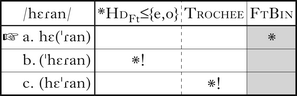
The descriptions generally agree that stress can be attracted to [a] away from the penultimate position. Such sonority attraction can be modelled as follows. The shift of the stress from the default position indicates that *HdFt≤{e,o} outranks the relevant metrical constraints. It is violated when the head of a foot (i.e. the stressed syllable) contains a segment with lower sonority than [a]. The constraints Trochee and FtBin require feet to be left-headed and binary respectively (Prince & Smolensky Reference Prince and Smolensky2004). The key point is that the sonority constraint *HdFt≤{e,o} must outrank the metrical constraint FtBin in order for candidate (4a) to be optimal. Candidate (4b) is ruled out because the head contains [ε], which is less sonorous than [a]. Although (4c) satisfies the head-sonority requirement, it fatally violates the foot-form constraint Trochee.
(4)
2.2 Disagreements
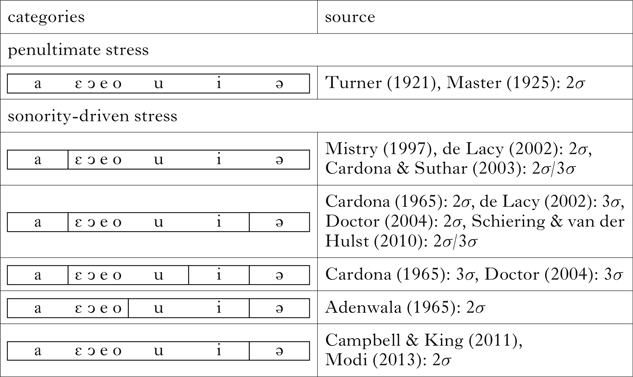
At this point, it is important to acknowledge the nature and extent of the disagreements between the accounts of sonority in the various descriptions, which are summarised in Table I. A particular description treats vowels in the same rectangle as a single class for stress assignment. For example, in Mistry's (Reference Mistry and Kaye1997) description, stress falls on [a] if it is present, but otherwise falls on the default syllable, regardless of vowel quality. Some descriptions also propose quite different principles for stress assignment in disyllables vs. trisyllables, claim that syllable shape affects stress or suggest that there is free variation; these will be discussed below where relevant.
Descriptions of Gujarati stress.

2.2.1 Fixed stress only
In some descriptions, the position of stress is fixed. For example, Turner (Reference Turner1921) claims that stress generally falls on the penultimate syllable, without mentioning any differences between two- and three-syllable words. Similarly, Master (Reference Master1925) reports that stress always falls on the penult in disyllables, even when words historically had final stress. Patel & Mody (Reference Patel and Mody1960) report that stress always falls on the initial syllable in both disyllables and trisyllables.
When vowel sonority is not a factor, stress is reported to fall on the penult in disyllabic words (Cardona Reference Cardona1965, Mistry Reference Mistry and Kaye1997, de Lacy Reference de Lacy2002, Cardona & Suthar Reference Cardona, Suthar, Cardona and Jain2003, Doctor Reference Doctor2004, Schiering & van der Hulst Reference Schiering, van der Hulst, der Hulst, Goedemans and van Zanten2010). There is disagreement, however, about stress position in trisyllabic words. Master (Reference Master1925) and Mistry (Reference Mistry and Kaye1997) report that stress is on the initial syllable, while de Lacy (Reference de Lacy2002) claims that the penult has stress, as do Cardona (Reference Cardona1965), Cardona & Suthar (Reference Cardona, Suthar, Cardona and Jain2003), Doctor (Reference Doctor2004) and Schiering & van der Hulst (Reference Schiering, van der Hulst, der Hulst, Goedemans and van Zanten2010).Footnote 1 The present study focuses entirely on disyllabic words.
Regardless of the differences, the central point on which almost all descriptions agree is that the default situation is that Gujarati stress falls on the penultimate syllable in disyllables. The only dissenting voice is Adenwala (Reference Adenwala1965), who reports that stress falls on the final syllable when a disyllabic word contains either [i] or [u] in both the penult and the final syllable (i.e. [Ci.ˈCi], [Ci.ˈCu], [Cu.ˈCu], [Cu.ˈCi]).
2.2.2 Vowel quality: [a]
Most descriptions agree that stress is affected by vowel quality. However, there are significant variations between descriptions; Table I shows the different groupings of vowels for stress-assignment purposes. For example, Turner (Reference Turner1921) treats all vowels as the same – vowel quality is ignored in stress assignment. In contrast, Cardona (Reference Cardona1965) describes stress as treating [a], [ε ɔ e o u], [i] and [ə] as four distinct categories in trisyllables: stress is attracted first to [a], then to vowels other than [i], and finally to [ə] if there is no other option. Nevertheless, most descriptions agree that [a] can attract stress away from the penultimate position to either the antepenultimate or final syllable, if the penult is not [a].
In contrast, Adenwala (Reference Adenwala1965) reports that stress is attracted to all non-high peripheral vowels (not just [a]), and Campbell & King (Reference Campbell and King2011) and Modi (Reference Modi2013) do not recognise any influence of peripheral vowels on stress.
2.2.3 Vowel quality: schwa
Many descriptions also report avoidance of stressed schwa, though such avoidance can be limited. For example, Cardona (Reference Cardona1965) and de Lacy (Reference de Lacy2002) report that stressing penultimate schwa is avoided only if there is a non-schwa in the antepenult. Some descriptions make further quality distinctions (e.g. Cardona Reference Cardona1965 and Doctor Reference Doctor2004 for trisyllables, though de Lacy Reference de Lacy2006: 234 claims that the relevant vowels are deleted). Campbell & King (Reference Campbell and King2011) assert that the first syllable usually has very light stress, which is also sometimes found elsewhere, depending on the presence and position of /ə/.
2.2.4 Vowel quality: other vowels
There is no consensus regarding the status of the mid vowels [ε ɔ e o] and the high vowels [i u]. Cardona's (Reference Cardona1965) and Doctor's (Reference Doctor2004) descriptions cannot be adequately modelled in Kenstowicz's (Reference Kenstowicz1997) and de Lacy's (Reference de Lacy2002, Reference de Lacy2004, Reference de Lacy2006) theories, because they distinguish [i] from [u], though de Lacy (Reference de Lacy2006: 241–242) suggests that [i] is deleted in the majority of these environments.
Below I discuss the disagreements on three aspects of the metrical system of Gujarati: syllable number (disyllables vs. trisyllables), syllable shape (open vs. closed syllables) and free variation.
2.2.5 Disyllabic vs. trisyllabic words
There are various proposals for sonority preference in disyllables and trisyllables.Footnote 2 For disyllabic words, de Lacy (Reference de Lacy2002), Cardona (Reference Cardona1965) and Doctor (Reference Doctor2004) agree that [a] attracts stress away from the default position, but Cardona and Doctor claim that when [ə] appears in either the penultimate or final syllable, stress falls on the non-[ə] syllable.
On the other hand, Adenwala (Reference Adenwala1965) proposes a more complicated hierarchy: the mid vowels form a group with [a]. That is, stress falls on both low and mid vowels, rather than on the low vowel alone. It avoids [i] and [u] when the non-[i u] syllable contains a low or mid vowel. However, stress falls on [i] and [u] when [ə] appears in the non-[i u] syllable. It is important to mention that Adenwala's proposal applies to words with the shape CV.CVC. For CV.CV and CVC.CVC words, stress always falls on the first syllable.
Finally, Campbell & King (Reference Campbell and King2011) and Modi (Reference Modi2013) report that stress only avoids [ə].
All of the descriptions can be modelled in different ways in the theories of sonority–foot interaction cited above. The descriptions of Cardona (Reference Cardona1965), de Lacy (Reference de Lacy2002) and Doctor (Reference Doctor2004) can be modelled in the theories with the constraint *HdFt≤{e,o}. Adenwala's (Reference Adenwala1965) description can be modelled with *HdFt≤{i,u}, rather than *HdFt≤{e,o}. Similarly, Campbell & King's (Reference Campbell and King2011) and Modi's (Reference Modi2013) descriptions can be explained by the constraint *HdFt≤{ə}.
For trisyllabic words, Cardona, de Lacy and Doctor agree that stress is attracted to [a] from the default position, and [ə] repels stress, which moves from the penult to the antepenult. However, Cardona and Doctor distinguish [i] from [u]: [i] repels stress, while [u] does not. Moreover, Adenwala claims that stress is not predictable in CV.CV.CV trisyllabic words.
Essentially, Cardona's and Doctor's descriptions cannot be adequately modelled in Kenstowicz's and de Lacy's theories, because they distinguish [i] from [u], though de Lacy (Reference de Lacy2006: 241–242) suggests that [i] is deleted in the majority of these environments.
Cardona & Suthar's (Reference Cardona, Suthar, Cardona and Jain2003) and Schiering & van der Hulst's (Reference Schiering, van der Hulst, der Hulst, Goedemans and van Zanten2010) sonority scales apply to both disyllabic and trisyllabic words.
2.2.6 Syllable shape
There are disagreements regarding whether syllable shape affects stress placement. Masica (Reference Masica1991) and Cardona & Suthar (Reference Cardona, Suthar, Cardona and Jain2003) assert that stress assignment in Gujarati is influenced not only by vowel quality, but also by syllable shape. However, no data are provided in the descriptions to support their claims.
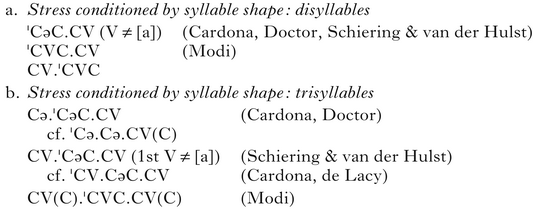
Other descriptions of syllable shape mainly focus on [ə]: when [ə] occurs in a closed syllable, it does not repel stress (Cardona Reference Cardona1965, Doctor Reference Doctor2004, Schiering & van der Hulst Reference Schiering, van der Hulst, der Hulst, Goedemans and van Zanten2010). Stress assignment with respect to other vowels is not conditioned by syllable shape. For disyllabic words, when the first syllable contains [ə] and is closed, it is stressed unless the second syllable contains [a] (Cardona Reference Cardona1965, Doctor Reference Doctor2004, Schiering & van der Hulst Reference Schiering, van der Hulst, der Hulst, Goedemans and van Zanten2010). However, Modi (Reference Modi2013) claims that the closed syllable always attracts stress, irrespective of vowel sonority, as shown in (5a). For trisyllabic words, Cardona and Doctor report that a penultimate syllable with [ə] is stressed when the penult is a closed syllable and the antepenult contains [ə]. However, in Schiering & van der Hulst's (Reference Schiering, van der Hulst, der Hulst, Goedemans and van Zanten2010) description, [CəC] in penultimate position always receives stress, regardless of the vowel in the antepenult. Finally, Modi states that a penultimate closed syllable is always stressed in trisyllabic words; cf. (5b).
(5)
2.2.7 Free variation
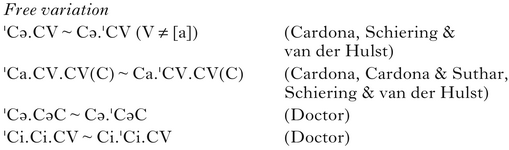
Many descriptions mention free variation of stress in certain environments. When [ə] appears in the penultimate syllable of disyllabic words, there is free variation between penultimate and final stress (Cardona Reference Cardona1965, Schiering & van der Hulst Reference Schiering, van der Hulst, der Hulst, Goedemans and van Zanten2010). In trisyllables, if the antepenult is [a], there is free variation between initial and penultimate stress (Cardona Reference Cardona1965, Cardona & Suthar Reference Cardona, Suthar, Cardona and Jain2003, Schiering & van der Hulst Reference Schiering, van der Hulst, der Hulst, Goedemans and van Zanten2010). It should be noted that in Cardona's description this type of free variation occurs if the penultimate syllable is not [i] or [ə].
However, it is not clear whether there is any condition on the penultimate syllable in Cardona & Suthar's and Schiering & van der Hulst's descriptions. It is possible that [ə] is prohibited, based on Schiering & van der Hulst's sonority hierarchy. Doctor (Reference Doctor2004) points out two other cases of free variation. When a disyllabic word has [ə] in initial and final syllables, some speakers tend to stress the vowel interchangeably. When a trisyllabic word has antepenultimate and penultimate [i], they can be ‘indifferently’ stressed, which I interpret as meaning that there is either free variation or no perceptible difference between the two; cf. (6).
(6)
2.2.8 Why is there disagreement?
No description of Gujarati stress agrees with any other in all their details (Cardona Reference Cardona1965 and Doctor Reference Doctor2004 are almost identical, but disagree about free variation). While some reasons for this disagreement will be discussed here, it is important to emphasise that the goals and scope of this study do not require perfectly homogeneous descriptions. The present goal is to determine whether Gujarati has sonority-driven stress, and almost every description agrees that it does for disyllables involving [a]. The focus of this study will therefore be on disyllables with [a].
One possible source of descriptive variation is diachronic change: after all, the descriptions range from Turner's in Reference Turner1921 to Modi's in Reference Modi2013. However, the descriptions show disagreement even when they are chronologically close.
Another obvious source of variation could be dialect. Some descriptions lack information about which Gujarati dialect they investigate (Masica Reference Masica1991, Mistry Reference Mistry and Kaye1997, Schiering & van der Hulst Reference Schiering, van der Hulst, der Hulst, Goedemans and van Zanten2010, Campbell & King Reference Campbell and King2011, Modi Reference Modi2013). The rest of the descriptions focus on the Ahmedabad dialect (Patel & Mody Reference Patel and Mody1960, Adenwala Reference Adenwala1965, Cardona Reference Cardona1965, Doctor Reference Doctor2004, de Lacy Reference de Lacy2006), except for the work by Master (Reference Master1925), whose description is based on the Charotar dialect. However, as the discussion above indicates, even the descriptions of the Ahmedabad dialect disagree with each other.
A final possibility is that the disagreements are due to the author's misperception of stress. To be specific, the discrepancies might in fact result from the impressionistic methodology in which investigators used different perceptual properties to identify the location of stress. Given that the authors’ native languages (and perceptual systems) vary, this is a significant possibility, highlighted in recent work on stress (e.g. Bowern et al. Reference Bowern, Alpher and Round2013 on Yidiny, and Tabain et al. Reference Tabain, Fletcher and Butcher2014 on Pitjantjatjara). §5.2 contains further discussion.
To summarise, there have been many descriptions of Gujarati stress, almost all of which disagree with each other. It is difficult to establish the reason for this diversity. Perhaps stress varies significantly even within dialects, or perhaps the impressionistic methods used to determine stress were inadequate. In any case, almost all the descriptions agree that the default position of stress is the penult, and that stress is influenced by the sonority of vowels in some way – specifically, almost all agree that stress seeks out [a], or avoids [ə], or does both. This sonority-sensitivity is the descriptive claim that will be investigated in the remainder of this paper.
2.3 Phonological evidence for metrical structure in Gujarati
Stress-sensitive allophony is mentioned in several descriptions of Gujarati. The central vowel [ə] is realised as [ʌ] when it is stressed (Patel & Mody Reference Patel and Mody1960, Lambert Reference Lambert1971, Nair Reference Nair1979). Allophonic alternations between high peripheral and non-peripheral vowels ([i u] ~ [ɪ ʊ]) are also reported to be conditioned by stress (Cardona Reference Cardona1965, de Lacy Reference de Lacy2002): the non-peripheral allophones appear in non-final open syllables, except when they are stressed. Allophony therefore provides extremely important evidence for the location of metrical heads. Unfortunately, allophony is the only stress-sensitive phonological process reported in previous descriptions (§4.1 will present evidence that allophony does not in fact support the sonority-driven descriptions of stress, but instead is consistent with sonority-insensitive penultimate stress).
No stress-sensitive morphophonological or phonological processes (such as vowel reduction) other than the putative suffix -av mentioned in Modi (Reference Modi2013) are identified in previous work. Finally, parts of intonational tunes may associate to heads, and so provide indirect evidence for their position; this point is explored in §4.3. Consequently, phonetic realisation is the primary source of evidence for Gujarati metrical structure.
2.4 Phonetic realisation of stress
Heads and non-heads can be phonetically realised in a variety of ways. Stressed vowels can be realised with an excursion in fundamental frequency (F0), increased intensity or increased duration. Examples are found in diverse languages: e.g. English (Fry Reference Fry1955, Reference Fry1958), Polish (Jassem et al. Reference Jassem, Morton, Steffen-Batog and Jassem1968), Chickasaw (Gordon Reference Gordon2004), Turkish (Levi Reference Levi2005) and Kabardian (Gordon & Applebaum Reference Gordon and Applebaum2010). Other potential acoustic correlates of stress have come to light, such as vocalic peripheralisation (or centralisation of unstressed vowels) (Gordon Reference Gordon2004) and lack of spectral tilt (Sluijter & van Heuven Reference Sluijter and van Heuven1996).
Although previous descriptions of the phonetic realisation of Gujarati stress are impressionistic, they are broadly consistent with the findings mentioned above. Stressed vowels are reported to have a longer duration (Pandit Reference Pandit1958, Adenwala Reference Adenwala1965, de Lacy Reference de Lacy2006, Modi Reference Modi2013), raised F0 (de Lacy Reference de Lacy2002, Reference de Lacy2006) and/or greater intensity (de Lacy Reference de Lacy2002) than unstressed vowels. When [a] is stressed, it is reported to have not only greater duration (Lambert Reference Lambert1971), but also higher intensity (Patel & Mody Reference Patel and Mody1960). However, Campbell (Reference Campbell1995: 209) asserts that stress is barely perceptible in the language.
For the present study, I assume that the general consistency of the phonetic realisation of metrical heads discussed above suggests that stress in Gujarati is likely to be realised by at least one of increased duration, F0 excursion, vowel quality (F1, F2) and intensity, so it is these acoustic properties that are the primary focus of this paper.
3 Methodology
3.1 Goal of the experiment
The goal of the experiment is to test whether there is sonority-driven stress in Gujarati. The focus of the experiment is [a], because most descriptions of sonority-driven stress refer to [a] as attracting stress. Given the descriptions in §2.2, the two hypotheses in (7) were examined.
(7)
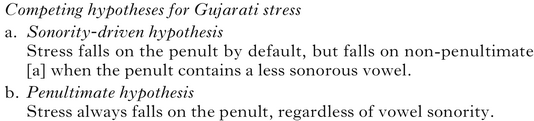
The motivation for the Sonority-driven hypothesis is that almost every description of Gujarati stress asserts that [a] attracts stress. The motivation for the Penultimate hypothesis is the observation that all the descriptions identify the penult as the default position for stress.
Forms such as [Ca.Ca], [Ca.CV] and [CV.Ca] play an essential role in disambiguating the two hypotheses, because the two hypotheses predict different stress patterns, as in (8) (as noted above, the symbol ‘V’ ranges over [o i u]).
(8)
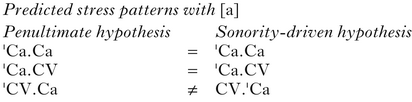
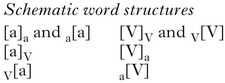
For ease of exposition, I will use the following abbreviations throughout the paper. [a]a and a[a] refer respectively to penultimate and final [a] in the form [Ca.Ca]. [a]V refers to [a] preceding [o i u], as in [Ca.CV], and V[a] refers to [a] following [o i u], as in [CV.Ca].
V[a] plays a crucial role in disambiguating the two hypotheses. The Penultimate hypothesis predicts that V[a] and a[a] should be acoustically very similar, if not identical – they are both final and non-heads. The sole difference is the identity of the penultimate vowel – V[a] vs. [a]a and [a]V. In contrast, the Sonority-driven hypothesis predicts that V[a] should be acoustically distinct from a[a], as V[a] and a[a] are identical – they appear in the same position (final), and differ only in metrical headedness.
Furthermore, if the influence of position is factored out, other comparisons are predicted to be revealing. The Penultimate hypothesis predicts that [a]a and [a]V should be acoustically distinct from V[a], whereas the Sonority-driven hypothesis predicts that [a]a, [a]V and V[a] should be acoustically similar.
In summary, in terms of acoustic similarity, the Penultimate hypothesis predicts that [a]a = [a]V, a[a] = V[a] and [a]a/[a]V ≠ a[a]/V[a] (where ‘ = ’ means acoustically similar, putting aside non-stress contextual influences); the Sonority-driven hypothesis predicts that [a]a = [a]V = V[a] and [a]a/[a]V/V[a] ≠ a[a].
Non-[a] vowels in other positions are also treated differently under the two hypotheses, as shown in (9). I will use [V]V and V[V] to refer to penultimate and final [V] respectively in the form [CV.CV]; [V]a refers to the vowel preceding [a] in [CV.Ca], and a[V] to the vowel following [a] in [Ca.CV].
(9)
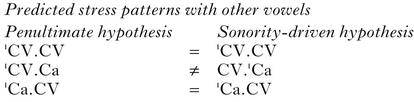
The Penultimate hypothesis predicts that [V]V and [V]a should be acoustically different from V[V] and a[V], since the former two are in the penult and the latter two in the final syllable. However, the Sonority-driven hypothesis predicts that [V]V, the only metrical head, should be acoustically different from the non-heads V[V], [V]a and a[V].
3.2 Experiment design
A word-list was constructed in consultation with three native speakers of Gujarati. Disyllabic words with the shape [Ca.Ca], [Ci.Ci], [Co.Co] and [Cu.Cu] were used to establish baselines for the acoustic realisation of stressed and unstressed vowels. Other word-types had the form [Ca.CV] and [CV.Ca]. [ε] and [ɔ] were not used, because they have a restricted distribution and low frequency of occurrence (see §2.1). The participants reported that Hindi borrowings can end with [e], so the mid vowel [e] was also excluded, in order to avoid potential confusion. [ə] was excluded because it does not appear word-finally. The pairs allowed direct comparison of vowels in both putatively stressed and unstressed conditions (see §3.1).
The initial consonant was limited to aspirated and unaspirated stops ([b(ʰ) d(ʰ) g(ʰ) p t(ʰ) k(ʰ)]), to reduce influence on the duration of the following vowel (van Santen Reference van Santen1992: 527–532),and the second consonant was a voiceless unaspirated or aspirated stop ([p t(ʰ) k(ʰ)]), to keep influence on the duration of the preceding vowel relatively constant (Peterson & Lehiste Reference Peterson and Lehiste1960). This stimulus structure not only facilitated the identification of vowel boundaries, but also minimised segmental effects on vowels (e.g. vowel lengthening before voiced consonants).
Trisyllabic words were excluded from this study. Since the consonants were limited to stops, the total number of real trisyllabic words compared with disyllabic words was very low. In practical terms, including trisyllabic words would require multiple comparisons of the same vowel in a variety of different prosodic positions, resulting in undesirably lengthy production tasks for the participants.
There were ten tokens for [Ca.Ca] words and five tokens for [CV.CV], [Ca.CV] and [CV.Ca] words. In sum, there were 55 stimuli in the experiment, listed in the online supplementary materials.Footnote 3 None of the descriptions provides information on word frequency in vernacular words. However, the informants who helped me compile the list reported that the words were all familiar to them and frequently used in everyday conversation. Loanwords from Hindi and English were excluded.
Morphologically, Gujarati is an agglutinative language. Hence some of the stimuli were composed of two morphemes, for example [kap-o] ‘to cut-masc’ and [kap-i] ‘to cut-fem’. Different parts of speech (nouns, verbs and adjectives) were used in the experiment. Almost none of the previous descriptions report that morpheme boundaries affect stress assignment, and several explicitly include examples of multimorphemic words showing sonority-sensitivity across such boundaries (e.g. Cardona Reference Cardona1965: 32–35). The only description of the relation between stress and affixes is found in Modi (Reference Modi2013: 160): the causative suffix -av takes stress and reduces the length of the previous syllables, irrespective of which vowel precedes it, as in [kud] ‘to jump’ → [kuˈdav]. Words with this putatively stress-attracting suffix was excluded from the study. In addition, both Cardona (Reference Cardona1965: 35) and de Lacy (Reference de Lacy2002: 71) report that prefixes are outside the stress-assignment domain. Prefixes were therefore also excluded.
To test the productivity of stress assignment in Gujarati, nonce words were used in the experiment (Berko Reference Berko1958): eleven of the 55 stimuli were nonce words. In particular, [Cu.Cu] and [Cu.Ca] words were relatively rare, so a relatively large number of nonce words was used. Statistical analysis showed that the native vs. nonce status of stimuli had no effect.
Each word was placed in two frame sentences, to control for phrase-final lengthening. All the words occurred in sentence-medial position, as illustrated in (10). It was found that there were different pauses in the frame sentences: a pause before the target word in (a) and a pause after the target word in (b). I will refer to the frame sentence in (10a) as the ‘postpausal’ context, and that in (10b) as the ‘prepausal’ context. We will see that pause (or phrase-finality) affects some aspects of the acoustic realisation of the final vowel (particularly duration).
(10)
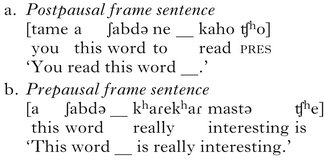
There were three recording sessions in the experiment. Participants read 55 stimuli and 15 fillers in the two frame sentences, yielding a total of 330 tokens per speaker (55 stimuli × 2 frame sentences × 3 repetitions). Colloquial filler sentences were employed to encourage participants to employ vernacular speech. Fillers were interspersed among the stimuli, with a spacing of seven stimuli. Five fillers were introduced at the beginning of each session, to take into account the effects of any initial nervousness the subject might have. The order of the stimuli was pseudo-randomised, and counterbalanced in each session.
3.3 Participants
One female and four male native Gujarati speakers participated in the experiment. Their ages ranged from 19 to 24. All had recently moved to the United States, and still communicated in Gujarati on a daily basis. They were from Gujarat State, except for one participant, who was from a Gujarati community in Mumbai. All participants spoke the standard dialect of Gujarati, including the varieties spoken in Mumbai and Ahmedabad, the former capital of Gujarat. The participants were naive as to the goal of the experiment, and none had any linguistic training or a history of speech impairments. They received nominal monetary compensation for their participation.
3.4 Procedure
The experiment was performed at the Phonology and Field Research Laboratory (Phonolab) at Rutgers University. Participants were recorded while sitting in a sound-attenuated booth and wearing an AKG C420 head-worn microphone with a behind-the-neck headband to keep the microphone at a constant distance from the mouth. The microphone was connected to an ART MPA Gold preamplifier, which output to an M-Audio Delta 1010LT sound card. The recording was done using GoldWave v6. 10 at a 44.1k Hz sampling rate and 16-bit quantising rate in mono.
Prior to the experiment, the participants were asked to fill out a circadian rhythm questionnaire adapted from Smith et al. (Reference Smith, Reilly and Midkiff1989), which elicited information concerning their circadian rhythm types. The purpose was to ensure participants felt at their best – when they felt most alert and awake in the experiment. All of the participants belonged to the ‘intermediate’ type, so the experiment sessions were scheduled around noon. Instructions for the day before the experiment were e-mailed to participants to make certain they kept to their daily routines.
Participants were presented with words written in Gujarati script on a computer screen. Before the recording sessions began, some of the target words were shown on the screen to familiarise the participants with the Gujarati font, since Gujarati script is normally handwritten.Footnote 4 The words were presented one at a time, without frame sentences, i.e. participants had to generate the two predetermined sentences during the experiment. The recording sessions were conducted individually. Participants read the words when they were ready, at a normal conversational speed, and breaks were given after each recording session. During the breaks, a Gujarati research assistant engaged them in conversations in vernacular speech about everyday activities, to try to ensure that the data were elicited from the vernacular L1 phonological module of each participant (de Lacy Reference de Lacy and van der Hulst2014: 13–16). The research assistant was informed of the purpose of the experiment, and the methods used. To avoid exhaustion, four of the five participants engaged in the experiment over two different days, while one participant – who showed few signs of tiredness – finished the experiment in one day. The experiment was structured so that the potential effect of intraspeaker differences in two separate sessions was minimised.
3.5 Measurements
Five acoustic correlates of stressed and unstressed vowels were measured: duration, F0, F1, F2 and intensity. Using Praat TextGrids (Boersma & Weenink Reference Boersma and Weenink2016), four intervals were identified for each file: the extent of the first and second vowels of the target word in each of the two frame sentences.
The left boundary of each vowel was marked at the beginning of the first non-deformed periodic waveform. The right boundary was identified as the end of the F2; when F2 continued up to closure, the boundary was marked at the end of a robust F3. The segmentation was initially performed by two groups of three research assistants. The results were compared within each group, to minimise error. Finally, the author examined the TextGrids, making corrections only when (a) wrong vowels were labelled, (b) consonants were mislabelled as part of a vowel or (c) the right boundary of vowels was noted by the research assistants as uncertain; otherwise, no changes were made.
The labelled sound files were then run through customised Praat scripts to obtain acoustic measures. Duration and mean intensity were extracted from the TextGrids. For F0, F1 and F2, the midpoint of each vowel was calculated, so as to measure the vowel's steady point.
3.6 Statistical methods
In §4, I determine whether each of the acoustic measures was a statistically significant correlate of stress of [a]a, a[a], [a]V and V[a] in Gujarati. The values of each measure were analysed using linear mixed-effects models. These were implemented in R (R Core Team 2016) using the lmer() function of the lme4 package (Bates et al. Reference Bates, Mächler, Bolker and Walker2015). For each vowel ([a o i u]), five separate models were fitted to determine the acoustic correlates of Gujarati stress. The acoustic measures (F1, F2, intensity, F0, duration) were the dependent variable. For each model, vowel position (e.g. [a]a, a[a], [a]V, V[a]) and frame sentences (postpausal, prepausal) were set as fixed effects. An additional variable, aspiration, was added to the duration model to test whether aspiration has an influence on vowel duration. Speaker and word were included as random effects. The interaction between the fixed effects (vowel positions and frame sentences) was tested using the anova() function to compare likelihood between models (Baayen Reference Baayen2008). Random slopes for the by-speaker and by-word effects of vowel positions and frame sentences were specified for each model (Barr et al. Reference Barr, Levy, Scheepers and Tily2013). In order to test whether the nonce words were treated differently from native words, different linear mixed-effects models were applied to the stimuli ([Ca.Ca], [Co.Ca], [Ci.Ca], [Cu.Ca], [Cu.Cu]). For each model, the acoustic measures were the dependent variable, and wug (nonce words, real words) was set as the fixed effect. Random slopes for the by-speaker and by-word effects of wug words were specified for each model. P-values were obtained using the summary() function of the lmerTest package (Kuznetsova et al. Reference Kuznetsova, Brockhoff and Christensen2013). It was found that wug words were not acoustically different from real words (all p>0.106).
For the F1 model for [i], the F2 models for [a i u] and the F0 model for [o], the interaction term was not found to significantly improve model fit. For random slope structure, the F1 model for [i], the F2 models for [o u], the intensity model for [a], the F0 model for [i] and the duration models for [a i u] failed to converge. So the next-best models were chosen, based on the likelihood-ratio test mentioned above. The duration model for [u] included by-speaker random slope for the effect of vowel positions, and by-word random slope for the effects of vowel positions and frame sentences. Other models included by-speaker random slope for the effects of vowel positions and frame sentences, and by-word random slope for the effect of frame sentences. Visual inspection of remaining plots did not reveal any obvious deviations from homoscedasticity or normality. Crucially, in §4 I report multiple pairwise comparisons for each vowel, obtained using the pairwise() function of the lsmeans package (Lenth Reference Lenth2016). The estimates were based on the Tukey Honestly Significant Difference (Tukey HSD) method. I report t-values as well as p-values provided in the model output. When the interaction term is not significant for the model (i.e. the vowel does not behave differently in different frame sentences), I report multiple pairwise comparisons for both frame sentences.
4 Results
This section presents results from the experiment on the alleged stress attraction of [a] in Gujarati. §4.1, §4.2, §4.3 and §4.4 present results for F1/F2, intensity, F0 and duration respectively.
Recall that predictions were made in §3.1 on the basis of vowels in different positions. Using the schema in (11), both the Sonority-driven and Penultimate hypotheses predict that the penult is stressed in [Ca.Ca], [Ca.CV] and [CV.CV] words, but differ for [CV.Ca] words. I will refer to this schema throughout the following discussion.
(11)
4.1 F1 and F2
Recall that allophonic alternations between high peripheral and non-peripheral vowels ([i u] ~ [ɪ ʊ]) are claimed to be conditioned by stress (Cardona Reference Cardona1965, de Lacy Reference de Lacy2002). Stress could therefore be reasonably expected to affect vowel quality: [a] is expected to have different realisations when stressed. If stress is sonority-driven, then V[a] in [CV.Ca] should be stressed and therefore more peripheral than a[a] in [Ca.Ca], and potentially the same quality as stressed [a]a (as long as no other non-stress factors interfere). If stress falls on the penultimate syllable, V[a] should be unstressed, and thus have a similar vowel quality to a[a]. V[a] therefore plays an important role in distinguishing between the two hypotheses.
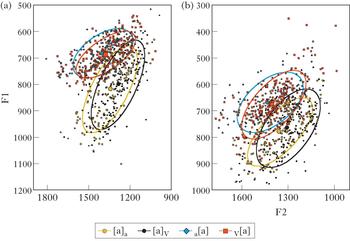
Results from the linear mixed-effects model show that V[a] and a[a] belong to one category, and [a]a and [a]V to another, as shown in Fig. 1. Under the Sonority-driven hypothesis, V[a] should have a different quality from a[a], because V[a] is stressed and a[a] unstressed. In contrast, the Penultimate hypothesis predicts that they should have the same quality, as both are unstressed.
Vowel plots for [a] in (a) postpausal and (b) prepausal contexts. The ellipsis delineates one standard deviation from the mean value.

For F1, V[a] overlaps with a[a] (t = −0.501, p = 0.9558). This suggests that the centralised V[a] is actually unstressed: if V[a] is stressed, it should be the same as [a]a and [a]V in terms of vowel height. The fact that V[a] overlaps with unstressed a[a] is consistent with the hypothesis that stress falls on the penult, rather than on [a]. The Penultimate hypothesis is further supported by a comparison of V[a] with [a]a and [a]V. If [a] attracts stress, V[a] should be identical to stressed [a]a and [a]V, according to the Sonority-driven hypothesis. However, they differ in that V[a] has a lower F1 than stressed [a]a and [a]V (t = 4.938, p = 0.0105 for V[a] vs. [a]a; t = 4.387, p = 0.0157 for V[a] vs. [a]V).
The F1 pattern for [a] is the same across the different frame sentences. In the prepausal context, V[a] is significantly more centralised than stressed [a]V and [a]a, and has the same height as unstressed a[a] (t = 3.567, p = 0.0461 for V[a] vs. [a]V; t = 3.995, p = 0.0329 for V[a] vs. [a]a; t = −0.676, p = 0.9028 for V[a] vs. a[a]).
For F2, I find no evidence to support the Sonority-driven hypothesis. If stress is sonority-driven, V[a] should have a lower F2 than a[a], and the same F2 as [a]V and [a]a. However, this is not the case. In both contexts, the crucial vowel V[a] makes no distinction between [a]a and a[a] (t = −1.25, p = 0.6074 for V[a] vs. [a]a; t = 0.478, p = 0.9632 for V[a] vs. a[a]), and V[a] is marginally significantly more fronted than [a]V (t = −2.823, p = 0.0395).
In short, multiple pairwise comparisons of the mean F1 values of [a] provide support for the Penultimate hypothesis rather than the Sonority-driven hypothesis.
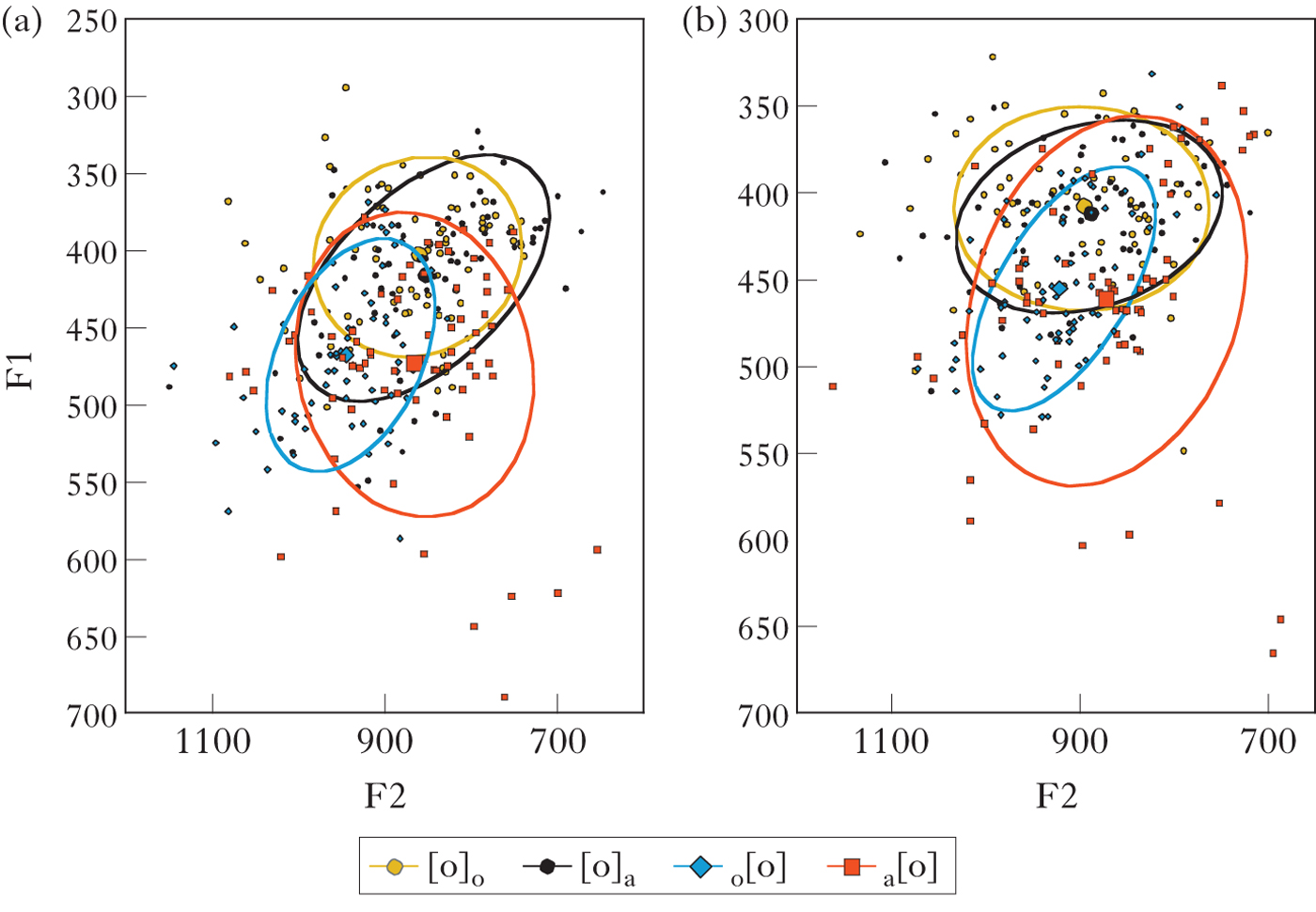
If the Penultimate hypothesis is correct, and vowel height is conditioned by stress in Gujarati, the same pattern should be found for other vowels. Figure 2 shows [o] in postpausal and prepausal contexts in different positions (cf. (11) above). The F1 pattern of [o] is in line with the Penultimate hypothesis. If stress is sonority-driven, a[o], [o]a and o[o] should be unstressed, having the same vowel quality. [o]o should be the only stressed vowel, and have a vowel quality distinct from a[o], [o]a and o[o]. In the postpausal context, no statistical distinction was found between a[o] and o[o] (t = −0.513, p = 0.9525) or between [o]a and [o]o (t = −1.411, p = 0.5206); both a[o] and o[o] have higher F1 values than [o]a and [o]o. Moreover, the F1 pattern of [o] is the same in the prepausal context (t = −0.451, p = 0.9667 for a[o] vs. o[o]; t = −0.611, p = 0.9261 for [o]a vs. [o]o).
Vowel plots for [o] in (a) postpausal and (b) prepausal contexts. The ellipsis delineates one standard deviation from the mean value.
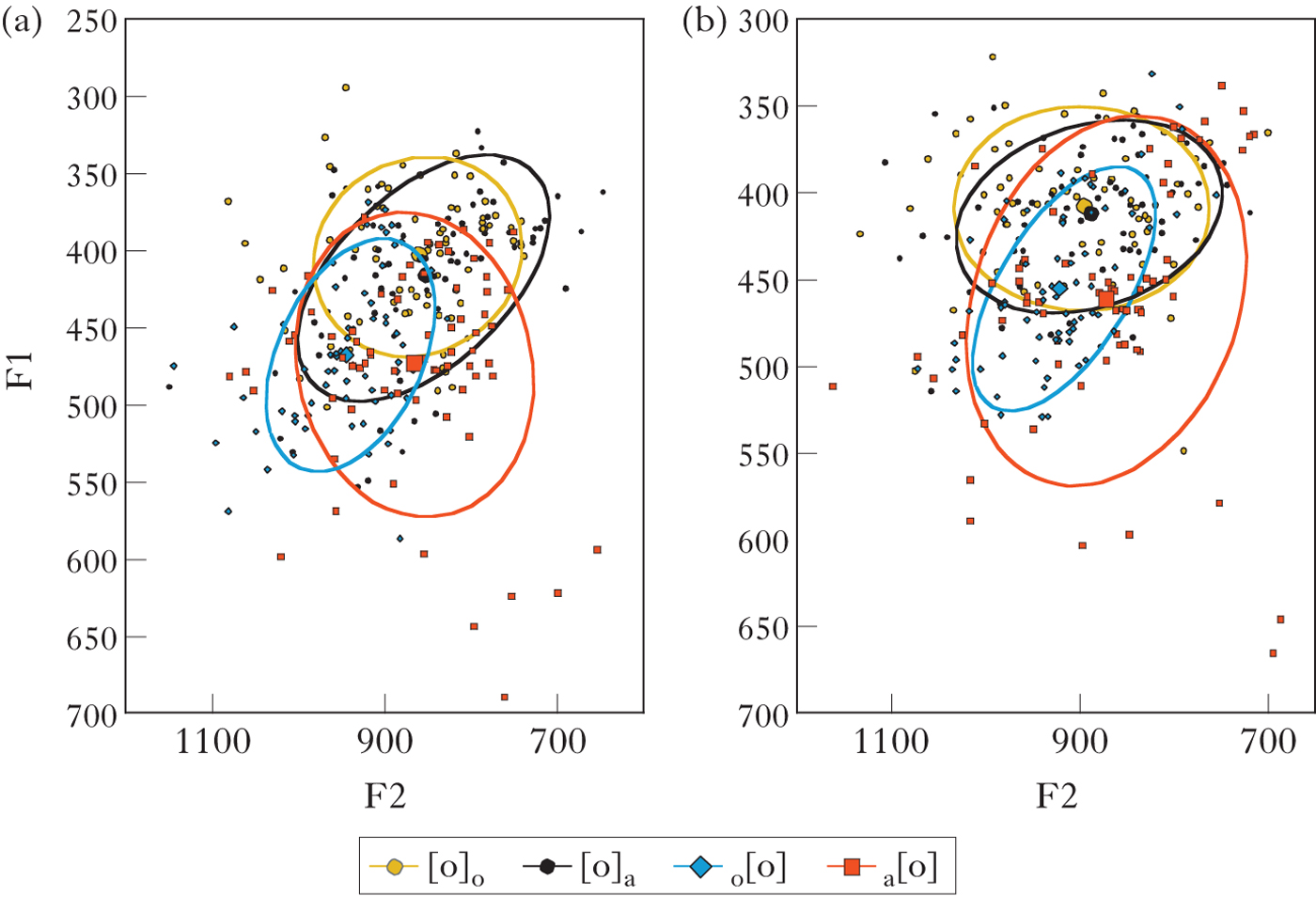
For F2, no statistical distinctions were found among pairs in either context (all p > 0.1961), except that the difference between o[o] and [o]o in the postpausal context was marginal (t = −3.495, p = 0.0614). If sonority-driven stress exists, [o]o should have a lower F2 than a[o], [o]a and o[o]. If stress falls on the penultimate syllable, the F2 of [o]o and [o]a should be lower than o[o] and a[o]. However, the facts suggest that there is no evidence from F2 to differentiate the two hypotheses.
For [i], the mean F1 values seem to suggest that stress falls on the penultimate syllable ([i]i: 286 Hz (SD = 29), i[i]: 311 Hz (SD = 47), [i]a: 273 Hz (SD = 24), a[i]: 313 Hz (SD = 46)). That is, a[i] and i[i] are more centralised than [i]a and [i]i, indicating that a[i] and i[i] are unstressed. However, the statistical analysis does not show any significant difference (all p>0.2032). It is possible that the participants in this study employ a smaller acoustic vowel space, so that the quality distinction between stressed and unstressed [i] is not statistically significant.
For F2, [i] displays the same pattern as [o]. That is, there is almost no difference in F2 between each pair in both contexts ([i]i: 2411 Hz (SD = 217), i[i]: 2451 Hz (SD = 227), [i]a: 2419 Hz (SD = 235), a[i]: 2484 Hz (SD = 241); all p>0.1107).
Finally, [u] in the postpausal context displays a similar F1 pattern to [o] and [i] ([u]u: 324 Hz (SD = 34), u[u]: 364 Hz (SD = 43), [u]a: 333 Hz (SD = 36), a[u]: 373 Hz (SD = 44)). a[u] and u[u] have a higher F1 than [u]u and [u]a (t = −5.495, p = 0.0003 for a[u] vs. [u]u; t = −3.947, p = 0.0065 for a[u] vs. [u]a; t = −5.49, p = 0.0022 for u[u] vs. [u]u; t = −3.339, p = 0.0348 for u[u] vs. [u]a). In other words, a[u] and u[u] are more centralised than [u]a and [u]u. On the other hand, multiple comparisons of [u] in the prepausal context broadly show no significant difference; ([u]u: 335 Hz (SD = 32), u[u]: 346 Hz (SD = 42), [u]a: 336 Hz (SD = 31), a[u]: 356 Hz (SD = 38); all p>0.0921). The p-value for the a[u] vs. [u]u is 0.0196; a[u] is more centralised than [u]u, which is expected. It should be noted that the F1 and F2 of [u] are too close to each other for Praat to be able to correctly identify the vowel formants. It is not practical to examine and then exclude the problematic data one by one. So the F1 and F2 patterns reported here may not accurately reflect the real situation.
For F2, none of the pairwise comparisons show any differences ([u]u: 873 Hz (SD = 114), u[u]: 796 Hz (SD = 113), [u]a: 776 Hz (SD = 121), a[u]: 811 Hz (SD = 130); all p>0.2061). The F2 pattern of [u] is consistent with those of [o] and [i].
In short, the F1 outcomes from [a] and [o], and perhaps [i] and [u], support the Penultimate hypothesis. Vowels in the final syllable are generally more central than vowels in the penult. The high vowels [i u] and the mid vowel [o] are lowered and the low vowel [a] is raised when they are unstressed. I conclude that F1 serves as an acoustic cue for stress in Gujarati. This shift in F1 is not accompanied by an overall significant change in F2.
The comparison of vowel quality in postpausal and prepausal sentences suggests that it is probably not conditioned by duration. Typically, changes in the vowel space for unstressed vowels are discussed in terms of undershoot or vowel reduction (Lindblom Reference Lindblom, Hardcastle and Marchal1990). It is then conceivable that the reduced vowel space in Gujarati is a result of the low duration of unstressed vowels. Specifically, articulatory targets may not be fully reached, because there is insufficient time for articulatory movement. As I will discuss in §4.4.1, the duration of the stimuli (especially the final syllable) in prepausal sentences increases, due to phrase-final lengthening. If the reduced vowel space in Gujarati is actually a result of articulatory undershoot, this phonetic effect should not be found for the stimuli in prepausal sentences. However, results from the linear mixed-effects models on F1 reveal that the vowel-height pattern is identical in both frame sentences, except for a few vowel tokens. I therefore conclude that vowel quality in Gujarati is not determined by undershoot (see Garellek & White Reference Garellek and White2015 for a similar finding for Tongan).
Changes in vowel quality as a function of stress are often found in other languages. Cross-linguistically, many languages tend to centralise unstressed vowels (see Crosswhite Reference Crosswhite2001). The reduction can be either phonological (a category shift) or phonetic (a gradient change). In English, vowels undergo a category shift to schwa when they are unstressed (Bolinger Reference Bolinger1958, Fry Reference Fry, Zwirner and Bethge1965). In Chickasaw, the unstressed vowels [a o i] are more centralised than vowels with primary or secondary stress (Gordon Reference Gordon2004). The centralisation of unstressed vowels involves the adjustment of either F1 or F2 to reduce the vowel space. The reduction in Chickasaw is a gradient process rather than a category shift. Garellek & White's (Reference Garellek and White2015) work on Tongan stress shows that unstressed vowels are shorter than vowels with primary stress, so a reduced vowel space for unstressed vowels is expected. However, the pattern found in Tongan does not involve undershoot or a reduced vowel space. The F1 of unstressed vowels is consistently higher than that of their stressed counterparts, but the size of the vowel space is comparable for stressed and unstressed vowels. Garellek & White attribute this unique vowel-space shift (lowering of unstressed vowels) to the maintenance of perceptual clarity. That is, the contrast between stressed and unstressed vowels is enhanced without sacrificing the vowel-quality contrast. However, Gordon & Applebaum (Reference Gordon and Applebaum2010) argue that in Turkish Kabardian, although unstressed schwa and the central vowel [ɐ] have a lower F1 than their stressed counterparts, this apparent vowel-space shift is due to coarticulation with surrounding consonants with a coronal primary or secondary articulation. For example, the unstressed schwa is raised because [s] precedes the target schwa in the root [bəsəm] ‘host’. The tongue is raised for the coronal, and must lower to assume the canonical position for schwa. However, there is insufficient time to reach the target schwa, since unstressed vowels in Turkish Kabardian have shorter duration. This, then, is a result of phonetic undershoot. Gordon & Applebaum conclude that changes in vowel quality in Turkish Kabardian do not function as cues for stress.
In Gujarati, the reduced vowel space for unstressed vowels is in keeping with the centralisation type of reduction. That is, high vowels are lower and low vowels are higher. Interestingly, the mid vowel [o] is lowered when it is unstressed. This is contrary to Gordon's (Reference Gordon2004) finding for Chickasaw, in which unstressed [o] is raised. Moreover, Gujarati does not show the Tongan pattern found by Garellek & White (Reference Garellek and White2015); in Gujarati, the space occupied by the unstressed vowels is compressed in comparison to the stressed vowels. Finally, the possibility that the F1 lowering of [a] is due to coarticulation with adjacent coronal consonants is excluded. Recall that the consonants used in this study are not solely limited to coronals (see §3.2). If [a] is lowered because of adjacent coronals, the lowering effect should not be found when the surrounding consonants are bilabials and velars. A one-way ANOVA was performed to determine whether a[a] (i.e. a[ta], a[pa], a[ka]) and V[a] (i.e. V[ta], V[pa], V[ka]) have a lowered F1 when the onset is a coronal, rather than a bilabial or velar. The result shows that there is no significant difference between a[a]’s F1 with different onsets (a[ta]: 682 Hz (SD = 74); a[pa]: 689 Hz (SD = 79); a[ka]: 665 Hz (SD = 62) (F(2, 287) = 2.783, p = 0.064)). a[ka] has a lower mean F1 than a[ta] and a[pa]. Furthermore, there is also no significant difference between V[a]’s F1 with different onsets (V[ta]: 690 Hz (SD = 76); V[pa]: 681 Hz (SD = 65); V[ka]: 675 Hz (SD = 70) (F(2, 440) = 1.886, p = 0.153)). If the F1 lowering of [a] is really due to coronal onsets in Gujarati, we would expect [a] with a coronal onset to have a significantly higher F1 than [a] with bilabial and velar onsets. However, this is not the case. The pattern found here is in contrast to Gordon's finding in Turkish Kabardian. Thus [a] is lowered due to the lack of stress, rather than the presence of surrounding coronals.
Finally, one might wonder whether the F1 pattern results from domain-initial strengthening. Studies indicate that segments which are not strictly local to the initial prosodic boundary are less likely to display articulatory and acoustic properties of domain-initial strengthening (e.g. Georgeton & Fougeron Reference Georgeton and Fougeron2014 and references cited therein). When non-local segments did show effects of domain-initial strengthening, they were more likely to be found initially in higher prosodic domains (e.g. intonational phrase/utterance). In the current experiment, the penultimate vowels are not strictly local to the left boundary of a word; they are always preceded by a voiceless stop. They are also not close to a high-level prosodic boundary; while they are near a prosodic word (ω) boundary, domain-initial strengthening is not robust at the ω-level, as seen in the previous studies. Finally, the F1 pattern (peripheralisation vs. centralisation) is seen in both postpausal and prepausal contexts, suggesting that F1 is not conditioned by domain-initial strengthening. Therefore, the possibility that domain-initial strengthening explains the properties of penultimate vowels reported here is relatively low.
In summary, the height of [a] varies with its position: it is more centralised in final syllables. This is not consistent with the Sonority-driven hypothesis, unless stress has no impact at all on vowel height. However, it is consistent with the Penultimate hypothesis, which is also supported by results from other vowels, also generally more centralised in final position. Final vowels are generally more centralised. Finally, the reduced vowel space for unstressed vowels is in line with the centralisation type of reduction.
4.2 Intensity
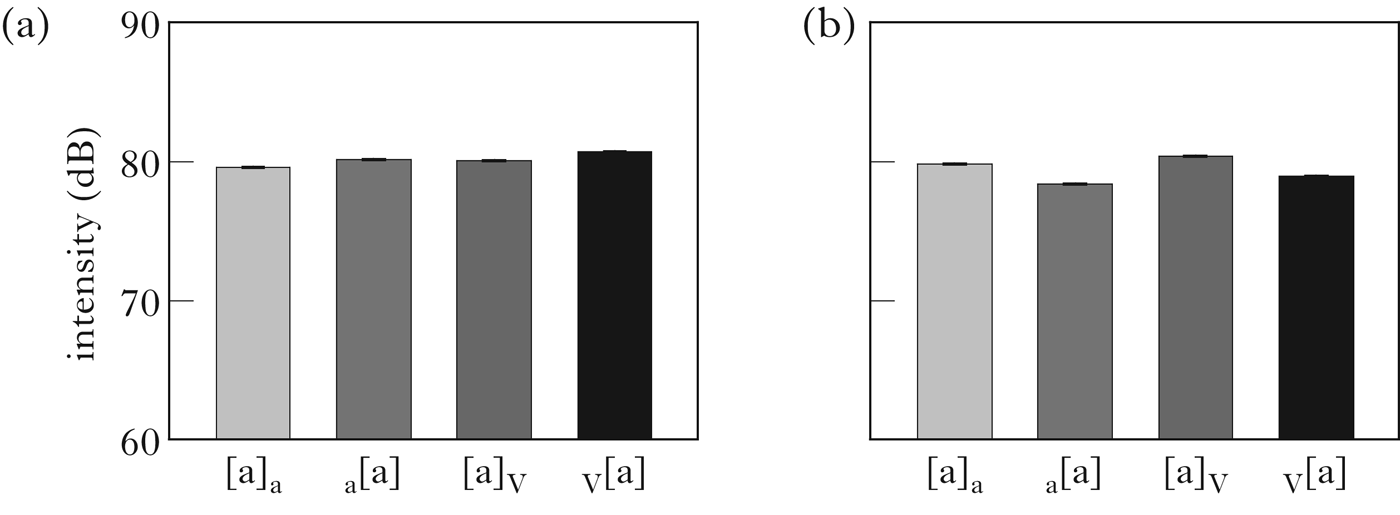
This section explores whether stressed and unstressed vowels are distinguished by intensity in Gujarati. According to Patel & Mody (Reference Patel and Mody1960) and de Lacy (Reference de Lacy2002), [a] has greater intensity when it is stressed. On this prediction, [a] in [CV.Ca] should have higher intensity under the Sonority-driven hypothesis, but lower intensity under the Penultimate hypothesis. I report the results in the postpausal and prepausal contexts separately, in Fig. 3.
Intensity differences between occurrences of [a] in (a) postpausal and (b) prepausal contexts. Error bars represent standard error of the mean.

The intensity patterns of [a] in different contexts do not clearly support either hypothesis. In the postpausal context, there is no significant dif-ference between the vowels. That is, V[a] has the same intensity value as [a]a, a[a] and [a]V (t = −1.648, p = 0.4325 for V[a] vs. [a]a; t = −1.743, p = 0.3215 for V[a] vs. a[a]; t = −0.878, p = 0.8166 for V[a] vs. [a]V). If intensity is a correlate of stress in Gujarati, V[a] is expected to have a higher intensity value than a[a] under the Sonority-driven hypothesis. However, they have the same intensity values. In the prepausal context, V[a] also has the same intensity value as [a]a, a[a] and [a]V (t = 1.307, p = 0.5933 for V[a] vs. [a]a; t = −1.708, p = 0.3386 for V[a] vs. a[a]; t = 2.392, p = 0.1830 for V[a] vs. [a]V). In short, results from the two frame sentences suggest that intensity is probably not a relevant acoustic cue for stress in Gujarati.
Similarly, results from other vowels do not clearly support either hypothesis. If stress in Gujarati is sonority-driven, V[V], [V]a and a[V] should have lower intensity than [V]V, since [V]V is the only stressed vowel. If stress falls on the penultimate syllable, V[V] and a[V] should have lower intensity than [V]V and [V]a, because V[V] and a[V] are in final position.
For [o] in the postpausal context, [o]o does not differ from o[o], [o]a or a[o] in terms of intensity ([o]o: 80.5 dB (SD = 2.4), o[o]: 81.7 dB (SD = 2.4), [o]a: 79.3 dB (SD = 2.6), a[o]: 80.3 dB (SD = 2.6); all p>0.1319). So the Sonority-driven hypothesis is not supported. With respect to the Penultimate hypothesis, o[o] and a[o] do not have significantly lower intensity value than [o]o and [o]a (all p>0.1297). So the Penultimate hypothesis is not supported either. In the prepausal context, none of the comparisons show statistical differences ([o]o: 80.2 dB (SD = 2.2), o[o]: 79.8 dB (SD = 2.8), [o]a: 78.9 dB (SD = 2.5), a[o]: 78.8 dB (SD = 2.6); all p>0.0842). Therefore, the intensity pattern of [o] in the prepausal context does not support either hypothesis.
A similar pattern is observed for [i]. In the postpausal context, each comparison is non-significant ([i]i: 76 dB (SD = 3.5), i[i]: 77.6 dB (SD = 2.6), [i]a: 75.3 dB (SD = 4.2), a[i]: 76 dB (SD = 2.4); all p > 0.0506). Notice that the difference between [i]a and i[i] is borderline (t = 3.033, p = 0.0506). However, i[i] has a higher intensity value than [i]a, the opposite of what is expected under both hypotheses, if intensity is a cue to stress. In the prepausal context, no overall significant difference is found among each pair ([i]i: 76 dB (SD = 3.4), i[i]: 76.1 dB (SD = 3.4), [i]a: 75.4 dB (SD = 3.4), a[i]: 75 dB (SD = 2.6); all p>0.3827). Again, this result is not predicted by either hypothesis.
Finally, [u] displays a similar pattern to other vowels. In both contexts, none of the multiple comparisons reach statistical significance (for [u] in the postpausal context: [u]u: 79.1 dB (SD = 3.3), u[u]: 79 dB (SD = 3.2), [u]a: 78 dB (SD = 3.4), a[u]: 79.2 dB (SD = 3.3); for [u] in the prepausal context: [u]u: 79.2 dB (SD = 2.8), u[u]: 78 dB (SD = 3.4), [u]a: 77.7 dB (SD = 3.2), a[u]: 77.9 dB (SD = 3.7); all p>0.2972). In short, results from [u] suggest that intensity does not provide evidence for either of the hypotheses.
Cross-linguistically, greater intensity is an acoustic correlate of stress in many languages, including English (Lieberman Reference Lieberman1960), Pirahã (Everett Reference Everett1998), Chickasaw (Gordon Reference Gordon2004) and Tashlhiyt Berber (Gordon & Nafi Reference Gordon and Nafi2012). Unlike other languages, Gujarati does not use intensity as a cue to stress. Vowel-to-vowel comparisons do not show a significant difference. Since the just noticeable difference (JND) in sound intensity for the human ear is about 1 dB (Harris Reference Harris1963), it is probable that the intensity differences in Gujarati are not perceptually significant, given the similar mean and standard deviation for each pair (e.g. for [a] in the postpausal context: [a]a: 79.6 dB (SD = 2.2), a[a]: 80.2 dB (SD = 2), [a]V: 80.1 dB (SD = 2.1), V[a]: 80.7 dB (SD = 2); for [a] in the prepausal context: [a]a: 79.9 dB (SD = 2.1), a[a]: 78.4 dB (SD = 2.2), [a]V: 80.4 dB (SD = 2), V[a]: 79 dB (SD = 2.2)).
In summary, comparing the intensity values of [a] does not confirm either the Sonority-driven hypothesis or the Penultimate hypothesis; in most cases, vowels in different positions do not display intensity distinctions. Based on the multiple vowel-intensity comparisons, I conclude that Gujarati does not use intensity as a cue for stress, unlike the languages cited above.
4.3 F0
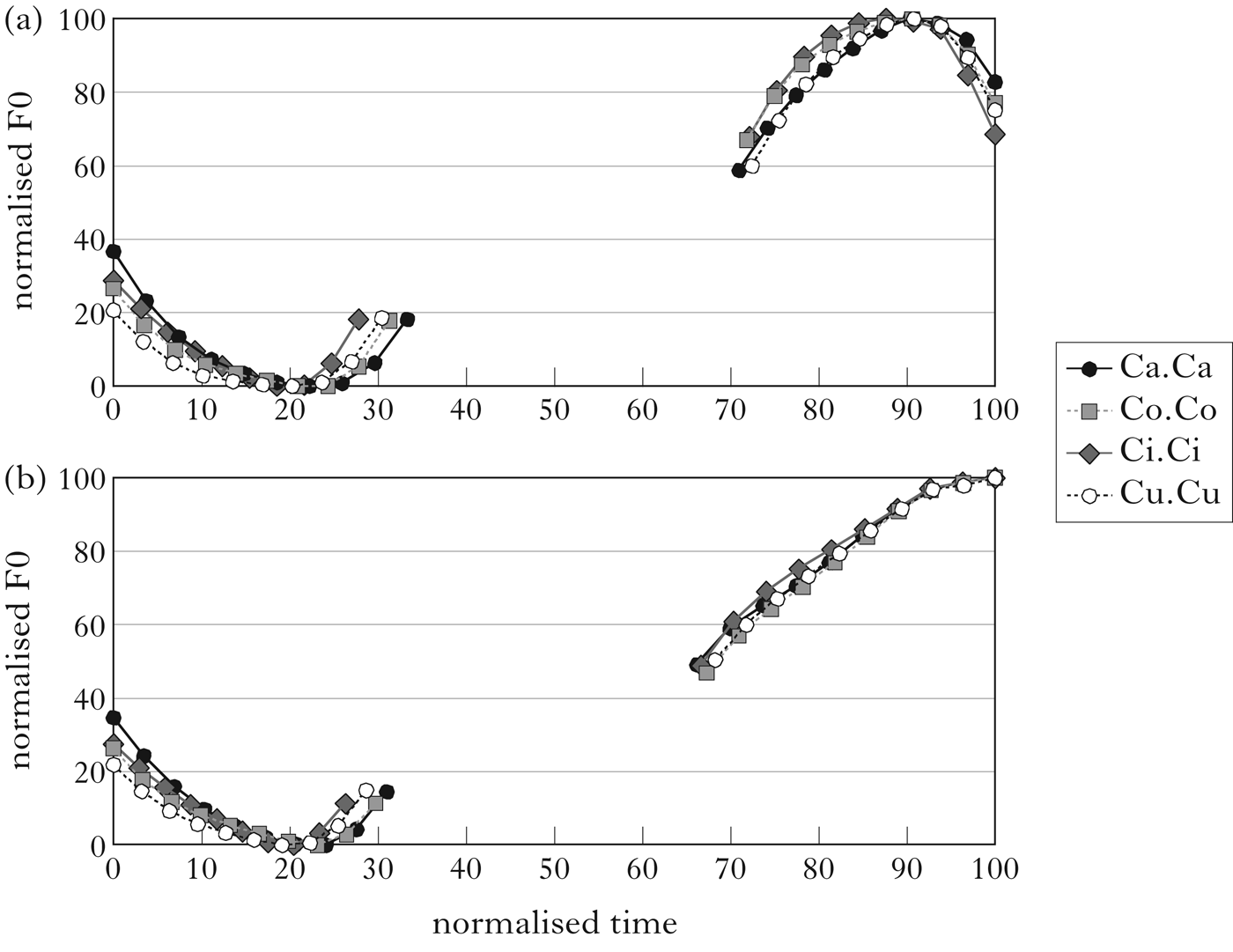
While F0 is influenced by many phonological and phonetic factors, the primary determinant of F0 in Gujarati is phonological sentence-level tone specifications (i.e. intonational elements). In both frame sentences in (10), the target word has a rising (LH) contour, as shown in Fig. 4. Speech rate and pitch range varied from speaker to speaker, so time and F0 contours were normalised, using the Prosody Pro script for Praat (Xu Reference Xu, Bigi and Hirst2013).
LH intonation on [CV.CV] in (a) the postpausal and (b) the prepausal contexts. Normalised F0 and time are given in arbitrary units.

Figures 4a and b show the normalised pitch track of the two target vowels for different vowel types. As will be discussed in the next section, vowels in the prepausal context are affected by phrase-final lengthening, so that the pitch track of the second vowel in the prepausal context starts earlier than that of the second vowel in the postpausal context. Notice that for the second vowel in the postpausal context (Fig. 4a), there is a dip at both ends of the pitch track. It is possible that the pitch is lowered because of the adjacent stops. However, this pattern is not seen in the prepausal context (Fig. 4b). As mentioned above, there is a significant pause immediately following the target word in the prepausal context. The reason that there is no lowering at the end of the vowel is therefore probably the absence of the consonant effect.
There are three possible interpretations of this F0 contour. One is that it is the realisation of a phonological L*H% melody, consisting of a pitch accent on the stressed syllable and a H boundary tone. A second interpretation is that it is the realisation of a phonological L%H* melody, consisting of a L boundary tone marking the initial position of a ω and a pitch accent on the stressed syllable. The third option is that it is the realisation of a L%H% melody, with L and H being boundary tones. In this scenario, intonation is not sensitive to word-level stress.
The three hypotheses potentially make different predictions about the interpretations of the F0 melody. For the first scenario (L*H%), the Penultimate hypothesis predicts that the L should always fall on the penult, as in (12a), but the Sonority-driven approach predicts that the L should appear on the final syllable in [CV.Ca] words, as in (12b).
(12)
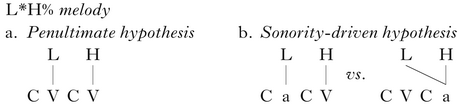
In this case, we would expect a greater slope on the final syllable of [CV.Ca] than in [Ca.Ca], [Ca.CV] or [CV.CV]. The effect on F0 would be a later transition to the H target – i.e. a later rise in the [CV.Ca] case, with a rise in F0 over the final [a].
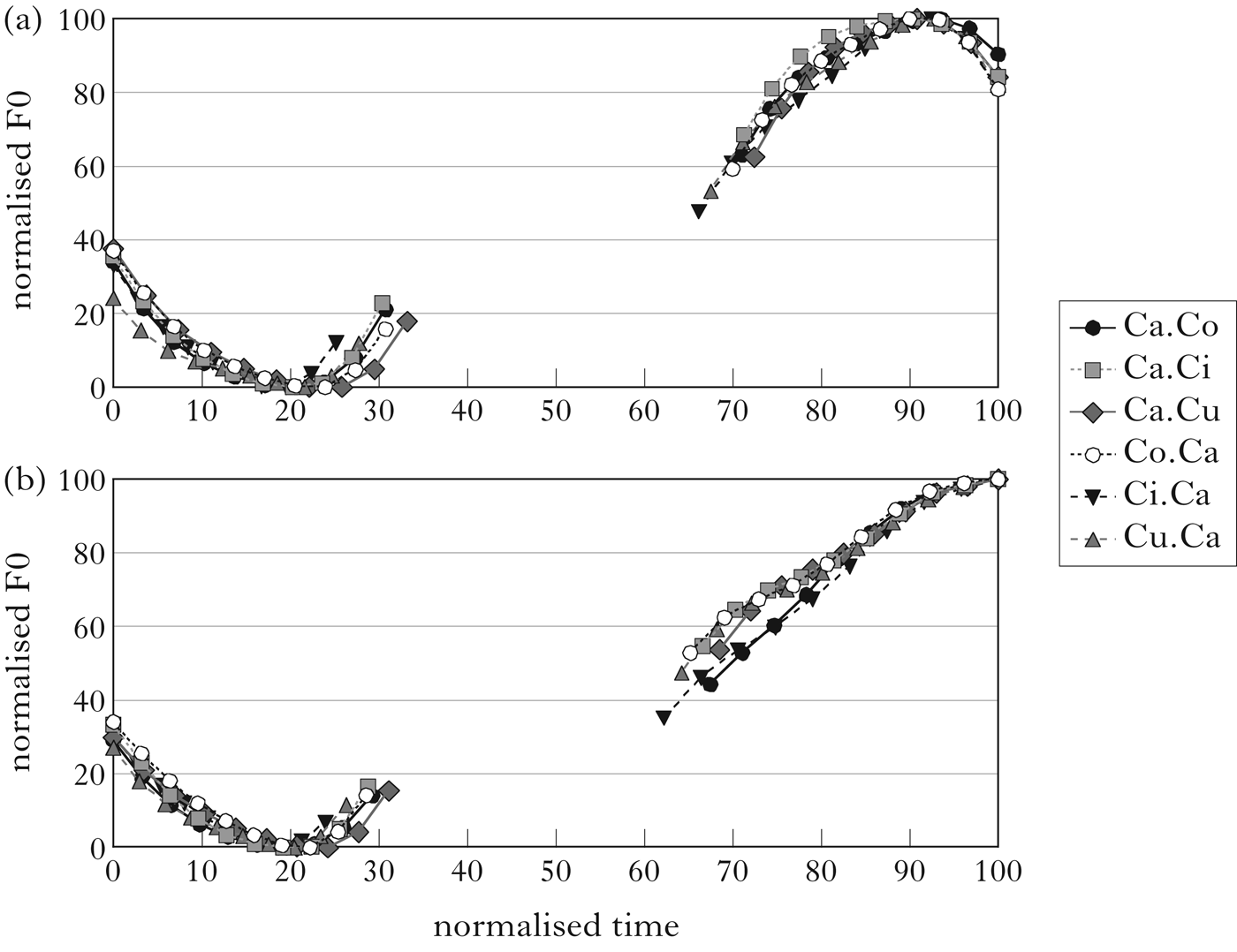
However, the intonation pattern in [CV.Ca] words shows no rise on the syllable [Ca]. Instead, we find a level H on the [Ca] syllable. As shown in Fig. 5, the pitch contours of [CV.Ca] words overlap with the pitch contours of [Ca.CV] words in both contexts. In other words, [CV.Ca] words are not differentiated from [Ca.CV] words by a F0 distinction. Thus there is no evidence in favour of the Sonority-driven hypothesis.
LH intonation on [Ca.CV] and [CV.Ca] in (a) the postpausal and (b) the prepausal contexts. Normalised F0 and time are given in arbitrary units.

For the second scenario (L%H*), the Penultimate hypothesis predicts that H should always fall on the penult, as in (13a). On the other hand, the Sonority-driven approach predicts that the H should appear on the final syllable in [CV.Ca] words, as in (b).
(13)
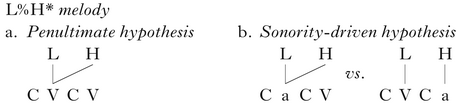
In this case, we would expect a greater slope on the first syllable of [Ca.CV], [Ca.Ca] and [CV.CV] than in [CV.Ca]. The effect on F0 would be an earlier transition to the H target – i.e. an earlier rise in the cases of [Ca.CV], [Ca.Ca] and [CV.CV], with a rise in F0 over the first syllable.
As mentioned above, the pitch contours of [Ca.CV], [Ca.Ca] and [CV.CV] words overlap with those of [CV.Ca] words in both contexts, as shown in Fig. 5. [Ca.CV] words are not differentiated from [CV.Ca] words by a F0 distinction, and there is thus no evidence in favour of the Sonority-driven hypothesis.
In short, assuming that one of the tones is a pitch accent, the intonation observed is consistent only with the Penultimate hypothesis. If neither tone is a pitch accent, then intonation is irrelevant to stress.
A final possible scenario would be that phonological conditions, such as a ban on tonal overcrowding, force the L to always appear on the penult. In this case, we would expect stress to have the effect of lowering/raising F0 on the stressed vowel. Thus we would expect F0 on [a] in [CV.Ca] to be higher/lower than on the final vowel in [Ca.Ca], [Ca.CV] or [CV.CV]. To test the possibility of tonal crowding, multiple comparisons of V[a] and other vowels (a[a], a[V], V[V]) were obtained by using a one-way ANOVA with a post hoc Tukey HSD test.
The result for the postpausal context is significant: F(7, 789) = 4.5119, p<0.01. However, a post hoc Tukey HSD test shows that only two pairs, V[a] vs. i[i] and V[a] vs. u[u], are statistically significant (p = 0.0373 for V[a] vs. i[i]; p = 0.0073 for V[a] vs. u[u]). Other pairs do not show any statistical differences (all p>0.3235). The result for the prepausal context is also significant: F(7, 773) = 4.9156, p<0.01. Three pairs, V[a] vs. i[i], V[a] vs. a[u] and V[a] vs. u[u], were found to be statistically significant (p = 0.0039 for V[a] vs. i[i]; p = 0.0104 for V[a] vs. a[u]; p = 0.0071 for V[a] vs. u[u]). Other pairs do not show any statistical differences (all p>0.4926), though the difference between V[a] and a[i] is marginal (p = 0.057). If tonal crowding exists in Gujarati, we would expect V[a] to differ from a[a] in terms of F0. However, it does not, indicating that V[a] is actually unstressed if tonal crowding constrains the intonation contour in Gujarati. Notice that the high vowels [i u] have higher F0s than the low vowel [a]. This is perhaps because high vowels such as [i] and [u] have intrinsically higher F0s than low vowels such as [a] (Whalen & Levitt Reference Whalen and Levitt1995).
4.4 Duration
This section explores whether duration is an acoustic correlate of stress in Gujarati.
4.4.1 Prepausal context
There was always a pause after the stimuli in the prepausal sentences, indicating that the stimuli are in the final position of a prosodic phrase. Vowels in the final syllable (e.g. a[a] and V[a]) are therefore expected to be lengthened.
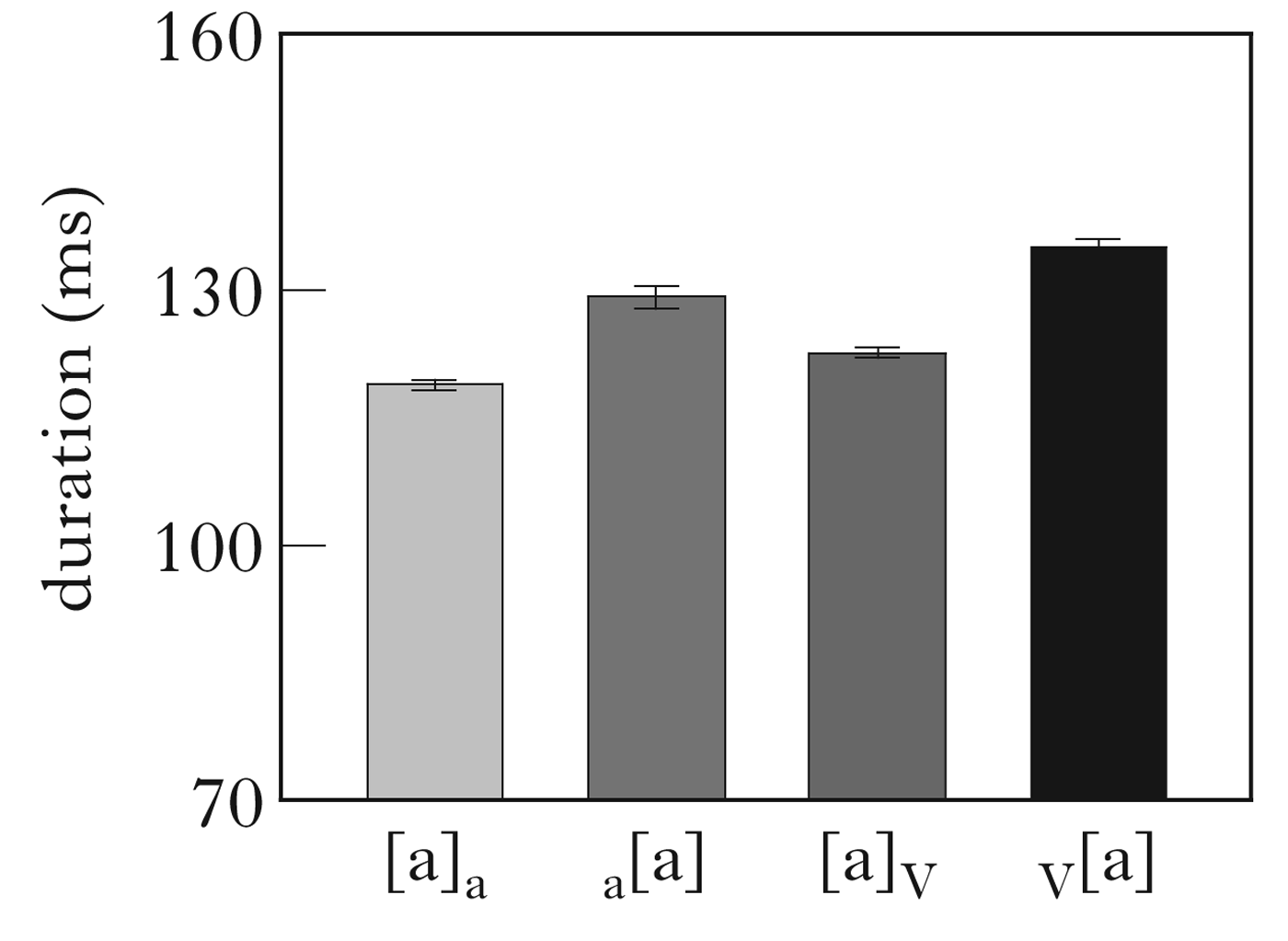
a[a] and V[a] are lengthened due to phrase-final lengthening, though the multiple comparisons of [a] show no significant difference (all p>0.0874). Based on the mean duration, all final [a]’s are longer than penultimate [a]’s, as shown in Fig. 6.
Duration differences between occurrences of [a] in the prepausal context. Error bars represent standard error of the mean.

Moreover, phrase-final lengthening is additive (e.g. Wightman et al. Reference Wightman, Shattuck-Hufnagel, Ostendorf and Price1992, Gordon & Munro Reference Gordon and Munro2007), so a phrase-final stressed vowel should still be longer than a phrase-final unstressed vowel. If this is the case, V[a] should be longer than a[a] if stress is sonority-driven in Gujarati. However, no significant difference was found between V[a] and a[a] (t = −1.443, p = 0.4892). Thus this finding provides further support for the Penultimate hypothesis.
The lengthening effect is found to be consistent for all vowels (for [o]o: 112 ms (SD = 17), o[o]: 118 ms (SD = 29), [o]a: 103 ms (SD = 15), a[o]: 117 ms (SD = 31); for [i]i: 98 ms (SD = 20), i[i]: 115 ms (SD = 29), [i]a: 91 ms (SD = 16), a[i]: 113 ms (SD = 29); for [u]u: 94 ms (SD = 18), u[u]: 108 ms (SD = 24), [u]a: 94 ms (SD = 19), a[u]: 106 ms (SD = 25)), though the statistical analysis shows no significant difference (all p>0.1268). That is, all the final vowels are lengthened, and their mean duration is greater than that of the penultimate vowels.
Finally, vowel duration can be affected by many factors, of which phrase-final lengthening is one. This effect obscures word-level stress, by lengthening the duration of the final syllable. It is therefore important to disentangle word-level stress and phrase-level influences.
4.4.2 Postpausal context
It has been reported that in Gujarati stressed vowels are longer than unstressed vowels (Pandit Reference Pandit1958, Adenwala Reference Adenwala1965, Lambert Reference Lambert1971, de Lacy Reference de Lacy2006, Modi Reference Modi2013). In particular, Lambert (Reference Lambert1971) claims that [a] has greater duration when it is stressed. Under the Sonority-driven hypothesis, it is therefore expected that V[a] in [CV.Ca] should have the same duration as [a]a and [a]V, but should be longer than a[a] (putting aside the influence of word). On the other hand, if stress falls on the penultimate syllable, V[a] is expected to have the same duration as a[a].
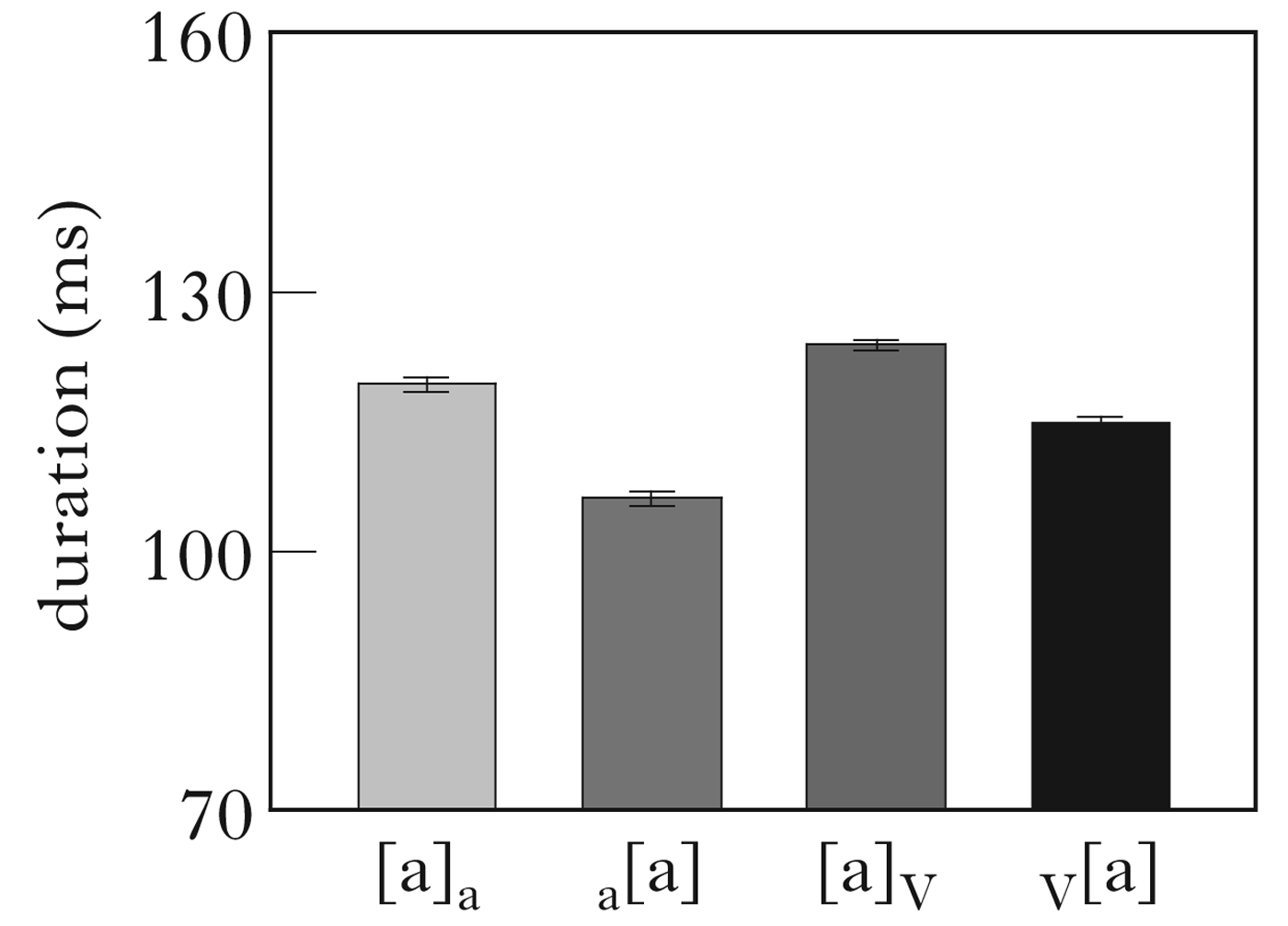
However, the comparison in Fig. 7 shows that V[a] is not significantly longer than a[a] (t = −2.210, p = 0.1582). It should be noted that V[a] and a[a] are in prosodically similar positions. As discussed in §4.3, the target word has a rising (LH) contour, where the low tone falls on the penultimate syllable and high tone on the final syllable. F0 might have an influence on the duration of the syllable; for example, Gandour (Reference Gandour1977) reports that low-toned vowels are longer than high-toned vowels in Thai. Since V[a] and a[a] are in the final syllable with a high tone, F0 should not influence duration.
Duration differences between occurrences of [a] in the postpausal context. Error bars represent standard error of the mean.

Although the fact that V[a] and a[a] have the same duration is consistent with the Penultimate hypothesis, V[a] is not significantly shorter than [a]a or [a]V (t = 1.103, p = 0.6987 for V[a] vs. [a]a; t = 2.27, p = 0.1839 for V[a] vs. [a]V). If duration is a cue for stress in Gujarati, the overall pattern is not predicted by either of the hypotheses. Because duration can be influenced by many other factors, both segmental and prosodic, I leave this issue for future investigation.
For other vowels, if stress is sonority-driven, [V]V is the only stressed syllable and thus should have greater duration than other vowels. However, [V]V does not differ from V[V], [V] a or a[V] in terms of duration (for [o]o: 113 ms (SD = 17), o[o]: 95 ms (SD = 20), [o]a: 101 ms (SD = 17), a[o]: 103 ms (SD = 22); for [i]i: 98 ms (SD = 20), i[i]: 88 ms (SD = 24), [i]a: 89 ms (SD = 18), a[i]: 93 ms (SD = 19); for [u]u: 93 ms (SD = 21), u[u]: 90 ms (SD = 20), [u]a: 96 ms (SD = 20), a[u]: 87 ms (SD = 19); all p>0.1755).
Cross-linguistically, duration has been shown to be an important acoustic correlate of stress (Fry Reference Fry1955, Lieberman Reference Lieberman1960, Everett Reference Everett1998, Gordon Reference Gordon2004, Gordon & Applebaum Reference Gordon and Applebaum2010, among others). However, the statistical results above suggest that duration in Gujarati is not a robust cue for stress. The next subsection will focus on the perceptual robustness of duration in Gujarati.
4.4.3 Perceptual robustness
An important diagnostic is whether any consistent differences are perceptually robust. If differences are not perceptible, they cannot be learned directly, calling their relevance into question.
There are no perceptually significant differences between vowels in different positions in terms of duration. Adopting Klatt's (Reference Klatt1976: 1219) just noticeable difference (JND) for segmental duration of 20%, the perceptually significant duration thresholds of [a] vowels in various positions averaged 23.2 ms. The pair which shows the greatest durational difference is a[a] vs. [a]V (18 ms), which is still 5 ms less than the average threshold. The durational differences of other pairs are far lower than the threshold. Moreover, the raw durational difference between each vowel is roughly 9.7 ms on average. The average durational difference does not cross the average threshold either. Based on these findings, I conclude that duration is not a reliable perceptual cue of stress in Gujarati.
5 Implications
This section discusses the implications of the study reported in the preceding sections. §5.1 identifies analytical implications for theories such as Optimality Theory, while §5.2 offers possible explanations for incorrect interpretations of stress in Gujarati.
5.1 Symmetric effect
Gujarati is important for sonority-driven stress, because it is one of very few cases where stress treats certain peripheral vowels differently from other peripheral vowels. Most other cases of sonority-driven stress involve avoidance of schwa, which can be analysed in a variety of different ways.
The other five cases listed by de Lacy (Reference de Lacy2004: 193) where stress distinguishes between peripheral vowels present a variety of issues. All the descriptions are impressionistic. As opposed to previous descriptions of Nganasan, Vaysman (Reference Vaysman2009: 25) does not observe stress avoidance of high vowels. For the other four cases, there is only one description of stress placement (for problems with relying on unreplicated descriptions, see de Lacy Reference de Lacy and van der Hulst2014). This leaves Gujarati as the most extensively described sonority-driven stress case with distinctions among peripheral vowels. However, this study has argued that stress in Gujarati is not sonority-driven. As a consequence, the three analyses in (14) are possible.
(14)

It is impossible to address (a), as this would require experimental evidence that is not available. However, suppose either (b) or (c) is correct; either consequence presents interesting challenges in analytical frameworks such as Optimality Theory, because of the property of ‘symmetric effect’. Constraints with the form *x/y have a symmetric effect if their violations can be avoided by altering either x or y. For example, violations of *Non-HdFt/a can be avoided by either moving the foot, or by changing the vowel (e.g. through deletion or neutralisation).
De Lacy (Reference de Lacy2002, Reference de Lacy2004, Reference de Lacy2006) proposes that there is a unifying theoretical mechanism that accounts for sonority-driven stress, and that this same mechanism accounts for interactions at all prosodic levels. Following his work, the sonority hierarchy in (1) can be expressed in the form of constraints in Optimality Theory. The symmetric constraint forms and definitions are given schematically in (15).
(15)
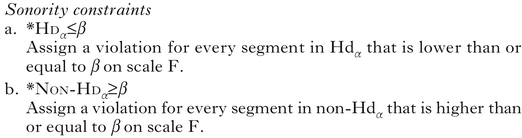
In general, *HdA≤β and *Non-HdA≥β have the ability to restrict certain vowels of different sonority in head and non-head positions. The constraint *HdA≤β plays an essential role in sonority-driven systems, since it can ban vowels with low sonority in head position. In particular, *HdFt≤{e,o} plays a crucial role in Gujarati stress, since it is the foot head which requires vowels with high sonority (de Lacy Reference de Lacy2002: 74–75), as shown in (16). The constraints AllFt-R and Trochee are omitted in the tableaux below; FtBin ⪼ AllFt-R, and Trochee is undominated.
(16)
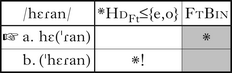
Crucially, the non-metrical constraint *HdFt≤{e,o} must outrank the metrical constraint FtBin in order for candidate (16a) to be optimal. Candidate (b) is ruled out because the head contains an [ε]. The competitor [(hεˈɾan)], with an iambic foot, is eliminated through the undominated constraint Trochee. The metrical structure is changed, due to the fact that *HdFt≤{e,o} outranks FtBin. However, *HdFt≤β cannot exist if there is no sonority-driven stress.
Similarly, *Non-HdFt≥β must not exist, otherwise it could be used to overgenerate – i.e. create the Gujarati system, as demonstrated in (17).
(17)
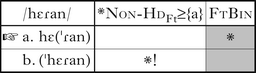
However, *(Non-)HdA/β is necessary to account for stress-driven neutralisation, deletion, metathesis and coalescence (de Lacy Reference de Lacy2006: ch. 7). These are cases where prosodic structure is kept constant, while sonority changes. Take stress-driven deletion as an example. The constraint *Non-HdFt≥{a} prohibits [a] in non-head position. So, deleting [a] in non-head position avoids the violation of *Non-HdFt≥{a}. This is the case in Lushootseed (Urbanczyk Reference Urbanczyk1996, Gouskova Reference Gouskova2003), where [a] is deleted if it would appear in the non-head of a foot, as in (18).
(18)

This pattern can be explained if *Non-HdFt≥{a} outranks the anti-deletion constraint Max (de Lacy Reference de Lacy and de Lacy2007), as shown in (19). The constraints AllFt-L and Ident[low] must also dominate Max. Candidate (19d) is the winner, because it avoids [a] in non-head position by deletion.
(19)
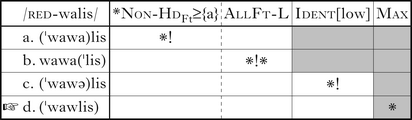
If either (14b) or (c) is correct, the existence of *HdA≤β and *Non-HdA≥β is problematic. The repair strategy for the constraint *(Non-)HdA/β could be either to fix the prosody or to change the vowel sonority. As a consequence, we lose the ability to account for stress-driven phenomena other than sonority-driven stress, such as neutralisation, deletion, metathesis and coalescence.
The fundamental problem is one of ‘too many solutions’ (e.g. Blumenfeld Reference Blumenfeld2006). While the *(Non-)HdA/β constraints can motivate vowel reduction and deletion, they should not be permitted to motivate relocation of metrical heads. It is not the goal of this article to propose a solution to the ‘too many solutions’ problem. Instead, the goal is to identify sonority-driven stress as a potential case in need of a solution.
5.2 Perceptual implications
A significant question remains unanswered in this study: why did previous investigators perceive Gujarati stress as sonority-driven? §2.2 shows that while the majority of the descriptions agrees that there is some sonority-driven stress, they do not agree on the details. In addition, no phonological or morphophonological processes refer to stress except for allophony. Stress is also not contrastive in Gujarati.
The diversity of descriptions suggests the possibility that previous investigators were profoundly influenced, and misled, by their native perceptual systems in detecting the location of stress in Gujarati (see e.g. Bowern et al. Reference Bowern, Alpher and Round2013). This is a reasonable speculation, since most of the investigators who report that Gujarati has sonority-driven stress were non-native speakers (e.g. Cardona Reference Cardona1965, de Lacy Reference de Lacy2002).Footnote 5 In his study of Chuvash stress, Dobrovolsky (Reference Dobrovolsky, Ohala, Hasegawa, Ohala, Granville and Bailey1999) proposes that non-native listeners can rely on acoustic cues that are significant in their native language, even when those cues are not used to realise stress in the target language. For example, if listeners are attuned to large durational differences to determine stress position, Gujarati will provide little in terms of consistent value. Instead, however, listeners intent on using duration to identify stress might turn to inherent vowel duration.
Penultimate [a] is inherently the longest vowel in Gujarati, followed by final [a], and these are significantly longer than the other vowels. The average duration of all the vowels pooled from the postpausal sentence is as follows: penultimate: [a]: 122 ms, [o]: 107 ms, [i]: 92 ms, [u]: 94 ms; final: [a]: 111 ms, [o]: 99 ms, [i]: 90 ms, [u]: 88 ms. As can be seen, /a/, either in penultimate or final position, has the longest duration of the four vowels. Comparing final [a] with penultimate [o i u] shows that even unstressed final [a] has a greater duration than stressed [i] and [u]. A one-way ANOVA analysis with four independent treatments shows that the comparison is significant: F(3, 795) = 45.346, p<0.01. A post hoc Tukey HSD test shows that final [a] has significantly greater duration than penultimate [i] and [u] (p<0.01 for [a] vs. [i]; p<0.01 for [a] vs. [u]). The difference between [a] and [o] is not significant (p = 0.081).Footnote 6
As a consequence, a perceptual system attuned to durational differences could interpret inherent vowel-duration differences as phonologically controlled. This speculation might correspond to Masica's (Reference Masica1991: 121) assertion about Gujarati stress: ‘those [formulations of stress assignment] by foreigners sometimes confuse the prominence of long vowels with stress’. Similar findings are reported by Dobrovolsky (Reference Dobrovolsky, Ohala, Hasegawa, Ohala, Granville and Bailey1999) for Chuvash, and Bowern et al. (Reference Bowern, Alpher and Round2013) for Yidiny.
According to Krueger (Reference Krueger1961), stress in Chuvash falls on the rightmost heavy syllable (a syllable containing a vowel other than schwa), otherwise on the initial syllable. However, Dobrovolsky (Reference Dobrovolsky, Ohala, Hasegawa, Ohala, Granville and Bailey1999) argues that there is no default initial stress in Chuvash. Dobrovolsky measured peak intensity, average intensity, duration, fundamental frequency and the intensity integral of disyllabic words for the following combinations of heavy and light syllables: HH, HL, LH and LL. The results show that the first L in LL is not realised by greater peak, average or total intensity, or by increased duration. Instead, the first L has the highest F0, which falls throughout the rest of the word. This initial F0 peak is a consistent property of the initial syllable, even when it was not predicted to be stressed. Therefore, what is perceived as a default stress is actually a falling intonation that is assigned at a higher suprasegmental level than word-level stress assignment.
On the other hand, Dixon (Reference Dixon1977a, Reference Dixonb) claims that stress in Yidiny is by default trochaic, with left-to-right alignment. In addition, stress is attracted to long vowels, as in [durˈguː] ‘mopoke owl (abs)’. However, Bowern et al. (Reference Bowern, Alpher and Round2013) argue that Yidiny stress is consistently word-initial, and does not move to long vowels. Of the four types of phonetic evidence examined (duration, intensity, pitch and centralisation), duration and pitch provide clear evidence for consistent initial stress. Stress appears consistently on the initial syllable of the word, and is realised primarily by increased duration and a L*+H pitch accent. Bowern et al. provide further possible explanations for Dixon's impression on Yidiny stress. One of the possible confusions is that phonologically long vowels in Yidiny are on average 1.7 times as long as their short counterparts. This corresponds to Oller's (Reference Oller1973) finding in English that stressed vowels are on average 1.5 times as long as unstressed vowels. Due to the similar ratio between the duration of stressed and unstressed vowels, Dixon might have misperceived the phonologically long vowels as stressed, based on his own perceptual system.
Bowern et al.'s s conjecture corresponds to Fry's (1955) findings for English. Fry performed a perception study to test whether English speakers use duration and intensity as correlates of stress. He discovered that listeners judge long, high-intensity vowels to be strongly stressed, and short, low-intensity vowels to be weakly stressed. In particular, duration ratio is a more salient cue than intensity ratio. Intensity manipulation produced an increase in stress judgements of only 29%, while duration manipulation resulted in a 70% increase. Thus duration plays a crucial role for English speakers in their detection of the location of stress.
Still another possibility is that the investigators confounded stress with the effects of phrase-final lengthening. As shown in §4.4.1, the stimuli vowels are significantly lengthened in the prepausal sentence environment. It is conceivable that investigators listened to the words in phrase-final position, and identified the lengthened final [a] as stressed. Moreover, words in citation forms are also phrase-final. The words elicited in previous studies were perhaps uttered in isolation, so that [CV.Ca] words were reported as having final stress because V[a] was lengthened, even though the lengthening was not the realisation of phonological metrical structure.
6 Conclusion
This article has shown that there is no evidence for sonority-driven stress in Gujarati. Specifically, there is no evidence that stress seeks out [a], avoiding less sonorous vowels. The evidence instead supports consistent penultimate stress.
This finding is important, because Gujarati has provided central evidence for the claim that sonority-driven stress exists (de Lacy Reference de Lacy2002, Reference de Lacy2006). It is the most extensively documented case of sonority-driven stress, and one of the few where stress is claimed to make a distinction between peripheral vowels. Without Gujarati, the evidence for the claim that sonority-driven stress exists is far more uncertain.
This article has not addressed the issue of whether stress can avoid schwa. It is possible that the avoidance of stressed schwa is of a different nature than the avoidance of peripheral vowels, and so this issue must be left for future research.
If there is no sonority-driven stress, or sonority-driven stress reduces to the avoidance of stressed schwa, then there are profound theoretical implications. Any theory whose constraints have a symmetric effect must grapple with having to account for vowel reduction without permitting sonority-driven stress – a difficult challenge.
Supplementary materials and methods
The supplementary material for this article can be found at https://doi.org/10.1017/S0952675718000064