

Introduction
Across the Arab World, support for globalization is quite high, and surveys illustrate that citizens on average would welcome greater globalization. In the third wave of the Arab Barometer, citizens from 12 Arab countries (N = 14,809) were asked whether they thought the effect of international trade on their economy was positive, 72% agreed. Another 70% agreed when asked whether the effect of FDI on their economy was positive. Further, it appears that citizens in the region would like to see greater economic ties with Western countries. When asked in the fourth wave of the Arab Barometer (N = 8,918) in eight countries, majorities agreed that they wanted to either sustain or increase economic ties with the EU (77%) and the US (70%). This support for globalization is also found in Tunisia. In our national survey of Tunisians (N = 4,986), we found a similar trend. When asked whether they believe Tunisia receives not enough, just about the right amount, or too much foreign direct investment? 88% of respondents reported that Tunisia does not receive enough foreign direct investment. Thus, it appears on the surface there is great support for globalization in the Middle East and North Africa (MENA).
Yet alongside these levels of support there’s another literature that claims that citizens of MENA are wary of Western globalization because it might undermine some of their core values linked to Islam. Scholarship on globalization and Islam has recognized that Western globalizers are sometimes concerned about the probable economic inefficiencies linked to certain religious and cultural practices, like five daily prayers, fasting, and low female market labor participation. (Klasen and Lamanna Reference Klasen and Lamanna2009; Bouzar and Bouzar Reference Bouzar and Bouzar2009; Kuran Reference Kuran2011; Campante Yanagizawa-Drott Reference Campante and Yanagizawa-Drott2013). These practices and norms linked to Islam can harm efficiency, growth, and productivity.
This debate about the compatibility of Islam and Western globalization also extends to the “purported” cultural divide between Islam and the West. Most notably, the “Clash of Civilizations” argument maintains that there are significant “unbridgeable” cultural differences between the civilizations of Islam and the West. While many scholars have disputed the accuracy of this depiction claiming it to be exaggerated, there remains the issue of whether Muslim societies are sensitive to Western economic penetration. These sensitivities are not solely the artifact of cultural differences, but also emanate from a long history of Western intervention in the Muslim world, especially the Middle East (Hourani Reference Hourani1991; Ayoubi Reference Ayoubi1995; Ibrahim Reference Ibrahim1995; Brownlee Reference Brownlee2005; Dawisha Reference Dawisha2005; Jamal Reference Jamal2012; Korany Reference Korany2012).
This debate then raises the question about the stability of Tunisian preferences toward FDI. What happens to these preferences if core Islamic norms or practices are challenged by investors? How will Tunisians balance the tradeoffs between the economic opportunities linked to globalization against loss of, or challenges to, traditional Islamic culture? Will people reduce their support for FDI if they find that it challenges or threatens their core belief systems?
In this paper, we find that although Tunisians profess very high levels of support for FDI, these levels of support are conditional on respect of core Islamic tenets. Support for FDI is highest when it accommodates Islam, and it drops significantly when it disregards the faith tradition.
Islam and globalization
Islamic critiques of Western globalization do shape debates about FDI and globalization more generally. In the Middle East, alongside these impressive levels of support for FDI, there is concern from more traditional and conservative voices about the negative influences of globalization. Leading Arab Islamic public intellectuals, like Yusuf al-Quardawi, have argued that globalization is designed to encourage consumerism and “looseness” of mores among the community of Muslim believers, and promotes the destruction of Muslim values and beliefs. Footnote 1 (Zuhur Reference Zuhur1992; Kepel Reference Kepel2002; Roy Reference Roy2004; Masoud Reference Masoud2008; Barber Reference Barber1992; Brown Reference Brown2012; Wickham Reference Wickham2015).
Policy makers in MENA have worried that Islamic groups can deter globalization if they continue to insist on the upholding of Islamic practices and norms. Recent debates about whether Ennahda, Tunisia’s Islamist party, would ban alcohol and bikinis from beaches illustrate the ways in which Islamic convictions figure into debates about globalization (BBC News 2011). The Tunisian political party, Nida’ Tunis, the secular counterpart to the Islamic Ennahda, argued that these Islamic laws would injure Tunisia’s economy by undermining its ability to attract investors.
Citizens also have expressed concern that investors might hold an anti-Islamic bias. In the United Arab Emirates, for example, which in many ways is the great gateway of globalization into the region, Muslim women have complained to the Ministry of Labor and Social Affairs that they may have been discriminated against in the job market, or even dismissed by private-sector firms, for wearing the hijab in the workplace. Footnote 2 Similar to accounts of discrimination against women in the hijab in many Western countries, especially in Europe, it is reported that some women are continually asked by their employers to justify wearing a headscarf at work. For example, a recruitment firm in the UAE had explicitly stated to a potential employee that its clients preferred to deal with women who displayed a “western outlook.” Footnote 3 In our national Tunisian survey (N = 4,986), 67% of women reported wearing the hijab and 20% of the sample (or 1 in 5) expressed concern that women who wear hijabs would be discriminated against by foreign firms.
Further, our survey also revealed citizens believe that globalization should be banned if it contradicts core Islamic values. A majority (60%) maintain that banks that charge interest contradict the teachings of Islam and should be banned; 51% believe that foreign companies that bring in impermissible goods like pork and alcohol should also be banned from Tunisia; and 68% of Tunisians do not support allowing foreign investment if it brings in non-Islamic practices and products. Yet, what remains unclear is whether these commitments to Islam will dampen support for FDI.
FDI and Tunisia
In order to investigate how Tunisians react to the prospect of globalization clashing with or accommodating their Islamic norms, we take our analysis to Tunisia, where we focus on FDI. Economically, Tunisia continues to face significant challenges. The early optimism linked to the Arab Spring was quickly replaced by anxieties and turmoil as economic problems worsened. According to the Arab Barometer’s 5th Wave, 7 years after the Arab Spring, a majority of Tunisians identified the economy, the financial crisis, and unemployment as the most important issues facing the country. Eighty-two percent described the economic situation as bad. Between June and October 2013, the percentage of people saying they had trouble feeding their family and buying essential items needed for survival jumped from 19% to 29%. Forty-four percent believed their household economic situation worsened over the past year (Dreisbach, Reference Dreisbach2013).
Given the ongoing changes and economic challenges the country faces, Tunisia is an ideal case to explore preferences toward globalization. While the country stands to benefit economically from increasing globalization, it is unclear whether and to what extent Tunisians’ commitment to Islam might pose serious challenges to policies that advance globalization. Given that Tunisia is more secular than neighboring Arab countries and does not legally mandate the accommodation of Islam in the workplace, it is a sound test for our inquiry about Islam’s role in shaping support for globalization. Further, if we do find that support for FDI decreases if it runs counter to Islamic norms and practices, we are confident that this pattern will exist elsewhere in less secular contexts as well.
Tests and hypotheses
To test whether support for FDI is conditional on the accommodation of Islamic practices, we frame the role of FDI along three dimensions: Islamically neutral, Islamically accommodating, and Islamically threatening. To capture FDI that is not threatening to Islamic norms (neutral and accommodating frames), we develop a conjoint experiment that allows us to primarily assess citizen preferences for different investors (Western versus Islamic) and investment packages (some more Islamically accommodating than others). To gauge whether support for FDI decreases if it is seen as “culturally threatening,” we designed a second social vignette experiment where citizens were primed with investments that counter Islamic norms and practices.
We hypothesize that citizens of Tunisia will have higher support for FDI so long as it is not culturally threatening to core Islamic norms and practices. We will focus on two central Islamic norms. The first set of issues revolve around women’s rights and their Islamic dress. The second set of issues more directly relates to Islamic ritual practices, like praying and fasting, which might undermine economic efficiency in the workplace (Klasen and Lamanna Reference Klasen and Lamanna2009; Bouzar and Bouzar Reference Bouzar and Bouzar2009; Campante Yanagizawa-Drott Reference Campante and Yanagizawa-Drott2013).
H1: Support for FDI will increase when FDI accommodates Islamic core norms and practices. Similarly, support for FDI will decrease when FDI challenges or threatens Islamic core norms and practices.
Experimental design I
In order to gauge the first core hypothesis about whether citizens will be more welcoming of FDI when it accommodates Islamic culture and practices, we develop a conjoint experiment that randomizes several different aspects of FDI. The advantage of the conjoint for our purposes is that is allows us to understand the relative magnitude of support for different foreign investment options that include country of origin, target industries, skill level, and target region, compared to factors linked to Islamic norms and practices.
The text of our conjoint experiment reads as follows:
-
Please thoroughly inspect the following two investment opportunities, Investment A and Investment B.
Investment A/B: Some {American/French/Saudi Arabian/Tunisian} firms are planning to invest large sums of dinars {in factories/in banks/in call centers/No Mention} in Tunisia. These investments are likely to create jobs for {women, including those who wear the hijab/ for women who don’t wear the hijab/ for women who wear the hijab/for men/No Mention} in {urban/rural} areas of Tunisia. {These jobs require workers to be educated and skilled/ These jobs do not require much education or skills/No Mention.} {They will have wadu areas and prayer rooms in their facilities./They will have no wadu areas or prayer rooms in their facilities/No Mention.Footnote 4 }
In order to investigate whether men are more likely to resist FDI if it benefits women, we alter the gender of the beneficiary (male and female). To get at whether FDI might undermine Islamic norms as it pertains to female dress, we look at whether support for FDI increases (or decreases) if it is seen as beneficial (disadvantageous) to women wearing a hijab. In order to capture this in our prompt, we break down our female beneficiaries into three categories: (a) exclusively women who do not wear the hijab, (b) exclusively women who do wear the hijab, and (c) inclusively all women, including those who both wear and do not wear the hijab. Our rationale to separate women into three categories is based on the following. First, we needed a straightforward comparison of attitudes toward FDI when the globalizer preferred women without the hijab against women with the hijab. However, some might argue that any investment option that favors one group of women over another based on religious dress is in fact discriminatory. So we created a third dimension, which is an inclusive category for women (for both those who do and do not wear the hijab). We also include a category that does not mention beneficiary at all.
To assess whether Tunisians change their support for FDI if it accommodates workplace prayers, we include a prime stating that these new industries have “wadu areas and prayer rooms” or they do not offer these amenities. We also include a treatment that does not mention these amenities at all.
We also include other important dimensions, such as the source of investment. Do Tunisians prefer Islamic investors to Western ones? In our conjoint, we include four different countries initiating investment. The first two are Western countries: France and the US. We include Saudi Arabia as an Islamic country; and we include Tunisia to investigate preferences for domestic investments too.
Finally, in order to get a better sense of the relative magnitude of the aforementioned effects, we include several non-cultural factors to the conjoint. These non-cultural factors include the location of investment (rural versus urban), whether it targets high versus low skill labor, and the type of sector (factories versus call centers and banks). We did not have ex-ante hypotheses related to these factors.
For our outcome measures, we used both a rank-based and choice-based measure. Respondents were first asked to rate the investments on a scale of 1 to 7, with 1 being very strongly supportive of such investment; and 7 being very strongly opposed to such investment (see, e.g., Huff and Kertzer Reference Huff and Kertzer2017).Footnote 5 Respondents were then asked to choose whether they preferred investment A or B (see, e.g., Hainmueller and Hopkins Reference Hainmueller and Hopkins2015). Each respondent received 5 pairs of investments with the randomized treatments to compare. In total, there were 1,440 different combinations of investment choices. The entire instrument was translated into and administered in Arabic.
We worked with a reputable vendor in Tunisia: One to One. Footnote 6 The experiment was conducted in October and November 2016 on a sample of adult Tunisian citizens (N = 1,502) from the Greater Tunis area. The experiments were held in our makeshift “labs” in downtown Tunis (details on recruitment and experimental design are available in Section 2 in the Appendix).
Results
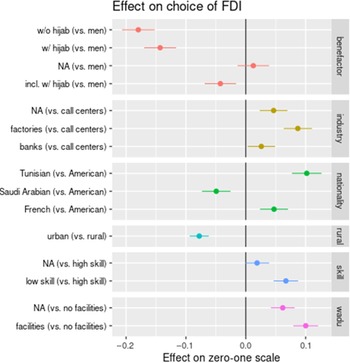
First, it appears that Tunisians turn against FDI when the status of the hijab determines job allocation. Compared to investment targeting an inclusive category of female beneficiaries, investment targeting only hijab-wearing female beneficiaries received 10% less support (p-value = 0.000) as measured by participants’ investment choice.Footnote 7 Similarly, investors are further penalized when targeting exclusively non-hijab wearing female beneficiaries compared to those targeting an inclusive category of female beneficiaries. There we see a reduction in support in FDI by 14% (p-value = 0.000). We had anticipated that FDI that targeted female beneficiaries who wore the hijab would elicit greater support for FDI in keeping with Islamic norms. However, respondents penalized FDI when investors are described as “exclusively” benefiting certain women depending on their hijab, one way or the other. Although 67% of women in Tunisia wear the hijab, it does not appear that citizens want to see any one category of women privileged over the other. Still we do see that the exclusive category of jobs going to women with the hijab receives slightly more support for FDI by 4% (p-value = 0.005) than the exclusive category of women without the hijab. This does indicate that although any form of selection by hijab status is frowned upon, there is still more preference for FDI that accommodates women in hijab than that which does not.
Muslim societies might be sensitive to the fact that FDI might undermine existing norms of patriarchy. And, indeed, we find that the gender of the beneficiary matters in our analysis. While support for FDI is not significantly different between the control (where gender is not mentioned) and when beneficiaries are male, we see a significant and slight reduction in support for FDI when beneficiaries are female. When we compare male to female beneficiaries, the reduction in support for FDI is 4% (p-value = 0.001). Moreover, men compared to women are more likely to support FDI when it benefits males.
Next, we turn to whether FDI gains support if it accommodates important religious practices like prayers in the firm. We find FDI that is Islamically accommodating receives 10% points more support over FDI initiatives that are not accommodating (p-value = 0.000). These projects that will provide prayer and wadu facilities, in keeping with Islamic norms and practices, gain more support than those that do not. See Figure 1 below. Footnote 8
Conjoint Results on Choice of Investment (Based on FDI Features).

In terms of the source of investment, most importantly, we find that there does not seem to be a preference for Islamic investment over Western investment. When the globalizer is Saudi Arabia, an influential Islamic country, we see support for FDI falls by 5% compared to the US (p-value = 0.000) and falls by another 9% (p-value = 0.000) compared to the French. Thus, on the surface, there does not appear to be a bias against Western firms; if anything there is more support for Western investment than Saudi investment. US investments, however, are less preferred than French investments by 5% (p-value = 0.000). And Tunisian investments are most preferred. We believe this preference is driven by nationalism.
To compare the size of these effects to other non-Islamic features like whether the FDI will create factory jobs, or target low-skill labor and favor rural areas, we see that on average these socio-tropic concerns indeed influence support for FDI. The creation of low-skill jobs increases support for FDI by 5% (p-value = 0.000) over the baseline that does not mention a skill level. The creation of high-skill jobs slightly decreases support for FDI by 2% (p-value = 0.076). And the difference between support for investors bringing high- versus low-skill jobs is about 7% (p-value = 0.000). Footnote 9 Furthermore, we also see that FDI linked to the creation of urban jobs over rural ones decreases support for FDI by approximately 8% (p-value = 0.000). Footnote 10 These results point out that socio-tropic concerns matter, but the influence of Islamic factors like the accommodation of prayer (10%) seems to matter slightly more. When we consider Islamic dress, however, we see that factor has the most influence in our conjoint experiment. There we find that Tunisians become much less supportive of FDI if it singles out the issue of the hijab (one way or the other). Subgroup analyses that examine the influence of gender, religiosity, and unemployment are in the Appendix.Footnote 11 In general, the results are not conditioned by these subgroup covariates, except we find that men generally are more supportive of employment that benefits men.
To summarize the key findings from Experiment 1, the accommodation of Islamic practices like prayer, by offering wadu facilities, increased support for FDI. Further, hiring preferences that discriminate against women with or without the hijab significantly reduced support for FDI more so than any other category.
Experimental design II
For our second test, we manipulate the type of “Islamic” or “cultural” threat that FDI might pose and examine how this shapes levels of support for Western FDI. We developed a second survey experiment (N = 504) to examine the role of cultural threat on support for FDI. The norms we focus on here are similar to those outlined above in our conjoint experiment: empowerment of women, work place accommodation of Islamic prayer, and the accommodation of women who wear the hijab. Finally, we include an additional prime: the economic exploitation of Tunisian labor as a placebo reference category, to further gauge whether Islamic norms matter more than this other “threat”. The experiment was conducted by One to One in the same location with a similar recruitment method following our conjoint experiment outlined above, in November 2016 (see Section 2 in Appendix).
To capture our placebo reference category, concerns about Western economic exploitation and hegemony (Ayoubi Reference Ayoubi1995, Dawisha Reference Dawisha2005; Jamal Reference Jamal2012), we advanced the following vignette.
-
Treatment 1 (Economic Exploitation) There is a proposal from a foreign Western firm to invest in Tunisia. The proposal promises to bring many new jobs to Tunisia. Yet, some Tunisian analysts worry that Western firms are bringing jobs to Tunisia that Westerners themselves do not want. These analysts also worry that the West has a history of exploiting the Arab world and its people. They view these investments as a mean of asserting economic hegemony over the region.
To directly probe concerns about foreigners’ accommodation and respect for Islamic religious practices like prayer, we designed the following vignette.
-
Treatment 2 (Lack of Accommodation of Islamic Practices) There is a proposal from a foreign Western firm to invest in Tunisia. The proposal promises to bring many new jobs to Tunisia. Yet, some Tunisian analysts worry that these Western firms are not being sensitive to Tunisia’s Islamic and cultural norms. For example, some of these firms will not allow their workers adequate time and space to perform daily prayers.
To better assess the role that discrimination against women in the hijabs might play in structuring preferences on FDI, we included this vignette.
-
Treatment 3 (Discrimination against Women in Hijabs) There is a proposal from a foreign Western firm to invest in Tunisia. The proposal promises to bring many new jobs to Tunisia. Yet, some Tunisian analysts worry that these Western firms are not being sensitive to Tunisia’s Islamic and cultural norms. For example, some of these firms have shown that they prefer not to hire women who wear hijabs.
And finally to probe concerns that foreign investors might want to encourage the empowerment of women in ways that challenge existing patriarchal norms, we included the following vignette.
-
Treatment 4 (Female Empowerment) There is a proposal from a foreign Western firm to invest in Tunisia. The proposal promises to bring many new jobs to Tunisia. Yet, some Tunisian analysts worry that these Western firms have an objective of empowering women outside their households. For example, some of these firms have shown that they prefer to hire women rather than men.
Finally, we included a control vignette with no mention of threats from Western investment.
-
Control: There is a proposal from a foreign Western firm to invest in Tunisia. The proposal promises to bring many new jobs to Tunisia.
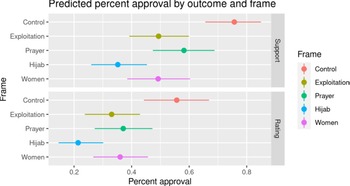
The control and treatment vignettes were randomly assigned to 504 respondents. All of the treatment vignettes were designed to raise concerns about the “negative” influences of foreign investment on Tunisian culture and society. With this design, we are able to determine the factor that elicits the most negative reaction. We ask two subsequent questions that form our dependent variables: “Do you support this investment project?” Responses were provided on a 4-point Likert scale including Strongly Agree, Agree, Disagree, and Strongly Disagree. We then asked people to rate the investment on a scale from 1 (very strong support for the investment) to 7 (very strong opposition for the investment)Footnote 12 . In the analyses below (Figure 2), we present the dichotomized logit probabilities (Approve vs. Disapprove) and the rating dependent variable divided at the median,Footnote 13 see Figure 2. OLS and ordered logistic results are also in the Appendix using the full range of both DVs (see Appendix Figure 1.2). The results are similar to those using the dichotomized DVs.
Social Vignettes Results on Support and Rating for FDI (Dichotomized DVs).Footnote 17

The vignette sample resembled the conjoint sample: an urban-based sample from Tunis. Our sample is slightly more educated and urban than the national sample. However, treatment groups across core covariates, on average, are balanced.Footnote 14
Overall, support for FDI as indicated in our national survey is high. About 90% of our sample, as noted above, supports FDI in the control condition, which states that a Western firm will be investing in Tunisia with the promise of the creation of many new jobs (see Figure 2). Each of the Islamic cultural factors, as anticipated, decreases support for FDI (both on our dichotomized outcome measure: approve vs disapprove and our rating of FDI measure). All percentages reported in this section are based on our dichotomized outcome measure.Footnote 15 As a reference point, the Western exploitation frame reduces support for FDI by about 19% (p-value = 0.000) over the control. The empowerment of women also reduces support, equally, by 19% (p-value = 0.000). The lack of Islamic accommodation for prayer reduces support by 11% (p-value = 0.012). These are significant changes in support for FDI that underscore the importance of Islamic norms. But it is important to note that even after these overt Islamic challenges, support for FDI remains quite high, persisting among a large majority of citizens. Specifically, Western FDI’s challenges to Islam, such as the lack of accommodation of workplace prayer, reduced support for FDI to 80%, which is still a remarkably high percentage. Further, these Islamic factors do not matter more than our placebo measure of economic exploitation. So, while these threats to Islam matter, they do not outweigh other non-Islamic threats, and they do not reduce support for FDI below 80% of the sample.
The one area that elicits a more negative reaction toward FDI is the discrimination against women who wear the hijab. This investment option witnessed a decrease of support by 32% (p-value = 0.000). In fact, the hijab vignette significantly reduced support for FDI when compared to every other treatment as well. Discriminating against women with the hijab reduced support by 14% (p-value = 0.051) compared to the economic exploitation and women’s empowerment frames (p-value = 0.047) and reduced support by 21% against the prayer frame (p-value = 0.001). Notably, the one dimension of Islamic threat that appears to stand out is the issue of the hijab. These results generally held up in subgroup analyses that examine the role of religiosity and gender, with religious people responding more negatively to FDI when it discriminates against women in hijabs.Footnote 16
Experiment 2 reveals that support for FDI is highly sensitive to respect for Islam. Support for FDI falls quite significantly when it fails to accommodate prayer in the workplace. FDI is further penalized if it discriminates against women in hijabs.
Taken together, these results demonstrate that there is strong support for FDI in MENA and that support is the strongest when it accommodates Islamic norms. Failing to accommodate, and specifically targeting observers of Islamic rituals, significantly reduces FDI support. Notably, support for FDI fell by 32% in the social vignette experiment when hijabis were discriminated against.Footnote Footnote 18 That we found that a third of Tunisians, on average, were likely to penalize FDI if it was seen as discriminating against women in the hijab is telling. It signals that even in the most “secular” of Arab countries, there is a strong desire for Islamic norms to be respected by globalizers. In more conservative states, like Jordan, Egypt, or the Gulf, we would expect these results to be even stronger.
Data Availability Statement
The data, code, and any additional materials required to replicate all analyses in this article are available at the Journal of Experimental Political Science Dataverse within the Harvard Dataverse Network at https://doi.org/10.7910/DVN/745PK1.
Acknowledgments
We would like to thank Chantal Berman for her outstanding oversight and management of research in the field. We also thank Gordon Arsenoff and Torben Behmer for their excellent research support. The manuscript benefited from comments from audiences at the Princeton Research in Experimental Social Science (PRESS) 2018, Association for Analytic Learning about Islam and Muslim Societies (AALIMS) 2018, and the Winter Experimental Social Sciences Institute (WESSI) 2018. We also thank Robert Kubinec for his comments on this paper.
Supplementary Material
To view supplementary material for this article, please visit https://doi.org/10.1017/XPS.2021.5
Conflicts of Interest
No conflict of interests pertain to this research. EGAP Registration ID 20150118AA, Princeton IRB: 0000006162.