A disaster can be defined as “an event that causes adverse health impacts on a population; usually, but not always, causing wide spread destruction to the environment.”Reference Binder and Sanderson1 It can be categorized as either natural or manmade, and can be further subdivided based on whether the onset is rapid or slow.Reference Lechat2 Disasters with a rapid onset tend to cause most morbidity and mortality immediately as a direct result of the primary event,3 whereas slower-onset disasters cause morbidity and mortality through prolonged, secondary effects.Reference Shears4
Infectious diseases following natural disasters tend to occur as a result of the prolonged secondary effects of the disaster, most often when there is an interruption of public health measures resulting from destruction of the local infrastructure. Despite popular belief, infectious disease outbreaks following disasters are rare, although it is crucial that programmatic implementation take infectious issues into account for the significant theoretical risk that they pose. As evidenced from prior disasters, the precise impact of this infrastructure destruction is variable and contingent upon the predisaster baseline (eg, if the preexisting level of sanitation is poor, a disaster may have little impact on baseline rates of infectious disease). The converse also is true, in that a highly developed infrastructure with a low baseline disease rate can offer a significant reserve capacity that can lessen the perceived impact of the disaster.5 Thus, it is difficult to predict the risk of infectious disease outbreaks after a disaster simply based upon the magnitude of the disaster event itself.
More helpful in predicting the risk of postdisaster infectious diseases are the synergistic effects of 3 overlapping concerns: new pathogens introduced into a community without preexisting immunity, a change in the susceptibility of the population, or an increase in the transmissibility of local pathogens. These will be discussed in turn, followed by examples of specific types of disasters and their associated infectious risks.
PRINCIPLES OF POSTDISASTER INFECTIOUS DISEASES
New Pathogens
As many historical examples illustrate, the introduction of new pathogens into a population increases the risk of infectious outbreaks. Disasters can provide the means for the introduction of these new pathogens, bringing low-incidence endemic diseases to the forefront. The postflood environment, for example, is a prime breeding ground for fungi and mold that would previously have survival difficulties, where flooded homes and buildings newly pose infectious risks.Reference Adhikari, Jung and Reponen6 The aeration and spread of soil and particulate matter have the potential to introduce new soilborne organisms into the environment, specifically fungi such as histoplasmosis and coccidioides.Reference Schneider, Hajjeh and Spiegel7 Collapsing wood and chaotic debris increase the risk of tetanus exposures. New vectors can be introduced postdisaster, with new mosquito habitats created in the postdisaster flotsam, increasing the theoretical risk of mosquito-borne illnesses such as malaria or dengue. Waterborne pathogens from marine water have been documented to cause wound infection in the postflood situation, notably during the response to Hurricane Katrina.8
An often-cited concern is the infectious risks posed by dead bodies. This has been widely examined, and there are no data to suggest that the body of a person killed in a disaster who is free of infection at the time of death will pose any risk of infection to others.Reference Morgan9Reference Gionis, Wecht, Marshall and Hagigi10 Appropriate public education is vital, with World Health Organization guidelines stating that every effort should be made to identify and bury or cremate the corpse, all the while respecting appropriate customs and laws.Reference de Ville de Goyet11 In addition, typical universal precautions for body fluids should be observed. Concern about dead bodies will persist among workers and evacuees,Reference Chhotray, Pal and Khuntia12Reference Alexander13 and reassurance should be given them by the disaster services provider or providers.
Altered Susceptibilities
Populations in movement or under stress are more vulnerable than otherwise, with an associated increased susceptibility to infectious diseases. This vulnerability comes from mechanical factors such as the compromise of personal hygiene and the presence of disaster-related wounds,Reference Ligon14 and biological factors such as a potentially compromised immune response due to the stress, hypothermia, or malnutrition associated with the postdisaster environment. Thus, both the likelihood of disease acquisition and the case-fatality rate are increased in the postdisaster setting.
Increased Transmissibility
Although not specific to any 1 type of disaster, populations clustering in close proximity and spending time indoors are at increased risk for a host of infections, especially respiratory and gastrointestinal illnesses. The enteric viruses, such as norovirus or rotavirus, have been implicated in outbreaks of gastroenteritis in the postdisaster setting.Reference Schmid, Lederer, Much, Pichler and Allerberger15Reference Phanuwan, Takizawa, Oguma, Katayama, Yunika and Ohgaki16Reference Nomura, Murai and Nakahashi1718 The risk of tuberculosis transmission is increased with close-contact living and should be anticipated. Common respiratory virus transmission has been well documented in the close conditions of the postdisaster setting.19 Airborne pathogens such as measles are also significant risks that need to be considered.
In all of these situations, previously low-incident diseases increase their basic reproductive number due to the close-contact living conditions in postdisaster settings. Therefore, the threshold vaccination rate required to achieve herd immunity is increased; measles outbreaks have occurred, for example, in crowded settings with rates of immunization up to 80%.Reference Connolly20 This increased disease transmissibility must be taken into account when discussing any programmatic implementation, including shelter, sanitation, food distribution, and health care.
SPECIFIC TYPES OF DISASTERS
Floods
Floods are one of the most frequent of all natural disasters. Drinking water contamination is the most frequent concern from an infectious diseases perspective, with numerous historical epidemics of postflood gastrointestinal illness.21Reference Kunii, Nakamura, Abdur and Wakai22Reference Shears23Reference Wade, Sandhu and Levy24 There are also examples, however, in which significant flooding and subsequent water system damage occurred without any documented outbreaks.2526Reference Setzer and Domino27 When outbreaks have occurred, they have typically been associated with previously endemic organisms, such as Shigella Reference Shears23 and Giardia,21 although most cases have no etiologic agent identified, with drinking water being only the assumed culprit.
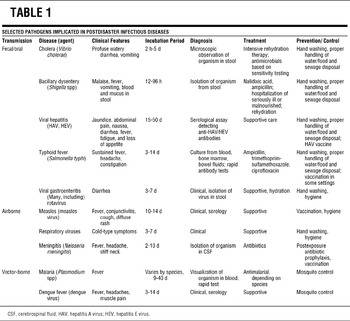
A study of water quality that was being conducted when a major flood of the Mississippi River occurred provides interesting insight.Reference Wade, Sandhu and Levy24 Source drinking water concentrations of both Giardia and coliform species significantly increased (330% and 270%, respectively) postflood. The 2 major factors that increased a person's individual risk of diarrhea were whether the individual house or yard was flooded and whether the person individually assisted with cleanup efforts. Active water-purifying devices had no discernible effect. This suggests that infection actually occurred through a route other then the consumption of contaminated drinking water and that source water purification may not play a significant role in attenuating outbreaks, although this is only 1 study. Similarly, following the 1998 Bangladesh floods, factors such as crowding, lack of latrine use, no lid on water storage containers, and the use of small storage containers for water were associated with increased rates of diarrheal illness.5Reference Kunii, Nakamura, Abdur and Wakai22 This again illustrates that factors beyond simply a supply of clean source water are important to prevent disease, and that educational interventions regarding appropriate hygiene and infection prevention are crucial. Common causes of diarrheal illnesses postdisaster are listed in Table 1.
Selected Pathogens Implicated in Postdisaster Infectious Diseases

In addition to contaminated drinking water, flooding also raises the theoretical specter of increased vector-borne illnesses due to increased mosquito populations.526 After the 1993 Iowa floods, a significant increase in the number of mosquitoes was documented, although without an accompanying increase in the endemic but sufficiently rare western equine encephalopathy.21 Relief workers aiding the recovery efforts following Hurricane Georges in Puerto Rico did not contract the mosquito-borne dengue fever, despite its occurring during an epidemic of dengue fever.Reference O'Leary, Rigau-Perez, Hayes, Vorndam, Clark and Gubler28 Despite a lack of precedent, arthropod-borne infections pose a risk in newly formed wetlands, and a lack of evidence should not lead to complacency in education or preventive measures against such infections.
Another specific risk posed by floods is mold growth resulting from extensive water damage. After hurricanes Katrina and Rita, in New Orleans, household levels of fungal by-products were significantly higher in severely flooded homes, specifically the fungi Aspergillus niger, Penicillium spp, Trichoderma, and Paecilomyces. All of these are known to cause significant invasive respiratory and dermatological disease, especially in immunocompromised individuals. There was no significant human outbreak of these illnesses post-Katrina, although a theoretical risk exists in future disasters.Reference Adhikari, Jung and Reponen6Reference Rao, Riggs and Chew29
Hurricanes, Cyclones, and Typhoons
Hurricanes, cyclones, and typhoons share a great deal in common with floods in terms of their postdisaster impact. The storm surge itself is responsible for most of the death and injury, and the postdisaster issues are similar to flooding, with similar concerns as described above.Reference Noji30 Again, the pattern of outbreaks occurring where there are endemic diseasesReference Chhotray, Pal and Khuntia12 and no outbreaks where diseases are not endemicReference Lee, Fonseca and Brett31 holds true. In 1 example, a large outbreak of diarrhea (97 934 cases) occurred following a cyclone in India.Reference Chhotray, Pal and Khuntia12 Molecular analysis confirmed that this outbreak was caused by endemic strains of Vibrio cholera, Escherichia coli, and Shigella, although with a much lower case fatality rate compared with predisaster baseline, possibly explained by early detection and aggressive public health interventions. After Hurricane Katrina in 2005, several occurrences of primarily skin and soft tissue infections due to endemic species of Vibrio were reported.3233 The most widely reported case was a norovirus outbreak in a shelter, with more than 1000 cases of gastroenteritis documented.Reference Yee, Palacio and Atmar34
Tornadoes
Tornadoes share the ferocious power of wind with hurricanes, but they lack the storm surge and flooding that accompany hurricanes. However, tornadoes occur with greater frequency and tend to affect inland areas more then hurricanes, at times spawning from remnants of hurricanes. Although tornadoes themselves have not been reported to directly result in infectious disease outbreaks, wound infections from traumatic injuries contaminated with soil or water incurred during a tornado have been reported.Reference Millie, Senkowski, Stuart, Davis, Ochsner and Boyd35
Earthquakes
Earthquakes are one of the most dramatic, rapid, and destructive natural disasters that occur. The loss of life and injuries can be numerous after an earthquake, although the risk for infectious outbreaks is relatively low.Reference Alexander1336Reference De Bruycker, Greco, Lechat, Annino, De Ruggiero and Triassi37 In fact, nearly 95% of injuries and deaths due to earthquakes occur within minutes of the quake.36Reference De Bruycker, Greco, Lechat, Annino, De Ruggiero and Triassi37 Even in a situation in which significant damage has been sustained to public infrastructure and thousands of people are homeless, outbreaks have rarely occurred immediately following earthquakes.Reference Alexander13Reference Lora-Suarez, Marin-Vasquez and Loango38
When outbreaks of illness do occur after an earthquake, they are typically the result of an increased incidence of endemic pathogens. Following the 1994 Northridge earthquake in California, Ventura County experienced an outbreak of 203 cases of Coccidioidomycosis, including 72 deaths, as a result of dust clouds created during landslides.Reference Schneider, Hajjeh and Spiegel736 After an earthquake in Turkey, a large but brief outbreak of diarrhea was noted,Reference Vahaboglu, Gundes and Karadenizli39 although with no significant change in the baseline rates of isolation of endemic pathogens, prompting Vahaboglu and colleagues to speculate that either emotional stress or a sudden change in the diet of displaced people or both was to account for the illnesses documented.
A unique property of earthquakes is their ability to cause tsunamis. Tsunamis combine both powerful destructive forces along with flooding, resulting in a unique disaster. Aside from drowning, the most common serious injuries reported after the southeast Asian tsunami in 2004 were large flap lacerations.Reference Andresen, Donaldson and Choo40Reference Maegele, Gregor and Steinhausen41 Andresen et al and Maegele et al reported that wounds were grossly contaminated with seawater, coral, or soil, causing infections by often drug-resistant organisms such as Acinetobacter, Pseudomonas, Stenotrophomonas, E coli, Aeromonas, and Mucor. These organisms are endemic in the above-listed contaminants, although otherwise rarely causing wound infections.
DISPLACED POPULATIONS
A unifying feature of the postdisaster environment is the presence of displaced populations. People displaced due to complex emergencies such as civil unrest or political instability are discussed elsewhere.Reference Lautze, Leaning, Raven-Roberts, Kent and Mazurana42Reference Connolly, Gayer, Ryan, Salama, Spiegel and Heymann43Reference Salama, Spiegel, Talley and Waldman44 Populations displaced to emergency shelters in the event of natural disasters have been extensively studied. As was widely publicized during Hurricane Katrina, people evacuated to emergency shelters often faced crowded living conditions that made the population vulnerable to outbreaks of communicable diseases. Outbreaks of methicillin-resistant Staphylococcus aureus skin infections and gastrointestinal illnesses were common in post-Katrina evacuation centers.8 During Hurricane Hugo, for example, 10 300 people were evacuated to 161 emergency shelters, where outbreaks of head lice and influenza-like illnesses were reported frequently. People sheltered in buildings with 1 large room (eg, churches, community centers) were at significantly higher risk of contracting an influenza-like illness than those in shelters with several smaller rooms (eg, schools).19 Following 2 hurricanes that struck the Dominican Republic in 1979, community-wide outbreaks of hepatitis, gastroenteritis, and measles occurred,Reference Bissell45 although disease rates did not increase significantly from already elevated baseline rates for 5 months. Small outbreaks of respiratory illnesses, scabies, and lice occurred after the 1980 earthquake in Italy.Reference Alexander13
The quasipermanent nature of “temporary shelters” poses delayed infection risks, with shelter-based outbreaks of Giardia occurring multiple years after the disaster itself.5Reference Oztürk, Sahin, Yavuz, Ozturk, Akgunoglu and Kaya46 When populations become displaced for long periods of time, natural disasters can spawn complex emergencies that can prompt outbreaks of diseases such as malaria, meningitis, pneumonia, tuberculosis and human immunodeficiency virus (HIV).Reference Shears4Reference Connolly, Gayer, Ryan, Salama, Spiegel and Heymann43Reference Aghababian and Teuscher47Reference Heyman, Ginosar and Niel48Reference Moore, Toole, Nieburg, Waldman and Broome49Reference Santaniello-Newton and Hunter50 Postdisaster crowding itself is a complex enterprise, with new pathogens, altered susceptibilities, and increased transmissibility of illnesses synergistically resulting in a significantly increased risk of a diverse spectrum of infectious diseases.
INTERVENTIONS
Most interventions should be centered upon anticipatory prevention, given the risks of a significant infectious outbreak. Vital to these interventions is surveillance, both immediately after and in the weeks following a disaster as the response continues. The ability to detect greater-than-baseline incidences of diarrhea, respiratory illness, or fevers with rash is the cornerstone of any outbreak response.
Rapid health assessments, performed as soon as possible, have been proven to be helpful in stemming any subsequent outbreak that may occur.Reference Connolly20 These assessments include determining any major health risks in the direct environment, visually inspecting the environment, obtaining baseline epidemiological data for the diseases listed above, and establishing a coherent health care coordinating mechanism. Subsequently, it is imperative that responders rapidly set up an effective surveillance mechanismReference Murray, Kilborn and DesVignes-Kendrick51 to detect any new clusters of illness so that appropriate responses can be scaled up early and appropriately. Standardized forms for this process have been created by the Centers for the Disease Control and Prevention and are freely available.52
Implementing appropriate infection control precautions, including universal precautions when dealing with body fluids, illness transmission–based precautions when dealing with patients suspected of carrying infection, and standard precautions in all other situations is vital for health workers' safety and outbreak control. In addition, the availability of hand-washing stations, which help to ensure frequent and thorough hand cleansing, is potentially the most cost-effective intervention in the postdisaster setting to stem the spread of disease, as determined through extrapolating nondisaster setting data.Reference Connolly20Reference Pittet, Sax, Hugonnet and Harbarth53 Maintaining a focus on hygiene through mandated clean food preparation and eating areas, appropriately placed lavatories, and containment of soiled areas is vital to prevent an outbreak of infection.18Reference Watson, Gayer and Connolly54 As mentioned above, postdisaster sheltering in many, small-size rooms is preferable to few, large-size rooms, if it is feasible to do so.
History reveals that, after natural disasters, there has often been a reflex response to undertake mass vaccination or chemoprophylaxis campaigns.5Reference Alexander13Reference Lee, Fonseca and Brett31 When such vaccination campaigns have been undertaken during disaster conditions, immunization records have not been kept, incomplete series of vaccinations have been given, and no follow-up care has been arranged.Reference Alexander13Reference Lee, Fonseca and Brett31 Rapidly changing epidemiology makes each situation unique, however, and the merits of vaccinating postdisaster evacuees should be examined on a case-by-case basis.Reference Howard, Brillman and Burkle55 In places such as CanadaReference Avis, Tan, Anderson, Tan and Muhajarine56 or the United Kingdom,Reference Lamden and Gemmell57 with measles immunization rates of <90%, there may be a need to introduce measles mass-vaccination campaigns to achieve the new, higher threshold of herd immunity in postdisaster crowding, should the situation warrant. Similarly, in settings in the developing world, the lower baseline vaccination rate coupled with increases in their basic reproductive number make preventive measles vaccination a priority in all children up to 15 years of age.Reference Salama, Assefa, Talley, Spiegel, van Der Veen and Gotway58
The Centers for Disease Control and Prevention has issued guidelines regarding immunizations for displaced people in postdisaster settings, encouraging updating tetanus, meningococcal, and pneumococcal series for those who do not have up to date immunizations.59 In addition, varicella, influenza, and measles, mumps, and rubella vaccines should be considered for individuals living in crowded group settings and without written documentation of having received the vaccines. Targeted vaccinations for at-risk populations can be used to control outbreaks such as meningitis and to prevent tetanus, to which people are commonly exposed during disaster cleanup activities.Reference Ahlawat, Kumar, Roy, Varma and Sharma6061Reference Morgan and de Ville de Goyet62 Crucial to all of these vaccination recommendations is adequate documentation of any intervention to avoid costly repetition, with vaccination cards provided, if necessary.59
The chemoprophylaxis and vaccination needs of responders to a disaster, ideally organized before departure, should include provisions for HIV postexposure prophylaxis following percutaneous exposures. Postexposure chemoprophylaxis for documented cases of meningitis or rabies should be performed on an as-necessary basis. In addition, many patients will have chronic infectious issues, namely HIV, for which access to medications will be a likely concern.Reference Clark, Besch and Murphy63 It was estimated that up to 40% of people affected by Hurricane Katrina lived with a chronic illness,Reference Miller and Arquilla64 making disease exacerbations a concern.
A crucial component of infection control and triage for people with a suspected or documented infection is a local health center where there is limited exposure to other community members and easy access to medical personnel.65 Anticipatory preparation of these health and evacuation centers for expected outbreaks, especially of diarrheal illness, should be performed. The creation of appropriate diagnostic centers where rapid assessment of patients, including rudimentary laboratory facilities, is a reasonable step for prolonged postdisaster conditions.Reference Yee, Palacio and Atmar34Reference Murray, Kilborn and DesVignes-Kendrick51
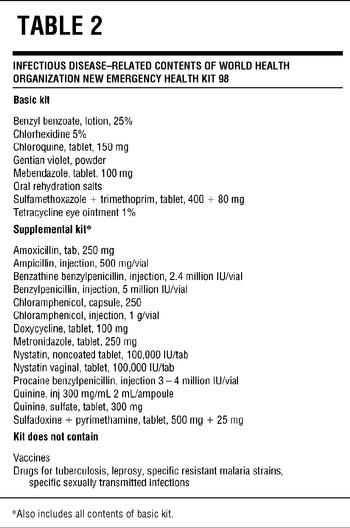
The distribution of antimicrobial medications should be done on a patient-by-patient basis by appropriately trained professionals. Table 2 lists the antibiotic-related contents of the most recent World Health Organization emergency kit, which can be used as a guide in deciding upon appropriate medications for the setting.66
Infectious Disease–Related Contents of World Health Organization New Emergency Health Kit 98

The following lists considerations to take into account when creating an antibiotic formulary for postdisaster settings:
• Endemic organisms in the disaster area
• Resistance patterns of endemic organisms
• Ease of administration in the field (oral preferred over intramuscular preferred over intravenous)
• Storage requirements (avoid drugs that require refrigeration or are damaged by freezing)
• Expiration dates for drugs not <4 y
• Vaccines and chemoprophlyactic agents
• Drugs needed to treat people affected by the disaster and the potential needs of those responding to the disaster
Again, because of rapidly changing epidemiology, drug formulary selection should be performed on a situational basis using the criteria listed above and the specific environment, with the WHO emergency kit used simply as the backbone. Baseline rates of antibiotic resistance should be ascertained, if there are preexisting data, and antibiotic kits appropriately modified.
CONCLUSIONS
Disasters, whether natural or man-made, have the potential to lead to outbreaks of infectious diseases. Despite the common portrayals by the media, outbreaks after a disaster are relatively infrequent and when they do occur, most are caused by endemic organisms as opposed to novel ones. The body of literature pertaining to infectious diseases after disasters has significant limitations, including the frequent lack of baseline data for comparison with postdisaster rates of infections and a lack of documentation of etiologic agents causing outbreaks. The main tools in prevention and treatment remain infection control, epidemiologic analysis, and laboratory diagnostics. By considering the type of disaster, rapidity of onset, endemic organisms, public health infrastructure, and baseline population characteristics, responders should be able to predict with reasonable certainty what infectious agents may pose a threat after a disaster, thereby allowing a tailored response. The recent movement toward including active research agendas in disaster response further solidifies our knowledge and improves the evidence-based foundation for interventions.
Author Disclosures: The author reports no conflicts of interest.