Bereavement is a universal experience that can result in a variety of emotional, cognitive, behavioural and biological changes that collectively we label as grief. Research indicates that although most people find ways to manage and adapt to their loss, a small percentage experiences chronic distress. Termed prolonged grief disorder (PGD), it is characterised by longing for the deceased, intense emotional pain related to the loss, shock, avoidance of reminders, difficulties in feeling the loss is real, numbness, difficulties in reengaging with life, meaninglessness and bitterness (Prigerson et al., Reference Prigerson, Horowitz, Jacobs, Parkes, Aslan, Goodkin and Maciejewski2009; World Health Organization, 2018). Empirical interest has increased significantly over the past two decades, and this study has highlighted a range of factors relevant to understanding heterogeneity in bereavement (Boelen, van den Hout, & van den Bout, Reference Boelen, van den Hout and van den Bout2006; Maccallum & Bryant, Reference Maccallum and Bryant2013; Stroebe, Schut, & Boerner, Reference Stroebe, Schut and Boerner2010), and resulted in the development of several promising treatments for PGD (e.g. Bryant et al., Reference Bryant, Kenny, Joscelyne, Rawson, Maccallum, Cahill and Nickerson2014; Shear et al., Reference Shear, Reynolds, Simon, Zisook, Wang, Mauro and Skritskaya2016). However, further research is needed to understand the multiple factors that impact grief reactions over time.
Gender has long been proposed as a potential predictor of bereavement outcomes. In an early study of PGD, Bierhals et al. (Reference Bierhals, Prigerson, Fasiczka, Frank, Miller and Reynolds1995) found that spousally bereaved females experienced higher levels of grief, anxiety and depression, than males during the first 2 years of bereavement. However, in subsequent studies, the observed relationship between gender and bereavement outcome has been mixed (see Burke & Neimeyer, Reference Burke, Neimeyer, Stroebe, Schut and van den Bout2013; Lobb et al., Reference Lobb, Kristjanson, Aoun, Monterosso, Halkett and Davies2010). One of the frequent limitations in bereavement research has been a reliance on, often small, samples of convenience, which can result in a relative lack of male participants. Although this pattern may reflect actual differences in death rates (Stroebe, Stroebe, & Schut, Reference Stroebe, Stroebe and Schut2001), the extent to which sampling approaches may have resulted in sample bias is unclear (e.g. Stroebe & Stroebe, Reference Stroebe and Stroebe1989).
In an attempt to resolve inconsistencies and methodological issues in the field, Stroebe et al. (Reference Stroebe, Stroebe and Schut2001) undertook a large-scale review comparing levels of distress in males and females in bereaved and nonbereaved samples. This enabled separation of bereavement-related distress from the base rate population-level distress. They found that compared to bereaved females, bereaved males showed a greater increase from the population-level distress in the acute grieving period. Thus they concluded that the consequences of spousal bereavement may be greater for males, at least in the acute phase. More recently, Lundorff, Bonanno, Johannsen, and O'Connor (Reference Lundorff, Bonanno, Johannsen and O'Connor2020) examined the impact of gender on grief during the first 12 months of bereavement in a large sample of spousally bereaved participants involved in The Aarhus Bereavement Study (TABstudy). This study applied latent growth curve mixture modelling to identify whether the data were best represented by one, or by multiple outcome trajectories. The analysis identified four distinct outcome trajectories (Resilient, 64%; Moderate-stable, 20.4%; Recovery, 8.4% and Prolonged grief, 6.8%), with no differences observed in the proportion of males and females in any one trajectory, suggesting gender had little impact on grief severity over time. An exception, however, was for individuals in the Prolonged grief trajectory. In this trajectory, males had more severe symptoms at baseline (2 months post bereavement), and showed a greater decrease in symptoms across time compared to females. These studies suggest that some males may experience higher distress in early bereavement, but that distress, when present, persists longer in females. However, the extent to which such differences have implications for optimal support provision has received less attention. The one bereavement intervention study that we are aware of that has directly examined gender and treatment efficacy concluded that males benefitted more from emotion-focussed treatments, whereas females benefitted more from problem-solving approaches (Schut, Stroebe, van den Bout, & de Keijser, Reference Schut, Stroebe, van den Bout and de Keijser1997). However, this study was conducted prior to contemporary conceptualisations of PGD.
Here, we extended investigation of gender and PGD by applying network analysis to data from a population cohort study (TABstudy). Network analysis builds on the proposition that mental health disorders arise and persist as a result of direct causal associations between the symptoms that comprise these conditions (Borsboom & Cramer, Reference Borsboom and Cramer2013). This contrasts with traditional views of psychopathology, which proposes that individual symptoms do not influence each other, rather they represent independent markers of an underlying process or pathology (Borsboom & Cramer, Reference Borsboom and Cramer2013; McNally et al., Reference McNally, Robinaugh, Wu, Wang, Deserno and Borsboom2015). Thus, from a network perspective, PGD is not a latent entity that gives rise to symptoms such as yearning, distress, avoidance and meaninglessness, but rather the symptoms directly cause and reinforce each other. For example, yearning and the failure to physically reunite with the deceased triggers distress, which may lead to avoiding reminders, which may result in a sense of meaninglessness, which perpetuates the yearning and distress. A practical implication of the network approach is that outcomes could be improved by developing interventions that target key nodes and connections; and, alternatively, where key nodes and connections differ, different treatment approaches may be indicated. Network analysis has been profitably applied to understanding the relationships between symptoms of PGD and comorbid conditions, identifying potentially influential nodes within networks, and exploring how individual symptoms may be differentially related to functional outcomes (e.g. Maccallum & Bryant, Reference Maccallum and Bryant2019; Maccallum, Malgaroli, & Bonanno, Reference Maccallum, Malgaroli and Bonanno2017; Malgaroli, Maccallum, & Bonanno, Reference Malgaroli, Maccallum and Bonanno2018; Robinaugh, LeBlanc, Vuletich, & McNally, Reference Robinaugh, LeBlanc, Vuletich and McNally2014).
In the current study, we constructed PGD symptom networks separately for males and females. Overall, we expected to see more similarities than differences between the networks. In line with previous network analyses, we expected yearning and distress to be strongly connected, and that meaninglessness would emerge as an important node. However, taking into account previous findings (Lundorff et al., Reference Lundorff, Bonanno, Johannsen and O'Connor2020; Stroebe et al., Reference Stroebe, Stroebe and Schut2001), we thought potential differences between genders may be more likely as the time since loss increased. For this reason, we constructed networks of PGD symptoms for male and female genders at two time points: in the acute phase, and nearing the end of their first year of bereavement when a diagnosis for PGD could be considered. Our primary interest was in exploring differences in key nodes and connections across networks, as these may provide important information for optimising supports and interventions for males and females across time.
Method
Participants and procedures
Data for this analysis were accessed from the TABstudy. This large multi-wave population-based survey of grief reactions is managed by the last author of this paper (https://psy.au.dk/en/research/research-centres-and-units/unit-for-bereavement-research/).
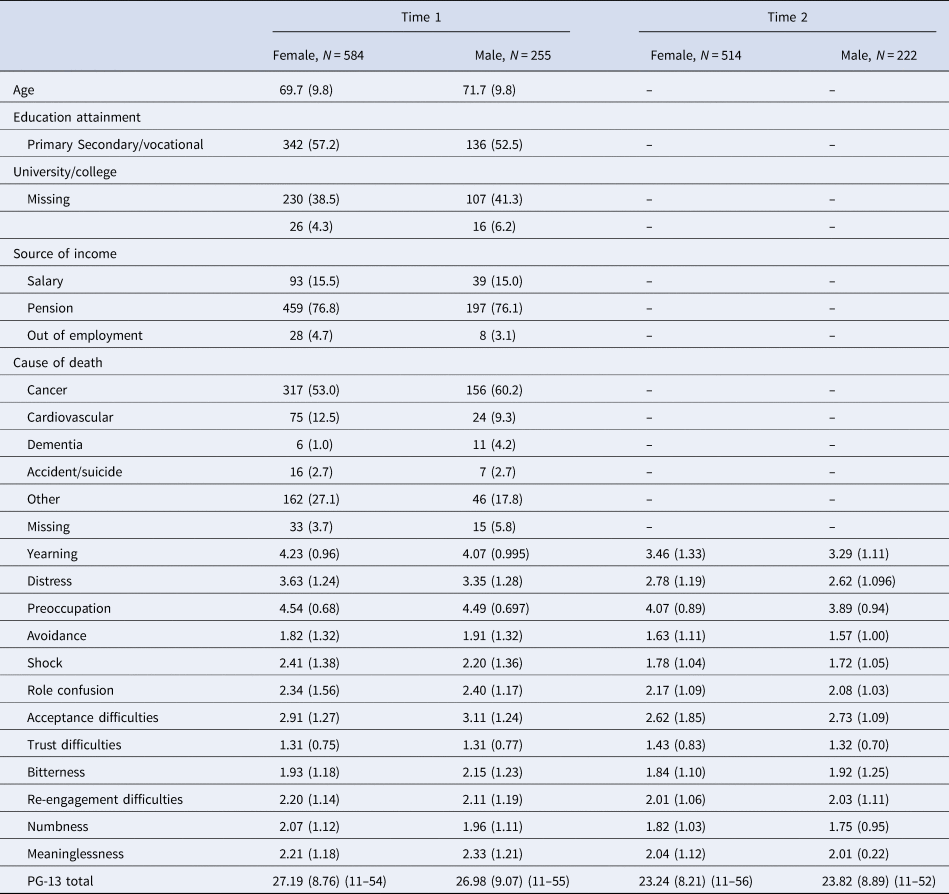
The TABstudy follows the General Data Protection Regulation of the European Union (2016/679), is conducted under the surveillance of the Danish Data Protection Agency (registration number: 2015-57-0002-62908-266) and was pre-registered at ClinicalTrials.org (NCT03049007) regarding the original hypotheses. Data were collected and managed using the research electronic data capture (REDcap) tool hosted at Aarhus University (Harris et al., Reference Harris, Taylor, Thielke, Payne, Gonzalez and Conde2009). This study includes a post hoc analysis performed on existing TABstudy data. The spousal bereaved sample was identified through consecutive extractions from the Danish Civil Registration System (DCRS), a nationwide registry with personal information about all Danish residents. The extractions identified individuals (aged 25–85) who had lost a spouse in the municipalities around Aarhus, Denmark, from January 2017 to March 2018. Identified individuals received a letter of condolence and an information pamphlet 1 month after their loss. Two months post-loss, eligible participants were contacted by telephone. Of 2006 identified adults, 1464 were contacted, and 986 agreed to participate. To address the aims of this study we used the data collected at 2- (time 1) and 11-months (time 2) post-loss. The TABstudy also includes a 6-month post-loss data collection time point. We did not analyse 6-month data for this study. In total, 847 individuals returned questionnaires, of which 760 (89.7%) had no missing grief data at time 1 (89.1% female; 91.1% male). At time 2, 694 (81.7%) had no missing grief data (82.0% female; 81.8% male). In total, 106 (13%) were missing all grief data at time 2. Participant characteristics are presented in Table 1. The sample was predominantly female (69.5%, n = 589), with a mean age of 70.3 years (s.d. = 9.7). The main form of income was the pension (79.6%) and the most common cause of death was cancer (57.6%). We have no information on race/ethnical background, but less than 10% of Danes are of other ethnicity than Danish. Comparing the eligible sample and the consenting group, there were no significant differences regarding gender. Gender was self-reported by participants.
Mean response on the PG-13 for males and females at 2- and 11-months post bereavement

Note: Educational attainment was dichotomised as (1) primary education (primary school, high school and vocational training) and (2) secondary education (college and university). Source of income was categorised as (1) salary for those holding a job, (2) pension for those on early voluntary retirement and those receiving self-financed or government-assisted pension and (3) out of employment (including unemployment benefits, government-sponsored support and social security payments due to sickness).
Measures
PGD symptoms were assessed using the Prolonged Grief-13 (PG-13; Prigerson et al., Reference Prigerson, Horowitz, Jacobs, Parkes, Aslan, Goodkin and Maciejewski2009). The PG-13 is a self-report measure that assesses the presence of yearning, emotional distress at the lost relationship, difficulty in accepting the death, shock, avoidance of reminders, numbness, bitterness, difficulty engaging in life, identity disturbance, a sense of purposelessness and meaninglessness, and functional impairment. Participants respond using 5-point rating scales from 1 (not at all) to 5 (several times a day/overwhelmingly). The items relating to functional impairment and symptom duration were not included in the networks. We included one additional item, which measured preoccupation with the circumstances of the loss on the same scale. This item was taken from the ICG-R (Prigerson et al., Reference Prigerson, Maciejewski, Reynolds, Bierhals, Newsom, Fasiczka and Miller1995). This additional symptom has been included in both ICD-11 and DSM-5 diagnostic definitions.
Data analysis
Network estimation and inference
Analyses were conducted using R version 4.0.2 (R Core Team, 2016). First, we estimated networks of regularised partial correlation coefficients for PGD symptoms, separately for male and female genders at 2 and 11-months post-loss, using the Fused Graphical Lasso procedure (FGL; Fried et al., Reference Fried, Eidhof, Palic, Costantini, Huisman-van Dijk, Bockting and Karstoft2018; Knefel et al., Reference Knefel, Lueger-Schuster, Bisson, Karatzias, Kazlauskas and Roberts2020). In a regularised partial correlation network, each edge represents the correlation between pairs of nodes after controlling for the value of all other variables in the network. The edge weights represent the strength of the partial correlation between nodes. When the partial correlation is zero, no edge is drawn. The graphical lasso (GLASSO) procedure employs a ‘least absolute shrinkage and selection operator’ (LASSO) correction to shrink very small connections to zero. The degree of correction is determined by minimising the Extended Bayesian Information Criteria (EBIC). The aim is to compute a parsimonious network, where fewer edges are used to explain variation in the data (Epskamp, Borsboom, & Fried, Reference Epskamp, Borsboom and Fried2018; Friedman, Hastie, & Tibshirani, Reference Friedman, Hastie and Tibshirani2008). The FGL procedure was implemented as it can produce more accurate estimations of network structures than estimating networks from related samples individually (Costantini et al., Reference Costantini, Richetin, Preti, Casini, Epskamp and Perugini2019; Danaher, Wang, & Witten, Reference Danaher, Wang and Witten2014). If the networks do differ, the FGL procedure comes closer to estimating the networks independently, while simultaneously drawing on similarities to improve estimation accuracy (Fried et al., Reference Fried, Eidhof, Palic, Costantini, Huisman-van Dijk, Bockting and Karstoft2018). We used the R package EstimateGroupNetwork to implement FGL (Costantini & Epskamp, Reference Costantini and Epskamp2017). To allow for consistency across analyses, we set the tuning parameter to EBIC (see Costantini et al., Reference Costantini, Richetin, Preti, Casini, Epskamp and Perugini2019). Responses were identified as ordinal. Recent simulation studies suggest that Spearman correlations provide more reliable estimates for ordinal data (Isvoranu & Epskamp, Reference Isvoranu and Epskamp2021). Accordingly, networks were based on Spearman correlations. Following network estimation, the importance of individual nodes was estimated by calculating node strength centrality. Pairwise-deletion of missing responses was implemented.
There are currently no methods to test the stability of jointly estimated networks. To explore network stability, we used the R package bootnet 1.1.0 (Epskamp et al., Reference Epskamp, Borsboom and Fried2018) on independently estimated networks. bootnet draws on qgraph (Epskamp, Cramer, Waldorp, Schmittmann, & Borsboom, Reference Epskamp, Cramer, Waldorp, Schmittmann and Borsboom2012) to compute 95% confidence intervals around each edge and test for significant differences in edge weights and node strength centrality within a network. bootnet also calculates an index known as the CS-coefficient. This indicates the extent to which apparent differences in node strength are stable and interpretable. It represents the maximum proportion of cases that can be dropped from the sample and retain a correlation of 0.7 (with 95% certainty) with the produced indices. It is recommended that where a CS-coefficient is above 0.50, the index can be interpreted with a degree of confidence; however, if a CS-coefficient falls below 0.20, the index should not be interpreted (Epskamp et al., Reference Epskamp, Borsboom and Fried2018).
Finally, we compared networks by examining correlations between edge weights and node order. We then used the R package ‘NetworkComparisonTest’ (NCT; van Borkulo et al., Reference van Borkulo, Boschloo, Borsboom, Penninx, Waldorp and Schoevers2015). The NCT package uses Pearson correlations to compare networks. However, correlations between Spearman and Pearson correlations were all greater than 0.97, suggesting it was acceptable to use the package. The NCT first provides an overall test of the extent to which all edges in a pair of networks are similar. Next, the package applies post hoc tests to examine how many of the possible edges differ across the pair. Finally, differences in the global strength estimates across two networks are tested. A significance value of p < 0.05 suggests that the two networks are reliably different. We set gamma at 0.5 and the number of iterations at 10 000. Recognising that different sample sizes can lead to a loss of power when comparing two networks, for each comparison, we subsampled the larger data set down to the same size of the smaller data set five times and repeated the NCT procedure as described earlier (see Fried et al., Reference Fried, Eidhof, Palic, Costantini, Huisman-van Dijk, Bockting and Karstoft2018). The results were similar: we report the initial analysis with unequal samples in the article and the secondary analysis in the online Supplementary Table S1.
Results
Participant's characteristics are presented in Table 1. A 2 (gender) × 2 (time) repeated measures analysis of variance on PG-13 scores indicated a main effect of time (F (1,670) = 198.475, p = 0.000, η = 0.23) only. Overall, PG-13 scores reduced significantly from time 1 to time 2. Table 1 presents frequencies on each PGD symptom for male and female genders at time 1 and time 2.
Network estimation
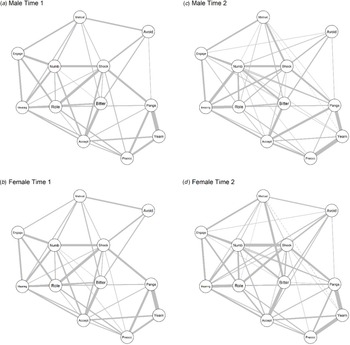
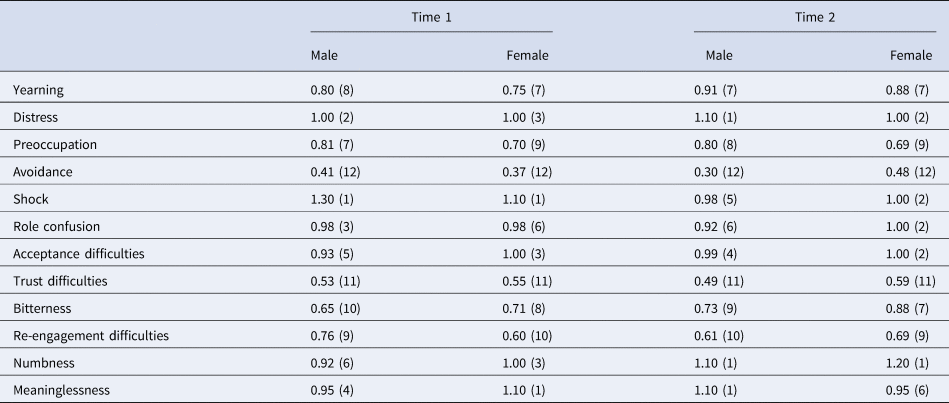
Figure 1 presents the estimated networks for male and female genders, 2 months (time 1; Figs 1a and b) and 11 months (time 2; Figs 1c and d) after the death, constructed using FGL (online Supplementary Fig. S1 for the combined networks for time 1 and time 2). Visual inspection of the time 1 networks revealed many similar edges across networks. For male gender, 38 of a possible 55 edges were present (69.1%); for female gender, 39 edges were present (70.9%). Overall, the Bootnet analysis indicated confidence intervals around the edge weights estimates were moderately large for both genders, indicating that only the weights of the thickest edges should be interpreted (see online Supplementary Figs S3 and S5). The strongest edge for both genders was from yearning to emotional pain/pangs of grief (pangs). For males, role confusion to shock, numbness to engagement, and acceptance to bitterness were the next strongest edges, however, few edges were identified as being stronger than any other. For females, acceptance difficulties to bitterness, and shock to numbness were the next strongest, and were identified as stronger than most other edges (online Supplementary Figs S2 and S4). In terms of node strength at time 1, the CS indices for males and females were 0.67 and 0.75, respectively, indicating that strength centrality order could be interpreted with some confidence. For males, shock was the strongest node (see Table 2). That is, this node had the highest absolute sum of edge weights. It was stronger than all other nodes, except for pangs. For female gender, shock had the highest strength centrality, however, approximately half the nodes also showed comparatively high strength (shock, yearning, role confusion, numbness and meaninglessness; see online Supplementary Figs S3 and S4).
Joint estimated networks of prolonged grief symptoms at time 1 and time 2 for males and female genders. Yearn = yearning; Pangs = emotional distress/pangs of grief; Preocc = preoccupation with circumstances of the death; Accept = difficulties with acceptance; Shock = sense of shock; Bitter = bitterness relating to the loss; Role = self-identity/role disturbance; Numb = emotional numbness; Mistrust = trust difficulties; Avoid = avoidance of reminders; Engage = difficulties reengaging with life; Meaning = meaninglessness.

Strength centrality indices for male and female networks at 2- and 11-months post bereavement

Note: Values represent the absolute edge strengths for each node. Numbers in parentheses refer to strength centrality order.
At 11 months post-loss (time 2), the edge between yearning and pangs continued as one of the strongest in both networks (see Figs 1c and d). Yearning to preoccupation also emerged as a strong edge in both networks. Again, bootnet indicated that only the weights of the thickest edges should be interpreted (online Supplementary Figs S7 and S9). For males, role confusion to meaninglessness and numbness to meaninglessness were the next strongest edges (45/55 edges present, 81.8%). For females, acceptance difficulties to bitterness, shock to numbness, and role confusion to meaninglessness were strongest edges (47/55 edges present, 85.4%) (online Supplementary Figs S6 and S8). In terms of node strength centrality, the CS indices were 0.64 and 0.67 for males and females, respectively, indicating that order was interpretable. For males, shock no longer had the highest centrality. Meaninglessness and numbness emerged as the strongest nodes at this time point. Numbness was also the most central node for females at time 2. However, for both genders, in relative terms, approximately half the nodes had higher strength centrality and half had lower strength centrality (see also online Supplementary Figs S7 and S9).
Network comparison
To compare male and female networks, we first correlated edge weights and strength centrality for each pair of networks (male and female at time 1 and time 2, respectively, see online Supplementary Table S1). In terms of edge weights, Spearman correlations between genders (time 1: r_s = 0.97; time: 2 r_s = 0.76) and within genders from time 1 to time 2 (males: r_s = 0.69; females: r_s = 0.80) were medium to large, indicating a similarity between networks. In terms of strength centrality, there was also agreement in strength centrality order between gender networks at time 1 (r_s = 0.93) and time 2 (r_s = 0.86). There was also agreement in strength centrality within genders from time 1 to time 2 (males: r_s = 0.85; females: r_s = 0.82).
Next, we used the NCT package to compare the temporal networks on several characteristics. In terms of the overall similarity of the network structures, the analysis indicated no significant differences between males and females at time 1 (p = 0.07) or time 2 (p = 0.42). Similarly, no differences were revealed in overall network structure for male and female gender networks across time (males: p = 0.27 and females: p = 0.18). Next, post hoc tests were conducted to determine how many individual edges differed across pairs of networks. NCT uses the Holm–Bonferroni method to correct for multiple testing in this analysis. This indicated six edges (10% of possible edges) differed significantly between males and females at time 1, with males having the stronger absolute edge in each case. The largest difference was between mistrust and re-engagement (see online Supplementary Table S2). At time 2, only three edges were identified as significantly different between the genders (5%); again, males had a stronger edge in each case. In terms of differences within genders across time, eight edges were significantly different for males between time 1 and time 2 (16% of possible edges). Most of these were weaker at time 2, with the exceptions of yeaning to preoccupation, which increased across time. Only four edges were identified as significantly different for females from time 1 to time 2 (7%). Three increased and one decreased in absolute strength: the largest was a decrease in bitterness to meaninglessness (see online Supplementary Table S2). Finally, we compared the global strength of the networks, that is, the absolute sum of edge weights for each network. There was no difference in global strength between the male and female network at time 1 (p = 0.72); however, females had greater global strength than males at time 2 (p = 0.031). There were no differences in the global strength of networks across time (males: p = 0.26, and females: p = 0.61, respectively).
Discussion
This study used network analysis to explore gender differences in symptoms of PGD after the death of a spouse. Although we identified some differences in the male and female networks, overall, our analyses revealed more similarities across genders. At 2- and 11-months post-loss, the edge between yearning and pangs of grief was one of the strongest for males and females. At 2 months, the edge between acceptance difficulties and bitterness was also strong for both genders. At 11 months, edges involving meaninglessness and numbness became more prominent for both genders (see Figs 1a–1d). These finding are consistent with previous network analyses of PGD symptoms (Maccallum et al., Reference Maccallum, Malgaroli and Bonanno2017; Malgaroli et al., Reference Malgaroli, Maccallum and Bonanno2018; Robinaugh et al., Reference Robinaugh, LeBlanc, Vuletich and McNally2014). Other similarities across genders included the strength centrality of shock at 2 months, and numbness and meaninglessness at 11 months post-loss. In contrast, an apparent difference between gender networks was the relative differences in strength centrality at time 1. Two months post-loss, shock was singularly central for males compared with females. For females, acceptance and meaninglessness evidenced comparable strength centrality to shock. The female network also had greater global strength 11 months post-loss.
We undertook this analysis as a novel way of exploring differences in bereavement outcomes of males and females. In an early investigation of PGD, Bierhals et al. (Reference Bierhals, Prigerson, Fasiczka, Frank, Miller and Reynolds1995) found that females experienced higher levels of grief, depression and anxiety across the first 2 years of bereavement. Subsequent analyses, which have applied a range of analytic techniques, have produced mixed findings (Boelen & Van den Bout, 2002-Reference Boelen and Van den Bout2003; Lundorff et al., Reference Lundorff, Bonanno, Johannsen and O'Connor2020; Stroebe et al., Reference Stroebe, Stroebe and Schut2001). Much of this study has focussed on overall symptom severity, in contrast, network analysis examines the relationships between symptoms. From a network perspective, psychological disorders develop when symptoms directly reinforce each other, ultimately settling into a ‘pathological equilibrium’ (McNally et al., Reference McNally, Robinaugh, Wu, Wang, Deserno and Borsboom2015). As each of our networks was constructed using between-subject data, we cannot comment on the direction of the relationships we observed. However, it is conceivable they are bidirectional. For example, yearning and the inevitable failure to achieve the goal of reunion may cause distress, and in turn, distress may promote yearning for the deceased spouse. Similarly, difficulties with acceptance may perpetuate a sense of bitterness (e.g. ‘This should not have happened’), and a sense of bitterness about the death may impede acceptance (‘It's so unfair. It can't be true’). The opposite could also be expected: reduced bitterness may promote greater acceptance, and increased acceptance may promote reduced bitterness. In contrast, the absence of an edge indicates that one symptom has no independent impact on the occurrence of the other (Borsboom, Reference Borsboom2017; Borsboom & Cramer, Reference Borsboom and Cramer2013). For example, at time 1, the presence or absence of emotional pangs of grief among females had no direct relationship with avoidance behaviour. Within network theory, observed differences in the independent relationships between symptoms of PGD for males and females could have implications for understanding the maintenance of the syndrome across genders and therefore optimal avenues for interventions (e.g. Schut et al., Reference Schut, Stroebe, van den Bout and de Keijser1997).
For a network as a whole to be influenced, however, the connections that extend beyond individual pairs of nodes are important. Our observed patterns of centrality may provide a possible mechanism for understanding relative differences in the persistence of PGD symptoms, such as those observed in Lundorff et al. (Reference Lundorff, Bonanno, Johannsen and O'Connor2020). For males, lessening shock could be expected to be associated with reduced activation of many other nodes in the network. Whereas for females, several nodes with equal centrality may mean that any one node has less impact on overall network activation, due to the potential reinforcing influence of more distant nodes with similar strength centrality. Where individuals are experiencing high distress at time 1, the greater strength of several nodes in the female network may have resulted in greater mutual reinforcement between symptoms, increasing their severity across time. To investigate the extent to which node strength differences emerge only as a property of network activation, or due to other factors, future studies would benefit from the inclusion of variables external to the PGD diagnosis, such as relationship dependence, or practical impacts such as financial changes.
Consistent with studies that have applied network analysis to understanding PGD more than 1-year post-death (Maccallum et al., Reference Maccallum, Malgaroli and Bonanno2017; Maccallum & Bryant, Reference Maccallum and Bryant2019; Robinaugh et al., Reference Robinaugh, LeBlanc, Vuletich and McNally2014), meaninglessness and numbness emerged as prominent nodes at 11 months post-loss for both males and females. These links are consistent with theoretical models of PGD, which have highlighted the difficulties that loss of meaning and loss of important roles can play in the maintenance of symptoms (Maccallum & Bryant, Reference Maccallum and Bryant2013; Neimeyer, Reference Neimeyer2019; Stroebe & Schut, Reference Stroebe and Schut1999). Overall, the findings are also in line with empirically validated treatments for PGD, which include components directed towards reducing disbelief, increasing acceptance, and building new sources of meaning (Bryant et al., Reference Bryant, Kenny, Joscelyne, Rawson, Maccallum, Cahill and Nickerson2014; Shear et al., Reference Shear, Reynolds, Simon, Zisook, Wang, Mauro and Skritskaya2016). The similarities between gender networks could be considered somewhat at odds with Schut et al. (Reference Schut, Stroebe, van den Bout and de Keijser1997), who found males and females showed differential responses to treatments, suggesting potential differences in mechanisms; however, as Schut et al. (Reference Schut, Stroebe, van den Bout and de Keijser1997) measured general health outcomes rather PGD symptoms, it is difficult to draw direct comparisons. Future investigations including a wider variety of indicators and applying more intensive longitudinal sampling to map dynamic, within-person change could provide further insights into the mechanisms of action of treatment.
There are a number of limitations to the conclusions that can be drawn from the current study. Although our data were drawn from a population-based sample, and we had a large number of male participants compared to previous bereavement studies, there remained a gender imbalance in our study, likely because more bereaved spouses in old age are female. We adopted several analytic measures to address this issue but cannot rule out an impact of this imbalance on the findings. Second, our sample comprised of older participants who had lost a spouse. Future studies will be needed to determine which findings are generalisable to other populations. Third, although there are no firm statistics for assessing network reliability, visual inspection suggests the edge widths at 11 months are more reliable (narrower confidence intervals) than those at 2 months. Few studies have examined grief reactions as early as 2 months post-loss, but data suggest that grief reactions reduce over time for most people (Bonanno & Malgaroli, Reference Bonanno and Malgaroli2020; Lundorff et al., Reference Lundorff, Bonanno, Johannsen and O'Connor2020). It is possible that networks constructed on data collected early in the bereavement may be capturing relationships that are in a state of flux, and have not yet developed into stable network structures; whereas, edges visualised at later time points may be modelling relationships which have settled into a degree of homoeostasis. Fourth, the networks were constructed using self-report data. Although the measures are widely used and validated, future studies may benefit from replication using structured clinical interviews. Finally, PGD is only one potential mental health consequence of bereavement. Future network investigations examining relationships for major depression or generalised anxiety could shed light on whether gender impacts other common bereavement-related mental health conditions. It may also be interesting to examine the impact of gender on more favourable consequences of bereavement, such as posttraumatic growth.
In summary, despite some gender differences, the most consistent finding in this study was that males and females are more similar than different when it comes to the ways in which the symptoms of PGD relate to each other. In line with an increasing number of studies which have highlighted the large amount of heterogeneity in bereavement outcomes (Bonanno & Malgaroli, Reference Bonanno and Malgaroli2020; Lundorff et al., Reference Lundorff, Bonanno, Johannsen and O'Connor2020; Maccallum & Bryant, Reference Maccallum and Bryant2018; Maccallum, Galatzer-Levy, & Bonanno, Reference Maccallum, Galatzer-Levy and Bonanno2015), our findings are consistent with the conclusion that there is potentially greater heterogeneity within genders than between genders. This does not exclude the possibility that gender can influence PGD expression. Indeed, we observed a greater overall global network strength for females compared to males at time 2. We did not, however, observe structural differences between genders. Increased understanding of the sources of heterogeneity in bereavement will come from the continued application of emerging statistical approaches that are capable of mapping sources of individual variation.
Supplementary material
The supplementary material for this article can be found at https://doi.org/10.1017/S0033291721003391.
Financial support
This work was supported by a grant from the Aarhus University Research Foundation (AUFF) awarded to the last author (grant number AUFF-E-2015-FLS-8-63). The funder had no role in study design, data collection and analysis, decision to publish or preparation of the manuscript.
Conflict of interest
None.