I. INTRODUCTION
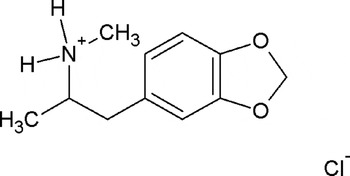
Methylenedioxymethylamphetamine hydrochloride, commonly known as MDMA.HCl or Ecstasy, is a well-known drug of abuse and is available in powdered and tablet form as anhydrous salt (Figure 1). A number of hydrated crystalline forms also exist, and Shulgin (Reference Shulgin1986) has referred to the melting points of five individual phases: anhydrous salt, quarter hydrate, hemihydrate, three-quarter hydrate and monohydrate. The final form assumed by the salt during crystallization depends on temperature and concentration in the initial stages of crystallization (Shulgin and Shulgin, Reference Shulgin and Shulgin1992).
Structural diagram of anhydrous MDMA.HCl (Ecstasy).

X-ray powder diffraction (XRD) is used in many forensic science laboratories for the analysis of drugs of abuse, together with their adulterants and excipients. Analysis of these mixtures is occasionally complicated by the presence of seemingly unidentified material. Powders containing Ecstasy are no exception, and if their analyses show them to be free from precursors and common adulterants or excipients, then consideration should be given to the possibility that the contaminant is either a polymorph or a hydrated form of the drug itself.
Single-crystal data have been collected for both the anhydrous (Morimoto et al., Reference Morimoto, Lovell and Kahr1998), PDF 02-070-4055 (ICDD, Reference Kabekkodu2012) and monohydrate (Zapata-Torres et al., Reference Zapata-Torres, Cassels, Parra-Mouchet, Mascarenhas, Ellena and De Araujo2008), PDF 02-098-9765 (ICDD, Reference Kabekkodu2012), forms of MDMA.HCl. The only experimental pattern in the Powder Diffraction File is that of the anhydrous form, PDF 00-039-1560 (ICDD, Reference Kabekkodu2012). Consequently, attempts to produce crystals of the monohydrate of MDMA.HCl have been undertaken to generate high-quality X-ray powder data.
II. EXPERIMENTAL
A. Preparation
Attempts to grow crystals of the monohydrate were made using four solvents: (a) deionized water, (b) methanol, (c) acetone, and (d) chloroform. Approximately 200 mg pure MDMA.HCl was dissolved in the minimum volume of solvent in small porcelain crucibles. A lid was placed on each crucible to protect the solutions from airborne contamination, and the solutions were allowed to evaporate at room temperature (20 ± 1 °C). When the solvents had completely evaporated, the resulting crystals were hand-ground for 5 min using an agate mortar and pestle. The finely powdered samples were side-loaded for powder diffractometry using the technique of McMurdie et al. (Reference McMurdie, Morris, Evans, Paretzkin and Wong-Ng1986).
B. Data collection
X-ray data were collected using a Philips PW1050/37 vertical diffractometer in θ/2θ mode with Fe-filtered CoKα radiation (λ = 1.78897 Å) from a Philips long fine focus tube powered at 35 kV and 42 mA. Fixed slits (1° divergence, 1° scatter, and 0.2 mm receiving) and a stationary sample holder were used. A scan range of 3–63° 2θ was used with a step size of 0.05° 2θ and a count time of 1 s at each step. Data were collected at 20 °C.
III. RESULTS AND DISCUSSION
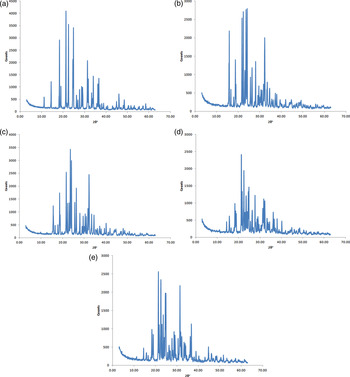
The X-ray powder patterns obtained are shown in Figure 2. The powder pattern for the sample of MDMA.HCl used as starting material (Figure 2a) was, as expected, identical to that reported in PDF 00-039-1560 (ICDD, Reference Kabekkodu2012). This will be referred to as Form I.
Powder diffraction patterns of: (a) pure anhydrous MDMA.HCl (Form I), (b) MDMA.HCl recrystallized from methanol (Form II), (c) MDMA.HCl recrystallized from acetone (Form II), (d) MDMA.HCl recrystallized from water (mixture of Forms I and II), and (e) MDMA.HCl recrystallized from chloroform (mixture of Forms I and II).

The XRD patterns of the samples recrystallized from methanol (Figure 2b) and acetone (Figure 2c) were identical in terms of d-spacing, but with slightly differing relative intensities, probably owing to a degree of preferred orientation. The overall diffraction pattern is, however, quite different from that of the starting material, Form I. This compound will be referred to as Form II. The patterns of the samples recrystallized from water (Figure 2d) and chloroform (Figure 2e) are clearly owing to mixtures of Forms I and II.
The powder data from Form II were indexed and unit cell parameters determined using DICVOL04 (Boultif and Louer, Reference Boultif and Louer2004). The Smith–Snyder (Smith and Snyder, Reference Smith and Snyder1979) index F N for Form II is F 20 = 70.0(0.0092, 31). These experimental unit cell parameters agree closely with those determined from the single-crystal study of MDMA.HCl.H2O (Zapata-Torres et al., Reference Zapata-Torres, Cassels, Parra-Mouchet, Mascarenhas, Ellena and De Araujo2008) suggesting that Form II is indeed the monohydrate of MDMA.HCl.
Crystal data are as follows:
3,4-methylenedioxymethylamphetamine hydrochloride monohydrate
C11H15NO2.HCl.H2O F.W. = 247.71
Monoclinic, space group P21/n (No. 14)
a = 7.2457 (12), b = 20.8132 (38), c = 9.1857 (17) Å, β = 108.257 (19)°
V = 1315.53 Å3, Z = 4, D x = 1.251 (g cm−3).
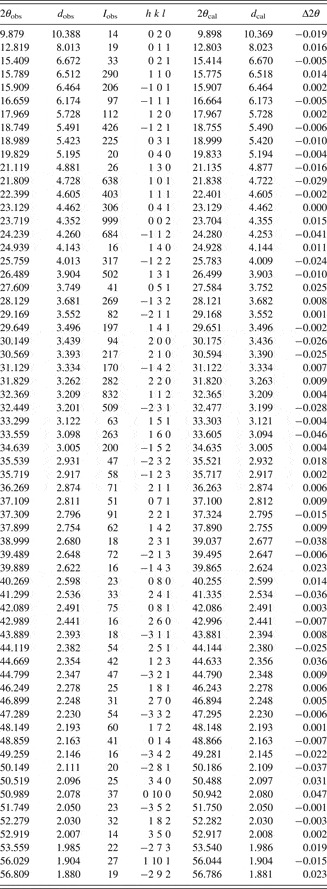
Table I shows 2θobs, d obs, I obs, hkl, 2θcal, and Δ2θ for 3,4-methylenedioxymethylamphetamine hydrochloride monohydrate.
XRD data for MDMA.HCl.H2O (CoKα).

IV. CONCLUSION
Crystallization of MDMA.HCl from a variety of solvents may result in either a monohydrate salt or a mixture of anhydrous salt and monohydrate. This work has resulted in an ambient temperature experimental powder pattern of pure monohydrate of the drug, which will be of use to forensic diffractionists.