Psychiatric comorbidity is exceptionally high, with the majority of individuals meeting criteria for multiple disorders (Caspi & Moffitt, Reference Caspi and Moffitt2018; Kessler, Chiu, Demler, & Walters, Reference Kessler, Chiu, Demler and Walters2005). Twin studies indicate psychiatric disorders contain a large heritable component, with estimates of ~40–80% depending on the disorder (Polderman et al., Reference Polderman, Benyamin, De Leeuw, Sullivan, Van Bochoven, Visscher and Posthuma2015). Taken together, a reasonable expectation is that diagnostic overlap would be mirrored at the genetic level of analysis. This was first demonstrated in family studies that examined an individual with a particular disorder, referred to as the proband, and levels of psychiatric risk in their close relatives. These results are suggestive of transdiagnostic risk pathways, with relatives presenting at increased risk for an array of psychiatric disorders and not solely the disorder present in the proband (Dean et al., Reference Dean, Stevens, Mortensen, Murray, Walsh and Pedersen2010; McLaughlin et al., Reference McLaughlin, Gadermann, Hwang, Sampson, Al-Hamzawi, Andrade and Kessler2012). This observation is by no means new, with reports of disorders not ‘breeding true’ recognized as early as the 19th century (Kendler, Reference Kendler2020). More specific examples of these reciprocal relationships have been identified for bipolar disorder (BIP) and major depressive disorder (MDD) (Smoller & Finn, Reference Smoller and Finn2003), increased risk for autism spectrum disorder (ASD) for relatives of probands with BIP or schizophrenia (SCZ) (Sullivan et al., Reference Sullivan, Magnusson, Reichenberg, Boman, Dalman, Davidson and Lichtenstein2012), and shared liability across the major anxiety disorders (Smoller, Gardner Schuster, & Covino, Reference Smoller, Gardner Schuster and Covino2008). The finding that BIP and SCZ also co-aggregate within families (Lichtenstein et al., Reference Lichtenstein, Yip, Björk, Pawitan, Cannon, Sullivan and Hultman2009) stands in contrast to even the classic ‘Kraepelinian dichotomy’ that sharply delineates between these two disorders. Indeed, this observation has resulted in others challenging this dichotomy both recently (Craddock & Owen, Reference Craddock and Owen2005) and over a century ago when it was first introduced (Kendler & Engstrom, Reference Kendler and Engstrom2018). Twin methods have corroborated this general pattern of findings by identifying the high levels of genetic correlations across disorders (see Smoller et al., Reference Smoller, Andreassen, Edenberg, Faraone, Glatt and Kendler2019 for a review) and modeling these correlations to identify overarching genetic factors for clusters of disorders (e.g. externalizing, internalizing; Kendler et al., Reference Kendler, Aggen, Knudsen, Røysamb, Neale and Reichborn-Kjennerud2011). Genomics, which uses information about directly measured DNA, has more recently been used to understand cross-disorder risk in novel and exciting ways. The following provides an overview of recent advances in cross-disorder genomics at various levels of analysis (Fig. 1), discusses next major steps, and considers how these findings might be incorporated into future diagnostic revisions.
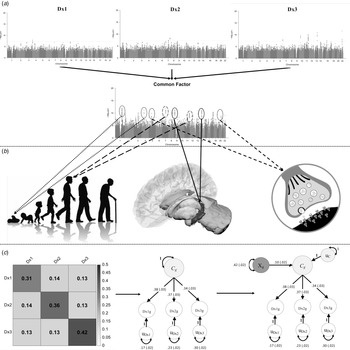
Levels of genomic analysis. Panel (a) depicts Manhattan plots for three hypothetical disorders (Dx1, Dx2, and Dx3). Manhattan plots are typically used to depict GWAS results with −log 10(p values) on the y-axis, the chromosomes on the x-axis, and each point reflecting the result for an individual genetic variant. The common factor Manhattan plot directly below the individual disorder plots is illustrative of cross-disorder efforts to identify the genetic signal shared across the three disorders. Panel (b) depicts the goal of mechanistic studies to group together variants based on their functional characteristics. These characteristics can include when in development (e.g. early life and adulthood), specific tissue types (e.g. the hippocampus), and neuronal subtypes or functions (e.g. calcium channel signaling) where the variants are expressed. Panel (c) depicts the genetic covariance matrix across the three disorders estimated using LDSC, which was then used as input for Genomic SEM to produce the unstandardized estimates for the common factor model shown in the middle. Once a measurement model is identified, psychiatric factors can be associated with relevant external correlates, depicted in the generic form here as trait X in the rightmost panel. Notably, none of these external traits or disorders need to be measured in the same sample in order to be included in the model.

Genetic variants transgress diagnostic boundaries
Initial efforts to identify genetic variants associated with psychiatric risk employed a candidate gene approach. This methodology compared candidate genes thought to have large effect across samples of cases and controls. These studies ultimately failed to produce replicable findings due, in part, to extremely low statistical power. This low power reflects the highly polygenic nature of human complex traits, wherein the vast majority of outcomes are influenced by thousands of variants that individually explain a very small portion of the genetic variance in the population (Manolio et al., Reference Manolio, Collins, Cox, Goldstein, Hindorff, Hunter and Visscher2009; Visscher et al., Reference Visscher, Wray, Zhang, Sklar, McCarthy, Brown and Yang2017). This issue is further compounded by the observation that the field was generally poor at choosing the candidates. For example, a recent analysis for MDD found that the most popularly studied candidate genes evinced negligible associations in larger samples and were no more associated with depression phenotypes than genes selected at random (Border et al., Reference Border, Johnson, Evans, Smolen, Berley, Sullivan and Keller2019).
Genome-wide association studies (GWAS), combined with large sample sizes reflective of collaboration across many individual studies, have since been used to perform a hypothesis-free search of the genome (Fig. 1a). GWAS largely focuses on common (i.e. frequency >1%) DNA variants, known as single-nucleotide polymorphisms (SNPs) that generally consist of two alleles, and some more rare copy number variants (CNVs). The output of a GWAS is referred to as a set of summary statistics, which consist of regression relationships between each SNP and the trait of interest. In the context of psychiatric GWAS studies that typically employ samples of cases and controls, the GWAS then tests for differences in allele frequencies across individuals with and without a particular disorder. These efforts have expanded rapidly in the last decade, with the latest efforts for MDD and SCZ identifying over 102 and 270 associated variants, respectively (Howard et al., Reference Howard, Adams, Clarke, Hafferty, Gibson, Shirali and McIntosh2019; Schizophrenia Working Group of the Psychiatric Genomics Consortium, 2020).
As most traits are affected by thousands of genetic variants, it follows that many of the underlying causal variants would be shared across traits (Visscher et al., Reference Visscher, Wray, Zhang, Sklar, McCarthy, Brown and Yang2017). Indeed, approximately 90% of variants are estimated to pleiotropic, which is to say that they are associated with multiple outcomes (Watanabe et al., Reference Watanabe, Stringer, Frei, Mirkov, de Leeuw, Polderman and Posthuma2019). Cross-disorder genomic efforts have sought to capitalize on this shared genetic architecture to identify variants that are pleiotropic across psychiatric disorders. Initial evidence indicated that rare CNVs were associated with a diverse range of disorders, including ASD, attention-deficit/hyperactivity disorder (ADHD), and SCZ (Malhotra & Sebat, Reference Malhotra and Sebat2012). The Cross-Disorder Working Group of the Psychiatric Genomics Consortium (PGC) undertook their second major effort (CDG2) to meta-analyze a sample of 727 126 participants across eight distinct psychiatric disorders (Lee et al., Reference Lee, Anttila, Won, Feng, Rosenthal, Zhu and Smoller2019). Results were indicative of 109 pleiotropic variants that were associated with at least two disorders, and 23 pleiotropic variants associated with four or more disorders. This included a variant (rs8084351) in the DCC gene associated with all eight disorders and a variant (rs7193263) in the RBFOX1 gene associated with all disorders except for anorexia nervosa. These genes are also biologically plausible candidates for neuropsychiatric risk given the role of the DCC gene in axonal growth during neurodevelopment (Bendriem & Ross, Reference Bendriem and Ross2017) and of RBFOX1 in synapse formation (Hamada et al., Reference Hamada, Ito, Iwamoto, Morishita, Tabata and Nagata2015). In the most recent cross-disorder genomic effort, 152 pleiotropic variants were identified across 11 psychiatric disorders (Grotzinger et al., Reference Grotzinger, Mallard, Akingbuwa, Ip, Adams, Lewis and Nivard2020).
Identified pleiotropic variants likely reflect some combination of three different types of pleiotropy (Paaby & Rockman, Reference Paaby and Rockman2013). Vertical (i.e. mediated) pleiotropy refers to a causal cascade, where the variant affects trait A, and trait A causes trait B, thereby introducing an indirect association between the variant and trait B. In contrast, horizontal pleiotropy reflects a variant that directly affects traits A and B. Horizontal pleiotropy can occur when a single variant codes for multiple molecular functions, when a variant affects a single upstream process with broad downstream effects, or when phenotypes share certain characteristics. For psychiatric disorders, the latter two cases are more plausible given overlapping symptoms (i.e. shared characteristics) and risk factors (i.e. shared upstream process) across disorders. Methods for discriminating between horizontal and vertical pleiotropy have found evidence for both when applied to human complex traits more generally (Verbanck, Chen, Neale, & Do, Reference Verbanck, Chen, Neale and Do2018; Zhu et al., Reference Zhu, Zheng, Zhang, Wu, Trzaskowski and Maier2018). This likely also holds for psychiatric traits, but largely remains to be tested. However, others have noted as indication against vertical pleiotropy a paucity of evidence that early onset disorders are causal for later onset disorders (Schijven, Veldink, & Luykx, Reference Schijven, Veldink and Luykx2020).
The third type, spurious pleiotropy, captures variants that are falsely associated with multiple traits due to different forms of bias. One such source of bias can arise due to linkage disequilibrium, which refers to the correlational structure in the genome induced by physically proximal variants being inherited together (Slatkin, Reference Slatkin2008). This has the consequence that a variant identified as associated with two traits may be a surrogate for two, separate causal variants. Fine mapping strategies that aim to identify the likely causal variant in a genomic region (Schaid, Chen, & Larson, Reference Schaid, Chen and Larson2018) can be used in future research to determine if the actual causal variant is shared across disorders. Diagnostic misclassification will also inflate the levels of spurious pleiotropy, a particular challenge for psychiatric genomics given findings such as 15% misdiagnosis rates across BIP and SCZ (Bromet et al., Reference Bromet, Kotov, Fochtmann, Carlson, Tanenberg-Karant, Ruggero and Chang2011). However, it should be noted that it can also be unclear what the ‘correct’ diagnosis is for so-called mixed presentations that do not neatly fall into a single disorder class. In addition, longitudinal studies using standardized assessment batteries indicate changing diagnoses over time within an individual (e.g. Caspi et al., Reference Caspi, Houts, Ambler, Danese, Elliott, Hariri and Rasmussen2020). Given genotypes that do not change over time, with respect to genomics efforts it would be ideal to capture the transdiagnostic traits that predict risk across these changing diagnoses. Mixed-presentations and changing diagnoses may both be addressed by utilizing more fine-grained phenotypes (e.g. shared symptoms or risk factors) that transcend diagnostic boundaries, a topic returned to in the future directions section.
Mechanistic studies detect transdiagnostic risk pathways
As sample sizes in GWAS continue to grow, we will begin to uncover thousands of variants associated with psychiatric risk. If we consider each variant an individual brushstroke, mechanistic studies look to zoom out to understand the biological picture being painted (Gandal, Leppa, Won, Parikshak, & Geschwind, Reference Gandal, Leppa, Won, Parikshak and Geschwind2016). This is achieved by grouping variants together based on functional characteristics, such as the specific tissue types (e.g. certain areas of the brain) or when in development the genes are expressed. These characteristics are typically identified using collateral gene expression data, such as single-cell RNA sequencing. Mechanistic approaches thereby offer a means of distilling the thousands of constituent parts (genetic risk variants) down to a handful of cohesive, biological targets (Fig. 1b). Within the PGC, a number of exciting results have already emerged. In the first major cross-disorder effort (Cross Disorder Working Group of the Psychiatric Genomics Consortium, 2013), genes involved in calcium channel signaling were found to be associated with ASD, ADHD, SCZ, MDD, and BIP. In follow-up research from the PGC Network and Pathways Analysis subgroup, BIP, MDD, and SCZ were collectively associated with pathways relevant to immune and neurotrophic function, histone methylation, and synaptic biology (Network and Pathway Analysis Subgroup of the Psychiatric Genomics Consortium, 2015). The CDG2 project mentioned previously identified enrichment across the eight disorders for pathways relevant to glutamate receptor signaling, neurodevelopment (e.g. neuron differentiation), genes expressed during the second prenatal trimester, and voltage-gated calcium channel signaling (Lee et al., Reference Lee, Anttila, Won, Feng, Rosenthal, Zhu and Smoller2019). Stratified genomic structural equation modeling (Genomic SEM) is a recently introduced method that can be used to specifically examine multivariate enrichment (Grotzinger et al., Reference Grotzinger, Mallard, Akingbuwa, Ip, Adams, Lewis and Nivard2020). Application of this method to 11 psychiatric disorders identified conserved regions to be enriched across disorders. Conserved regions capture genes that occur across species (i.e. that are conserved) and, in line with its broad transdiagnostic associations, are consequently thought to be particularly relevant to overall functioning. In contrast, GABAergic and excitatory genes were specifically enriched for shared genetic risk across BIP and SCZ. Collectively, these findings offer insight into varying levels of cross-cutting risk, from entirely transdiagnostic to a specific pair of disorders. As GWAS results may implicate effective drug targets (King, Davis, & Degner, Reference King, Davis and Degner2019), cross-disorder mechanistic findings offer opportunities for drug repurposing or novel pharmacological targets for particularly comorbid presentations.
Genome-wide analyses identify disorder clustering
At the uppermost level of genomic analysis, methods such as LD-score regression (LDSC; Bulik-Sullivan et al., Reference Bulik-Sullivan, Finucane, Anttila, Gusev, Day, Loh and Neale2015a) have been developed to translate GWAS estimates into SNP-based heritability estimates for individual traits. SNP-based heritabilities are estimated using the entire set of summary statistics, and not just the statistically significant SNPs. These estimates are generally lower than those obtained from twin studies, in part because summary statistics include only common variants, while twin study estimates encompass all inherited variants. Current estimates for psychiatric disorders indicate that SNP-based heritability captures approximately 30–50% of the genetic variance estimated from twin studies (Baselmans, Yengo, Van Rheenen, & Wray, Reference Baselmans, Yengo, Van Rheenen and Wray2020).
Cross-trait LDSC applies the same underlying principles to pairs of summary statistics to estimate genetic co-heritability (i.e. genetic covariance; Bulik-Sullivan et al., Reference Bulik-Sullivan, Loh, Finucane, Ripke, Yang, Patterson and Neale2015b). Genomic SEM (Grotzinger et al., Reference Grotzinger, Rhemtulla, de Vlaming, Ritchie, Mallard, Hill and Tucker-Drob2019) builds on bivariate LDSC to formally model genetic covariance matrices estimated across multiple pairs of summary statistics. Numerous forms of models can be estimated in Genomic SEM. This includes the ability to model latent factors that reflect shared variance across psychiatric disorders or symptoms within a disorder, multiple regression models that examine shared and unique associations across disorders and relevant external correlates (e.g. socioeconomic outcomes), or some combination of the two. Notably, the summary statistics used to construct these genetic covariance matrices can be estimated using participant samples with varying levels of overlap, including entirely independent sets of participants. Relationships within and across disorders should not be taken as causal as the sets of traits included in the model are unlikely to be longitudinal, much less measured in the same sample. However, it is specifically because the summary statistics can come from independent samples that presents such a unique opportunity in psychiatric comorbidity research. Namely, systems of relationships can now be examined in the same statistical model across rare, and even mutually exclusive traits, such as disorders that disallow one another (e.g. BIP and SCZ) and distinct developmental presentations within disorders (e.g. early and late onset versions of SCZ).
In one of the first major applications of Genomic SEM, CDG2 modeled eight disorders to identify three correlated genomic factors defined primarily by compulsive disorders [anorexia nervosa, obsessive-compulsive disorder, and Tourette syndrome (TS)], mood and psychotic disorders (MDD, BIP, and SCZ), and early-onset neurodevelopmental disorders (ASD, ADHD, and TS; Lee et al., Reference Lee, Anttila, Won, Feng, Rosenthal, Zhu and Smoller2019). A fourth, internalizing disorder factor has since been identified using Genomic SEM, reflecting the inclusion of post-traumatic stress disorder, anxiety disorders, and alcohol use disorder (Grotzinger et al., Reference Grotzinger, Mallard, Akingbuwa, Ip, Adams, Lewis and Nivard2020).
These results should be interpreted in the context of three primary considerations. First, because genetic correlations estimated from GWAS summary statistics utilize only common variants, genetic correlations will only be equivalent across genomic and family-based estimation methods as long as the genetic correlation is constant across rare and common variants (Van Rheenen, Peyrot, Schork, Lee, & Wray, Reference Van Rheenen, Peyrot, Schork, Lee and Wray2019). This largely remains an open question as sequencing efforts that capture rare variants are only just beginning to produce results in psychiatric genomics. Second, it is of note that the absolute level of genetic correlations can be upwardly biased when misclassification is present (Wray, Lee, & Kendler, Reference Wray, Lee and Kendler2012). However, simulations indicate that extremely high rates would be needed to explain the pattern of sizeable genetic correlations across psychiatric traits (Anttila et al., Reference Anttila, Bulik-Sullivan, Finucane, Walters, Bras, Duncan and Neale2018). Third, simulation results indicate that ascertainment of controls in GWAS can upwardly bias estimates of genetic correlation when studies utilize super-normal controls that are screened both for the disorder of interest and related disorders (Kendler, Chatzinakos, & Bacanu, Reference Kendler, Chatzinakos and Bacanu2020). It is worth noting that the upward bias was found to be most pronounced for traits with a population prevalence higher than what is commonly observed for the majority of psychiatric traits (e.g. >15%). Simulations then indicate both that estimated genetic correlations across psychiatric traits are likely upwardly biased, but are highly unlikely to be entirely artifactual.
Even as genomics has rapidly expanded there are certain traits, namely those that are more intensive to measure, that are unlikely to reach sufficient sample sizes for GWAS in the near future. In these instances, polygenic risk score (PRS) analyses may prove informative in associating genetic risk for a given psychiatric disorder to these more nuanced outcomes. PRS analyses utilize genome-wide summary statistics from an independent sample to construct individual participants' risk scores based on their measured genotypes (Wray et al., Reference Wray, Lee, Mehta, Vinkhuyzen, Dudbridge and Middeldorp2014). Constructing a PRS is similar to scoring a questionnaire, where the summary statistics reflect the scoring key, and the participant genotypes their responses on the survey. A PRS then reflects an omnibus, single measure of an individual's genetic risk for a given outcome across the genome. These sorts of analyses have been used in interesting ways to examine genetic overlap across different presentations of disorders. For example, SCZ PRSs evinced a stronger positive association with BIP characterized by mood-incongruent psychosis than BIP with mood-congruent psychosis or without psychosis (Allardyce et al., Reference Allardyce, Leonenko, Hamshere, Pardiñas, Forty, Knott and Escott-Price2018). In addition, SCZ PRSs have been positively associated with the earlier age of onset of BIP (Ruderfer et al., Reference Ruderfer, Ripke, McQuillin, Boocock, Stahl, Pavlides and Freedman2018).
The future of cross-disorder genomics
Psychiatric genomics has made amazing advances over the last decade, revealing high levels of polygenicity and pleiotropy across disorders, shared functional pathways, and patterns of genetic overlap modeled to identify clusters of disorders. Even still, we have only just begun to understand the cumulative genetic architecture across psychiatric traits. An obvious next step is to continue to collect more data. To this end, the PGC has set the goal of obtaining GWAS data on 100 000 cases for each major disorder (Sullivan et al., Reference Sullivan, Agrawal, Bulik, Andreassen, Børglum, Breen and O'Donovan2018). These efforts will also include whole genome and exome sequencing efforts that aim to capture more rare variants. Larger sample sizes coupled with sequencing efforts will certainly uncover more associated variants and, given sizeable SNP-based co-heritability estimates, many of these variants are likely to be pleiotropic. At the same time, it is estimated that even with samples of 500 000 cases and controls (i.e. total N = 1 000 000), identified risk variants will account for 60% of the SNP-based heritability for SCZ and BIP, and only 10% of the SNP-based heritability for MDD (Holland et al., Reference Holland, Frei, Desikan, Fan, Shadrin, Smeland and Dale2020). Identifying risk variants for MDD is especially difficult as this reflects a disorder that is both highly polygenic and less heritable, which is to say that there are a relatively large number of risk variants with particularly small effect to uncover. This indicates that cross-disorder genomic efforts in the near future should look beyond solely identifying additional pleiotropic loci as this will likely only capture a portion of the overarching biological picture. With that said, efforts to include more sophisticated phenotypes and explicitly consider the role of the environment are both within reach and likely to add considerable nuance to our current understanding.
For pragmatic reasons, psychiatric GWAS outcomes are typically at the level of comparing those with and without a disorder. This has the advantage of being able to combine across cohorts utilizing various ascertainment strategies in order to obtain the extremely large sample sizes necessary to achieve adequate power. One downside with respect to cross-disorder efforts is that this will aggregate across potential subgroups within a disorder, or clusters of disorder symptoms, that may be more tightly linked with other disorders. The PRS analyses noted above highlight a particular example where certain presentations of BIP may be characterized by higher levels of genetic overlap with SCZ. Methods such as BUHMBOX (Han et al., Reference Han, Pouget, Slowikowski, Stahl, Lee, Diogo and Raychaudhuri2016) can be used to detect whether there are particular subgroups within a disorder that drive genetic correlations with other disorders. Initial findings have not found evidence for these subgroups within MDD (Howard et al., Reference Howard, Folkersen, Coleman, Adams, Glanville, Werge and McIntosh2020), but this remains to be tested across other disorders. Extraordinary efforts are also underway to collect symptom level data for individual disorders. In addition, electronic health records (EHRs) are becoming an increasingly utilized resource that can be used to link genomic data and population-level medical registries that include information on both a wide range of psychiatric traits and other diseases or outcomes (Smoller, Reference Smoller2018). Indeed, a number of initiatives have been created with the explicit purpose of capitalizing on EHR and genomic data, including the eMERGE network (Gottesman et al., Reference Gottesman, Kuivaniemi, Tromp, Faucett, Li, Manolio and Brilliant2013), the PsycheMERGE consortium (Zheutlin et al., Reference Zheutlin, Dennis, Karlsson Linnér, Moscati, Restrepo, Straub and Huckins2019), the NIH ‘All of Us’ program (All of Us Research Program, 2019), the Genomic Aggregation Project in Sweden (GAPS; Bergen & Sullivan, Reference Bergen and Sullivan2018), the Danish Biobank Register (Agerbo et al. Reference Agerbo, Sullivan, Vilhjalmsson, Pedersen, Mors, Børglum and Ripke2015), and the Nord Trondelag Health Study (HUNT; Krokstad et al., Reference Krokstad, Langhammer, Hveem, Holmen, Midthjell, Stene and Holmen2013).
Absent from this review thus far is consideration of the environment. Indeed, the environment is important not just in its own right, but also as a contextual moderator of heritability estimates. That is, although our genetic code is static, estimates of heritability will vary across environments that increase or decrease the role of genetically influenced individual differences. For example, a heritability estimate of 50% may reflect a scenario where a trait is entirely due to the environment in half the population and entirely due to genetics in the other half of the population (Purcell, Reference Purcell2002). Due to this gene–environment interplay, genetic estimates are always best considered in light of the environment they are measured in. The term environment is used here to include both the aspects of our external surroundings and our internal milieu at different developmental stages. Consideration of the environment is specifically relevant to cross-disorder efforts as the pattern of overlap across disorders may also shift across contexts, including developmental stages and socioeconomic backgrounds. Recent study has specifically demonstrated the moderating role of biological sex for genetic correlations across a number of psychiatric traits, including a positive and null genetic correlation between BIP and MDD in females and males, respectively (Martin et al., Reference Martin, Khramtsova, Goleva, Blokland, Traglia and Walters2021).
Moving toward a bottom-up psychiatric nosology
Fuzzy disorder boundaries arguably reflect a diagnostic system that was largely constructed based on clinical observation and expert consensus. An alternative path forward is to look toward creating a bottom-up nosology based on biological research, such as the cross-disorder genomic results reviewed here. In line with research initiatives such as RDoC (Insel & Cuthbert, Reference Insel and Cuthbert2009) and HiTOP (Kotov et al., Reference Kotov, Krueger, Watson, Achenbach, Althoff, Bagby and Zimmerman2017), future diagnostic manuals may describe alterations in dimensions of functioning, as opposed to discrete categories. Psychiatric genomics indicates that the majority of these dimensions are likely to be shared across the disorders, while fewer may be highly disorder specific. Future mechanistic and genomic modeling research can begin to inform how these dimensions map onto our current categories, an enterprise that has tangible clinical implications. For example, it is standard clinical practice to ask about family history of mental illness as this can inform the differential diagnoses under consideration. Consider a patient in the current framework who is diagnosed with SCZ and has a family history of BIP. A future diagnostic system might use convergent evidence across different levels of explanation (e.g. genomics, functional imaging, and sociocontextual factors) to reconceptualize BIP and SCZ as sharing risk pathways relevant to episodic emotion dysregulation and SCZ as additionally characterized by cognitive deficits. A model where a patient and their family members are diagnosed with episodic dysregulation, and the patient additionally noted to have cognitive deficits, provides more tangible intervention targets with explicitly linked familial risk pathways.
An alternative approach is that the diagnoses remain unchanged, but a separate section in diagnostic manuals addresses considerations for particularly comorbid presentations. As many psychiatric medications are already prescribed universally across disorders (e.g. selective serotonin reuptake inhibitors; Vaswani, Linda, & Ramesh, Reference Vaswani, Linda and Ramesh2003), future mechanistic studies offer the opportunity to make more informed decisions around identifying transdiagnostic biological targets. Medications that regulate these targets might then be considered as first-line treatments for particularly comorbid presentations and ultimately reduce growing levels of psychiatric polypharmacy (Mojtabai & Olfson, Reference Mojtabai and Olfson2010). Without any diagnostic revision, we might also consider an explicit goal of patient psychoeducation to clarify that individuals diagnosed with multiple disorders do not face an overwhelming array of independent problems. Rather, receiving multiple psychiatric diagnoses ultimately reflects overlapping risk pathways indicated across convergent lines of evidence from phenotypic, genetic, and environmental research.
Conclusions
The comorbidity problem is by no means unique to psychiatry. Similar sets of results with respect to familial clustering, cross-disorder treatment effects, and high levels of pleiotropy are observed across autoimmune disorders including Crohn's disease, rheumatoid arthritis, and type 1 diabetes (for an review, see Cotsapas & Hafler, Reference Cotsapas and Hafler2013). This has resulted in analogous conversations surrounding revision of autoimmune nosology and highlights an important point: type 1 diabetes and arthritis certainly appear quite different, but despite our observation the biology points toward a conglomeration of both cross-cutting and distinct pathways. Within psychiatry, many disorders also seem dissimilar, but their general co-occurrence at levels far higher than chance necessitate understanding the underlying causes of this overlap. Cross-disorder genomics is converging on the ability to fill in major gaps in our understanding of comorbidity via emerging evidence across genome-wide, mechanistic, and individual variant levels of analysis. As genomic research continues to progress, it will likely play an increasingly important role in the process of ‘epistemic iteration’, whereby our diagnostic categories are iteratively updated to reflect an evidence base that gradually approximates the latent structure of psychopathology (Kendler, Reference Kendler2009).
Conflict of interest
The author declares no competing interests.