Depression is a highly prevalent mental disorder, and the leading cause of disability worldwide (ABS, 2018) disproportionately affecting Indigenous Australians. Indigenous Australians are three times more likely to experience high levels of psychological distress compared to non-Indigenous Australians and have a 33% lifetime prevalence of depression juxtaposed with the national estimate of 14% (ABS, 2013; McNamara et al., Reference McNamara2018).
The cause of this higher rate of depression is yet to be determined; however, a range of risk factors including early life disadvantage, poorer overall health, discrimination, socio-economic disadvantage, and reduced access to mental health information and treatment are likely contributing factors (Krieg, Reference Krieg2009; Zubrick et al., Reference Zubrick2010). The few studies that examine depression in older Indigenous Australians focus on social and physical outcomes factors that can protect against depressive symptoms are yet to be examined in detail (Almeida et al., Reference Almeida2014; Gubhaju et al., Reference Gubhaju2013; Shen et al., Reference Shen, Radford, Daylight, Cumming, Broe and Draper2018).
Two predominant factors known to impact later life depression are level of physical activity and adverse early life experiences, such as childhood trauma.
Physical activity is recognised as an important contributor to health across all people, and in non-Indigenous populations has been seen to reduce rates of depression even after controlling for body mass index, smoking history, and physical health conditions (Mead et al., Reference Mead, Morley, Campbell, Greig, McMurdo and Lawlor2008; Ströhle, Reference Ströhle2009). This relationship has been reported across multiple age ranges and various cultural groups (Schuch et al., Reference Schuch, Vancampfort, Richards, Rosenbaum, Ward and Stubbs2017). The effects of physical activity on depressive symptoms have been reported as similar to pharmacological treatments or Cognitive Behavioural Therapy, with further links to improved physical health (Mead et al., Reference Mead, Morley, Campbell, Greig, McMurdo and Lawlor2008) and increased acceptability within the Indigenous community (Esgin et al., Reference Esgin, Hersh, Rowley, Gilroy and Newton2018; Fletcher et al., Reference Fletcher, Landolfo, Niebauer, Ozemek, Arena and Lavie2018).
Indigenous Australians have a higher incidence of depression and sedentary behaviour than non-Indigenous Australians (ABS, 2013). Despite acceptability and promotion of physical activity in youth, high rates of sedentary behaviour persist (Gifford et al., Reference Gifford2018). According to the Hierarchical Leisure Constraints Model; intrapersonal, interpersonal, and structural constraints act together to limit participation in leisure activity such as physical exercise. In populations with lower incomes and educational attainment, perception of constraints is higher, which may explain higher rates of sedentary behaviour (Stodolska et al., Reference Stodolska, Shinew and Camarillo2019). Despite this information, little research examines the perceived barriers to physical activity for Indigenous Australians (Williamson et al., Reference Williamson2014).
Childhood trauma is also a strong predictor of later life depressive symptoms across populations (Radford et al., Reference Radford, Delbaere, Draper, Mack, Daylight, Cumming, Chalkley, Minogue and Broe2017; Schuch et al., Reference Schuch, Vancampfort, Richards, Rosenbaum, Ward and Stubbs2016; Shen et al., Reference Shen, Radford, Daylight, Cumming, Broe and Draper2018). Childhood trauma can be characterised as emotional abuse, neglect, sexual abuse, physical abuse, as well household dysfunction such as drug abuse, and domestic violence (Nelson et al., Reference Nelson, Klumparendt, Doebler and Ehring2017). The later-life effects of childhood trauma are varied and profound, with evidence for increased risk of depression, diabetes, obesity, cardiovascular disease (Hughes et al., Reference Hughes2017), and lower life-expectancy (Sarnyai et al., Reference Sarnyai, Berger and Jawan2016). Childhood trauma rarely occurs in isolation, often being multifaceted and occurring alongside other adverse life events such as poverty, parental distress, and mental illness (Steele et al., Reference Steele2016).
Research examining physical activity as an intervention for the psychological effects of childhood trauma is limited. However, extensive literature highlights a number of benefits from physical activity in individuals experiencing Posttraumatic Stress Disorder (Oppizzi and Umberger, Reference Oppizzi and Umberger2018) including: improved cognitive functioning, better sleep regulation, and reduced stress (Hegberg et al., Reference Hegberg, Hayes and Hayes2019). Physical activity may have similar effects in those with childhood trauma experience; however, further investigation is required (D’Andrea et al., Reference D’Andrea, Bergholz, Fortunato and Spinazzola2013).
Understanding the relationships between physical activity, childhood trauma, and later-life depressive symptoms in older Indigenous Australians provides several benefits. First, it examines the potential to moderate later-life depressive symptoms associated with childhood trauma through physical activity. Secondly, as older Indigenous Australians are known to be at increased risk for depression, it assists development of appropriate support strategies. While the impact of physical activity on depression in older adults is well documented (Mašanović et al., Reference Mašanović, Popović, Bjelica, Vukotic and Zoric2018), the facilitators and barriers to physical activity in an Indigenous Australian sample are yet to be explored. Similarly, the relationship between the intensity of physical activity and depressive symptoms in this population have not been evaluated. Exploring these relationships will inform strategies on reducing depression experienced by older Indigenous Australians.
This study was conducted to make ethical use of the data and time volunteered by participants involved in the Koori Growing Old Well Study (KGOWS; Radford et al., Reference Radford2014) and to provide a jumping off point to inform the direction of future research. To ensure the voices of Indigenous people were included in this research, a focus group followed the secondary-data analysis as prospective research into the facilitators and barriers to physical activity.
This study had two main aims. First, to examine the relationships among physical activity, childhood trauma and later life depression. Specifically, examining whether physical activity can moderate the relationship between early life trauma and later life depressive symptoms. The second aim was to investigate the perceived barriers and facilitators to physical activity in older Indigenous Australians. It was hypothesised that physical activity would moderate the depressive effects associated with childhood trauma, that physical activity intensity would relate to depressive symptoms and, finally, that social support and environmental accessibility would be major facilitators and barriers to physical activity in older Indigenous Australians.
Methods
This two-phase research consisted of two studies. Study One examined data from the Koori Growing Old Well Study (KGOWS; Radford et al., Reference Radford2014) to evaluate the relationships between depression, childhood trauma, and physical activity. Study Two examined the barriers and facilitators to physical activity in older Indigenous Australians.
Ethics
Ethics approval was obtained from the Aboriginal Health and Medical Research Council (AHMRC; 615/07), The University of New South Wales Human Research Ethics Committee (HREC 08003), NSW Population & Health Services Research Ethics Committee (AU RED Ref: HREC/09/CIPHS/65) and Southern Cross University Human Research Ethics Committee (ECN-19-119).
Participants, study 1
Data for the first study was collected as part of the Koori Growing Old Well Study (KGOWS). KGOWS was a cross-sectional population-level study conducted across Aboriginal communities located in five local government areas (LGA’s) in NSW (two metropolitan areas: La Perouse, Campbelltown; and three regional/rural: Kempsey, Nambucca, Coffs Harbour) with the assistance of Aboriginal research assistants and Aboriginal community health care providers. Recruitment was conducted after partnering with local Aboriginal Community Controlled Health Organisations (ACCHO) and extensive community consultation. The final sample consisted of 336 Indigenous Australians, who were at least 60 years of age. For further information on participant recruitment, see Radford et al. (Reference Radford2014).
Measures
Structured interviews were used to collect information about participants’ early life experiences, health, and wellbeing. The modified Patient Health Questionnaire (mPHQ-9 (Esler et al., Reference Esler, Johnston, Thomas and Davis2008) was used to assess depressive symptoms. The aPHQ-9 which shares a significant overlap with the mPHQ-9 is validated in an Aboriginal population with high sensitivity (80%) and specificity for measuring depression (71.4%; The Getting It Right Collaborative Group, 2019) unfortunately it was unavailable at the time of the study. Scores for depressive symptoms ranged from 0 to 24, with 0–5 being coded as not depressed, 5–10 as mild, 10–15 as moderate, and 15 and above as severe depressive symptoms. These cut-offs were in line with established clinical standards (The Getting it Right Collaborative Group, 2019).
The Childhood Trauma Questionnaire (CTQ; Bernstein et al., Reference Bernstein2003) was used to quantify experiences corresponding to neglect and abuse on a 5-point Likert scale, with higher scores correlating to higher levels of trauma. CTQ has strong psychometric qualities, with internal consistency a = .91 and invariant factor structure (Bernstein et al., Reference Bernstein2003). The CTQ has been successfully applied to younger and older Indigenous Australians (Viola et al., Reference Viola2016; Radford et al., 2017). This study made use of the total CTQ score which has stronger psychometric qualities than the separate subscales (Bernstein et al., Reference Bernstein2003). Childhood trauma scores ranged from 0 to 171. Scores less than 51 were classified as no/low exposure, and scores above 51 were classified moderate to severe exposure (Bernstein and Fink, Reference Bernstein and Fink1997).
Physical activity was assessed via three dichotomous yes/no questions: “In the last 3 months have you…taken part in mildly energetic sport or physical activities (e.g., walking, housework, gardening, etc.); taken part in moderately energetic sport or physical activities (e.g., swimming, dancing, lawn mowing, etc.); taken part in vigorous sport or physical activities (e.g., running, footy, digging, etc.)?” During analysis, physical activity was determined by calculating the highest reported level of physical activity, for example, if a participant answered “yes” to moderate and vigorous activity they would be coded as vigorous (0 = none, 1 = mild, 2 = moderate, 3 = vigorous).
Procedure
Statistical analyses were conducted using IBM SPSS v25. Descriptive statistics were used for demographic information, childhood trauma severity, depressive symptom severity, and current physical activity. Prior to further analysis, assumption testing was conducted. A one-way analysis of variance (ANOVA) was run to assess the effects of physical activity on depressive symptoms. Simple regression analyses were performed to examine the relationship between early life trauma (CTQ) and later life depressive symptoms (mPHQ-9). A subsequent moderation analysis was performed to determine whether the relationship between early life trauma and depression is moderated by physical activity.
Results: study 1
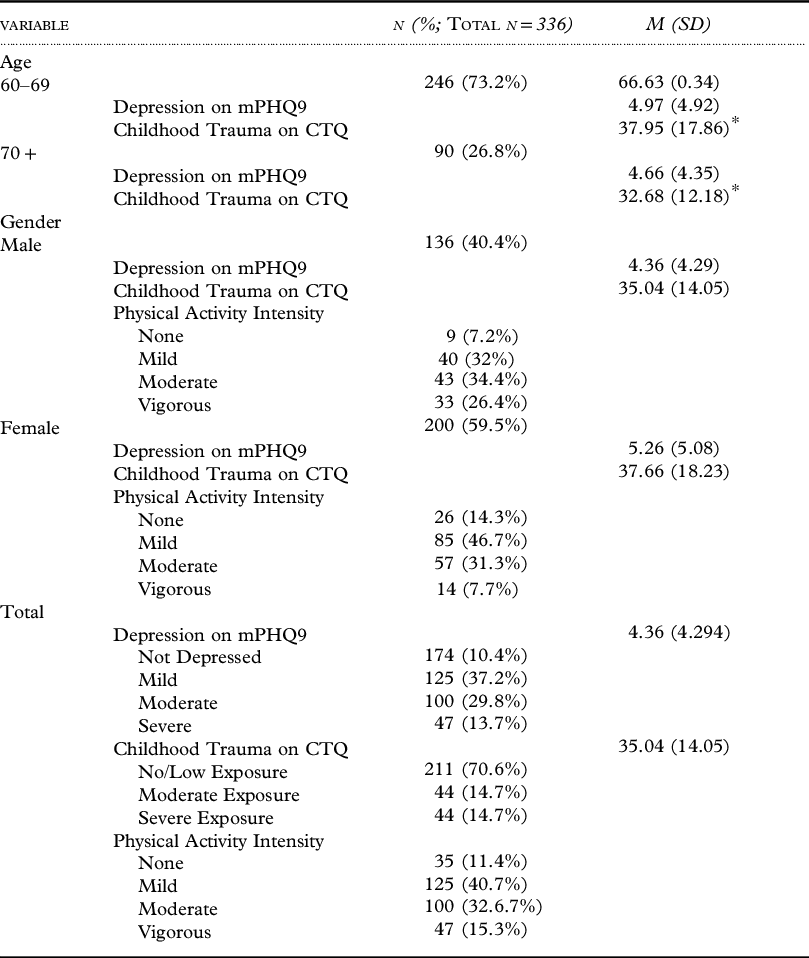
Of the 336 participants, 147 (43.5%) met criteria for moderate to severe depression. The mean CTQ score was 35.04 (SD = 14.05), and 88 (29.4%) participants met criteria for moderate to severe childhood trauma exposure. Demographic information is presented in Table 1. Though women had higher depression and CTQ scores, there were no significant differences across sex. There were no differences between age groups on depression but the older age group (70+) scored significantly higher on CTQ.
Demographics, means, and standard deviation for depression and childhood trauma scores

Note: Table excludes responses where participant declined to answer. Significant difference in mean score *(p = 0.019).
Main effects
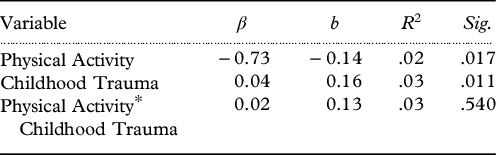
Missing data were reported for depression (29) and childhood trauma (45). A Missing Value Analysis using Estimated Means test was conducted. This test did not reach significance providing support for the null hypothesis of Little’s Missing at complete random test, suggesting the data was missing at random. Participants with missing data on variables included in the analyses were removed from the dataset. A standard regression was run with CTQ and physical activity as predictors (N = 254). Unstandardised and standardised regression coefficients are presented in Table 2. A moderation analysis (N = 254) was performed to assess whether physical activity can moderate the relationship between depression and childhood trauma.
Regression coefficients for multiple regression analysis using Childhood Trauma “CTQ Score” and physical activity participation to predict depression

Note. b = unstandardised regression coefficients; β = standardised regression coefficients.
Physical activity was found to significantly predict depression scores, F(1, 305) = 5.77, p = .017, as was severity of childhood trauma experienced, F(1, 253) = 6.58, p = .011. The interaction effect examining whether physical activity can act as a moderator for childhood trauma on depressive scores failed to reach significance. The two predictors accounted for 3.3% of the variance in depression, R 2 = .033, adjusted R 2 = .025, F(2, 252) = 4.27, p = .015 with only 1% of the variance explained by the interaction model between physical activity and childhood trauma, R 2 = .034, adjusted R 2 = .023, F(3, 251) = 2.96, p = .033.
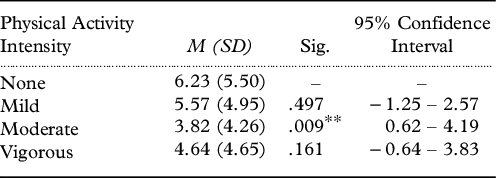
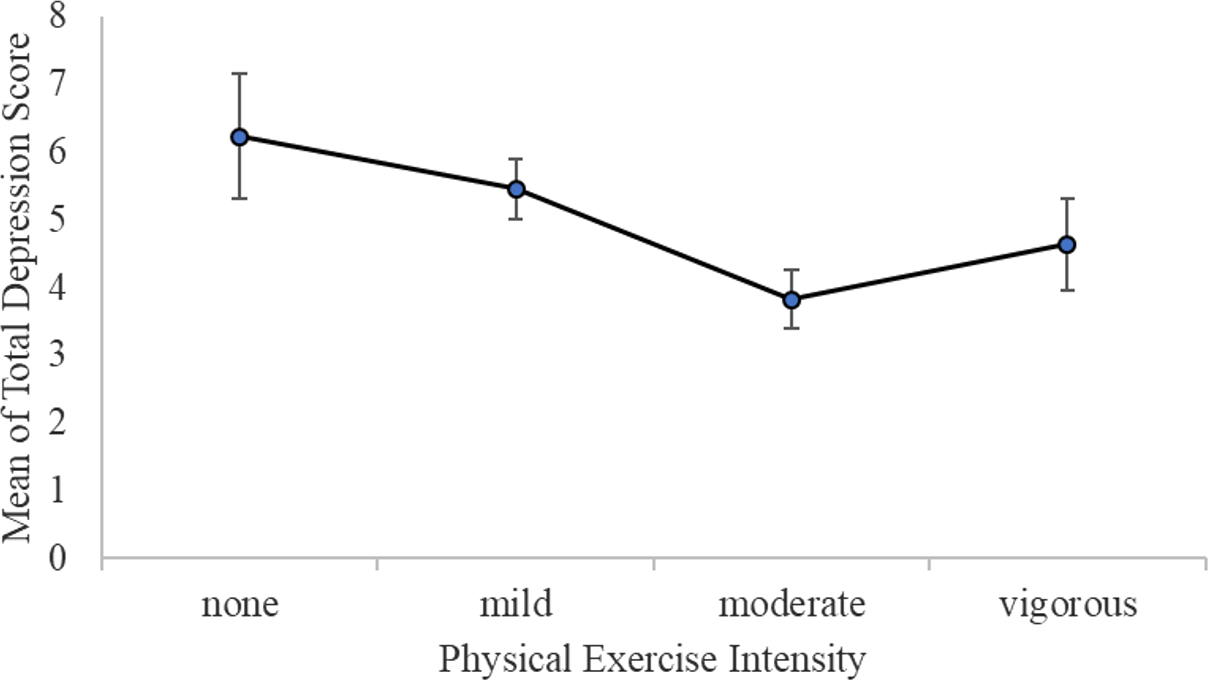
A one-way ANOVA was conducted to assess the effects of physical activity intensity on depressive symptoms. The different levels of physical activity intensity were significantly related to depressive score F(3, 306) = 3.51, p = .016, partial η 2 = .033 (see Figure 1) . Follow up t-tests revealed that there was a significant difference between no physical activity and moderate physical intensity, with lower levels of depressive symptoms demonstrated in the moderate group (see Table 3).
t-tests for mild, moderate, and vigorous physical activity intensity on depression as compared to none

Note. M = mean; SD = standard deviation.
*p < .05, **Bonferroni adjusted p < .017
Participants: study 2
A separate sample of older Indigenous Australians participating in an over 50’s social support programme at Abcare was recruited. Though all members were invited, only women agreed to participate. The final sample consisted of seven Aboriginal and/or Torres Strait Islander women between 55 and 70 years of age. Additional demographic data were not recorded to maintain anonymity.
Measures and procedure
A meeting was arranged to introduce the research, distribute information sheets, and conduct a focus group on the barriers and facilitators to physical activity. The information sheet was read aloud. Written consent was obtained by all participants prior to data collection.
The topics covered in the focus group included attitudes and beliefs surrounding physical activity, physical activity history, and current participation. The focus group explored facilitators and barriers to physical activity in daily life and across the lifespan. This data collection format was chosen to provide opportunity for participants to guide the session (Kitzinger, Reference Kitzinger and Holloway2005). Given the scarcity of available literature regarding factors that influence physical activity in older Indigenous Australians, a participant focussed qualitative approach, whereby semi-structured questions were asked and discussion was guided by participants, was implemented. The primary researcher conducted the interview and had no existing relationships with the research participants.
A semi-structured focus group guide was developed in line with the research aims considering past research focused on similarly aged participants from various cultural backgrounds. Initial questions were broad and open-ended to facilitate discussion (e.g. “What comes to mind when you think of physical activity?”). When discussion ceased, additional prompts were used to encourage further detail (e.g., “How about sporting clubs, family events?”; “can you elaborate further?”). The included questions were used flexibly to ensure data reflected the participant’s experiences and to support input from all group members.
The focus group was audio-recorded and transcribed. All identifying information was removed from the transcript as well as data the participants explicitly requested to be removed. The data was then subjected to a descriptive inductive thematic analysis whereby the transcript was scoured for themes. Familiarisation, initial coding, and searching for themes were conducted by the first author (Braun and Clarke, Reference Braun and Clarke2013). This involved in-depth reading of the transcript and development of initial codes and themes. Codes were then reviewed with the full text and relevant literature to be grouped into more specific themes that theorised the barriers and facilitators to physical activity.
Results: study 2
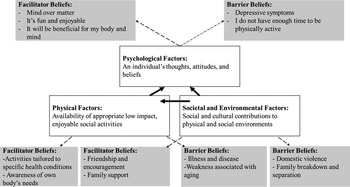
The duration of the focus group was 1 hour and 20 minutes. The thematic analysis revealed a range of barriers and facilitators which influenced physical activity participation in older Indigenous Australians women. These barriers and facilitators were classified into three overarching themes (psychological, physical, and societal/environmental), containing the subthemes of barriers or facilitators (Figure 2).
Mean of depression scores using physical activity.

Theme diagram of the relationship between facilitators and barriers of physical activity. Primary themes are indicated in the centre with the solid line boxes. Factors that are associated with these themes are in the grey box offshoots; indicated by the broken lined arrows.

Psychological factors
One of the strongest themes related to engaging in physical activity was the mental schemas available to the individual. If physical activity was associated with enjoyment and feelings of competency and health, then participants reported a greater inclination to participate. This pattern was similar for the individual’s attitude; viewing it as important and enjoyable, greatly increased the likelihood of being regularly active. Although high drive to be active was a strong facilitator, motivation to get started was a strong barrier, as perceived time and effort constraints impacted participation.
I feel like it’s like a mind over matter thing now ‘cos all the grandkids are in school you know, so what’s stopping me from going and doing these other things? …but it’s like my mind’s just set on what they need, their needs, and not what I need (Participant, 5).
Motivation to be more active was reported by all participants; demonstrating that additional factors were limiting participation. The idea of “mind over matter” was discussed in depth, but it appeared as though social support and environmental factors were the key barriers present with participants disengaging in physical activity when other areas of their lives, such as family commitments, took precedence. Participants were aware that physical activity was beneficial for mental wellness and for establishing a healthy routine.
There was a prevailing sense among participants that mental illness was as a primary barrier to physical activity participation despite the knowledge that physical activity decreased depressive symptoms. Physical activity was viewed as low priority for someone with mental illness, particularly depression, especially when difficulty was experienced maintaining relationships or leaving the house. This further demonstrates that variables beyond intrapersonal influences can bar individuals from participating in physical activity.
Physical factors
Barriers were more commonly reported than facilitators when examining physical factors. Illness, disability, and declining physical health were perceived as major barriers with participants feeling disheartened by the limitations faced due to obesity, health conditions, and illness. However, it was the emphasis on their physical health and awareness of the decline associated with age that also facilitated and motivated all participants to persist even with health-related limitations.
The whole thing is to aim to exercise – (be) health(y), whatever it is. But if you really look at it: it’s your health and your fitness. And being healthy …you feel better every day…we’re not getting any younger (Participant, 7).
Awareness of negative effects associated with sedentary behaviour such as decreased overall quality of life and bodily capability appeared to motivate participants to at least participate in low impact activities. The motivation for this extended beyond the self, and for many – the role of being a caregiver illustrated the importance of staying well to take care of others. Participants that had taken part in group activity sessions discussed the profound motivating effect they had felt, so long as the sessions were at an appropriate intensity level and something they enjoyed. The energising effect of physical activity was discussed as an ongoing facilitator, where the positive effects of physical activity on energy and health motivated them to partake regularly. It was noted that the proximity of low-impact group activities and facilities was a strong facilitator. However, this was not all-encompassing as some focus group members described participating in physical activity at home, demonstrating that self-determination superseded availability of appropriate facilities.
Societal/environmental factors
Negative life experiences were seen to reduce physical activity. Participants recounted how societal and family influences can create environments that reduce engagement and legitimise reductions in physical activity.
I was out in the bush with my mother and you know…I was lean and fit until I – Mum and Dad separated, and I had to move so many times a year… Yeah, that’s when I started putting weight on (Participant, 3).
Family breakdown, domestic violence, and lack of support from family and friends were viewed as a major barrier to physical activity participation. Many of the participants had experienced severe negative life events and recounted how these external events whether by shifting priorities or by immobilising the individual (as in the case of domestic violence or severe injury) were the greatest barriers to physical activity. The absence of negative environments or stressors acted more as a facilitator, rather than any specific external reinforcer or influencer. While there were some positive environmental factors, such as the supportive nature of the group, the majority of mentioned examples illustrate how past negative experiences can perpetuate barriers to physical activity engagement. Only when these negative experiences had been overcome could the individuals reengage with physical activity as a staple in daily life.
Discussion
This study is the first to examine the relationship between childhood trauma, physical activity and depression in urban and regional community-based samples of older Indigenous Australians. The primary findings showed that those who performed more self-reported physical activity at a moderate intensity, experienced fewer depressive symptoms than those who performed lighter or no physical activity; however, the effect size was small. Though there is a large proportion of unexplained variance, the reduction of depressive symptoms is clinically significant and highlights the need to consider other variables such as psychological resilience. Similar to previous geriatric research, females were more likely to report symptoms of depression (Gopal et al., Reference Gopal, Chacko, Sharma and Mitra2018). Compared to normative samples, Indigenous Australians have been found to have much higher risk for high or very high psychological distress scores ranging from 50 to 75% compared to overall rates of 20.2–26.6%. A higher prevalence rate was found for Indigenous Australians of both sexes and of all adult age groups (Jorm, Bourchier, Cvetkovski & Stewart, Reference Jorm, Bourchier, Cvetkovski and Stewart2012). In this study, 43.5% met criteria for moderate to severe depression, giving a more precise depiction of the problem. Similarly, Indigenous Australians were at increased risk for childhood trauma with 29.4% reporting moderate to severe childhood trauma exposure, and a mean score of 35.04 on the CTQ compared to 31.77 in the normative community sample (Scher et al., Reference Scher, Stein, Asmundson, McCreary and Forde2001).
Those with higher CTQ scores were found more likely to experience depression than those who had lower CTQ scores. Similarly, those who participated in moderate intensity physical activity were less likely to experience depressive symptoms. Both findings are consistent with prior research that childhood trauma is correlated with depressive symptoms (Christ et al., Reference Christ2019), and that physical activity participation predicts lower levels of depressive symptoms (Schuch et al., Reference Schuch, Vancampfort, Richards, Rosenbaum, Ward and Stubbs2017). Contrary to our expectations, physical activity was not found to moderate the association between childhood trauma and depression. Nevertheless, the results suggest that physical activity might still act as a useful tool in improving psychological wellbeing, even in populations with childhood trauma exposure. In similar studies with non-Indigenous participants, physical activity can improve reported quality of life in older persons (De Souza et al., Reference De Souza, De Carvalho and Ferreira2018).
The original KGOWS dataset included lifestyle questions pertaining to physical activity which were sampled to run the analysis. Though exercise intensity was recorded, the full breadth of physical activity participation (e.g., frequency of physical activity) was not captured in these lifestyle questions. This may have impacted the sensitivity of the measure. Though this is a significant limitation, and perhaps a contributing factor the limited variance explained in the results, the lack of research pertaining to this population regarding physical activity and depression, and the significant amount of effort and time donated by elderly Indigenous participants in the KGOWS led to the decision that inclusion was an ethical choice and provided a good jumping off point for future research. For example, the results of this study demonstrate that physical activity warrants further study in this population using both subjective and objective measures to ascertain the more specific effects of physical activity.
Interpretation of the present results must also consider the exclusive use of self-report measures which were used to assess depressive symptoms, childhood trauma and the exercise frequency of participants (Althubaiti, Reference Althubaiti2016). A significant number of participants had to be removed from the dataset due to missing data, though care was taken to minimise bias and employ a missing at random analysis, there is potential that these missing data points may have influenced the results. Furthermore, as the research design is cross-sectional, causality cannot be inferred and is subject to errors arising from possible confounding variables occluding the results (Levin, Reference Levin2006). However, previous meta-analytic research indicating that retrospectively assessed childhood trauma has a causal role in increasing risk of mood disorders, and the documented anti-depressant properties of physical activity in previous studies, addresses some of the issues of causality (Byrne and Byrne, Reference Byrne and Byrne1993; Morres et al., Reference Morres2019; Norman et al., Reference Norman, Byambaa, De, Butchart, Scott and Vos2012). At present, there are no longitudinal studies examining the effects of physical activity on depression or the later life effects of childhood trauma and so it is recommended that further intervention studies with longitudinal designs could conclude with greater certainty that physical activity is related to improved mental health and may assist in reducing the negative psychological effects associated with childhood trauma in Indigenous Australians.
In line with previous findings, depressive scores were highest in the no physical activity subgroup. In this sample, the moderate physical activity group was the only group to have significantly lower depressive symptoms compared to the no physical activity group. This finding is in line with previous research outlining moderate physical activity as the most beneficial intensity of participation. It is also worth noting that although physical activity has been shown with high efficacy to reduce depression, motivation is a key element to the success of physical activity as a meaningful intervention (Booth et al., Reference Booth, Harwood, Hancox, Hood-Moore, Masud and Logan2018). The results of the qualitative study contribute to a better understanding of physical activity, current activity levels, and the facilitators and barriers to participation in older Indigenous Australians.
Responses from the focus group indicate the majority of participants enjoyed physical activity and valued it highly as an important part of a healthy lifestyle and an essential part of healthy aging. However, some found that mental illness and environmental influences made it difficult to participate as much as they would like. Participants who were more active reported that accessibility to low-impact group activities, as well as social interaction, was one of the driving forces for maintained commitment consistent with previous research investigating group participation in physical activity programs (Herens et al., Reference Herens, Wagemakers, Vaandrager and Koelen2015).
The three themes of facilitators and barriers to physical activity reported by the participants (psychological, physical and societal/environmental) can be examined within the context of Crawford and Godbey’s hierarchical model of leisure constraints (Crawford et al., Reference Crawford, Jackson and Godbey1991; Godbey et al., Reference Godbey, Crawford and Shen2010). In regard to physical activity, this model proposes that constraints are found in three levels: intrapersonal (personal mental states), interpersonal (influence of others) and structural (environmental). The model suggests that these constraints need to be overcome in successive order. This theory has certainly been reflected in the responses gathered from the focus group members. Motivation and positive beliefs were found to be foundational to physical activity participation, followed closely by support from friends and family before being either facilitated or blocked by access to appropriate activities or personal physical mobility.
“Physical activity” was most associated with traditional leisure activities like gym or sport, rather than those commonly associated with mobility (i.e. housework or climbing stairs) which is different to other samples of older adults (Burton et al., Reference Burton, Clancy and Cowap2018). Participants expressed that they took part in frequent, and occasionally high intensity physical activity and from group discussion appeared to be meeting The World Health Organisation (WHO) recommendations for weekly physical activity participation (WHO, 2010), which compared to other research in older Australians is uncommon. Participants also displayed an awareness of physical activity requirements and were educated on the benefits, posing another potential discrepancy to other populations of older adults (Knox et al., Reference Knox, Esliger, Biddle and Sherar2013). It is acknowledged that the sample involved in the focus group were all from the Coffs Harbour region and was made up entirely of Indigenous Australian female voices. These women were a particularly motivated group and therefore might not be representative of a larger sample. It is possible that Indigenous Australians living in more remote locations and male participants may express a different set of barriers and facilitators which affect physical activity participation differently and may also be less informed or motivated to participate in regular activity. Further research should aim to interview multiple groups to provide further clarity.
A limitation of this study is the gender diversity involved in the focus group. Participants were approached after a meeting and on this date only one man had attended, who later declined participation. Having a larger sample, or running multiple focus groups on days when more men attended could have mitigated this limitation. To better understand the role of gender in the facilitator and barriers to physical activity, this is an area strongly recommended for future research.
This study has many strengths, the first being the representativeness of the sample included in the quantitative analysis. This study represents a significant move towards exploring the effect of early life experiences on later life depression and the comprehensive examination of reported childhood trauma supports the importance of examining these exposures and how they influence mental wellbeing. Another strength of this study is the use of a two-part design to capture further dimensions of physical activity in older Indigenous Australians. Supplementing the secondary data analysis with the qualitative research to capture the voices of older Indigenous Australians, providing agency to help shape future research in this area by identifying specific needs (Hanson et al., Reference Hanson, Creswell, Clark, Petska and Creswell2005; Kingsley et al., Reference Kingsley, Phillips, Townsend and Henderson-Wilson2010).
Consultation with older Indigenous Australian women identified factors which can improve physical activity interventions at the psychological, physical, and societal/environmental level. Future research should examine these facilitators and barriers when developing interventions. Further analysis of physical activity on later life mental health in Indigenous Australians is recommended to understand the therapeutic and protective effects. Interventions that make use of low-impact, group activity such as water-aerobics or walking groups would be ideal in measuring the effects of physical activity in older Indigenous Australian’s mental health and wellbeing.
In conclusion, this study has demonstrated that childhood trauma significantly increases the likelihood of developing later life depression. Physical activity can play an important role in reducing depressive symptoms in Indigenous Australians and is seen as integral to maintaining a healthy, happy life. The focus group indicated that there is awareness of the beneficial aspects of physical activity and that motivation to participate was not a barrier to participation like it may be for other older adult populations. While situational factors, health problems, and trauma impact physical activity participation, access to low-impact group activities with social support was identified to help navigate these barriers. While physical activity did not moderate the later-life depressive effects associated with childhood trauma in this study, it still should be considered as a culturally appropriate intervention to help lessen the burden of depression in older Indigenous Australians.
Conflict of interest
None.
Description of authors’ roles
GR, EH, PH and KR designed the study.
GR and EH conducted statistical design and analysis.
GR wrote the paper. EH and PH contributed to the writing of the paper.
KR, BD, RC, GD, GG, KD and TB conducted the KGOWs study from which the secondary data analysis was conducted.
All authors critically reviewed and revised the manuscript.
Acknowledgements
This work relied on the support of many individuals and organizations. The authors are grateful to the participants involved; our localElder guidance groups and those used in the KGOWS, the KGOWS Aboriginal Reference Group; and the Aboriginal Health and Medical ResearchCouncil without whom this secondary data analysis and focus group would not be possible.