INTRODUCTION
The distribution of parasites within a host population is often influenced by various host-related factors. In particular, gender-biased differences in infestation by parasites have been recorded in numerous hosts and for a variety of parasite taxa (Poulin, Reference Poulin1996; Schalk and Forbes, Reference Schalk and Forbes1997; Hughes and Randolph, Reference Hughes and Randolph2001; Moore and Wilson, Reference Moore and Wilson2002; Morand et al. Reference Morand, De Bellocq, Stanko and Miklisová2004; Perkins et al. Reference Perkins, Cattadori, Tagliapietra, Rizzoli and Hudson2003, Roberts et al. Reference Roberts, Buchanan and Evans2004; Krasnov et al. Reference Krasnov, Morand, Hawlena, Khokhlova and Shenbrot2005; Perez-Orella and Schulte-Hostedde, Reference Perez-Orella and Schulte-Hostedde2005; Cox and Henry, Reference Cox and Henry2007; Gorrell and Schulte-Hostedde, Reference Gorrell and Schulte-Hostedde2008). It is commonly accepted that gender-biased patterns of infestation in vertebrate hosts are driven by morphological, physiological and behavioural differences between male and female hosts in the face of parasitism.
Parasite infestations in mammals are often characterized by male bias. This bias has been attributed to several not mutually exclusive factors. Males and females in many mammals differ in their body sizes; with individuals of a larger gender (often males) habouring greater parasite loads compared to individuals of a smaller gender (Moore and Wilson, Reference Moore and Wilson2002). Another reason for male-biased parasitism may be the inhibiting effect of androgens, such as testosterone, on the male immune function (Hughes and Randolph, Reference Hughes and Randolph2001; Cox and Henry, Reference Cox and Henry2007). Gender-related differences in behaviour may also play an important role in sustaining gender-biased parasitism as increased mobility of certain individuals (e.g. males) within a host population, especially during the breeding season, can facilitate a higher contact rate with either infected individuals or infective stages of parasites or both (Bandilla et al. Reference Bandilla, Hakalahti, Hudson and Valtonen2005). In addition, there may be gender differences in anti-parasitic grooming that result in higher efficiency of one gender (usually females in mammals) to remove ectoparasites and thus sustain lower infestations as compared to another gender (Mooring and Hart, Reference Mooring and Hart1995; Hillegass et al. Reference Hillegass, Waterman and Roth2008). In addition, male-biased parasite infection can be the result of a combination of some or all of these factors.
Although commonly known, gender-biased parasitism appears not always to be the case (e.g. Morand et al. Reference Morand, De Bellocq, Stanko and Miklisová2004 versus Hilton and Best, Reference Hilton, Best, Chapman and Laerm2000). Moreover, several meta-analyses suggested that some parasite taxa are more prone to demonstrate gender-biased infections compared to other parasite taxa (Poulin, Reference Poulin1996; Schalk and Forbes, Reference Schalk and Forbes1997; Moore and Wilson, Reference Moore and Wilson2002; Roberts et al. Reference Roberts, Buchanan and Evans2004). In other words, occurrence and extent of gender-biased parasitism vary among parasites. For example, support for male-biased infections has been reported for many arthropod ectoparasites, helminths and unicellular parasites of many mammals, reptiles and birds (Poulin, Reference Poulin1996; Schalk and Forbes, Reference Schalk and Forbes1997) and female-biased parasitism has been found in some blood parasites of birds (McCurdy, Reference McCurdy1998), nematodes of fish (Reimchen and Nosil, Reference Reimchen and Nosil2001), and arthropod parasites of beetles (Seeman and Nahrung, Reference Seeman and Nahrung2004) and bats (Christe et al. Reference Christe, Glaizot, Evanno, Bruyndonckx, Devevey, Yannic, Patthey, Maeder, Vogel and Arlettaz2007; Patterson et al. Reference Patterson, Dick and Dittmar2008; Presley and Willig, Reference Presley and Willig2008), whereas many parasites of arthropod hosts do not demonstrate gender-biased parasitism (Field, Reference Field1969; Kuris et al. Reference Kuris, Poinar and Hess1980; Sheridan et al. Reference Sheridan, Poulin, Ward and Zuk2000). This suggests that the effect of host-related factors that cause gender-biased parasitism may be mediated by some taxon-specific life-history traits in parasites and, thus, manifested differently in different parasites.
The majority of studies on gender-biased parasitism have used either pooled data on different parasites or data on a single parasite species (Cox and Henry, Reference Cox and Henry2007; Poulin, Reference Poulin1996; Schalk and Forbes, Reference Schalk and Forbes1997; Moore and Wilson, Reference Moore and Wilson2002; Roberts et al. Reference Roberts, Buchanan and Evans2004). Although the former approach is valuable for elucidating the general patterns, it fails to discern parasite species-specific differences and, thus, does not allow clarification of the role of parasite-related factors underlying gender-biased patterns of parasitism (Morales-Montor et al. Reference Morales-Montor, Chavarria, De León, Del Castillo, Escobedo, Sánchez, Vargas, Hernández-Flores, Romo-González and Larralde2004; Gorrell and Schulte-Hostedde, Reference Gorrell and Schulte-Hostedde2008). However, very few studies have compared gender-bias in the infestation of the same host species by individual parasite species belonging to the same or different higher taxa (Lareschi, Reference Lareschi2006; Presley and Willig, Reference Presley and Willig2008).
To fill this gap, we studied prevalence, abundance, species richness and the level of aggregation of ticks (Acari: Parasitiformes), mites (Acari: Parasitiformes), lice (Insecta: Phthiraptera) and fleas (Insecta: Siphonaptera) exploiting male and female striped mice (Rhabdomys pumilio) in 9 localities of the Western Cape Province of South Africa. Male-biased infestation has previously been reported for some ticks (Hughes and Randolph, Reference Hughes and Randolph2001; Perkins et al. Reference Perkins, Cattadori, Tagliapietra, Rizzoli and Hudson2003), mites (Lareschi, Reference Lareschi2006) and fleas (Morand et al. Reference Morand, De Bellocq, Stanko and Miklisová2004) parasitic on rodents. However, these parasites vary in their life-histories. In particular, they substantially differ in the relative amount of time spent on the host or in the external environment. Engorged ticks drop-off from the host and re-emerge after development to the next stage, on the vegetation in close proximity to the point of drop-off. The majority of fleas and mites alternate between periods when they stay on the host and when they stay in its burrow or nest. Lice are permanent parasites and spend their life entirely on the host. This suggests that different parasites may respond differently to the main host-related factors that cause gender-biased infestation. In particular, it may be assumed that less time spent on a host, coupled with more time spent in the extermal environment, would result in (a) less time in direct contact with the host's immune system, (b) smaller risk to be groomed off and (c) higher chances to attack a mobile host individual. Consequently, we hypothesize that the extent of male-biased parasitism will be distinctly different among ticks, mites, lice and fleas and expect that it will be the highest in ticks, medium in fleas and mites and the lowest in lice. However, given that parasites belonging to the same higher taxon share many features of their physiology, reproduction and life history, we predict that manifestation of male-biased parasitism will be similar among parasite species within a higher taxon. In addition, we expect that the extent of male-bias in the infestation by the same parasite species or higher taxon will be spatially invariable, i.e. will not differ among localities.
MATERIALS AND METHODS
Study area and sampling
The striped mouse, Rhabdomys pumilio, is one of the most abundant rodents in southern Africa. It occupies a variety of habitats and is a host for numerous ecto- and endoparasites (De Graaf, Reference De Graaf1981; Matthee et al. Reference Matthee, Horak, Beaucournu, Durden, Ueckermann and McGeoch2007). We captured R. pumilio in 2003–2004 in 9 localities in the Western Cape Province in South Africa. These localities included 5 pristine lowland Fynbos/Renosterveld regions and 4 bordering agricultural areas (see details in Matthee et al. Reference Matthee, Horak, Beaucournu, Durden, Ueckermann and McGeoch2007). Sampling was conducted during a 4-month period from September to December (austral spring and summer) with 5 of 9 localities sampled in November. The abundance of ectoparasitic arthropods was relatively stable within this period. This period falls within the main breeding season for R. pumilio in the Western Cape Province, a region with winter rainfall. Rodents were captured using Sherman-type live traps (90–180 traps per locality) baited with peanut butter and oats. A traping session in each locality lasted 3–12 days. Parasites were collected from adult rodents, i.e. individuals with a body mass of more than 40 g. The aim was to trap 40–60 mice in the shortest possible time at each of the localities. These animals were euthanized with Fluothane, placed in individual pre-marked plastic bags and transferred to a laboratory where each animal was systematically examined under a stereoscopic microscope. All ectoparasites were removed using forceps, counted and identified to species level. The protocol of the study was approved and permits were issued by the Ethical Committee of the University of Stellenbosch and by the Western Cape Nature Conservation Board.
Data analysis
A parasite species was included in the analyses only if it was collected from at least 5 different host individuals in at least 2 localities. For each locality and for male and female hosts separately, we calculated mean abundance, variance of abundance and prevalence (fraction of infested individuals) of (a) each parasite species, (b) all parasites belonging to a particular higher taxon (ticks, mites and fleas; lice were represented by a single species) and (c) all parasites. In addition, we calculated mean species richness of all parasites as well as of ticks, mites and fleas separately for male and female hosts within a locality.
To compare prevalence of infestation between genders, we calculated the odds ratio of proportions of infested male and female hosts for each parasite species within each locality. Then, to evaluate the general trend of gender bias in prevalence of infestation by a given parasite, we applied the meta-analyses of the odds ratios within a parasite species across localities. The resulting effect sizes and their confidence limits for each species were then used in the next runs of meta-analyses aimed to evaluate the trend of gender bias in prevalence for (a) parasites belonging to the same higher taxon (ticks, mites and fleas) and (b) all parasites. Differences between males and females in mean abundance of parasites were tested in a similar fashion. We calculated standardized mean difference between male and female hosts in abundance of each parasite species within a locality and applied the meta-analyses within a parasite species across localities. Standardized mean difference is the difference between 2 normalized means, i.e. the mean values divided by an estimate of the within-group standard deviation. Then, we used effect sizes and their standard errors calculated by the meta-analysis for the next runs of the meta-analyses within the higher taxon across species and across all species of all higher taxa. We repeated all these analyses for combined data on parasites of each higher taxon independent of their species identity as well as for combined data on all parasites independent of their species or higher taxon identity. The latter analysis was not carried out for prevalence because each captured rodent was infested by at least 1 parasite. Differences between male and female hosts in species richness of their parasite assemblages were analysed by the meta-analysis of standardized differences in mean number of parasite species they harboured across localities. This was done for ticks, mites and fleas separately as well as for all parasite taxa together.
Mean abundance (M) and variance of mean abundance [V(M)] of an organism's distribution are related by a power law V(M)=aM b (Taylor, Reference Taylor1961). This empirical relationship known as Taylor's power law is supported by numerous data on both free-living and parasitic species (Taylor and Taylor, Reference Taylor and Taylor1977; Taylor and Woiwod, Reference Taylor and Woiwod1980; Anderson and Gordon, Reference Anderson and Gordon1982; Perry and Taylor, Reference Perry and Taylor1986; Shaw and Dobson, Reference Shaw and Dobson1995). Exponent (parameter b or slope of Taylor's relationship) of this power function is accepted as a spatially implicit indicator of a tendency of organisms to be aggregated (Perry, Reference Perry1988; Veldtman and McGeoch, Reference Veldtman and McGeoch2004). Consequently, for parasites, it is commonly accepted as a measure of aggregation (see Morand and Krasnov, Reference Krasnov2008 for a review). We compared slopes b of Taylor's power relationships between male and female hosts using ANCOVAs with log-transformed variance of parasite abundance as a dependent variable, host gender as a categorical predictor and against log-transformed mean of parasite abundance as a continuous predictor. This was done for each parasite species recorded in at least 5 localities as well as for combined data on parasites belonging to the same higher taxon and on all parasites together independent of their species and higher taxon identity. The resultant slopes of Taylor's power relationships for each parasite species within either male or female hosts were then used as input data for the meta-analyses of the gender difference in these slopes across ticks, mites, fleas and all parasites together.
The meta-analyses that used both fixed effects and random effects models produced similar results. Here, we report the results of the analyses that used the fixed effects model only. All meta-analyses were carried out using the computer program Comprehensive Meta-Analysis 2.2 (Biostat Inc., Englewood, NJ, USA).
RESULTS
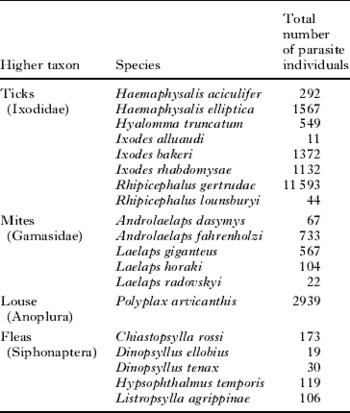
In total, we captured and examined 217 male and 149 female R. pumilio. Numbers of captured male and female rodents varied among localities from 15 to 35 and from 8 to 28, respectively. Parasites belonging to 19 species were collected from at least 5 different host individuals in at least 2 localities. Among them, there were 8 ticks, 5 mites, 1 louse and 5 fleas (Table 1).
Data on ectoparasites collected from male and female Rhabdomys pumilio in nine localities

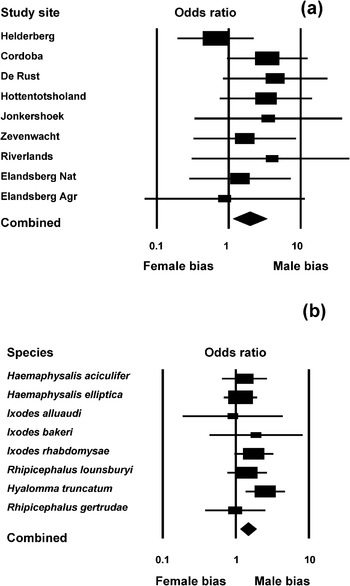
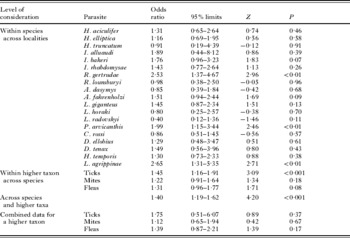
The odds ratio of prevalence of infestation of male and female hosts by the same parasite species varied among localities from being female-biased to being male-biased (Table 2). Nevertheless, the combined within-species odds ratio indicated that gender differences (male-biased) in prevalence were significant in only 3 of 19 parasite species (the tick Rhipicephalus gertrudae, the louse Polyplax arvicanthis and the flea Listropsylla agrippinae) (Table 2, see Fig. 1a for an illustrative example with the louse). No significant female bias in prevalence was found. Across-parasite, within-higher taxon meta-analyses demonstrated significant male bias in prevalence for ticks only (Table 2). Meta-analysis of host gender differences in prevalence across all 19 parasites showed significant male bias (Table 2). Nevertheless, when parasites were considered at the level of higher taxa without taking into account their species identity, combined odds ratio indicated that prevalence of infestation by parasites of the 3 higher taxa was similar in male and female hosts (Table 2).
Forest plots for the meta-analyses of odds ratio of male and female infestation by (a) the louse Polyplax arvicanthis across localities and (b) across 8 species of ticks. Each square represents the value of the odds ratio and the line indicates the 95% confidence intervals, for each locality or species separately and for all localities or species combined; the size of the square is proportional to locality or species weight. Diamonds denote combined effects.

Summary of meta-analyses of the odds ratio of host gender differences in prevalence of infestation by ectoparasites
(Positive Z=male-bias, negative Z=female-bias.)

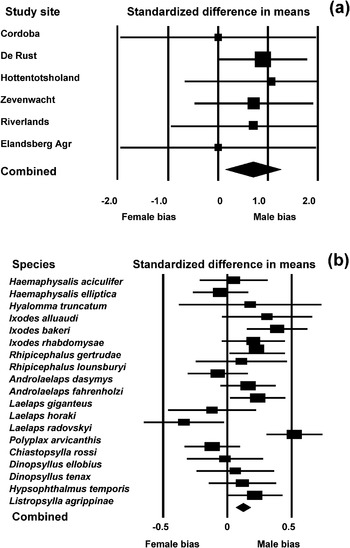
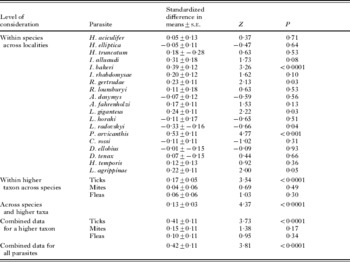
The results of the meta-analyses of host gender differences in parasite abundance are presented in Table 3. The across-locality within-parasite meta-analyses indicated higher abundance of parasites on male than on female hosts and was significant for 2 ticks (Ixodes bakeri and R. gertrudae), 1 mite (Laelaps giganteus), the louse and 1 flea (L. agrippinae) (see Fig. 2a for illustrative example with the flea L. agrippinae). Significant female bias in parasite abundance was found for the mite L. radovskyi only (Fig. 2b), although this could be a result of very low absolute numbers of this species (Table 1). When gender difference in parasite abundance was considered across parasite species within higher taxa, significant male bias was found for ticks, but not for mites or for fleas. The same results were produced by meta-analyses of the combined abundance of parasites belonging to the same taxon across localities. However, when the meta-analysis of parasite abundance in male and female rodents was carried out across all parasites, significant male bias was found. The same was the case when combined data on all parasite species were analysed across localities.
Forest plots for the meta-analyses of male and female difference in abundance of (a) the flea Listropsylla agrippinae across localities and (b) across 19 species of ectoparasites. Each square represents the value of the standardized mean difference in parasite abundance between male and female hosts and the line indicates the 95% confidence intervals, for each species separately and for all species combined; the size of the square is proportional to locality or species weight. Diamonds denote combined effects.

Summary of meta-analyses of host gender differences in abundance of ectoparasites
(Positive Z=male-bias, negative Z=female-bias.)

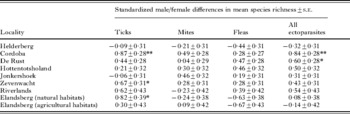
Male hosts harboured significantly richer tick assemblages than female hosts in 3 of 9 localities (Table 4). No significant gender difference in mite or flea species richness was found in any locality. Furthermore, significant male bias in total parasite species richness was found in 2 localities (Table 4). The meta-analyses supported male bias in tick and total parasite species richness (standardized differences in means were 0·41±0·11, Z=3·73 and 0·35±0·11, Z=3·22, respectively; P<0·001 for both), but not for either mite or flea species richness (standardized differences in means were 0·15±0·11, Z=1·38 and 0·10±0·11, Z=0·95, respectively; P>0·15 for both).
Gender differences in species richness of parasite assemblages in Rhabdomys pumilio in nine localities
(* P<0·05, ** P<0·01. Positive differences=male-bias, negative differences=female-bias.)

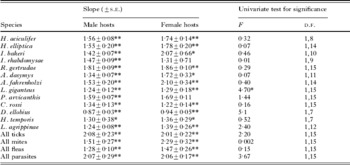
The slope of the relationship between variance and mean abundance of each parasite was significantly greater than unity in both male and female hosts (except for the tick Ixodes rhabdomysae in female hosts; Table 5), suggesting that almost all parasites were aggregated among individual hosts of both genders. The same was true for each of the 3 higher taxa of parasites as well as for combined data of all parasites. Some trend of greater values of slopes of the regressions of log-transformed variances against log-transformed mean abundances of separate parasite species, higher taxa or combined parasites in female hosts can be seen from Table 5. Nevertheless, these differences were not statistically significant except in the mite L. giganteus. The degree of aggregation of this mite in female hosts was higher than that in male hosts. Meta-analyses within higher taxa demonstrated the lack of host gender differences between slopes of Taylor's power relationships for each higher taxon (standardized differences between males and females in the slope values were −0·33±0·24, Z=−1·37 for ticks, −0·47±0·29, Z=−1·62 for mites and −0·14±0·28, Z=−0·49 for fleas; P>0·10 for all). Nevertheless, when the meta-analysis was carried out for all parasite species, we found significant host gender difference in the slope values (greater in female compared with male hosts; standardized difference between males and females in the slope values was −0·31±0·15, Z=−2·14, p<0·05).
Slopes (±S.E.) of the regressions of log variance of mean abundance of parasites of Rhabdomys pumilio against the log mean abundance across nine localities and the results of univariate tests for significance of difference between these slopes for male and female hosts within parasite species, within parasite higher taxon or for combined data on all parasites
(* P<0·05, ** P<0·001.)

DISCUSSION
The results of this study did not support our main hypothesis predictions in that no general difference in the extent of gender-biased parasitism was found among higher parasite taxa. Instead, and contrary to our expectations, the occurrence and extent of gender-biased infestation varied among parasites belonging to the same higher taxon and within parasite species among localities. In other words, there was gender bias in host infestation by some parasites, whereas male and female hosts were similarly infested by other closely-related parasites. Similarly, although infestation by a given parasite was strongly male-biased in the majority of localities, this was not the case for other localities. In addition, whenever significant difference in infestation pattern between male and female hosts was found, males appeared to be more infested than females, except for the mite L. radovskyi, this supporting the results of numerous earlier studies. Furthermore, female-biased infestation by L. radovskyi could be the result of low abundance of this species and, consequently, statistical error.
Gender-biased parasitism is spatially variable
One of the possible reasons for spatial variation in within-parasite gender-biased infestation might be among-locality difference in relative abundance of reproductively active individuals. Gender-biased parasitism in rodents has been shown to be manifested mainly during reproductive periods due to 2 main not mutually exclusive reasons (Krasnov et al. Reference Krasnov, Morand, Hawlena, Khokhlova and Shenbrot2005). One of the reasons is greater gender differences in territoriality during the reproductive period due to higher mobility of breeding males that search for mating partners and sedentarity of breeding females that usually stay in the vicinity of their burrows (Lott, Reference Lott1991). Another reason is greater gender differences in the immunocompetence due to higher levels of androgens in males that suppress the immune function (Folstad and Karter, Reference Folstad and Karter1992). Although populations of R. pumilio in all localities during our study were in breeding condition, the proportion of reproductively active individuals varied among localities. For example, the proportion of reproductively active rodents in Helderberg attained only about 50%, whereas reproductively active individuals comprised as high as 70–80% of the population in Cordoba (S. Matthee, unpublished data). As a possible result, there was no significant gender bias in infestation by the louse P. arvicanthis in the former locality, but strong male bias in the infestation by this parasite was found in the latter locality. Nevertheless, the exact reasons for spatial variation in gender-biased infestation remain to be studied.
Gender-biased parasitism varies among closely-related parasites
Surprisingly, gender bias in parasite infestation varied within a higher taxon among different tick, mite and flea species. Moreover, when the meta-analyses were carried out across parasite species to compare different parasite species within a taxon, the presence of significant gender bias was either retained (in ticks) or disappeared (in mites and fleas), whereas the meta-analysis on the combined data for all parasites supported significant gender bias. This suggests that the pattern found when pooling data on different parasites is actually driven by a strong gender bias in a few individual species only. Caution must therefore be taken when interpreting findings based on pooled across-parasite data because the observed pattern may not be representative for all parasites. For example, gender-biased ectoparasite loads have been reported for the northern flying squirrel Glaucomys sabrinus (Perez-Orella and Schulte-Hostedde, Reference Perez-Orella and Schulte-Hostedde2005). However, given that data on different parasite species (2 mite species and 1 flea species) were pooled in this study, it is difficult to say whether indeed infestation by each of the 3 parasite species was male-biased.
The likely mechanism behind among-parasite variation in the manifestation of the pattern of gender-biased parasitism is different responses of closely-related parasite species to host-related factors involved in the generation of gender-biased parasitism. For example, it is commonly known that immune responses of a host are efficient against some, but not other closely-related parasites (e.g. McTier et al. Reference McTier, George and Bennet1981; Rechav et al. Reference Rechav, Heller-Haupt and Varma1989 for ticks; Studdert and Arundel, Reference Studdert and Arundel1988 for fleas; but see Rechav, Reference Rechav1992). The variation among closely-related species in their ability to withstand host grooming was reported for fleas (Nikitina and Nikolaeva, Reference Nikitina and Nikolaeva1981). Experimental rodents succeeded in the removal of some flea species, but failed to remove other flea species. The among-flea variation in ability to resist host grooming resulted from the variation in flea behaviour (some, but not other, flea species prefer those areas of the host's body that are the least accessible by paws or teeth of a host) and morphology (some, but not other, flea species possess helmets, ctenidia, spines and setae that allows them to anchor themselves to the host's hairs and to resist the host's grooming) (see Krasnov, Reference Krasnov2008 for review). In addition, parasites of relatively large size can be more easily dislodged by hosts than parasites of smaller size (Poulin, Reference Poulin2007). Gender-biased pattern of infestation may thus be characteristic for parasites that are unable to withstand host defences and/or are relatively large, but not for parasites that are able to cope successfully with gender-dependent immunological or behavioural defences of their hosts and/or are relatively small. Indeed, we found that among 5 mite species, significant male bias was characteristic for the largest species L. giganteus (average body length of a female is 1274·30 μm, whereas body length of a female of the most abundant mite A. fahrenholzi is 716·4 μm). Similarly, among 5 flea species, significant male bias was characteristic for the largest species L. agrippinae (average body length of female is 3650 μm, whereas average body length of a female of the most abundant flea C. rossi is 1750 μm).
In addition, strategies for host search differ among closely-related parasites. For example, substantial differences in host-seeking strategies (from passive to active) are known for ticks (Sonenshine, Reference Sonenshine1993, Reference Sonenshine, Goodman, Dennis and Sonenshine2005). Obviously, the gender-related difference in host mobility is less likely to generate a male-biased pattern of infestation in parasites that search actively for a host than in parasites that prefer a sit-and-wait strategy.
Male bias in parasite infestation
Whenever gender bias in infestation was found to be significant, parasite prevalence, abundance and species richness were generally biased towards male hosts, whereas the level of aggregation was generally higher in female than in male hosts. Lower b values in male hosts indicated that parasites were more evenly distributed across males than females, suggesting that a higher proportion of males was parasitized compared to females. This is in agreement with higher prevalence and abundance values found in male hosts. The male-biased pattern found in this study is similar to that found in other studies of arthropod ectoparasites in small mammals carried out in different regions such as Europe (Hughes and Randolph, Reference Hughes and Randolph2001; Perkins et al. Reference Perkins, Cattadori, Tagliapietra, Rizzoli and Hudson2003; Morand et al. Reference Morand, De Bellocq, Stanko and Miklisová2004), the Middle East (Krasnov et al. Reference Krasnov, Morand, Hawlena, Khokhlova and Shenbrot2005) and South America (Lareschi, Reference Lareschi2006). Despite differences in the manifestation of this pattern among closely-related parasites discussed above, similarity in gender-biased pattern across the parasites belonging to different taxa suggests that host gender differences in tick, mite, louse and flea parasitism are first and foremost driven by host-related factors such as gender difference in anti-parasitic defence (Schalk and Forbes, Reference Schalk and Forbes1997; Hughes and Randolph, Reference Hughes and Randolph2001; Moore and Wilson, Reference Moore and Wilson2002; Morand et al. Reference Morand, De Bellocq, Stanko and Miklisová2004; Cox and Henry, Reference Cox and Henry2007; Hillegass et al. Reference Hillegass, Waterman and Roth2008) and mobility (Hughes and Randolph, Reference Hughes and Randolph2001; Lareschi, Reference Lareschi2006; Cox and Henry, Reference Folstad and Karter2007). However, as we discussed above, the operation of these factors may be mediated by species-specific life-history patterns of parasites.
In conclusion, our results suggest that the extent of the gender-biased pattern of parasite infestation of the same host may not only involve several different host-related mechanisms but also depends on biological features of a particular parasite species.
ACKNOWLEDGEMENTS
We are grateful to J-C Beaucournu, L.A. Durden, I.G. Horak and E. Ueckermann for the identification of the ectoparasite species, C. Boonzaaier, P. le Roux, C. Matthee, C. Montgelard and M. van Rooyen for field and technical assistance. This study was funded jointly by the National Research Foundation (bursary to S.M.), University of Stellenbosch, Centre for Invasion Biology and BIOTA southern Africa. This is publication no. 651 of the Mitrani Department of Desert Ecology.