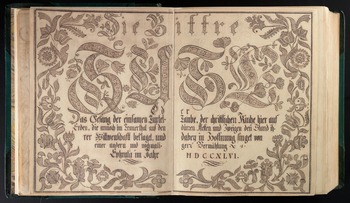
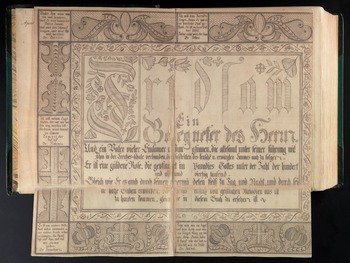
While living in London in 1771, Benjamin Franklin (1706–90) received a gift in the mail from a fellow Pennsylvanian named Peter Miller (1710–96). It was a large handwritten music book described in its accompanying letter as a “present” (see Figure 1). Miller referred to it as, “the Father's musical Book, wherein are contained the most part of the musical Concerts, by himself composed.”Footnote 1 This “Father” in Miller's letter was Conrad Beissel (1691–1768), a charismatic religious leader who emigrated from the Rhenish Palatinate to Pennsylvania in 1720. In 1732, after more than a decade spent in Philadelphia and Germantown, Beissel established an ascetic commune on land home to the Susquehannock people, along the banks of the Cocalico River in Lancaster County. The settlement came to be known later as the Ephrata Cloister. It was comprised of German-speaking, celibate sisters and brothers, plus a group of surrounding families known as “householders,” all of whom followed Beissel's unorthodox interpretation of Pietism.Footnote 2
1746 Ephrata Codex, LC, M 2116.E6 1746, title page. Courtesy: the Music Division at the Library of Congress.

After Beissel died in 1768, Miller took over leadership of Ephrata, which by that point was a community in decline. Miller had known Franklin for several decades; it was Franklin who printed the first of Ephrata's hymnals in the 1730s.Footnote 3 Although Miller's motives for sending Beissel's “musical Book” to London are unclear, it appears from records of correspondence that he held Franklin in high esteem. For Franklin's part, he acknowledged receipt of Miller's present in a letter to his wife, Deborah, which he sent from London on January 28, 1772: “I received the Box and Letter from Mr. Peter Miller… I write by this Opportunity to Mr. Miller. What he sent me is a most valuable Curiosity.”Footnote 4 There are no other explicit mentions of items from Ephrata in Franklin's extant correspondence, and the letter that Franklin said he would write to Miller apparently did not arrive. Miller, having never received a reply from Franklin, wrote to the Philadelphian Quaker pharmacist Christopher Marshall in 1773, attempting to get information on the status of his letter and gift. Marshall approached Deborah Franklin, who explained that “her husband had acknowledged the receiving of it some small time before he had set out on his tour for Ireland”Footnote 5 in 1772.Footnote 6
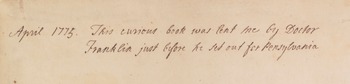
Franklin returned to America in 1775, and it seems that he left the Ephrata music book in London, giving it to an acquaintance who wrote in it, “April 1775. This curious book was lent me by Doctor Franklin just before he set out for Pennsylvania” (see Figure 2). There is no name directly affiliated with this attribution other than Franklin's, and the provenance of the music manuscript is unknown until 1927, at which point the book resurfaced at an auction at Anderson Galleries on Park Avenue in New York City. The book was sold on March 22 of that year to the American antiquarian Gabriel Wells for $475 from “the property of a London consigner.” Wells then sold the manuscript to the Library of Congress for the same price.Footnote 7
Inscription mentioning “Dr. Franklin” in Ephrata Codex. 1746 Ephrata Codex, LC, M 2116.E6 1746, inside cover. Courtesy: the Music Division at the Library of Congress.

The Library of Congress named the volume the “Ephrata Codex,” a title still commonly used today. In addition, a librarian misread the frakturschrift title “Die Bittre Süse” (“The Bitter Sweet”) and instead recorded it as “Die Bittre Gute” (“The Bitter Good”) in the catalog (see Figure 1). It was presumably in 1927 that the April 1775 handwriting was attributed to John Wilkes (1725–97), a British dissident political leader. Both American Book–Prices Current and the 1927 Report of the Librarian of Congress state that the attribution is “in the hand[writing] of John Wilkes,”Footnote 8 but there is no evidence to support this assertion.Footnote 9
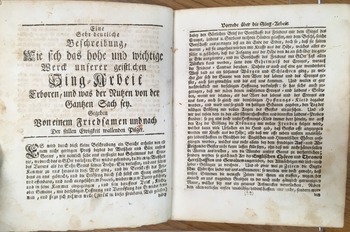
This book, which Franklin left in London, contained inscriptions crediting women as composers. Indeed, this music manuscript, known today as the Ephrata Codex, includes a number of unique features of considerable historical significance. The 972-page volume, dated 1746, contains one of the first theoretical musical treatises written in the Western Hemisphere.Footnote 10 This handwritten treatise was printed the following year as the preface to Ephrata's first self-published hymnal, Das Gesäng der einsamen und verlassenen Turtel=Taube (see Figure 3).Footnote 11 The Ephrata Codex also contains a plethora of drawings in the tradition of medieval illuminated manuscripts. These drawings, alternating between literal illustrations and geometric images, accompany musical settings of hymn texts found in two printed hymnals: the aforementioned 1747 Turtel=Taube, and the earlier 1739 Zionitischer Weyrauchs Hügel, printed for the Ephrata community by Christoph Sauer (1695–1758) of Germantown.Footnote 12 The texts in the Zionitischer Weyrauchs Hügel are a combination of hymns written by European Pietists and other Protestants, alongside original works by brothers and sisters of Ephrata. By contrast, the hymn texts in the Turtel=Taube were written exclusively by the Ephrata community.
1747 Turtel=Taube, page ††. Seventh Day Baptist Historical Society, 245.2865 E. Courtesy: Council of History of the Seventh Day Baptist General Conference of USA and Canada.

These unique features aside, perhaps the most significant contents of the Ephrata Codex are attributions of names written next to specific musical compositions. These name attributions and their implications for authorship, gender, and music history are the inspiration for this article. They indicate that three women of Ephrata (Sisters Föben, Hanna, and Ketura) composed music and received credit for it, making them a notable exception to the sieve-like and male-dominated historical record of Western music. There is a strong temptation to declare these women as the “first known female composers in America.” Indeed, such a headline attracts attention. However, “firsting” these three Ephrata women results in an oversimplification and an avoidance of the vast numbers of music creators who existed in the Americas for millennia before European conquest.Footnote 13 It also ignores the void of information inherent in any archive: History, whether it is written by its victors or not, is a complicated ecosystem with unknown and/or forgotten documents surfacing each day.Footnote 14 Attempting to avoid “archival orientalism”Footnote 15 or academic cultural domination, we state simply that these Ephrata women created music.
Before we arrive at specific details about these women and their work, some background information about Ephrata, its print and manuscript creation, and its attitudes and practices when it came to dealing with authorship is necessary. The information presented in this article is derived from colonialist archives and related to a specific eighteenth-century settler group. This narrow focus is necessary because of Ephrata's specificity and insularity. In addition, there is inherent bias in this study because of its specific archival focus. As Glenda Goodman asserts in a 2019 article in this journal, “the extant historical sources on early American music overwhelmingly represent women and men of settler societies.”Footnote 16 Ephrata and its documents are no exception.
Ephrata Text and Music Materials
Over the course of its short history, Ephrata was a mainly celibate commune with frequently shifting religious practices. Although segregation of sisters and brothers was consistent at the settlement, there was significant variation in the ascetic and mystic techniques of self-denial.Footnote 17 In addition, there was a large amount of activity in the material production of prints and manuscripts. Ephrata had both a paper mill and a printing press.Footnote 18 This printing press, only the third in the colony (after Franklin's and Sauer's), was run by the solitary brothers. They produced copies of Der Martyrer Spiegel for the burgeoning Mennonite communities in Pennsylvania. The press was also used to create text-only hymnals for use by the Ephrata community, the first of which was the 1747 Turtel=Taube. Subsequent original printed hymnals included the 1749 version of the Turtel=Taube, the 1755 Nachklang zum Gesäng der einsamen Turtel=Taube, the 1762 Neuvermehrtes Gesäng der einsamen Turtel=Taube, and the 1766 Paradisisches Wunderspiel.Footnote 19
It bears mentioning that Ephrata was separatist and inward-looking in nature; its own religious and musical texts and materials were rarely shared beyond its borders. Furthermore, Ephrata's residents were not missionaries; in contrast to other German diaspora sects like the Moravians, they did not attempt to convert Indigenous communities or other groups. Thus, although Pietist hymnody spread throughout territories with “strong German communities,”Footnote 20 and although the Moravian leader Count Nikolaus Ludwig von Zinzendorf “contributed many original hymns to the efflorescence of hymnody in America,”Footnote 21 the music of Ephrata, by contrast, was not intended for broad dissemination. Furthermore, Ephrata's musical style does not bear any significant resemblance to original hymnody of other German diaspora groups in Pennsylvania, specifically the Johannes Kelpius manuscript at the Historical Society of PennsylvaniaFootnote 22 and the flourishing of Baroque-style Moravian music that has been widely reproduced and cataloged throughout the years.Footnote 23 Finally, even the text sources for Ephrata hymnals were not directly related to Moravian hymnal text sources: The hymnologist Hedwig Durnbaugh explains that “at the time Sauer was planning the [Zionitischer Weyrauchs Hügel], there existed no Moravian hymnal collections that he could use as sources.”Footnote 24
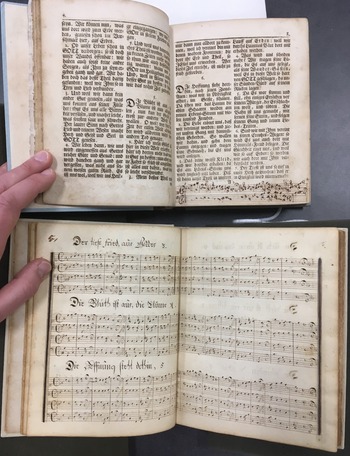
While the Ephrata brothers worked in the print shop, the sisters ran a scriptorium, producing illuminated theological handbooks alongside myriad music manuscripts. These music manuscripts contain entirely original compositions and were intended for coordinated use with the printed hymnals (see Figure 4). The common format for Ephrata music manuscripts is a duodecimo-size book of over 100 pages. Three hymn texts are set per page, with the musical notation for each running from left to right, from verso to recto. Most hymn settings are in four parts, for soprano, alto, tenor, and bass. The music notation usually does not contain text underlay. Rather, the incipit for a hymn is indicated above its corresponding musical setting, with a number that correlates with the appropriate page in a printed hymnal.
1749 Turtel=Taube (Franklin and Marshall College, EPHRATA 1747 B889G, pages 4–5) with music manuscript for 1749 Turtel=Taube (Franklin and Marshall College, Miscellaneous Manuscripts Collection—MSS 5 Literary Manuscripts, Ephrata Cloister Music Manuscript in Book Form, ca. 1745, page 2).

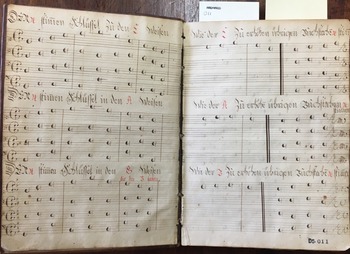
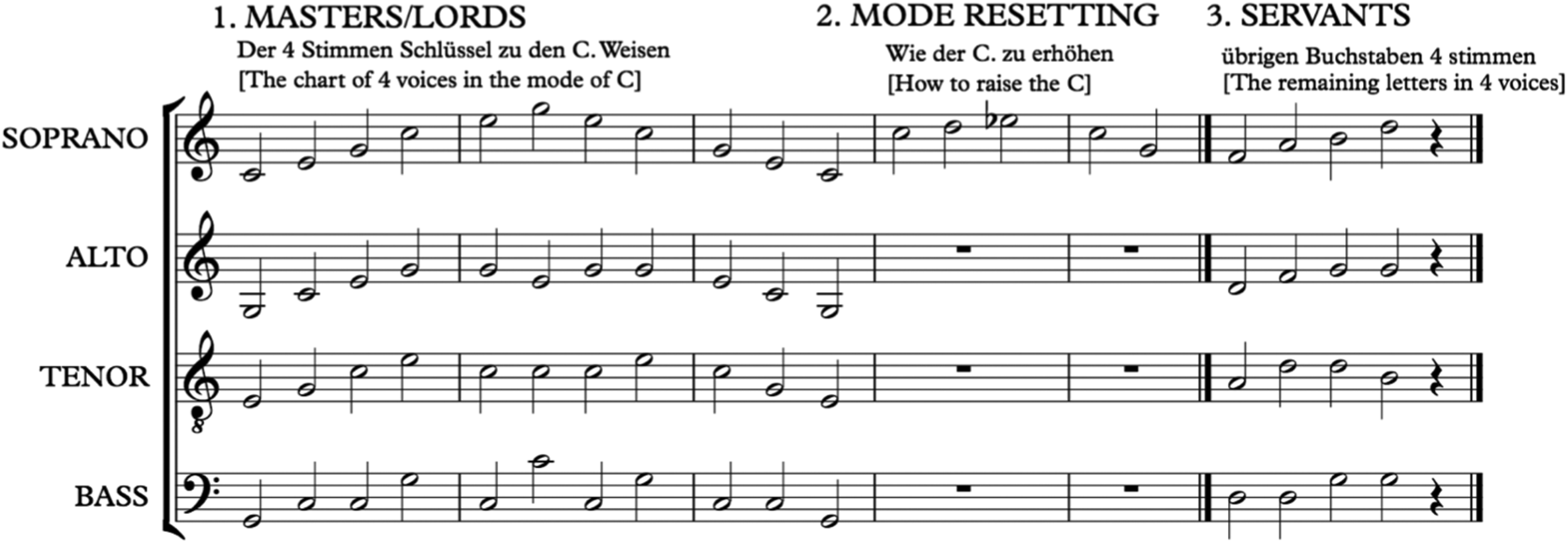
Ephrata music is almost entirely homophonic hymnody, and the composition process was formulaic. This conclusion is supported by the original music theory treatise mentioned above. It is also corroborated by modal charts found in the initial pages of many music manuscripts (see Figures 5 and 6). Composition at Ephrata followed a system of “if… then”; if a specific note appeared in the soprano, then the alto, tenor, and bass would be harmonized according to a prescribed system.Footnote 25 This schema meant that once a soprano melody for a hymn setting was proposed, harmonization for the music could be carried out quickly by anyone familiar with the set of rules. Production was swift, as evidenced by the number of musical settings of hymn texts (at least 1,500). Music was clearly an important social and spiritual element at Ephrata. Ephrata was not unlike many other Pennsylvania German communities, which performed hymns in the frontier “wilderness” as “protective charms, reinforcing the saving power of God.”Footnote 26 Hymns were performed by the entire community. They contain many stanzas, all of which were sung; contemporaneous accounts by visitors mention specific hymns’ durations as lasting several minutes or longer.Footnote 27
Ephrata modal chart in music manuscript for the 1749 Turtel=Taube Type 1, delineating the modes of C major, A minor, and G major. Juniata, DS 011.

Modern transcription of Ephrata modal chart for the mode of C major. The three sections of the chart are included at the top.

Composing Music at Ephrata
It is unclear whom to credit for music theory and composition at Ephrata. One of the principal reasons for this is a lack of authorship attributions in nearly all Ephrata music manuscripts. Indeed, although decorated name plates are frequently found in the manuscripts to denote ownership, there are usually no other names included throughout the volumes. However, the general consensus among the handful of musicologists who have examined Ephrata music is that Beissel was a leading force, if not the leading force in the community's compositional practice.Footnote 28 With the evidence presented below, this article aims to cast doubt on this presumption.
Julius Sachse (1842–1919) was the first person to attempt a comprehensive study of Ephrata music, and he argued that Beissel was the sole source of musical creativity at the cloister.Footnote 29 Sachse's assertion is based on a statement in the opening of the Chronicon Ephratense, Ephrata's self-produced retroactive historical record, completed by Peter Miller in 1786, which describes Beissel as having studied the violin in Germany.Footnote 30 Although the view of Beissel as sole composer rose to prominence during the twentieth century, it is important to note that portions of Sachse's work are considered to be of dubious credibility; he fabricated several of his visual examples and made numerous claims without citing any sources.Footnote 31 A skeptical summary of this dominant view of Beissel as composer reads as follows: “Although there is sufficient evidence to establish that many members of the cloister community authored [texts of] hymns, based on no strong evidence to the contrary Beissel is considered to be the sole composer of all musical settings.”Footnote 32 Thus, Beissel has been given composer status by default and not because of any direct evidence.
More recently, Dorothy Hampton Duck argued that one of the early Ephrata inhabitants, a man named Ludwig Blum, was responsible for introducing musical practice to the community.Footnote 33 Blum's father Johannes was a keyboard player in The Netherlands, and colonial land records indicate that he worked as a musician in churches in Pennsylvania after emigrating to America.Footnote 34 His son Ludwig became a householder at Ephrata, where he was involved in the establishment of a “singing school” around 1740.Footnote 35 The Chronicon states that Blum was apparently a “master-singer, and was also versed in composition; he once brought some artistic pieces to [Beissel], which induced [Beissel] to make use of the Brother (Blum) in his church building.”Footnote 36 Ephrata contained no known musical instruments, but the modal charts found in the music manuscripts closely resemble many contemporaneous European règle de l'octave rubrics used by composers and keyboard improvisers.Footnote 37 The principal difference between the Ephrata charts and the European models is that Ephrata centered its system around the soprano, whereas virtually all European charts are built upon the bass voice.Footnote 38 Blum, who likely learned the keyboard in Europe from his father, was probably familiar with the concepts of the règle de l'octave, and it would seem that if he was indeed responsible for introducing music to the community, then it might have been he who established Ephrata's soprano-led composition system. The fact that Blum worked with the sisters (and not the brothers) before being ostracized by BeisselFootnote 39 lends credence to the idea that the sisters carried out the job of writing and copying music for the community.
Whoever introduced musical composition at Ephrata, the Chronicon establishes the sister's scriptorium as the space in which it was done. This is further borne out by the first-hand account of the Swedish traveler Israel Acrelius, who visited the community in 1753, and described a group of sisters as “constantly engaged in copying musical note-books for themselves and the brethren.”Footnote 40 The fact that Ephrata women were in charge of the creation of music manuscripts is no exception to dominant practices in eighteenth-century America, where printshops were generally run by men and many manuscript books were produced by women in more private settings. Indeed, this gendered labor division in book creation impacted many social contexts in the British Colonies throughout the eighteenth century, and results in a re-examination of the concepts of authorship, particularly with regard to the differences between print and manuscript.Footnote 41 Gender division aside, the sisters’ scriptorium was a hotbed of creative activity. As was the situation in many German-speaking Pennsylvanian communities, the creation of manuscripts at Ephrata was an act of devotion, central to faith identity.Footnote 42 Music manuscript creation included an additional spiritual benefit; the plentiful illuminations found throughout the sisters’ handiwork served to “render the invisible [music] visible” via calligraphy, embellishments, and illustrations of birds, flowers, trees, and biblical scenes.Footnote 43 To wit, there are today at least 135 extant Ephrata and Snow HillFootnote 44 music manuscripts at various libraries, archives, and collections in the United States and abroad.Footnote 45
Authorship at Ephrata
The notion of individual creation at Ephrata, and, arguably, throughout the American colonies, was quite different from the modern concept of authorship. In her work on music during the first century of printing, Kate Van Orden discusses the challenges we encounter by applying our modern idea of authorship to a different historical period. As a point of reference, she looks to Michel Foucault for a suitable definition:
Unlike a proper name, which moves from the interior of a discourse to the real person outside who produced it, the name of the author remains at the contours of texts—separating one from the other, defining their form, and characterizing their mode of existence. It points to the existence of certain groups of discourse and refers to the status of this discourse within a society and culture. The author's name is not a function of a man's civil status, nor is it fictional; it is situated in the breach, among the discontinuities, which gives rise to new groups of discourse and their singular mode of existence.Footnote 46
In other words, the modern author does not merely produce text; s/he has an identity as a creator, and this identity gives her/him social meaning. Van Orden argues that those who created music during the first half of the sixteenth century did so as part of a broader identity of musicianship, rather than specific authorship. Composer status was not necessarily assumed for them; indeed, during this period composers functioned principally as performers or “producers of events.”Footnote 47
Van Orden proposes two valuable questions: “What do we miss when we adopt authorship as a fundament of music history?” and “What cultural complexities are erased when we seek to assign written music to an author?”Footnote 48 These questions should be considered when approaching the topic of authorship at Ephrata. In this context, we assert that the people who created music at Ephrata did not necessarily view themselves as composers in our modern sense. Their creations were not intended with a function of, in Foucault's words, “separating of one from the other.” Instead, the Ephrata creators viewed their writing of hymn texts and melodies as a devotional activity, and part of a communal effort. In this context, they did not inhabit the role of “author,” as we see it today. Indeed, we might be better served to consider authorship at Ephrata through a communal lens. Rather than ascribing to a limited notion of author as individual, it would be prudent to adjust our consideration to include the “essential component” of centuries of substantial contributions to religion, science, and the arts resulting from group-focused collaboration.Footnote 49 We might also be better served to consider authorship at Ephrata as part of a broader dynamic that divided the brothers as printers from the sisters as copyists. With the brothers occupying a “rational and public-facing” role through printing technology, it leaves the sisters in a more “murky private and ideological”Footnote 50 space that can easily be forgotten through the retrospective filter of history. The sisters, as writers, scribes, and copyists, thus participated in a culture of what Alexander Ames terms “scribal authorship,” in which manuscript creators “authored ‘new’ texts designed to meet the needs of devotional readers [and musicians] for whom the texts were produced.”Footnote 51
An additional idea to incorporate into this reframing of the concept of authorship is the fact that there was documented conflict between communal obligation and individuality at Ephrata. Jeff Bach explains that this is seen most clearly through the writings of Ezechiel Sangmeister (1723–84), who lived at Ephrata from 1748 to 1752, and again after 1764 until his death. Sangmeister's writings illustrate the tension “between a gathered community and an individual quest for God.”Footnote 52 This tension is found throughout Ephrata documents. Although the goal of a harmonious community was always intended, individuals or small groups frequently aired grievances or rearranged living situations to express personal protests against Beissel or other colleagues.Footnote 53 It seems that although communal focus was a stated objective, individuality frequently took precedence, resulting in demands for recognition of creative activity. These conflicting views of credit for work situate Ephrata on the cusp between a centuries-old tradition of communal creation and the more modern concept of individual authorship.
Authorship Attributions in Printed Hymnals
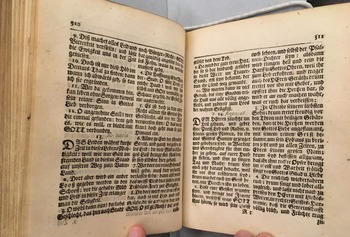
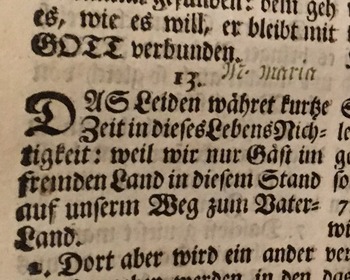
We can tell from various handwritten attributions in printed hymnals that individual credit was important to Ephrata residents, even though their theology emphasized virtues of humility and self-abasement. In many printed hymnals, and especially in the 1747 and 1749 Turtel=Taube, the names of various brothers and sisters were handwritten before hymn texts (see Figures 7 and 8). Those included are usually M. Maria, V. Friedsam (Beissel), S. Rahel, S. Ketura, S. Föben, B. Jonathan, B. Nathan, B. Agonius,Footnote 54 and several others among a core group whose names appear repeatedly throughout Ephrata imprints, in the Chronicon, and in “Die Rose,” the historical account of the sisterhood.Footnote 55
Authorship indications for “M. Maria” and “B. Agonius.” Print of 1749 Turtel=Taube. Pennsylvania State Library, RB EpB83 093 1747 c.1, pages 310–11.

Authorship indication for “M. Maria” written above the hymn “Das Leiden währet kurtze Zeit.” Detail in print of 1749 Turtel=Taube. Pennsylvania State Library, RB EpB83 093 1747 c.1, page 310.

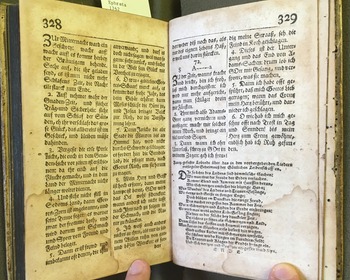
These names are included in handwriting but not in print. A rationale for these inscriptions emerges via an examination of a later printed hymnal: the 1762 Neuvermehrtes Gesäng der einsamen Turtel=Taube. In this imprint, authorship indications for hymn texts are included in print (as opposed to handwriting). As can be seen in Figure 9, the indication S. A-----A—for the name of Sister Anastasia or Sister Athanasia—is far from explicit. This attribution, bearing only the first and last letters of the sister's name, would only have meaning for an Ephrata insider. Nowhere in this printed hymnal are completely spelled-out names to be found; all follow the same cryptic format. Thus, the inclusion of names in the 1762 Neuvermehrtes Gesäng printed hymnal seems to serve a function that was internal to the community. Allen Viehmeyer surmises that the authorship designations might have resulted from “a concern…that the knowledge of authorship identity was being lost.”Footnote 56 However, it is more likely, given the arguments presented above, that providing a printed record of individuals’ work would have served to mitigate conflicts and needs for independent acknowledgment within the collective.
Authorship indication for “S. A-----A,” presumably “Schwester Anastasia” or “Schwester Athanasia.” Details in print of 1762 Neuvermehrtes Gesäng der einsamen Turtel=Taube. Free Library of Philadelphia, EPHRATA 1962, pages 328–29. Courtesy: Rare Book Department, Free Library of Philadelphia.

There are two potential reasons for how these printed attributions relate to the handwritten author designations in earlier printed hymnals. One theory is that once the printed notations were included in the 1762 Neuvermehrtes Gesäng, the notion of authorship at Ephrata changed; recognition for individual work could be affirmed through written inscriptions. If this were the case, handwritten notations of authorship (see Figures 7 and 8) would have been applied retroactively to various printed hymnals at their owners’ discretion. An opposing hypothesis is that the printed names in the 1762 Neuvermehrtes Gesäng represent a culmination of handwritten authorship attributions in printed hymnals throughout Ephrata's history before 1762. Whatever the case, it is unlikely that we will ever be able to assign specific dates to the handwritten name attributions in the printed hymnals, and therefore it is difficult to test either theory regarding authorship. However, the fact that the attributions exist proves that recognition of individual creation was important to some, if not all, members of the Ephrata community.
There is an important distinction to make when discussing name inscriptions in materials of German diaspora communities in eighteenth- and nineteenth-century America. It was common for individuals and families in various Pennsylvania German groups to write their names, often in frakturschrift-style calligraphy, in religious documents such as bibles, hymnals, or other spiritual tracts. Including name(s) in their books “further associated their family with the cosmological narrative of grace and eternal life found in the Bible.”Footnote 57 This practice denoting ownership and spiritual connection is somewhat different from that of writing a name next to a specific passage within a work, such as those found in Ephrata materials.
Authorship Markings in Music Manuscripts
In very rare instances, authorship is indicated in Ephrata music manuscripts. These manuscripts can be considered within a broader category of bound handwritten musical volumes that were prevalent in Europe and the Americas between the seventeenth and nineteenth centuries. This category of written material “push[es] us to think seriously about matters of gender, culture, and the technologies used to produce and sustain them, the concept of authorship and the role of the reader.”Footnote 58 Whereas printed materials firmly linked (mostly male) authors to a public audience, handwritten manuscripts were generally intended for private and individual consumption. In the case of music manuscripts, the copying of music became an avenue of creative expression. “Amateurs used the design elements ingrained in music reproduction technologies to creatively experiment with their self-presentation. Manipulating the appearance of manuscript provided amateurs an outlet for self-display and thus spoke to a desire to make personal taste externally evident.”Footnote 59 Ephrata music manuscripts, containing many Fraktur-style illuminations, decorative calligraphy, elaborate name plates, and other name inscriptions, are no exception to this trend.Footnote 60
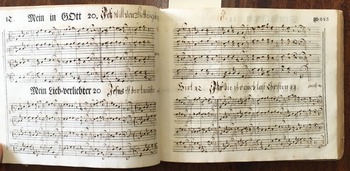
In Juniata DS 015, one of two extant music manuscripts for the 1755 Nachklang zum Gesäng der einsamen Turtel=Taube, “jacob n.” is written on the right side of page 12 recto (see Figure 10). Viehmeyer's Index to the Hymns and Hymn Tunes of the Ephrata Cloister 1730–1785 tells us that Jacob Naegle (a householder) is the author of the hymn text “Ich will von Gottes=Güte sagen” on the top of the page. This hymn text is found in the 1755 Nachklang zum Gesäng, the 1762 Neuvermehrtes Gesäng, and the 1766 Paradisisches Wunderspiel.Footnote 61 Naegle is known to have written only one other hymn text: “Wie hastu meiner doch so gantz.”Footnote 62 Perhaps the fact that he wrote a hymn text was a novelty, and therefore deserved recognition in the music manuscript.
“jacob n.” written on right side of page. Music manuscript 1755 Nachklang zum Gesäng der einsamen Turtel=Taube. Juniata, DS 015, page 12.
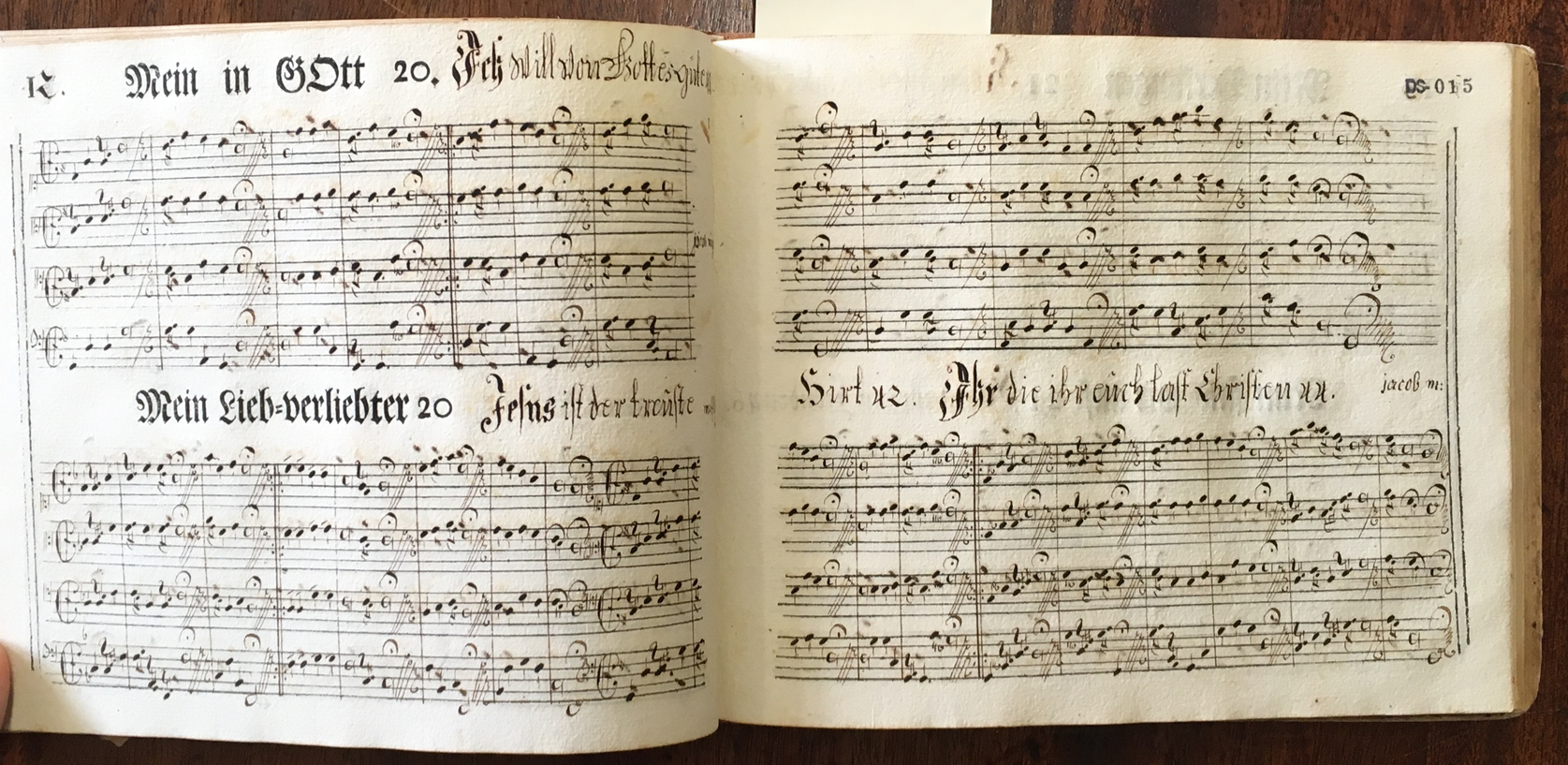
Another possibility to explain what we presume to be Naegle's name in the margin is that the appearance of it indicates composer status. This is unlikely given what we have surmised about the Ephrata writing workshops and singing school systems; a male householder would likely not have been part of the day-to-day process of composing. Nonetheless, Naegle could have written the tune with the text for “Ich will von Gottes=Güte sagen,” and this might have made its way through the music copying system in such a manner that a scribe was compelled to write Naegle's name on the music manuscript.
In the context of the 1755 Nachklang zum Gesäng, a printed hymnal that contains texts mainly by householders,Footnote 63 the division between householders and solitary brothers and sisters is important to mention. There is evidence of distinct separation between these two Ephrata groups. Guy Tilghman Holliday's study of inheritance practices at Ephrata highlights this issue. Holliday explains that Beissel's divisive personality and the social stratification among the community led to financial consequences, seen most starkly in the lack of major bequests left to the solitary by householders during the eighteenth century. With the exception of a few major gifts, wealth tended to remain in the hands of the householders, leaving the brothers and sisters of the Cloister reliant on income earned through printing, teaching Latin, and other crafts for economic resources.Footnote 64 If there was such tension between the solitary and the non-celibates, perhaps writing a householder's name in a music manuscript would have helped to ease conflict.
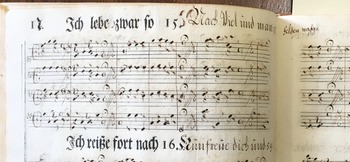
Another curious notation exists on page 17 recto of Juniata DS 015 (see Figure 11). On the upper left-hand corner of the page, next to the hymn incipit “Nach viel und manchen Trauer=Stunden,” is the attribution “felden magg.” “Felden” is a diminutive for the name “Valentine” and “magg” could be an alternate spelling for the surname “Mack.” Indeed, Viehmeyer's Index tells us that the author of this hymn text is Br. Valentine Mack, another householder. Viehmeyer presents plenty of data to support this, including corroborating handwritten author attributions for Mack from six different printed hymnals.Footnote 65 Thus, Mack wrote the text for this hymn, and it is possible that he could also be the composer of the musical setting.
“felden magg” is written on top of page. Music manuscript 1755 Nachklang zum Gesäng der einsamen Turtel=Taube. Juniata, DS 015, page 17.

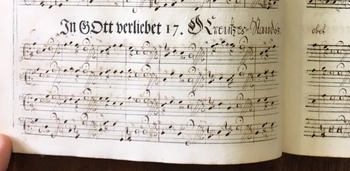
One other attribution is to be found in Juniata DS 015 on page 18 recto (see Figure 12). The name “obed” is written after the hymn incipit “O Creutzes=Stand! O edles Band!” Viehmeyer confirms that Brother Obed, a householder also known as Ludwig Höcker, is the author of the text.Footnote 66 Obed also happens to be the author of numerous other hymn texts, some of which are in the 1755 Nachklang zum Gesäng der einsamen Turtel=Taube. It is unclear why Obed's name is included in this manuscript, particularly when other texts that he wrote are also found therein and not given specific attributions. It is therefore possible that the attribution indicates that he composed the music to “O Creutzes-Stand.”
The name “obed” is written to the right of the hymn incipit “O Creutzes=Stand.” Music manuscript 1755 Nachklang zum Gesäng der einsamen Turtel=Taube. Juniata, DS 015, page 18.

Whereas there is ambiguity regarding the purpose for the three name attributions in the music manuscript for the 1755 Nachklang zum Gesäng, there is more certainty surrounding those found in the Ephrata Codex. It should be remembered that the 1746 Ephrata Codex is a unique presentational manuscript that was dedicated to Beissel. It is the largest of all Ephrata music manuscripts, and is written almost exclusively for five voices, as opposed to four. The title page includes the names of brothers (Jethro, Nehemia, Theonis, Jonathan, and Jaebez) who presented the manuscript to Beissel (see Figure 13).
Names of brethren who presented the volume to Beissel are below Biblical quotes in five boxes along edges of page. 1746 Ephrata Codex, LC, M 2116.E6 1746, dedication page. Courtesy: the Music Division at the Library of Congress.

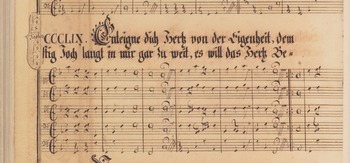
The majority of the Ephrata Codex does not contain any named attributions. However, starting in the middle of section 3 of the manuscript, names can be found. Two of these names are Jaebez (also known as Peter Miller) and Theonis. For example, Jaebez's name is written next to the hymn setting for “Enteigne dich Hertz von der Eigenheit” on page 147 (see Figure 14). The text to this hymn, from the 1739 Zionitischer Weyrauchs Hügel, appears in print as early as 1712 in the radical Pietist hymnal Anmuthiger Blumen=Kranz and it does not have a known author.Footnote 67 Therefore, the name attribution for Jaebez does not necessarily reveal any specific information about the musical setting.
Name of Jaebez written to the left of the Roman numerals for “Enteigne dich Hertz von der Eigenheit.” 1746 Ephrata Codex, LC, M 2116.E6 1746, section 3, page 147. Courtesy: the Music Division at the Library of Congress.

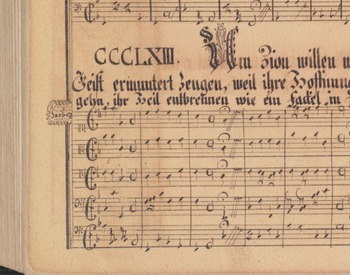
The next attribution, however, provides an opening for inquiry. On the following page (section 3, page 148), Jaebez's name is written next to the hymn setting for “Um Zion willen will ich nimmer schweigen” (see Figure 15). The text of this hymn, from the 1739 Zionitischer Weyrauchs Hügel, is by Peter Lessle, a householder.Footnote 68 Unless it is a mistake, Jaebez's name does not signify authorship of the text; his name would not be included next to a hymn setting whose text was written by another member of the community. The attention paid to recognition of authorship of hymn texts would likely prevent false attributions from being made. The alternative explanation is that Jaebez was responsible for the music on the page, either as a copyist or as a composer.
Name of Jaebez written next to “Um Zion willen will ich nimmer schweigen.” 1746 Ephrata Codex, LC, M 2116.E6 1746, section 3, page 148. Courtesy: the Music Division at the Library of Congress.
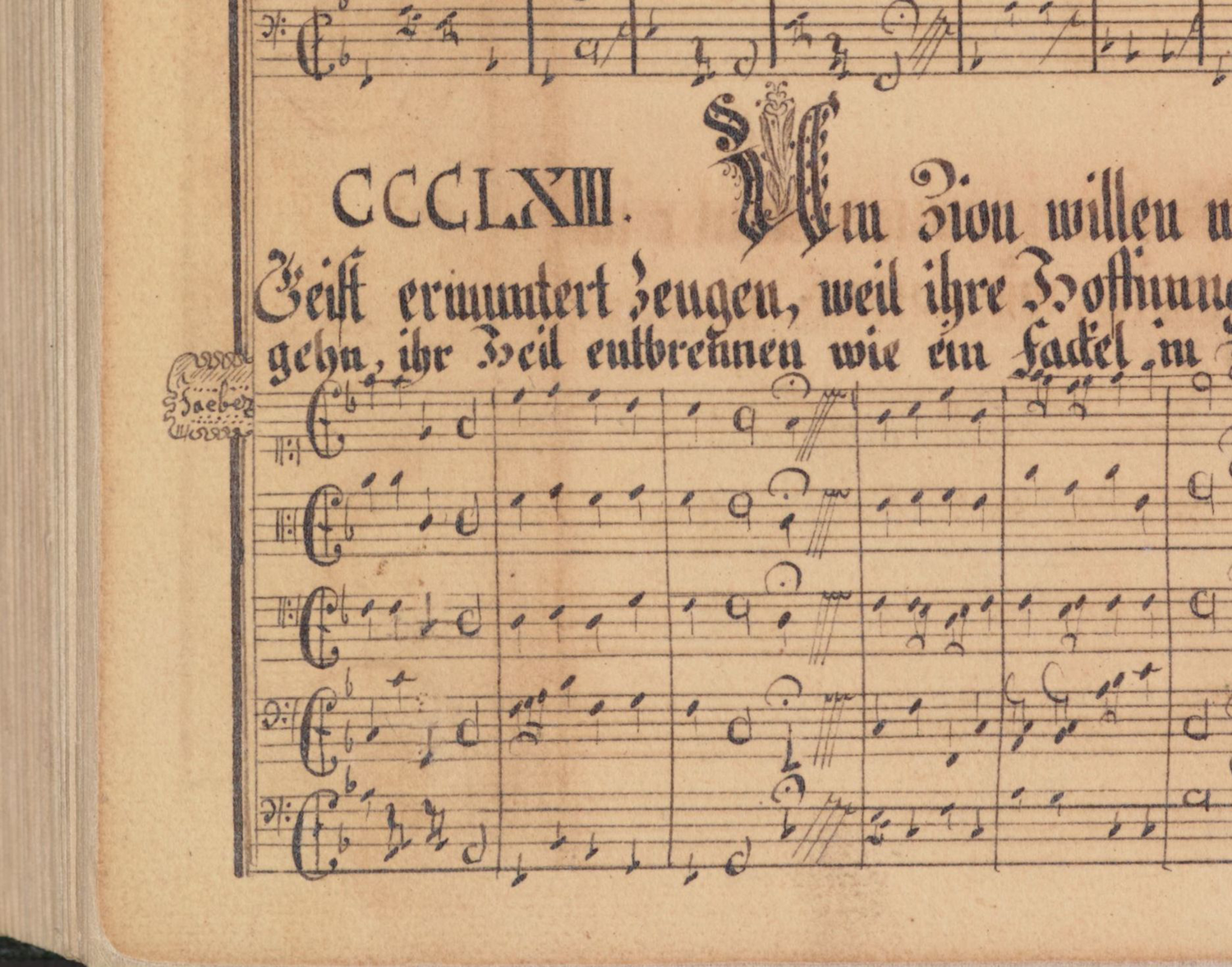
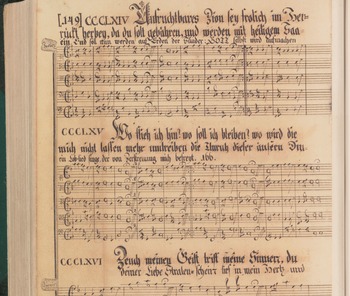
If we consider the theory that Jaebez is the copyist of this hymn setting, it is required that we compare the paleography of the music with the other hymn settings surrounding it. Such an analysis reveals no significant variation. In addition, the following page (section 3, page 149) includes two name attributions, one for Jaebez (“Unfruchtbares Zion sey fröhlich,” with text by an unknown EuropeanFootnote 69), and the other for Theonis (“Zeuch meinen Geist, triff meine Sinnen,” with text by the European writer Christian Knorr von Rosenroth [1636–89]Footnote 70) (see Figure 16). It appears that the same hand notated this music in addition to the hymn settings presented in Figures 14 and 15. Given that there is no change in the style of handwriting or music notation, it does lead one to question why a copyist would be credited three times over the course of three separate pages, and only in connection with specific pieces of music.
Name of Jaebez written next to “Unfruchtbares Zion sey fröhlich” and name of Theonis written next to “Zeuch meinen Geist, triff meine Sinnen.” 1746 Ephrata Codex, LC, M 2116.E6 1746, section 3, page 149. Courtesy: the Music Division at the Library of Congress.
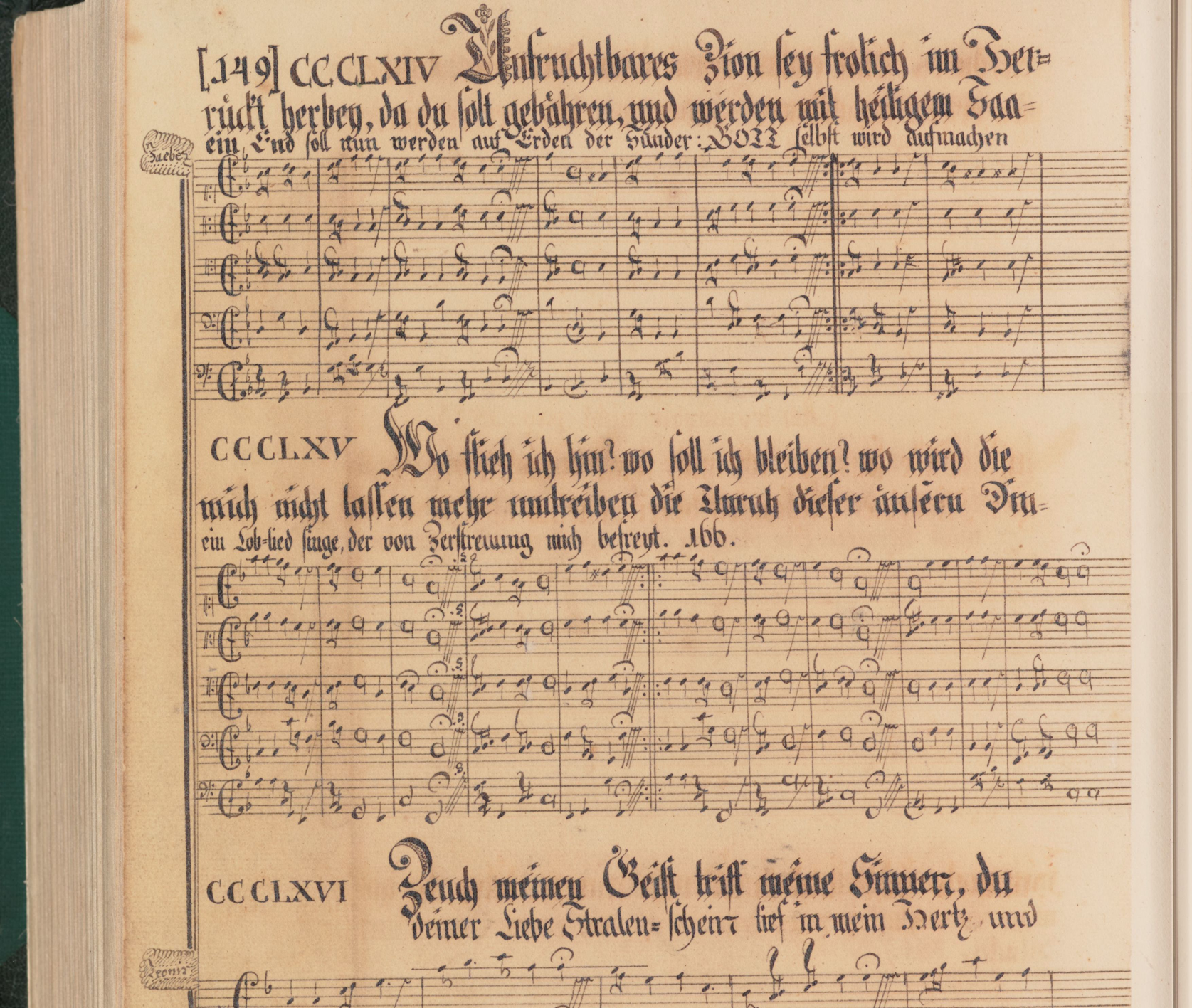
It thus would appear that the name attributions in the Ephrata Codex do not signify copyist designations. This suggests the likelihood that the names indicate authorship of music. Does this mean that Jaebez and Theonis wrote the hymn tunes? Does it denote that they performed the task of voicing? Or does it convey that they carried out the entire task of composition? If, as argued above, Ephrata music was written in a workshop system following prescribed rules for voicing, then it would imply that Jaebez and Theonis were composers of both the tune and the harmonies. The fact that their names are written next to the music reveals that they wanted Beissel, the recipient of the volume, to know of their specific personal contributions. Accordingly, the attributions transport Jaebez and Theonis from the communal positions of contributors to the “culturally constructed status” of composers.Footnote 71
Ephrata's Female Composers
If one continues to explore section 3 of the Ephrata Codex, one encounters three other names written in a similar style to the attributions for Jaebez and Theonis. These are Sisters Föben, Hanna, and Ketura. Biographical information for these three women is extremely scarce. “Die Rose” provides some clues: Ketura and Föben are listed as leaders within the sisterhood, in positions of seniority and authority.Footnote 72 In addition, the “Death Register of the Ephrata Cloister,” held at the Historical Society of Pennsylvania, helps to situate these women and their colleagues more firmly in time and space. The entries provide valuable information about the sisters’ ages, backgrounds, and activities. For example, the “Death Register” reveals that Föben was 28 years old in 1746, the year of the presentation of the Ephrata Codex. We also learn from “Die Rose” and the “Death Register” that in 1746, Hanna was 32 years old and that Ketura was 28 years old.Footnote 73 Thanks to the research performed by genealogists of the Pennsylvania Historical and Museum Commission at the Ephrata Cloister during the twentieth century, we are able to identify these three women by their given names in addition to their chosen Cloister names.Footnote 74 They are:
Sister Föben
Born Christianna Lassle, unknown locale, ca. 1717. Died March 4, 1784.
Sister Hanna
Born Hannah Lichty in Germany, ca. 1714. Died October 31, 1793.
Sister Ketura
Born Catherine Hagamann, unknown locale, ca. 1718. Died October 10, 1797.
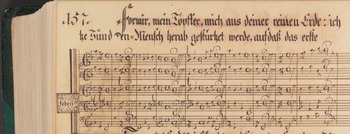
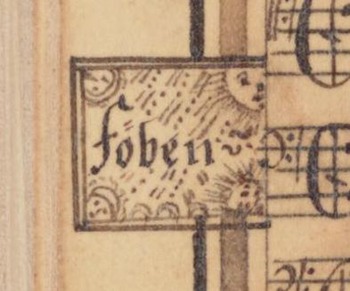
In section 3, page 157 of the Ephrata Codex, an attribution for “Föben” is found next to the hymn setting for “Formir, mein Töpffer” (see Figures 17 and 18). Here, Föben's name appears within a box including images of sun, rain, and the faces of two people, presumably solitary sisters, as suggested by their head coverings. The author of the hymn text for “Formir, mein Töpffer” is the European writer Michael Müller (1673–1704).Footnote 75
Name of Föben written next to “Formir, mein Töpffer.” 1746 Ephrata Codex, LC, M 2116.E6 1746, section 3, page 157. Courtesy: the Music Division at the Library of Congress.

Detail of attribution for Föben, written next to “Formir, mein Töpffer.” 1746 Ephrata Codex, LC, M 2116.E6 1746, section 3, page 157. Courtesy: the Music Division at the Library of Congress.

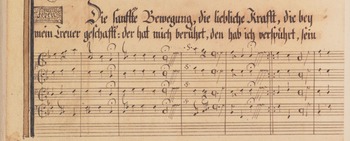
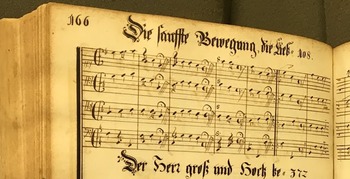
Föben's name also appears on the preceding page (section 3, page 156), next to the hymn setting for “Die sanfte Bewegung, die liebliche Kraft” (see Figure 19). The text of this hymn is by the European writer Christian Friedrich Richter (1676–1711).Footnote 76 If we apply the argument presented above for Jaebez and Theonis, there is no probable explanation for the presence of Föben's name here other than that she is the composer of the music.
Name of Föben written next to “Die sanfte Bewegung, die liebliche Kraft.” 1746 Ephrata Codex, LC, M 2116.E6 1746, section 3, page 156. Courtesy: the Music Division at the Library of Congress.

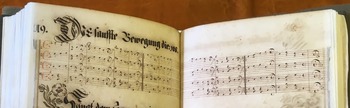
A unique feature of this setting is that it is written for four voices as opposed to five, which is a rarity in the Ephrata Codex. This setting is also found in music manuscripts for the 1739 Zionitischer Weyrauchs Hügel Type 1Footnote 77 on page 119 (see Figure 20). The voicing is identical in both settings, indicating that this composition was likely copied into the Ephrata Codex. Thus, it would appear that if Föben were the composer of this hymn setting, her influence was spread throughout the proliferation of music manuscripts. This idea is supported by the fact that it was the Ephrata sisterhood who led the scriptorium and by “Die Rose,” which places Föben in a position of seniority among the sisters.Footnote 78
Setting of “Die sanfte Bewegung, die liebliche Kraft.” 1739 Zionitischer Weyrauchs Hügel Type 1. Free Library of Philadelphia, Borneman MS 2, page 119. Courtesy: Rare Book Department, Free Library of Philadelphia.

Another item that bolsters the case for Föben's authorship of the music for “Die sanfte Bewegung” is consideration of where and how the hymn setting appears in a music manuscript for the 1739 Zionitischer Weyrauchs Hügel Type 2: Winterthur, Col. 318, 65x562. In this document, the hymn setting is found in section 3, page 166 (see Figure 21). Whereas the content leading up to page 163 of section 3 is of a similar and non-ornamental style of paleography, everything changes after page 164. Here, writing becomes more intricate, with gothic lettering for hymn incipits. Music manuscripts for the 1739 Zionitischer Weyrauchs Hügel Type 2 were likely created by the brothers (not the sisters) as practice runs for the Ephrata Codex.Footnote 79 This manuscript type does not contain many illuminations, and the handwriting is not as intricate or precise as many of the other music manuscripts. If the brothers, unaccustomed to scriptorium work, produced the majority of the pages of this manuscript type, it would then be credible that the final pages of the section were given to the sisters for completion. This would account for the change in paleography and greater attention to detail, including the introduction of illustrations on blank pages at the end of this section, presumably produced in the sisters’ scriptorium.
Setting of “Die sanfte Bewegung, die liebliche Kraft.” 1739 Zionitischer Weyrauchs Hügel Type 2. Winterthur, Col. 318, 65x562, section 3, page 166. Courtesy: the Winterthur Library: Joseph Downs Collection of Manuscripts and Printed Ephemera.

A comparison to another Type 2 manuscript yields corroborating evidence. Columbia Ephrata Cloister Collection Document 12 includes “Die sanfte Bewegung” in section 2, page 127. In its Register (German for “index”), 127 is added in larger lettering than the text surrounding it, which indicates that the number was likely written by a different hand. Just as in Winterthur, Col. 318, 65x562, the section containing this hymn setting is set apart; this time it is differentiated less by paleography, and instead by its placement after a blank page (page 125). Although it is impossible to prove, one hypothesis is that the blank page might serve to segregate hymn settings written by men from the hymn settings written by women. Finally, Ephrata Cloister Collection, EC 77.3, another music manuscript for the 1739 Zionitischer Weyrauchs Hügel Type 2, does not even include “Die sanfte Bewegung.” Again, this music manuscript type was likely created by the brothers.
If the Ephrata Codex was produced by the Ephrata brothers as a presentational volume to Beissel, why would Föben's name be included as an extremely rare composer designation? One answer would be that the creators of the manuscript wished to highlight Föben's compositional contributions and to do so quite blatantly. That Föben's name appears in a similar manner to the names of Jaebez and Theonis indicates that, through her role as composer, she was viewed in a light comparable to her male counterparts.
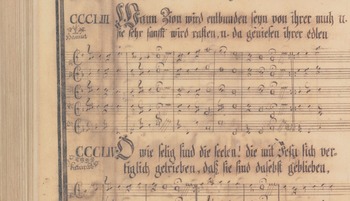
The Ephrata Codex includes two other sisters’ names: Hanna and Ketura, both in section 3, page 144.Footnote 80 Hanna's name is written next to the hymn setting “Wann Zion wird entbunden,” and Ketura's name is written next to “O wie selig sind die seelen!” (see Figure 22). The paleography for both names appears to be the same, and neither name receives the rectangular illumination that frames Föben. Nonetheless, both names are written in gothic lettering and decorated with flowers.
Names of Hanna and Ketura written next to hymn settings. 1746 Ephrata Codex, LC, M 2116.E6 1746, section 3, page 144. Courtesy: the Music Division at the Library of Congress.

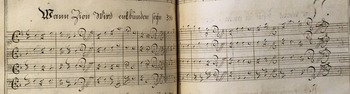
Viehmeyer's Index reveals that Hanna is the author of three hymn texts, and Ketura is the author of seventeen hymn texts throughout the Ephrata oeuvre.Footnote 81 None of these are the texts for the two musical settings by which their names appear in the Ephrata Codex. The text of “Wann Zion wird entbunden” is by Beissel himself. The text appears in the 1739 Zionitischer Weyrauchs Hügel,Footnote 82 and the tune to which it is set in the Ephrata Codex appears in several other music manuscripts throughout the oeuvre. It is important to mention that this text receives an alternate musical setting within the Ephrata Codex and elsewhere. The fact that Hanna's name appears next to one of the settings would presumably serve to point out that she is the composer of this particular music. As with Föben's setting of “Die sanfte Bewegung,” Hanna's setting of “Wann Zion wird entbunden” in Winterthur, Col. 318, 65x562 is positioned at the end of part 3 (page 160), and this placement suggests that it is a late addition. In her eponymous music manuscript, Ephrata Cloister Collection, EC 77.3 (which includes Hanna's name on the ownership plate of the volume), there appears to be a special and unique flourish at the end of each stave of this setting (see Figure 23). This notational anomaly within Hanna's own volume might correlate with her status as composer of this specific music.
Setting of “Wann Zion wird entbünden” in 1739 Zionitischer Weyrauchs Hügel Type 2. Ephrata Cloister Collection, EC 77.3, section 3, page 164. Unique flourish at end of each stave.

Even in the event of confusion over the attribution of some of the texts set to the music with female composer designations in the Ephrata Codex, there is no doubt regarding Beissel's authorship of the text for “Wann Zion wird entbunden.” The presence of Hanna's name next to Beissel's hymn text in the Codex thus further strengthens the idea of her authorship of the music, whether it be the tune, the voicings, or both.
The hymn setting “O wie selig sind die Seelen!” with the attribution to Sister Ketura (see Figure 22) is for a text by Christian Friedrich Richter,Footnote 83 and its music is also found in other sources, including multiple copies of music manuscripts for the 1739 Zionitischer Weyrauchs Hügel Type 1 and music manuscripts for the 1739 Zionitischer Weyrauchs Hügel Type 2. In Winterthur, Col. 318, 65x562, it is placed immediately above Hanna's “Wann Zion wird entbunden” on page 160. Moreover in Ephrata Cloister Collection, EC 77.3, it is placed immediately after Hanna's “Wann Zion wird entbunden” on page 164.
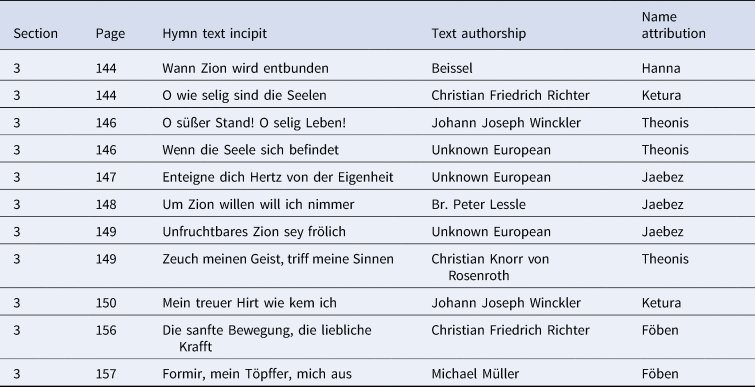
A complete table of the apparent composer attributions found in the Ephrata Codex is presented in Table 1.
Complete list of name attributions next to hymn settings in 1746 Ephrata Codex, LC, M 2116.E6 1746, section 3

Although the data presented above do not provide watertight and irrefutable evidence of composer status, they do support a convincing and compelling argument that Föben, Hanna, Jaebez, Ketura, and Theonis wrote hymn tunes and their harmonies. Based on what we understand about life and creative activity at Ephrata, it is highly likely that these individuals wrote music, resulting in the designation we might use to describe them today: composers.
Expanding Ephrata's Sonic Boundaries
One of the products of this research has been an attempt to bring a sampling of Ephrata music into our time, using current technology, and releasing it as a professional recording in the modern digital marketplace.Footnote 84 In March 2019, we (the author, as producer and musical director, the audio engineer Joseph Greey, and four vocalists—Elizabeth Bates, Clifton Massey, Nils Neubert, and Steven Hrycelak) recorded an album in the Meetinghouse (or “Saal”) at the Historic Ephrata Cloister, one of the many sites administered by the Pennsylvania Historical & Museum Commission.Footnote 85 The selected works for the recording were new transcriptions made from a historicist perspective. They avoid the placement of Ephrata music within a preset metrical structure, as previous editions did, and attempt to preserve the metrical variation and ubiquitous absence of time signatures found throughout Ephrata music manuscripts.Footnote 86 Our recording, Voices in the Wilderness, is available on Spotify.Footnote 87 Released on the Bright Shiny Things label in November 2020, it received a considerable degree of attention, most specifically because of its inclusion of two hymns by Sister Föben: “Die sanfte bewegung, die liebliche Kraft” and “Formier, mein Töpffer, mich aus.”
Given the vast number of musical compositions throughout Ephrata music manuscripts, our work makes only a tiny dent in the corpus. However, because of streaming services like Spotify, Apple Music, and YouTube, this narrow collection of the music of Ephrata can now be heard anywhere for free. In addition, as a result of dissemination on social media beyond the sphere of southeastern Pennsylvania, this music now has a broader audience than previous marketed attempts. The situation presents a paradox because of conflicting intentions: Ephrata music was intended for internal and mainly private devotional use, but our scholarship (i.e., this article) and the Voices in the Wilderness recording are brazenly public. By following scholarly convention alongside a commitment to open access for resources and information, we have inadvertently ignored the intentions and agency of Ephrata composers.
In a way, this archival work, transcription, and recording have several aspects in common with projects of other contemporary scholars working in the field of North American eighteenth-century music. Sarah Eyerly's profound interactions with Moravian missionary music in a variety of Indigenous American languages lift a shroud from rarely remembered hybridized communities and their musical practices.Footnote 88 Eyerly makes an impactful commitment to digital humanities technology in order to present multimedia as part of an academic pursuit; the music in her study becomes more accessible, vibrant, and vital as a result. Moreover, Eyerly's continued work with Rachel Wheeler, Bill Miller, Brent Michael Davids, Chris Harvey, and others provides a new paradigm for interacting with music found in archives, particularly when this music intersects with historically marginalized, colonized, and oppressed communities.Footnote 89 Glenda Goodman's work in Native hymnody pulls together an abundance of information, which is all the more remarkable given the absence of the music manuscripts central to her study. Through a consideration of texts, materials, items, and legal documents that Joseph Johnson, a Mohegan/Brothertown Native American in Connecticut, interacted with, Goodman creates a “surrogate bibliography” to explain the context and significance of the music books that Johnson produced.Footnote 90 Johnson's music manuscripts have been lost, but the culture surrounding the music is discernable, and much can be learned from this subaltern reworking through colonialist archival documents.
Our “re-sounding” of Ephrata music seeks to bring voice to this marginal community that lived mainly on the fringes of German-speaking Pennsylvanian society in the eighteenth century. In many ways, and in contrast to Eyerly's and Goodman's work, this project benefited from a clearly defined set of music manuscripts, preexisting scholarship, and catalogued materials. It is also less intersectional: Ephrata's music did not occur within a context of overlapping languages and cultures. The fact that our recording took place in the Meetinghouse at the Ephrata Cloister adds an inherent historical authenticity to the album. However, although Ephrata music materials are relatively plentiful, information about how this music was performed is extremely scant.Footnote 91 During both the transcription process and recording sessions, we were forced to make editorial decisions regarding rhythms, voicing, tempo, dynamics, breathing, and vocal registration, to identify several of the musical dimensions that the music manuscripts and the few historical accounts of performance practice do not address. Our attempt to be faithful to the musical text is thus inherently intertwined with contemporary musical choices, all of which results in a new and potentially unfaithful interpretation that simultaneously, and perhaps ironically, draws attention and interest to the music of Ephrata and its composers.
The added dimension of gender within Ephrata music intensifies the project and adds nuance to it. In the wake of #MeToo and initiatives for diversity, equity, and inclusion at universities and other institutions, studies that discuss intersectionality, marginalized groups, and underrepresented voices tend to receive highlighted focus and scrutiny. The fact that Ephrata women wrote music can easily be harvested as a contemporary touchstone or talking point. In fact, some of the marketing for Voices in the Wilderness relies on the #WomenInMusic angle to bring more attention to the project. This author (a white male) must navigate this tension, attempting to assess the material objectively while also negotiating current cultural trends in U.S. academia. Ultimately, if this project helps to bring greater recognition to the “contributions of women in the history of American music,”Footnote 92 then it will have satisfied its aim.Footnote 93
Conclusion
The conditions at Ephrata, although difficult and ascetic, were in many ways favorable for female residents, and in particular the solitary sisters. In comparison with the state of women's situations in much of eighteenth-century America, the sisters were not obligated to perform the typical domestic responsibilities of family life. They were given a mandatory education that required advanced literacy, they did not bear children, and they enjoyed a considerable degree of independence from their male counterparts. In the context of many German-speaking Pietist/spiritual communities, such independence for women was noteworthy.Footnote 94 Bach asserts that “Beissel devalued women”Footnote 95 and Johann Georg Gichtel (1638–1710), one of Bessel's Pietist role models, warned that women, under the influence of the devil, “soften” men.Footnote 96 Although Beissel's generally misogynist views were applied wholesale to Ephrata theology, the sisters forged a degree of spiritual autonomy and economic independence.Footnote 97 To wit, “Die Rose” asserts that the sisterhood was founded independently, and without the assistance or influence of men.Footnote 98 For these reasons, it therefore is not surprising that certain women of Ephrata wrote music. What is perhaps unexpected is that they were credited for their work in a volume produced by men.
There is no reason to reimagine Ephrata as a society in which the sisters received any more social respect than bourgeois or upper-class women in major cities throughout the Atlantic world. In the coterminous context of female musicians and composers in Germany during the eighteenth century, limited female independence was associated with Enlightenment values. Although sometimes receiving credit for their accomplishments, “women were not, in any straightforward sense, empowered by feminocentric aesthetic frameworks, nor did they enjoy anything like full agency in musical culture.”Footnote 99 Ephrata appears to have existed in parallel to this construct in Europe. That being stated, the fact that some of the women of Ephrata composed music is an important addition to the record of music history. It extends the limited compass of historiography, which appears to locate one of the American republic's early female composers as Mrs. Mary Ann Pownall (1751–96), an English immigrant who collaborated on theater songs.Footnote 100
It should be noted that the inclusion of Maria Eicher (Mutter Maria of Ephrata) (1710–84) as the first entry in the Denkmäler Women Composers: Music Through the Ages Footnote 101 is misleading and potentially inaccurate. In her short article in that volume, Denise Seachrist discusses the leadership role that Maria played at Ephrata as prioress of the sisterhood and discusses her authorship of hymn texts. To her credit, Seachrist refers to the music presented in this volume as “the setting of Maria Eicher's O Tauben Einfalt! Unschulds Leben!” and does not identify the composer. This is an accurate description, and it reveals that it is not known who the composer of the hymn setting is, or whether it is a man or a woman. It is thus surprising that Maria Eicher is included in this collection of women composers, given that it is impossible to prove that she composed the presented music. A valid—and valuable—entry for a future compendium of works by female composers would be inclusion of the hymn settings by Föben, Ketura, and Hanna.
It is worth revisiting Miller's letter to Franklin, which describes the Ephrata Codex as containing “the most part of the musical Concerts, by [Beissel] composed.”Footnote 102 Although it is certainly not a surprise that the creative work of Ephrata women was not recognized or remembered by Miller or anyone else until now, it is ironic that the music of these three women was hidden for over 250 years inside a book that celebrated a celibate male religious leader. It is also remarkable that this book briefly ended up in Benjamin Franklin's personal library before being nearly lost to history. The “discovery” of these three composers was the result of a mere re-examination of the Ephrata Codex alongside an attempt to “move beyond the dominant Romantic definition of the individual author and to recognize, in the diversified processes of textual production, alternative formulations or experiences of authorship.”Footnote 103 One must wonder what other underrepresented creators might appear through a focused study of other known documents of vast early America.Footnote 104
Christopher Dylan Herbert is a musicologist and baritone who performs frequently throughout the Americas, Europe, and Asia. He is a two-time GRAMMY® nominee. He holds a B.A. in Music from Yale University, an M.A. in Middle Eastern Studies from Harvard University, and a D.M.A. in Voice from The Juilliard School. He is the head of the voice program at William Paterson University in New Jersey. His current research focuses on the music of the eighteenth-century Ephrata Cloister in Pennsylvania. He was the baritone in the critically acclaimed ensemble New York Polyphony from 2010 to 2020. www.christopherdylanherbert.com.