

Introduction
Reproductive success is one of the key demographic parameters influencing the dynamics of bird populations. Its determination and the analyses of ultimate and proximate causes of reproductive failure are critical for the conception of conservation strategies and the validation of management measures for many threatened species (Green Reference Green1999, Robinson et al. Reference Robinson, Morrison and Baillie2014, Brown and Graham Reference Brown and Graham2015). Often, however, a dilemma arises in pursuit of these goals: in order to investigate reproduction, researchers need to approach reproducing birds and their nest sites, and this disturbance might itself cause nest failure. Frequent visits to nests are needed to investigate clutch survival probabilities, number of hatchlings, cause of reproductive failure etc., and usually the knowledge gained is positively correlated with the number of visits to active nests (Mayfield Reference Mayfield1975, Verboven et al. Reference Verboven, Ens and Dechesne2001, Andes et al. Reference Andes, Shaffer, Sherfy, Hofer, Dovichin and Ellis-Felege2019). However, more frequent visits may increase the probability of reproductive failure, especially when the time interval between visits is short (Lenington Reference Lenington1979, Salathe Reference Salathe1987, Major Reference Major1990, Bêty and Gauthier Reference Bêty and Gauthier2001, Teunissen et al. Reference Teunissen, Schekkerman and Willems2006). Nests may be more prone to predation when unattended because of disturbance by researchers (MacInnes and Misra Reference MacInnes and Misra1972, Westmoreland and Best Reference Westmoreland and Best1985, Major Reference Major1990), repeatedly flushing birds of from nests may direct the attention of predators to nests (Lenington Reference Lenington1979), predators could learn to follow human scent to nests (Snelling Reference Snelling1968, Whelan et al. Reference Whelan, Dilger, Robson, Hallyn and Dilger1994), or predators may even directly follow investigators to nests (Strang Reference Strang1980).
Automatically triggered cameras (hereafter ‘cameras’) may offer an efficient solution to this dilemma because they allow permanent monitoring without repeated disturbance. Cameras have been used to monitor bird nests since the 1950s (Gysel and Davis Reference Gysel and Davis1956, Royama Reference Royama1959, Cox et al. Reference Cox, Pruett, Benson, Chiavacci, Thompson, Ribic, Thompson and Pietz2012). Since the early 1970s, the number of publications reporting use of cameras has constantly increased (Cox et al. Reference Cox, Pruett, Benson, Chiavacci, Thompson, Ribic, Thompson and Pietz2012). In recent decades, technical improvement, miniaturization and decreasing costs have further promoted the use of cameras in ornithological research (Cox et al. Reference Cox, Pruett, Benson, Chiavacci, Thompson, Ribic, Thompson and Pietz2012). The introduction of new technology in research often raises the question of whether and how the technology itself affects the result of the study (Ibáñez-Alamo et al. Reference Ibáñez-Álamo, Sanllorente and Soler2012). With respect to cameras monitoring bird nests the crucial question is whether the installation or presence of a camera influences reproductive success. For example, the installation of cameras could either lead to decreasing reproductive success if predators learn to associate cameras with prey (attraction effect), or they could lead to an increase in reproductive success if predators tend to avoid unfamiliar structures or human scent in their environment (deterrence effect) (Buler and Hamilton Reference Buler and Hamilton2000, Herranz et al. Reference Herranz, Yanes and Suárez2002, Richardson et al. Reference Richardson, Gardali and Jenkins2009, Herring et al. Reference Herring, Ackerman, Takekawa, Eagles-Smith and Eadie2011, Ellis-Felege and Caroll Reference Ellis-Felege, Caroll, Ribic, Thompson and Pietz2012, Weston et al. Reference Weston, Ekanayake, Lomas, Glover, Mead, Cribbin, Tan, Whisson, Maguire and Cardilini2017) or predators could simply ignore cameras. However, in many studies using cameras, the devices’ influence on results has not been assessed.
Since 2013, we have used cameras to monitor hatching success and causes of hatching failure of nests of the Black-tailed Godwit Limosa limosa. The Black-tailed Godwit nests on the ground in meadows and open grasslands in the Palaearctic, and young are precocial. The central European subspecies L. l. limosa has declined dramatically over most of its range during recent decades (Gill et al. Reference Gill, Langston, Alves, Atkinson, Bogher, Vieira, Crockford, Gélinaud, Groen, Gunnarsson, Hayhow, Hooijmeijer, Kentie, Kleijn, Lourenço, Masero, Meunier, Potts, Roodbergen, Schekkerman, Schröder, Wymenga and Piersma2007, Kentie et al. Reference Kentie, Senner, Hooijmeijer, Márquez-Ferrando, Figuerola, Masero, Verhoeven and Piersma2016). Habitat transformation due to changing land use practices has been the main threat to populations in central Europe (Schekkerman et al. Reference Schekkerman, Teunissen and Oosterveld2008, Kleijn et al. Reference Kleijn, Schekkerman, Dimmers, van Kats, Melman and Teunissen2010). The immediate demographic cause of the decrease is low reproductive success due to high clutch and chick mortality, both of which have increased in recent decades (Roodbergen et al. Reference Roodbergen, van der Werf and Hötker2012). Predation pressure on clutches and chicks has apparently increased in recent decades too (Bellebaum Reference Bellebaum2002, Roodbergen et al. Reference Roodbergen, van der Werf and Hötker2012, Kentie et al. Reference Kentie, Hooijmeijer, Trimbos, Groen and Piersma2013), and is now the main cause of nest failure and chick mortality at many sites. This often leads to reproductive rates insufficient to maintain stable populations and knowing the cause of breeding failure is, therefore, the key for successful management (Valkama and Currie Reference Valkama and Currie1999, MacDonald and Bolton Reference MacDonald and Bolton2008, Schekkerman et al. Reference Schekkerman, Teunissen and Oosterveld2009, Roodbergen et al. Reference Roodbergen, van der Werf and Hötker2012).
At the beginning of our project, we showed that the application of cameras did not reduce the survival prospects of clutches of Black-tailed Godwits (Salewski and Schmidt Reference Salewski and Schmidt2016). However, potential predators may need some time to learn to associate cameras with a valuable food resource, i.e. to develop a ‘search image’ (Tinbergen Reference Tinbergen1960, Langley Reference Langley1996, Dukas and Kamil Reference Dukas and Kamil2001). Thus, even though the application of cameras may not reduce hatching success immediately, it may do so in the future (Lenington Reference Lenington1979) though the validity of the concept of a ‘search image’ is controversial (e.g. Krebs Reference Krebs, Bateson and Klopfer1973, Guilford and Dawkins Reference Guilford and Dawkins1987, Reid and Shettleworth Reference Reid and Shettleworth1992). To determine if there is a lag effect on nest success due to learned behaviour by predators, we repeated our experiment after five years of continuous application of cameras. Here, we present an analysis of the effect of cameras on daily nest survival probabilities, which suggests that there is no such effect even after continuous use.
Methods
Study sites
Field work was conducted in two North Sea coast polders in Schleswig-Holstein, northern Germany: Beltringharder Koog (BeK; 54.561°N, 8.903°E) and Dithmarscher Speicherkoog Süd (SpS; 54.047°N, 9.002°E). Data for this study were collected in 2014 and 2019 as described below. In 2013 and 2015 to 2018, in the framework of a broader study on hatching success and nest predation of Black-tailed Godwit, similar routines were followed and almost all nests were equipped with cameras, thus allowing for potential long-term effects of cameras to occur.
Field work
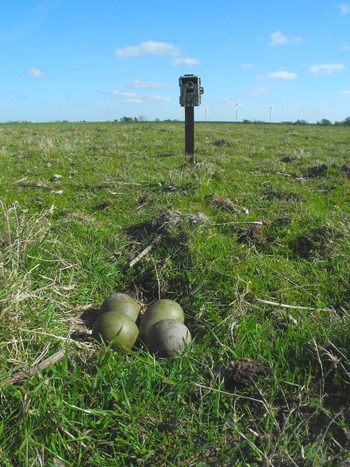
From early April to mid-June, we searched for nests of Black-tailed Godwits. At a distance of c. 3 m, nests were marked with one bamboo stick with a small flag. The hatching date was estimated using the ‘floating method’ (van Paassen et al. Reference van Paassen, Veldman and Beintema1984). Unless otherwise designated (see below), a camera (Moultrie Game Spy M-990i or M-999i) was mounted on a wooden post at a distance of 1.5–3.0 m from the nests and at a height of 30–80 cm (Figure 1). All nests (i.e. with or without a camera) were subsequently visited and checked at intervals of 2–5 days to document their fate. Broken eggs in or near a nest or the disappearance of the eggs before the presumed hatching date were indications of failure. Chicks or the presence of many small eggshell fragments in the nest indicated hatching success (Green et al. Reference Green, Hawell and Johnson1987).
Black-tailed Godwit clutch with camera.

Nests inside an anti-predator fence, or in parcels with livestock, have not been included in our analysis. Vertical structures such as cameras attract cattle and, therefore, increase the risk of trampling (Beintema and Müskens Reference Beintema and Müskens1987). We left every third Black-tailed Godwit nest without a camera in 2014 and every second in 2019, thus creating a random distribution of nests with and without a camera. However, some additional nests were excluded from the analysis as they were abandoned, or their fate remained unclear. One nest that was included in a preliminary analysis (Salewski and Schmidt Reference Salewski and Schmidt2016) from BeK was not considered here because it could not be ruled out that it had already been abandoned before we found it.
Statistical analysis
We used nest survival models implemented in the programme MARK to estimate the daily survival probability phi (ϕ) of Black-tailed Godwit clutches (Dinsmore et al. Reference Dinsmore, White and Knopf2002), using only visit data. The analyses started with the generation of encounter histories for each nest, which included information about the day when the nest was found, the last day the nest was alive, the last day the nest was checked, and the fate of the nest. In order to avoid positive bias in the estimates of ϕ by potentially considering exposure days after nests hatched, for successful nests we excluded days after the last check at which the nest was active (Dinsmore et al. Reference Dinsmore, White and Knopf2002).
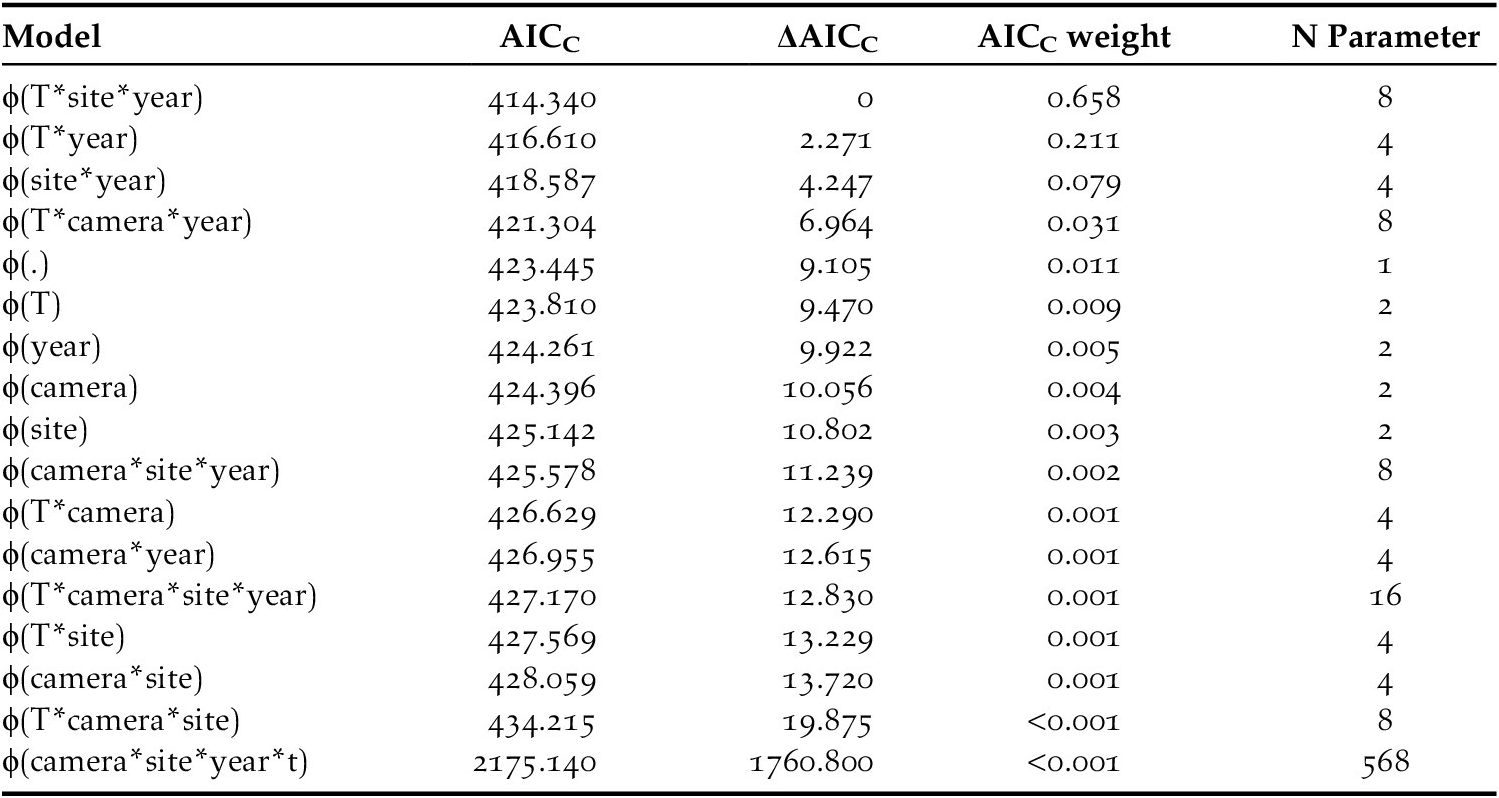
Beside the presence of a camera, other factors could cause variation in godwit nest success. Previous studies have shown that hatching probability can vary between sites (Nehls Reference Nehls2001, Schekkerman et al. Reference Schekkerman, Teunissen and Oosterveld2006, Salewski et al. Reference Salewski, Schmidt, Evers, Klinner-Hötker and Hötker2016), between years (Groen and Hemerik Reference Groen and Hemerik2002, Teunissen et al. Reference Teunissen, Schekkerman, Willems and Majoor2008), and with time within the breeding season (Schroeder et al. Reference Schroeder, Hooijmeijer, Both and Piersma2006, Kentie et al. Reference Kentie, Booth, Hooijmeijer and Piersma2015). Therefore, we included a camera effect (nest either with or without camera), a site effect (nest in SpS or BeK), a year effect (nest found in 2014 or in 2019), and a time effect t (ϕ varies daily throughout the breeding season) in our global model ([ϕ(camera*site*year*t)], Table 1). Competing models were all combinations of these factors, including all possible interactions, models that considered only one of these factors, and a model that assumed that ϕ does not vary with any of these factors [ϕ(.)]. We have previously shown that ϕ showed a constant trend (T) throughout the breeding season (Salewski et al. Reference Salewski, Schmidt, Evers, Klinner-Hötker and Hötker2016). Therefore, we only considered t in the global model, but T in all other models including a time effect. This left us with a set of 17 models (Table 1). Competing models were ranked according to their AICC values (Burnham and Anderson Reference Burnham and Anderson2002). We considered a ΔAICC > 2 between the most parsimonious model and any competing model as indicating that the competing model has considerably less support (Burnham and Anderson Reference Burnham and Anderson2002).
Models to estimate daily survival probability (ϕ) of Black-tailed Godwit clutches at two sites in northern Germany. ‘T’ denotes a constant trend throughout the breeding season and ‘t’ a variation with each day of the breeding season. ‘site’ and ‘year’ denote variations between sites and years, respectively.

Results
Our analysis used data from 141 nests, which included 32 nests from BeK in 2014 (20 with camera of which 11 hatched and eight were depredated and one was abandoned, 12 without camera of which seven hatched and five were depredated), 34 nests from SpS in 2014 (19 with camera of which seven hatched and 12 were depredated, 15 without camera of which four hatched and 11 were depredated), 37 nests from BeK in 2019 (18 with camera of which eight hatched and 10 were depredated, 19 without camera of which 14 hatched and four were depredated and one was abandoned), and 38 nests from SpS in 2019 (19 with camera of which 12 hatched and seven were depredated, 19 without camera of which 10 hatched and nine were depredated).
The most parsimonious model was the model including the factors T (constant trend over time), site and year, as well as their interactions ([ϕ(T*site*year)], Table 1). There was little support for any model that included ‘camera’.
AICC weights are probabilities that can be summed across models containing factors of interest to represent the relative weight of support for that factor. The sums of the AICC weights across all models containing ‘year’, ‘T’ and ‘site’ were 0.988, 0.912 and 0.745, respectively, whereas the sum of AICC weights for the factor ‘camera’ was only 0.041.
Discussion
Our analysis of data from Black-tailed Godwit nests with or without a camera provides the conclusion that daily survival probabilities vary between sites and years, and over time within the breeding season, but not with the installation of cameras. This is in line with a number of previous studies on ground-nesting meadow, sea- and shorebirds that found no change in predation probabilities when nests were equipped with cameras. Examples are White-rumped Sandpiper Calidris fuscicollis and Baird’s Sandpiper C. bairdii in Canada (McKinnon and Bêty Reference McKinnon and Bêty2009), Banded Dotterel Charadrius bicinctus and Black-fronted Tern Sterna albostriata in New Zealand (Sanders and Maloney Reference Sanders and Maloney2002), St. Helena Plover Charadrius sanctaehelenae on St. Helena in the South Atlantic Ocean (Burns et al. Reference Burns, Mcculloch, Székely and Bolton2013), and Northern Lapwing Vanellus vanellus on the British Isles (Bolton et al. Reference Bolton, Butcher, Sharpe, Stevens and Fisher2007). A study on Northern Lapwing and Black-tailed Godwit clutches in The Netherlands provided similar results: daily survival probability was lower in nests with video-cameras than nests without cameras in one out of six study sites, in one site survival probabilities were higher in nests with a video-camera, and in the other four sites survival probabilities did not differ (Teunissen et al. Reference Teunissen, Schekkerman, Willems and Majoor2008). A meta-analysis also failed to find a general effect of the installation of cameras at bird nests on their survival (Richardson et al. Reference Richardson, Gardali and Jenkins2009). Additionally, other markers such as sticks at nests of Black-tailed Godwits and Northern Lapwing did not increase predation (Beintema and Müskens Reference Beintema and Müskens1987, Zámecnik et al. Reference Zámecník, Kubelka and Sálek2018; see also Hannon et al. Reference Hannon, Martin, Thomas and Schieck1993). In contrast, a higher predation rate of clutches equipped with cameras compared to clutches without cameras was found in the White-rumped Sandpiper Calidris fuscicollis (Cantar and Montgomerie Reference Cantar and Montgomerie1985). However, the replacement of cameras three times during 2.5 days, but probably no similar frequency of close visits at the control group, was a massive disturbance that could have biased nest failure (McKinnon and Bêty Reference McKinnon and Bêty2009). Thus, in the literature there is a broad consensus that the appropriate use of nest cameras does not affect hatching success of ground nesting birds (see also Sanders and Maloney Reference Sanders and Maloney2002, Herring et al. Reference Herring, Ackerman, Takekawa, Eagles-Smith and Eadie2011, Mallord et al. Reference Mallord, Orsman, Cristinacce, Butcher, Stowe and Charman2012, Ellis-Felege and Carroll Reference Ellis-Felege, Caroll, Ribic, Thompson and Pietz2012, Andes et al. Reference Andes, Shaffer, Sherfy, Hofer, Dovichin and Ellis-Felege2019).
We also showed that there was no effect of cameras on survival probabilities of clutches even after these had been applied for several years. Hence, there is no indication that predators learn to associate cameras with valuable and predictable resources even when they had the chance to become familiar with them over an extended period of time. Nocturnal predators, that rely on visual as well as on olfactory cues to find food (Conover Reference Conover2007), are responsible for the majority of clutch failures of Black-tailed Godwits in our study area with three species, red fox Vulpes vulpes, raccoon dog Nyctereutes procyonoides and polecat Mustela putorius, responsible for 89% of all attributable predations. Diurnal birds that rely exclusively on visual cues to find food (e.g. Engel et al. Reference Engel, Végváry, Rice, Kubelka and Székely2020), accounted for only 5.1% (corvids 1.7%, raptors 3.4%) of attributable losses (Salewski et al. Reference Salewski and Schmidt2019), although they were permanently present throughout the breeding season (unpubl. data). There are indications that birds, especially corvids, may learn to associate human activities and markers at or near bird and reptile nests with food (Yahner and Wright Reference Yahner and Wright1985, Götmark Reference Götmark1992, Miller and Hobbs Reference Miller and Hobbs2000, Rollinson and Brooks Reference Rollinson and Brooks2007), although this could not be confirmed by Andes et al. (Reference Andes, Shaffer, Sherfy, Hofer, Dovichin and Ellis-Felege2019) with respect to cameras. Nevertheless, a different set of prevailing predators, for example corvids, and predators that may react on cameras in different ways (Meek et al. Reference Meek, Ballard, Fleming and Falzon2016) may lead to different results. Further, other bird species may differ in their reaction to cameras at their nests (Thompson et al. Reference Thompson, Dijak and Burhans1999, Pietz and Granfors Reference Pietz and Granfors2000) compared to Black-tailed Godwits, which readily accept cameras (pers. obs.). Therefore, cameras should be applied with caution in new projects, especially when they have never been used in the target species before. Their effect on the parameters studied should be carefully explored to avoid spurious results and, as a consequence, mislead conservation strategies.
Cameras are an effective tool for monitoring the fate of Black-tailed Godwit clutches and identifying the cause of failure (Salewski and Schmidt Reference Salewski and Schmidt2019, Salewski et al. Reference Salewski, Evers and Schmidt2019). In contrast, the information gathered by other methods is limited. Thermologgers are only able to detect the time when incubation stops (e.g. Teunissen et al. Reference Teunissen, Schekkerman, Willems and Majoor2008). Inference from cues such as egg remains (Green et al. Reference Green, Hawell and Johnson1987, Bellebaum and Boschert Reference Bellebaum and Boschert2003) can cause misidentification of predators or misinterpretation of the fate of clutches (Larivière Reference Larivière1999, Liebezeit and George Reference Liebezeit and George2003, Coates et al. Reference Coates, Connelly and Delehanty2008, Staller et al. Reference Staller, Palmer, Carroll, Thornton and Sisson2005, Macdonald and Bolton Reference MacDonald and Bolton2008, Ellis-Felege and Carroll Reference Ellis-Felege, Caroll, Ribic, Thompson and Pietz2012, Andes et al. Reference Andes, Shaffer, Sherfy, Hofer, Dovichin and Ellis-Felege2019, Salewski et al. Reference Salewski, Evers and Schmidt2019). The use of cameras is thus the only reliable method to identify nest predators to species level and to obtain other insights into the breeding ecology of birds through continuous monitoring with minimal disturbance (Cox et al. Reference Cox, Pruett, Benson, Chiavacci, Thompson, Ribic, Thompson and Pietz2012, Andes et al. Reference Andes, Shaffer, Sherfy, Hofer, Dovichin and Ellis-Felege2019). Cameras are an indispensable tool for basic research on breeding ecology and, therefore, provide basic information for the development of an evidence-based management of threatened species.
Acknowledgements
We are grateful to D. V. Cimiotti, A. Evers, H. Hötker and B. Klinner-Hötker for their help in the field. We thank the Landesamt für Landwirtschaft, Umwelt und ländliche Räume des Landes Schleswig-Holstein and the Bundeswehr especially the team of the WTD71, for the support in the BEK and SPS respectively. D. Franklin kindly improved our English. This is a publication of the EU LIFE Project LIFE-Limosa (LIFE11 NAT/DE/000353 LIFE-Limosa).