In the last three decades, the topic of body image has attracted growing public, clinical, and scholarly interest (Cash, Reference Cash2004). As a multidimensional concept, body image has been predominantly defined as the perception an individual has of his or her physical self and the feelings and thoughts he or she has as a result of that perception (Grogan, Reference Grogan2006). It is often conceptualised as embodying emotions associated with body shape and size, body size estimation, and evaluation of body attractiveness (Cash, Ancis, & Strachan, Reference Cash, Ancis and Strachan1997; Grogan, Reference Grogan2006). Body image has been captured along the four domains of perceptual, affective, cognitive, and behavioural (Roy & Meilleur, Reference Roy and Meilleur2010; Roy & Payette, Reference Roy and Payette2012). Disturbance in any of these domains is referred to as body image concerns or negative body image. Research from various disciplines has addressed the concept of body image as an emerging and important construct, affecting an individual's emotions, thoughts, and behaviour (Grogan, Reference Grogan2006). Body image concerns encompass various different aspects, including body dissatisfaction, body image distortion, body image disorder, body image disturbance, body perception, body dysphoria, body dysmorphia, appearance orientation, appearance issues, body appearance issues, appearance satisfaction, appearance evaluation, weight dissatisfaction, and size or weight perception accuracy (Cash, Reference Cash2004). Of these various aspects, body dissatisfaction has been found to be prevalent among adolescents and young adults, with a high percentage of young females and males in the United States having body dissatisfaction issues (Neumark-Sztainer, Hannan, Story, & Perry, Reference Neumark-Sztainer, Hannan, Story and Perry2004). While body image concerns appear to be highest in Western societies, such as the United Kingdom, United States, and Australia, research suggests that it is a growing concern in non-Western cultures, such as Fiji, Turkey, China, and Malaysia (Swami et al., Reference Swami, Frederick, Aavik, Alcalay, Allik, Anderson and Cunningham2010).
Adolescence refers to the critical developmental period that is conventionally understood as the years between the onset of puberty and the initiation of social independence (Steinberg, Reference Steinberg2014), and refers to individuals aged 10–19 years (World Health Organization [WHO], 2006). Adolescence is a period that produces many psychological, physical and social problems that can threaten health and wellbeing. In contrast, emerging adulthood refers to young people aged 18–25 years (Arnett, Reference Arnett2000). Emerging adulthood is different from other life stages as it involves major changes in health behaviour patterns and the development of one's identity (Arnett, Reference Arnett2000). It is also a risky period for the development of unhealthy diet and unhealthy physical practices, as well as obesity (Arnett, Reference Arnett2000). The transition from adolescence to young adulthood is a crucial stage of life where independence and behavioural patterns are established among young people (Nelson, Story, Larson, Neumark-Sztainer, & Lytle, Reference Nelson, Story, Larson, Neumark-Sztainer and Lytle2008).
Previous research has shown that a high percentage of adolescents and emerging adults have body dissatisfaction issues and desire to change the way they look (Cash, Reference Cash and Cash2012; McCabe & Ricciardelli, Reference McCabe and Ricciardelli2001). Based on published research on body image concerns, it appears to have a strong association with unhealthy weight-management strategies, unhealthy and disordered health-related behaviours, and inappropriate weight goals with regard to actual body size (Neumark-Sztainer et al., Reference Neumark-Sztainer, Levine, Paxton, Smolak, Piran and Wertheim2006; Roy & Gauvin, Reference Roy and Gauvin2009). Despite the paucity of studies that focus on emerging adults, a few research findings suggest that emerging adults’ wellbeing is vulnerable to the consequences of body image concerns (Fuller-Tyszkiewicz et al., Reference Fuller-Tyszkiewicz, Skouteris, McCabe, Mussap, Mellor and Ricciardelli2012). Adolescents and young adults with body image concerns have been found to engage in health-compromising and unhealthy weight-related behaviours, such as restrictive dieting, disordered eating patterns, binge eating, and self-induced vomiting (Grogan, Reference Grogan2006; Levine & Piran, Reference Levine and Piran2004). This could have serious implications for adolescents and emerging adults’ health and their emotional, social, and psychological wellbeing (Agliata & Tantleff-Dunn, Reference Agliata and Tantleff-Dunn2004; Cash & Hicks, Reference Cash and Hicks1990; Hinrichsen, Waller, & van Gerko, Reference Hinrichsen, Waller and van Gerko2004).
The significance of health issues associated with body image concerns highlights the need to clarify the relationship between body image concerns and weight-related behaviours for the development of effective strategies that help prevent negative body image. Thus, a systematic review was needed to bring all the evidence together and critically appraise it. Previous systematic reviews have not critically analysed or brought together the evidence of the association between body image concerns and weight-related behaviours. Thus, this systematic review is important as it will draw the literature together to enable a more comprehensive understanding of the state of evidence on the association between body image concerns and weight-related behaviours in adolescents and emerging adults. A clearer understanding of the evidence base is important for policy makers and practitioners to help promote more positive body image and healthy weight-related behaviours among adolescents and emerging adults. Therefore, this article reviews the relationship between body image concerns and weight-related behaviours of adolescents and emerging adults.
Methods
The systematic review was conducted in accordance with the Preferred Reporting Items for Systematic Reviews and Meta-Analyses (PRISMA) checklist (Moher, Liberati, Tetzlaff, Altman, & Group, Reference Moher, Liberati, Tetzlaff, Altman and Group2009). For the purpose of this review, ‘adolescence’ was defined as individuals aged from 10 to 19 years and emerging adults as individuals aged from 18 to 25 years old. Both adolescents and young adults were included in this review as they have a high prevalence of body image concerns. The transitional period from adolescence to young adulthood is a crucial period for the development of body image concerns and unhealthy and extreme weight-related behaviours often linked with changes in lifestyle choices. Therefore, both these groups were included in this study. Further, body image concerns were defined as the perception an individual has of their physical self and the feelings and thoughts they have as a result of that perception (Grogan, Reference Grogan2016).
Search Methods
Articles for this review were sourced from four online databases: MEDLINE (Ovid), PsycINFO, CINAHL, and ProQuest family health. These databases provide a broad coverage of allied health, including public health and psychology literature. As body image concerns are a multidimensional concept and have been defined in various ways, a body image concerns definition matrix was developed to identify appropriate search terms based on the various components or aspects of the concept. The keywords and combination of keywords were utilised to search the four electronic databases and were organised using AND and OR in order to achieve a targeted selection of literature. The matrix was informed by previous definitions of body image concern (Cash & Hicks, Reference Cash and Hicks1990; Grogan, Reference Grogan2016). This search was undertaken during the first two months of 2017. Searches for keywords were conducted for each database to identify publications that included combinations of the following terms: (“body image concerns” or “body concerns” or “body image” or “body dissatisfaction” or “body image dissatisfaction” or “body perception” or “negative body image” or “body shape” or “body image distortion” or “body anxiety” or “body shame” or “body image disturbance” or “weight concerns” or “weight dissatisfaction” or “weight related concerns” or “weight related attitudes” or “weight perception”) and (“weight related behavio*rs” or “weight behavio*rs” or “weight loss behavio*rs” or “dieting behavio*rs” or “eating disorders” or “binge eating” or “eating disturbance” or “unhealthy eating behavio*rs” or “extreme dieting” or “weight control behavio*rs” or “dietary restraint” or “weight control” or “weight loss” or “weight*loss”). This search strategy was complemented with forward citations searches being undertaken on the reference list of articles considered for review.
Study Selection
After removing duplicates and scanning titles and abstracts for relevance, a list of potentially eligible articles were identified, exported and saved into EndnoteR version X7. The selected articles were scanned independently by two reviewers to verify whether they met the inclusion criteria. One author (P.S.S.) performed the original search, reviewed the title and abstracts, and completed the data extraction from the selected articles, while two authors (P.S.S. and J.B.) reviewed the full articles and completed the quality ratings. Meanwhile the other authors (N.H. and C.D.) provided analytical support in reviewing articles and drafting the manuscript, and any discrepancies were resolved by discussion among all the authors.
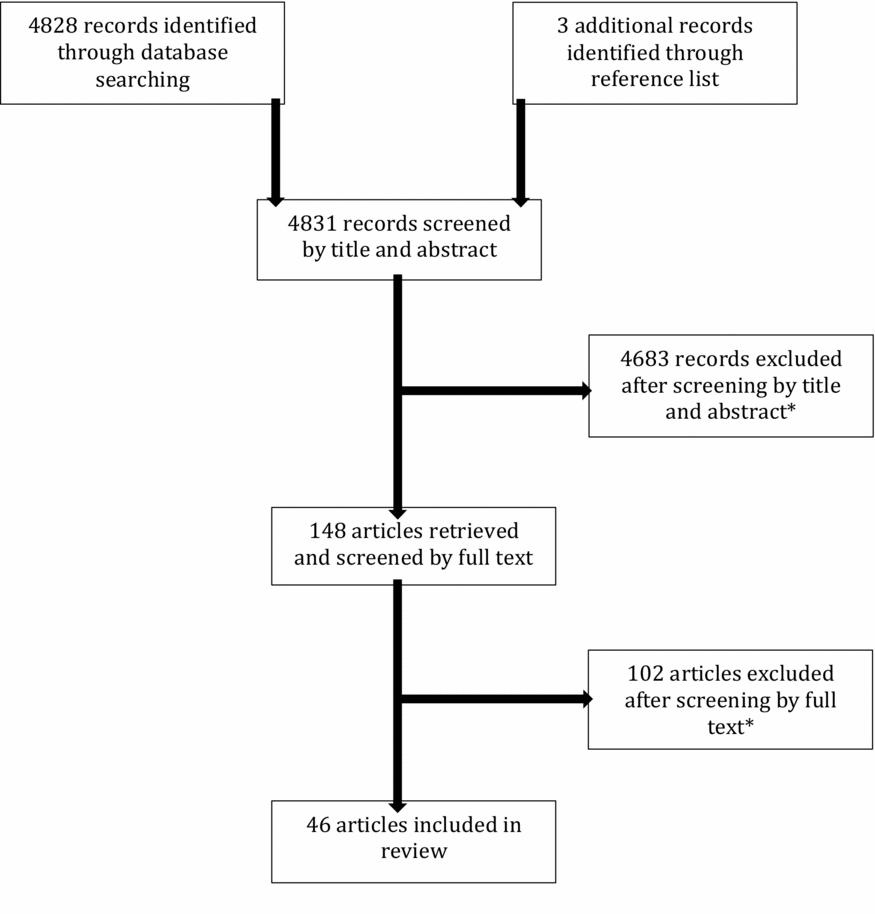
Articles were included for consideration if the title, abstract or keywords indicated the study measured an aspect of body image concerns and its relationship with weight-related behaviours among adolescents and/or emerging adults. Ineligible articles were removed and the reason for exclusions noted. The evaluation of all studies was according to the following inclusion criteria: (1) reported the evaluation of aspects of body image concerns and its relationship with weight-related behaviours of adolescents and/or emerging adults; (2) study participants included adolescents aged 10–19 and/or emerging adults aged 18–25; (3) if the age range of participants extended beyond 10 to 19 years or beyond 18 to 25 years, then the studies were included if the mean age was ≥10 years or ≤25 years; (4) the year of publication fell between 2005–2017; (5) the publications were available in the English language; and (6) the publications were peer reviewed. Meanwhile the studies were excluded according to the following exclusion criteria: (1) study participants were pregnant; (2) reported any co-existing chronic diseases and any other medical conditions; (3) patients diagnosed with anorexia or bulimia nervosa; (4) reported depression, suicide ideation, or anxiety; (5) body image concerns among homosexual participants; 6) peer, parent, or media influence. Before the finalisation of the included studies, differences in selections were discussed and articles deemed ineligible were removed from the list of selected articles after considering the exclusion criteria. The selection process of the study and the systematic review search were both documented with the aid of the PRISMA flow diagram (see Figure 1; Moher et al., Reference Moher, Liberati, Tetzlaff, Altman and Group2009).
Flowchart of the literature search and review process.

Data Extraction and Analysis
The extraction of the key information from each study selected for this review was conducted by one researcher (P.S.S.) and was then extracted into a prepared evidence worksheet for the purpose of comparison and quality assessment as suggested by the American Dietetic Association guidelines (American Dietetic Association, 2005). Data extraction included title, author, year of publication, study design, sample size, sample characteristics, purpose, study protocol, and outcome variables, as well as the results. Table 1 presents the summarised information.
Summary Table of Studies Included in this Systematic Literature Review and Summary Of Findings

Outcomes Assessed
Study outcomes were considered relevant if they reflected measures of some aspects of body image concerns (such as body dissatisfaction, body-weight perception, negative body image, or body image distortion) and the association with weight-related behaviours (such as dieting, weight-control behaviours, and unhealthy or extreme weight-control behaviours). Some of the studies considered for review focused on the mediating effect of body image concerns while others focused on the factors associated with weight-related behaviours. These studies were included only if they investigated the outcomes of an aspect of body image concerns on weight-related behaviours. Consistent with the set of inclusion criteria, reports and theses were not included in the review.
Quality Assessment
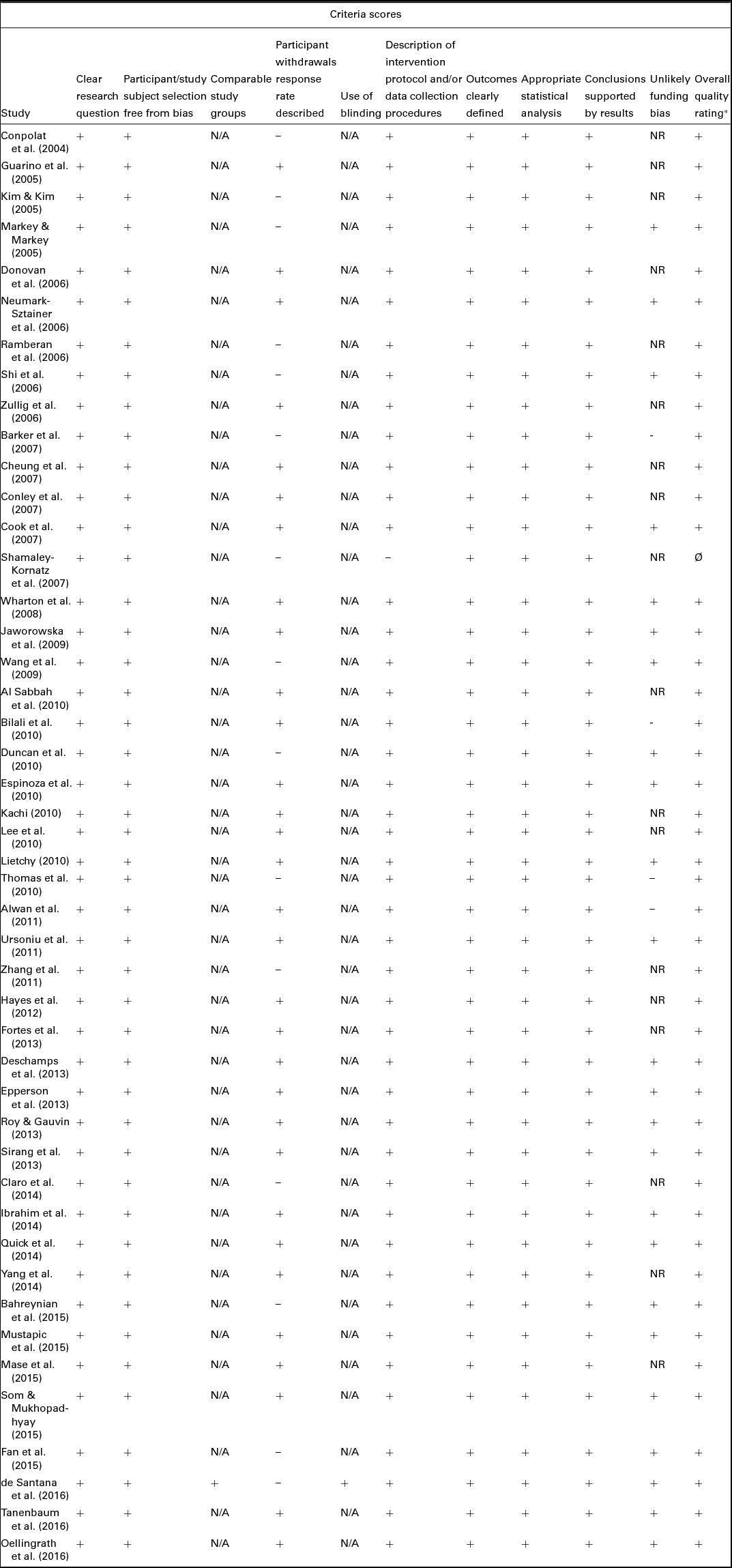
The risk of bias of the methodological quality within each individual study was assessed by two independent researchers (P.S.S. and J.B.) according to the PRISMA checklist, using the American Dietetic Association Quality Criteria Checklist (QCC; American Dietetic Association, 2005); see Table 2. The QCC includes 10 criteria that appraise the applicability to practice and scientific validity of each study. It is a reliable tool that addresses scientific rigour and is generally used to assess studies in the field of nutrition. Through the use of the QCC, the quality attributes of each study were classified as positive, neutral, or negative. A negative overall score was designated if six or more of the validity criteria questions were answered as ‘no’. A positive overall score was designated to the study if most of the answers to validity criteria questions were ‘yes’, including criteria 2, 3, 6, and 7, and at least an additional ‘yes’. Lastly, a neutral score was designated to the study if the answers to the validity criteria questions 2, 3, 6, and 7 did not indicate the study prominently strong (American Dietetic Association, 2005). Table 2 provides the results of the quality assessment.
Quality Assessment Attributes for Each Study Assessed Using the Quality Criteria Checklist (QCC)

Note: N/A = not applicable (due to the design of the study being cross-sectional); NR = not reported; *+ = positive overall score: this overall score is given if criteria 2, 3, 6 and 7 of the QCC and one additional criterion have received a positive score; Ø = neutral overall score: this score is given if more criteria are met than for a negative overall score but an overall positive score is not reached; – = negative overall score: this score is given if six or more QCC criteria are not met.
Results
A total of 4,831 articles were retrieved from the four database searches and of those articles, 148 were included with 4,683 determined as not eligible for further review. A full article review was conducted on the remaining 148 studies, after which an additional 102 were excluded. The 102 studies excluded did not include a measure of body image concerns and did not look at the association between body image concerns and weight-related behaviours (see Figure 1).
Summary of Included Studies
Table 1 provides a summary of each study included in the review. The studies were published between 2005 and 2017.
The eligible studies included 39 cross-sectional studies (Al Sabbah et al., Reference Al Sabbah, Vereecken, Abdeen, Kelly, Ojala, Németh and Maes2010; Alwan, Viswanathan, Williams, Paccaud, & Bovet, Reference Alwan, Viswanathan, Williams, Paccaud and Bovet2010; Bahreynian et al., Reference Bahreynian, Qorbani, Motlagh, Heshmat, Ardalan and Kelishadi2015; Barker & Galambos, Reference Barker and Galambos2007; Bilali, Galanis, Velonakis, & Katostaras, Reference Bilali, Galanis, Velonakis and Katostaras2010; Canpolat, Orsel, Akdemir, & Ozbay, Reference Canpolat, Orsel, Akdemir and Ozbay2005; Cheung, Ip, Lam, & Bibby, Reference Cheung, Ip, Lam and Bibby2007; Claro, Santos, & Oliveira-Campos, Reference Claro, Santos and Oliveira-Campos2014; Cook, MacPherson, & Langille, Reference Cook, MacPherson and Langille2007; de Sousa Fortes, Cipriani, & Ferreira, Reference de Sousa Fortes, Cipriani and Ferreira2013; Deschamps, Salanave, Chan-Chee, Vernay, & Castetbon, Reference Deschamps, Salanave, Chan-Chee, Vernay and Castetbon2015; Duncan, Duncan, & Schofield, Reference Duncan, Duncan and Schofield2011; Epperson et al., Reference Epperson, Song, Wallander, Markham, Cuccaro, Elliott and Schuster2014; Fan & Jin, Reference Fan and Jin2015; Guarino et al., Reference Guarino, Pellai, Bassoli, Cozzi, Di Sanzo, Campra and Guala2005; Hayes & Napolitano, Reference Hayes and Napolitano2012; Ibrahim, El-Kamary, Bailey, & St George, Reference Ibrahim, El-Kamary, Bailey and St George2014; Kachi, Reference Kachi2010; Kim & Kim, Reference Kim and Kim2005; Lee, Ha, Vann, & Choi, Reference Lee, Ha, Vann and Choi2009; Markey & Markey, Reference Markey and Markey2005; Mase, Miyawaki, Ohara, & Nakamura, Reference Mase, Miyawaki, Ohara and Nakamura2015; Mustapic, Marcinko, & Vargek, Reference Mustapic, Marcinko and Vargek2015; Oellingrath, Hestetun, & Svendsen, Reference Oellingrath, Hestetun and Svendsen2016; Quick et al., Reference Quick, Nansel, Liu, Lipsky, Due and Iannotti2014; Ramberan, Austin, & Nichols, Reference Ramberan, Austin and Nichols2006; Roy & Gauvin, Reference Roy and Gauvin2013; Shamaley-Kornatz, Smith, & Tomaka, Reference Shamaley-Kornatz, Smith and Tomaka2007; Shi, Lien, Kumar, & Holmboe-Ottesen, Reference Shi, Lien, Kumar and Holmboe-Ottesen2007; Sirang et al., Reference Sirang, Bashir, Jalil, Khan, Hussain, Baig and Kadir2013; Som & Mukhopadhyay, Reference Som and Mukhopadhyay2015; Tanenbaum et al., Reference Tanenbaum, Felicitas, Li, Tobias, Chou, Palmer and Xie2016; Thomas, Khan, & Abdulrahman, Reference Thomas, Khan and Abdulrahman2010; Ursoniu, Putnoky, & Vlaicu, Reference Ursoniu, Putnoky and Vlaicu2011; Wang et al., Reference Wang, Liang, Chen, Wang, Liang and Chen2009; Wharton, Adams, & Hampl, Reference Wharton, Adams and Hampl2008; Yang, Turk, Allison, James, & Chasens, Reference Yang, Turk, Allison, James and Chasens2014; Zhang et al., Reference Zhang, Seo, Kolbe, Lee, Middlestadt, Zhao and Huang2011; Zullig, Ubbes, Pyle, & Valois, Reference Zullig, Ubbes, Pyle and Valois2006) four longitudinal studies (Conley & Boardman, Reference Conley and Boardman2007; Espinoza, Penelo, & Raich, Reference Espinoza, Penelo and Raich2010; Liechty, Reference Liechty2010; Neumark-Sztainer, Paxton, Hannan, Haines, & Story, Reference Neumark-Sztainer, Paxton, Hannan, Haines and Story2006), one quasi experiment study (Jaworowska & Bazylak, Reference Jaworowska and Bazylak2009), one case control study nested in a cross-sectional study (de Santana et al., Reference de Santana, Assis, Silva, Raich, Machado, Pinto and Machado2016), and one study that incorporated both cross-sectional and longitudinal study designs (Donovan, Spence, & Sheffield, Reference Donovan, Spence and Sheffield2006). Thirteen studies were conducted in the United States (Conley & Boardman, Reference Conley and Boardman2007; Epperson et al., Reference Epperson, Song, Wallander, Markham, Cuccaro, Elliott and Schuster2014; Fan & Jin, Reference Fan and Jin2015; Hayes & Napolitano, Reference Hayes and Napolitano2012; Ibrahim et al., Reference Ibrahim, El-Kamary, Bailey and St George2014; Liechty, Reference Liechty2010; Markey & Markey, Reference Markey and Markey2005; Neumark-Sztainer et al., Reference Neumark-Sztainer, Levine, Paxton, Smolak, Piran and Wertheim2006; Shamaley-Kornatz et al., Reference Shamaley-Kornatz, Smith and Tomaka2007; Wang et al., Reference Wang, Liang, Chen, Wang, Liang and Chen2009; Wharton et al., Reference Wharton, Adams and Hampl2008; Yang et al., Reference Yang, Turk, Allison, James and Chasens2014; Zullig et al., Reference Zullig, Ubbes, Pyle and Valois2006). Nine studies were conducted in Asia in Hong Kong, Japan, Korea, China, Pakistan, and India (Cheung et al., Reference Cheung, Ip, Lam and Bibby2007; Kachi, Reference Kachi2010; Kim & Kim, Reference Kim and Kim2005; Lee et al., Reference Lee, Ha, Vann and Choi2009; Mase et al., Reference Mase, Miyawaki, Ohara and Nakamura2015; Shi et al., Reference Shi, Lien, Kumar and Holmboe-Ottesen2007; Sirang et al., Reference Sirang, Bashir, Jalil, Khan, Hussain, Baig and Kadir2013; Som & Mukhopadhyay, Reference Som and Mukhopadhyay2015; Tanenbaum et al., Reference Tanenbaum, Felicitas, Li, Tobias, Chou, Palmer and Xie2016); eight studies were conducted in Europe in Greece, Spain, Italy, Poland, Croatia, Romani, Norway, and France (Bilali et al., Reference Bilali, Galanis, Velonakis and Katostaras2010; Deschamps et al., Reference Deschamps, Salanave, Chan-Chee, Vernay and Castetbon2015; Espinoza et al., Reference Espinoza, Penelo and Raich2010; Guarino et al., Reference Guarino, Pellai, Bassoli, Cozzi, Di Sanzo, Campra and Guala2005; Jaworowska & Bazylak, Reference Jaworowska and Bazylak2009; Mustapic et al., Reference Mustapic, Marcinko and Vargek2015; Oellingrath et al., Reference Oellingrath, Hestetun and Svendsen2016; Ursoniu et al., Reference Ursoniu, Putnoky and Vlaicu2011); three studies were conducted in the Middle East in Palestine, Iran, and United Arab Emirates (Al Sabbah et al., Reference Al Sabbah, Vereecken, Abdeen, Kelly, Ojala, Németh and Maes2010; Bahreynian et al., Reference Bahreynian, Qorbani, Motlagh, Heshmat, Ardalan and Kelishadi2015; Thomas et al., Reference Thomas, Khan and Abdulrahman2010); three studies were conducted in Canada (Barker & Galambos, Reference Barker and Galambos2007; Cook et al., Reference Cook, MacPherson and Langille2007; Roy & Gauvin, Reference Roy and Gauvin2013) and South America, in Brazil (Claro et al., Reference Claro, Santos and Oliveira-Campos2014; de Santana et al., Reference de Santana, Assis, Silva, Raich, Machado, Pinto and Machado2016; de Sousa Fortes et al., Reference de Sousa Fortes, Cipriani and Ferreira2013); and one each in Australia (Donovan et al., Reference Donovan, Spence and Sheffield2006), New Zealand (Duncan et al., Reference Duncan, Duncan and Schofield2011), Trinidad and Tobago (Ramberan et al., Reference Ramberan, Austin and Nichols2006), Turkey (Canpolat et al., Reference Canpolat, Orsel, Akdemir and Ozbay2005) and the Seychelles (Alwan et al., Reference Alwan, Viswanathan, Williams, Paccaud and Bovet2010). One study was conducted in 24 countries (Croatia, Latvia, Lithuania, Poland, Portugal, Russia, Austria, Belgium, Czech Republic, Denmark, Finland, Ireland, Netherlands, Norway, Sweden, Switzerland, United Kingdom, United States, Canada, Italy, France, Spain, Slovenia, and Macedonia; Quick et al., Reference Quick, Nansel, Liu, Lipsky, Due and Iannotti2014), while another study was conducted in Asia (Hong Kong, Macau, and Taipei) and the United States (Zhang et al., Reference Zhang, Seo, Kolbe, Lee, Middlestadt, Zhao and Huang2011).The age range of participants was from 10 to 25 years old, while the number of participants ranged from 101 to 212,941
All of the studies used questionnaires for data collection. Twenty-seven studies investigated the relationship between body-weight perception and weight-related behaviours (such as dieting, weight-control behaviours, disordered eating behaviours, weight-loss attempts, extreme weight-management practices, exercise habits, and eating patterns (Al Sabbah et al., Reference Al Sabbah, Vereecken, Abdeen, Kelly, Ojala, Németh and Maes2010; Alwan et al., Reference Alwan, Viswanathan, Williams, Paccaud and Bovet2010; Bahreynian et al., Reference Bahreynian, Qorbani, Motlagh, Heshmat, Ardalan and Kelishadi2015; Cheung et al., Reference Cheung, Ip, Lam and Bibby2007; Claro et al., Reference Claro, Santos and Oliveira-Campos2014; Conley & Boardman, Reference Conley and Boardman2007; Cook et al., Reference Cook, MacPherson and Langille2007; Deschamps et al., Reference Deschamps, Salanave, Chan-Chee, Vernay and Castetbon2015; Duncan et al., Reference Duncan, Duncan and Schofield2011; Epperson et al., Reference Epperson, Song, Wallander, Markham, Cuccaro, Elliott and Schuster2014; Fan & Jin, Reference Fan and Jin2015; Guarino et al., Reference Guarino, Pellai, Bassoli, Cozzi, Di Sanzo, Campra and Guala2005; Ibrahim et al., Reference Ibrahim, El-Kamary, Bailey and St George2014; Jaworowska & Bazylak, Reference Jaworowska and Bazylak2009; Lee et al., Reference Lee, Ha, Vann and Choi2009; Mase et al., Reference Mase, Miyawaki, Ohara and Nakamura2015; Oellingrath et al., Reference Oellingrath, Hestetun and Svendsen2016; Quick et al., Reference Quick, Nansel, Liu, Lipsky, Due and Iannotti2014; Shamaley-Kornatz et al., Reference Shamaley-Kornatz, Smith and Tomaka2007; Shi et al., Reference Shi, Lien, Kumar and Holmboe-Ottesen2007; Som & Mukhopadhyay, Reference Som and Mukhopadhyay2015; Tanenbaum et al., Reference Tanenbaum, Felicitas, Li, Tobias, Chou, Palmer and Xie2016; Ursoniu et al., Reference Ursoniu, Putnoky and Vlaicu2011; Wharton et al., Reference Wharton, Adams and Hampl2008; Yang et al., Reference Yang, Turk, Allison, James and Chasens2014; Zhang et al., Reference Zhang, Seo, Kolbe, Lee, Middlestadt, Zhao and Huang2011; Zullig et al., Reference Zullig, Ubbes, Pyle and Valois2006); eight studies investigated the relationship between body dissatisfaction and weight-related behaviours (such as eating disorders, weight-loss behaviours, weight-restricting behaviours, binge-eating attitudes and behaviours, dieting and weight-control behaviours (Barker & Galambos, Reference Barker and Galambos2007; de Sousa Fortes et al., Reference de Sousa Fortes, Cipriani and Ferreira2013; Donovan et al., Reference Donovan, Spence and Sheffield2006; Hayes & Napolitano, Reference Hayes and Napolitano2012; Kachi, Reference Kachi2010; Kim & Kim, Reference Kim and Kim2005; Neumark-Sztainer et al., Reference Neumark-Sztainer, Levine, Paxton, Smolak, Piran and Wertheim2006; Roy & Gauvin, Reference Roy and Gauvin2013). Meanwhile, eight studies investigated two aspects of body image concerns that were weight perception and body dissatisfaction and their relationship with weight-related behaviours (such as abnormal eating attitudes, dieting behaviour, extreme weight-control behaviours, weight-changing practices and weight-control attempts, practices and dietary intake; Bilali et al., Reference Bilali, Galanis, Velonakis and Katostaras2010; Canpolat et al., Reference Canpolat, Orsel, Akdemir and Ozbay2005; de Santana et al., Reference de Santana, Assis, Silva, Raich, Machado, Pinto and Machado2016; Markey & Markey, Reference Markey and Markey2005; Ramberan et al., Reference Ramberan, Austin and Nichols2006; Sirang et al., Reference Sirang, Bashir, Jalil, Khan, Hussain, Baig and Kadir2013; Thomas et al., Reference Thomas, Khan and Abdulrahman2010; Wang et al., Reference Wang, Liang, Chen, Wang, Liang and Chen2009). One study investigated the relationship between body image satisfaction and body image problems with weight-related behaviours (eating attitudes and behaviours, and extreme weight-control behaviours; Espinoza et al., Reference Espinoza, Penelo and Raich2010). Another study investigated the relationship of body image perception and body image distortion with weight-related behaviours (weight-loss behaviours; Liechty, Reference Liechty2010) and one study investigated body dissatisfaction and body shame and the relationship they have with weight-related behaviours (disordered eating behaviour; Mustapic et al., Reference Mustapic, Marcinko and Vargek2015).
Body image concerns were measured using the Weight Perception Questionnaire (Al Sabbah et al., Reference Al Sabbah, Vereecken, Abdeen, Kelly, Ojala, Németh and Maes2010; Bahreynian et al., Reference Bahreynian, Qorbani, Motlagh, Heshmat, Ardalan and Kelishadi2015; Canpolat et al., Reference Canpolat, Orsel, Akdemir and Ozbay2005; Claro et al., Reference Claro, Santos and Oliveira-Campos2014; Conley & Boardman, Reference Conley and Boardman2007; Cook et al., Reference Cook, MacPherson and Langille2007; de Santana et al., Reference de Santana, Assis, Silva, Raich, Machado, Pinto and Machado2016; Deschamps et al., Reference Deschamps, Salanave, Chan-Chee, Vernay and Castetbon2015; Duncan et al., Reference Duncan, Duncan and Schofield2011; Fan & Jin, Reference Fan and Jin2015; Ibrahim et al., Reference Ibrahim, El-Kamary, Bailey and St George2014; Jaworowska & Bazylak, Reference Jaworowska and Bazylak2009; Lee et al., Reference Lee, Ha, Vann and Choi2009; Liechty, Reference Liechty2010; Mase et al., Reference Mase, Miyawaki, Ohara and Nakamura2015; Quick et al., Reference Quick, Nansel, Liu, Lipsky, Due and Iannotti2014; Shamaley-Kornatz et al., Reference Shamaley-Kornatz, Smith and Tomaka2007; Shi et al., Reference Shi, Lien, Kumar and Holmboe-Ottesen2007; Sirang et al., Reference Sirang, Bashir, Jalil, Khan, Hussain, Baig and Kadir2013; Som & Mukhopadhyay, Reference Som and Mukhopadhyay2015; Thomas et al., Reference Thomas, Khan and Abdulrahman2010; Ursoniu et al., Reference Ursoniu, Putnoky and Vlaicu2011; Wang et al., Reference Wang, Liang, Chen, Wang, Liang and Chen2009; Wharton et al., Reference Wharton, Adams and Hampl2008; Yang et al., Reference Yang, Turk, Allison, James and Chasens2014; Zhang et al., Reference Zhang, Seo, Kolbe, Lee, Middlestadt, Zhao and Huang2011; Zullig et al., Reference Zullig, Ubbes, Pyle and Valois2006), Body Shape Questionnaire (BSQ; de Santana et al., Reference de Santana, Assis, Silva, Raich, Machado, Pinto and Machado2016; de Sousa Fortes et al., Reference de Sousa Fortes, Cipriani and Ferreira2013; Ramberan et al., Reference Ramberan, Austin and Nichols2006), body dissatisfaction subscale of the Eating Disorder Inventory-Two (EDI-2; Donovan et al., Reference Donovan, Spence and Sheffield2006; Kachi, Reference Kachi2010), and Body Dissatisfaction Questionnaire (Bilali et al., Reference Bilali, Galanis, Velonakis and Katostaras2010; Hayes & Napolitano, Reference Hayes and Napolitano2012), Stunkard's pictorial silhouettes or Collin's pictorial silhouettes (Alwan et al., Reference Alwan, Viswanathan, Williams, Paccaud and Bovet2010; Markey & Markey, Reference Markey and Markey2005; Roy & Gauvin, Reference Roy and Gauvin2013), Figure-Rating scale (Thomas et al., Reference Thomas, Khan and Abdulrahman2010) and other questionnaires (Barker & Galambos, Reference Barker and Galambos2007; Cheung et al., Reference Cheung, Ip, Lam and Bibby2007; Epperson et al., Reference Epperson, Song, Wallander, Markham, Cuccaro, Elliott and Schuster2014; Espinoza et al., Reference Espinoza, Penelo and Raich2010; Guarino et al., Reference Guarino, Pellai, Bassoli, Cozzi, Di Sanzo, Campra and Guala2005; Kim & Kim, Reference Kim and Kim2005; Mustapic et al., Reference Mustapic, Marcinko and Vargek2015; Neumark-Sztainer et al., Reference Neumark-Sztainer, Levine, Paxton, Smolak, Piran and Wertheim2006; Som & Mukhopadhyay, Reference Som and Mukhopadhyay2015; Tanenbaum et al., Reference Tanenbaum, Felicitas, Li, Tobias, Chou, Palmer and Xie2016). Meanwhile, weight-related behaviours were measured using the Eating Attitude Test-26 (EAT-26; Bilali et al., Reference Bilali, Galanis, Velonakis and Katostaras2010; de Sousa Fortes et al., Reference de Sousa Fortes, Cipriani and Ferreira2013; Mase et al., Reference Mase, Miyawaki, Ohara and Nakamura2015; Mustapic et al., Reference Mustapic, Marcinko and Vargek2015; Ramberan et al., Reference Ramberan, Austin and Nichols2006; Thomas et al., Reference Thomas, Khan and Abdulrahman2010), Youth Risk Behavior Survey (YRBS; Cheung et al., Reference Cheung, Ip, Lam and Bibby2007; Guarino et al., Reference Guarino, Pellai, Bassoli, Cozzi, Di Sanzo, Campra and Guala2005; Ibrahim et al., Reference Ibrahim, El-Kamary, Bailey and St George2014; Roy & Gauvin, Reference Roy and Gauvin2013; Ursoniu et al., Reference Ursoniu, Putnoky and Vlaicu2011; Zullig et al., Reference Zullig, Ubbes, Pyle and Valois2006), Food Frequency Questionnaire (FFQ; Oellingrath et al., Reference Oellingrath, Hestetun and Svendsen2016), Drive for Thinness subscale of EDI-2 (Deschamps et al., Reference Deschamps, Salanave, Chan-Chee, Vernay and Castetbon2015; Hayes & Napolitano, Reference Hayes and Napolitano2012; Ramberan et al., Reference Ramberan, Austin and Nichols2006), dieting behaviour scale (DBS; Kachi, Reference Kachi2010), Weight Loss Practices Questionnaire (Bahreynian et al., Reference Bahreynian, Qorbani, Motlagh, Heshmat, Ardalan and Kelishadi2015; Canpolat et al., Reference Canpolat, Orsel, Akdemir and Ozbay2005; Claro et al., Reference Claro, Santos and Oliveira-Campos2014; Conley & Boardman, Reference Conley and Boardman2007; de Santana et al., Reference de Santana, Assis, Silva, Raich, Machado, Pinto and Machado2016; Donovan et al., Reference Donovan, Spence and Sheffield2006; Duncan et al., Reference Duncan, Duncan and Schofield2011; Epperson et al., Reference Epperson, Song, Wallander, Markham, Cuccaro, Elliott and Schuster2014; Espinoza et al., Reference Espinoza, Penelo and Raich2010; Fan & Jin, Reference Fan and Jin2015; Jaworowska & Bazylak, Reference Jaworowska and Bazylak2009; Kim & Kim, Reference Kim and Kim2005; Lee et al., Reference Lee, Ha, Vann and Choi2009; Liechty, Reference Liechty2010; Markey & Markey, Reference Markey and Markey2005; Mase et al., Reference Mase, Miyawaki, Ohara and Nakamura2015; Neumark-Sztainer et al., Reference Neumark-Sztainer, Levine, Paxton, Smolak, Piran and Wertheim2006; Quick et al., Reference Quick, Nansel, Liu, Lipsky, Due and Iannotti2014; Roy & Gauvin, Reference Roy and Gauvin2013; Shamaley-Kornatz et al., Reference Shamaley-Kornatz, Smith and Tomaka2007; Shi et al., Reference Shi, Lien, Kumar and Holmboe-Ottesen2007; Sirang et al., Reference Sirang, Bashir, Jalil, Khan, Hussain, Baig and Kadir2013; Som & Mukhopadhyay, Reference Som and Mukhopadhyay2015; Tanenbaum et al., Reference Tanenbaum, Felicitas, Li, Tobias, Chou, Palmer and Xie2016; Ursoniu et al., Reference Ursoniu, Putnoky and Vlaicu2011; Wang et al., Reference Wang, Liang, Chen, Wang, Liang and Chen2009; Wharton et al., Reference Wharton, Adams and Hampl2008; Yang et al., Reference Yang, Turk, Allison, James and Chasens2014; Zhang et al., Reference Zhang, Seo, Kolbe, Lee, Middlestadt, Zhao and Huang2011), and other questionnaires (Al Sabbah et al., Reference Al Sabbah, Vereecken, Abdeen, Kelly, Ojala, Németh and Maes2010; Alwan et al., Reference Alwan, Viswanathan, Williams, Paccaud and Bovet2010; Barker & Galambos, Reference Barker and Galambos2007; Cook et al., Reference Cook, MacPherson and Langille2007; Kachi, Reference Kachi2010).
The results of the quality assessment are shown in Table 2. Forty-five studies were assessed to have a positive quality rating and only one study received a neutral rating. Some parts of the assessment checklist were not applicable to the studies and were modified to evaluate the quality of the cross-sectional studies in the best way possible, as a majority of the studies used a cross-sectional study design. The criterion about describing the intervention protocol was modified to ‘description of data collection procedures’, while the criterion about comparable study groups was not applicable to the large majority of the cross-sectional studies. The reason some studies did not achieve a positive quality rating was linked to the lack of description of withdrawals and dropouts, or response rates of participants, blinding process, and participant selection.
The relationship between aspects of body image concerns and weight-related behaviours was examined in six approaches: (1) relationship between body-weight perception and weight-related behaviours; (2) body dissatisfaction and weight-related behaviours; (3) body-weight perception, body dissatisfaction, and weight-related behaviours; (4) body-image satisfaction, body-image problems and extreme weight-related behaviours; (5) body-image perception, body-image distortion, and weight-related behaviours; (6) body dissatisfaction, body shame and weight-related behaviours.
Body Weight Perception
Twenty-seven studies investigated the relationship between body-weight perception and weight-related behaviours, and all of the studies found a strong association between body-weight perception and weight-related behaviours (Al Sabbah et al., Reference Al Sabbah, Vereecken, Abdeen, Kelly, Ojala, Németh and Maes2010; Alwan et al., Reference Alwan, Viswanathan, Williams, Paccaud and Bovet2010; Bahreynian et al., Reference Bahreynian, Qorbani, Motlagh, Heshmat, Ardalan and Kelishadi2015; Cheung et al., Reference Cheung, Ip, Lam and Bibby2007; Claro et al., Reference Claro, Santos and Oliveira-Campos2014; Conley & Boardman, Reference Conley and Boardman2007; Cook et al., Reference Cook, MacPherson and Langille2007; Deschamps et al., Reference Deschamps, Salanave, Chan-Chee, Vernay and Castetbon2015; Duncan et al., Reference Duncan, Duncan and Schofield2011; Epperson et al., Reference Epperson, Song, Wallander, Markham, Cuccaro, Elliott and Schuster2014; Fan & Jin, Reference Fan and Jin2015; Guarino et al., Reference Guarino, Pellai, Bassoli, Cozzi, Di Sanzo, Campra and Guala2005; Ibrahim et al., Reference Ibrahim, El-Kamary, Bailey and St George2014; Jaworowska & Bazylak, Reference Jaworowska and Bazylak2009; Lee et al., Reference Lee, Ha, Vann and Choi2009; Mase et al., Reference Mase, Miyawaki, Ohara and Nakamura2015; Oellingrath et al., Reference Oellingrath, Hestetun and Svendsen2016; Quick et al., Reference Quick, Nansel, Liu, Lipsky, Due and Iannotti2014; Shamaley-Kornatz et al., Reference Shamaley-Kornatz, Smith and Tomaka2007; Shi et al., Reference Shi, Lien, Kumar and Holmboe-Ottesen2007; Som & Mukhopadhyay, Reference Som and Mukhopadhyay2015; Tanenbaum et al., Reference Tanenbaum, Felicitas, Li, Tobias, Chou, Palmer and Xie2016; Ursoniu et al., Reference Ursoniu, Putnoky and Vlaicu2011; Wharton et al., Reference Wharton, Adams and Hampl2008; Yang et al., Reference Yang, Turk, Allison, James and Chasens2014; Zhang et al., Reference Zhang, Seo, Kolbe, Lee, Middlestadt, Zhao and Huang2011; Zullig et al., Reference Zullig, Ubbes, Pyle and Valois2006). One study found a significant association between accuracy of weight perception and weight-loss efforts only when overweight or obese adolescents were included (Yang et al., Reference Yang, Turk, Allison, James and Chasens2014). A majority of the studies found that female participants misperceived their weight by overestimating their weight, while males underestimated their weight (Al Sabbah et al., Reference Al Sabbah, Vereecken, Abdeen, Kelly, Ojala, Németh and Maes2010; Claro et al., Reference Claro, Santos and Oliveira-Campos2014; Conley & Boardman, Reference Conley and Boardman2007; Deschamps et al., Reference Deschamps, Salanave, Chan-Chee, Vernay and Castetbon2015; Duncan et al., Reference Duncan, Duncan and Schofield2011; Jaworowska & Bazylak, Reference Jaworowska and Bazylak2009; Lee et al., Reference Lee, Ha, Vann and Choi2009; Shi et al., Reference Shi, Lien, Kumar and Holmboe-Ottesen2007; Ursoniu et al., Reference Ursoniu, Putnoky and Vlaicu2011; Wharton et al., Reference Wharton, Adams and Hampl2008; Zhang et al., Reference Zhang, Seo, Kolbe, Lee, Middlestadt, Zhao and Huang2011). Female participants were also found to be more likely to engage in weight-related behaviours such as self-induced vomiting, consuming slimming tablets or other remedies in order to lose weight (Bahreynian et al., Reference Bahreynian, Qorbani, Motlagh, Heshmat, Ardalan and Kelishadi2015; Guarino et al., Reference Guarino, Pellai, Bassoli, Cozzi, Di Sanzo, Campra and Guala2005; Markey & Markey, Reference Markey and Markey2005; Yang et al., Reference Yang, Turk, Allison, James and Chasens2014; Zhang et al., Reference Zhang, Seo, Kolbe, Lee, Middlestadt, Zhao and Huang2011) compared to males (Guarino et al., Reference Guarino, Pellai, Bassoli, Cozzi, Di Sanzo, Campra and Guala2005; Ursoniu et al., Reference Ursoniu, Putnoky and Vlaicu2011). However, one study found a higher percentage of male participants misperceived their weight compared to females (Ibrahim et al., Reference Ibrahim, El-Kamary, Bailey and St George2014). All 27 studies found that participants who inaccurately perceived their weight (over- or under-estimated) engaged in weight-related behaviours (Al Sabbah et al., Reference Al Sabbah, Vereecken, Abdeen, Kelly, Ojala, Németh and Maes2010; Alwan et al., Reference Alwan, Viswanathan, Williams, Paccaud and Bovet2010; Bahreynian et al., Reference Bahreynian, Qorbani, Motlagh, Heshmat, Ardalan and Kelishadi2015; Cheung et al., Reference Cheung, Ip, Lam and Bibby2007; Claro et al., Reference Claro, Santos and Oliveira-Campos2014; Conley & Boardman, Reference Conley and Boardman2007; Cook et al., Reference Cook, MacPherson and Langille2007; Deschamps et al., Reference Deschamps, Salanave, Chan-Chee, Vernay and Castetbon2015; Duncan et al., Reference Duncan, Duncan and Schofield2011; Epperson et al., Reference Epperson, Song, Wallander, Markham, Cuccaro, Elliott and Schuster2014; Fan & Jin, Reference Fan and Jin2015; Guarino et al., Reference Guarino, Pellai, Bassoli, Cozzi, Di Sanzo, Campra and Guala2005; Ibrahim et al., Reference Ibrahim, El-Kamary, Bailey and St George2014; Jaworowska & Bazylak, Reference Jaworowska and Bazylak2009; Lee et al., Reference Lee, Ha, Vann and Choi2009; Mase et al., Reference Mase, Miyawaki, Ohara and Nakamura2015; Oellingrath et al., Reference Oellingrath, Hestetun and Svendsen2016; Quick et al., Reference Quick, Nansel, Liu, Lipsky, Due and Iannotti2014; Shamaley-Kornatz et al., Reference Shamaley-Kornatz, Smith and Tomaka2007; Shi et al., Reference Shi, Lien, Kumar and Holmboe-Ottesen2007; Som & Mukhopadhyay, Reference Som and Mukhopadhyay2015; Tanenbaum et al., Reference Tanenbaum, Felicitas, Li, Tobias, Chou, Palmer and Xie2016; Ursoniu et al., Reference Ursoniu, Putnoky and Vlaicu2011; Wharton et al., Reference Wharton, Adams and Hampl2008; Yang et al., Reference Yang, Turk, Allison, James and Chasens2014; Zhang et al., Reference Zhang, Seo, Kolbe, Lee, Middlestadt, Zhao and Huang2011; Zullig et al., Reference Zullig, Ubbes, Pyle and Valois2006). Participants with inaccurate perception of weight had significantly higher odds of engaging in extreme weight-related behaviours compared to those who accurately perceived their weight and were of healthy weight (Ibrahim et al., Reference Ibrahim, El-Kamary, Bailey and St George2014). One study found that body perception partially mediated the relationship between body size and weight-related behaviours only among White youth, but weight perception was found to have a significant association with weight-related behaviours for both Latino and White youth (Epperson et al., Reference Epperson, Song, Wallander, Markham, Cuccaro, Elliott and Schuster2014).
Body Image Dissatisfaction
Body dissatisfaction among females reflected a desire to lose weight, while body dissatisfaction among males reflected a desire to gain weight (Roy & Gauvin, Reference Roy and Gauvin2013). Eight studies investigated the relationship between body dissatisfaction and weight-related behaviours (Barker & Galambos, Reference Barker and Galambos2007; de Sousa Fortes et al., Reference de Sousa Fortes, Cipriani and Ferreira2013; Donovan et al., Reference Donovan, Spence and Sheffield2006; Hayes & Napolitano, Reference Hayes and Napolitano2012; Kachi, Reference Kachi2010; Kim & Kim, Reference Kim and Kim2005; Neumark-Sztainer et al., Reference Neumark-Sztainer, Levine, Paxton, Smolak, Piran and Wertheim2006; Roy & Gauvin, Reference Roy and Gauvin2013). All eight studies found a significant association between body dissatisfaction and weight-related behaviours, including risk of eating disorders, weight-loss behaviour, weight-restricting behaviour, weight preoccupation, eating behaviour, binge eating, dieting and weight-control behaviour (Barker & Galambos, Reference Barker and Galambos2007; de Sousa Fortes et al., Reference de Sousa Fortes, Cipriani and Ferreira2013; Donovan et al., Reference Donovan, Spence and Sheffield2006; Hayes & Napolitano, Reference Hayes and Napolitano2012; Kachi, Reference Kachi2010; Kim & Kim, Reference Kim and Kim2005; Neumark-Sztainer et al., Reference Neumark-Sztainer, Levine, Paxton, Smolak, Piran and Wertheim2006; Roy & Gauvin, Reference Roy and Gauvin2013). Participants who were dissatisfied with their physical appearance were found to have an increased chance of developing eating disorders (de Sousa Fortes et al., Reference de Sousa Fortes, Cipriani and Ferreira2013), while those with increased body dissatisfaction had a significantly higher chance of engaging in unhealthy dieting behaviours (Kachi, Reference Kachi2010). A high percentage of participants reported that dieting was their primary method of weight control (Kim & Kim, Reference Kim and Kim2005). Higher body dissatisfaction had a significant positive association with increased levels of dieting, very unhealthy weight-control behaviours, and binge eating (Barker & Galambos, Reference Barker and Galambos2007; Neumark-Sztainer et al., Reference Neumark-Sztainer, Levine, Paxton, Smolak, Piran and Wertheim2006). One study that investigated the association between body dissatisfaction and weight-restricting behaviours and incorporated both cross-sectional and longitudinal study designs found that girls in Grade 8 who had body dissatisfaction had a greater likelihood of being preoccupied with their weight in Grade 9 and had a higher likelihood of engaging in weight-restricting behaviours in Grade 10 (Donovan et al., Reference Donovan, Spence and Sheffield2006). The study also found that body dissatisfaction significantly predicted weight-restricting behaviours among females (Donovan et al., Reference Donovan, Spence and Sheffield2006).
Body Weight Perception and Body Dissatisfaction
Eight studies incorporated two aspects of body image concerns (body-weight perception and body dissatisfaction) and investigated their relationship with weight-related behaviours; Bilali et al., Reference Bilali, Galanis, Velonakis and Katostaras2010; Canpolat et al., Reference Canpolat, Orsel, Akdemir and Ozbay2005; de Santana et al., Reference de Santana, Assis, Silva, Raich, Machado, Pinto and Machado2016; Markey & Markey, Reference Markey and Markey2005; Ramberan et al., Reference Ramberan, Austin and Nichols2006; Sirang et al., Reference Sirang, Bashir, Jalil, Khan, Hussain, Baig and Kadir2013; Thomas et al., Reference Thomas, Khan and Abdulrahman2010; Wang et al., Reference Wang, Liang, Chen, Wang, Liang and Chen2009). Of the eight studies, seven found that both body dissatisfaction and body-weight perception have a strong association with weight-related behaviours (abnormal eating attitudes, dieting behaviour, extreme weight-control behaviour, weight-changing practices, eating attitudes, weight-control attempts and practices, and dietary intake). Female participants were twice more likely to have body dissatisfaction and had a higher likelihood of engaging in weight-loss behaviours compared to males (Wang et al., Reference Wang, Liang, Chen, Wang, Liang and Chen2009). Participants who perceived themselves to be overweight were found to have abnormal eating attitudes (Bilali et al., Reference Bilali, Galanis, Velonakis and Katostaras2010). Body dissatisfaction was found to be a strong predictor of negative weight-control behaviours as a high percentage of participants with high body dissatisfaction engaged in extreme weight-control behaviours compared to participants who were satisfied with their physical appearance (de Santana et al., Reference de Santana, Assis, Silva, Raich, Machado, Pinto and Machado2016).
Participants who perceived themselves as being fat had a higher likelihood of engaging in weight-control behaviours (de Santana et al., Reference de Santana, Assis, Silva, Raich, Machado, Pinto and Machado2016). One study found that having a thinner body ideal instead of body dissatisfaction predicted frequent dieting behaviour among girls (Canpolat et al., Reference Canpolat, Orsel, Akdemir and Ozbay2005).
Body Image Satisfaction and Body Image Problems
One longitudinal study incorporated two aspects of body image concerns — that is, body image satisfaction and body image problems — and investigated their relationship with weight-related behaviours such as eating attitudes and behaviours, as well as extreme weight-control behaviours (Espinoza et al., Reference Espinoza, Penelo and Raich2010). The study found a positive association between body image problems and an increase in eating attitude disturbances (Espinoza et al., Reference Espinoza, Penelo and Raich2010). The follow-up analysis (after two years) found that body image problems were a potential predictor for an increase in eating disturbances (Espinoza et al., Reference Espinoza, Penelo and Raich2010).
Body Image Perception and Body Image Distortion
One study investigated the relationship between body image perception and body image distortion with weight-related behaviours such as weight-loss behaviours (Liechty, Reference Liechty2010). The research found a significant positive association between body image distortion and extreme weight-loss behaviours (Liechty, Reference Liechty2010). Female participants with body image distortion were found to over-estimate their body weight and had a higher likelihood of engaging in extreme weight-loss behaviours (Liechty, Reference Liechty2010).
Body Dissatisfaction and Body Shame
One study incorporated body dissatisfaction and body shape and investigated their relationship with disordered eating behaviours (Mustapic et al., Reference Mustapic, Marcinko and Vargek2015). There was a significant positive correlation between body dissatisfaction as well as body shame and disordered eating behaviours. Body dissatisfaction and body shape were strong predictors of disordered eating behaviours (Mustapic et al., Reference Mustapic, Marcinko and Vargek2015). Body shame was also found to mediate the relationship between body dissatisfaction and disordered eating behaviours (Mustapic et al., Reference Mustapic, Marcinko and Vargek2015).
Discussion
The present systematic review investigated the association between body image concerns and weight-related behaviours of adolescents and emerging adults. The evidence strongly suggests that body image concerns play a significant role in weight-related behaviours of adolescents and emerging adults (Al Sabbah et al., Reference Al Sabbah, Vereecken, Abdeen, Kelly, Ojala, Németh and Maes2010; Alwan et al., Reference Alwan, Viswanathan, Williams, Paccaud and Bovet2010; Bahreynian et al., Reference Bahreynian, Qorbani, Motlagh, Heshmat, Ardalan and Kelishadi2015; Barker & Galambos, Reference Barker and Galambos2007; Bilali et al., Reference Bilali, Galanis, Velonakis and Katostaras2010; Canpolat et al., Reference Canpolat, Orsel, Akdemir and Ozbay2005; Cheung et al., Reference Cheung, Ip, Lam and Bibby2007; Claro et al., Reference Claro, Santos and Oliveira-Campos2014; Conley & Boardman, Reference Conley and Boardman2007; Cook et al., Reference Cook, MacPherson and Langille2007; de Santana et al., Reference de Santana, Assis, Silva, Raich, Machado, Pinto and Machado2016; de Sousa Fortes et al., Reference de Sousa Fortes, Cipriani and Ferreira2013; Deschamps et al., Reference Deschamps, Salanave, Chan-Chee, Vernay and Castetbon2015; Donovan et al., Reference Donovan, Spence and Sheffield2006; Duncan et al., Reference Duncan, Duncan and Schofield2011; Epperson et al., Reference Epperson, Song, Wallander, Markham, Cuccaro, Elliott and Schuster2014; Espinoza et al., Reference Espinoza, Penelo and Raich2010; Fan & Jin, Reference Fan and Jin2015; Guarino et al., Reference Guarino, Pellai, Bassoli, Cozzi, Di Sanzo, Campra and Guala2005; Hayes & Napolitano, Reference Hayes and Napolitano2012; Ibrahim et al., Reference Ibrahim, El-Kamary, Bailey and St George2014; Jaworowska & Bazylak, Reference Jaworowska and Bazylak2009; Kachi, Reference Kachi2010; Kim & Kim, Reference Kim and Kim2005; Lee et al., Reference Lee, Ha, Vann and Choi2009; Liechty, Reference Liechty2010; Markey & Markey, Reference Markey and Markey2005; Mase et al., Reference Mase, Miyawaki, Ohara and Nakamura2015; Mustapic et al., Reference Mustapic, Marcinko and Vargek2015; Neumark-Sztainer et al., Reference Neumark-Sztainer, Levine, Paxton, Smolak, Piran and Wertheim2006; Oellingrath et al., Reference Oellingrath, Hestetun and Svendsen2016; Quick et al., Reference Quick, Nansel, Liu, Lipsky, Due and Iannotti2014; Ramberan et al., Reference Ramberan, Austin and Nichols2006; Roy & Gauvin, Reference Roy and Gauvin2013; Shamaley-Kornatz et al., Reference Shamaley-Kornatz, Smith and Tomaka2007; Shi et al., Reference Shi, Lien, Kumar and Holmboe-Ottesen2007; Sirang et al., Reference Sirang, Bashir, Jalil, Khan, Hussain, Baig and Kadir2013; Som & Mukhopadhyay, Reference Som and Mukhopadhyay2015; Tanenbaum et al., Reference Tanenbaum, Felicitas, Li, Tobias, Chou, Palmer and Xie2016; Thomas et al., Reference Thomas, Khan and Abdulrahman2010; Ursoniu et al., Reference Ursoniu, Putnoky and Vlaicu2011; Wang et al., Reference Wang, Liang, Chen, Wang, Liang and Chen2009; Wharton et al., Reference Wharton, Adams and Hampl2008; Yang et al., Reference Yang, Turk, Allison, James and Chasens2014; Zhang et al., Reference Zhang, Seo, Kolbe, Lee, Middlestadt, Zhao and Huang2011; Zullig et al., Reference Zullig, Ubbes, Pyle and Valois2006). The evidence indicates a strong association between body image concerns and extreme weight-related behaviours (Cheung et al., Reference Cheung, Ip, Lam and Bibby2007; Claro et al., Reference Claro, Santos and Oliveira-Campos2014; Cook et al., Reference Cook, MacPherson and Langille2007; de Santana et al., Reference de Santana, Assis, Silva, Raich, Machado, Pinto and Machado2016; Espinoza et al., Reference Espinoza, Penelo and Raich2010; Fan & Jin, Reference Fan and Jin2015; Guarino et al., Reference Guarino, Pellai, Bassoli, Cozzi, Di Sanzo, Campra and Guala2005; Ibrahim et al., Reference Ibrahim, El-Kamary, Bailey and St George2014; Liechty, Reference Liechty2010; Neumark-Sztainer et al., Reference Neumark-Sztainer, Levine, Paxton, Smolak, Piran and Wertheim2006; Tanenbaum et al., Reference Tanenbaum, Felicitas, Li, Tobias, Chou, Palmer and Xie2016; Wharton et al., Reference Wharton, Adams and Hampl2008; Zhang et al., Reference Zhang, Seo, Kolbe, Lee, Middlestadt, Zhao and Huang2011; Zullig et al., Reference Zullig, Ubbes, Pyle and Valois2006). For example, the study by Cheung et al. (Reference Cheung, Ip, Lam and Bibby2007) found that female participants who misperceived themselves as being overweight had a higher likelihood of engaging in extreme weight-control behaviours, such as consumption of diet pills and purging, and using laxatives and restricted caloric intake. Furthermore, findings suggest that body image and body shame mediated the relationship between body size, body dissatisfaction, and weight-related behaviours (Epperson et al., Reference Epperson, Song, Wallander, Markham, Cuccaro, Elliott and Schuster2014; Mustapic et al., Reference Mustapic, Marcinko and Vargek2015).
There were a variety of methodological approaches in the studies included in the present systematic review. A majority of the studies were cross-sectional in design and there was a lack of randomised control trial studies, which reduces the potential to determine the causal relationship between aspects of body image concerns and weight-related behaviours. Most studies that investigated specific aspects of body image concerns such as weight perception did not incorporate validated tools to measure those specific aspects of body image concerns but used tools that were developed for that specific investigation being reported. Instruments that incorporate the identified aspects of body image concerns must be developed and validated in order for body image concerns such as weight perception to become a well-established concept in understanding the complex relationship of body image concerns and weight-related behaviours. The studies included in this systematic review only measured one or two aspects of body image concerns and did not incorporate a holistic and comprehensive tool to measure the different aspects of body image concerns. This strongly indicates a need for further research for the development of a comprehensive validated tool that measures all aspects of body image concerns to increase the strength of future research on this concept.
Although a majority of the studies received a positive overall quality rating, it should be acknowledged that the QCC quality assessment list was modified to assess studies that used a cross-sectional study design (Moher et al., Reference Moher, Liberati, Tetzlaff, Altman and Group2009). Fifteen studies did not describe the participants’ response rate or withdrawals and dropouts (Bahreynian et al., Reference Bahreynian, Qorbani, Motlagh, Heshmat, Ardalan and Kelishadi2015; Barker & Galambos, Reference Barker and Galambos2007; Canpolat et al., Reference Canpolat, Orsel, Akdemir and Ozbay2005; Claro et al., Reference Claro, Santos and Oliveira-Campos2014; de Santana et al., Reference de Santana, Assis, Silva, Raich, Machado, Pinto and Machado2016; Duncan et al., Reference Duncan, Duncan and Schofield2011; Fan & Jin, Reference Fan and Jin2015; Kim & Kim, Reference Kim and Kim2005; Markey & Markey, Reference Markey and Markey2005; Ramberan et al., Reference Ramberan, Austin and Nichols2006; Shamaley-Kornatz et al., Reference Shamaley-Kornatz, Smith and Tomaka2007; Shi et al., Reference Shi, Lien, Kumar and Holmboe-Ottesen2007; Thomas et al., Reference Thomas, Khan and Abdulrahman2010; Wang et al., Reference Wang, Liang, Chen, Wang, Liang and Chen2009; Zhang et al., Reference Zhang, Seo, Kolbe, Lee, Middlestadt, Zhao and Huang2011). Attributes such as this could possibly limit the confidence in determining the magnitude of the association between body image concerns and weight-related behaviours. However, 45 studies received an overall positive score and found a significant positive relationship between body image concerns and weight-related behaviours (Al Sabbah et al., Reference Al Sabbah, Vereecken, Abdeen, Kelly, Ojala, Németh and Maes2010; Alwan et al., Reference Alwan, Viswanathan, Williams, Paccaud and Bovet2010; Bahreynian et al., Reference Bahreynian, Qorbani, Motlagh, Heshmat, Ardalan and Kelishadi2015; Barker & Galambos, Reference Barker and Galambos2007; Bilali et al., Reference Bilali, Galanis, Velonakis and Katostaras2010; Canpolat et al., Reference Canpolat, Orsel, Akdemir and Ozbay2005; Cheung et al., Reference Cheung, Ip, Lam and Bibby2007; Claro et al., Reference Claro, Santos and Oliveira-Campos2014; Conley & Boardman, Reference Conley and Boardman2007; Cook et al., Reference Cook, MacPherson and Langille2007; de Santana et al., Reference de Santana, Assis, Silva, Raich, Machado, Pinto and Machado2016; de Sousa Fortes et al., Reference de Sousa Fortes, Cipriani and Ferreira2013; Deschamps et al., Reference Deschamps, Salanave, Chan-Chee, Vernay and Castetbon2015; Donovan et al., Reference Donovan, Spence and Sheffield2006; Duncan et al., Reference Duncan, Duncan and Schofield2011; Epperson et al., Reference Epperson, Song, Wallander, Markham, Cuccaro, Elliott and Schuster2014; Espinoza et al., Reference Espinoza, Penelo and Raich2010; Fan & Jin, Reference Fan and Jin2015; Guarino et al., Reference Guarino, Pellai, Bassoli, Cozzi, Di Sanzo, Campra and Guala2005; Hayes & Napolitano, Reference Hayes and Napolitano2012; Ibrahim et al., Reference Ibrahim, El-Kamary, Bailey and St George2014; Jaworowska & Bazylak, Reference Jaworowska and Bazylak2009; Kachi, Reference Kachi2010; Kim & Kim, Reference Kim and Kim2005; Lee et al., Reference Lee, Ha, Vann and Choi2009; Liechty, Reference Liechty2010; Markey & Markey, Reference Markey and Markey2005; Mase et al., Reference Mase, Miyawaki, Ohara and Nakamura2015; Mustapic et al., Reference Mustapic, Marcinko and Vargek2015; Neumark-Sztainer et al., Reference Neumark-Sztainer, Levine, Paxton, Smolak, Piran and Wertheim2006; Oellingrath et al., Reference Oellingrath, Hestetun and Svendsen2016; Quick et al., Reference Quick, Nansel, Liu, Lipsky, Due and Iannotti2014; Ramberan et al., Reference Ramberan, Austin and Nichols2006; Roy & Gauvin, Reference Roy and Gauvin2013; Shi et al., Reference Shi, Lien, Kumar and Holmboe-Ottesen2007; Sirang et al., Reference Sirang, Bashir, Jalil, Khan, Hussain, Baig and Kadir2013; Som & Mukhopadhyay, Reference Som and Mukhopadhyay2015; Tanenbaum et al., Reference Tanenbaum, Felicitas, Li, Tobias, Chou, Palmer and Xie2016; Thomas et al., Reference Thomas, Khan and Abdulrahman2010; Ursoniu et al., Reference Ursoniu, Putnoky and Vlaicu2011; Wang et al., Reference Wang, Liang, Chen, Wang, Liang and Chen2009; Wharton et al., Reference Wharton, Adams and Hampl2008; Yang et al., Reference Yang, Turk, Allison, James and Chasens2014; Zhang et al., Reference Zhang, Seo, Kolbe, Lee, Middlestadt, Zhao and Huang2011; Zullig et al., Reference Zullig, Ubbes, Pyle and Valois2006), while one study received an overall neutral score (Shamaley-Kornatz et al., Reference Shamaley-Kornatz, Smith and Tomaka2007). Despite the strong association that body image concerns have, more meticulous research is needed to effectively assess the causality between body image concerns and weight-related behaviours. Most of the reviewed studies incorporated one aspect of body image concerns (body-weight perception; Al Sabbah et al., Reference Al Sabbah, Vereecken, Abdeen, Kelly, Ojala, Németh and Maes2010; Alwan et al., Reference Alwan, Viswanathan, Williams, Paccaud and Bovet2010; Bahreynian et al., Reference Bahreynian, Qorbani, Motlagh, Heshmat, Ardalan and Kelishadi2015; Cheung et al., Reference Cheung, Ip, Lam and Bibby2007; Claro et al., Reference Claro, Santos and Oliveira-Campos2014; Conley & Boardman, Reference Conley and Boardman2007; Cook et al., Reference Cook, MacPherson and Langille2007; Deschamps et al., Reference Deschamps, Salanave, Chan-Chee, Vernay and Castetbon2015; Duncan et al., Reference Duncan, Duncan and Schofield2011; Epperson et al., Reference Epperson, Song, Wallander, Markham, Cuccaro, Elliott and Schuster2014; Fan & Jin, Reference Fan and Jin2015; Guarino et al., Reference Guarino, Pellai, Bassoli, Cozzi, Di Sanzo, Campra and Guala2005; Ibrahim et al., Reference Ibrahim, El-Kamary, Bailey and St George2014; Jaworowska & Bazylak, Reference Jaworowska and Bazylak2009; Lee et al., Reference Lee, Ha, Vann and Choi2009; Mase et al., Reference Mase, Miyawaki, Ohara and Nakamura2015; Oellingrath et al., Reference Oellingrath, Hestetun and Svendsen2016; Quick et al., Reference Quick, Nansel, Liu, Lipsky, Due and Iannotti2014; Shamaley-Kornatz et al., Reference Shamaley-Kornatz, Smith and Tomaka2007; Shi et al., Reference Shi, Lien, Kumar and Holmboe-Ottesen2007; Som & Mukhopadhyay, Reference Som and Mukhopadhyay2015; Tanenbaum et al., Reference Tanenbaum, Felicitas, Li, Tobias, Chou, Palmer and Xie2016; Ursoniu et al., Reference Ursoniu, Putnoky and Vlaicu2011; Wharton et al., Reference Wharton, Adams and Hampl2008; Yang et al., Reference Yang, Turk, Allison, James and Chasens2014; Zhang et al., Reference Zhang, Seo, Kolbe, Lee, Middlestadt, Zhao and Huang2011; Zullig et al., Reference Zullig, Ubbes, Pyle and Valois2006) while 19 studies incorporated two aspects of body image concerns (Barker & Galambos, Reference Barker and Galambos2007; Bilali et al., Reference Bilali, Galanis, Velonakis and Katostaras2010; Canpolat et al., Reference Canpolat, Orsel, Akdemir and Ozbay2005; de Santana et al., Reference de Santana, Assis, Silva, Raich, Machado, Pinto and Machado2016; de Sousa Fortes et al., Reference de Sousa Fortes, Cipriani and Ferreira2013; Donovan et al., Reference Donovan, Spence and Sheffield2006; Espinoza et al., Reference Espinoza, Penelo and Raich2010; Hayes & Napolitano, Reference Hayes and Napolitano2012; Kachi, Reference Kachi2010; Kim & Kim, Reference Kim and Kim2005; Liechty, Reference Liechty2010; Markey & Markey, Reference Markey and Markey2005; Mustapic et al., Reference Mustapic, Marcinko and Vargek2015; Neumark-Sztainer et al., Reference Neumark-Sztainer, Levine, Paxton, Smolak, Piran and Wertheim2006; Ramberan et al., Reference Ramberan, Austin and Nichols2006; Roy & Gauvin, Reference Roy and Gauvin2013; Sirang et al., Reference Sirang, Bashir, Jalil, Khan, Hussain, Baig and Kadir2013; Thomas et al., Reference Thomas, Khan and Abdulrahman2010; Wang et al., Reference Wang, Liang, Chen, Wang, Liang and Chen2009).
The present systematic review underlines the strong association body image concerns have with weight-related behaviours in adolescents and emerging adults and how it could potentially impact their health and wellbeing. Evidence from this review found that adolescents and emerging adults with inaccurate perception of their weight were more likely to engage in weight-related behaviours such as dieting or slimming attempts, while others engaged in exercise, restricting caloric intake, skipping meals, consumption of diet pills or slimming tablets, purging, consumption of laxatives, fasting, vomiting, and other unhealthy or extreme behaviours (Al Sabbah et al., Reference Al Sabbah, Vereecken, Abdeen, Kelly, Ojala, Németh and Maes2010; Alwan et al., Reference Alwan, Viswanathan, Williams, Paccaud and Bovet2010; Bahreynian et al., Reference Bahreynian, Qorbani, Motlagh, Heshmat, Ardalan and Kelishadi2015; Cheung et al., Reference Cheung, Ip, Lam and Bibby2007; Claro et al., Reference Claro, Santos and Oliveira-Campos2014; Conley & Boardman, Reference Conley and Boardman2007; Cook et al., Reference Cook, MacPherson and Langille2007; Deschamps et al., Reference Deschamps, Salanave, Chan-Chee, Vernay and Castetbon2015; Duncan et al., Reference Duncan, Duncan and Schofield2011; Epperson et al., Reference Epperson, Song, Wallander, Markham, Cuccaro, Elliott and Schuster2014; Fan & Jin, Reference Fan and Jin2015; Guarino et al., Reference Guarino, Pellai, Bassoli, Cozzi, Di Sanzo, Campra and Guala2005; Ibrahim et al., Reference Ibrahim, El-Kamary, Bailey and St George2014; Jaworowska & Bazylak, Reference Jaworowska and Bazylak2009; Lee et al., Reference Lee, Ha, Vann and Choi2009; Mase et al., Reference Mase, Miyawaki, Ohara and Nakamura2015; Oellingrath et al., Reference Oellingrath, Hestetun and Svendsen2016; Quick et al., Reference Quick, Nansel, Liu, Lipsky, Due and Iannotti2014; Shamaley-Kornatz et al., Reference Shamaley-Kornatz, Smith and Tomaka2007; Shi et al., Reference Shi, Lien, Kumar and Holmboe-Ottesen2007; Som & Mukhopadhyay, Reference Som and Mukhopadhyay2015; Tanenbaum et al., Reference Tanenbaum, Felicitas, Li, Tobias, Chou, Palmer and Xie2016; Ursoniu et al., Reference Ursoniu, Putnoky and Vlaicu2011; Wharton et al., Reference Wharton, Adams and Hampl2008; Yang et al., Reference Yang, Turk, Allison, James and Chasens2014; Zhang et al., Reference Zhang, Seo, Kolbe, Lee, Middlestadt, Zhao and Huang2011; Zullig et al., Reference Zullig, Ubbes, Pyle and Valois2006). The evidence from this review is consistent with previous research by Strauss (1999) as well as Millstein et al. (2008), which looked at the relationship between body image concerns and the various weight-related behaviours.
This review provides insight into the strong association between body image concerns and weight-related behaviours, which underlines opportunities for future research. The findings from this review highlight the limited number of studies from non-Western countries, especially in Asia, where there have been permeating Western ideals of body image in recent years. This suggests a need for more studies in Asian countries such as Malaysia to investigate the relationship between body image concerns and weight-related behaviours. Meanwhile, there is also a need for more case-control and longitudinal study designs that investigate this relationship.
This systematic review's main strength lies in the systematic methodology that contrasts with a traditional review in which previous work is outlined but not systematically determined, assessed for quality, and synthesised. The independent researchers used the same quality assessment checklist and data extraction worksheet for each study in order to minimise bias. A total of four databases that provided a broad coverage of allied health including public health and behavioural and social sciences literature were used in this systematic review. The existing research has crucial implications for public health policy makers and practitioners, as the overall findings suggest that body image concern has a strong association with weight-related behaviours of adolescents and emerging adults. Increasing awareness of body image concerns and interventions that promote positive body image can be appropriate public health strategies to prevent unhealthy and extreme weight-related behaviours that could potentially lead to disordered eating behaviours among adolescent and emerging adults.
Limitations
There were several limitations in this systematic review. First, most of the evidence on the impact of aspects of body image concerns on weight-related behaviours was based on self-reported data. This may affect the reporting of actual body image concerns and weight-related behaviours by participants, thus decreasing the level of confidence in the study outcomes. There may have been some tendency for participants to under-report or provide inaccurate information, or some answers may have been subject to recall error (Brener, Billy, & Grady, Reference Brener, Billy and Grady2003). However, self-reported data on body image concerns has been shown to be reliable (Brener et al., Reference Brener, Billy and Grady2003). Second, as there were obvious differences in terms of study design, participant selection methods and data collection methods, it was challenging to compare the findings of the reviewed studies. The use of the same evidence worksheet and the quality assessment checklist for each study helped to minimise bias. There are several reasons why a systematic review on quantitative studies was conducted, rather than a meta-synthesis. First, the studies included in this review were statistically heterogeneous. The studies had different interventions, outcomes, study designs, metrics, participants, observational data and setting, thus preventing the incorporation of a meta-synthesis.
Conclusions
This systematic review identified that body image concerns have a strong and significant association with weight-related behaviours. A large number of studies in this review focused on adolescent and emerging adult populations in the United States, Europe and other Western countries, and focused less on non-Western populations, especially in Asia. This clearly identifies the need for future research to focus on adolescents and emerging adult populations in Asia — for example, in Malaysia, where there has been a permeation of Western ideals of body image in recent years. It is evident that weight perception was the aspect of body image concerns that was investigated more than other aspects, and this represents a weakness in the research. There is limited research that has measured all aspects of body image concerns. Meanwhile, there are inadequate experimental studies, such as randomised controlled trials, to provide high level evidence on causality. This systematic review underlines the need for more rigorous research designs to obtain a clearer understanding of the association between body image concerns and weight-related behaviours. The evidence presented in this review provides the basis to recommend public health policy makers and practitioners consider strategies that focus on enhancing positive body image and increased body satisfaction together with approaches that encourage healthy weight-related behaviours among adolescents and emerging adults.
Financial Support
This research received no specific grant from any funding agency, commercial or not-for-profit sectors.
Conflict of Interest
None. The authors declare that they have no competing interests.
Ethical Standards Disclosure
Ethical approval was not necessary as the paper was a systematic review of published research.