




No CrossRef data available.
Cardiac catheterisation in infants weighing less than 2500 grams
Published online by Cambridge University Press: 18 April 2005
Abstract
Objectives: To investigate the indications for, and outcome of, cardiac catheterisation in infants weighing less than 2500 g at a single institution over an 8-year period. Patients and Methods: We assessed all infants who were less than 2500 g at the time of cardiac catheterisation at Texas Children's Hospital from January 1993 to January 2001. Comparisons of morbidity and mortality were drawn with an equivalent number of infants of similar age weighing greater than 2500 g seen over the same period of time. Results: We performed interventional procedures in 22, and diagnostic catheterisations in 12 infants weighing less than 2500 g. Interventions included pulmonary valvoplasty in six patients, balloon angioplasty of critical coarctation in one, aortic valvoplasty in two, septostomy in ten, and coil occlusion of an arteriovenous malformation, redirection of a subclavian venous line, and coil occlusion of a patent arterial duct in one patient each. The median age at catheterisation was 5 days for children less than 2500 g, and 10 days for those above 2500 g. The median weights were 2.3 kg and 3.3 kg, and the median gestational ages were 35 weeks and 38 weeks, for the two respective groups. Of those weighing less than 2500 g, two died (6%), with no deaths occurring in those weighing more than 2500 g. In 3 patients weighing less than 2500 g (9%), there was vascular compromise, one child with bilateral femoral venous obstruction requiring fasciotomy compared, to one in the group weighing greater than 2500 g (2%). Conclusion: There is a significantly increased risk of mortality and vascular compromise in infants weighing less than 2500 g. Interventional catheterisation in these infants may be lifesaving, but given the aforementioned risks, diagnostic catheterisation should be deferred if possible in favor of noninvasive modalities.
Information
- Type
- Original Article
- Information
- Copyright
- © 2003 Cambridge University Press
Increasingly cardiac surgery has become both feasible and successful in infants with low birth weight.1–4 Although there are single case reports of cardiac catheterisation in infants with low birth weight, data is limited on the indications for, and outcome of, interventional cardiac catheterisation in a large cohort of patients weighing less than 2500 g.5–11 Improvements in catheter and sheath technology over the last decade, including the availability of smaller sized sheaths and balloon tipped catheters, has resulted in a reduction in frequency of vascular compromise and cardiac trauma among this population.12 Both interventional and diagnostic catheterisations have been increasingly performed in smaller infants, allowing survival of those who would have succumbed in previous generations from critical cardiac lesions. Additionally, with continuing improvements in neonatal care, and survival of increasingly premature infants, pediatric cardiologists will face an increasing population of low birth weight infants with congenital cardiac lesions.
Materials and methods
We retrospectively reviewed all neonates who presented to Texas Children's Hospital catheterisation laboratory with a weight less than 2500 g who underwent either interventional or diagnostic cardiac catheterisation between January 1993 and January 2001. The weight and age at catheterisation, indications for catheterisation, access obtained, results of interventional procedures, and complications during the procedure, including vascular compromise, were recorded. Comparisons of the aforementioned parameters were drawn with 34 infants weighing greater than 2500 g undergoing similar catheterisation procedures over the same period.
Results
Patients
We catheterized 34 patients of less than 2500 g during the period of study, 18 of whom were male and sixteen female. The median age at cardiac catheterisation was 5 days for those less than 2500 g, with a range from 1 to 90 days. The median weight was 2.3 kg, with a range from 0.9 to 2.5 kg, and the median gestational age was 35 weeks with a range from 27 to 40 weeks. The diagnoses are outlined in Tables 1 and 2.
Table 1. Characteristics of the interventional patient population less than 2500 g.

Table 2. Characteristics of diagnostic catheterisation population less than 2500 g.

Indications for catheterisation
We carried out interventions in 22 patients (Table 1), and diagnostic catheterisations (Table 2) in 12, with a ratio of 2.2:1. Indications for diagnostic catheterisation included delineation of anomalous pulmonary venous drainage, which was unclear from praecordial echocardiography, in three patients, clarification of aortopulmonary collateral arterial supply in tetralogy with pulmonary atresia in three patients, preoperative assessment of pulmonary arterial anatomy and coronary anatomy in symptomatic tetralogy of Fallot which could not be delineated by echocardiography in three patients, confirmation of interruption of the aortic arch between the left coronary carotid and subclavian arteries in a patient with extremely poor echocardiographic windows in one patient, confirmation of severe stenosis of the left coronary artery following an arterial switch procedure in one patient, and delineation of the extent of cardiovascular fusion and cardiac anatomy in one set of conjoined twins. Balloon atrial septostomy was performed in 10 patients with restrictive atrial communications. Balloon valvoplasty of severe right ventricular outflow tract obstruction was performed in six patients. Balloon valvoplasty was performed for obstructive lesions in the left heart in 3 children with critical aortic valvar stenosis, and for critical coarctation in one patient. Coil occlusion of multiple hepatic arteriovenous malformations was undertaken in one child, redirection of a subclavian line at catheterisation with confirmation of total thrombosis of the inferior caval vein in one patient subsequent to the Norwood procedure for hypoplastic left heart syndrome, and coil occlusion of a patent arterial duct in one patient.
Among those requiring atrial septostomy, three patients had transposition of the great vessels, three had pulmonary atresia with intact ventricular septum, three had hypoplastic left heart syndrome, and one patient had totally anomalous pulmonary venous connection with a restrictive atrial communication. Bedside septostomy was deferred because of the low weight and critical condition of the infants. The patient who underwent balloon dilation of coarctation was a 970 g infant with severe left ventricular dysfunction. The occlusion of the hepatic arteriovenous malformation using a coil, fed via the right internal mammary artery, was performed in a 2.5 kg infant with intractable high output congestive cardiac failure secondary to the arteriovenous malformation.
Access obtained and precautions during procedure
Venous access was obtained during catheterisation in 29 infants, while arterial access was used in 30. Umbilical vessels were used wherever possible to spare the peripheral vessels. Femoral venous access was not used in the patients requiring retrograde aortic valvoplasty via either the carotid or femoral arterial approaches, nor for those patients needing balloon dilation of aortic coarctation or coronary angiography to delineate left coronary arterial stenosis. One patient with critical aortic stenosis required cannulation of the right carotid artery to perform aortic valvoplasty. The patient with severe caudal regression sequence, who developed left coronary arterial stenosis following transfer of an anomalous left coronary artery from the pulmonary trunk needed access via the right brachial artery due to non-accessible femoral vessels. There were no complications related to carotid or brachial arterial access. Heparinisation was only used in infants who had arterial access, with routine assessment of activated clotting time at the end of the procedure.
We intubated 29 infants prior to the procedure, with 18 of these being electively intubated for the procedure, while 11 patients had been intubated previously for respiratory distress syndrome or apnoea resulting from intravenous prostaglandin infusion. Indications for intubation included interventional procedures, hemodynamic instability, or underlying respiratory distress. A warmer blanket was used with continuous monitoring of rectal temperature to ensure hypothermic stability. Blood glucose, and an arterial blood gas, were measured before and after all procedures. The mean period of fluoroscopy was 25 min, with a range from 4.3 to 56 min. Critically ill infants had venous sheaths exchanged for venous lines if necessary before return to the intensive care unit.
Outcomes of catheterisation
Following balloon atrial septostomy, there was a reduction in mean gradient across the atrial septum from 3 to 0 mmHg. In 2 patients, weighing 2.5 kg and 2.4 kg, preceding blade atrial septostomy had been performed because of a resistant septum, one of the patients with discordant ventriculo-arterial connections having been referred from an outside institution at 60 days of age, and the other patient with hypoplastic left heart syndrome having a thick and restrictive atrial septum. The mean gradient after the valvuloplasty procedure for patients with critical pulmonary stenosis was 20 mmHg, with a range from 18 to 26 mmHg, with comparable values for those with critical aortic stenosis being 25 mmHg, with a range from 24 to 27 mmHg. There was minimal aortic regurgitation following balloon angioplasty of critical aortic stenosis, ranging from grade 0 to + 1 for each patient.
The 970 g infant with Shone's syndrome, who underwent balloon angioplasty of coarctation, had the gradient reduced from 24 to 7 mmHg (previously reported). The presence of the moderately sized patent arterial duct probably underestimated the severity of obstruction in this child. Angioplasty of the coarctation resulted in a significant improvement in left and right ventricular function and reduction of right heart pressures. The infant was weaned successfully from prostaglandins following catheterisation. Seven weeks later, the infant underwent surgical repair of the coarctation after developing recurrent coarctation.
The patient with multiple hepatic arteriovenous malformations developed intractable high output cardiac failure with progressive acidosis and ventricular failure requiring endotracheal intubation and ventilation along with inotropic support. The malformations were occluded using 14 Cook coils (Boston Scientific, Quincy, MA), six 0.038 inch-5 cm-5 mm, four 0.035 inch-4 cm-3 mm, and four 0.038 inch-4 cm-3 mm coils. The coils were placed at the site of the feeding vessel from the right internal mammary artery, completely occluding the malformations. The infant was extubated two days after the procedure and discharged home three weeks later.
Complications
Catheterisation-related deaths
There was one death in a 2.5 kg infant with pulmonary atresia and intact ventricular septum who had a restrictive atrial communication. The infant was critically ill prior to the procedure, with acidosis, hypoxia and poor cardiac output despite intravenous prostaglandins. The infant became acutely bradycardic, and acidotic, and died during the procedure despite the absence of extravasation into the pericardium to suggest pulmonary or inferior caval venous trauma. A second infant with critical pulmonary stenosis died after valvoplasty due to acidosis and ventricular fibrillation.
Vascular compromise
Two infants, both of whom had femoral arterial access during the procedure, had transiently ischemic distal legs. This resolved within three hours on exposing the ischemic leg, with simultaneous wrapping of the opposite leg, and did not require anticoagulation. One patient with critical pulmonary stenosis developed bilateral femoral venous obstruction, which required fasciotomy. Both legs recovered with no sequels.
Other complications
In 4 patients weighing less than 2500 g, we encountered severe hypotension. In two cases, it resolved with an infusion of albumin and calcium (Fig. 1). Severe bradycardia with hypotension developed in one, requiring chest compressions, epinephrine boluses and volume support. Supraventricular tachycardia was seen in 4 patients, three of whom were terminated by catheter atrial distension. One patient became hypotensive after catheter-induced supraventricular tachycardia and required intravenous adenosine at a dose of 100 μm/kg, which successfully terminated the tachycardia.

Figure 1. Graphic illustration of complications in infants weighing less than 2500 g. Vasc Cm: vascular compromise; Hypo: hypotension; Arrhy: arrhythmia.
In those patients weighing greater than 2500 g, two children developed transient hypotension, which resolved with intravenous replacement of albumin. There was one case of supraventricular tachycardia terminated with intravenous adenosine (Fig. 2). There were no deaths in those children weighing greater than 2500 g.

Figure 2. Graphic illustration of complications in infants greater than 2500 g.
Discussion
Over the last two decades, continuing advances in neonatal support has resulted in increased survival of smaller infants. Consequently, cardiologists face an increased number of children with low birth weight who have potentially lethal cardiac conditions such as critical obstruction of either the left or right ventricular outflow tracts, restrictive communications at atrial level associated with poor mixing or low cardiac output, or large arteriovenous malformations with intractable high output cardiac failure. There are several reports of interventional and diagnostic catheterisation being performed in these smaller infants, allowing survival in an increased number who, in previous generations, would surely have succumbed from such critical lesions. There are, however, only isolated case reports of indications for, and outcome of, cardiac catheterisation in such infants with low birth weight.4–10
Although there are successful reports of surgery for congenital heart defects in this group of infants, the patients have a higher risk of morbidity and mortality for their respective lesions compared to those infants born at term or after term.1–3 Our policy, therefore, is to attempt to palliate such infants where possible to optimize weight gain and improve perioperative morbidity and mortality. Obviously, there needs to be communication between cardiologist and surgeon to determine when the risk of not operating outweighs the risk of going ahead. One of the most practical factors in assessing optimal weight includes adequate weight for cannulation prior to cardiopulmonary bypass.
For the majority of infants in our series, interventional procedures, such as atrial septostomy, were palliative measures with a subsequent shunt or arterial switch procedure performed shortly after. In certain cases, however, such as angioplasty of critical coarctation in the 970 g infant, significant recovery of ventricular function was achieved for several weeks, along with sufficient gain in weight, to optimize the perioperative outcome. Catheterisation was curative in the infant with extensive hepatic arteriovenous malformations, where conservative management would surely have resulted in death.
There was a significant predominance of interventional procedures in the study cohort. Diagnostic procedures were reserved for cases of undetermined pulmonary venous drainage, collateral blood flow, postoperative complications including coronary arterial stenosis, and complicated anatomical assessment of conjoined twins. Recent developments in magnetic resonance angiography, and 3-dimensional echocardiography, will inevitably result in a further significant reduction in the number of diagnostic cardiac catheterisations in this group of patients.13–14 Recently magnetic resonance angiography has proven not only equal to catheterisation in delineating intra-cardiac anatomy, but superior to catheterisation in determining sources of pulmonary blood flow in infants with tetralogy and ventricular septal defect, which is essential in strategizing surgical intervention among this group.15
Infants born with low weight represent a unique group of patients. They have multiple additional medical problems, including immature pulmonary function with abnormal lung compliance, edematous lungs, renal dysfunction, and an increased risk of sepsis due to prolonged stay in the intensive care unit and the placement of multiple lines. They also have little cardiac reserve compared to their peers born at the appropriate gestational age. Elective tracheal intubation and ventilation is preferable to ensure stability of the airways in these very small infants, particularly if undertaking interventional procedures. Routine assessment of the position of the endotracheal tube with fluoroscopy should be performed after the infant is secured to the catheterisation table. Maintenance of normal body temperature is essential, as is minimizing use of intravenous contrast to maintain renal function. Homeostasis should be optimized by correction of acidosis and anemia prior to leaving the catheterisation laboratory.
Up to three weeks of age, transumbilical access was used to spare the femoral veins, particularly in children who might require further interventions in the future. Gentle passage of dilators, followed by sheaths, resulted in a minimal number of vascular complications. Only one patient developed significant bilateral femoral venous obstruction. This required fasciotomy, albeit that both limbs recovered fully with no adverse sequels. Careful attention to pulses and perfusion after catheterisation, with use of Doppler ultrasound if necessary, should allow early detection of venous or arterial thrombosis. Interestingly, there were only two patients with cool legs, which resolved with positioning and covering of the other leg.
Cardiac catheterisation, therefore, carries a significant risk of mortality and morbidity in infants weighing less than 2500 g. Careful attention to the specific needs of these patients is essential when interventions are required to sustain life in this fragile population. Catheterisation should be deferred in favor of magnetic resonance angiography in infants weighing less than 2500 g where delineation of anatomy, including aortopulmonary collateral drainage, is required.
References
Reddy VM, McElhinney DB, Sagrado T, Parry AJ, Teitel DF, Hanley FL. Results of 102 cases of complete repair of congenital heart defects in patients weighing 700–2500 g. J Thorac Cardiovasc Surg 1999; 117: 324–331.Google Scholar
Beyens T, Biarnent D, Bouton JM, et al. Cardiac surgery with extracorporeal circulation in 23 infants weighing 2500 g or less: short and intermediate term outcome. Eur J Cardiothoracic Surg 1998; 14: 165–172.Google Scholar
Rossi AF, Seiden HS, Sadeghi AM, et al. The outcome of cardiac operations in infants weighing two kg or less. J Thorac Cardiovasc Surg 1998; 116: 28–35.Google Scholar
Numa A, Butt W, Mee RB. Outcome of infants with birthweight 2000 g or less who undergo major cardiac surgery. J Pediatr Child Health 1992; 28: 318–320.Google Scholar
Peuster M, Paul T, Hausdorf G. Anterograde double balloon valvuloplasty for treatment of severe valvar aortic stenosis in a preterm infant weighing 1400 g. Cardiol Young 2000; 10: 67–69.Google Scholar
Koch A, Buheitel G, Gerling S, Klinge J, Singer H, Hofbeck M. Balloon dilatation of critical left heart stenoses in low birthweight infants. Acta Pediatr 2000; 89: 979–982.Google Scholar
Schamberger MS, Lababidi ZA. Successful balloon angioplasty of a coarctation in an infant <500 g. Pediatr Cardiol 1998; 19: 418–419.Google Scholar
Fagan T, Ing FF, Edens RE, Caldarone CA, Scholtz TD. Balloon aortic valvuloplasty in a 1600 g infant. Catheter Cardiovasc Interv 2000; 50: 322–325.Google Scholar
Tometzki AJ, Gibbs JL, Weil J. Balloon valvuloplasty of critical aortic and pulmonary stenosis in the premature neonate. Int J Cardiol 1991; 30: 248–249.Google Scholar
Schneider M, Kampmann C, Schulze-Neick I, Hausdorf G, Lange PE. Antegrade balloon valvuloplasty in an infant weighing 1820 g. Z Kardiol 1993; 82: 131–134.Google Scholar
Magee AG, Nykanen D, McCrindle BW, Wax D, Freedom RM, Benson LN. Balloon dilation of severe aortic stenosis in the neonate: comparison of antegrade and retrograde catheter approaches. J Am Coll Cardiol 1997; 30: 1061–1066.Google Scholar
Beekman RH, Rocchini AP, Andes A. Balloon valvuloplasty for critical aortic stenosis in the newborn: influence of new catheter technology. J Am Coll Cardiol 1991; 17: 1172–1176.Google Scholar
Greil GF, Powell AJ, Gildein HP, Geva T. Gadolinium-enhanced three-dimensional magnetic resonance angiography of pulmonary and systemic venous anomalies. J Am Coll Cardiol 2002; 39: 335–341.Google Scholar
Powell AJ, Geva T. Blood flow measurement by magnetic resonance imaging in congenital heart disease. Pediatr Cardiol 2000; 21: 47–58.Google Scholar
Geva T, Greil T, Marshall AC, Lanzberg M, Powell AJ. Gadolinium-enhanced 3-dimensional magnetic resonance angiography of pulmonary blood supply in patients with complex pulmonary stenosis or atresia: comparison with X-ray angiography. Circulation 2002; 106: 473–478.Google Scholar
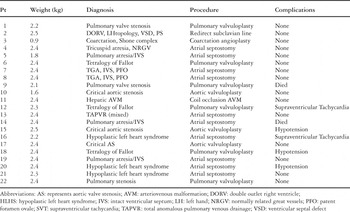
Table 1.
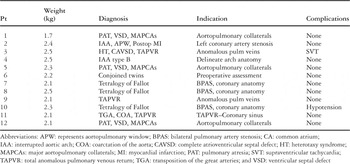
Table 2.

Graphic illustration of complications in infants weighing less than 2500 g. Vasc Cm: vascular compromise; Hypo: hypotension; Arrhy: arrhythmia.

Graphic illustration of complications in infants greater than 2500 g.
 You have
Access
- 17
- Cited by