I. INTRODUCTION
SrRuO3 is a ferromagnetic metal oxide with outstanding thermal conductivity, stability, and high resistance to chemical erosion.Reference Singh, Lees, Singh and Palmer 1 – Reference Choi, Jo, Oh, Kim, Kang, Yoo, Moon, Ha and Oh 3 Thin films of SrRuO3 have been widely used as a buffer layer for developing superconducting YBa2Cu3O7−δ filmsReference Choi, Jo, Oh, Kim, Kang, Yoo, Moon, Ha and Oh 3 and as a conducting electrode for ferroelectric capacitors.Reference Jia, Wu, Foltyn and Tiwari 4 – Reference Lzuha, Abe, Koike, Takeno and Fukushima 6 At room temperature, SrRuO3 exhibits orthorhombic perovskite structure with lattice constants a = 5.56 Å, b = 5.55 Å, and c = 7.86 Å,Reference Choi, Jo, Oh, Kim, Kang, Yoo, Moon, Ha and Oh 3 , Reference Wu, Foltyn, Dye, Coulter and Muenchausen 7 which can also be described as a pseudocubic perovskite structure with lattice constants of a = 3.93 Å.Reference Choi, Jo, Oh, Kim, Kang, Yoo, Moon, Ha and Oh 3 , Reference Yoo, Chmaissem, Kolesnik, Dabrowski, Maxwell, Kimball, McAnelly, Haji-Sheikh and Genis 8 With increasing temperature, the orthorhombic structure transforms into a tetragonal structure at 547 °C and subsequently transforms into a cubic structure at higher temperature (at 677 °C).Reference Kennedy and Hunter 9 , Reference Choi, Baek, Jang, Belenky, Lyubchenko and Eom 10 Polycrystalline SrRuO3 has a resistivity of around 1130 μΩ·cm, whereas the resistivity of single crystalline SrRuO3 is around 280 μΩ·cm at room temperature.Reference Zakharov, Satyalakshmi, Koren and Hesse 11
The microstructural and electrical properties of SrRuO3 thin films strongly depend on the deposition conditions. Substrate temperature and oxygen pressure are of prime importance when pulsed laser deposition (PLD) is used. Epitaxial SrRuO3 thin films have been successfully grown by PLD on various single crystal substrates, such as SrTiO3,Reference Zakharov, Satyalakshmi, Koren and Hesse
11
–
Reference Chen, Cao, Huang, Jiang, Zhang, Sun, Kang, Dezaneti, Chu and Chu
19
LaAlO3,Reference Wu, Foltyn, Dye, Coulter and Muenchausen
7
,
Reference Jia, Chu, Adams, Wu, Hawley, Cho, Findikoglu, Foltyn, Smith and Mitchell
20
–
Reference Jiang and Pan
22
and MgO.Reference Singh, Lees, Singh and Palmer
1
,
Reference Ai, Zhu, Zhang, Li, Liu, Wei, Li, Zheng, Qin and Liang
23
When SrRuO3 is deposited on (001) SrTiO3 substrate, film can grow epitaxially with [001], [110] or [1
 $\bar 1$
0] planes parallel to the SrTiO3 surface, which leads to six possible SrRuO3 domain structures and orientations.Reference Jiang, Tian, Pan, Gan and Eom
13
,
Reference Herranz, Sanchez, Fontcuberta, Garcia-Cuenca, Ferrater, Varela, Angelova, Cros and Cantarero
16
The domain structures of SrRuO3 films grown on LaAlO3 substrates are different from those grown on SrTiO3. SrRuO3 thin films on (001) LaAlO3 substrate consist of all three types of the orientation domains, which are randomly distributed in the film.Reference Ai, Zhu, Zhang, Li, Liu, Wei, Li, Zheng, Qin and Liang
23
In contrast to the atomically flat surface of SrRuO3 films on SrTiO3 substrate, the SrRuO3 film grown on LaAlO3 substrate has a rough surface with a sinusoidal-like modulation. The reason for these differences was ascribed as an effect of lattice mismatch across the film–substrate interface.Reference Jiang and Pan
22
Zakharov et al.Reference Zakharov, Satyalakshmi, Koren and Hesse
11
have shown that SrRuO3/SrTiO3 films deposited at 775 °C and 200 mTorr O2 pressure exhibit a low resistivity of 150 μΩ·cm because of the favorable combination of substrate temperature and oxygen pressure. The resistivity of SrRuO3/LaAlO3 films decreases with increasing deposition temperature due to the improved crystallinity of the films grown at higher temperatures.Reference Wu, Foltyn, Dye, Coulter and Muenchausen
7
,
Reference Ai, Zhu, Zhang, Li, Liu, Wei, Li, Zheng, Qin and Liang
23
The SrRuO3/LaAlO3 films grown at 775 °C and 200 mTorr O2 pressure show a room temperature resistivity of 280 μΩ·cm.Reference Ai, Zhu, Zhang, Li, Liu, Wei, Li, Zheng, Qin and Liang
23
The resistivity of SrRuO3 increases as the oxygen pressure during growth is decreased due to the disordering and lattice imperfections.Reference Hiratani, Okazaki, Imagawa and Takagi
24
To grow SrRuO3 epitaxially on single crystal substrate, less lattice mismatch between the in-plane lattice parameter of SrRuO3 and that of a substrate is required. The strain introduced by the residual lattice mismatch can affect the structural and electrical properties of the SrRuO3 films. The most common choice of substrates for growing SrRuO3 thin films are SrTiO3 and LaAlO3 because of their best lattice mismatch (0.6% for SrRuO3 on SrTiO3 and 1.7% for SrRuO3 on LaAlO3). However, the high relative dielectric constant (ε ≈ 300 at 300 K) of SrTiO3 and tendency to form crystallographic defects [e.g., twin planes along (100)] on LaAlO3 limit their applications particularly in microwave devices. For such application, MgO substrate (ε ≈ 10 at 300 K; tan δ ≈ 10−5) is more preferable even though the lattice mismatch between MgO and SrRuO3 is relatively larger (∼6.7%). Several SrRuO3 films were grown on MgO at various oxygen partial pressures and temperatures. However, (00l)- or (h00)-oriented SrRuO3 films have not been obtained at O2 pressure below 150 mTorr.Reference Choi, Jo, Oh, Kim, Kang, Yoo, Moon, Ha and Oh 3 Furthermore, none of the reported XRD studies on SrRuO3/MgO films presented the XRD pattern above 2θ of 55°. This leads to a question whether SrRuO3/MgO films are single crystalline films as an additional peak appears at 2θ of 55°.
Although significant knowledge has been gained on the microstructure of epitaxial SrRuO3 films grown on SrTiO3 and LaAlO3 substrates, there is still no comprehensive study of the SrRuO3 growth process on MgO substrate and especially about the effect of the oxygen partial pressure. Therefore, this paper reports on the impact of the oxygen partial deposition pressure on the structural and electrical properties of SrRuO3 thin films grown on MgO substrates.
II. EXPERIMENTAL
SrRuO3 thin films were grown on single crystal (001)-oriented MgO substrates by PLD using a KrF excimer laser (λ = 248 nm). A stoichiometric single-phase SrRuO3 target was ablated with a laser beam fluency of 0.8 J/cm2 at 8 Hz. During the deposition, the MgO substrates were kept at a temperature between 650 and 750 °C. The oxygen partial pressure was in the range from 10 to 300 mTorr. Subsequent to the PLD process, as-grown films were in situ post-annealed for 20 min at the deposition temperature and 700 Torr oxygen pressure and then slowly (10 °C/min) cooled down to room temperature. The target-to-substrate distance (50 mm) and laser fluency were optimized for SrRuO3 thin films deposition.
The crystalline structure of these thin films was investigated by x-ray diffraction (XRD) and scanning electron microscopy (SEM). The out-of-plane lattice parameters were evaluated out of θ–2θ scans performed from 20° to 120° in the Bragg–Brentano configuration, while the in-plane lattice parameters were evaluated by grazing incidence XRD. These evaluation procedures are presented in detail elsewhere.Reference Petrov, Sarma and Alford 25 The phase composition was investigated using an Oxford Instruments energy dispersive x-ray (EDX) analysis system (Oxford Instruments PLC, Oxfordshire, UK) attached to the SEM. The resistivity of the films was evaluated by a standard four-point probe method using Agilent B1500A semiconductor analyzer (Agilent Technologies UK Ltd., Santa Clara, CA) attached to a Signatone manual probe station (Signatone Corporation, Gilroy, CA).
III. RESULTS AND DISCUSSION
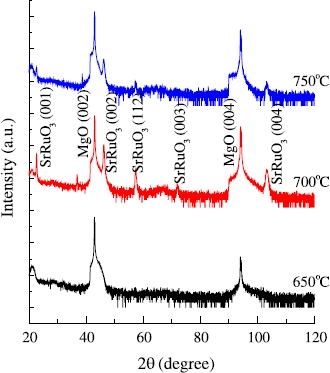
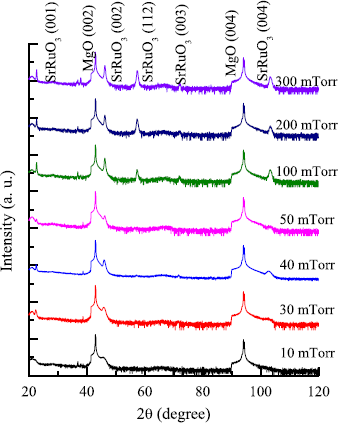
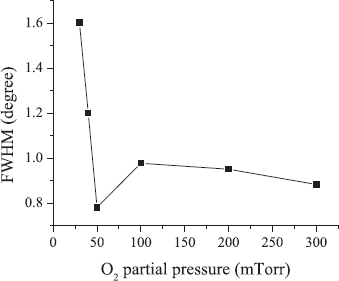
As shown in Fig. 1, the SrRuO3 film deposited on MgO at 650 °C and 100 mTorr O2 was amorphous. Crystalline SrRuO3 films were obtained when the deposition temperature was 700 °C or above. However, at higher deposition temperature of 750 °C, an additional peak was observed at 2θ of 57.3°, which was indexed as (112) peak. This additional peak may originate from the twin growth of SrRuO3 film, which has been reported. The twin formation during the SrRuO3 film growth depends strongly upon the growth conditions (substrate temperature and oxygen partial pressure) and miscut angle of the substrate.Reference Zakharov, Satyalakshmi, Koren and Hesse 11 , Reference Gan, Rao and Eom 12 Up to our knowledge, presence of this peak was not reported before (all previous studies reported XRD patterns of SrRuO3/MgO films only up to 2θ of 55°). Appearance of this additional peak can be suppressed by reducing the O2 partial pressure and will be further discussed hereinafter. Figure 2 shows the XRD patterns for the SrRuO3 thin films deposited at temperature of 700 °C and oxygen partial pressures varied from 10 to 300 mTorr. For simplicity, the peak indexes and the subsequent lattice constant evaluation were based on the consideration of the pseudocubic structure of SrRuO3. As one can see, the first evidence (i.e., XRD peaks) of crystalline SrRuO3 films growth appeared at O2 partial pressure of 10 mTorr. As the O2 partial pressure increased above 30 mTorr, the intensities of the SrRuO3 corresponding XRD peaks increased, while their full-width at half-maximum (FWHM) decreased, as can be seen in Fig. 3. The value of FWHM from the ω-rocking curve on (002) SrRuO3 reflection decreases monotonically with the increasing of the O2 partial pressure except the value of FWHM at 50 mTorr. This implies that the increase of O2 partial pressure improves the SrRuO3 film crystalline perfection and promotes preferential (00l) growth. The value of FWHM at 50 mTorr is 0.78°, which is comparable to the value (0.72°) measured on SrRuO3/LaAlO3 film.Reference Jiang, Pan and Chen 18 The lowest value of FWHM indicates that the best crystallinity of SrRuO3 thin film was obtained at 50 mTorr O2 partial pressure.
XRD patterns of SrRuO3 thin films deposited on MgO (001) substrates at 100 mTorr and different temperatures.

XRD patterns of SrRuO3 thin films on MgO (001) substrate deposited over a range O2 pressure from 10 to 300 mTorr.

Dependence of crystallinity of SrRuO3 thin films on O2 partial pressure. The value of FWHM is from the ω-rocking curve for the SrRuO3(002) reflection.

SrRuO3 (002) diffraction peaks shifted to higher 2θ angles as the working pressure was increased, indicating that the out-of-plane lattice constant was shortened in response to the increasing oxygen pressure. However, as the O2 pressure further increases from 100 to 300 mTorr, an additional peak (112) became more distinguishable. Therefore, it was observed that film grown at 50 mTorr O2 partial pressure was epitaxial (00l)-oriented single crystal.
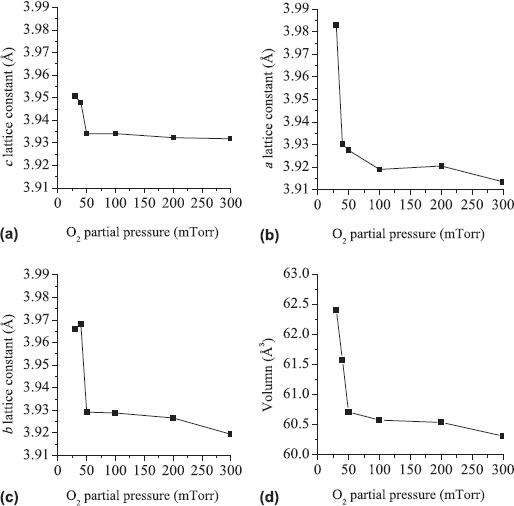
The SrRuO3 film deposited at 10 mTorr O2 pressure has only one diffraction peak (i.e., the lattice constant evaluation error was not satisfactory), and therefore, this lattice constant was excluded from further consideration. The evaluated lattice constants for films grown at 30–300 mTorr O2 partial pressure range are shown in Figs. 4(a)–4(c). To avoid ambiguity, all analyzed films had the same thickness of 150 nm. Films grown at the lower O2 pressure (from 30 to 50 mTorr) had significantly larger out-of-plane lattice constants compared with that of the bulk SrRuO3(3.93 Å). This residual strain is mainly due to the lattice mismatch between film and substrate.
(a) Out-of-plane lattice constants of SrRuO3 thin films determined from the θ–2θ scans; (b) and (c) in-plane lattice constants determined from grazing incidence scans; and (d) volume of unit cell for SrRuO3 thin films deposited at different O2 partial pressures.

The phenomenon of out-of-plane lattice constant decreasing with the increase in the O2 pressure is in good agreement with the result observed for the SrRuO3 thin films deposited on SrTiO3 substrates.Reference Yoo, Chmaissem, Kolesnik, Dabrowski, Maxwell, Kimball, McAnelly, Haji-Sheikh and Genis 8 The same phenomena were observed for the in-plane lattice constants too. The reason is that at low oxygen pressure, films are prone to lose Ru during the deposition. The Ru deficiency in the crystal structure causes crystal unit cell elongation in all the dimensions (i.e., increase of the unit cell volume) as shown in Fig. 4(d).
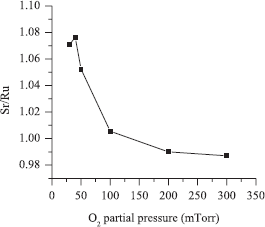
The Ru loss was further confirmed by the EDX measurement shown in Fig. 5. The analysis indicated that the films grown below 100 mTorr are Ru deficient, whereas the films grown above 100 mTorr exhibit a ratio of Sr and Ru close to one. This is a new result in comparison with the previously reported Ru deficiency in SrRuO3/SrTiO3 thin films deposited at O2 partial pressures from 0.1 to 300 mTorr.Reference Choi, Jo, Oh, Kim, Kang, Yoo, Moon, Ha and Oh 3
Intensity ratio of Sr and Ru peaks measured from EDX profiles of SrRuO3 films grown at different O2 partial pressures.

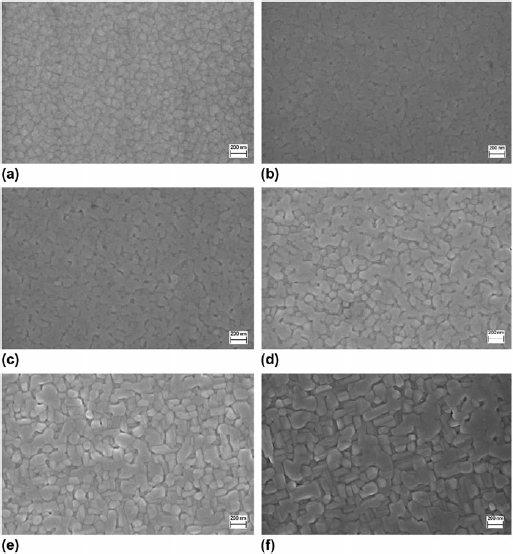
Sample morphology was studied by SEM (Fig. 6) and showed that the grain size of the SrRuO3 thin films increases when the deposition oxygen partial pressure increases. The SEM morphology of the SrRuO3 film deposited at 300 mTorr displayed a larger grain size compared with the SrRuO3 film deposited in 10 mTorr.
SEM images of SrRuO3 thin films grown at (a) 10 mTorr, (b) 30 mTorr, (c) 40 mTorr, (d) 100 mTorr, (e) 200 mTorr, and (f) 300 mTorr O2 partial pressure. The magnification for (a)–(f) is 100,000x.

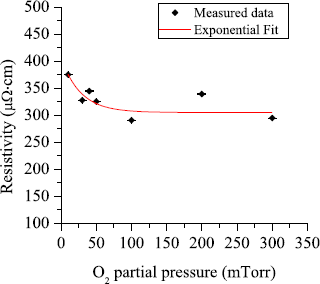
The resistivity of SrRuO3 films was evaluated (at room temperature) using conventional four-point probe method. Figure 7 shows that a resistivity of SrRuO3/MgO thin films decreases with the increase of O2 partial pressure. This can be explained by Ru loss at lower O2 partial pressure. And also the larger grain size in films deposited at high O2 partial pressure enhances electrical conductivity because of less grain boundary scattering of carries. A similar trend was observed on SrRuO3/SrTiO3 thin films, which showed higher resistivity of films deposited in a vacuum compared with films deposited at high O2 pressure.Reference Hiratani, Okazaki and Takagi 5 The SrRuO3 films grown at 50 mTorr O2 pressure showed a room temperature resistivity of 320 μΩ·cm.
Electrical resistivity as a function of O2 partial pressure for SrRuO3 thin films grown on MgO substrates.

IV. CONCLUSION
In summary, a comprehensive study of SrRuO3 thin film growth on (001) MgO substrates by PLD in a wide oxygen pressure range from 10 to 300 mTorr was carried out. Crystalline SrRuO3 films were obtained at the deposition temperature over 700 °C. However, at higher deposition temperature (>700 °C), an additional peak (112) was observed at 2θ of 57.3°. Appearance of this peak is reported for the first time (up to our knowledge, there are no previous reports of XRD studies of SrRuO3/MgO films performed above 2θ of 55°). The additional peak can be suppressed by reducing the O2 partial pressure. The optimal deposition conditions of epitaxial SrRuO3 thin films on MgO substrate were deposition temperature of 700 °C and 50 mTorr O2 partial pressure.
Both the lattice constants and electrical resistivity of SrRuO3 epitaxial thin films were found to depend on the growth oxygen partial pressure. The in-plane and out-of-plane lattice constants increased as the oxygen partial pressure was reduced. The results suggest that the elongated lattice constants for the films deposited at lower oxygen partial pressure were due to Ru loss during growth. The Ru deficiency in the crystal structure caused the unit cell to elongate in all dimensions (i.e., increase of the unit cell volume). The residual strain (due to the lattice mismatch between film and substrate) was also identified as contributing factor to the elongation of the lattice constants.
The oxygen pressure was found to have a direct effect on the resistivity of SrRuO3 too. The resistivity of SrRuO3/MgO films decreases with an increase of the oxygen partial pressure.
ACKNOWLEDGMENTS
We acknowledge the financial support from the Engineering and Physical Sciences Research Council and the King Abdullah University of Science and Technology.