Introduction
Rheumatic heart disease remains a major cause of valvular dysfunction in sub-Saharan Africa, where patients often present late with multivalvular, fibrotic, and calcified lesions. Reference Manuel, Mocumbi and Zühlke1 Although prevalent in this region, the disease has global significance. Reference Pereira, Câmara and Pinheiro2 Severe cases often require valve replacement rather than repair. Reference Pereira, Câmara and Pinheiro2,Reference Soesanto, Almazini and Ariani3 Mechanical prostheses are durable but pose significant challenges in low-resource settings due to the need for lifelong anticoagulation and consistent international normalised ratio monitoring, which are often unavailable. Reference Zilla, Human and Pennel4,Reference Manuel5
In young patients, the Ross procedure has been proposed as a physiological alternative for aortic valve replacement. However, its use in rheumatic populations remains controversial due to concerns about recurrence and long-term durability. Reference Sampath Kumar, Talwar, Saxena and Singh6–Reference Youssef, Etman, Allam, Mahgoub, Hafez and Afifi9 Nonetheless, emerging data suggest favourable outcomes in selected cases. Reference Réa, da Costa FD and Adam8,Reference Youssef, Etman, Allam, Mahgoub, Hafez and Afifi9
In Angola, the majority of valvular patients are young women of childbearing age, many of whom live outside urban centres. Reference Manuel, Vervoor, Gouveia, Edwin and Jacobs10 To avoid warfarin-related complications and teratogenicity, biological prostheses are often preferred. Reference Avila, Pinto and Brugnara11 However, bioprostheses have high rates of degeneration and complications in young patients. Reference Pereira, Câmara and Pinheiro2,Reference Manuel5,Reference Manuel12,Reference Egbe, Connolly and Abdelhalim13 In addition, the implantation of two stented prostheses in the aorto-mitral continuity may impose geometric constraints, sometimes requiring prosthesis downsizing and potentially affecting valve haemodynamics.
Unlike stented prostheses, aortic neocuspidisation preserves annular geometry and allows reconstruction according to the native annular size, avoiding prosthetic downsizing and maintaining favourable haemodynamics. Reference Fujikawa, Ozaki, Kiyohara, Goda, Takatoo and Shimura14 It also allows implantation of larger mitral prostheses in small aortic roots and eases reoperations by avoiding rigid prostheses.
Although the feasibility and safety of the Ozaki procedure have been previously described in rheumatic populations, data specifically addressing its use in patients with multivalvular rheumatic disease requiring concomitant mitral valve surgery in low-resource settings remain limited. Reference Omar, Mahmoud and Fadaly15–Reference Naik, Prabhu and Gan17 Because all patients required concomitant mitral valve surgery, the present study was not designed to isolate the specific haemodynamic contribution of the Ozaki procedure. Instead, our objective was to evaluate its feasibility and integration within multivalvular rheumatic surgery, which reflects the real-world clinical scenario in our setting.
Materials and methods
This was a retrospective observational study including consecutive patients who underwent aortic valve reconstruction using the Ozaki technique concomitant with other(s) valves between January 2022 and December 2024. All procedures were performed by the same surgical team with experience in rheumatic valve surgery and complex multivalve approaches.
The study included patients under 40 years of age with a confirmed diagnosis of rheumatic aortic valve disease, based on clinical history, echocardiographic findings, and intraoperative assessment. Surgical indications comprised severe aortic stenosis, severe aortic regurgitation, or mixed lesions, with symptoms and/or evidence of left ventricular dysfunction. Patients with active infective endocarditis or prior cardiac surgery were excluded. Concomitant mitral or tricuspid valve disease was not an exclusion criterion and was surgically addressed when indicated, including mitral or tricuspid repair or replacement.
Surgical technique: Aortic valve reconstruction was performed using autologous pericardium, treated with glutaraldehyde and tailored into neocusps using standardised templates, following the technique originally described by Ozaki. Reference Fujikawa, Ozaki, Kiyohara, Goda, Takatoo and Shimura14
The intervention was performed under general anaesthesia through a complete median sternotomy under cardiopulmonary bypass and aortic cross-clamping using the Ozaki-AVNeo kit containing dedicated surgical instruments (JOMDD Inc., Tokyo, Japan). A 7 cm × 8 cm sheet of anterior autologous pericardium was harvested and fixed onto a dedicated plate using multiple sutures to maintain adequate tension. The pericardium was carefully cleaned to remove adipose tissue and then treated with 0.6% glutaraldehyde solution for 10 mins. Subsequently, the pericardium was rinsed in three separate containers containing 500 mL of physiological saline solution for 6 mins each.
Myocardial protection was achieved using cold Del Nido cardioplegia administered at a temperature of 2–4°C.
A transverse aortotomy was performed approximately 5 mm above the commissures to expose the aortic valve. The diseased cusps were excised, and the annulus was carefully decalcified when necessary. The distance between the commissures of each Valsalva sinus was measured using the dedicated sizing system from the Ozaki-AVNeo kit to determine the appropriate cusp size. The nadir of each sinus was marked, and templates were used to outline the neocusps on the treated pericardium with the smooth surface oriented toward the ventricular side. The cusps were then trimmed according to the template dimensions.
Each neocusp was sutured to the corresponding annulus using a running 4-0 polypropylene suture, starting from the midpoint of each sinus and progressing toward the commissures. Commissural coaptation was reinforced with additional sutures to ensure proper valve geometry and leaflet coaptation (Figure 1(a)), using transesophageal echocardiography before closure of the aortotomy and after weaning from cardiopulmonary bypass (Figure 1(b) and (c)).
Data collection and outcomes: Clinical, echocardiographic, and intraoperative data were collected retrospectively from our institutional database. Preoperative variables included age, sex, NYHA functional class, type of aortic lesion (stenosis, regurgitation, or mixed), and left ventricular ejection fraction. Intraoperative variables included cross-clamp time, cardiopulmonary bypass time, concomitant valve procedures, and type of prosthesis implanted or repaired in mitral or tricuspid positions when applicable.
Early postoperative outcomes were assessed until discharge or 30 days after surgery, including mortality, reoperation, thromboembolic or haemorrhagic events, infective endocarditis, and early echocardiographic findings. Medium-term outcomes were also evaluated based on the most recent outpatient echocardiogram, including valve function, transvalvular gradients, and ventricular performance.
Variable definitions
Early outcomes were defined as events occurring during the index hospitalisation or within 30 days after surgery. These included mortality, reoperation, thromboembolic events, bleeding complications, infective endocarditis, and echocardiographic valve performance assessed before hospital discharge.
Mid-term outcomes were defined as clinical and echocardiographic results obtained after hospital discharge during outpatient follow-up. Follow-up included clinical evaluation and transthoracic echocardiography performed according to institutional practice, and the most recent echocardiographic examination available for each patient was used for mid-term analysis.
Echocardiographic evaluation included assessment of aortic regurgitation grade, peak and mean transvalvular gradients, and left ventricular function.
Follow-up duration was calculated from the date of surgery to the most recent clinical or echocardiographic evaluation. Follow-up completeness and duration were recorded to allow assessment of early and mid-term outcomes.
Ethical considerations: The study was conducted in accordance with the Declaration of Helsinki, and institutional approval was granted for this retrospective analysis.
Statistical analysis
Descriptive statistical analysis was performed using IBM SPSS version 30.0 (Corp., Armonk, NY, USA). Categorical variables are presented as absolute numbers and percentages, while continuous variables are expressed as mean ± standard deviation or median with interquartile range (25th to 75th percentile), as appropriate. No formal hypothesis testing was conducted, given the exploratory nature and limited sample size of this initial experience.
Results
Preoperative characteristics
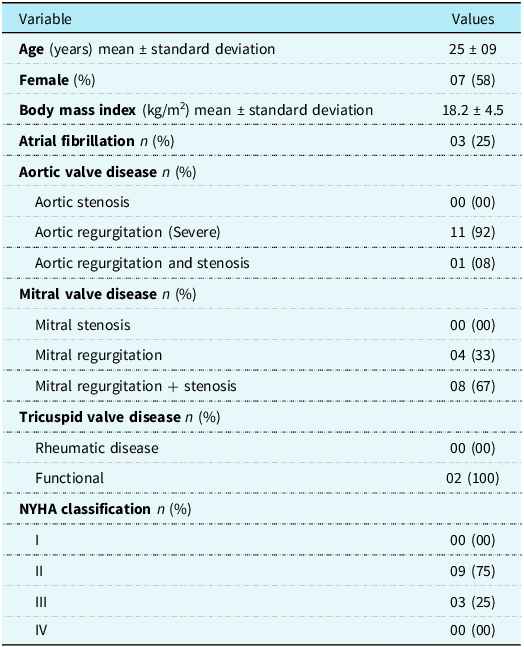
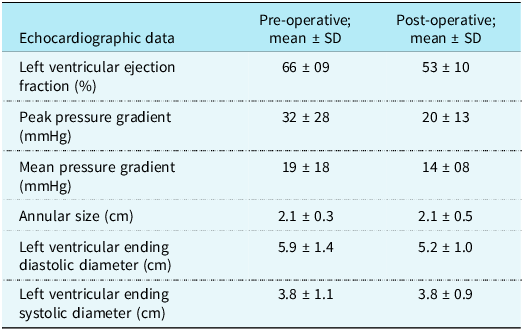
A total of 12 patients with rheumatic multivalvar disease was included in the analysis (Table 1). The mean age was 25 ± 9 years, and 58% were female. All patients had rheumatic aortic valve disease: 92% presented with predominant aortic regurgitation and 8% with mixed lesions with stenosis predominance (Table 2). The mean left ventricular ejection fraction was 66 ± 9 % (interquartile range: 49–79). A significant proportion of patients (75%) were classified as NYHA functional class II at the time of surgery.
Baseline characteristics of 12 patients with severe multivalve rheumatic disease with aortic valve involvement

Preoperative, immediate postoperative, and follow-up echocardiographic data of aortic valve

All patients had concomitant mitral valve disease that demanded a surgical approach, and 16.7% (n = 2) had tricuspid valve involvement.
Intraoperative data
The Ozaki procedure was successfully performed in all 12 patients. The mean aortic cross-clamp time was 153 ± 39 mins, and the mean cardiopulmonary bypass time was 168 ± 43 mins. Concomitant mitral valve repair was performed in 16.7% of patients (n = 2), mitral valve replacement in 83.3% (n = 10), and concomitant tricuspid valve repair in 16.7% (n = 2). All prosthetic valves implanted were biological. There were no intraoperative deaths and no need for conversion to prostheses implementation. Transesophageal echocardiography confirmed satisfactory geometry and effective cusp coaptation in all cases.
Initial outcomes
There were no deaths. Reoperation was required in three (25%) patients; two (16.7%) due to bleeding, and one patient (8.3%) required surgical revision of the Ozaki reconstruction due to cusp dysfunction. In this case, intraoperative transesophageal echocardiography identified a paraneocuspid leak involving the neocusp corresponding to the right coronary sinus. The defect was attributed to tearing of the annular tissue and was corrected immediately during the same surgical procedure, with satisfactory final valve function.
One additional patient (8.3%) presented with early postoperative dysfunction of the neocusps associated with clinical and laboratory signs of acute rheumatic activity. This case was managed successfully with medical therapy, and follow-up echocardiography confirmed resolution of the regurgitation without the need for reintervention.
No thromboembolic events or major conduction disturbances were observed. Early transthoracic echocardiography demonstrated preserved aortic valve function in all remaining patients, with either trivial or no regurgitation and acceptable transvalvular gradients (Table 2), comparing preoperative and early postoperative echocardiographic parameters.
The mean hospital length of stay was 27 ± 10 days.
The median follow-up duration was 18 months (range 6–32 months). Clinical follow-up was available for all patients, and echocardiographic follow-up was available for 10 patients (83%). During follow-up, no deaths or valve-related reinterventions were observed.
Discussion
The selection of an appropriate heart valve substitute in young patients with rheumatic aortic valve disease remains one of the most complex decisions in cardiac surgery, particularly in low- and middle-income countries. Reference Manuel5 These regions face a unique intersection of challenges: a high burden of rheumatic heart disease, limited access to specialised surgical care, and a patient population largely composed of young women of childbearing age. Reference Soesanto, Almazini and Ariani3–Reference Manuel, Vervoor, Gouveia, Edwin and Jacobs10,Reference Doh, An and Chang18–Reference Manuel, Jacobs and Edwin20 In this context, the three main options, mechanical prostheses, biological prostheses, the Ross procedure and the Ozaki procedure, each present distinct advantages and limitations.
The Ross procedure, which involves replacing the diseased aortic valve with the patient’s own pulmonary valve and reconstructing the right ventricular outflow tract with a homograft, is considered by many to be the ideal aortic valve substitute for young patients. Reference Vahanian, Beyersdorf and Praz21 It provides excellent long-term survival, near-native haemodynamics, and freedom from anticoagulation. However, its application in rheumatic disease remains controversial due to concerns about potential rheumatic involvement of the pulmonary autograft over time. Reference Sampath Kumar, Talwar, Saxena and Singh6,Reference Alsoufi, Manlhiot and Fadel7 Despite these concerns, emerging evidence has shown encouraging mid- and long-term outcomes in selected rheumatic patients, suggesting that, when performed in expert centres and with careful patient selection, the Ross procedure can be a viable option. Reference Réa, da Costa FD and Adam8,Reference Youssef, Etman, Allam, Mahgoub, Hafez and Afifi9 Nevertheless, the technical complexity of the operation and the need for homografts, which are often unavailable in low-resource settings, limit its applicability in sub-Saharan Africa and similar contexts.
Mechanical prostheses offer excellent long-term durability, making them a theoretically ideal option for young patients with long life expectancy. Reference Egbe, Connolly and Abdelhalim13 However, they require lifelong anticoagulation with warfarin, which poses major risks in low-resource settings. Reference Zilla, Human and Pennel4 Many patients lack access to consistent monitoring of blood coagulation, resulting in poor control and a high risk of clotting or bleeding complications. Reference Zilla, Human and Pennel4 Furthermore, warfarin is harmful during pregnancy, limiting its use in young women, a population highly affected by rheumatic heart disease. Reference Zilla, Human and Pennel4,Reference Avila, Pinto and Brugnara11 Although low-molecular-weight heparin is sometimes used during pregnancy as an alternative, it introduces logistical and financial burdens that are difficult to sustain in underserved areas. Reference Avila, Pinto and Brugnara11
When comparing mechanical prostheses with the Ross procedure, the latter offers clear advantages in terms of haemodynamics, quality of life, and avoidance of anticoagulation. Reference Mazine, Rocha and El-Hamamsy22 However, mechanical valves are more widely available, less technically demanding, and not dependent on homograft banks, factors that still favour their use in many centres. In contrast, Ross demands a double-valve operation and is more technically complex, with higher early operative risk if performed by inexperienced teams. Still, in experienced hands, Ross outcomes may rival or surpass those of mechanical prostheses, even in rheumatic patients, although this remains an area of ongoing research.
Biological prostheses do not require anticoagulation and are technically straightforward to implant. However, current guidelines recommend at least six months of anticoagulation, particularly in mitral or double valve positions. Reference Vahanian, Beyersdorf and Praz21 In young patients with rheumatic disease, bioprostheses are prone to early degeneration due to persistent inflammation and high calcium turnover. In addition, recent reports in congenital populations have shown an association with ventricular dysfunction. Reference Egbe, Connolly and Abdelhalim13 These findings raise concerns about their durability, especially in regions where access to repeat surgical or catheter-based interventions is limited. Reference Doh, An and Chang18–Reference Manuel, Jacobs and Edwin20 The use of two prostheses in multivalvar surgery increases overall cost and exposure to foreign material. In contrast, our strategy may reduce total surgical cost by avoiding the implantation of a second prosthesis. Importantly, the superior haemodynamics of the Ozaki procedure, particularly the low transvalvular gradient, may be one of its greatest advantages in this setting.
Comparative data between the Ozaki procedure and conventional bioprosthetic aortic valve replacement have already been reported. In a large propensity-matched analysis including 776 patients undergoing aortic valve neocuspidisation and 627 patients receiving stented bovine pericardial prostheses, the Ozaki procedure demonstrated lower transvalvular gradients, reflecting favourable haemodynamic performance. Reference Unai, Ozaki and Johnston23 However, a higher incidence of recurrent aortic regurgitation was observed over time when compared with conventional bioprostheses. Despite this, freedom from valve replacement and overall survival were similar between the two groups at mid-term follow-up, supporting the safety and acceptable durability of the technique. These findings suggest that aortic valve neocuspidisation can represent a viable alternative to conventional bioprosthetic replacement in selected patients. Nevertheless, our study was not designed to compare these surgical strategies or to demonstrate superiority or non-inferiority. Instead, our objective was to evaluate the feasibility and early safety of integrating the Ozaki procedure within complex rheumatic multivalvular surgery in a low- and middle-income country setting, where limitations in resources, access to long-term follow-up, and the need to facilitate potential future reoperations may significantly influence surgical decision-making.
The Ozaki procedure preserves near-native valve haemodynamics, avoids the use of synthetic or bovine prosthetic material, and does not require anticoagulation. Reference Fujikawa, Ozaki, Kiyohara, Goda, Takatoo and Shimura14 These characteristics are particularly beneficial in low- and middle-income countries, where both affordability and safety in women of childbearing age are critical considerations. In our series, the procedure proved feasible and reproducible, even in patients with complex multivalvar disease. Importantly, it enabled the implantation of a larger mitral prosthesis, even in the presence of a small aortic annulus, a relevant technical advantage in patients with small aortic roots. In the event of reoperation, the absence of a rigid prosthesis in the aortic position simplifies the surgical approach, offering further benefit in resource-limited environments. In our institutional strategy, the combination of a mitral bioprosthesis with aortic neocuspidisation was considered a context-adapted alternative aimed at avoiding double prosthetic implantation, preserving prosthesis sizing within the aorto-mitral continuity, and potentially reducing overall procedural costs in patients with limited access to long-term follow-up.
One patient developed early aortic regurgitation after the Ozaki procedure, attributed to acute rheumatic activity. The patient was treated with corticosteroids: intravenous methylprednisolone (01 g/day for 03 consecutive days), followed by a tapering course of oral prednisone starting at 01 mg/kg/day, maintained for 04 weeks and then gradually tapered over an additional 04 weeks. The clinical response was favourable, and the valve dysfunction resolved without the need for reoperation. This highlights the potential reversibility of early valve dysfunction in rheumatic patients.
An additional technical event observed in our series was a paraneocuspid leak detected intraoperatively in one patient, associated with the neocuspid corresponding to the right coronary sinus. The defect was immediately corrected during the same surgical procedure, with no residual dysfunction on postoperative imaging. The lesion was likely related to the fragility of the annular tissue, which may be present in rheumatic valves. Although paraneocuspid leakage is considered an uncommon complication, it has been described during the early learning curve of aortic valve neocuspidisation techniques. Reference Ozaki24 Given the small sample size of our cohort, the observed rate should be interpreted cautiously and does not necessarily reflect the expected incidence in larger series.
Hospital length of stay in our series may appear longer when compared with reports from high-income centres. However, in our setting, discharge timing is influenced by geographic barriers to early postoperative follow-up, limited access to specialised outpatient care, and socioeconomic factors that may delay safe home recovery. In addition, patients undergoing multivalvular rheumatic surgery often require cautious postoperative monitoring before discharge.
When comparing the Ozaki and Ross procedures, both offer excellent haemodynamic performance and avoid the need for lifelong anticoagulation, which is especially advantageous in young patients. Reference Wang, Zhang and Ma25,Reference Zhang, Jiang and Liu26 The Ross procedure has more robust long-term data, particularly in non-rheumatic populations, and has shown superior midterm durability in paediatric cohorts. Recent studies in children demonstrated significantly higher rates of moderate or severe aortic regurgitation and stenosis after Ozaki compared to Ross, with lower freedom from reintervention at 4 years. Nevertheless, Ozaki remains an attractive option in selected cases, particularly due to its technical simplicity, adaptability in multivalvular disease, and avoidance of homograft usage, an advantage in low-resource settings. Moreover, unlike Ross, it preserves the pulmonary valve and may simplify future reoperations. However, the long-term performance of Ozaki in adolescents and young adults, especially those with rheumatic aetiology, still requires further investigation.
Therefore, our findings should be interpreted primarily as an initial feasibility experience in a specific clinical and socioeconomic context rather than evidence of superiority over established procedures such as the Ross operation or conventional prosthetic valve replacement.
In summary, although mechanical and biological prostheses remain widely used, both have important limitations when applied to young patients with rheumatic multivalve disease in low- and middle-income countries. In this context, the Ozaki procedure may represent a feasible and context-adapted reconstructive option when combined with multivalve surgery, although larger studies with longer follow-up are required to define its comparative durability and long-term clinical role.
Representative, intraoperative, and echocardiographic findings after aortic valve reconstruction using the Ozaki technique. ( a ) Intraoperative view of autologous pericardial neocusps after reconstruction. ( b ) Transesophageal echocardiography short-axis view of the reconstructed valve during systole. ( c ) Colour Doppler transesophageal echocardiography demonstrating satisfactory valve function without significant aortic regurgitation.

Acknowledgements
None.
Financial support
None.
Competing interests
None.