Introduction
The Xeromelissinae is one of five subfamilies of Colletidae (Hymenoptera), which, other than for a few species in Central America and Mexico, is restricted to South America (Michener Reference Michener2007). It currently consists of four genera: Chilicola Spinola, 1851; Geodiscelis Michener and Rozen, Reference Michener and Rozen1999; Xenochilicola Toro and Moldenke, Reference Toro and Moldenke1979; and Xeromelissa Cockerell, 1926. Here I describe a fifth genus: Patagonicola Packer from Patagonian Argentina. The new genus contains one new species, P. graveli Packer, new species, and an additional species previously placed in Chilioediscelis Toro and Moldenke, Reference Toro and Moldenke1979, a subgenus of the genus Chilicola (Packer and Genaro Reference Packer and Genaro2007) although this taxonomic affiliation was soon cast into doubt (Almeida et al. Reference Almeida, Packer and Danforth2008). The new genus has some characteristics suggestive of an affinity with both Xenochilicola and Chilicola but does not share the suite of autapomorphies of either genus and is seemingly more closely related to (Geodiscelis +Xeromelissa). A revised key for the genera of Xeromelissinae is provided.
Materials and methods
Institutional abbreviations indicating where material is deposited are as follows: MACN – Museo Argentino de Ciencias Naturales, Buenos Aires, Argentina; PCYU – Packer collection at York University, Toronto, Canada.
Two of the specimens of P. graveli described below were captured in a bottle trap. These are 0.5 L plastic water bottles in which the top has been cut off, painted bright yellow or bright blue and replaced, upside-down, into the opening of the bottle, which is then partly filled with fluid, in this case propylene glycol, and partially buried in the ground. Such traps can be left out in the field (in arid locations at least) for weeks at a time.
Some specimens referred to in this paper were cleared to permit observation of internal structures. They were relaxed overnight and then placed in 5% KOH at room temperature for six hours and then transferred to glycerine. Images were taken with a Visionary Digital BK Plus imaging system (Visionary Digital Enterprises, West Hollywood, California, United States of America), using a Canon EOS 40D digital SLR camera (Canon, Ōta, Tokyo, Japan) and processed with Adobe Photoshop (Adobe Systems, San Jose, California, United States of America). Cleared material was temporarily mounted in KY jelly (Johnson and Johnson, New Brunswick, New Jersey, United States of America) for imaging.
Standard terminology is used for the descriptions; following Genaro and Packer (Reference Genaro and Packer2005), Michener (Reference Michener2007), Packer and Genaro (Reference Packer and Genaro2007), and Packer (Reference Packer2008) except that the term metapostnotum is used for what is often called the dorsal surface of the propodeum (Brothers Reference Brothers1976). Terminology for surface sculpture generally follows Harris (Reference Harris1979) and puncture density is expressed in terms of the size of the spaces between them (i) and puncture diameter (d), for example i = 2d. Abbreviations used are as follows: MOD – transverse diameter of median ocellus, OOD – ocellocular distance, IOD – interocellar distance, UOD – upper ocular distance, LOD – lower ocular distance, F followed by a number refers to individual flagellomeres, T and S followed by a number refers to individual metasomal terga and sterna, respectively. Hair length is given in terms of MOD.
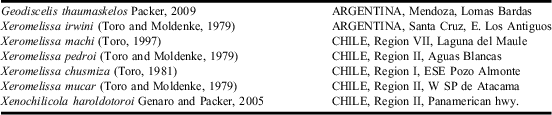
The phylogenetic analysis was based upon an extensive data matrix developed for a generic-level phylogeny of the subfamily and an analysis of the subgenera of Chilicola (Packer Reference Packer2008). Additional characters are from an ongoing revision of the genus Xeromelissa and study of the genus described herein. The taxa included in the analysis differ from that in the earlier paper as follows. All known species of Xenochilicola and Geodiscelis were included (species included herein not included in Packer (Reference Packer2008), as well as their locality information, are shown in Table 1), but the number of representatives of Chilicola was reduced such that only one representative of each subgenus or larger clade between the root for Chilicola and the previous location of P. aenigma (Packer, 2007) on the cladogram was included with the exception of Chilioediscelis for which both of the previously used exemplars were included. The number of outgroup taxa was reduced by eliminating multiple representatives of the Hylaeinae, Euryglossinae, and Scrapterinae. The new suite of taxa rendered many characters from the original matrix uninformative, such as those that previously provided only subgeneric synapomorphies. Such uninformative characters were removed as were those that might be considered as duplications of other characters (Michener Reference Michener2007: 905).
Taxa used in the phylogenetic analysis other than those already reported by Packer (Reference Packer2008) and locality of provenance.

Note: All specimens are housed at PCYU and both sexes of each were available for study except for females of Xn. haroldotoroi.
PCYU, Packer collection at York University.
Initially, the malar, genal, lower paraocular and supraclypeal areas, and the clypeus were coded as five separate characters. However, increased yellow colouration in some of the xeromelissine lineages seemed to occur in consort as if these changes were not independent. To avoid this potential redundancy, these colour characters were combined into a reduced number of variables using nonredundant linear coding (O'Grady and Deets Reference O'Grady and Deets1987). This resulted in two ordered multistate characters (see Appendices 1 and 2 for details). All other characters were treated as nonadditive.
The data were analysed with TNT (Goloboff et al. Reference Goloboff, Farris and Nixon2003b) using ratchet, tree fusion and drift routines combined, each with default options except with the random seed set to 0 and the number of times the minimum length tree(s) had to be found set to 100. Successive approximations character weighting (Carpenter Reference Carpenter1988) was employed using the rescaled consistency index as the weighting function. Group support was assessed using symmetric resampling (Goloboff et al. Reference Goloboff, Farris, Källersjö, Oxelman, Ramírez and Szumik2003a) as implemented in TNT based upon 1000 resampled matrices. The results are shown as GC values, which indicate the proportion of times a given node was found among the resampled matrices minus the proportion of times a different arrangement of the subtended taxa was found. Standard bootstrap frequencies are also reported for the most pertinent nodes and were calculated similarly using TNT. Trees were read into Asado (Nixon Reference Nixon2008) for image generation and character mapping and edited in Microsoft Paint (Microsoft, Redmond, Washington, United States of America).
Patagonicola new genus
Type Species.Chilicola (Chilioediscelis) aenigma Packer in Packer and Genaro Reference Packer and Genaro2007. Here designated.
Etymology. The generic name combines Patagonia with cola (a Latin suffix meaning “dweller”, gender masculine) and refers to the geographic distribution of both known species in the genus.
Diagnosis. The combination of: (i) epistomal suture not forming a lobe that projects into the clypeus on either side and with short dorsolateral branch leading to anterior tentorial pit (Fig. 1), (ii) episternal groove clearly posteroventrally oriented above and below scrobal groove (Fig. 3), and (iii) metapostnotum longer than metanotum (Fig. 5) is diagnostic among the genera of Xeromelissinae. The first characteristic separates the new genus from Xeromelissa and Geodiscelis, both of which have an elongate epistomal lobe (Fig. 2, see also Fig. 22), the second distinguishes it from Chilicola, which has a vertical episternal groove (Fig. 4), and the last serves to separate it from Xenochilicola, which has a very short metapostnotum that is shorter than the metanotum (Fig. 6).
Generic characters that separate Patagonicola from other Xeromelissinae. 1. Patagonicola graveli male lower face, frontal view, to show lower paraocular area and anterior tentorial pit. The lower paraocular area does not extend as a strong lobe projecting into the clypeus and the anterior tentorial pit (red line) is seemingly at the end of a short branch from the epistomal suture. 2. Xeromelissa wilmattae Cockerell, 1926 male lower face, frontal view, to show epistomal suture and anterior tentorial pit (note that this is the shortest epistomal lobe found within the two genera Xeromelissa and Geodiscelis). The blue line points to the extension of the clypeus that is laterad of the epistomal lobe (see also Fig. 21). The anterior tentorial pit, red line, is along the epistomal suture. 3. Patagonicola aenigma female mesosoma, side view to show posteroventral orientation of episternal groove, the red line parallels the groove. 4. Chilicola (Oroediscelis) species female mesosoma, side view to show ventral orientation of the groove, the red line parallels the groove. 5. Patagonicola graveli mesosoma, dorsal view to show the elongate metapostnotum (blue line), which is notably longer than the metanotum (red line). 6. Xenochilicola diminuta Toro and Moldenke, Reference Toro and Moldenke1979, mesosoma, dorsal view to show the short metapostnotum. Red and blue lines as in Fig. 5. All scale lines = 0.5 mm.
Description. Body length 3–5 mm. Black except male labrum, most of mandible, clypeus and lower paraocular areas and markings on legs yellow; metasoma with or without yellow markings. Female body mostly black with red markings on metasoma and with or without yellow markings on clypeus and legs (Figs. 9, 10, 13, 14). Head and thorax with imbricate microsculpture and small punctures, somewhat obscure on face. Pubescence white; somewhat woolly on mesosoma with interrupted subapical setal bands on T1–T3 or T1–T4 (Figs. 9, 13). Female lacking mesotarsal rake of long robust setae, S2 scopa lacking corbiculate structure. Head higher than wide (Figs. 8, 10, 12, 14). Labrum twice as wide as long. Mandible twice as long as basal depth, preapical tooth well defined. Maxillary palpus unmodified, all six palpomeres of similar length. Four labial palpomeres. Galeal comb absent. Epistomal lobe not invading clypeus, tentorial pits at end of a groove that extends dorsolaterally from epistomal suture (Fig. 1). Malar space higher than wide (Figs. 7, 9, 11, 13), malar line present. Facial fovea absent. Inner margin of compound eye weakly emarginate, eyes weakly converging below (Figs. 8, 10, 12, 14). Male with antenna and legs unmodified (Figs. 7, 11). Pronotum with collar short but distinct, somewhat <1 MOD in length (Fig. 13). Preepisternal groove complete, posteroventrally oriented (Fig. 3). Female with metatibial spurs unmodified or robust and strongly curved. Dorsal surface of metapostnotum longer than metanotum (Fig. 5). Metasoma not unusually flattened, apical impressed areas long, ∼¼of postgradular length on second tergum. Male metasomal sterna either with transverse ridges on S2–S5 and a pair of lobes on S6 (Fig. 20) or unmodified except for a pair of long, narrow, medially curved processes on S5 (Fig. 15). S7 with largely dorsally directed short, blunt process (Fig. 16). S8 with apical lobe very short, lateral lobe long with narrow elongate posteriorly directed process surpassing apex of apical lobe (Fig. 17). Gonobase ventroapical lobes well developed, widely separated (Fig. 19). Gonocoxite lacking membranous medial lobe. Gonostylus weakly differentiated from gonocoxite, short (Fig. 19). Penis valve lacking membranous processes.
Patagonicola aenigma. 7. Male habitus, lateral view. 8. Male face, frontal view. 9. Female habitus, lateral view. 10. Female face, frontal view. Scale lines = 1.0 mm.
Patagonicola graveli. 11. Male habitus, lateral view. 12. Male face, frontal view. 13. Female habitus, lateral view. 14. Female face, frontal view. Scale lines = 1.0 mm.
Metasomal characters of male Patagonicola and S5 of Xenochilicola diminuta. 15. Patagonicola graveli S5, ventral view. 16. Patagonicola graveli S7, dorsal view. 17. Patagonicola graveli S8, ventral view (note that the narrow processes from the lateral lobe are muscle fibres that were not adequately cleared in the preparation). 18. Xenochilicola diminuta S5, ventral view. 19. Patagonicola graveli genital capsule, ventral view; the red line points to the broad apicoventral lobes to the gonobase. 20. Patagonicola aenigma apex of metasoma, apical view, to show paired lobes of S6. Scale lines = 0.5 mm.
Natural history. Most specimens of the type species of the genus were obtained from flowers of Adesmia de Candolle (Fabaceae) species. Other than for one specimen that was caught on the ground, all individuals of P. graveli were obtained from traps and no floral host data are available for the species.
Distribution. The genus is currently only known from Santa Cruz and Chubut Provinces in Patagonian Argentina. It is known from both the coastal plain (near Rada Tilly) and closer to the foothills of the Patagonian Andes (near Los Antiguos). It undoubtedly occurs also in adjacent Chile, around the town of Chile Chico in particular.
Patagonicola aenigma (Packer in Packer and Genaro, Reference Packer and Genaro2007) new combination
(Figs. 3, 7–10, 20, 37, 39, 42, 43)
Chilicola (Chilioediscelis) aenigma Packer in Packer and Genaro, Reference Packer and Genaro2007.
This species was recently described in some detail (Packer and Genaro Reference Packer and Genaro2007) and this information is not repeated here, although lateral habitus images and facial views are provided (Figs. 7–10) as are some key characteristics for separating it from its only known congener (see Figs. 42 and 43 associated with the key below). The characters from the diagnosis for Patagonicola above along with the metatibial spurs strongly sclerotised and curved is diagnostic for both sexes of this species among all Xeromelissinae.
This species is associated with Adesmia as a floral host and seems to possess the same “head upwards” death posture (Fig. 7) that is often associated with specialists on these flowers (Dumesh and Packer Reference Dumesh and Packer2011). The robust metatibial claws also seem associated with taxa visiting the tight flowers of Adesmia and may aid purchase as the bees attempt to force entry.
The discussion section below provides a treatment of the taxonomic confusion associated with this species.
Patagonicola graveli new species
(Figs. 1, 11–17, 19, 23, 32, 38, 40, 41, 44)
Epistomal suture characters for couplet 1. 21. Xeromelissa wilmattae male lower face, oblique view, to show comparatively short, almost parallel-sided epistomal lobe (red line). 22. Xeromelissa pedroi (Toro and Moldenke, Reference Toro and Moldenke1979), male lower face, oblique view, to show long, narrow lobe (which is black in colour and denoted by the red line) and maxillary palpomere differentiation (for couplet 2) (blue lines and numbers denote the maxillary palpomeres). 23. Patagonicola graveli male lower face, slightly oblique view, to show absence of lobe and location of anterior tentorial pit (orange line). Scale lines = 0.5 mm.
Type material.Holotype (female) labelled: “ARGENTINA, Chubut/∼8 km S. of Rada Tilly/45°59′043′′S, 72°36′322′′W/30 m, 19.xi.-23.xii.2006/bottle trap, A.-I. & M. Gravel”; “HOLOTYPE [red background]/Patagonicola/graveli Packer” (MACN). Paratypes: one male one female same data as holotype except pan trap (MACN); two males (one in glycerine) same data as holotype except pan trap (PCYU); one female, Santa Cruz, 25 km W. of Los Antiguos, bottle trap, A.-I. & M. Gravel (PCYU); one same data except 22.xi.2003, L. Packer, netted female from the ground (PCYU).
Etymology. The specific epithet honours the collectors of the type series, Anne-Isabelle and Michael Gravel. It is to be considered a noun in apposition.
Diagnosis. Males can instantly be separated from all other Xeromelissinae by the combination of abundant yellow markings on the metasoma (Fig. 11) and elongate, robust, spinous processes on S5 (Fig. 15). The only other xeromelissine with males with yellow markings on the metasoma and processes on S5 (Xenochilicola diminuta Toro and Moldenke, Reference Toro and Moldenke1979) has the processes much shorter and broader and the overall form of the sternum entirely different (Fig. 18). Females can be identified by the combination of orange-red markings on at least the first three metasomal terga (Fig. 13), interrupted apical setal bands on T1–T4 (Fig. 13), unmodified metatibial spurs (Fig. 44) and posteroventrally oriented episternal groove (as in Fig. 3). Some other female xeromelissines have red markings on the metasoma, but none of them with the metatibial spurs unmodified have hair patches laterally on T1–T3 or T1–T4 with the exception of some species of Chilicola (Heteroediscelis) Toro and Moldenke, Reference Toro and Moldenke1979. The orientation of the episternal groove (as in Fig. 3), along with numerous other morphological features and geography separate P. graveli from those members of Heteroediscelis that possess a red metasoma.
Description. Male. Body length 3.0 mm, forewing length 2.2 mm, head width 0.9 mm.
Colouration. Black, with yellow as follows: labrum, mandible (except apical half copper), clypeus, lower paraocular area to antennal socket, apicoventral spot on scape, pronotal lobe, large spot on tegula, ventral surface of metacoxa, most of metafemur, broad apical rings on mesofemora and metafemora, all tibiae (except for brown mesofemur and metafemur spot on posterior surface at midlength), all tarsi, metasomal terga (except for brown basal bands and translucent pale straw coloured apical impressed areas), metasomal sterna (except S1 suffused with brown); following parts yellow-brown: pedicel, flagellum, ventral surface of all trochanters.
Surface sculpture. Body surface somewhat shiny despite strong microsculpture; labrum lacking microsculpture, i > d; clypeus and supraclypeal area with irregular mostly shallow punctures, i = 1−5d; lower paraocular area densely punctate, i ≈ d; frons with dense imbricate microsculpture and shallow widely spaced punctures; vertex microreticulate with deeper denser punctures, i ≈ d; hypostomal area shiny and impunctate; mesoscutum imbricate with shallow punctures varying considerably in size, i ≈ d; scutellum more irregularly punctuate, i = 1−5d; metanotum roughened; dorsal surface of metapostnotum with sparse but strong anastomosing rugae; metasoma with irregular shallow punctures.
Pubescence. White, somewhat woolly, mostly short (≈MOD) and sparse; denser on gena, posterior margin of pronotum, posterior margin of metanotum and dorsolateral portion of metapostnotum. Slightly longer, simple hairs on scape, legs and metasomal terga. S6 with pair of small apicolateral hair patches.
Structure. Head: Longer than broad (66:56). Labrum short, length to breadth 8:17, apex weakly convex. Mandible slightly more than 2 × as long as basal depth, subapical tooth long. Clypeus longer than broad (22:20), extending below lower ocular tangent by 0.8 × its length; epistomal suture sinuate, anterior tentorial pit separated from suture by more than twice pit diameter, at end of groove diverging dorsolaterally from epistomal suture. Subantennal suture outwardly concave, convergent below; supraclypeal area slightly narrowing below, length: basal width:apical width 12:12:10; UOD:LOD 34:29; OOC:IOC 13:7, OOC larger than ocellar diameter (7:5). Upper ocular tangent tangential to lower margin of lateral ocellus. Scape 2.5 × as long as apical breadth, pedicel longer than broad, F1 slightly longer than broad, F2 slightly shorter than broad, F3–F10 with length and breadth subequal, F11 longer than broad. Gena narrow, ratio to greatest width of compound eye (8:22) in side view. Malar space 2 × as long as basal depth of mandible.
Mesosoma: Length:maximum depth 75:45. Pronotal collar narrowly rounded. Prosternal carinae meeting before apex (character visible only upon dissection). Ratio of lengths of scutellum:metanotum:metapostnotum 15:6:9. Legs unmodified. Protarsal and mesotarsal claws cleft, metatarsal claws with subapical tooth. Stigma somewhat divergent towards vein r, weakly convex in marginal cell; first and second recurrent veins entering second submarginal cell.
Metasoma: Apical impressed areas of terga >0.25 × as long as postgradular portion of tergum. S5 with apicolateral spinous process ≈ 0.75 × as long as S6. S7 with dorsally directed double lobe; lobes short, blunt, closely approximated and deeply incised. S8 with apical process short, rounded; lateral lobe with long, posteriorly directed process extending beyond apex of apical process, spiculum moderately short and narrow, 0.2 × length of sternum. Genital capsule with gonobase somewhat concave anterodorsally, ventroapical margin with two large well separated lobes; gonocoxite lacking apicomedial lobe; gonostylus weakly differentiated from gonocoxite, short; penis valve strongly curved, lacking membranous lobes.
Female. As in male, except for usual secondary sexual characteristics and as follows.
Larger, body length 3.4 mm, forewing length 2.8 mm, head width 1.0 mm.
Colouration. Blackish brown, labrum brown, mandible, pedicel and flagellum pale yellowish brown; clypeus with elongate yellow medial mark; all femora with apical yellow ring, protibia with apical and basal rings and entire anterior surface yellow, mesotibia and metatibia with basal and apical yellow rings, tarsi pale yellow suffused with brown, more strongly so proceeding from front to hind leg. Horizontal surface of T1, most of T2 and broad subapical lunate marking on T3 and T4 orange, remainder of terga dark brown except apical impressed areas on T1 and T2 translucent orange, apical impressed areas of remaining terga translucent grey. Apex of S1, all of S2 and base of S3 orange, rest of sterna red-brown.
Surface sculpture. Clypeus and supraclypeal area with punctures somewhat larger and denser than in male; metanotum with large shallow punctures on microsculptured background; metapostnotum with rugae straighter than in male.
Pubescence. Hypostomal hair row single, comprised of long sparse hairs. Probasitarsus with a few long hairs, but not forming a rake, mesotarsus lacking long hairs. Dorsolateral portion of propodeum with elongate woolly hairs 1.5 MOD. Metafemur and metatibia with sparse scopal hairs ⩽2.0 MOD. T1–T4 with apicolateral bands of woolly hairs increasing in breadth on more posterior terga, those on T4 as wide as the space that separates them, T5 and T6 with normal setation, not forming obvious patches or bands. S2 with long scopal hairs ⩽2.5 MOD, not forming corbicula.
Structure. Head (Fig. 14) relatively longer than in male (65:51). Labrum with apical margin convex. Maxillary palpomeres cylindrical (in glycerine, flattened in dried specimens), four labial palpomeres, palpus narrowing to apex. Premental fovea restricted to apical sixth, prementum long and narrow. Clypeus longer than broad (21:18), extending beyond lower ocular tangent by ≈0.75 × its length. F1–F9 shorter than wide, F1 and F7–F9 only slightly shorter, F10 longer than wide.
Variation. The size of the yellow clypeal marking in the female varies from a narrow longitudinal oval (Fig. 12) to longer and broader, extending from the base almost to the apex of the clypeus. T4 has a subapical transverse orange band in some females.
Phylogenetic analysis
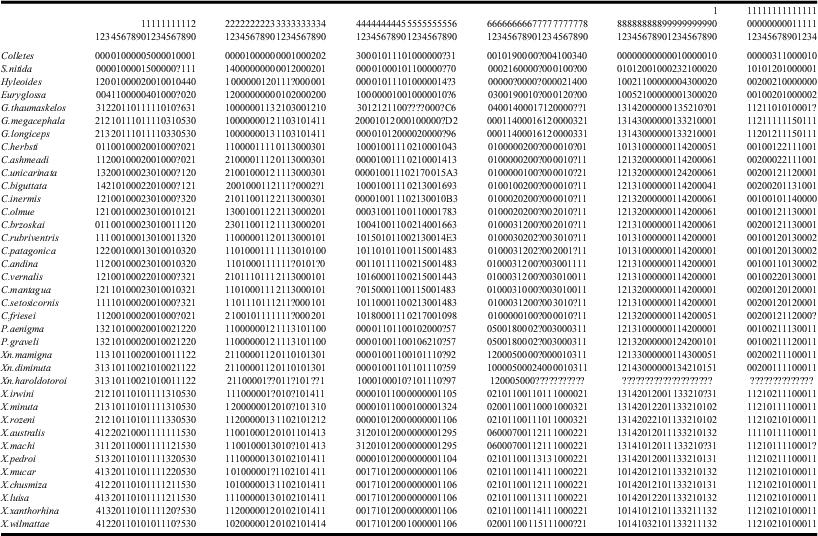
Characters, character states and references to images for them are given (Appendix 1) with further elaboration of the use of nonredundant linear coding for the two facial colouration characters shown in Appendix 2. The resultant data matrix is given in Appendix 3.
Three equally most parsimonious trees were obtained, with a length of 542 steps, a consistency index of 50 and retention index of 76. One of these trees (Fig. 45) is identical to the single tree found after two rounds of successive approximations character weighting and is considered to be the preferred tree. The strict consensus of the three trees is fully resolved other than for two polytomies deep within the genus Xeromelissa. All xeromelissine genera are monophyletic with Chilicola as sister genus to the remainder, which has the pattern (Xenochilicola (Patagonicola (Geodiscelis + Xeromelissa)).
Symmetric resampling showed strong support for the monophyly of both Patagonicola and Xenochilicola (GC = 99 and 95, respectively, bootstrap values 98 and 92), but not for the sister group relationship between Patagonicola and (Geodiscelis + Xeromelissa) (GC = 8, bootstrap value 10). This is not surprising as forcing Patagonicola to be the sister group to Xenochilicola (Geodiscelis + Xeromelissa) results in trees that are only four steps longer and forcing Xenochilicola and Patagonicola to be sister groups increases tree length by only two steps.
Monophyly of Patagonicola is indicated by the numerous synapomorphies (see Fig. 46), all of which arise as homoplasies elsewhere on the tree or could be considered part of transformation series in multi-state characters. The most convincing among them are as follows: (1) anterior tentorial pit apparently separated from the epistomal suture, at the end of a separate, short, dorsolaterally oriented suture (Fig. 1) (a unique character state); (2) male face below antennae entirely yellow except supraclypeal area black (Figs. 1, 8, 12) (this character has one parallelism in C. unicarinata); (3) metasternum between mesocoxae wide (Fig. 47) (with one parallelism within Chilicola); (4) apicodorsal lobes of male S7 short, blunt, dorsally oriented (Fig. 16) (a unique character state); (4) ventroapical rim of gonobase with widely separated lobes (Fig. 19, see arrow) (a unique character state); (5) female with three or more metasomal terga with lateral hair patches (Figs. 9, 13) (with one parallelism within Chilicola); (6) hypostomal profile convex (Fig. 47) (a highly homoplasious character state) and (7) malar space elongate (Figs. 8, 10, 12, 14) (also a highly homoplasious character state).
The following synapomorphies support the monophyly of (Xenochilicola + (Patagonicola (Geodiscelis + Xeromelissa))): Episternal groove clearly posteroventrally oriented (Fig. 3), metapleuron strongly posteromedially oriented (Fig. 38) and male S8 with apical lobe short and rounded (Fig. 17) (although this is reversed in (Geodiscelis + Xeromelissa)). Three additional character states support this grouping: male metafemur with yellow; loss of the ventral lobes on the male S7 and female S6 forming an obtuse angle in posterior view. The first of these exhibits parallelism in some species of Chilicola, the S7 character exhibits a reversal to lobe present in Xeromelissa and also exhibits homoplasy in some of the outgroup taxa and the last character state is also found in Colletes.
The monophyly of (Patagonicola (Geodiscelis +Xeromelissa)) is supported by four characters states: vertex curved onto occipital area (Fig. 47); male gonostylus clearly demarcated from gonocoxite (Fig. 19); female scopa on S2 not corbiculate (Fig. 49); and facial fovea absent (Figs. 10, 14). All characters show limited homoplasy within the Xeromelissinae, with one parallelism and one reversal in both the vertexal and gonostylar characters, and one parallelism in each of the other two.
Discussion
Almeida et al. (Reference Almeida, Packer and Danforth2008) noted the remarkably different phylogenetic positions occupied by the species herein referred to as P. aenigma (Chilicola aenigma in the original) in morphological in comparison to molecular and combined analyses. The morphological analysis suggested that this species belonged to Chilicola subgenus Chilioediscelis, one of the most derived subgenera within the genus. In contrast, the molecular and combined data suggested a closer relationship with the genus Xenochilicola. They further noted that a recently found undescribed species seemed to possess characteristics intermediate between those of P. aenigma and Xenochilicola; that “undescribed” species is P. graveli, described above. The morphological matrix analysed herein supports the sister group relationship between P. aenigma and P. graveli but does not support their forming a monophyletic group with Xenochilicola.
Xenochilicola was originally described by Toro and Moldenke (Reference Toro and Moldenke1979) who, in their diagnosis of the genus, noted the lack of a distinct concavity to the inner eye margins (Fig. 30), the sharp dorsal pronotal surface (Fig. 31), the mostly vertical metapostnotum with the horizontal portion being shorter than the metanotum (Fig. 6) and, in males, the deeply concave posterior margin of S5 (Fig. 18). All of these features except the metapostnotal character state are apomorphic, although the pronotal character is highly homoplasious. Additional synapomorphies uniting the three known species of Xenochilicola include mesophragma very short (fig. 4G in Packer Reference Packer2008), prosternal carinae not meeting (fig. 7F in Packer Reference Packer2008), S3–S5 with graduli absent medially and comma-shaped laterally (Fig. 18), S5 with antecosta missing medially (Fig. 18) (with a parallelism in P. graveli), anterior margin of gonobase deeply concave (Fig. 51), and galeal comb absent.
Patagonicola has none of the character states that define Xenochilicola. Although P. graveli has a bispinose S5, these processes seem very different to the lobes of S5 found in Xenochilicola, which are formed by the medial concavity to the apical margin of the sternum rather than as outgrowths from it (compare Figs. 15 and 18) and are thought not to be homologous. In addition, there are two morphological characters in which the two genera seemingly diverge in state from the condition found in related taxa. Both the metasternum and the apicoventral gonobasal lobes are wider in Patagonicola and narrower in Xenochilicola than in related taxa (the latter are sometimes absent in Xenochilicola as is the case in Fig. 51). Consequently, even if Patagonicola and Xenochilicola were to be considered sister taxa, they would both seem to be deserving of generic status.
The past taxonomic mistreatment of P. aenigma requires some explanation. Packer (Reference Packer2008) and Packer and Genaro (Reference Packer and Genaro2007) considered this species to be a member of the subgenus Chilioediscelis based upon phylogenetic analysis, a result later contradicted by molecular and combined morphological and molecular analyses (Almeida et al. Reference Almeida, Packer and Danforth2008). Its placement within Chilicola is now shown to be an error even when only morphological data are included. The error seemingly resulted from a mistake in data entry and four apparent synapomorphies that are now understood to be homoplasies: a broad metasternum, robust metatibial spurs, a noncorbiculate S2 and reduced inner tarsal-claw teeth. The metatibial spur character was considered to be a synapomorphy uniting the subgenera Chilicola and Chilioediscelis and the metasternal character was shared with the clade containing the same two subgenera plus Oediscelis Philippi, 1866 and Heteroediscelis. The other two character states were synapomorphies for the six known species of Chilioediscelis (Willis and Packer Reference Willis and Packer2008). Patagonicola aenigma lacks some of the other apomorphic characteristics expected if it were to belong to Chilioediscelis, such as episternal groove absent below scrobal groove, modified male hind legs and membranous lobes to the penis valves. The discovery of P. graveli results in the placement of P. aenigma in a phylogenetic position, based on morphology, which is more consistent with that suggested by molecular and combined evidence data (Almeida et al. Reference Almeida, Packer and Danforth2008).
Acknowledgements
The author is grateful to Sheila Dumesh for taking the images, amalgamating them, for commenting upon the manuscript and dealing with administrative issues; she is funded by the Dean of the Faculty of Science and Engineering and Vice-President for Research and Innovation of York University. The imaging system was purchased with assistance from the Canadian Foundation for Innovation and the Ontario Research Fund through Canadensys. Fieldwork that resulted in collection of specimens used in this paper was supported by the Natural Sciences and Engineering Research Council of Canada and National Geographic. The author is grateful to Alfredo Ugarte, Arturo Roig Alsina, and Miguel Archangelsky for facilitating fieldwork, to Anne-Isabelle Gravel and Michael Gravel for collecting most specimens of P. graveli and to Anne-Isabelle Gravel for translating the abstract. Comments of two anonymous reviewers resulted in an improved manuscript and I am most grateful for their diligence.
Appendix 1
Characters and character states used in the phylogenetic analysis. After the list of states for a character, the original character number in Packer (Reference Packer2008) is given unless the character herein is new. Differences in states used between the present study and the previous one, and errors detected in the earlier study are also given. References to images of the character states are updated from the earlier paper where necessary. Where no citation for a figure is given, the figure number refers to those herein.
Males
Colour
Note on characters 1 and 2. As outlined in the text, the two male facial colour characters were derived from five characters using nonredundant linear coding.
The original characters were: (A) Clypeus 0. Black; 1. With yellow. (B) Paraocular area 0. Black; 1. Partly pale; 2. Entirely pale. (C) Malar area 0. Dark; 1. With pale marking: (D) Genal area 0. Dark; 1. With pale: (E) Supraclypeal area 0. Dark; 1. Pale below; 2. Pale below summit.
How these five characters with a total of 12 states were combined into two characters with a total of nine states is shown in Appendix 2.
1. Face, first character, see Appendix 2.
2. Face, second character, see Appendix 2.
3. Protibia: 0. Entirely dark; 1. Anterior surface pale; 2. Mostly yellow; 3. Entirely yellow; 4. Entirely orange. = 14.
4. Metafemur: 0. Entirely dark; 1. At most apical one third pale; 2. Mostly pale. New.
Pubescence
5. Apical fringe of labrum: 0. Fine hairs; 1. Robust bristles.
6. Hypostomal area above hypostomal carina: 0. Hairs not forming a row; 1. Hairs forming a single row; 2. Glabrous. = 25.
7. Lower paraocular area: 0. Without dense appressed pubescence (Figs. 8, 12); 1. With dense appressed pubescence (Fig. 30, albeit hairs somewhat abraded). = 26.
8. Metasomal terga appressed basal hair bands: 0. Absent (Figs. 7, 11); 1. Present (Fig. 28). = 34.
Figs. 24–29Characters for couplet 2. 24. Xeromelissa wilmattae apex of head and mouthparts, oblique view, to show maxillary palpus with three robust palpomeres and one minute one, numbers and lines indicate the four palpomeres. 25. Xeromelissa rozeni (Toro and Moldenke, Reference Toro and Moldenke1979), mouthparts, dorsal view, showing two short (palpomeres 1–2), then two enormously elongate (palpomeres 3–4) and two very short palpomeres (palpomeres 5–6), blue lines and numbers indicate palpomeres one through six. 26. Geodiscelis thaumaskelos Packer, Reference Packer2008, maxillary palpomeres, dorsal view, showing six similar palpomeres, blue lines and numbers indicate palpomeres one through six. 27. Xeromelissa pedroi (Toro and Moldenke, Reference Toro and Moldenke1979) female, basal metasomal terga, dorsal view to show apicolateral hair patch on T1 indicated by red line. 28. Geodiscelis longiceps Packer, 2004, female, basal metasomal terga, dorsal view, to show basal bands of appressed hairs. 29. Geodiscelis thaumaskelos female, basal metasomal terga, dorsal view to show absence of hair patches or bands and presence of minute, silvery hairs. Scale lines = 0.5 mm.
 Figs. 30–33
Key characters for couplet 3. 30. Xenochilicola mamigna Toro and Moldenke, Reference Toro and Moldenke1979, female face, frontal view to show comparatively straight inner eye margins. 31. Xenochilicola mamigna female, head and thorax, dorsal view to show sharp dorsal margin of pronotum. 32. Patagonicola graveli female face, frontal view to show broadly concave inner eye margins. 33. Chilicola (Obesicola) Packer, Reference Packer2008 species female head and thorax, dorsal view to show long pronotal collar. Scale lines = 1.0 mm.
Figs. 34–41Characters for couplet 4. 34. Chilicola (Oroediscelis) species mesosoma side view to show vertical episternal groove, red line. 35. Chilicola (Oroediscelis) species mesosoma, ventral view to show comparatively longitudinal orientation of surface of metapleuron, parallel to red line. 36. Chilicola (Oroediscelis) species, male metasoma, side view showing processes on S4 and S5 and lack of pale markings. 37. Patagonicola graveli mesosoma, side view to show posteroventrally oriented episternal groove, red line. 38. Patagonicola graveli most of mesothoracic and metathoracic venter, ventral view, to show strongly posteromedial orientation of metapleuron, parallel to red line. 39. Patagonicola aenigma male, metasomal apex, apical view to show paired lobes of S6. 40. S5. Patagonicola graveli male S5, ventral view to show spinous processes. 41. Patagonicola graveli male, metasoma, side view to show yellow markings. Scale lines = 0.5 mm.
Figs. 42–44Characters for couplet 5. 42. Patagonicola aenigma female, apex of metatibia and base of metabasitarsus, anterior view to show robust, curved metatibial spurs (the anterior spur largely overlays the posterior one, but the curvature of both can be seen). 43. Metasoma of Patagonicola aenigma, male, metasoma, lateral view. 44. Patagonicola graveli female, apex of metatibia and base of metabasitarsus, anterior view to show fine, straight metatibial spurs (the anterior spur largely overlays the posterior one). Scale lines = 0.5 mm.
Fig. 45Phylogeny for all known species of Patagonicola, Xenochilicola, and Geodiscelis and selected members of Xeromelissa and Chilicola, with appropriate outgroup taxa (Colletes, Scrapter, Hyleoides, and Euryglossa). Genera are indicated as follows: S. Scrapter. G. Geodiscelis, X. Xeromelissa, Xn. Xenochilicola. Numbers above the internodes are GC support values (see Materials and methods).
Fig. 46Part of the phylogeny shown in Fig. 45 to show the character state changes relevant to the generic level classification of Xeromelissinae. Solid squares are unambiguous synapomorphies, open squares show homoplasious character state changes. The numbers refer to the characters (above the squares on the branch) and character states (below the squares on the branch) as enumerated in Appendix 1.
Figs. 47–52Phylogenetically important characters discussed in the text (see “Phylogenetic analysis”). 47. Patagonicola graveli mesosomal venter to show broad metasternum, length and breadth indicated by red and orange lines respectively. 48. Patagonicola aenigma female head, side view, to show curved hypostomal profile that parallels the red curve. 49. Patagonicola graveli female metasomal venter to show lack of corbicular structure to the scopa of S2, red line points to the area where a bald space would be if a corbiculum were to be present (as it is in Fig. 52). 50. Xenochilicola mamigna mesosomal venter to show narrow metasternum, length and breadth indicated by red and orange lines respectively. 51. Genital capsule of Xenochilicola diminuta male, ventral view to show angularly concave anterolateral margin of gonobase (red line) and absence of apicoventral median process (blue line) (compare to Fig. 19). Note that the orientation of the image underestimates the depth of the concavity. 52. Chilicola (Oroediscelis) species female metasomal venter to show corbicular structure to the scopa of S2 (bare medial area indicated by the red line). Scale lines = 0.5 mm.
9. Metasomal terga with subappressed silvery hairs: 0. Absent (Fig. 28); 1. Present (Figs. 27, 29). = 33.
Surface sculpture
10. Labral punctation: 0. Absent; 1. Sparse, mostly separated more than the puncture diameters; 2. Dense, mostly separated by a distance equal to, or less than, the puncture diameters. = 42.
Structure
Head
11. Apical margin of labrum: 0. Straight (Toro and Moldenke Reference Toro and Moldenke1979; fig. 283); 1. Strongly convex (Toro and Moldenke Reference Toro and Moldenke1979; fig. 293); 2. Weakly convex (Toro and Moldenke Reference Toro and Moldenke1979; fig. 66); 3. Biconcave (Toro and Moldenke Reference Toro and Moldenke1979; fig. 212); 4. Concave or straight medially (Toro and Moldenke Reference Toro and Moldenke1979; fig. 196); 5. Triangular (Davies and Brothers Reference Davies and Brothers2006; fig. 9). = 60, old state 4 not needed, old state 6 renumbered as state 4.
12. Shape of labrum: 0. Transverse (Toro and Moldenke Reference Toro and Moldenke1979, fig. 7); 1. Elongate (Toro and Moldenke Reference Toro and Moldenke1979; fig. 293). = 59.
13. Mandible: 0. Widest distal to base of subapical tooth; 1. Widest at base of subapical tooth. = 63.
14. Mandible strong acetabular carina: 0. Absent; 1. Present. = 64.
15. Lateral flange of clypeus: 0. Not distinctly separated by recurved epistomal suture (Michener Reference Michener2007; fig. 46-3e). 1. Well defined and triangular (Michener Reference Michener2007; fig. 46-5d); 2. Well defined and U-shaped (Michener Reference Michener2007; fig. 46-5b); 3. Well defined and elongate (Toro and Moldenke Reference Toro and Moldenke1979; fig. 315). Similar to 68 but with finer state discrimination resulting from more detailed study of Xeromelissa.
16. Malar space: 0. Absent (Michener Reference Michener2007; fig. 46-5d); 1. Short, at most subequal to basal depth of mandible (Genaro and Packer Reference Genaro and Packer2005; fig., 1); 2. Longer than basal depth of mandible (Figs. 8, 10, 12, 14); 3. Enormous, approaching length of compound eye (Packer Reference Packer2005; Fig. 1). = 66 but more finely divided.
17. Malar line: 0. Absent (Michener Reference Michener2007, fig. 46-5b); 1. Present (Michener Reference Michener2007; fig. 46-3g). = 67.
18. Anterior tentorial pit: 0. Punctiform (Michener Reference Michener2007; fig. 46-2a); 1. Comma-shaped (Packer and Genaro 1979; fig. 5A); 2. Separated from epistomal suture (Fig. 23). 3. Triangular (Gibbs and Packer Reference Gibbs and Packer2006; fig. 3C); 4. Elongate oval (Michener Reference Michener2007; fig. 47-4g); 5. Extremely elongate (Fig. 22); 6. Long and deep (Fig. 21). = 69. The old state 2 is no longer needed, new state 2 is a synapomorphy for Patagonicola species.
19. Epistomal sulcus, lateral portion: 0. Evenly convex (Proshchalykin and Kuhlmann Reference Proshchalykin and Kuhlmann2012; fig. 19a); 1. Angularly bent laterad below (Eardley Reference Eardley1996; fig. 3); 2. Divergent and straight to weakly sinuate (Fig. 23); 3. Strongly recurved ventrally (Figs. 21, 22); 4. Concave at mid-length (Michener Reference Michener2007; fig. 47-4g). = 70, old state 4 not needed, old state 5 now state 4.
20. Inner margin of eye: 0. Broadly and shallowly concave (Fig. 32); 1. Emargination short (Michener Reference Michener2007; fig. 46-3a) ; 2. Not, or weakly emarginate (Genaro and Packer Reference Genaro and Packer2005, figs. 1–3). = 75.
21. Inner eye margins: 0. Subparallel; 1. Slightly convergent below (Fig. 12); 2. Strongly convergent below (Genaro and Packer Reference Genaro and Packer2005; fig. 1). = 76.
22. Flagellomere 1: 0. Evenly divergent ventrally; 1. Abruptly divergent ventrally at base; 2. Divergent dorsally and ventrally; 3. Swollen ventrobasally; 4. Concave ventrally. = 85.
23. Number of flagellomeres beyond the first that are extremely short (>3× as wide as long): 0. 0; 1. 1; 2. 2. = 86.
24. Flagellomeres, other than the first few and apical one: 0. Not dorsoventrally swollen towards apex (Figs. 8, 12); 1. Dorsoventrally swollen apically (these swellings house membranous structures that are sometimes visible in dried specimens) (Packer Reference Packer2008; fig. 6F). = 87.
25. Flagellomeres: 0. Not unusually elongate, clearly much less than 1.3 × as long as wide (Figs. 8, 12); 1. At least 1.3× as long as wide (Packer Reference Packer2008; fig. 6F). New.
26. Flagellomere 11: 0. At least as long as wide (Fig. 12); 1. Clearly shorter than wide (Packer Reference Packer2008; fig. 6F). = 88.
27. Vertex: 0. Flat or weakly rounded behind ocellar triangle (Fig. 33); 1. Transversely depressed behind ocellar triangle (Fig. 31). = 77.
28. Margin between vertex and occiput: 0. Rounded (Fig. 33); 1. Sharp (Fig. 31). = 78. Old state 2 not needed.
29. Occipital sulcus: 0. Strongest dorsally (Packer Reference Packer2008; fig. 8F); 1. Strongest dorsolaterally (Packer Reference Packer2008; fig. 8G); 2. Undetectable. = 83. Old state 2 not needed.
30. Postoccipital sutures: 0. Fused medially (Packer Reference Packer2008; fig. 8F); 1. Not quite meeting (Packer Reference Packer2008; fig. 8D); 2. Clearly, but not widely, separated (Packer Reference Packer2008; fig. 8H); 3 Very widely separated (Packer Reference Packer2008; fig. 8G). = 84.
Mesosoma
31. Pronotal collar length: 0. Short, forming a sharp transverse edge (Fig. 31); 1. Less than 1 MOD (Fig. 13); 2. Subequal to or longer than 1 MOD (Fig. 33). = 91, old state 3 not needed.
32. Vertical pronotal carina: 0. Present; 1. Absent. = 90.
33. Propleuron, dorsolaterally: 0. Flat; 1. Concave (concavity receives anterior margin of side of pronotum) (Packer Reference Packer2008; fig. 7F).
34. Mesophragma: 0. Very short (Packer Reference Packer2008; fig. 4G); 1. Short (Packer Reference Packer2008; fig. 4(H); Moderately long, broad (Packer Reference Packer2008; fig. 4I); 3. Elongate, narrow (Packer Reference Packer2008; fig. 4J). = 107.
35. Episternal groove: 0. Vertically oriented (Fig. 4); 1. Posteroventrally oriented (Fig. 3). = 110.
36. Episternal groove below scrobal groove: 0. Present (Figs. 3, 4); 1. Absent (Gibbs and Packer Reference Gibbs and Packer2006; fig. 13G). = 111.
37. Metapleuron: 0. More longitudinally oriented (Fig. 35); 1. Strongly posteromedially oriented especially below (Fig. 38). = 113.
38. Metasternum between mesocoxae: 0. Very wide (as in Packer Reference Packer2008; fig. 7J); 1. Wide (Fig. 47); 2. Moderately narrow (Packer Reference Packer2008; fig. 7L); 3. Narrow (Fig. 50); 4. Very narrow (Packer Reference Packer2008, fig. 7N – note that this figure is of X. xanthorhina (Toro and Moldenke Reference Toro and Moldenke1979) and not of X. rozeni as stated in the figure legend). = 116.
39. Basal articular lobe of procoxa: 0. Long and narrow (Packer Reference Packer2008; fig. 4E); 1. Short and broad (Packer Reference Packer2008; fig. 4D). = 97.
40. Protibia: 0. Deepest basal to malus (Packer Reference Packer2008; fig. 4K); 1. Deepest at malus (Packer Reference Packer2008; fig. 4L); 2. Parallel-sided (Packer Reference Packer2008; fig. 4M); 3. Expanding gradually to apex (Packer Reference Packer2008; fig. 4N); 4. More basally broadened than in states 0–3. = 102 but state 4 added.
41. Protibia, glabrous patch on inner surface: 0. Absent (Packer Reference Packer2008; fig. 4K) ; 1. Present, undivided, not ventrally positioned (Packer Reference Packer2008; fig. 4M); 2. Present, divided by longitudinal row of hairs; 3. Present, undivided, large, more ventrally positioned (Packer Reference Packer2008; fig. 4N). = 103 with states reorganised.
42. Apex of malus: 0. Not bent ventrad; 1. Bent ventrad. = 104.
43. Metafemur: 0. Unmodified (Figs. 7, 11); 1. Swollen (Packer and Genaro Reference Packer and Genaro2007; fig. 9F); 2. Not swollen but flattened ventrally (Toro and Moldenke Reference Toro and Moldenke1979; fig. 356). Simplified from 122.
44. Metatibia: 0. Unmodified (Figs. 7, 11); 1. Gradually expanded to apex (Packer and Genaro Reference Packer and Genaro2007; fig. 16D); 2. Triangular in lateral view (Packer Reference Packer2009; fig. 1); 3. Slightly expanded at apex (Toro and Moldenke Reference Toro and Moldenke1979; fig. 178); 4. Swollen with pronounced crests (Michener Reference Michener2002; fig. 31C); 5. Swollen with incision near apex (Gibbs and Packer Reference Gibbs and Packer2006; fig. 1E); 6. Considerably expanded apically (Toro and Moldenke Reference Toro and Moldenke1979; fig. 228); 7. Expanded with inner apical surface flat and surrounded by a carina; 8. With a flattened blade extending beyond apex (Packer Reference Packer2008; fig. 7O) = 123, state 2 is new, old state 2 is subsumed as a minor modification from 0; note that Scrapter heterodoxus (Cockerell, 1921) although not treated herein, was erroneously given state 0 instead of an autapomorphic modification previously (Packer Reference Packer2008).
45. Metatibia: 0. Shorter than metafemur. 1. Longer than metafemur. = 124.
46. Outer metatibial spur: 0. Normal (Fig. 44); 1. Strongly sclerotised and curved (Fig. 42). 2. Absent (Packer Reference Packer2009; figs. 3–5). = 125, state 2 is new.
47. Pterostigma, margins basal to vein Rs: 0. Apically divergent (Fig. 13); 1. Parallel-sided (Packer Reference Packer2008; fig. 7B). = 118.
48. Hindwing M + Cu: 0. Second abscissa much shorter than first (Michener Reference Michener2007, fig. 41-1a); 1. First and second abscissae subequal (Michener Reference Michener2007; fig. 46-1a); 2. Second abscissa longer than first. = 120.
49. Propodeum in profile: 0. Gradually curved; 1. Junction between dorsal and posterior declivitous surfaces at least somewhat angulate (Fig. 7). = 128.
Metasoma
50. Metasoma: 0. Unmodified (Figs. 41, 43). 1. Subpetiolate; T1 longer than apical breadth. = 129.
51. T2 gradulus: 0. Posteriorly bent at lateral extremity (Packer Reference Packer2008; fig. 4O); 1. Not posteriorly bent at lateral extremity, straight (Packer Reference Packer2008; fig. 4P). = 130, old state 2 not needed.
52. S2 gradulus laterally: 0. Not extended posteriorly; 1. Extended posteriorly for a distance clearly less than half the postgradular length of the sternum; 2. Extended posteriorly for a distance approximately half as long as the postgradular length of the sternum or more = 131.
53. S2 gradulus medially: 0. Straight; 1. Bowed posteriorly. = 133.
54. Sternal graduli on S3–S5: 0. Absent; 1. Elongate comma-shaped on S3 and S4 (Packer Reference Packer2008; fig. 4V); 2. Central portion only present. 3. Very small, circular (Packer Reference Packer2008; fig. 4X); 4. Entire on S3 and S4 (Packer Reference Packer2008, fig. 4Y); 5. Divided into three separate portions (Packer Reference Packer2008; fig. 4Z); 6. On S5 only; 7. L-shaped on S2, small on S3 and S4 (Packer Reference Packer2008; fig. 4AA); = 134, states 2 and 6 are new, old states 2, 6, and 8 not required.
55. Posterior margin of S5: 0. Neither deeply concave nor bearing long processes; 1. Deeply concave (Fig. 18); 2. With two spinous processes (Fig. 15). = 135 with state 2 added for P. graveli.
56. Antecosta of S6: 0. Entire; 1. Absent medially. New.
Terminalia
57. S7 ventral lobes: 0. Absent (Fig. 16). 1. Present. = 137.
58. S7 ventral lobes, form: 0. Triangular (Toro and Moldenke Reference Toro and Moldenke1979; fig. 188); 1. Membranous, laterally oriented; (Toro and Moldenke Reference Toro and Moldenke1979; fig. 299); 2. A small protuberance (Toro and Moldenke Reference Toro and Moldenke1979; fig. 360); 3. Flag-like (Toro and Moldenke Reference Toro and Moldenke1979; fig. 345); 4. Laterally oriented strap (Toro and Moldenke Reference Toro and Moldenke1979; fig. 2); 5. A very short sharp edge (Packer and Genaro Reference Packer and Genaro2007; fig. 5G); 6. Retort-shaped (Packer and Genaro Reference Packer and Genaro2007, fig. 9H); 7. Shaped somewhat like a bird wing with row of long hairs (Toro and Moldenke Reference Toro and Moldenke1979; fig. 177) = 139 with substantial changes necessitated by different combination of taxa and reassessment of states.
59. S7 apicodorsal lobes, form: 0. Digitiform (Toro and Moldenke Reference Toro and Moldenke1979; fig. 299); 1. Laterally oriented, strap-like (Michener Reference Michener2002; fig. 5c); 2. Conical (Toro and Moldenke Reference Toro and Moldenke1979; fig. 345); 3. Expanded, posteriorly concave with digitiform medial process (Proshchalykin and Kuhlmann Reference Proshchalykin and Kuhlmann2012; fig. 11a); 4. A short rounded lobe (Toro and Moldenke Reference Toro and Moldenke1979; fig. 188); 5. Short, blunt, somewhat dorsally oriented (Fig. 16); 6. Broad with narrow apicolateral filament (Michener Reference Michener2002; fig. 34d); 7. Small, anterolaterally directed (Eardley Reference Eardley1996; fig. 4); 8. Triangular, posteriorly oriented (Packer and Genaro Reference Packer and Genaro2007; fig. 16G); 9. Broad, membranous, somewhat ear-shaped (Packer and Genaro Reference Packer and Genaro2007; fig. 9H); A. Broadly based, short strap with lateral row of bristles (Packer and Genaro Reference Packer and Genaro2007; fig. 5G); B. Elongate, almost lunate (Packer and Genaro 1979; fig. 13F); C. Narrowly pointed, setose apically and basally (Packer Reference Packer2009; fig. 6); D. Short, simple, flat lobe (Michener and Rozen Reference Michener and Rozen1999; fig. 7); E. Lateral strap with concave apex and posterolateral narrow filament (Gibbs and Packer Reference Gibbs and Packer2006; fig. 1G). Similar to 142 but with somewhat different states due to different included taxa and reassessment of states.
60. S8 apical process: 0. Elongate, sclerotised, broad near apex (Eardley Reference Eardley1996; fig. 49); 1. Narrow, setose (Michener Reference Michener2007; fig. 40-2c); 2. Narrow, narrowly oval towards apex (Genaro and Packer Reference Genaro and Packer2005; fig. 16); 3. Expanding towards apex, which is broadly and shallowly concave (Michener Reference Michener2002; fig. 5c); 4. Triangular with apex blunt (Toro and Moldenke Reference Toro and Moldenke1979; fig. 342); 5. Gradually narrowing towards apex, elongate and triangular (Toro and Moldenke Reference Toro and Moldenke1979; fig. 357); 6. Rounded basally, ending in a narrow rod (Toro and Moldenke Reference Toro and Moldenke1979; fig. 332); 7. Rounded, shorter than lateral lobe (Fig. 17); 8. Sides sinuate, broadest subapically, apex angularly incised, whole lobe somewhat membranous (Packer and Genaro Reference Packer and Genaro2007; fig. 10H); 9. Rounded, longer than lateral lobe (Genaro and Packer Reference Genaro and Packer2005; fig. 16). reorganised from 144.
61. Gonobase, anterior margin dorsally: 0. Weakly concave to transverse, if weakly concave then anterolateral margins of concavity rounded (Fig. 19); 1. Deeply concave, angulate anterolaterally (Fig. 51). = 147.
62. Gonobase, posteroventral margin: 0. Lacking a process (Fig. 51); 1. With a short, bilobed process (Packer and Genaro Reference Packer and Genaro2007; fig. 13H); 2. With a narrow process (Toro and Moldenke Reference Toro and Moldenke1979; fig. 291); 3. With a broadly triangular process; 4. With a trapezoidal process (Packer Reference Packer2009; fig. 9); 5. With widely separated short lobes (Fig. 19): 6. With a minute process. = 146, with states 4 and 5 new, P. aenigma changed from 1–5.
63. Gonoforceps, internal longitudinal basal ridge: 0. Absent. 1. Present. = 149.
64. Inner margin of gonoforceps, posteriorly: 0. Convex but not angulate or produced into a triangular process (Figs. 19, 51); 1. Angulate (Packer Reference Packer2005; fig. 5); 2. Produced to triangular process (Eardley Reference Eardley1996, fig. 50). = 150.
65. Gonostylus: 0. Indistinct, forming continuous curve from posterolateral margin of gonocoxite (Fig. 51); 1. More clearly demarcated from gonocoxite, not continuing curved outer margin of gonocoxite (Fig. 19). = 154.
66. Gonostylus: 0. Short, generally continuing outline of gonocoxite, apex narrowly rounded, posteromedially oriented (Packer and Genaro Reference Packer and Genaro2007; fig. 5I); 1. Short, generally continuing outline of gonocoxite, parallel-sided, narrow, apicomedially oriented (Toro and Moldenke Reference Toro and Moldenke1979; fig. 291); 2. Elongate, generally continuing outline of gonocoxite, apex narrowly rounded, posteriorly oriented (Packer and Genaro Reference Packer and Genaro2007; fig. 13H); 3. Moderately long, generally continuing outline of gonocoxite, apicomedially curved to rounded apex (Gibbs and Packer Reference Gibbs and Packer2006; fig. 1I); 4. Moderately long, deflected medially from apex of gonocoxite (Packer Reference Packer2009; fig. 8); 5. Short, generally continuing outline of gonocoxite, broadly rounded (Fig. 51); 6. Moderately long, generally continuing outline of gonocoxite, unevenly narrowed to apex from broad base (Eardley Reference Eardley1996; fig. 49); 7. Elongate, generally continuing outline of gonocoxite, narrowing to somewhat acutely angulate apex (Toro and Moldenke Reference Toro and Moldenke1979; fig. 318); 8. Very short, generally continuing outline of gonocoxite, apex broadly rounded (Fig. 19); 9. Oval (similar to Stephen Reference Stephen1954; fig. 5). = 155 but with states 7 and 8 new, and old state A now 4, old states 4, 7, and 8 not required.
67. Penis valve, lateral shelf: 0. Absent (Packer and Genaro Reference Packer and Genaro2007; fig. 10I); 1. Present (Michener Reference Michener2002; fig. 24a). = 157 with state 2 subsumed under state 1.
68. Penis valve, membranous lobes: 0. Absent (Fig. 19); 1. One (Packer and Genaro Reference Packer and Genaro2007; fig. 5I); 2. Two (Gibbs and Packer Reference Gibbs and Packer2006; fig. 1I). = 158, P. aenigma (incorrectly given as C. anomalipes in table), erroneously given state 2 instead of 0.
69. Cuspis of volsella: 0. Not covered by ventral surface of gonoforceps (Gibbs and Packer Reference Gibbs and Packer2006; fig. 1I); 1. Covered by ventral surface of gonoforceps (Fig. 19). = 153.
Female
Colour
70. T2 colour: 0. Dark; 1. With yellow subapical band; 2. Largely or entirely red (Figs. 9, 13). New, somewhat similar to character 24 for males in Packer (Reference Packer2008).
71. T2: 0. Yellow, narrow, unmargined with orange; 1. Yellow, narrow and narrowly margined with orange; 2. Yellow, narrow, more broadly margined with orange; 3. Yellow band extensive, narrowly margined with orange (Fig. 27); 4. Orange covering most of tergum; 5. White; 6. Pale fawn or cream band (Fig. 28). 7. Broadly dark yellow on a maroon background (Fig. 29). New, somewhat similar to character 24 for males in earlier paper. Taxa without yellow bands are scored as not applicable for this character.
Pubescence
72. Protarsal rake: 0. Absent; 1. Present. = 167.
73. Mesotarsal rake: 0. Absent; 1. Weak; 2. Strong, multiple hairs on a tarsomere in a single series (Packer Reference Packer2005, fig. 2); 3. Strong, multiple hairs on a tarsomere in parallel series. = 170 with state 3 added.
74. Metasomal terga: 0. Patches of hairs absent, hairs sparse (Fig. 29); 1. T1 with distinct apicolateral patch, elsewhere hairs short and sparse (Fig. 27); 2. T1 and sometimes T2 with apicolateral hairs bands, elsewhere hairs mostly short and sparse; 3. At least T1–T3 with apicolateral bands, elsewhere hairs mostly short and sparse (Figs. 9, 13); 4. All terga covered in long hairs, lacking distinct patches (Proshchalykin and Kuhlmann Reference Proshchalykin and Kuhlmann2012; fig. 11b). = 173.
75. Prepygidial fimbria: 0. Absent; 1. Present.= 174.
76. Scopa on S2: 0. Complete (Fig. 49); 1. Corbiculate (Fig. 52); 2. absent. = 175.
Surface sculpture
77. Lower face, striation: 0. Absent (other surface sculpture may be present) (Gibbs and Packer Reference Gibbs and Packer2006; fig. 12L); 1. Present (though sometimes mixed with other sculpture) (Gibbs and Packer Reference Gibbs and Packer2006; fig. 12K). = 177.
78. Malar space, punctures: 0. Basal only, distinct; 1. Throughout, minute and difficult to detect; 2. On anterodorsal portion only, distinct; 3. Throughout, distinct (Fig. 23); 4. Absent. This character cannot be scored for species with the malar space absent, where it is scored as not applicable. New.
Structure
Mouthparts
79. Pharyngeal rods: 0. Blunt (Packer Reference Packer2008; fig. 5P); 1. Recurved (Packer Reference Packer2008; fig. 5Q); 2. Doubly angulate (Packer Reference Packer2008; fig. 5R); 3. Tapered (Packer Reference Packer2008; fig. 5T); 4. Expanded subapically, narrowing to apex (Packer Reference Packer2008; fig. 5U). = 183.
80. Loral apron: 0. Heavily sclerotised (Michener Reference Michener2007; fig. 33-4c); 1. Weakly sclerotised (Michener Reference Michener2007; fig. 33-4g). = 193.
81. Lorum, shape. 0. Shorter than broad (Michener Reference Michener2007; fig. 33-4c); 1. Longer than broad. = 194.
82. Cardo, basal articulation: 0. Cardinal lever more strongly developed than cardinal condyle (Packer Reference Packer2008; fig. 5AB); 1. Lever and condyle equally developed approximately forming an L-shape (Packer Reference Packer2008; fig. 5AD); 2. Lever and condyle equally developed, forming a V-shape (Packer Reference Packer2008; fig. 5AC); 3. Lever and condyle not developed, articulation blunt (Packer Reference Packer2008; fig. 5AE) = 190.
83. Stipes, position of greatest width: 0. At, or beyond, midlength 1. At basal third or less. = 196.
84. Lacinia: 0. A small, membranous, densely setose lobe; 1. Triangular, unevenly narrowing to pointed apex, sparsely setose; 2. A narrow, sclerotised, sparsely setose strap; 3. An elongate triangle, shorter than galeal blade, sparsely setose; 4. Narrow and elongate, much longer than galeal blade, sparsely setose; 5. A broad lobe with dense robust hairs. = 204.
85. Galeal comb teeth: 0. ≈30; 1. 10–25 (Michener Reference Michener2007; fig. 41-2a); 2. 1–9 (Michener Reference Michener2007; fig. 41-2b); 3. None. = 198.
86. Galeal comb: 0. Appressed to galea (Michener Reference Michener2007; fig. 41-2); 1. Arising from a lobe extending from the surface of the galea (Michener Reference Michener2007; fig. 48-1). = 197.
87. Maxillary palpus: 0. With 6 similar palpomeres (Fig. 26); 1. With apical three palpomeres differentiated from basal three (Fig. 22); 2. Palpomeres 1 and 2 short, palpomeres 3 and 4 enormously elongate, palpomeres 5 and 6 small (Fig. 25); 3. Palpomeres 1–3 robust, remaining palpomeres vary in number from 0 to 5 and deciduous (Fig. 24 shows one small 4th palpomere on one maxillary palpus and three on the other).
88. Maxillary palpomere 1: 0. Cylindrical, ecarinate; 1. Concave ventrally, ecarinate; 2. Laterally compressed, longitudinally carinate. = 200.
89. Maxillary palpomere 2: 0. Glabrous; 1. With many hairs not arranged in a row; 2. With a single row of hairs. = 201.
90. Maxillary palpomere 3: 0. Glabrous 1. With a row of hairs. Character 202 in the earlier study is divided into two characters (90 and 91) herein.
91. Maxillary palpomere 3, mesal surface: 0. Smooth; 1. Denticulate (Packer Reference Packer2008; fig. 6A).
92. Insertion of suspensorium on prementum: 0. Laterad (Packer Reference Packer2008; fig. 8A); 1. Interstitial but not in a deep pocket (Packer Reference Packer2008; fig. 8E); 2. Interstitial in a deep pocket that is visible in ventral view of a cleared prementum (Packer Reference Packer2008; fig. 8B). = 205.
93. Insertion of suspensorium along prementum: 0. Beyond midlength; 1. At middle (Packer Reference Packer2008; fig. 8C); 2. Near basal third; 3. Near basal quarter. = 206.
94. Premental fovea: 0. Absent (Packer Reference Packer2008; fig. 8A); 1. Present only apically, not carinate (Davis and Brothers 2006; fig. 25); 2. With carinate margin converging apically (Packer Reference Packer2008; fig. 8B); 3. With subparallel, weak carinae (Packer Reference Packer2008; fig. 6A); 4. With subparallel, strong carinae (Packer Reference Packer2008; fig. 8C); 5. Present only apically, weakly carinate. = 208, old 5 not needed, new 5 was previously subsumed under 3.
95. Premental median thickening: 0. Extending for almost entire length of prementum (Packer Reference Packer2008; fig. 8A); 1. Basal only (Packer Reference Packer2008; fig. 8B); 2. Apical only (Packer Reference Packer2008; fig. 8C); 3. Absent. = 210.
96. Prementum: 0. Wider than deep; 1. Width and depth subequal. = 212.
97. Labial palpus: 0. 4 palpomeres; 1. 3 palpomeres. = 215.
98. Oral surface of labrum: 0. Mostly sclerotised; 1. Approximately apical half sclerotised. = 182, state 2 not needed.
Head
99. Facial fovea: 0. Absent (Figs. 10, 14); 1. Very deep, broad and distinct (Proshchalykin and Kuhlmann Reference Proshchalykin and Kuhlmann2012; fig. 5C); 2. Deep, linear (Michener Reference Michener2007; fig. 47-4h); 3. A broad, elongate, shallow groove. 4. Broad, short, weak but distinctly differently sculptured; 5. Very weakly depressed, visible only from certain angles, short, not markedly differently sculptured. 6. Not depressed, short and broad, detectable as distinctly shiny area. = 180, new 4 is old 9, new 5 is old 8, old 8 and 9 no longer required.
100. Clypeus in apical view: 0. Evenly curved (Packer Reference Packer2008; fig. 5X); 1. Abruptly curved laterally (Packer Reference Packer2008; figs. 5Y, Z); 2. Curved around labrum laterally (Packer Reference Packer2008; fig. 5AA). = 216, previous states 1 + 2 combined as new 1, old 3 now state 2.
101. Compound eye: 0. Elongate (Michener Reference Michener2007; fig. 47-1a); 1. More rounded (Michener Reference Michener2007; fig. 46-5b). = 218.
102. Lower face: 0. From weakly concave to weakly convex (Michener Reference Michener2007, fig. 46-3b); 1. Strongly convex, protuberant (Michener Reference Michener2007, fig. 46-5b). New.
103. Hypostomal carina in profile: 0. Sinuate. 1. Convex (Fig. 48); 2. Straight. = 223.
104. Supraclypeal area: 0. Weakly convex (Fig. 48); 1. Strongly convex (Michener Reference Michener2007; fig. 46-5b). New.
Mesosoma
105. Metatibial spurs: 0. Less than half as long as metabasitarsus (Fig. 42); 1. More than half as long as metabasitarsus (Packer Reference Packer2009; Fig. 11). = 228.
106. Recurrent veins, intersection with Rs + M: 0. Both basal to respective submarginal cross-veins (Michener Reference Michener2007; fig. 46-2a); 1. First recurrent vein interstitial with first submarginal cross-vein, second in second submarginal cell (Packer Reference Packer2008; fig. 7A); 2. Both in second submarginal cell (Fig. 7); 3. First recurrent vein in second submarginal cell, second recurrent vein in third submarginal cell (Michener Reference Michener2007; fig. 40-3). = 233.
107. Stigmal margin in marginal cell: 0. Angularly convex (Packer Reference Packer2008; fig. 7C); 1. Straight to concave (Fig. 7); 2. Convex but not angulate (Packer Reference Packer2008; fig. 7A). = 231.
108. Stigmal perpendicular: 0. Basal to, or level with anterior margin of, first submarginal cross-vein (Packer Reference Packer2009; fig. 1); 1. In basal half of second submarginal cell (Fig. 7); 2. In apical half of second submarginal cell (Packer Reference Packer2008; fig. 7A). = 232, state 3 not needed.
109. Hindwing Cu: 0. Tubular and distinct even if short (Michener Reference Michener2007; figs. 41-1a, 47-5a); 1. Reduced to, at most, an angulation (Michener Reference Michener2007; fig. 46-2). = 234. Previous state 1 subsumed under 0, previous state 2 now state 1.
110. Metapostnotum, dorsal portion: 0. Short and broad, at least half of metapostnotum declivitous, not triangular (Fig. 6); 1. Long and narrowly U-shaped, mostly not declivitous, depressed with a raised posterior margin; 2. Long and broad, posterior margin somewhat rounded, mostly not declivitous, flat (Fig. 5); 3. Moderately long, apex truncate, mostly not declivitous, flat; 4. Moderately long, semicircular, mostly not declivitous, depressed because surrounding surface of propodeum swollen (Packer Reference Packer2008; fig. 6I); 5. Long, V-shaped, mostly not declivitous. = 236, 5 is a new state for two Geodiscelis species Previously coded as 0.
111. Dorsal surface of metapostnotum, longitudinal median carina: 0. Absent (Fig. 5); 1. Present. = 235.
Metasoma
112. Metasoma distinctly flattened: 0. No. 1. Yes. New.
113. Curvature of entire S6 in apical view: 0. Acute or almost right-angular; 1. Obtuse. = 242.
114. Sting shaft curvature: 0. Ventrally (Packer Reference Packer2003; fig. 11B). 1. None, straight (Packer Reference Packer2003; fig. 11C). 2. Dorsally.
Appendix 2
Character state tree for non-redundant linear coding (O'Grady and Deets Reference O'Grady and Deets1987), of potentially confounded male facial colour characters. The numbers in a row refer to the colour of, in sequence, the clypeus, malar area, paraocular area, genal area, and supraclypeal area. Nine different character state combinations are shown as linked by single evolutionary changes (the absence of some combinations suggests that two structures change in colour in synchrony – thus the change from 10 000 to 10 110 is one step as there are no included taxa with only one of the malar and genal areas yellow. The associated bolded pairs of numbers give the character states derived from the five characters and included as the first two characters in the data matrix.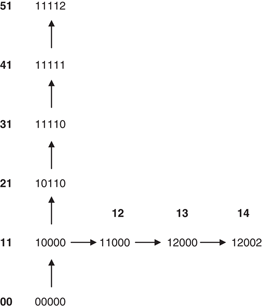
Data matrix used in phylogenetic analysis.