INTRODUCTION
Life-cycles of parasites may provide important information on the pathogenic importance of each particular parasite, its epidemiological significance in relation to the development of effective control programmes, and the evolutionary potential of parasites. An important determinant of the cycle of parasites and insect herbivores is resource location. For these organisms, resource detection has a double dimension: they must find an appropriate host but also ensure that their host-feeding stages are synchronized with the times when those hosts provide the appropriate food resource. Therefore, these animals have evolved dispersal and developmental mechanisms (especially diapause) to safeguard their success in finding an appropriate host at the right moment (Enright, 1970; Tauber, Tauber and Masaki, 1986; Danks, 1987; Jones, 2001). Diapause is a form of dormancy determined both by genetic and environmental factors that allows individuals to survive when conditions are unfavourable for development and reproduction, and ensures synchronization of active stages with favourable conditions (Tauber et al. 1986; Danks, 1987, 1992; Soula and Menu, 2003). Diapause and dispersal have been considered as two alternative responses to unfavourable environmental conditions (Southwood, 1977; Hanski, 1988; Bohonak and Jenkins, 2003), so that temporal dispersal via developmental mechanisms (especially diapause) is considered to be functionally equivalent to spatial dispersal (Hairston, 2000; Hairston and Kearns, 2002; Bohonak and Jenkins, 2003).
In many insect (Tauber and Tauber, 1981; Danks, 1987, 1992; Hanski, 1988; Menu, Roebuck and Viala, 2000) and plant species (Philippi, 1993a,b; Clauss and Venable, 2000) life-cycle duration varies within the population. Some individuals of the same generation may miss one or more breeding opportunities by remaining longer in diapause than others, a phenomenon called prolonged diapause (Hanski, 1988). Prolonged diapause is usually interpreted as an adaptation to unpredictable environments (Hopper, 1999) and has been investigated primarily in plant-feeding insects and their parasitoids (Danks, 1987, 1992; Hanski, 1988; Soula and Menu, 2005). Parasites, probably more than any other group of organisms, face a high degree of variability and unpredictability in their environment. Since unpredictability in the temporal availability of susceptible hosts is a likely selective pressure affecting the life-history strategies of parasites (Hakalahti, Hakkinen and Valtonen, 2004), life-cycle adaptations to such unpredictability, like prolonged diapause, would be expected. Long life-cycles that include prolonged diapauses are especially common in plant-feeding insects dependent on potentially unreliable food supplies (Danks, 1987, 1992; Soula and Menu, 2005), but few studies report on prolonged diapause in ‘true’ parasites (i.e. parasites that usually do not kill their hosts) of animals (but see Baird, 1975).
Here we report on intrapopulation variation in the diapause pattern and prolonged diapause of a widespread ectoparasite of a large number of bird species, Carnus hemapterus (Diptera: Cyclorrhapha, Acalyptratae) (Capelle and Whitworth, 1973; Kirkpatrick and Colvin, 1989; Dawson and Bortolotti, 1997; Grimaldi, 1997). We aim to contribute to the knowledge of life-cycles of parasites by providing evidence of prolonged diapause in a parasite species and by addressing the question of how frequent is prolonged diapause in true parasites of animals and the reasons for its apparent low frequency in this group.
MATERIALS AND METHODS
Study species
Carnus hemapterus is a 2 mm long blood-sucking fly that parasitizes nestlings of a variety of bird species (Grimaldi, 1997). Neither adult carnid flies nor larvae have been found on adult birds. The term host therefore refers in this system exclusively to the nestlings of the attacked species. Carnus hemapterus is distributed throughout the Palearctic region and eastern and northern North America. Its life-cycle comprises an adult stage, 3 larval phases encompassing around 21 days at 22 °C and 95% relative humidity and a nymphal stage. After a diapause usually lasting several months (Guiguen, Launay and Beaucournu, 1983) nymphs emerge the following spring at the time after nesting sites have been re-occupied by birds, thus allowing the perpetuation of Carnus in the nest. Adults are initially winged and capable of flying, but they typically lose their wings once they have found a suitable host (Roulin, 1998, 1999). Flies are assumed to colonize new host nests actively during the winged phase of their life-cycle (Grimaldi, 1997; Roulin, 1998, 1999). Adults are short-lived (less than 2 days; Calero-Torralbo, Casas-Crivillé and Valera, manuscript in preparation) and copulations take place on the hosts (Guiguen et al. 1983; personal observation).
Hoopoes Upupa epops, little owls Athene noctua, Eurasian kestrels Falco tinnunculus, European bee-eaters Merops apiaster and European rollers Coracias garrulus are cavity nesting bird species widespread in Spain where they frequently occur in sympatry in arid areas. The former 3 are resident species, whereas the bee-eater and the roller are migrant birds. In our study area bee-eaters dig their burrows in sandy cliffs and hoopoes breed in natural holes in olive trees and stone piles. Rollers, kestrels and little owls breed in holes in sandy cliffs as well as in crevices and cavities in human constructions. Bee-eaters seldom re-use their nests but they usually re-occupy breeding colonies for several years. Hoopoes' nests are used exclusively by this species. Rollers, little owls and kestrels frequently re-use the same hole in successive years, although they exchange their nests not infrequently. All bird species lay a single clutch (although replacement clutches occur) with the exception of the hoopoe, which may lay a second clutch after raising a successful brood (Martín-Vivaldi et al. 1999).
Data collection
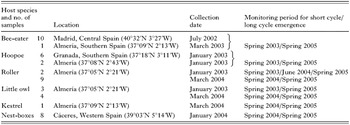
In the framework of a broader study on the relationships between C. hemapterus and its hosts we collected nest material from several host species and locations. Emergence of carnid flies did not occur in some samples, probably because the nests were not infested by C. hemapterus. Here we report on the samples on which the estimate of the frequency of prolonged diapause is based (Table 1). Most samples were collected from natural nests but some nest boxes (probably used by rollers, kestrels, starlings Sturnus unicolor and sparrows Passer spp.) were also sampled. All samples but 5 came from different nests. Five cavities were used for breeding in successive years by the same bird species (2 by rollers and 3 by little owls). These nests were sampled twice (in January 2003 and in March 2004, Table 1) and each sample was stored apart from the others and subsequently monitored for several periods (see below and Table 1). Since environmental factors influencing the larval and pupal stage and diapause of C. hemapterus are likely to vary among years we consider the sample as the unit of replication.

Sampling consisted of removing part of the material from the nest bottom using a spoon attached to a stick long enough to reach the nest chamber or by hand. Whenever the nest was made of vegetable material, the whole structure (i.e., the nest cup) and the earth below the nest were taken. The amount of nest material collected varied among nests.
Emergence patterns are ideally studied in the field. Nevertheless this was not possible since this would have necessitated the periodical sampling of nests occupied by birds during the breeding season (i.e. when carnid flies emerge), which would result in the disturbance of adults and nestlings. Therefore, the emergence of flies was recorded in the laboratory. This approach, in turn, ensured homogeneous conditions (i.e., the same temperature) for the samples, which is not possible in the field, where local conditions and the timing or length of use of nests by birds could influence emergence time.
After collection, the samples were kept in plastic bags and stored in the Estación Experimental de Zonas Áridas (Almería, around 35 km from the location where most samples were collected). The samples were placed in a room with open windows and drawn curtains to resemble the conditions experienced by pupae in cavities in the wild (i.e. ambient temperature moderated by partial enclosure and semi-darkness). All samples were stored in the same place, except for 2 roller samples collected in January 2003, which were kept throughout the winter season 2003–2004 in a cellar at a lower temperature than the rest of the samples. These 2 samples were moved the following wintering season to the same room where most samples were stored.
Our initial sampling schedule contemplated monitoring of emerging flies (approximately every 3–4 days until insect emergence ceased) during the first spring after collection (Table 1). Thus, the study period lasted from 31 January 2003 until 8 July 2003 for the samples collected in 2002–2003, from 9 March until 13 July 2004 for those samples collected in 2004 in Tabernas and from 4 March until 13 July 2004 for the samples collected in 2004 from nest-boxes in western Spain. However, the 2 roller nests collected in January 2003 were checked by chance in mid-June 2004 (i.e. the second spring after collection) and recently dead flies and emergence of fresh flies were detected, thus supplying evidence for prolonged diapause. From then onwards, emerged flies in these samples were counted but the flies that could have emerged before we started our observations were most probably missing by then. The information about flies with prolonged diapause in these two nests is therefore conservative. As it was too late to monitor emergence in the remaining samples from different hosts and localities, all the samples were controlled again the next spring from 2 March 2005 until 15 July 2005 (Table 1).
In summary, our data set consisted of 2 samples (roller) studied for 3 consecutive springs (2003 to 2005), 22 samples (1 kestrel, 4 little owl, 9 roller, 8 from nest boxes) for 2 consecutive springs (2004 and 2005), and 22 samples (11 bee-eater, 8 hoopoe, 3 little owl) for the first and the third spring after sampling (2003 and 2005) (Table 1). Therefore, the number of controlled samples for prolonged diapause after at least 2 consecutive springs is 24.
Estimation of the frequency of prolonged diapause
The frequency of prolonged diapause was estimated with respect to the number of flies emerging the first spring only on the samples with prolonged diapause. We refer to the samples in which we have not recorded prolonged diapause only to estimate the proportion of samples with prolonged diapause.
The samples collected in this study probably contain pupae with different diapause histories. Flies emerging the first spring can therefore include individuals that pupated more than 1 year before the first spring. Our data on frequency of prolonged diapause are thus conservative both regarding the number of flies with a long-cycle and the duration (i.e. years) in prolonged diapause.
Statistical analyses
Parasite distributions are known to be aggregated, which makes their quantification and comparison difficult (Rózsa, Reiczigel and Majoros, 2000). Following Rózsa et al. (2000) prevalence (proportion of infected samples) and mean intensity (mean number of individuals found in the infected samples) of flies were used for quantification purposes. We compared median intensity (median number of individuals found in the infected samples) of flies by using Mood's median test.
Statistical tests were done using the program Quantitative Parasitology 2.0 (Reiczigel and Rózsa, 2001) and the STATISTICA 6.0 package (StatSoft, Inc. 2001).
RESULTS
Frequency of prolonged diapause in Carnus hemapterus
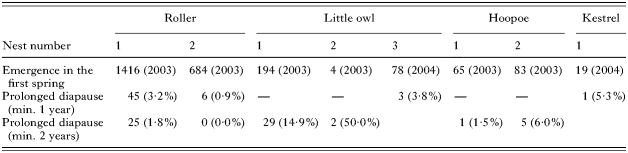
Emergence of carnid flies 1 year after the first emergence was detected in 4 samples (Table 2) out of the 24 samples (16·7%) controlled for prolonged diapause after at least 2 consecutive springs (Table 1). Compared to the number of flies that emerged during the first spring, we calculated an average of 3·3% (S.E.=0·91, range=0·9%–5·3%) individuals with a long cycle.
Table 2. Emergence of Carnus hemapterus in nests where prolonged diapause was recorded (The number of flies emerging in successive springs in nests of different hosts is shown (in parentheses the percentage of individuals compared to the number of flies emerging during the first spring). Years in parentheses refer to the year when emergence was monitored for the first time. Dashes refer to years when emergence was not monitored whereas empty cells indicate that 2-year prolonged diapause should eventually occur in spring 2006.)
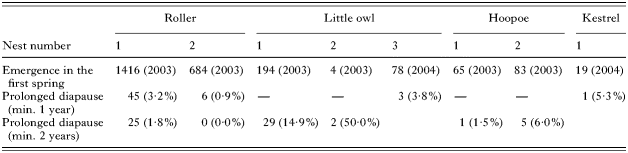
Results obtained from a different set of samples (see Table 1) showed that emergence of carnid flies 2 years after the first emergence bout occurred in at least 5 (20·8%) out of 24 samples (Table 2). Monitoring of the 2 roller samples studied for 3 consecutive springs revealed that carnid flies emerged from both samples during the second spring, and that emergence was recorded in only 1 sample during the third spring (Table 2). Considering only the samples with prolonged diapause, an average of 14·8% of flies (S.E.=9·11, range=1·5–50%, the latter being of a nest where emergence was low during the first spring, Table 2) emerged after more than 2 years of diapause with respect to the flies that emerged during the first spring.
The median number of flies emerging the first spring was significantly higher in samples where prolonged diapause was recorded than in samples where it was not (median values: 80·5 and 5 respectively, Mood's median test, P=0·018). The number of emerged flies after prolonged diapause (all cases pooled) was positively correlated with the number of flies emerging during the first spring (Spearman rank correlation, rs=0·89, P=0·002, n=8).
Phenology of emergence of Carnus hemapterus
The pattern of appearance of flies with protracted emergence closely resembled that observed for flies emerging during the first spring.
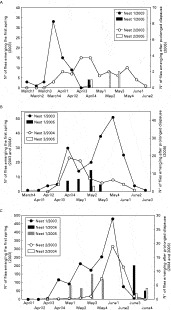
Flies with prolonged diapause in hoopoe nests 1 and 2 (Table 2) emerged within the period observed for flies emerging during the first spring (Fig. 1A). This is also the case for flies emerging from little owl nests 1 and 3 (Fig. 1B, Table 2). The only 2 flies with delayed diapause found in nest 2 (not represented in the figure) emerged during the first week of May, well within the period observed for flies emerging the first spring in the same nest (first week of April to second week of May).

Fig. 1. Phenology of emergence of short cycle (lines) and long cycle (bars) Carnus hemapterus flies from nests of (A) hoopoes, (B) little owls and (C) rollers. For each species the emergence of flies during the first spring (left ordinate) and flies with prolonged diapause (right ordinate) in several nests in successive springs is shown. Data refer to emergence per week from early March to late June.
Concerning flies from rollers' nests, we found a similar pattern for individuals emerging in 2003 and 2005 (Fig. 1C). The apparently late emergence of flies in 2004 could be due to our missing the first flies emerging (see Materials and Methods section) (Fig. 1C only includes the flies whose emergence could be dated accurately) and/or to the lower storage temperature during the winter season 2003–2004 (see Materials and Methods and Discussion sections).
The only fly with prolonged diapause found in a kestrel nest (Table 2) emerged 2 weeks later (fourth week of May) than the latest ones observed during the first spring in this nest (emergence period from the second week of April to the first week of May).
DISCUSSION
We recorded emergence of C. hemapterus after at least 2 and 3 wintering seasons in around 17% and 21% of the samples respectively. In 1 sample emergence of carnid flies was recorded for 3 consecutive springs. The number of flies emerging in those samples ranked 0·9–50% with respect to the number of flies emerging the first spring. Several factors suggest that the frequency of prolonged diapause in C. hemapterus can be more frequent than these figures show. First, given that both the occurrence and the number of flies with a long life-cycle are related to the number of flies emerging the first spring, the likelihood of detection of individuals with prolonged diapause in nests where little nest material was collected and/or with a low parasitic load (the range of emergence was 1–1416 flies) is low. Second, we cannot discard that some of the flies emerging during the first spring may in fact be individuals with a long cycle that started prolonged diapause years before.
It is well known that many insect species can extend their life-cycle over several years (Tauber and Tauber, 1981; Danks, 1987, 1992; Hanski, 1988; Debouzie and Menu, 1992). Long life-cycles are usually viewed as resulting from prolonged diapause caused by extension of the usual winter diapause. However, in contrast to the usual hypothesis, Soula and Menu (2005) showed that the long cycles in the Chestnut weevil Curculio elephas is due to a prolonged diapause occurring secondarily to a developmental phase. Therefore, we interpret the emergence of carnid flies in samples stored for 2 or more adverse seasons as the result of prolonged diapause without information on the exact mechanism. An alternative explanation is that some flies emerging after our last control in the first spring could have mated in the bags and produce larvae and pupae which would overwinter and result in adults the next spring. However, this is unlikely as carnid flies need to feed on a host to survive (Kirkpatrick and Colvin, 1989; Dawson and Bortolotti, 1997; Grimaldi, 1997), mating usually occurs on the host (Guiguen et al. 1983; pers. obs) and adult flies live for less than 2 days in absence of the host (Calero-Torralbo et al., manuscript in preparation). Thus, we maintain that C. hemapterus has a prolonged diapause.
A within-generation variation in life-cycle duration (mixing of short and long cycles) occurs in many insects, crustaceans, and plants (see Soula and Menu, 2005 and references therein). However, the occurrence of prolonged diapause in parasites is much less common. It does exist in plant-feeding insects (Danks, 1987, 1992; Soula and Menu, 2005) and some host-parasitoid systems (see Danks, 1987; Hanski, 1988) but a thorough literature review yielded only 1 study reporting prolonged diapause in a ‘true’ parasite (i.e. not a parasitoid) of animals, the rodent botfly Cuterebra tenebrosa (Baird, 1975). Danks (1992) reviewed the occurrence of long life-cycles in ectoparasitic insects like human fleas (Pulex irritans), sand martin fleas (Ceratophyllus styx jordani) or bugs (Rhodnius prolixus). He concluded that such long cycles were in accordance with the unreliable availability of hosts. However, these cases cannot be considered as prolonged diapause because individuals “do not skip an opportunity for breeding and opt for survival” (Hanski, 1988), rather they are the result of prolonged dormancy until host availability is detected.
Several hypotheses for the adaptive value of long cycles have been proposed (Tauber et al. 1986; Danks, 1987; Hanski, 1988; Menu et al. 2000; Soula and Menu, 2003). Long life-cycles are correlated with environmental adversities, such as cold or unpredictable temperatures, patchy, unreliable or low quality food supplies (Danks, 1992). Prolonged diapause, usually resulting in long life-cycles, is interpreted as a local adaptation to multi-annual fluctuations in resource availability (Debouzie and Menu, 1992; Hopper, 1999; Menu et al. 2000; Soula and Menu, 2003, but see Menu, 1993; Menu and Desouhant, 2002 for other selective factors for variability in life-cycle duration). In some species it has been considered a bet-hedging or risk-spreading strategy, because it prevents extinction when resources are lacking (Menu and Debouzie, 1993; Menu et al. 2000). For parasitic organisms that infect via free-living stages actively seeking for a host, the probability of host encounter is likely to be highly unpredictable (Hakalahti et al. 2004). It is therefore not surprising that the infection strategies of such parasites may be one of the most obvious traits in which bet-hedging life-history traits are likely to exist (Fenton and Hudson, 2002; Hakalahti et al. 2004). Since C. hemapterus can perpetuate by itself in a given nest, one could assume that dispersal is not necessary for this species. However, factors like alterations in the nest or its surroundings (making it unattractive for birds), interannual nest-site change of the host to avoid parasitism (Loye and Carroll, 1998) or predation before hatching may result in vacant nests, which seriously jeopardizes the future of the lineage of parasites inhabiting that nest. In that case, freshly emerged flies should disperse and look for an occupied nest.
Dispersal is perhaps the most dangerous part of most parasites' life-cycles (Ward et al. 1998). Several factors suggest that dispersal in time (i.e. prolonged diapause) can be better for C. hemapterus than spatial dispersal. Even though C. hemapterus is a vagile insect, its flight range is probably short and it is unclear whether it can control its own flight direction. Moreover, its dispersal ability is probably limited by the short life-span of adult flies (less than 2 days). If a suitable host is not found rapidly, adult flies die. In the case where no dispersing fly succeeds in finding a host, the survival of the lineage is ensured by the pupae in prolonged diapause. They give rise to adults in succeeding years when the nest can be occupied again by the same or other host species. In agreement with this, it is remarkable that the emergence pattern of flies with prolonged diapause was similar to that observed for flies with a short cycle. Most flies with prolonged diapause emerged between mid-April and late May, when chicks of most of the host species have already hatched, so that flies seem to synchronize their emergence dates with host occurrence (Liker et al. 2001; Valera, Casas-Crivillé and Hoi, 2003; Valera, Martín-Vivaldi and Carles-Tolrá, 2006). Breaking of diapause and activation of metabolic processes commonly requires an exposure to one or several cues (e.g. changes in temperature or photoperiod) (Tauber et al. 1986). Powell (1989, 2001) showed that environmental factors (i.e. temperature) promoted variation in diapause patterns in plant-feeding moth larvae. Observational and experimental data (manipulating temperature during the pupal stage) suggest that the emergence time of C. hemapterus is determined by an endogenous annual timing mechanism that can be modified, within certain limits, by temperature (manuscript in preparation), as is the case for many insects in temperate climates (Tauber and Tauber, 1981; Smith and McIver, 1984; Leather, Walters and Bale, 1993). The late emergence observed in flies from rollers' nests in 2004 could be explained by the lower temperature experienced by pupae during the winter season 2003–2004. In this study system, appropriate environmental cues are thus likely to favour diapause development.
Whereas we cannot discard other selective factors (like predation, larval attack by entomopathogenic fungi or climate) for within-generation variability in life-cycle duration (see, for instance, Menu, 1993; Menu and Debouzie, 1993; Menu and Desouhant, 2002) our current knowledge suggests that host-finding is an important selective pressure for this study species. Further work should focus on whether the unpredictability of host encounter could produce bet-hedging for variability in life-cycle duration in C. hemapterus. Within-generation variability in diapause duration can result from diversified bet-hedging (sensuSeger and Brockmann, 1987), from a mixed evolutionary stable strategy or a genetic polymorphism of pure strategies (Soula and Menu, 2003). Although Hopper's review (1999) suggests that genetic variation and conditional responses to environmental cues explain most phenotypic variation in diapause, without invoking bet-hedging, he pointed out that diapause is an appropriate trait to increase our knowledge of risk-spreading in insect populations. Recently, Menu and Desouhant (2002) and Soula and Menu (2003) provided evidence of diversified bet-hedging for variability in life-cycle duration in the chestnut weevil.
This being, to our knowledge, the second report on prolonged diapause in true parasites of animals, the question arises whether this mechanism is rare among these organisms or whether it has passed unnoticed. Diapause and dispersal are considered alternative ways of escaping unfavourable conditions so that the frequency of prolonged diapause is negatively correlated with dispersal rate (Hanski, 1988; Bohonak and Jenkins, 2003). The short life-span of adult carnid flies could account for the occurrence of prolonged diapause in this parasite. Thus, C. hemapterus could be considered a peculiar case in the ‘parasite community’. Alternatively, the occurrence of prolonged diapause may have been overlooked in parasites for different reasons (e.g. the long period needed to detect it, the complexity of host-parasite systems). Hanski (1988) stated that “prolonged diapause will rarely be detected where it is not looked for, and it is generally only looked for where it is expected to occur”. Since environmental unpredictability is the rule for many parasitic organisms we suggest that prolonged diapause could occur in other parasites. Here we stress the need of long-term studies to fully understand the life-cycles of parasites.
We are grateful to H. Hoi, M. Martín-Vivaldi, E. Darolová and J. Kristofik for their help and for sharing unpublished information with us, and to the two anonymous referees for constructive comments on the manuscript. J. Avilés and D. Parejo kindly made available nest boxes in Extremadura and provided logistic support. The Consejería de Medio Ambiente (Junta de Andalucía) kindly allowed us to sample nests of different bird species. F.V.H. was supported by the Programa de Ayudas para el Retorno de Investigadores de la Consejería de Educación y Ciencia (Junta de Andalucía), M.A.C.T. was funded by the Spanish Ministerio de Educación y Ciencia (Programa de Formación de Profesorado Universitario FPU) and A.C.C. was funded by the Spanish Ornithological Society (SEO-Birdlife).