Introduction
One contemporary controversy in social science and public health research involves our understanding of the effects of the ‘Great Recession’ on people’s health and well-being. Many systematic reviews have been conducted on aspects of recessions and health (Platt, Reference Platt1984; Thomson et al., Reference Thomson, Petticrew and Morrison2002; McKee-Ryan et al., Reference McKee-Ryan, Song, Wanberg and Kinicki2005; Suhrcke et al., Reference Suhrcke, Stuckler, Suk, Desai, Senek, McKee, Tsolova, Basu, Abubakar, Hunter, Rechel and Semenza2010; Catalano et al., Reference Catalano, Goldman-Mellor, Saxton, Margerison-Zilko, Subbaraman, LeWinn and Anderson2011; Modrek et al., Reference Modrek, Stuckler, McKee and Cullen2013). Based on these reviews, there is a clear recognition that economic downturns significantly affect health, but views differ as to how. One group warns that, “the health community should prepare for the worst”, pointing to the risks of depression, suicide, heart attacks, inadequate nutrition and elevated chronic disease risk. Yet, one commentator on this body of work summarises the findings as “Recessions save lives”, suggesting that the real danger instead comes from economic recovery (Mulligan, Reference Mulligan2013).
Our fundamental question is how it can be that, when confronted with similar data and evidence, two sets of writers arrive at such markedly differing conclusions and what does this mean for research on the consequences for health of major economic fluctuations? To answer this, we undertake new analyses on the relevant literature. We test four hypotheses. First, we ask whether there are distinct ‘camps’, or disciplinary silos, drawing on different bodies of evidence. We address this by evaluating patterns of citation across authors, journals and disciplines. Second, we look at the predictive power of these different camps, comparing what was predicted from research on earlier periods of recession with the documented health effects in the current recession. Third, we explore concepts of causality as applied to economic crises by researchers from different disciplines. We return to the philosophical roots of causality to ask whether different interpretations influence the conclusions drawn. Finally, we examine the inferences made by those in different camps for policy. We conclude by proposing an integrated research agenda that builds on lessons of successes and failures in research traditions across social sciences and public health.
Data and methods
Peer-reviewed scientific literature was drawn from the Web of Science using the search terms ‘recession’ and ‘health’ in the article’s topics. Although other search engines such as Scopus or Google Scholar could be used, an advantage of Web of Science is its comprehensive and consistent categorisation of documentary details. While further terms could be used to widen the inclusion criteria, the review aims to provide a representative snapshot of the field. The initial search on recession and health yielded 501 studies. This initial set included studies of gum ‘recession’ and other unrelated periodontal literature and so we filtered out journals on dentistry. This left a final analytical sample of 461 articles.
Using BibExcel, a citation analysis tool, we extracted citation lists from these 461 articles, giving rise to a total of 14,401 cited documents. The highest number of citations contained within this literature sample was 64. We next mapped academic disciplines based on the Web of Science Category (WC). Several articles of the 461 had two classifications, giving rise to a total of 706 classifications.
To evaluate the literature network, we constructed citation matrices and mapped them according to academic discipline, journal of publication and authors. Both co-citations (i.e. who is citing the same groups) and direct citations (i.e. who is citing whom) were analysed using BibExcel. Briefly, two documents are co-cited if they are cited by the same third document. This is similar to an alternative measure, bibliographic coupling, which deems coupling to occur if the articles both cite the same third document. Co-citation scores measure the semantic similarity of research articles, journals and authors. Pajek64 v3.12 and VoSViewer were used to map networks and perform VOS clustering analyses, testing for the presence of communities or camps, in citation networks. Next, we traced the evolution of literature on recessions and health over time. Finally, we examined how well previous studies had predicted what is being seen in the current recession.
Results
Co-citation analysis of disciplines, journals and authors
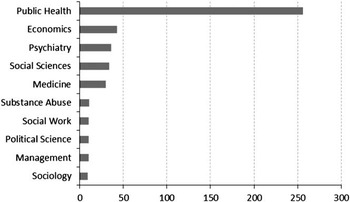
Figure 1 shows the 10 most frequent disciplinary areas publishing on the topic of recession and health. The largest concentration was in public health, followed by economics. Significant contributions have also been made from psychiatry, general social sciences, medicine, political science, management and sociology.
Top 10 disciplines publishing on recessions and health Notes: Total of 706 classifications listed in 461 articles. Public health includes ‘public, environmental and occupational health’, ‘health policy and services’ and ‘health care sciences and services’. Psychiatry also includes clinical neurology.

To assess the extent of cross-fertilisation, we then mapped the strength of co-citation across disciplinary areas (Web appendix, Figure W1 in Supplementary Material). The strongest co-citation links were for the classifications ‘health policy & services’ and ‘health care sciences & services’ (co-citation=51), followed by ‘public health’ and ‘social sciences, biomedical’ (co-citation=31). There were few co-citations among economics, sociology and public health. Psychiatry and substance abuse disciplines were on one pole, while sociology and demography, and political science occupied the opposite pole).
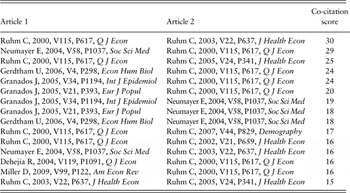
We extended the analysis to journals in which the articles were published. Using VOS clustering algorithms, six clusters were identified, broadly reflecting disciplines of economics, medicine, social science and medicine, psychology and psychiatry, and substance abuse. Web appendix Figure W2 shows mapping of spatial location based on the Euclidean distances between clusters, weighted by the strength of co-citation. For this analysis only, we have limited the sample to the 338 articles with greater than three citations. The central journal, and most highly cross-cited, is Social Science & Medicine. Economic journals occupy a point on the periphery, with journals such as Demography and the International Journal of Epidemiology (where one of the leading authors, Tapia-Granados has published extensively) lying in between them. The substance abuse literature was the most isolated of the publishing clusters. Table 1 lists the most highly co-cited documents.
Highly co-cited articles

Taken together, the network analysis indicates the presence of disciplinary silos. It also reveals a high degree of co-citation within economics journals, and a degree of relative isolation of psychiatry and substance abuse journals.
Chronology of academic literature
We identified four main periods of scholarship from the cited documents in Web of Science (Web appendix Figure W3).
First generation, 1897–1969
The earliest article cited in literature on recessions and health is Durkheim’s Suicide in 1897 (cited as The Free Press 1997 version; Durkheim, Reference Durkheim1997). Durkheim found, using early equivalents of ‘fixed effects’ models to analyse variations within countries, that suicide rates tended to rise both in periods of rapid economic growth and decline. What mattered most was the magnitude of change, not so much as the direction. The next article, by Ogburn and Thomas in 1922, identified a strongly significant negative association between fluctuations in economic activity and suicides rates, r=0.77. It was the first in the sample to have investigated overall mortality rates, reporting that, “The correlation [of the business cycle and death rates] is positive and fairly high, r=0.57…This is a surprising result, as one would guess that if there were any correlation at all between business conditions and death rates it would be negative” (Ogburn and Thomas, Reference Ogburn and Thomas1922). However, their findings of an inverse correlation of economic activity with mortality rates were not replicated in England and Wales when using trade data, leading them to conclude that “These results increase our scepticism regarding the existence of a significant correlation between death rates and the business cycle”.
It should be noted that this early scholarship was published during the US economic boom years of the 1920s that led up to the stock market crash in 1929. This was a time when the biologist Raymond Pearl published a seminal text on population growth, finding that faster growth rates in fruit flies strongly correlated with decreased longevity (Pearl, Reference Pearl1928). This contributed to a more general concern about the ‘mode of living’, and a fast pace of life. The work continued during the Great Depression, when epidemiologists such as Edgar Sydenstricker, writing in the Milbank Quarterly, began to find these patterns manifesting in their data on human mortality (Sydenstricker, Reference Sydenstricker1933).
Second generation: 1970–1989
The next wave of literature emerged in the period of stagflation in the mid-1970s. In 1971, Harvey Brenner published in the American Journal of Public Health a article that concluded that “economic upturns are associated with decreased heart mortality”, setting the stage for debate (Brenner, Reference Brenner1971). However, in a series of articles in the International Journal of Health Services, Joseph Eyer found that “the general death rate rises during business booms and falls during depressions. The causes of death involved in this variation range from infectious diseases through accidents to heart disease, cancer, and cirrhosis of the liver, and include the great majority of all causes of death”(Eyer, Reference Eyer1977). In 1979, Stanley Kasl (Kasl, Reference Kasl1979) published a methodological critique of an ecological article in which Bunn had replicated Brenner’s findings in Australia (Bunn, Reference Bunn1979). In the early 1980s, economist Hugh Gravelle critiqued Brenner’s 1979 Lancet article on methodological grounds (including the risk of ‘ecological fallacy’) (Gravelle et al., Reference Gravelle, Hutchinson and Stern1981). One epidemiologist, Ralph Catalono, sought to provide a mechanism, finding that manufacturing injuries rose in the periods when new workers were added (Catalono, Reference Catalono1979).
In parallel, a set of studies began to emerge in psychology and epidemiology journals. These articles evaluated individual-level risks associated with the correlates of recession, such as job loss, debt and impoverishment. In marked contrast to the ecological studies, these have consistently found that the individual-level factors adversely impact on health and, in particular, on mental health. Among others, Marie Jahoda and Stephen Platt found strong evidence of increased risk of suicide with job loss (Platt, Reference Platt1984). Richard Smith edited a special series in the British Medical Journal in 1985 on unemployment and health (Smith, Reference Smith1985). However, the validity of these individual-level studies was critiqued because of the possibility that those losing their jobs include a disproportionate number of people already in poor health (healthy worker effect) (Carpenter, Reference Carpenter1987). The issues were not simply methodological and disciplinary, but also ideological. Bartley describes the social processes that shaped this evidence and how it would be used (Bartley, Reference Bartley1992) while George Davey Smith (personal communication) has suggested that interpretations may have been shaped by political views. Brenner, a liberal, focused on the adverse consequences when economies are not functioning as they should while Eyer, a Marxist, viewed growth in capitalist economic systems as harmful because of the opportunities to employers to extend working hours, adopt policies that increase migration and thereby foster ‘social disintegration’ (Eyer and Sterling, Reference Eyer and Sterling1977).
Third generation: 1990–2008
The pace of scholarship began to rise in the early 1990s concurrent with periods of economic growth in the United States and Western Europe. A review of the relationship between unemployment and health by Jin et al. concluded that, “Evaluated on an epidemiologic basis, the evidence suggests a strong, positive association between unemployment and many adverse health outcomes” (Jin et al., Reference Jin, Shah and Svoboda1995). However, it also expressed methodological concerns that, “Whether unemployment causes these adverse outcomes is less straightforward, however, because there are likely many mediating and confounding factors, which may be social, economic or clinical”.
Eyer’s findings of a positive association between economic downturns and mortality rates were replicated by two economists, Christopher Ruhm and Jose Tapia-Granados in a series of articles in Japan, Sweden, Finland and a number of other high-income countries (Ruhm, Reference Ruhm2000, Reference Ruhm2003, Reference Ruhm2006, Reference Ruhm2008a, Reference Ruhm2008b; Tapia-Granados, Reference Tapia-Granados2005a, Reference Tapia-Granados2005b, Reference Tapia-Granados2008; Gerdtham and Ruhm, Reference Gerdtham and Ruhm2006). However, their findings on the specific populations affected and types of mortality varied considerably. A highly cited article by Ruhm analysing US state-level data reports that “State unemployment rates are also negatively and significantly related to eight of the ten specific causes of death, confirming that many aspects of health deteriorate when the economy improves” (Ruhm, Reference Ruhm2000). These included motor vehicle crashes, homicides, cardiovascular disease, influenza, pneumonia, liver disease, other accidents, neonatal mortality and infant mortality. Tapia-Granados, in a highly cited article taking advantage of provincial differences in Spain finds that “the effect of province unemployment on cardiovascular mortality suggest that cardiovascular deaths are very weakly procyclical…Cancer mortality appears procyclical with respect to local unemployment rates or employment ratios…Mortality due to infectious disease decreased about 0.6% for each percentage point increase in province unemployment” (Tapia-Granados, Reference Tapia-Granados2005).
However, another body of work turned to evaluating the large economic disasters of the 1990s. One was the post-communist mortality crisis that was associated with the transitions to capitalism in eastern Europe, including the work of demographer Vladimir Shkolnikov and epidemiologists David Leon, Martin McKee and Johan Mackenbach among others (Leon et al., Reference Leon, Chenet, Shkolnikov, Zakharov, Shapiro, Rakhmanova, Vassin and McKee1997, Reference Leon, Saburova, Tomkins, Andreev, Kiryanov, McKee and Shkolnikov2007; Walberg et al., Reference Walberg, McKee, Shkolnikov, Chenet and Leon1998; Leinsalu et al., Reference Leinsalu, Stirbu, Vagero, Kalediene, Kovacs, Wojtyniak, Wroblewska, Mackenbach and Kunst2009). In Russia, Latvia and Kazakhstan researchers found clear, positive associations between economic collapse and a rise in mortality rates. However, other nations’ that were affected in this period, such as Finland and Cuba, revealed the opposite patterns (Garfield and Santana, Reference Garfield and Santana1997; Jäntti et al., Reference Jäntti, Martikainen and Valkonen2000). Researchers such as Hugh Waters and Sandra Hopkins also investigated the Asian financial crisis, finding that mortality rates tended to decline overall during periods of economic hardship, but that suicides increased (Waters et al., Reference Waters, Saadah and Pradhan2003; Hopkins, Reference Hopkins2006).
In summary, before the Great Recession that began in 2007, the state of research on recessions and health was highly variable. Much work undertaken at the ecological level, mostly by social scientists, produced the seemingly counterintuitive result that mortality fell during recessions and increased during recoveries. In contrast, work undertaken at the individual level, mostly by epidemiologists, documented substantial risks associated with job loss, debt, foreclosure and sequelae of recessions.
Fourth generation, 2008-present
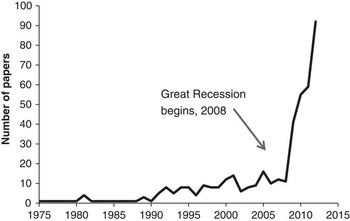
In general, the production of research on recessions and health has tended to occur in periods of economic instability: either during phases of economic disasters or rapid economic growth. The current economic crisis has coincided with a large increase in research activity on recessions and health. As shown in Figure 2, shortly after the onset of the recession, the pace of academic activity increased eightfold. In 2008, the number of published articles was 11, increasing to 92 in 2012.
Web of Science articles on ‘recession’ and ‘health’, 1975–2013

Comparing evidence from the Great Recession to prior research
The Great Recession has provided the opportunity to test predictions from prior studies using ‘out-of-sample’ data. Our 2009 re-analysis of mortality associated with economic changes in Europe over three decades has confirmed the association of suicides with recessions and a decline in road traffic deaths (Stuckler et al., Reference Stuckler, Basu, Suhrcke, Coutts and McKee2009). The latter is easily explicable by declining volumes of traffic. A re-assessment of data from the Great Depression found similarly that only these two sub-sets of mortality rates significantly correlated with short-term economic shocks (Stuckler et al., Reference Stuckler, Basu, Meissner, Fishback and McKee2012).
Both findings have been corroborated (Karanikolos et al., Reference Karanikolos, Rechel, Stuckler and McKee2013a). Once the data from Europe became available, it was clear that the long-term decline in suicides had reversed in almost all countries. In the United States, United Kingdom and across Europe an increase in suicides, numbering more than 10,000 over and above historical trends, has occurred (Reeves et al., Reference Reeves, McKee and Stuckler2014). Austria, which had continued to invest substantially in social protection, was a rare exception. Other studies have looked in depth at individual countries. One study in Spain found substantial increases in consultation rates for mental health problems such as depression (Gili et al., Reference Gili, Roca, Basu, McKee and Stuckler2013), known to be a major risk factor for suicide, with another showing an association between the economic crisis and a step change in the Spanish suicide rate, which increased by about 10% over the pre-existing trend (Lopez-Bernal et al., Reference Lopez-Bernal, Gasparrini, Artundo and McKee2013). Across Europe and North America, road traffic death rates declined, most greatly in the nations where initial road safety conditions were the worst. Lithuania experienced a 50% reduction in road traffic deaths associated with the 2008–2009 recession (Stuckler et al., Reference Stuckler, Basu, Suhrcke, Coutts and McKee2011).
The changes in deaths from other causes described previously have not been observed to any extent in the current recession. While one study has identified an increase in myocardial infarction in London (Smolina et al., Reference Smolina, Wright, Rayner and Goldacre2012), there has been no consistent, statistically significant change in overall mortality rates from cardiovascular disease. As noted above, many of the ecological studies also find a decline in deaths from cancer, where it is difficult to identify any plausible explanation, leading to concerns about unexplained confounding. In the current recession, these findings were not confirmed (Karanikolos et al., Reference Karanikolos, Rechel, Stuckler and McKee2013a).
Discussion
By using network analysis of citation patterns, our research has made several important observations. First, it is clear that research on recessions and health occupies disciplinary silos. In particular, there is little interaction between epidemiologists and economists and the latter predominantly cite their own literature. Psychiatry and substance abuse seem relatively isolated, suggesting potential scope for collaboration with other disciplines.
Second, using the Great Recession as a test case against pre-existing studies, our review of the literature reveals two important points about mortality change. One is that there is a long, consistent finding that recessionary episodes are correlated with deterioration in mental health. Another is that recessions are linked to declines in road traffic deaths. Both are plausible. Apart from these exceptions, virtually all other mortality changes identified in the literature, such as short-term associations of recessions with cancer and heart disease, have not been replicated in the Great Recession.
Our analysis of the literature has several limitations. First, we used Web of Science, which covers less ‘grey’ literature than Google Scholar, thus yielding fewer citations. However, a strength is that Web of Science provides more detailed documentation of journal articles, which was necessary for our analyses of disciplines. Second, cited document lists from Web of Science only include the first author of the cited work. This lack of bibliographic detail may understate the level of collaboration across fields. This reflects a common tendency of scientific articles in Nature and Science, among other journals, to provide limited information on cited works. Third, Web of Science has less historical coverage than PubMed. However, the strength of the chronological review process is that it provides a systematic mechanism for tracing the genesis of literature. Fourth, the search terms on topics of recession and health were designed to provide a representative snapshot of the field; however, if important contributions to the literature were not captured in the initial sample of 461 articles, they are likely to have been included in the 14,401 cited documents. Fifth, and importantly, our analysis could document the presence of disciplinary differences, but the citation data alone did not articulate their meaning. We explore possible interpretations in the following section.
Difference 1: causal frameworks
It is clear, from a detailed reading of the articles, that the divisions identified in our analysis go beyond disciplines. They involve differences in the core concept of causality. At risk of over generalisation, the economic literature related to economic crises seems to be dominated by the concept of causality espoused by the 18th century Scottish philosopher David Hume (Hume, Reference Hume1896) and John Stuart Mill (who proposed the empirical Mills Methods) (Mill, Reference Mill1874). These theories are based on induction and the idea that, among others, where two events are regularly, strongly and temporally associated they are likely to be causally related, as long as confounding factors are, as far as possible, taken account of mathematically by including them in equations. Risks of reverse causality can be assessed in various ways, using lagged effects, testing for what is termed Granger causality. It is also possible to use what are termed instrumental variables that are not associated with the dependent variable. These methods are discussed in detail in academic articles that explore explicitly ideas of causality in economics (LeRoy, Reference LeRoy2004) and complex ecosystems (Sugihara et al., Reference Sugihara, May, Ye, Hsieh, Deyle, Fogarty and Munch2012).
An alternative to this broad empirical approach was, however, outlined by Immanuel Kant, who argued that a set of a priori rules were needed to characterise the association and the conditions when inference of causality could be drawn (Kant, Reference Kant1963). These two approaches are explicitly combined in the most widely used framework for establishing causality used by epidemiologists, the nine criteria developed by Sir Austin Bradford Hill. These included both the Humean concepts of strength of association, consistency, specificity, a temporal relationship, a biological gradient, experiment and reversibility, but also the distinctly Kantian concepts of analogy, plausibility and coherence (Hill, Reference Hill1965). From a Kantian perspective, it was not sufficient to show mere association, no matter how consistently this was done. It was also necessary to propose a mechanism. From this perspective, a mechanism linking recession with fewer deaths from cancer defied a plausible explanation and so any association would be less likely to be considered causal. Writers in other disciplines, such as psychology, have also sought to reconcile the Humean and Kantian perspectives in different ways (Cheng, Reference Cheng1997).
This disciplinary difference has been noted before, although we believe it is less well recognised than it should be. A recent example was the apparent observed association between the degree of competition in the health care market in England and a decline in mortality from heart disease (Cooper et al., Reference Cooper, Gibbons, Jones and McGuire2010). As critics noted, while the association was clearly observable, this was not consistent with previous research (Propper et al., Reference Propper, Burgess and Green2004) and there was no plausible biological mechanism that could have explained what was seen (Pollock et al., Reference Pollock, Macfarlane, Kirkwood, Majeed, Greener, Morelli, Boyle, Mellett, Godden, Price and Brhlikova2011). As Bevan and Skellern have noted, there are substantial problems with the choice of exposure to competition and the outcome, and the organisational mechanisms that might link them (which they describe as a “black box”; Bevan and Skellern, Reference Bevan and Skellern2011). Although it has been suggested that the explanation for the conflicting results at different times may be explained by whether or not prices were fixed (Gaynor and Propper, Reference Gaynor and Propper2012), it is also plausible the explanation is as likely to lie in artefacts of the data, such as coding changes, which pose an inevitable problem in comparisons of hospital performance (Steinwald and Dummit, Reference Steinwald and Dummit1989).
It is, however, important to stress that our conclusion with regard to a disciplinary division draws on what we observe in the literature on economic crises, as many contrary examples exist in the broader public health and economic literatures. For example, there is an extensive body of aetiological epidemiology, especially that based on analyses of large cohorts with dietary data, that has identified numerous risk factor disease associations that lack plausible mechanisms and have failed to confirm in subsequent experimental studies (Smith and Phillips, Reference Smith and Phillips1990). Many econometricians have also criticised the seeming unthinking overreliance on statistical significance in analyses of observational data (Hendry, Reference Hendry1980; Sims, Reference Sims1980; Leamer, Reference Leamer1983).
Since 2009, some economists have been seeking mechanisms that would explain the view that recessions are good for your health (Miller et al., Reference Miller, Page, Stevens and Filipski2009). Miller et al. suggest that procyclical mortality is driven by changes in deaths among elderly groups, suggesting that the “primary causes of death contributing to cyclical mortality fluctuations among working-age adults are not typically associated with stress levels or health behaviours. As a result is seems unlikely that changes in individuals’ own labor force status, work, or health behaviours are the key determinants of aggregate mortality changes”. The authors invoke the consequence of changes in the job market making it easier to recruit skilled workers to care homes. However, this would require both a highly dynamic employment market and the effect size of changes in skill mix to be many fold greater than has ever been suggested in health services research. Another is pollution, leading to a decline in deaths from respiratory diseases. Heutel and Ruhm suggest that the relationship between overall mortality rates and unemployment rates is attenuated by 30% after correcting for ozone, carbon dioxide and particulate matter levels (Heutel and Ruhm, Reference Heutel and Ruhm2013). It is possible that this may have applied in a previous time when environmental controls were much more lax. This is supported by another economic study of health changes in the Great Recession using individual-level data, reporting that “we show that the association between economic deterioration and these outcomes [respiratory deaths] has weakened considerably during the recent recession. In fact, majority of our estimates indicate that the relationship has practically become zero” (Tekin et al., Reference Tekin, McClellan and Minyard2013).
Difference 2: complexity and effect modification
Recent studies from a public health perspective have begun to document the complexity of the association between recessions and health and the role of effect modification, in particular identifying factors that influence exposures differentially along the causal pathway to disease and death. Previous ecological research on alcohol had revealed yet another of the paradoxes that seems so common in this area, suggesting that consumption declined, even as suicides, which are often associated with heavy drinking, were increasing. More detailed analyses in the United States by Bor et al. and in the United Kingdom (Harhay et al., Reference Harhay, Bor, Basu, McKee, Mindell, Shelton and Stuckler2014) show that there is indeed an overall decline in consumption as light and moderate drinkers consume less (Bor et al., Reference Bor, Basu, Coutts, McKee and Stuckler2013). However, there is a simultaneous increase in the amount of hazardous drinking by existing heavy drinkers.
The association between the recession and infectious disease is especially complex. A systematic review of the association of economic and political crises on infectious diseases revealed that much depends on three factors: (i) background risk of outbreaks of disease, influenced by factors such as the presence of insect or other animal vectors, as well as high risk groups, such as homeless persons and drug users; (ii) contact rates, which express the degree of exposure to infectious agents and (iii) transmissibility, which largely depends on the effectiveness of public health programs (Suhrcke et al., Reference Suhrcke, Stuckler, Suk, Desai, Senek, McKee, Tsolova, Basu, Abubakar, Hunter, Rechel and Semenza2010). Where these risk factors are present, a breakdown of control activities may give rise to an epidemic. However, this is extremely context specific. For example, large-scale mortgage foreclosures in California resulted in many swimming pools being abandoned and thus accumulating stagnant pools of water (Reisen et al., Reference Reisen, Takahashi, Carroll and Quiring2008). In this warm climate, they provided an ideal breeding site for mosquitoes that could transmit West Nile virus. Clearly, such circumstances would not occur in many other parts of the world. Within Europe, a reduction in spraying activities in Greece has been associated with resurgent malaria and outbreaks of West Nile virus (Bonovas and Nikolopoulos, Reference Bonovas and Nikolopoulos2012; Stuckler and Basu, Reference Stuckler and Basu2013). Moreover, there is wide variation in the vulnerability of individuals within populations to infectious diseases, so it will almost always be necessary to look in detail at those with particular characteristics, such as homeless people and illegal migrants. As these often comprise a small share within a population, and are especially likely to be excluded from routine data collection systems, analyses based on aggregate population data should be treated with great care.
An example can be seen in Greece, where austerity policies reduced harm reduction programmes, which was followed by a rapid increase in HIV infections among intravenous drug users (Kentikelenis et al., Reference Kentikelenis, Karanikolos, Papanicolas, Basu, McKee and Stuckler2011, Reference Kentikelenis, Karanikolos, Reeves, McKee and Stuckler2014).
These nuanced approaches place greater emphasis on assessing the role of modifying factors. In contrast, much of the research in social science disciplines has paid little attention to the social context in which disease risks are produced and amplified. Thus, these studies have tended not to consider the role of some, perhaps obvious modifying factors. This oversight seems likely to have contributed to the failure to replicate the majority of research findings across countries, recessions and over time.
From a public health perspective, the hope and promise of this type of research is that, if we can understand how recessions cause people’s health to suffer then we may be able to identify effective interventions that can increase their resilience and therefore mitigate the effects of economic shocks. Thus, the risk of suicide in the face of unemployment has been found to be neutralised in the context of higher degrees of labour market protection. Infectious disease risk depends on exposure to an infectious agent, the effectiveness of treatment and prevention programmes, all which vary in different settings but can, to a considerable extent, be anticipated and acted on. An emerging theme from this work is the risks to health arising from deep budget cuts to social protection and public health programmes (Karanikolos et al., Reference Karanikolos, Mladovsky, Cylus, Thomson, Basu, Stuckler, Mackenbach and McKee2013b; Stuckler and Basu, Reference Stuckler and Basu2013).
Conclusion
This review has highlighted significant disciplinary differences in how researchers have attempted to answer the question about how recessions affect health. There are clear communities that draw primarily on their own literature. This is likely to reflect, in part, the propensity for interaction, at conferences and other venues, and the journals that they read. However, it may also reflect differences between researchers in the concepts of causation that are favoured. All of these communities have something to contribute to these complex problems. It is not necessary that they all speak the same language, but rather that they recognise that they are speaking different languages. We argue that there is a need for an integrated, trans-disciplinary approach, whereby researchers increase their awareness of what is being done by others. Future research would look both at the effects of financial shocks on health and the factors that modulate their effects, such as resilience, recognising that these exist at an individual and a societal level. It would address explicitly the different approaches to establishing causation and, we argue, would include the need to demonstrate biological plausibility. The research that would flow from this effort would, we argue, bring much greater clarity to an issue that has, for too long, been shrouded in controversy.
Acknowledgement
The authors are grateful to George Davey Smith for valuable comments on an earlier draft.
Supplementary Materials
To view supplementary material for this article, please visit http://dx.doi.org/10.1017/S1744133114000255