Introduction
Tonsillectomy is one of the most common surgical procedures worldwide. Within the USA alone, over 500 000 tonsillectomies are performed annually.Reference Hall, Schwartzman, Zhang and Liu1 The most common indications are sleep-disordered breathing and recurrent throat infections.Reference Erickson, Larson, St Sauver, Meverden and Orvidas2, Reference Burton and Doree3
Studies have documented improvements in behaviour and quality of life after tonsillectomy, as well as elimination of episodes of infections, depending on frequency and severity.Reference Mitchell and Kelly4, Reference Garetz5 Complications could be related to anaesthesia, haemorrhage, infections and dehydration. Haemorrhage is the most feared complication and occurs in 0.28–3 per cent of cases. It may lead to suffocation, airway obstruction, haemorrhagic shock and death.Reference De Luca, Pachêco-Pereira, Aydinoz, Bhattacharjee, Tan and Kheirandish-Gozal6 Nausea and vomiting following anaesthesia can be a contributing factor to throat pain and may cause a decrease in oral intake and dehydration. A soft diet is recommended for 10–14 days, with a gradual return to normal activities. The preferred analgesic regimen includes paracetamol and non‐steroidal anti‐inflammatory drugs, although caution should be exercised when using opioids.Reference Aldamluji, Burgess, Pogatzki-Zahn, Raeder and Beloeil7
Tonsillectomy is a cornerstone of otolaryngology training, usually performed during the first year of residency. As a common procedure, it is crucial for residents to master this surgical technique. Previous studies have shown no significant differences in complication rates between attending surgeons and residents performing total thyroidectomy and laparoscopic cholecystectomy.Reference Emre, Cakmak, Tascilar, Ucan, Irkorucu and Karakaya8–Reference Sousa, Tustumi, Steinman and Santos10 However, to date, little has been published on the difference in tonsillectomy outcomes between attending surgeons and residents.
Objectives
We hypothesised that tonsillectomies performed by residents under attending supervision are as safe as an operation performed by an attending. Accordingly, in this current prospective cohort study we aimed to: (1) evaluate the short-term tonsillectomy outcomes, by means of length of stay, number of days to return to normal diet, amount of analgesia consumption, haemorrhage rates and rehospitalisations; and (2) assess whether the level of training of the operating surgeon is associated with adverse outcomes in children undergoing tonsillectomy.
Methods
This prospective, randomised study included all paediatric tonsillectomy procedures, with or without adenoidectomy. The study was performed at Rambam Healthcare Campus (tertiary academic referral hospital) after receiving approval by the review board of our institution, and informed consent was received from the parents of the participating children. This study was approved by the Helsinki Committee review board at Rambam Healthcare Campus prior to its commencement. All procedures adhered to the ethical standards of the Declaration of Helsinki. As this was a retrospective study, informed consent was waived by the ethics committee, and all data were anonymised to ensure participant confidentiality.
Participants were randomised into two groups: children who were operated on by experienced attending surgeons (A.G. or M.C.V.) and children who underwent surgery performed by a resident (S.S., W.M. or I.K.) under the guidance of a supervising attending. For the purposes of this study, ‘direct supervision’ meant that the attending physician was in the operating theatre only to provide verbal direction and advice; the supervisors did not perform haemostasis, scrub in or perform any part of the surgery themselves. The residents who conducted this surgical procedure received comprehensive training covering all aspects of the surgery. They independently completed a minimum of 10 similar previous surgical procedures before their involvement in the study.
Eligible patients for the study were children under age 18 years who underwent a tonsillectomy surgical procedure, with or without adenoidectomy, for sleep-disordered breathing and inflammatory aetiologies at our institution between January 2019 and December 2022. Exclusion criteria included: (1) bleeding disorders; (2) revision surgery; (3) neoplasms; and (4) inability to adhere to follow up. The allocation of participants into two groups (1:1 ratio) was determined through a computer-generated list using a random allocation sequence.
We used the Strengthening the Reporting of Observational Studies in Epidemiology statement to guide the reporting of this research.
Outcome measures
All children were followed during the first month after surgery. Our primary outcome was to determine the frequency of post-operative bleeding that necessitated a secondary surgical procedure to manage haemorrhage. Secondary outcomes included operating time, length of stay at hospital, time to normal diet resumption and painkiller use duration, and post-operative complications (e.g. epistaxis, fever).
Surgical technique
Patients underwent the procedure under general endotracheal anaesthesia. They were positioned in the Rose position, with a shoulder roll in place to support them. A McGyver mouth gag, equipped with a slotted tongue depressor, was gently inserted into the mouth and carefully opened. Following this, an Alyss clamp was used to grasp the upper end of the tonsil and was gently pulled medially to provide better access. With the tonsil in view, a blunt dissector was employed to carefully separate the tonsil’s tissue in a subcapsular plain. To control bleeding, a bipolar diathermy was utilised at a low setting (15 W). Once the bleeding was under control and haemostasis achieved, the mouth gag was released and a few minutes were allowed to pass. The surgical site, specifically the tonsillar fossae, was carefully inspected again to ensure there was no ongoing bleeding. After confirming that bleeding was adequately controlled, the mouth gag was removed and the patient’s breathing tube was taken out as they were emerging from anaesthesia. All the dissections performed in this study were extracapsular, performed in the subcapsular plane and represented a complete tonsillectomy.
Statistical analysis
Descriptive statistics were used to characterise the sample. Independent sample tests or X 2 analyses, where appropriate, were used to assess group differences for all outcome measures. All analyses were performed using the IBM SPSS Statistics package (IBM Corporation, Armonk, NY, USA). All p values were two-sided, and a p value of less than 0.05 was considered the threshold for significance.
Results
A total of 115 children who underwent tonsillectomy during the study period were enrolled in this study; the mean follow-up time was one month.
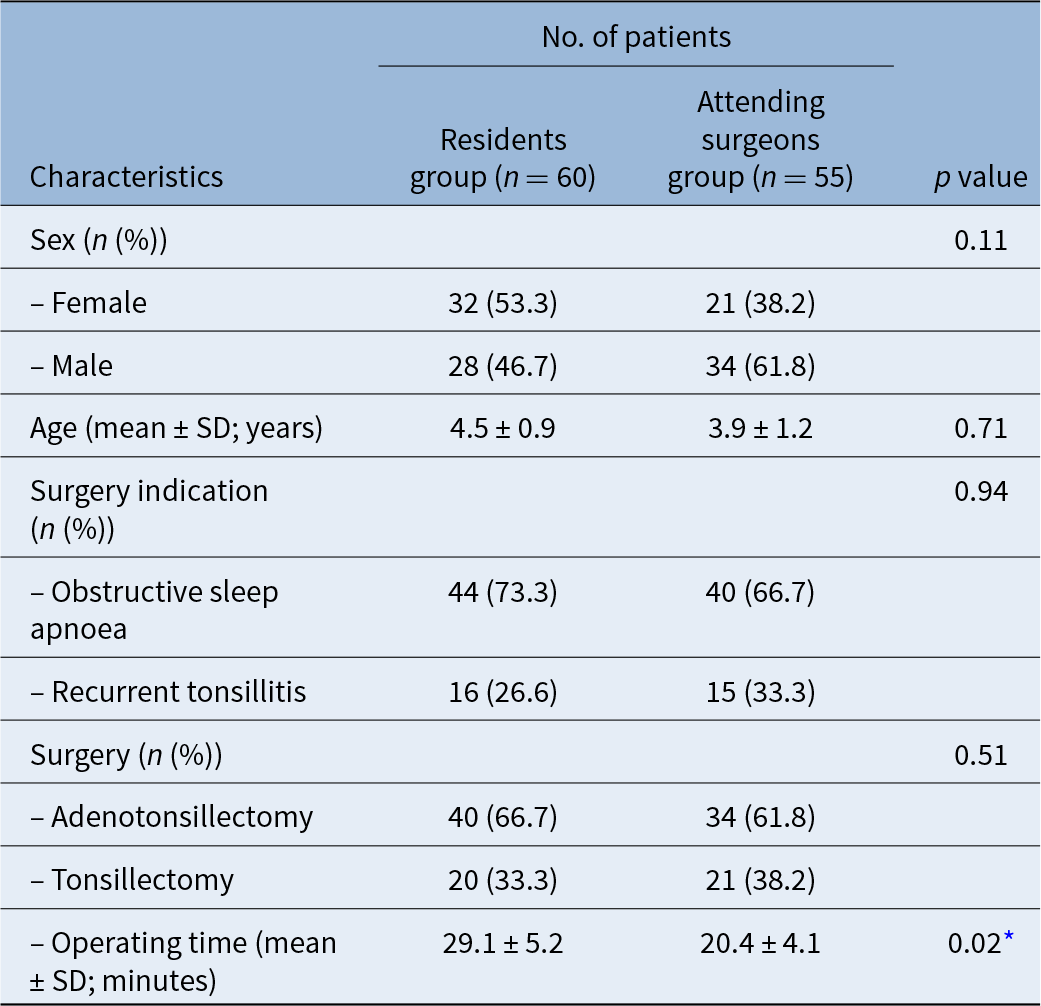
Overall, three residents who were supervised by two attending surgeons performed the operations. The mean age of the patients was 4.2 years and 62 (53.9 per cent) were male. The demographics of the patients and surgical procedures were similar in both groups (Table 1). The mean operation time was longer for the procedures performed by residents than for those performed by attending surgeons (29.1 vs 20.4 minutes, mean difference = 8.7 minutes, 95 per cent CI = 3.1–14.3 minutes, p = 0.02). During hospitalisation, post-operative bleeding necessitating revision surgery was not reported in either group. In terms of intra-operative complications, the residents’ group experienced one labial laceration case, which fully healed in two weeks.
Demographic and clinical characteristics of the cohort according to the training of the surgeon

SD = standard deviation
* to denote statistically significant findings
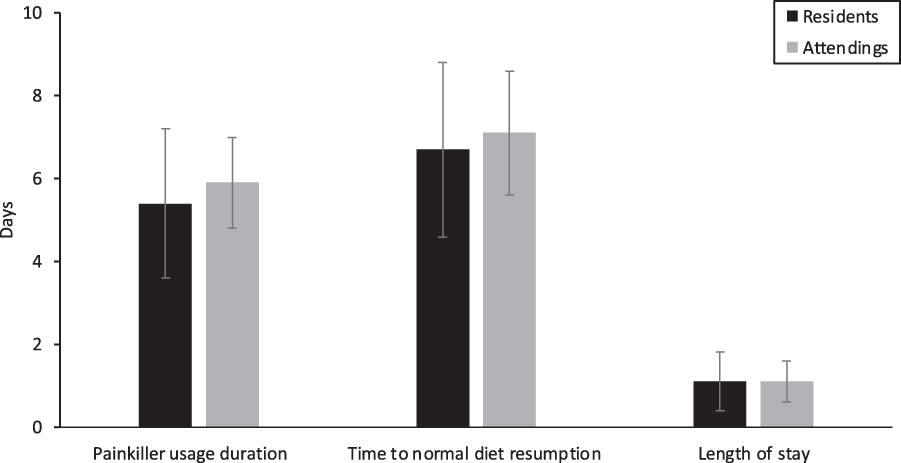
The length of hospital stay was similar in both groups, averaging 1.1 days (Figure 1). In the post-discharge period, we first compared the duration of painkiller use and time to normal diet resumption between groups. Children operated on by residents showed a shorter time to return to a normal diet and reduced use of painkillers compared with children operated on by attending physicians. However, the differences were not statistically significant (Figure 1).
Comparison of post-operative outcomes for tonsillectomy performed by attending surgeons and residents.

Finally, we evaluated post-discharge complications and re-admission rates within one month following the operation. Regarding re-admission rates, 2 patients (3.3 per cent) in the residents’ group were re-admitted, while only 1 patient (2.9 per cent) was re-admitted in the attending surgeons’ group (p = 0.77). Respective overall complication rates (pain, fever and bleeding) were 5.0 per cent (3 patients) and 5.5 per cent (3 patients) (p = 0.53). Of the procedures performed by residents, 43 were conducted by those in post-graduate years 1 and 2; the remaining 17 procedures were performed by residents who were post-graduate years 3–6. For post-graduate years 1 and 2 residents, intra- and post-admission complication rates were 3.3 and 6.3 per cent.
Discussion
Tonsillectomy, with or without adenoidectomy, is among the most common surgical interventions carried out by otolaryngologists. This surgical technique is typically introduced during early residency training, allowing residents to achieve proficiency in performing the procedure under supervision as early as post-graduate year 1, under the careful supervision of an attending physician.
This study aimed to evaluate surgical outcomes in paediatric patients undergoing tonsillectomy with or without adenoidectomy performed by residents and attending surgeons at a tertiary academic hospital. Apart from the longer operative time, the outcomes were largely similar between the two groups, encompassing rates of post-operative complication and re-admission. Even junior residents demonstrated comparable outcomes to those of their more experienced counterparts, including attending physicians.
Several factors likely contributed to the observed equivalence in outcomes. First, the anatomy and surgical technique involved in tonsillectomy are relatively straightforward, which allows residents to acquire proficiency quickly. Previous studies have documented the short learning curve associated with tonsillectomy, reinforcing the notion that this procedure can be mastered efficiently during early residency training.Reference Abou-Foul, Taghi, Tolley and Awad11, Reference Wei, Chu and Wang12 Moreover, we assume that the presence of a supervising attending likely plays a crucial role in preventing complications during surgical procedures performed by residents. This supervisory role provides a safety net, ensuring that any emerging issues can be promptly addressed.
Our findings align with those in other surgical disciplines, where residents typically require more time than attending surgeons to complete surgical procedures. However, the impact on complication rates varies. In some studies, such as those in general surgery and gynaecology, residents had either higher or similar rates of complications and re-admissions compared with attending physicians.Reference Fearing, Cusick and Helmer13–Reference Kauvar, Braswell, Brown and Harnisch15
As demonstrated in both our prospective study and the earlier retrospective study by Na’ara et al.,Reference Na’ara, Aronov, Gil and Gordin16 outcomes such as post-operative complications and re-admission rates remain comparable whether the surgery is performed by an attending surgeon or by a resident under direct supervision. Although our findings indicate that procedures performed by residents require a longer operating time, consistent with findings by Leader et al.,Reference Leader, Wiebracht, Meinzen-Derr and Ishman17 this is a well-recognised phenomenon inherent to the learning process.
From an economic perspective, longer surgical times can translate to higher operational costs.Reference Chamberlain, Patil, Minja and Kordears18 However, the incremental expense associated with resident training must be weighed against the long-term benefits of cultivating surgical competence. Investing in resident education is crucial not only for maintaining high standards in patient care but also for ensuring the future sustainability of the healthcare workforce. The slight increase in operative duration observed in our study did not lead to a higher rate of adverse outcomes, suggesting that the supervised training environment effectively mitigates potential risks.
Our prospective design adds robustness to these findings compared with previous retrospective analyses. By controlling for key variables and following a randomised allocation of cases, our study provides more definitive evidence that resident involvement, when adequately supervised, does not compromise patient safety. This is critical for academic centres, where balancing cost-efficiency with the imperative of training future surgeons is essential.
The findings also have significant implications for training programmes in academic hospitals. One of the primary goals in such settings is to train the next generation of surgeons by gradually increasing their responsibilities under careful supervision. This study provides evidence that this educational approach does not compromise patient safety in the context of tonsillectomy. It is essential to recognise the perspectives of patients and their families, who might prefer surgical procedures to be performed by attending physicians, particularly in private medical settings. Ensuring transparency about the qualifications of the operating team and the supervision structure can help alleviate concerns and build trust in the care provided in academic hospitals.
One limitation of this study is that the residents were not in the earliest stage of their surgical training. They had already built a foundation of operative experience before participating. This background may influence how our results apply to completely inexperienced residents.
• Tonsillectomy is a common surgery for children and its main complications are bleeding and pain
• The level of surgical training of the person performing a procedure may affect the outcomes, but evidence on this for tonsillectomy is limited
• Residents often perform tonsillectomy early in their training under supervision
• Tonsillectomies performed by residents, with supervision, have similar short-term outcomes compared to those done by attending surgeons
• There are no significant differences in bleeding, use of pain relief medications, when diets are resumed, hospitalisation or complications between tonsillectomies performed by residents and those done by attending surgeons, and the only significant difference is that residents take longer to complete the surgery
• The findings of this study support the safety and effectiveness of tonsillectomy performed by residents with proper supervision
Conclusions
In conclusion, this study demonstrates that tonsillectomy performed by residents, under the supervision of attending surgeons, results in outcomes comparable to those of surgical procedures performed by attending surgeons. This also reassures patients and their families that safety is maintained during resident-led surgical procedures, provided there is adequate attending supervision. Future research could further explore specific factors that contribute to successful surgical training and identify additional strategies to optimise the learning curve for residents across various surgical procedures.
Competing interests
None declared.
Data availability statement
The data collected and analysed during the current study are not publicly available because of ethical restrictions and participant confidentiality. The data that support the findings of this study are available on request from the corresponding author.