1. INTRODUCTION: ISLAMIST MILITANCY IN BANGLADESH
In March 2014, Dan Mozena, then the United States Ambassador to Bangladesh, said that Bangladesh is “a moderate and generally secular and tolerant — though sometimes this is getting stretched at the moment — alternative to violent extremism in a very troubled part of the world” (Gowen Reference Gowen2014). While Mozena's statement reflects the general perception that Bangladesh is a success story of a moderate, secular, Muslim democracy, this view never rested on strong empirical ground. Indeed, since Bangladesh's independence from Pakistan in 1971, the durability of both secularism and democracy has been undermined by numerous military coups — many of which involved multiple counter-coups before a clear “victor” emerged — in 1974–1975, 1977–1980, 1981–1982, 1996, and 2007. (In 2012, the military announced that it had thwarted yet another coup in January of that year.) Bangladesh's two mainstream political parties, the left-of-center Awami League led by Prime Minister Sheikh Hasina and the right-of-center Bangladesh National Party (BNP) led by former Prime Minister Khaleda Zia, are known more for their rivalry, corruption, and incompetence than for good governance.
Since independence, Bangladesh has experienced creeping Islamism that enjoys popular support (Fair and Oldmixon Reference Fair and Oldmixon2015). Increasingly, Bangladesh is the site of Islamist violence. According to data derived from the Global Terrorism Database maintained by the National Consortium for the Study of Terrorism and Responses to Terrorism (START), there have been 944 terrorist attacks between 2000 and 2015. While the perpetrators of the majority of events in the Global Terrorism Database are listed as “unknown” or attributed to political parties, 114 were perpetrated by confirmed Islamist militant groups. However, the victim yields for these attacks are quite low with an average of one fatality and under seven persons wounded per attack. These low victim yields may explain in part why this kind of violence in Bangladesh has attracted little attention. By way of contrast, using the same dataset, the Lashkar-e-Taiba, in the same period, has perpetrated 136 attacks killing about six persons and wounding another 14 per attack in India. Perhaps if Bangladeshi terrorist groups were more lethal, they would garner more attention. More recently, the Islamic State (IS) and Al-Qaeda Indian Subcontinent (AQIS) have claimed many of these attacks (Kumar and Iyengar Reference Kumar and Iyengar2016), casting a further pall over Bangladesh’ ostensible success story.
We aver that Bangladesh merits greater scholarly attention. After all, Bangladesh has one of the world's largest Muslim populations with more than 150 million Muslims.Footnote 1 Bangladesh's Muslim population exceeds the combined populaces of Iran (81.2 million), Afghanistan (32.6 million), and Saudi Arabia (27.7 million) (U.S. Central Intelligence Agency 2016a; 2016b; 2016c). But it is also one of the world's least developed countries: Bangladesh ranks 142 out of 190 countries according to the United Nations Human Development Index (United Nations Development Program 2015). Its citizens also view their country as plagued by corruption, ranking 139 out of 167 countries ranked in Transparency International's 2015 Corruption Perception Index (Transparency International Reference International2016). Bangladesh is an important provider of global security, consistently being one of the largest contributors to United Nations Peacekeeping Missions (United Nations 2016).Footnote 2 While not a top-tier military, its military forces are ranked 52 out of 126, using an index that considers the forces' end-strength, diversity and number of weapons systems as well as measures of national power (Global Fire Power 2016).Footnote 3
Whereas the origins of Islamist militancy and support for the same are fairly well characterized in other Muslim countries, these issues have not been explored empirically in Bangladesh. To address this lacuna, we employ data for Bangladesh from the Pew Research Center's World's Muslims Data Set to conduct an ordinary least squares regression analysis on Bangladeshi support for suicide terrorism using a set of theoretically derived independent and control variables. We find that support for suicide attacks is rather high in Bangladesh with almost half of the population finding them justified in some measure. Levels of justification for suicide attacks in Bangladesh are considerably higher than in most other Muslim countries studied by the Pew Research Center. We find that respondents who support literal interpretations of the Quran, including physical criminal punishments (known as Hudood punishments), are more likely to support suicide terrorism whereas respondents who support traditional roles of Muslim leaders (e.g., settling family disputes) are less likely to do so. We also find that males and those who view themselves as economically well-off are more supportive of suicide attacks, whereas those who are better educated are less supportive.
We organize the remainder of this article as follows. In Section 2, we provide an overview of the Islamist militant landscape in Bangladesh. In Section 3, we review the theoretical and empirical literature on the determinants of support for Islamist violence from which we draw out several testable hypotheses. In Sections 4 and 5, respectively, we describe the data and methods that we employ in this analysis and present our empirical findings. In Section 6, we conclude with a discussion of the implications of this research.
2. ISLAMIST MILITANT MILIEU IN BANGLADESH
Three complex international developments have enabled the growth of Islamist militancy in Bangladesh. First, during the 1980s, some Bangladeshis participated in the so-called “jihad” to oust the Soviets from Afghanistan where they learned to fight. Returning militants brought with them their new knowledge of insurgent warfare and jihadist ideology to Bangladesh (Hasan Reference Hasan2011). Bangladesh received about 15% of its bilateral development assistance aid from the United States in the 1980s and because the United States vigorously supported the efforts in Afghanistan (along with Saudi Arabia and China), Bangladesh tolerated its citizens traveling to and from Afghanistan to fight (Hasan Reference Hasan2012). Second, in the early 1980s, Muslim ethnic Rohingyas (International Crisis Group 2014) formed the Rohingya Solidarity Organization (RSO) in the wake of a massive military operation waged by the Myanmar military that drove some 200,000 Rohingya into Bangladesh.Footnote 4 The RSO enjoyed explicit support from the Bangladesh Jamaat-e-Islami Bangladesh (BJeI), which is Bangladesh's largest Islamist party which aims to transform Bangladesh into an Islamic state. While the size of the RSO remains debated, analysts assess that “small numbers” of Rohingya militants continued to train in remote bases in Bangladesh opposite Myanmar's Maungdaw district until the 1990s (Marshall Reference Marshall2014; International Crisis Group 2014). Rohingyas became sources of recruitment for different Islamist militant groups including the Afghan Taliban and al-Qaeda, detailed below (Lintner Reference Lintner2002a; Reference Lintner2002b; Reference Lintner2003). Three, as we describe below, Bangladesh became one of the regional hubs which Pakistan has used to train, hide, and dispatch Islamist terror groups into India for well over a decade (Montero Reference Montero2010).
There are several Islamist militant groups that have operated in the recent past or are currently operating in Bangladesh, some of which are strictly domestic while several operate across South Asia and beyond. With varying degrees of evidence, some scholars and the current Bangladeshi government assert that the BJeI is the taproot of many of the country's Islamist militant organizations. The BJeI has been able to develop political influence disproportionate to its share of votes because of its association with the BNP and its role as kingmaker in helping the BNP create a majority coalition in 2001 (Fair and Oldmixon Reference Fair and Oldmixon2015). The BJeI has attracted episodic international scrutiny since 2001 due to its purported deep involvement in numerous terror attacks which targeted Hindus, Ahmedis, Awami League activists and liberal activists in Bangladesh. The student wing of the BJeI, Islami Chhatra Shibir or Jamaat-Shibir, has also been involved in militant attacks (Kumar Reference Kumar2014).Footnote 5
The Jamatul Mujahideen Bangladesh (JMB) is an indigenous, Bangladesh-based militant group which coalesced in 1998. The JMB perpetrated many well-publicized terrorist attacks in the early 2000s, including a shocking August 2005 attack in which the group set off 459 bombs simultaneously in 63 of Bangladesh's 64 districts in effort to push the country into adopting Sharia law (The Indian Express 2015). JMB has also been linked to recent violence in Bangladesh, including an incident in Dinajpur at the end of 2015 in which an Italian Catholic priest was attacked (BBC News 2016a).
Harkat-ul-Jihad-al Islami Bangladesh (HuJI-B) was founded in 1992 and facilitated the development of many other Islamist groups in the country (Riaz and Fair Reference Riaz and Fair2011). HuJI-B is widely believed to be behind some of the earliest Islamist terrorist actions in Bangladesh, including the 1993 death threats against the feminist author Taslima Nasreen, who had to leave Bangladesh after a $5,000 bounty was put on her head (Lintner Reference Lintner2003). Analysts believe that HuJI-B tried to assassinate both Shamshur Rahman, a famed secular poet, and Prime Minister Sheikh Hasina (Hasan Reference Hasan2011). Many of HuJI-B's members came from or were trained by foreign militants, especially fighters from the war in Afghanistan (U.S. Department of State Office of the Coordinator for Counterterrorism 2006). In its early years, Osama bin Laden funded the group (Hasan Reference Hasan2011).
Many Rohingyas also closely collaborated with and even trained HuJI-B members in the 1990s (Riaz and Fair Reference Riaz and Fair2011). HuJI-B recruited members from Rohingya communities in southeastern Bangladesh (Lintner Reference Lintner2002a; Reference Lintner2002b). Because of their abject poverty and the limited number of options available to them, Rohingya fighters were often assigned to the riskiest fighting jobs, doing tasks such as carrying equipment or removing mines (Lintner Reference Lintner2002a; Reference Lintner2002b). The relationship between the RSO and Bangladeshi Islamist groups like HuJI-B and the JMB ultimately proved beneficial to both sides: the JMB, for example, taught Rohingyas to build and detonate bombs, while Rohingya experts trained JMB members in arms usage (Riaz and Fair Reference Riaz and Fair2011). Riaz and Fair argue that “this relationship, tacitly encouraged by the then Bangladesh government headed by Khaleda Zia, helped shape future relationships between various militant groups who use the hill tracts as their bases” (Riaz and Fair Reference Riaz and Fair2011, 158). Some of these fighters stayed in Bangladesh to work for HuJI-B or JMB, but many went to war to aid al-Qaeda and the Taliban in Afghanistan (Lintner Reference Lintner2002a; Reference Lintner2002b). The presence of the camps has allowed the different militant groups to collaborate, train together, and strengthen each other.
Another group of concern is Hefazat-e-Islami (HeI), which is “an alliance of teachers and students associated with radical madrasas and with JeI” (Stark Reference Stark2015). It has ties to more than 25,000 madrasahs in Bangladesh (Stark Reference Stark2015; Mustafa Reference Mustafa2013) and has linkages to the Afghan Taliban (Bashir Reference Bashir2015). This amalgamation of several Islamist organizations came to the fore when its members participated in large public demonstrations supporting the murder of a young, secular blogger in 2013. It drew further attention when it released its 13-point charter of demands, which included enactment of an anti-blasphemy law with provision for the death penalty, imposing restrictions on women, declaring Ahmedis as “non-Muslims,” among others (Mustafa Reference Mustafa2013).
In addition to these Bangladeshi groups, there are several regional Islamist militant groups that operate in Bangladesh. One such group is Lashkar-e-Taiba (LeT), which is based in Pakistan but also operates in Bangladesh. LeT has organized many terrorist attacks in both Bangladesh and India, though it is most renowned for its November 2008 assault on multiple targets in the Indian mega-city of Mumbai. LeT also operates under several front organizations, including Jamaat-ud-Dawa and Filah-e-Insaniat Foundation, all of which have been proscribed by the United Nations as “terrorist organizations” (U.S. Department of State 2010). Mufti Obaidullah, a Bangladeshi national who was associated with LeT and had fought in Afghanistan four times — in 1988, 1990, 1991, and 1992 — was arrested in 2009 after spending 14 years teaching in a Bangladeshi madrassah under a fake name (The Daily Star 2009; Habib Reference Habib2009; The Hindustan Times 2009).
Two transnational groups, (AQIS and the IS), have also become increasingly active in Bangladesh in recent years. AQIS has taken responsibility for a number of murders, including murders of secular publishers and bloggers, at least one of whom was American (Barry and Manik Reference Barry and Manik2015), while IS has taken responsibility for other attacks on foreigners, homosexuals, Shia, Ahmadis, Sufis, and religious minorities among others (Bashir Reference Bashir2015; Manik and Barry Reference Manik and Barry2016; Dwibhashyam Reference Dwibhashyam2016; Al Arabiya English 2015). In July 2016, several Bangladeshi terrorists attacked Dhaka's Holey Artisan Bakery killing 20 persons over the course of more than 12 hours (BBC News 2016b). The attackers were in touch with the IS and dedicated the attack in their name, although there is no evidence that the IS aided or abetted the terrorists in question (Swami Reference Swami2016).
Islamist militants have targeted secular writers and bloggers in particular, with a “hit list” available online. The Ansarullah Bangla Team, a banned Bangladeshi Islamist group that first gained attention in 2013, is responsible for many of these murders. Ansarullah Bangla Team, which has also called itself Ansar al-Islam and Ansar Bangla 7, is affiliated with Al-Qaeda (Al-Mahmood Reference Al-Mahmood2015). Dozens of Bangladeshis, including persons of Bangladeshi extraction in the United Kingdom, have gone to fight with the IS (Dodwell, Milton, and Rassler Reference Dodwell, Milton and Rassler2016; Roul Reference Roul2016a; Reference Roul2016b; Hussain Reference Hussain2016). Recently, IS' English-language magazine Dabiq offered a tribute to a Bangladeshi militant who died in Syria (Islamic State1437 (Rajab); Khandake Reference Khandake2016). It appears as if AQIS and IS are competing for influence, people, and cash in Bangladesh (Mahmood Reference Mahmood2016; Roul Reference Roul2016b). In attempt to retain its stronghold over South Asia, AQIS has launched its own efforts to focus upon Bangladesh and other parts of South Asia (Fair Reference Fair2014; Chandran Reference Chandran2015).
Despite these various claims by IS and AQIS, Bangladesh's government has generally insisted that these groups do not have a presence in the country (Ganguly Reference Ganguly2016; Agrawal Reference Agrawal2016) with the notable exception of the Holey Bakery attack, which forced the government to niggardly concede the potential for international connections. Instead, Prime Minister Sheikh Hasina alleges that the BNP and BJeI are conducting these attacks “to destabilize the country” (Manik Reference Manik2016). Despite Hasina's ostensibly secular reputation, she has demurred from explicitly condemning the killing of secular activists and minorities and has even blamed the victims for provoking the terrorists with their controversial speech (Sing Reference Singh2016).
3. REVIEWING THE EXTANT LITERATURE: EXPLAINING SUPPORT FOR ISLAMIST MILITANCY
The body of scholarly literature examining support for violent groups has traditionally focused on ethnic conflicts (Horowitz Reference Horowitz1985), state repression (Scott Reference Scott1976), grievances (Gurr Reference Gurr1970), and a variety of individual-level explanatory factors and motivations (inter alia Blair et al. Reference Blair, Fair, Malhotra and Shapiro2013; Blair, Lyall, and Imai Reference Blair, Lyall and Imai2013; Chiozza Reference Chiozza, Katzenstein and Keohane2007; Tessler and Robbins Reference Tessler and Robbins2007; Shafiq and Sinno Reference Shafiq and Sinno2010; Fair et al. Reference Fair, Littman, Malhotra and Shapiro2016). Here we review the expansive literature on individual-level explanations for support for militant violence and consider these studies with reference to Bangladesh's political history with the intent of generating several hypotheses which we subsequently test empirically.
3.1. Poverty and Support for Violence
One sort of personal motivation derives from poverty or perceived poverty. Several scholars have argued that low-income individuals are more likely to support militant organizations due to feelings of powerlessness and general dissatisfaction with the current political system (see, Abadie Reference Abadie2006; Esposito and Voll Reference Esposito and Voll1996; Piazza Reference Piazza2007; Tessler and Robbins Reference Tessler and Robbins2007). Yet another possible mechanism for the relationship between poverty and support for violence focuses on opportunity costs: persons living in poverty have lower opportunity costs associated with supporting political violence than their wealthier counterparts, making them more likely to do so ceteris parabis (Gates Reference Gates2002; Dal Bó and Dal Bó Reference Dal Bó and Dal Bó2011).
Ethan Bueno de Mesquita offers a somewhat different interpretation of the opportunity cost argument. He observes that poorer countries are more likely to produce terrorists but notes that the terrorists themselves are generally better educated than the societies from which they are recruited. This is because terrorist groups, like any other hirer of labor, recruit on quality: as long as there are more high quality recruits than are lower quality persons willing to join, militant groups will hire the higher quality individual. There are two components to his explanation. First, during economic downturn, those better educated persons who find themselves unemployed face larger negative changes in their opportunity costs to participate in militancy than do persons with lower educational attainment rendered unemployed. (He uses education as a proxy for quality or human capital.) Second, terrorist groups select on quality when they can and economic downturn increases the proportion of higher quality recruits compared to periods of economic growth (Bueno de Mesquita Reference Bueno de Mesquita2005).
The empirical evidence on the relationship between poverty and support for political violence is mixed (Burgoon Reference Burgoon2006; Krueger and Malekova Reference Krueger and Malekova2003; Berrebi Reference Berrebi2007). Tessler and Robbins find that “neither personal nor societal economic circumstances, by themselves, are important determinants of attitudes toward terrorism directed at the United States” (Tessler and Robbins Reference Tessler and Robbins2007). Shafiq and Sinno, using Pew's Global Attitudes Survey from 2005, find that the relationship between education and income on the one hand and support for suicide bombings on the other varies across countries and targets (Shafiq and Sinno Reference Shafiq and Sinno2010). Chiozza, also employing Pew's Global Attitudes Survey data, similarly concluded that individual-level income and support for suicide bombing varies across countries (Chiozza Reference Chiozza2011). Mousseau (Reference Mousseau2011), mobilizing Pew's 2002 Global Attitudes Survey data from 14 Muslim nations, observed that support for Islamist terrorism is highest among the urban poor.
In 2009, Blair and co-workers fielded a 6,000-person representative survey in the four main provinces of Pakistan. In contrast to the works cited above, which measures support for militancy using direct questioning, they used a series of endorsement experiments (Bullock, Imai, and Shapiro Reference Bullock, Imai and Shapiro2011) to discern indirect support for a variety of Islamist militants in Pakistan (Blair et al. Reference Fair, Malhotra and Shapiro2014). They found that poor Pakistanis were most opposed to the militants than were middle-class citizens and that this aversion was strongest among the urban poor, particularly those in violence-afflicted districts. They presented evidence that suggested urban poor are most opposed to these groups because they are most exposed to the negative externalities of militant violence. Following up on that work, Fair and co-workers fielded a nationally-representative survey in Pakistan among 16,279-persons. Per Blair et al. (Reference Blair, Fair, Malhotra and Shapiro2013), they employed the endorsement experiment methodology to measure indirect support for several Islamist militant groups operating in or from Pakistan. They found, using expenditures as a measure of socio-economic standing rather than income, that lower-class respondent were less supportive of militant groups. To further explore the linkages between socio-economic status and support for Islamist militancy, they experimentally induced perceptions of relative poverty among half of their respondents. They found that support for Islamist militant groups was lowered among those in the treatment group, relative to the untreated group (Fair et al. Reference Fair, Littman, Malhotra and Shapiro2016).
At first blush, this work in Pakistan seems most germane to our present study of Bangladesh rather than similar work on Middle Eastern or Southeast Asian polities for several reasons. First, Pakistan and Bangladesh were the same country until 1971. Prior to that the peoples of South Asia shared hundreds of years under British governance, first under the British East India Company (1600–1857) and then under the Raj (1857–1947) as well as centuries under various Portuguese, French, Mughal, Hindu, and Buddhist governance structures prior to the arrival of the British. The citizens of today's Bangladesh and those of today's Pakistan, as well as those in many states in north India, embrace a common socio-cultural history (van Schendel Reference van Schendel2009). Second, Bangladesh exhibits many — but by no means all — of the sectarian divides (i.e., Sufi, Ahl-e-Hadis, Deobandi, Shia, Ahmedi, etc.) and religious traditions of Pakistan stemming from the afore-noted shared social, cultural and religious history. Third, Islamist organizations such as JeI developed offshoots in Bangladesh from their parental organizations in Pakistan, which in turn are rooted in 19th century Islamist political movements in pre-independence India (Titus Reference Titus1959; Eaton Reference Eaton1993; Robinson Reference Robinson2004). Finally, there has been considerable movement of Islamist militant groups between both Pakistan and Bangladesh as noted above (Riaz Reference Riaz2007; Jalal Reference Jalal2008).
However, there also critical ways in which Bangladesh does not resemble Pakistan. First and foremost, the Bangladeshi state has never actively promoted jihad nor has the state nurtured and deployed jihadi organizations as a tool of statecraft. Second, unlike Pakistan where militant groups openly operate and roam freely, Bangladesh is a hostile environment and groups are forced to operate through clandestine networks and are the subject of ongoing law enforcement activities. Third, Bangladesh's popular culture does not valorize Islamist “freedom fighters” as is the case in Pakistan. In fact, in Bangladesh “freedom fighters” refer to those Bengalis who opposed Pakistani state and its efforts to Islamize ethnic Bengalis (Riaz Reference Riaz2016). Finally, Bangladesh differs from Pakistan in that while Islamist violence has increased in recent decades, it is nowhere as lethal as it is in Pakistan. Thus, findings of Blair et al. (Reference Blair, Fair, Malhotra and Shapiro2013) that poorer persons in Pakistan experience the negative externalities of terrorist violence and thus less receptive to their appeals is not likely to apply here.
Given the inconsistent empirical findings on the relationships between economic standing and support for violent politics, there is no a priori prediction for what relationship may obtain in Bangladesh. We derive two testable null hypotheses from this literature:
H1:
Economic status is not correlated with support for Islamist violence.
H2:
Perceived economic status is not correlated with support for Islamist violence.
3.2. Clash of Civilizations
Another explanation that scholars have mobilized to explain support for Islamist violence is the “clash of civilizations” thesis outlined by Huntington (Reference Huntington1984; Reference Huntington1993; Reference Huntington1996), which argues for a fundamental conflict between the Christian West and the so-called Islamic World, to posit that support for terrorism and/or militancy derives from adherence to Islam itself (Laqueur Reference Laqueur1999; Calver Reference Calvert2002; Stern Reference Stern2003; Mendelsohn Reference Mendelsohn2005). Accordingly, several public intellectuals argued that support for Islamist militancy is rooted in Muslim religiosity or faith (Laqueur Reference Laqueur1999; Calver Reference Calvert2002; Stern Reference Stern2003; Mendelsohn Reference Mendelsohn2005). While there is limited anecdotal as well as empirical support for the asserted causal relationship between Islamic piety and political violence (Weinberg, Pedazhur, and Canetti-Nisim Reference Weinberg, Pedahzur and Canetti-Nisim2003; Ginges, Hansen, and Norenzayan Reference Ginges, Hansen and Norenzayan2009), most analytic studies find little association between simply believing in Islam and supporting violent politics (Tessler and Robbins Reference Tessler and Robbins2007; Esposito Reference Esposito2002; Tessler and Nachtwey Reference Tessler and Nachtwey1998). When a correlation between embracing Islam and violence does exist, the relationship is driven by a particular understanding of Islam (e.g., for example, beliefs about the efficacy or compulsory nature of individual militarized jihad) (Fair, Malhotra, and Shapiro Reference Fair, Malhotra and Shapiro2014; Fair, Littman, and Nugent Reference Fair, Littman and Nugent2017). Other studies have found that adherence to specific sectarian traditions predict support for Islamist militant groups (Fair Reference Fair2015).Footnote 6 At least two scholars have presented limited evidence that individuals with greater knowledge of Islam, obtained through Quranic study groups and other pietic practices, are better able to resist the arguments of militant thought leaders and thus less likely to support Islamist militant politics (Wiktorowicz Reference Wiktorowicz2005; Fair, Goldstein, and Hamza Reference Fair, Goldstein and Hamza2016). This set of studies gives rise to a third testable hypothesis, namely:
H3:
Piety is not correlated with support for Islamist violence.
Another argument that epistemologically draws from the so-called “Clash of Civilizations” thesis is the contention that preferences for political Islam or Islamism — terms that scholars tend to use interchangeably — explains support for Islamist violence. Studies exploring these purported links have yielded contradictory conclusions. Fair, Littman, and Nugent contend that these conflicted results likely stem from the fact that there is no universally held understanding of what the application of Sharia looks like and from the problematic survey items that analysts use to proxy support for “political Islam” (Fair, Littman, and Nugent Reference Fair, Littman and Nugent2017). They identify and tweeze out several factors that are usually collapsed into the concept of “support for Sharia.” Motivated by the notion that some Muslims view Islamic government in terms of good governance in Afghanistan, Pakistan, the Caucasus and Central Asia, Egypt, Iran, and Turkey (Abdul-Ahad Reference Abdul-Ahad2008; Collins Reference Collins2007; Rheault and Mogahed Reference Rheault and Mogahed2008; Fair, Littman, and Nugent Reference Fair, Littman and Nugent2017), they developed several survey items to specifically indicate support for Sharia as a vehicle for providing government services and another set of questions that elicit support for scriptural literalism (physical punishments, restrictions upon women). They construct index variables for both notions of “provision” and “punishment” and find that the former does explain support for Islamist militancy while the latter does not. The mechanism they posit is that Islamist militants specifically argue for the kind of physical punishments included in the index while tending not to argue for the kinds of actions included in the other index.Footnote 7
In the context of Bangladesh, Bangladeshi militants also make specific appeals to Hudood punishments as they do elsewhere and they have specifically sought to use violence to coerce the state to abandon its judicial system and replace it with sharia courts (Bhattacharyya Reference Bhattacharyya2015). In contrast, Bangladesh’ Islamist militant groups have not made any arguments that Sharia involves the provision of public services. Applying this component approach to Sharia to Bangladesh gives rise to two additional testable hypotheses, namely:
H4:
Persons who are favorable to scriptural literalism and physical punishments will be more likely to support Islamist political violence.
H5:
Support for the notion of provision of services will not be related to support for Islamist violence.
While militant groups in Bangladesh have been arguing for a government based upon their interpretation of Sharia, Bangladesh's left-of-center political elites have demurred from such debates about the role of secularism in the state and the current government has astutely avoided any direct national conversation even though Bangladesh's civil society has strong and vocal proponents of secularism — many of whom have paid with their lives. During Bangladesh's independence movement, the West Pakistan army and their JeI allies specifically singled out and murdered Bangladesh's secularists who today are revered as Bangladesh's heroes (Bass Reference Bass2013). As noted above, Islamist militants have specifically targeted Bangladesh's secularists and liberal activists presumably as they oppose the Islamist agenda of rendering Bangladesh an Islamist state. The historical role that the struggle over secularism has played in Bangladesh's civil and not-so-civil society (Khondker Reference Khondker2006), gives rise to our final hypothesis, namely:
H6:
Respondent support for secularism should be negatively related to respondent support for Islamist militancy.
4. DATA AND METHODS
We leverage publicly available data for Bangladesh from the Pew Foundation's “World's Muslims Data Set.” These data are derived from a nationally representative survey of 1,918 adult respondents, conducted between November 2011 and February 2012 in Bangladesh's national language, Bangla (Bengali). Pew's sampling design was based on “stratified area probability of all seven administrative divisions to population size and urban/rural population” (Pew Research Center 2013a; 2013b). Pew included Bangladesh in its Global Attitudes Survey in 2014; however, that sample size was smaller (1,000 persons) and that survey did not include the variables that we require for this analysis.
While this dataset is the largest such dataset on Bangladesh and includes the most comprehensive assessment of Bangladeshi religious beliefs and practices, it has a number of drawbacks. First, Pew does not provide any geographic information other than a binary of whether or not the respondent lives in a rural or urban area. It would have been ideal had Pew at least provided information about the division in which respondents live. (Bangladesh has eight divisions.) With this kind of information, we could have merged in extant data on terrorist events (Global Terrorism Data Base) to exploit geographical variation among our respondents as a potential explanatory factor in support for violence per Blair et al. (Reference Blair, Fair, Malhotra and Shapiro2013). Second, the questions that Pew employs in its questionnaire are not tailored to Bangladesh; rather, Pew generally poses identical questions in all countries the firm surveys. Third, Pew's instrument does little to illuminate how Muslims in their multi-country study understand important yet complex concepts like “Sharia.” Finally, Pew uses a standard question about support for suicide attacks that are denuded of context even though previous studies show that respondent support for suicide attacks is highly sensitive to context and details of the attackers and victims.Footnote 8 Despite these — and other — shortcomings, these are the best data for this study.
We derive our dependent variable from the sub-optimal question that asked respondents: “Some people think that suicide bombing and other forms of violence against civilian targets are justified in order to defend Islam from its enemies. Other people believe that, no matter what the reason, this kind of violence is never justified. Do you personally feel that this kind of violence is often justified to defend Islam, sometimes justified, rarely justified, or never justified?” Despite the problematic nature of this question, the vast majority of respondents answered it. Fewer than 3% of the sample indicated that they “don't know” or “refused.” We treat these observations as missing in our regression models.
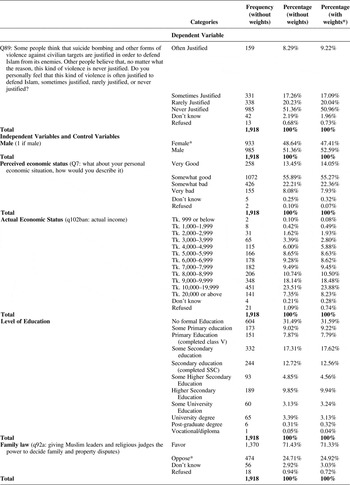
To test the posited relationship between actual economic status and support for Islamist violence (H1), we use the question that asks respondents about monthly income and use the categories provided by Pew (Tables 1a, 1b). This variable is not ideal for two reasons. First, persons are frequently not honest when asked to report income. For this reason, it is preferable to ask respondents about expenditures. Second, Pew has provided this variable in pre-set bins whereas we would prefer an continuous numerical income variable with which we could construct our own categories (e.g., quintiles).
Descriptive statistics

*Indicates the reference category in the regressions.
Descriptive statistics (with weights)

To test the posited relationship between perceived economic status and support for Islamist violence (H2), we use a question that asks respondents: “And what about your personal economic situation, how would you describe it — is it very good, somewhat good, somewhat bad or very bad?”
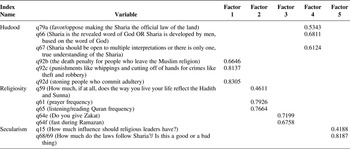
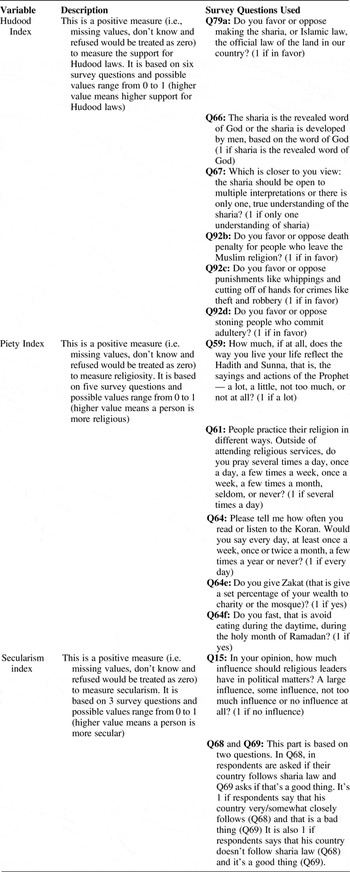
To test our hypothesized relationships in H3 and H4, we constructed two indices following the methods adopted by Fair, Littman, and Nugent (Reference Fair, Littman and Nugent2017). To test H3, we constructed a simple additive index, called “piety,” from five questions about religious beliefs and specific practices with a possible range of zero (least pious) to one (described in Appendix 1). Because this and our other additive two indices are positive measures, we treated “Don't Know” and “Refused” responses as zeros in tabulating the indices' values. Factor analysis (shown in Table 2) confirms that this index taps into two specific concepts of belief and practice. To test H4 we create a variable called “Hudood,” which resembles the “imposes” of Fair, Littman, and Nugent (Reference Fair, Littman and Nugent2017).Footnote 9 This variable, scaled from zero to one, is an additive index derived from five questions (detailed in Appendix 1) that tap into respondent support for Quranic literalism and physical punishments. Factor analysis (Table 2) confirms the two distinct concepts comprising this index.
Principle component analysis: Rotated factor loadings* (pattern matrix)

Note: Small loadings (i.e., less than 0.4) are left as blank.
To test H5, we operationalize the notion that Sharia provides service using a question that asks respondents whether or not they believe Muslims leaders should decide family and property disputes. Fair, Littman, and Nugent (Reference Fair, Littman and Nugent2017) had access to a survey that they specifically designed to test their hypotheses about the different ways respondents conceptualize Sharia and their beliefs about Islamist extremism. Unfortunately, we must make do with the questions afforded by Pew howsoever, imperfect. We believe that this question about the role of religious leaders in adjudicating family and personal disputes is the best way to operationalize this posited relationship put forth in their study because recourse to religious leaders as an informal and timely means to resolve these conflicts help preclude extrajudicial violence in Bangladesh (and elsewhere in South Asia), particularly given the enormous backlog in Bangladesh's judicial system (United Nations Development Program 2013).
To test H6, we created a third additive index variable to proxy support for respondent secularism based upon three questions (described in Appendix 1). The first asked how much influence religious leaders should have in political affairs. The second and third questions asked respondents whether they believed Bangladesh follows Sharia law and whether or not they believe this is a good or bad thing. This index ranged from zero (least supportive of secularism) to one (most supportive). Factor analysis confirmed the intuition behind this index as well, as shown in Table 2.
Based upon previous work by Shafiq and Sinno (Reference Shafiq and Sinno2010) among others who have studied respondent-level support for Islamist violence, we included the following control variables: the respondent's level of education, gender, and age. We provide descriptive statistics for the dependent, independent, and control variables in Tables 1a and 1b. Note that we indicate the reference categories that we employ in our regression models with an “*” in Table 1a.
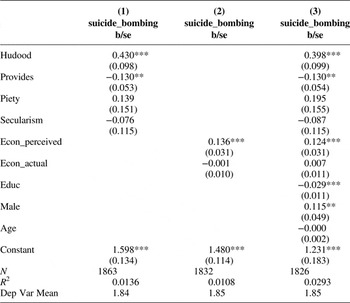
We estimated three models for our dependent variable (support for suicide bombing), using ordinary least squares regression (OLS).Footnote 10 Unless noted otherwise, we treat “Don't Know/Refused” responses as missing. Table 1a provides the response categories (including “Don't Know/Refused) for each of the variables we employ. We perform all analyses using the sample weights provided by Pew, as recommended in Pew's documentation. These weights are important because, per Pew's methodology, Pew's sample has an urban bias. Pew uses these weights to adjust for this fundamental bias in sample collection. Our OLS results are available in Table 3. The first model includes only the Islamism, piety, and secularism independent variables to isolate their effects whereas in the second model, we included only the economic variables to isolate their impacts. The third model included the entire set of independent and control variables. We consider Model 3 to be the complete model.
Regression results (with weights)

*p < 0.10; **p < 0.05; ***p < 0.01.
Source: In-house analysis.
5. DISCUSSION OF EMPIRICAL RESULTS
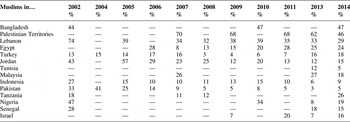
As the summary data in Table 1a indicate, 47% of our sample justifies suicide attacks in some measure. In Table 4, we benchmark this level of observed support relative to other national Muslim populations surveyed by Pew from 2002 to 2014. Pew asked this question in Bangladesh only in 2014, 2010, and 2002. In 2014 and 2010, support for suicide attacks was highest in Bangladesh. Historically, from 2002 to 2014, the highest level of support for suicide attacks came from the Palestinian Territories (70% in 2007) and Lebanon (74% in 2002).

As noted above, this question about support for suicide attacks is problematic. Support for the tactic, as discussed, has been shown to vary when respondents are given different versions of this question that vary details about the attacker, the victim and the political context in which the tactic is used. For this reason, it is important to note that Bangladesh has experienced only four suicide bombings as of 2016 (Chicago Project on Security and Threats 2016) compared to other countries surveyed by Pew, which have experienced such attacks more frequently. Moreover, the suicide attacks in Bangladesh have had some of lowest victim yields observed in suicide bombings (Chicago Project on Security and Threats 2016). (See data table in Appendix 2 for details.) It is possible that support for suicide attacks in Bangladesh is high because it has witnessed so few attacks. In Pakistan, for example, support for suicide bombing began to decline once Pakistanis began experiencing the lethality of the tactic in their own country (Fair Reference Fair2009). This suggests a free-rider effect: persons may be willing to support this kind of violence as a show of force against the “enemies of Islam” (as the question is phrased), provided that their own country does not experience the negative consequences of its use.
Turning to the results of our model estimations, we find no evidence from either model 2 or 3 to support H1 that economic status varies with support for Islamist violence, as some other afore-cited studies have found. Because the variable for this measure is problematic for several reasons previously explained, we cannot rule out measurement error with this variable. To test H1 more thoroughly, we require a better measure of income than we have in this survey. However, we find strong evidence for H2, which holds that perceived economic status will positively vary with support for Islamist violence. This is consistent with the findings of Blair et al. (Reference Blair, Fair, Malhotra and Shapiro2013) who found that wealthier Pakistanis tend to be more supportive of Islamist violence. They found that the urban poor were in fact the most opposed to Islamist militant groups. By using district-level violence as an explanatory factor for public support for Islamist militants, they conclude that one reason why the urban poor are most opposed to these groups is that they are far more likely to experience the negative externalities of this violence relative to wealthier Pakistanis as Pakistani terror groups tend to conduct attacks in congested areas in Pakistanis cities, where the wealthy are less likely to live and conduct business. We are unable to replicate this approach here because Pew does not provide locational information. This is likely an important future direction for research should suitable data become available.
Consistent with our prediction in H3, we find no statistically significant relationship between piety and support for suicide bombing in either model 1 or 3. This finding for Bangladesh is similar to the finding of Fair, Littman, and Nugent (Reference Fair, Littman and Nugent2017) for Pakistan.
Turning to H4 which posited that those who support scriptural literalism will be more likely to support Islamist political violence, we find strong support for this hypothesis in models 1 and 3. This result also comports with that of Fair, Littman, and Nugent (Reference Fair, Littman and Nugent2017). Unravelling why such persons are more supportive of suicide attacks is a challenge given the suboptimal phrasing of Pew's suicide bombing question and the fact that suicide bombing in Bangladesh is recent and rare. One possible explanation for this finding is that the Islamist militant organizations which have perpetrated suicide bombing, ostensibly to protect Islam, generally espouse such literalist interpretations of Islam and wage their campaigns of violence with the explicit goal of establishing a regime which is governed by their version of Sharia. These groups include transnational organizations such as Al-Qaeda and the IS (and their regional affiliates) as well as regional Islamist militant groups such as, inter alia, the Afghan Taliban in Afghanistan, the Pakistani Taliban in Pakistan, al Shabab in Somalia, Hamas and numerous other groups in the Palestinian Territories. Second, while most of Bangladesh’ indigenous terrorist groups have not engaged in suicide bombing, they too have conducted violence with the explicit goal of imposing literalist interpretations of Sharia upon Bangladeshis (Roul Reference Roul2016a). One recent study by Ciftci, O'Donnell, and Tanner (Reference Ciftci, O'Donnel and Tanner2017) supports this explanation in some measure. They utilized 2012 survey data for Muslim respondents from the Pew Global Attitudes Project surveys for Egypt, Jordan, Tunisia, and Turkey. They found that respondents “who desire the implementation of Islamic law based on a highly distinct interpretation of religious texts (literalist outlook) lean more favorably toward al-Qaeda” (Ciftci, O'Donnell, and Tanner Reference Ciftci, O'Donnel and Tanner2017, 2).
Turning to H5, we found no significant correlation between support for the traditional role of Islamist leaders resolving disputes and support for suicide bombing (H5). Recall that Fair, Littman, and Nugent (Reference Fair, Littman and Nugent2017) did find a correlation between these variables in their survey of Pakistan. There are several potential explanations for this discordant finding. First, the differences may simply be attributed to the different way in which both studies instrumentalized the dependent variables and/or the independent variables or other important differences in how the two studies were conducted, including the surveys that are employed in each. A second explanation may be the important differences in Bangladeshi and Pakistani polities and/or the kinds of Islamist actors operating in both countries. Unfortunately, we are unable to definitively account for these differences with these data.
Among the control variables, two are significant: males are more likely to support suicide bombing as are persons with less education. Few studies have explored the impacts of gender upon support for Islamist violence. Those studies that have examined gender as an explanatory factor have found that gender's effects vary widely across Muslim polities (Fair and Shepherd Reference Fair and Shepherd2006). Similarly, with respect to education, Shafiq and Sinno (Reference Shafiq and Sinno2010) find that the effect of educational attainment on support for suicide attacks varies across countries.Footnote 11
CONCLUSION AND IMPLICATIONS
Bangladesh is a highly-populated and troubled country but it has generally been ignored by the security studies community and is under-represented in large-n surveys of the type employed in this study. This remains the case despite the variegated history of Islamist violence and the recent spate of violent attacks on non-Muslim minorities, Sufis, Ahmedis, liberal and secular social activists, and foreigners as well as the high levels of support for suicide bombing among the population. Even though both the IS and Al-Qaeda in South Asia have locked their sights on one of the world's largest Muslim countries, the government remains rooted in a posture of denial about the activities of these two organizations on Bangladeshi soil. Equally disturbing, the country's institutions are highly politicized and the two mainstream parties seem more interested in fighting each other than the serious sources of instability that threatens the country.
There is a pressing need for more and better data about this important country. As we have discussed herein, these Pew data are important because they exist and are available to scholars. However, Pew uses sample sizes that are smaller than desired, poses questions that are not specific to Bangladesh, and does no collect geographical reference points that would permit scholars to merge in other forms of data that may help explain variation in support for suicide attacks. Critically, due to the nature of these data, we are unable to study important potential relationships between geographical variation in exposure to violence and beliefs about violence.
Despite the limitations of this present study, we believe that our findings are important if disquieting. Variables that strongly predict support for suicide bombings, such as our “Hudood” index, have significant support. We suspect — but cannot show definitively — that this may be due to the fact that major transnational and regional Islamist militant groups engaging in suicide bombing seek to establish emirates wherein they impose their interpretations of Sharia as do the various Bangladeshi domestic militant groups. And as we noted earlier in this paper, Bangladesh has witnessed a long and often sanguinary political struggle between those who favor secularism and those, such as the BJeI, who seek to transform Bangladesh into an IS
While popular support for notions of Islamist leaders providing dispute resolution is high, with some 70% of respondents embracing it, the mitigating value of this variable is less than the exacerbating contribution of the “Hudood” index. Bangladesh has consistently attracted the attention of development economists and sociologists and it has long been the recipient of developmental aid intended to expand employment and educational opportunities. However, these variables are opposing in their impacts upon support for suicide terrorism. While education seems to mitigate support for violence, higher perceived economic standing exacerbates it. The different influences of these variables suggest that developmental assistance is unlikely to have the palliative effects aid organizations often claim.
Too often scholars, analysts, and policy makers find themselves chasing problems only after they emerge. There is a real chance to prevent both the further spread of Islamist militancy and increased lethality in the attacks in this important but overlooked country. This can happen only if scholars and policy makers embrace this challenge earnestly and rigorously. We hope that this present study motivates others to begin making Bangladesh a focus of crucial scholarly and policy analytic inquiry.
APPENDIX 1. CONSTRUCTING THE INDICES
Variables used to construct indices

Below we provide the survey questions that we used in the construction of the Hudood, Piety, and Secularism indices.
Q15: In your opinion, how much influence should [In Iran: religious figures; in all other countries: religious leaders] have in political matters? A large influence, some influence, not too much influence or no influence at all?
-
1 Large influence
-
2 Some influence
-
3 Not too much influence
-
4 No influence at all
-
8 Don't know (DO NOT READ)
-
9 Refused (DO NOT READ)
Q59: How much, if at all, does the way you live your life reflect the Hadith and Sunna, that is, the sayings and actions of the Prophet — a lot, a little, not too much, or not at all?
-
1 A lot
-
2 A little
-
3 Not too much
-
4 Not at all
-
8 Don't know (DO NOT READ)
-
9 Refused (DO NOT READ)
Q61: People practice their religion in different ways. Outside of attending religious services, do you pray several times a day, once a day, a few times a week, once a week, a few times a month, seldom, or never?
-
1 Several times a day
-
2 Once a day
-
3 A few times a week
-
4 Once a week
-
5 A few times a month
-
6 Seldom
-
7 Never
-
8 Don't know (DO NOT READ)
-
9 Refused (DO NOT READ)
Q64e: Do you give zakat that is give a set percentage of your wealth to charity or the mosque?
-
1 Yes
-
2 No
-
8 Don't know (DO NOT READ)
-
9 Refused (DO NOT READ)
Q64f: Do you fast, that is avoid eating during the daytime, during the holy month of Ramadan?
-
1 Yes
-
2 No
-
8 Don't know (DO NOT READ)
-
9 Refused (DO NOT READ)
Q65: Please tell me how often you read or listen to the Koran. Would you say every day, at least once a week, once or twice a month, a few times a year or never?
-
1 Every day
-
2 At least once a week
-
3 Once or twice a month
-
5 A few times a year
-
6 Never
-
8 Don't know (DO NOT READ)
-
9 Refused (DO NOT READ
Q66: I am going to read you two statements, please tell me which comes closer to your view, even if neither is exactly right.
-
1 The sharia is the revealed word of God.
OR
-
2 The sharia is developed by men, based on the word of God.
-
3 Both (DO NOT READ)
-
8 Don't know (DO NOT READ)
-
9 Refused (DO NOT READ)
Q67: Which is closer to you view: the sharia should be open to multiple interpretations or there is only one, true understanding of the sharia?
-
1 Should be open to multiple interpretations
-
2 One true understanding
-
3 Neither (DO NOT READ)
-
8 Don't know (DO NOT READ)
-
9 Refused (DO NOT READ)
Q79a: Do you favor or oppose making the sharia, or Islamic law, the official law of the land in our country?
-
1 Favor
-
2 Oppose
-
8 Don't know (DO NOT READ)
-
9 Refused (DO NOT READ)
Q92: Do you favor or oppose the following? (READ LIST)
-
1 Favor
-
2 Oppose
-
8 Don't know (DO NOT READ)
-
9 Refused (DO NOT READ)
Q92b: The death penalty for people who leave the Muslim religion
Q92c: Punishments like whippings and cutting off of hands for crimes like theft and robbery
Q92d: Stoning people who commit adultery
NOTE: We created a new dummy variable using Q68 and Q69. This new variable was a positive measure of respondent's secularity. It was 1 if respondent believed that
-
• Their country's laws closely follow sharia (if Q68 is 1 or 2) AND it is a bad thing (if Q69 is 2)
-
• Their county's laws do not follow share (if Q68 is 3 or 4) AND it is a good thing (if Q69 is 1)
Otherwiseit was coded as zero.
Q68: How closely, if at all, do the laws in our country follow the sharia? Would you say very closely, somewhat closely, not too closely or not at all closely?
-
1 Very closely
-
2 Somewhat closely
-
3 Not too closely
-
4 Not at all closely
-
8 Don't know (DO NOT READ)
-
9 Refused (DO NOT READ)
ASK IF ANSWER GIVEN (Q68 = 1, 2, 3, 4)
Q69: And is this a good thing or a bad thing?
-
1 Good thing
-
2 Bad thing
-
3 Neither (DO NOT READ)
-
8 Don't know (DO NOT READ)
-
9 Refused (DO NOT READ)
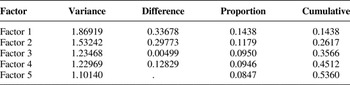
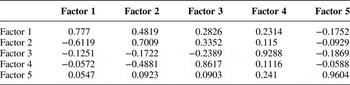
To validate our indices, we conducted factor analysis (principle component analysis).
Method: principal-component factors; Rotation: orthogonal varimax (Kaiser off); Number of observations = 1,918; Retained factors = 5; Number of params = 55.
Principal component analysis

factor rotation matrix

APPENDIX 2. SUICIDE ATTACKS BY COUNTRY

APPENDIX 3. ORDERED LOGIT REGRESSION RESULTS