Aromatics, especially benzene, toluene and xylene, are important organic chemical materials in the petrochemical industry. The traditional production of aromatics is derived mainly from catalytic reforming of naphtha (Yoshio, Reference Yoshio1992; Wei et al., Reference Wei, Chen, Cao, Wen, Zhou, Xu and Zhu2017). However, the situation regarding paraffin-based crude oil in China has resulted in serious shortages of catalytic reforming raw materials, and it is difficult to improve the yields of aromatics through catalytic reforming. Therefore, it is important to develop alternative production processes for aromatics.
The aromatization of light hydrocarbons is a novel method for the production of aromatics which uses low-cost, light hydrocarbons as raw materials. Light hydrocarbons are converted to aromatics by cracking, dehydrogenation, oligomerization, hydrogen transfer, cyclization and isomerization through this process (Viswanadham et al., Reference Viswanadham, Dhar and Rao1997; Barthos & Solymosi, Reference Barthos and Solymosi2005; Fan et al., Reference Fan, Yin, Shi, Liu and Bao2009). The number and strength of the acid sites in the catalyst are important factors that affect the activity and product selectivity in the aromatization reaction (Aloise et al., Reference Aloise, Catizzone, Migliori, Nagy and Giordano2017; Samanta et al., Reference Samanta, Bai, Robinson, Chen and Hu2017). The strong acid sites, which are responsible for hydrogen transfer reactions, can improve the formation of aromatics (Sahoo et al., Reference Sahoo, Viswanadham, Ray, Gupta and Singh2001). Unfortunately, coke (polyaromatic species) forms rapidly at the strong acid sites (Valle et al., Reference Valle, Castaño, Olazar, Bilbao and Gayubo2012; Wei et al., Reference Wei, Chen, Cao, Wen, Zhou, Xu and Zhu2017). This coke covers some of the acid sites and blocks the channels of the catalyst, thereby affecting the activity and selectivity of the catalyst (Guisnet & Gnep, Reference Guisnet and Gnep1996). Adjusting the acidity and pore structure of the catalyst would be a reasonable method for inhibiting the formation of coke. Viswanadham et al. (Reference Viswanadham, Pradhan, Ray, Vishnoi, Shanker and Rao1996) investigated the effects of H-ZSM-5 and Zn/H-ZSM-5 zeolite catalysts on n-heptane aromatization reactions and reported that the incorporation of zinc might enhance the concentration of olefin precursors through its effective dehydrogenation action on paraffins, which ultimately led to improvements in yields of aromatics.
Montmorillonite (MMT) is a 2:1 clay mineral composed of two Si tetrahedral sheets sandwiching an octahedral Al sheet (Hao et al., Reference Hao, Wang, Zhao, Liu and Liu2013). Considering the composition and layered structure of MMT, the textural and chemical properties of MMT may be significantly adjusted through several methods, such as acid and alkaline activation, cation exchange and pillaring (Komadel, Reference Komadel2003; Temuujin et al., Reference Temuujin, Jadambaa, Burmaa, Erdenechimeg, Amarsanaa and MacKenzie2004; Gao et al., Reference Gao, Zhao, Luo, Wu, Ye, Wang and Zhang2014; Hao et al., Reference Hao, Wang, Zhao, Liu and Liu2013; Zhao et al., Reference Zhao, Hao, Song, Fan, Liu and Liu2013; Taxiarchou & Douni, Reference Taxiarchou and Douni2014). Among the available modification methods, acid activation has been regarded as one of the most simple and effective strategies for adjusting the porosity and acidity of MMT (Komadel, Reference Komadel2003; Temuujin et al., Reference Temuujin, Jadambaa, Burmaa, Erdenechimeg, Amarsanaa and MacKenzie2004). Recently, the structural, textural and acidic properties of Na-MMT were adjusted via activation with HNO3 simply by varying the acid activation conditions (Zhao et al., Reference Zhao, Wang, Hao, Liu and Liu2015).
In the present study, acid-activated MMTs (Acid-MMTs) with various textural and acidity properties were prepared by treating Na-MMT with HNO3 under various conditions, and these were then impregnated with zinc and examined in terms of their performance in the aromatization reaction. The influence of the textural and acidic properties of the Acid-MMT on the aromatization reaction using Zn/Acid-MMT catalysts was investigated.
Experimental
Catalyst preparation
The Na-MMT (Zhejiang Sanding Group Co., Ltd) was dispersed in 20 wt.% aqueous HNO3 solution at a concentration of 2 wt.% and was heated to 70°C and 104°C for 4 and 12 h under stirring. After treatment, the suspension was centrifuged, washed, dried and calcined at 500°C for 4 h. The resulting materials were denoted Acid-MMT-t/T, where t and T are the treatment time (h) and temperature (°C), respectively.
The catalysts loaded with 4 wt.% Zn were prepared via the incipient impregnation method using Zn(NO3)2⋅6H2O as the Zn precursor. After impregnation, the samples were dried at 120°C for 12 h and then calcined at 500°C for 4 h with a temperature ramp of 5°C min–1.
Characterization techniques
X-ray diffraction (XRD) traces of samples were obtained on a Bruker D8 Advance X-ray diffractometer at room temperature using monochromatized Cu-Kα radiation (40 kV and 40 mA), with a scanning speed of 6° min–1.
Fourier-transform infrared (FTIR) spectra of pyridine adsorbed on samples (Py-IR) were collected using a Bruker Vertex 70 spectrometer. Typically, the samples (~20 mg) were pressed into self-supporting wafers and were preheated to 400°C for 1 h under vacuum. Subsequently, the wafer was cooled to 30°C and saturated in pyridine vapour for 0.5 h. Then, the wafer was heated to 150°C under vacuum. After 0.5 h, the spectrum was recorded. The IR spectra obtained from pyridine adsorption were subtracted from the corresponding background spectra to get the Py-IR spectra.
Aromatization reaction
The catalytic tests were carried out at 550°C and at 0.2 MPa in a stainless steel tubular reactor (inner diameter = 10 mm) by loading 1.0 g of catalyst (40–60 mesh) using n-heptane with a LHSV (liquid hourly space velocity) of 1.0 h–1 as a feed. To avoid condensation of the products, the line between the outlet of the reactor and the inlet of the gas chromatography (GC) column was heated to 180°C. The effluent products were analysed using online GC equipped with a PONA capillary column (50.0 m × 0.2 mm × 0.5 μm) and a flame ionization detector.
Results and discussion
Characterization of the sample
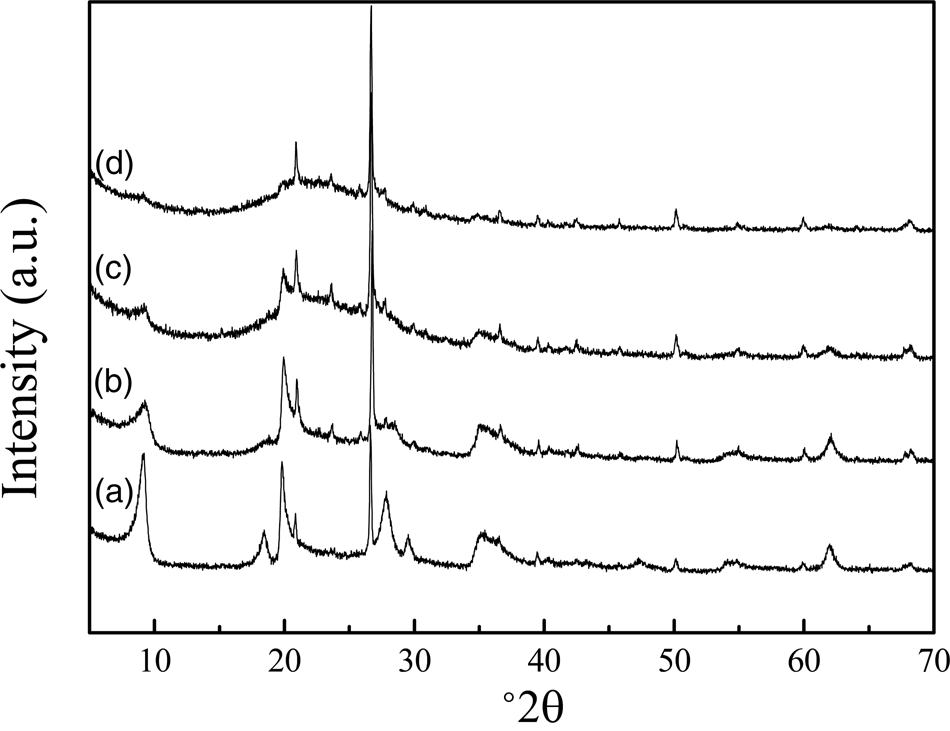
The XRD traces of the Zn-supported MMTs are shown in Fig. 1. The diffraction intensity of the (001) peak of MMT of the Zn/Acid-MMTs decreased compared to that of Zn/Na-MMTs, or disappeared entirely. This suggests that the layered structure of MMT was subjected to partial dissolution due to dealumination during acid activation. The intensity of the (001) diffraction peak of Zn/Acid-MMT-12/70 was slightly less than that of Zn/Acid-MMT-4/70. In addition, the (001) diffraction peak of Zn/Acid-MMT-12/104 disappeared completely, suggesting considerable dissolution of the layered structure of MMT, indicating that the structure of MMT might be adjusted by altering the acid-treatment conditions. Compared with its Acid-MMT counterpart (Zhao et al., Reference Zhao, Wang, Hao, Liu and Liu2015), the (001) diffraction peak position of MMT was not changed for all Zn/Acid-MMT samples, although their intensities were clearly decreased. This suggests that the regularity of the layered structure of MMT was further decreased after the introduction of Zn. However, the presence of Zn phases was not verified, indicating that Zn was well dispersed on the MMT.
XRD traces for Zn-supported (a) Na-MMT, (b) Acid-MMT-4/70, (c) Acid-MMT-12/70 and (d) Acid-MMT-12/104.

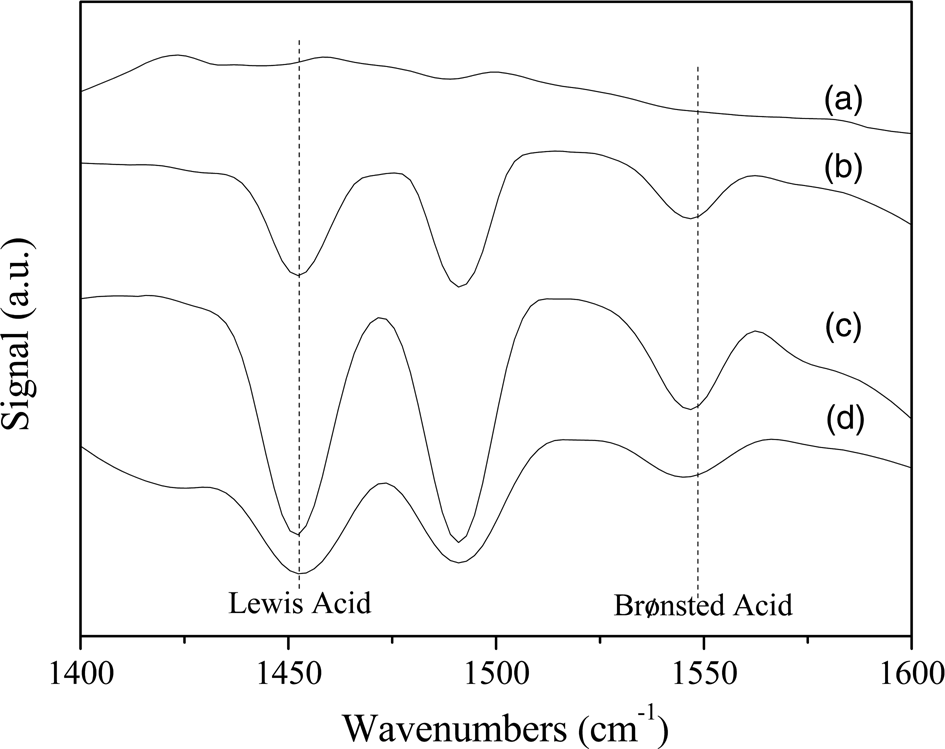
The FTIR spectra of adsorbed pyridine were used to identify the changes in the Lewis-acid sites (LAS) and Brønsted-acid sites (BAS) of the MMT (Fig. 2). The intensity of the band at ~1540 cm–1 associated with pyridinium ions generated on BAS and of the band at 1450 cm–1 attributed to coordinate interaction of bound pyridine with LAS (Topsoe et al., Reference Topsoe, Joensen and Derouane1988; Wei et al., Reference Wei, Chen, Cao, Wen, Zhou, Xu and Zhu2017) increased to a maximum, and then reduced with increasing treatment time and temperature. Furthermore, the increase of LAS and BAS in Acid-MMT was different after Na-MMT treated by acid.
Py-IR profiles of (a) Na-MMT, (b) Acid-MMT-4/70, (c) Acid-MMT-12/70 and (d) Acid-MMT-12/104.

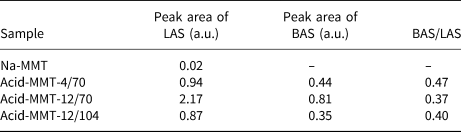
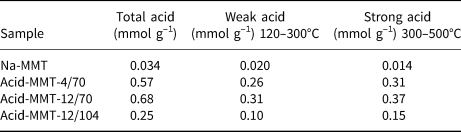
To better observe the change in LAS and BAS of Acid-MMT, the areas of the band assigned to LAS and BAS in Fig. 2 were integrated, and the results are shown in Table 1. The change in LAS and BAS for Acid-MMT are seen clearly; Acid-MMT-12/70 presented the most LAS and BAS. The different proportions of LAS and BAS further indicate that the degree of modification of LAS and BAS varied during acid activation of MMT. Hence, the proportions of LAS and BAS might be adjusted by modifying the conditions of acid treatment. Moreover, the acid strength of MMT was adjusted through acid treatment, and a large number of weak and strong acid sites were produced due to the exchange of interlayer cations with protons and the formation of tetrahedral Al3+ from the leaching of one of the pair of the octahedrally coordinated Al3+ ions during acid treatment (Kumar et al., Reference Kumar, Jasar and Bhat1995; Zhao et al., Reference Zhao, Wang, Hao, Liu and Liu2015). The proportions of total, weak and strong acid sites were calculated by integrating the NH3-TPD (temperature-programmed desorption) band area (Zhao et al., Reference Zhao, Wang, Hao, Liu and Liu2015), in which the areas of 120–300°C and 300–500°C were ascribed to weak and strong acid sites, respectively. The results are shown in Table 2. The proportion of acid sites increased to a maximum and then reduced with increasing treatment time and temperature. In addition, Acid-MMT-12/70 exhibited the maximum total, strong and weak acid sites. Therefore, the acid type and strength might be adjusted by altering the acid-treatment conditions.
Peak area of Py-IR for various samples.

The amount of acid sites with different strengths for the various samples.

Catalytic performance
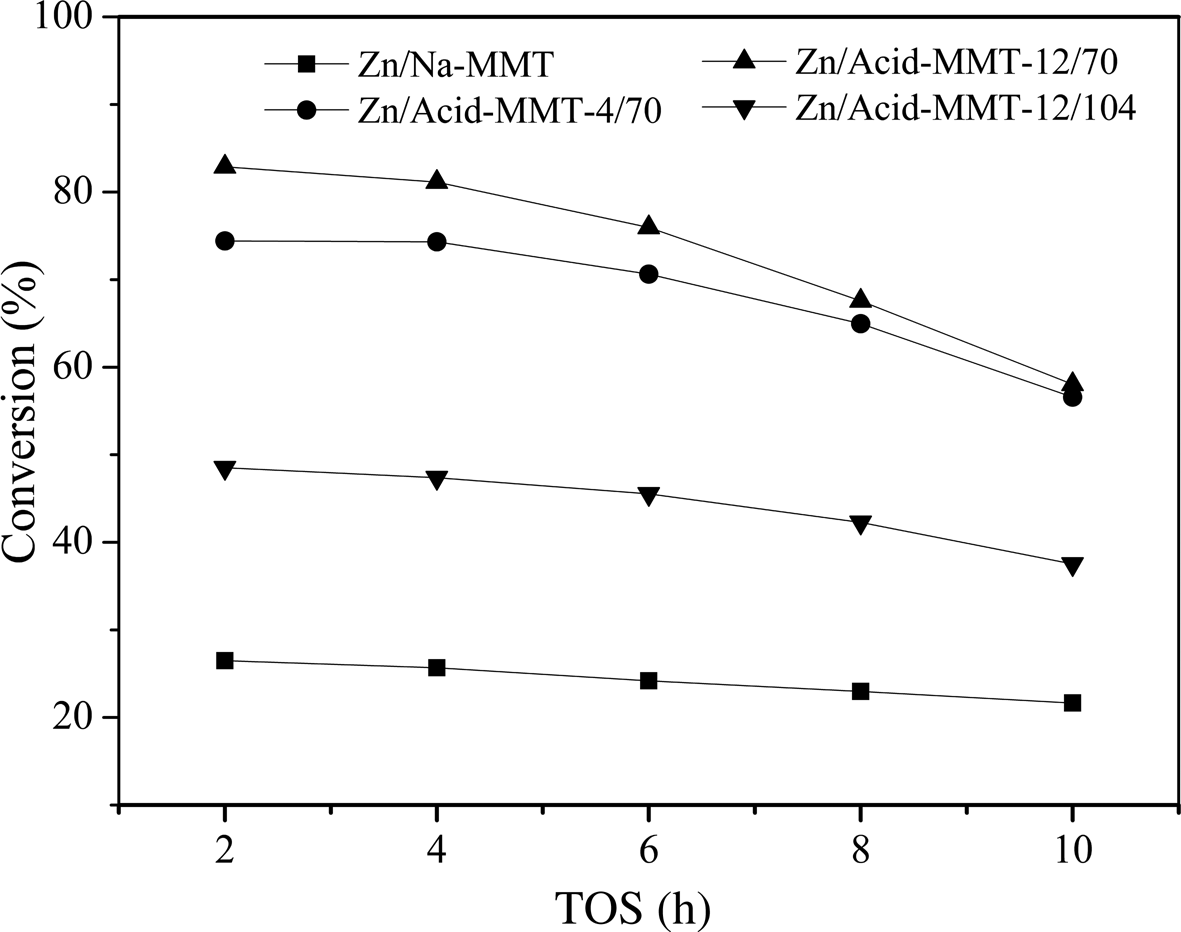
The conversion of heptane obtained on the Zn-supported materials derived from MMT as a function of time on stream (TOS) is shown in Fig. 3. Compared with Zn/Na-MMT, the heptane conversion for Zn/Acid-MMT increased significantly. The conversion was heavily dependent on the acid-treatment conditions (i.e. it increased to a maximum, and then it decreased with increasing treatment time and temperature). The Zn/Acid-MMT-12/70 catalyst achieved the maximum heptane conversion.
TOS heptane conversions for the various catalysts.

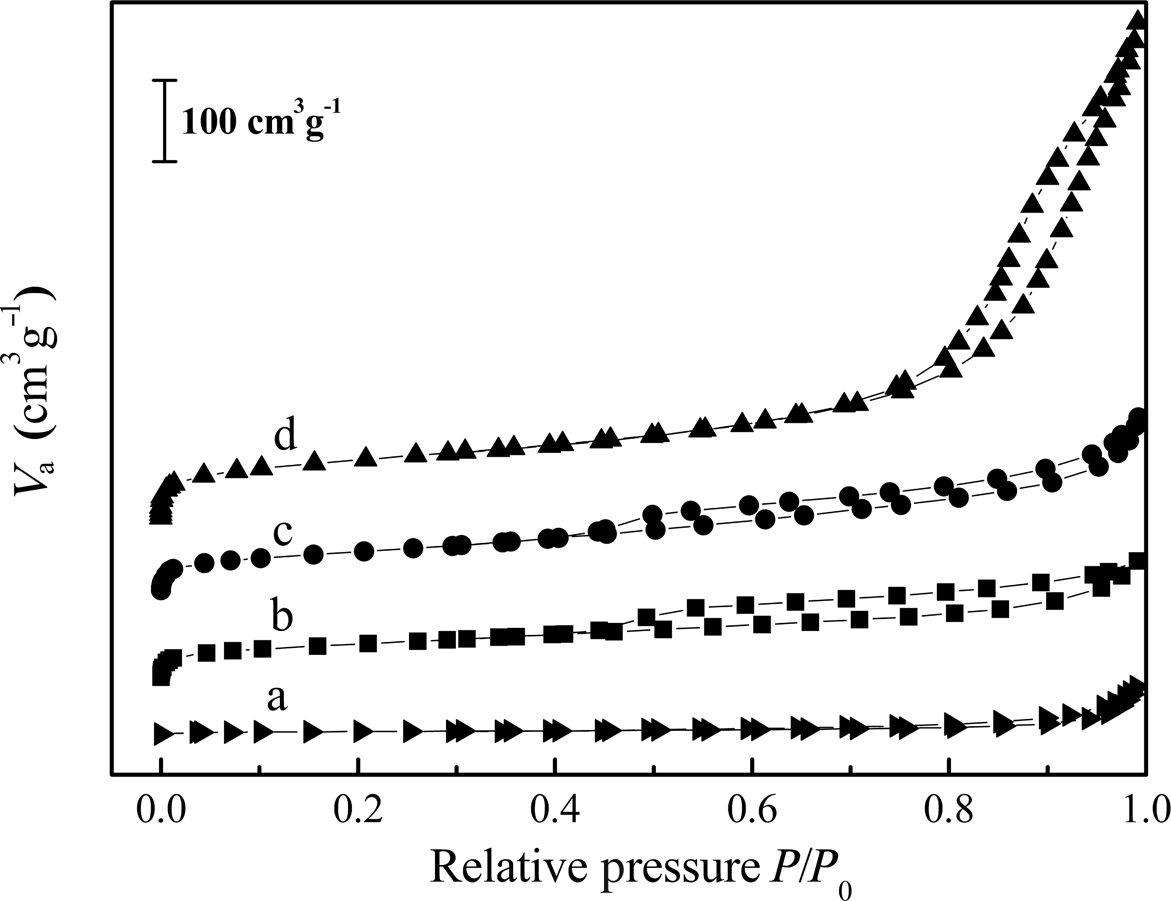
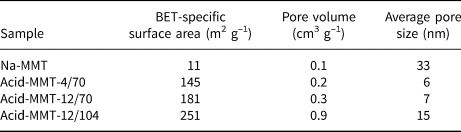
The textural properties of MMT might be adjusted by acid treatment (Fig. 4 & Table 3) (Zhao et al., Reference Zhao, Wang, Hao, Liu and Liu2015). For example, the Brunauer–Emmett–Teller (BET)-specific surface area of the Acid-MMTs increased sharply compared with that of raw Na-MMT, with the increase depending on the acid-treatment conditions. In addition, the BET-specific surface area, the pore volume and the average pore size increased monotonically with increasing intensity of the acid-treatment conditions. This might be attributed to the fact that most micro- and meso-porosity was formed after acid treatment of Na-MMT under various conditions, due to the presence of disordered domains resulting from the collapse of the MMT lamellar structure. To explain these activity results, the pore size, BET-specific surface area and pore volume of the catalysts (Table 3) were associated with heptane conversions. Clearly, the porous properties of the catalysts were not key factors in controlling the aromatization reaction. It has been reported that the aromatization reaction of light hydrocarbons involves cracking, oligomerization, hydrogen transfer and cyclization reactions, which are related to the acid sites of the catalyst (Viswanadham et al., Reference Viswanadham, Dhar and Rao1997; Fan et al., Reference Fan, Yin, Shi, Liu and Bao2009). This was observed by correlating the number of acid sites in the catalyst (Table 2) with the heptane conversion over different catalysts (i.e. the heptane conversion increased with increasing total number of acid sites). This is in general agreement with previous work in which heptane conversion over a series of stream-treated ZSM-5 catalysts declined with decreasing density of acid sites (Sahoo et al., Reference Sahoo, Viswanadham, Ray, Gupta and Singh2001). At the beginning of TOS, the Zn/Acid-MMT-12/70 catalyst exhibited maximum activity, which decreased sharply with increasing TOS. The heptane conversion over Zn/Acid-MMT-4/70 was similar to that of Zn/Acid-MMT-12/70 after reaction for 10 h, which demonstrated that the stability of Zn/Acid-MMT-4/70 was greater than that of Zn/Acid-MMT-12/70. The catalyst deactivation for aromatization has commonly been attributed to carbon deposition on the strong BAS of the catalyst (Valle et al., Reference Valle, Castaño, Olazar, Bilbao and Gayubo2012; Wei et al., Reference Wei, Chen, Cao, Wen, Zhou, Xu and Zhu2017; Zhao et al., Reference Zhao, Gao, Wang, Zhou and Huang2018). In fact, there were fewer BAS for Zn/Acid-MMT-4/70 than for Zn/Acid-MMT-12/70 (Table 1); thus, the catalyst stability would be enhanced. Indeed, it was observed that the Zn/Acid-MMT-12/104 catalyst with fewer BAS exhibited greater stability.
N2 adsorption–desorption isotherms of (a) Na-MMT, (b) Acid-MMT-4/70, (c) Acid-MMT-12/70 and (d) Acid-MMT-12/104.

Summary of the textural properties of the various MMTs.

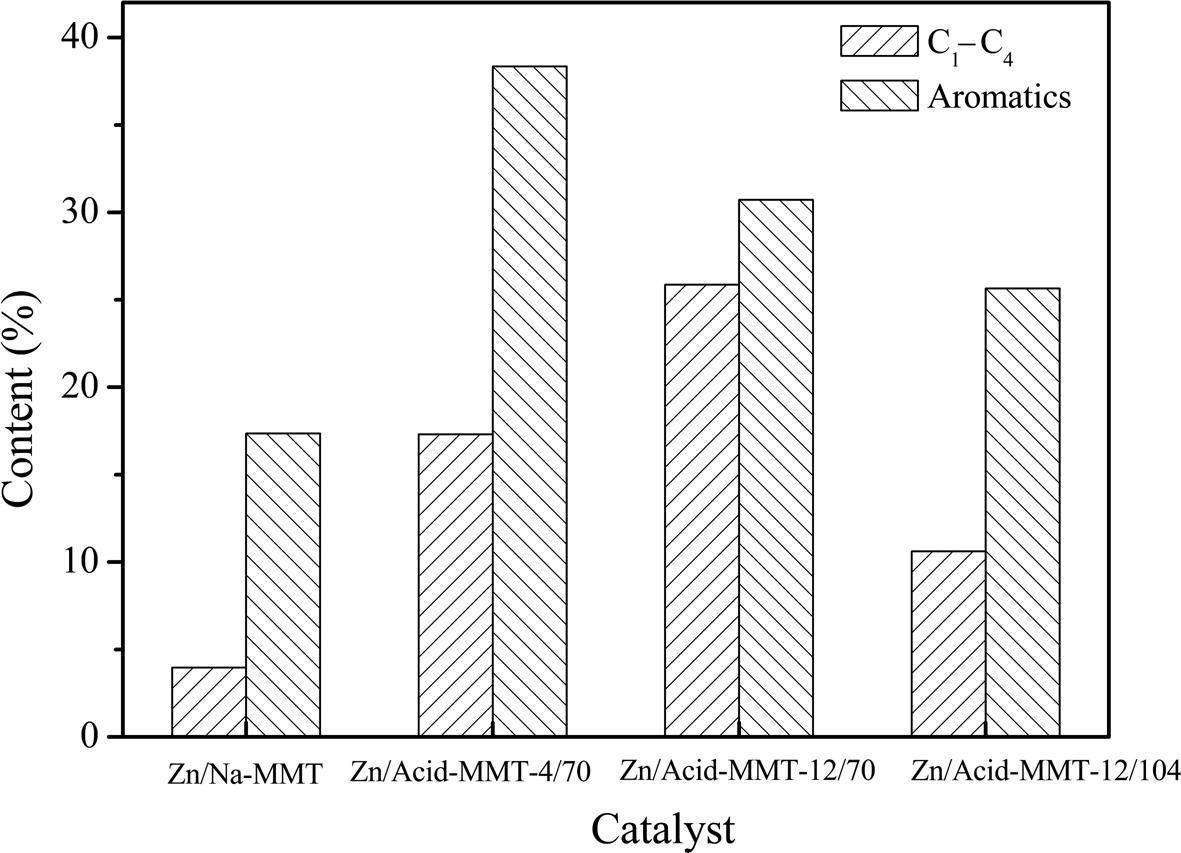
The amounts of gases (C1–C4) and aromatic products for the various catalysts at a TOS of 10 h are shown in Fig. 5. The gas content was well correlated with the total number of acid sites of the different catalysts (i.e. the amount of gas increased with increasing total number of acid sites) (Table 2). However, the trend in the amount of aromatic product cannot be explained simply by the total number of acid sites in the catalyst. In order to explain this behaviour, the types of acid sites of the various catalysts were analysed. Acid-MMTs increased both the LAS and BAS strength (Table 1), depending on the acid-treatment conditions. The aromatization reaction should result from a combination of LAS and BAS. Zn/Acid-MMT-12/70 exhibited maximum LAS and BAS, although the amount of aromatic products formed was not at a maximum. This suggests that the relative proportions of LAS and BAS should be optimal to obtain the maximum aromatic product content, as was observed with the aromatic products formed from Zn/Acid-MMT-4/70. Indeed, there were fewer LAS and BAS for Zn/Acid-MMT-4/70 than for Zn/Acid-MMT-12/70. However, the aromatic product yield for Zn/Acid-MMT-4/70 was increased. The decreasing amounts of LAS and BAS was different for Zn/Acid-MMT-4/70 compared to the peak area of LAS and BAS (Table 1). Thus, the ratio between the LAS and BAS of Zn/Acid-MMT-4/70 would be optimal, thereby enhancing the amount of aromatic product for Zn/Acid-MMT-4/70. The Zn/Acid-MMT-12/104 and Zn/Na-MMT samples exhibited lower aromatic product yields due to their low activity.
The amounts of gases and aromatics at a TOS of 10 h for the various catalysts.

Conclusions
Acid-MMTs with varying structures and acid properties were obtained via treatment of Na-MMT with HNO3 under various conditions. Acid sites were formed over the Acid-MMTs, the amount of which was heavily dependent on the acid-activation conditions. Furthermore, the type of acid sites (LAS or/and BAS) and the distribution (strong and weak acid sites) of Acid-MMTs could be adjusted by altering the acid-treatment temperature and time. The initial conversion to heptane decreased in the order Zn/Acid-MMT-12/70 > Zn/Acid-MMT-4/70 > Zn/Acid-MMT-12/104 > Zn/Na-MMT, in accordance with the total number of acid sites of the catalysts. The Zn/Acid-MMT-4/70 catalyst exhibited maximum aromatic production due to its optimum proportions of LAS and BAS.
Acknowledgements
This work was supported by the Natural Science Foundation of Liaoning Province (No. 20180510057), the Doctor Startup Research Foundation of Liaoning Province (No. 2020-BS-240) and the opening project of Guangxi College and Universities Key Laboratory of Beibu Gulf Oil and Natural Gas Resource Effective Utilization (2017KLOG10).