Introduction
Human toxocariasis results from the contamination of the environment by faecal eggs of Toxocara canis and Toxocara cati, common parasitic infections in dogs and cats (Dado et al., Reference Dado, Izquierdo, Vera, Montoya, Mateo, Fenoy, Galv, Garc, Garc, Arguez, Lez, Del guila and Mi2012). The prevalence in dogs and cats can reach up to 40% (Habluetzel et al., Reference Habluetzel, Traldi, Ruggieri, Attili, Scuppa, Marchetti, Menghini and Esposito2003). This potential zoonosis is also a global public health problem (Macpherson, Reference Macpherson2013; Woodhall et al., Reference Woodhall, Eberhard and Parise2014). In Vietnam, human infections, based on immunological testing, are reported in many regions. Recently, T. canis larvae were recovered from the eye of a 34-year-old man (De et al., Reference De, Trung, Duyet and Chai2013).
The present study was performed to assess the prevalence of Toxocara infection in household cats and dogs, the presence of anti-Toxocara IgG antibodies in humans and the level of Toxocara egg contamination of the local environment. Such information is needed to help assess the risk of human toxocariasis in Vietnam.
Materials and methods
Collection and examination of samples
A Toxocara prevalence survey in cats, dogs and humans was conducted from July to August, 2014, in two communes in the Hanoi city districts of Thanh Oai and Thuong Tin. Up to 148 households with dogs and cats were selected randomly and faecal samples from 284 dogs, 253 cats and hair from the tails of 16 dogs were obtained. Up to 106 soil and 48 garden vegetable samples, each about 200 g in weight were also examined. Blood samples from 298 persons residing in urban households were examined for the presence of anti-Toxocara IgG antibodies. Animal owners, mostly women, were interviewed using a questionnaire about each animal's free-roaming behaviour, defecation sites, deworming history, bathing frequency and whether hugging of dogs and cats, or sleeping with dogs and cats, was practised. Also investigated were whether the vegetable garden was fenced off, and the frequency of consumption of raw vegetables by the householders.
Toxocara eggs in the faecal samples were examined using the McMaster technique (Roepstorff & Nansen, Reference Roepstorff and Nansen1998) and eggs per gram of faeces (epg) were calculated for each sample. Total daily egg excretion for dogs and cats was calculated from four factors: number of dogs and cats in the two districts, their Toxocara prevalence, mean intensity (epg) and estimated amount of faeces excreted per day (obtained from Wang et al., Reference Wang, Maria, Zhang, Wang, Wu, Zhang, Pan, Ju and Niels2005). Vegetable, soil and hair samples were examined using the methods described by Abougrain et al. (Reference Abougrain, Nahaisi, Madi, Saied and Ghenghesh2010), Gawor et al. (Reference Gawor, Borecka, Zarnowska, Marczyńska and Dobosz2008) and Tavassoli et al. (Reference Tavassoli, Javadi, Firozi, Rezaei, Khezri and Hadian2012), respectively. Serology was performed with a Toxocara IgG enzyme-linked immunosorbent assay (ELISA) Kit (Diagnostic Automation/Cortez Diagnostic, Inc., Calabasas, California, USA). All persons who tested positive with Toxocara antibodies were treated with albendazole at the conclusion of the study.
Data analysis and risk assessment
Data from the parasitological examination and information from the questionnaire were combined, recorded and transferred to SAS version 9.1 (SAS Institute, Inc., Cary, North Carolina, USA) for statistical analysis. For risk factor analysis, univariable and multivariable logistic regression analyses were implemented at household level (n= 148). A household was considered positive only if one or more of the animals of the same species was positive with Toxocara eggs. Factors with a P value < 0.25 in univariable analysis were included in the initial multivariable models. The Fisher exact test was used to compare prevalence of Toxocara infection between dogs and cats, to analyse relationships at the household level between animal prevalence and vegetable contamination, and between animal prevalence and egg contamination in soil and hair samples.
Results and discussion
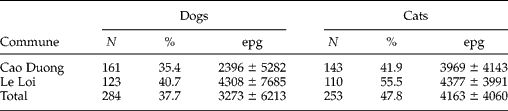
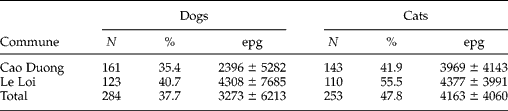
The prevalence of Toxocara spp. infections was greater (P= 0.017) in cats than in dogs (47.8% vs. 37.7%) (table 1). There was also a significant difference in cat Toxocara prevalence between the two communes (P= 0.042). Infection intensity for cats was also greater than that for dogs (table 1). This difference may be due to the greater longevity of cats, resulting in longer exposures. Total daily egg excretion from dogs and cats was 446 × 109 eggs.
The prevalence (%) and intensity of infection measured as mean eggs/g faeces (epg ± SD) in dogs and cats from two communes, Cao Duong and Le Loi, in Hanoi, Vietnam; N, number of samples examined.
In the households, 25.0% of vegetable samples and 35.8% of soil samples contained Toxocara spp. eggs. Eggs were also found in 9 of 16 dog-hair samples. Multivariable logistic analysis revealed that Toxocara egg contamination of soil was associated with prevalence of infection in dogs and cats (which was 26.7 times greater in households with soil egg contamination).
The high infection prevalence and egg excretion rate, coupled with frequency of free roaming and infrequent deworming of dogs and cats, were important sources of the eggs contaminating soil and vegetables. These, in turn, may be the most important causes of the high rate of anti-Toxocara antibodies found in 58.7% of people surveyed. Among household residents 82.3% reported eating raw vegetables and 53.7% allowed children to play in soil. Similar risk factors were also reported in human studies carried out in Libya and in Poland (Gawor et al., Reference Gawor, Borecka, Zarnowska, Marczyńska and Dobosz2008; Abougrain et al., Reference Abougrain, Nahaisi, Madi, Saied and Ghenghesh2010). In addition to these risk factors, some vegetables (such as Centella sp., Houttuynia sp. and Eclipta alba hassk) are used as traditional medicine and drunk raw to relieve fever in children or to reduce body temperature during hot weather in Vietnam.
The presence of Toxocara eggs on hair of the dogs represents another infection risk for people; 49.7% of households reported that their children hug and hold dogs in their arms. Studies in The Netherlands and Iran have concluded that the contamination on hair of dogs was a potential risk for human infection (Overgaauw et al., Reference Overgaauw, Zutphen, Hoek, Yaya, Roelfsema, Pinelli, Knapen and Kortbeek2009; Tavassoli et al., Reference Tavassoli, Javadi, Firozi, Rezaei, Khezri and Hadian2012).
In conclusion, a sound overall veterinary and public health programme to mitigate toxocarosis must include prevention and control of Toxocara infection in dogs and cats to limit the risk of transmission to humans. Important components of such a programme are the education of households on sources of the infection to humans, the importance of regular anthelmintic treatments for dogs and cats, and the necessity of improved environmental sanitation, including the management of their animal's defecation behaviour.
Acknowledgements
We are grateful to farmers in Cao Duong and Le Loi communes in Hanoi city for their participation in the study, and to local veterinarians for their assistance.
Financial support
We acknowledge the National Foundation for Science and Technology Development (NAFOSTED) of Vietnam (No. 106-YS.06-2013.02) for their financial support of this study.
Conflict of interest
None.
Ethical aspects
The human study was approved by the Ethical Committee of National Institute of Malariology, Parasitology and Entomology, Hanoi, Vietnam.