Introduction
The last two decades have witnessed an increasing interest in abusive supervision among theoreticians and practitioners alike (Fischer, Tian, Lee, & Hughes, Reference Fischer, Tian, Lee and Hughes2021; Tepper, Simon, & Park, Reference Tepper, Simon and Park2017). Abusive supervision refers to ‘employees’ perceptions of the extent to which leaders engage in the sustained display of hostile verbal and nonverbal behaviors, excluding physical contact’ (Tepper, Reference Tepper2000: 178). In the past, research has suggested that employees are victims of abusive supervision, as they typically experience detrimental outcomes and engage in avoidance reactions following exposure to this behavior (Tepper et al., Reference Tepper, Simon and Park2017). Although it might seem as if employees are usually passive recipients of abusive supervision, a growing body of evidence indicates that they can actively adopt coping strategies to deal with abusive supervision, with the intention of changing adverse working conditions (Lian, Ferris, Morrison, & Brown, Reference Lian, Ferris, Morrison and Brown2014; Lian, Brown, Ferris, Liang, Keeping, & Morrison, Reference Lian, Brown, Ferris, Liang, Keeping and Morrison2014; Lian, Ferris, & Brown, Reference Lian, Ferris and Brown2012; Tepper, Mitchell, Haggard, Kwan, & Park, Reference Tepper, Mitchell, Haggard, Kwan and Park2015; Wee, Liao, Liu, & Liu, Reference Wee, Liao, Liu and Liu2017; Yagil, Ben-Zur, & Tamir, Reference Yagil, Ben-Zur and Tamir2011; Yu & Duffy, Reference Yu and Duffy2021). Adopting an employee actor–based perspective is, therefore, important to understand how employees – as the major and direct targets of abusive supervision – react to this leader behavior (Mawritz, Dust, & Resick, Reference Mawritz, Dust and Resick2014; Yagil et al., Reference Yagil, Ben-Zur and Tamir2011). Indeed, ‘employees do not just let life happen to them. Rather, they try to affect, shape, curtail, expand, and temper what happens in their lives’ (Grant & Ashford, Reference Grant and Ashford2008: 3). Practically, this perspective provides constructive suggestions for victimized employees, empowering them to adaptively deal with abusive supervision and effectively mitigate its negative influences.
In particular, impression management – defined as the process by which people attempt to influence others’ image of them (Rosenfeld, Giacalone, & Riordan, Reference Rosenfeld, Giacalone and Riordan1995) – is a coping strategy that is often applied as a way to deal with negative outcomes in the workplace (Huang, Zhao, Niu, Ashford, & Lee, Reference Huang, Zhao, Niu, Ashford and Lee2013; Wu, Yim, Kwan, & Zhang, Reference Wu, Yim, Kwan and Zhang2012). According to Barry and Watson (Reference Barry, Watson and Burleson1996), people in lower positions (i.e., subordinates) use such social influence strategies as a means of shaping the behaviors of others in higher positions (i.e., supervisors) through verbal and/or symbolic actions. In other words, these coping strategies are expected to bring about desired changes in the perception or behavior of the target (e.g., the supervisor) that otherwise would not have occurred. However, relatively little is known about the factors that trigger or suppress employees’ choices of coping strategies (Rasheed, Zaheer, & Manzoor, Reference Rasheed, Zaheer and Manzoor2020; Tröster & Van Quaquebeke, Reference Tröster and Van Quaquebeke2021). This oversight is problematic, as reactions to abusive supervision typically depend on employees’ interpretation of such leader behavior (Martinko, Harvey, Sikora, & Douglas, Reference Martinko, Harvey, Sikora and Douglas2011). Although recent studies have examined the role of attributions in abusive supervision, most have focused on the emotional or cognitive processes linking abusive supervision and the outcomes (Liao, Lee, Johnson, Song, & Liu, Reference Liao, Lee, Johnson, Song and Liu2021; Yu & Duffy, Reference Yu and Duffy2021) without unpacking specific coping strategies.
The social functional view of work, for example, reflects individuals’ true inner state, offering real-time feedback that helps them understand their social roles, status, and relationships and guiding their behaviors. Meanwhile, examination of the underlying psychological mechanisms that feed into the link between abusive supervision and coping strategies and the distal influences of particular strategies of impression management offers other informative insights. These mechanisms involve selectively presenting or manipulating information to create a desired impression, which may not necessarily align with the individual’s true feelings or intentions; that is, they focus on influencing others’ perceptions through strategic displays as a way to further influence interactions. Yet another line of research has explored the positive consequences of abusive supervision (Liao, Lee, Johnson, Song & Liu, Reference Liao, Lee, Johnson, Song and Liu2021; Tröster & Van Quaquebeke, Reference Tröster and Van Quaquebeke2021). However, it is crucial to simultaneously unpack the bright and dark sides of coping strategies adopted by victims of abusive supervision, given this behavior’s potential ‘double-edged sword’ effects, to provide a more complete picture of abusive supervision’s role in the workplace.
To investigate these important research questions, we draw upon attribution theory (Kelley, Reference Kelley1973; Kelley & Michela, Reference Kelley and Michela1980; Weiner, Reference Weiner1985) and impression management research to explore (1) when and how abused employees engage in different coping strategies and (2) what the interpersonal consequences of these strategies are for employees. Attribution theory is relevant because employees form their interpretations of why their leaders treat them in a specific way, and these interpretations then affect the focal individuals’ psychological and behavioral reactions (Gardner, Karam, Tribble, & Cogliser, Reference Gardner, Karam, Tribble and Cogliser2019; Liu, Liao, & Loi, Reference Liu, Liao and Loi2012). Our model proposes that employees may attribute abusive supervision to two distinct motivations: (1) injury initiation, which aims to purposely harm employees, or (2) performance promotion, which seeks to enhance subordinate performance (Liu et al., Reference Liu, Liao and Loi2012). When abusive supervision is associated with the injury initiation motive, that attribution is more likely to induce employees’ revenge motivation (Bradfield & Aquino, Reference Bradfield and Aquino1999), such that employees engage in some impression management strategies to take revenge. In contrast, when abusive supervision is attributed to the performance promotion motive, it is more likely to increase employees’ motivation to reconcile (Tomlinson, Dineen, & Lewicki, Reference Tomlinson, Dineen and Lewicki2004), whereby employees engage in some impression management strategies in an effort to improve their relationship with leaders.
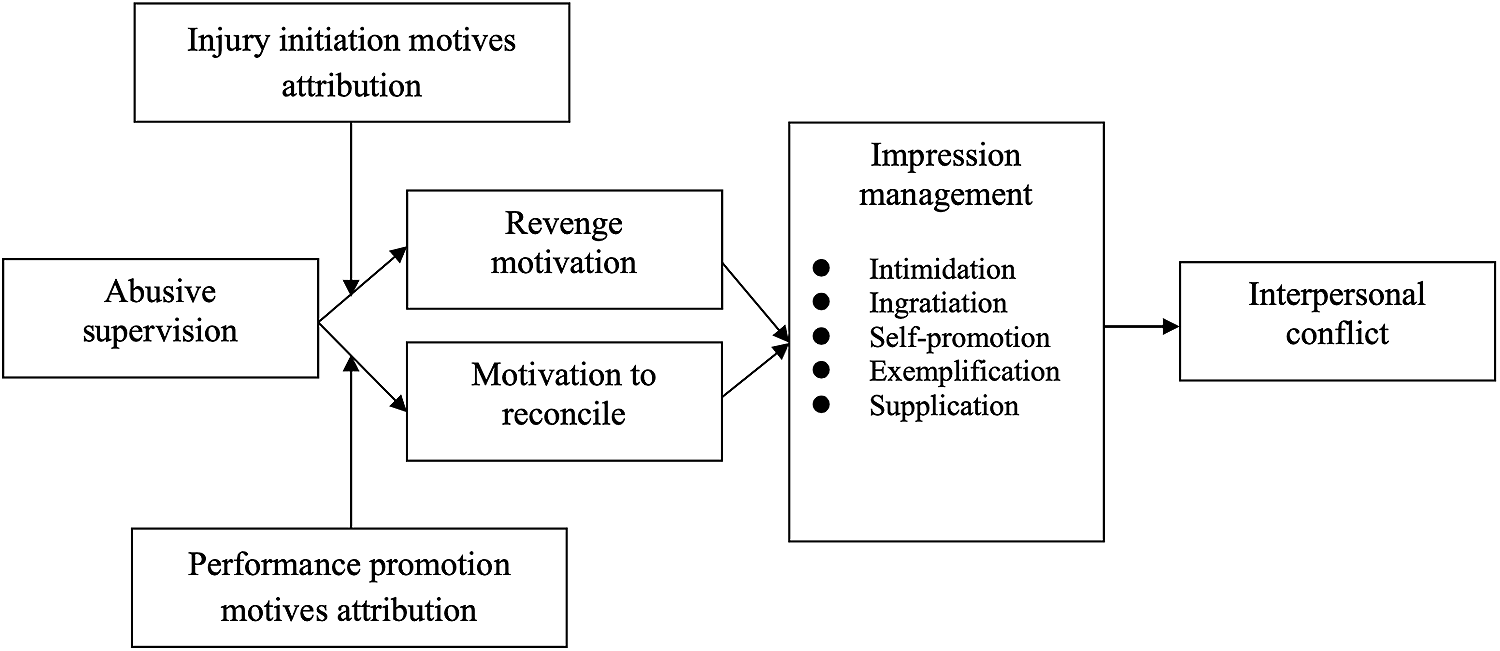
The lessons learned from prior impression management research allow us to focus on specific strategies in our study. First, we posit that employees may respond to abusive supervision by using different coping tactics to express their revenge motivation versus their reconciling motivation. Furthermore, we examine the consequences of those coping strategies by considering interpersonal conflict with leaders – that is, direct and indirect oppositional acts occurring between employees and leaders, including confrontations and doing nasty things (Liu, Spector & Shi, Reference Liu, Spector and Shi2007; Spector & Jex, Reference Spector and Jex1998) – as an indicator of interpersonal interactions. Previous research on abusive supervision has primarily focused on single-direction behaviors, either employees’ reactions toward leaders (e.g., deviance toward the supervisor and supervisor-directed helping; Lian, Brown, et al., Reference Lian, Brown, Ferris, Liang, Keeping and Morrison2014; Liao et al., Reference Liao, Lee, Johnson, Song and Liu2021; Park, Hoobler, Wu, Liden, Hu, & Wilson, Reference Park, Hoobler, Wu, Liden, Hu and Wilson2019; Tröster & Van Quaquebeke, Reference Tröster and Van Quaquebeke2021; Zellars, Tepper, & Duffy, Reference Zellars, Tepper and Duffy2002) or leaders’ subsequent reactions toward employees (e.g., abusive supervision; Chen, Qin, Johnson, Huang, Yang, & Liu, Reference Chen, Qin, Johnson, Huang, Yang and Liu2021; Wee et al., Reference Wee, Liao, Liu and Liu2017). Our research departs from this approach and instead focuses on interpersonal conflict, emphasizing the bidirectional negative interactions between leaders and employees. Interpersonal conflict is, in essence, an escalation of abusive supervision. From a practical standpoint, it is a common and costly problem for organizations, making it essential to identify opportunities to reduce its occurrence (Liu, Spector, & Shi, Reference Liu, Spector and Shi2007). In summary, our model suggests that employees’ psychological reactions to abusive supervision and coping strategies, which are contingent upon their attributions of abusive supervision, have differential impacts on employees’ interpersonal conflict with leaders (Figure 1).
The hypothesized model

This research makes several important theoretical contributions. First, we extend the literature addressing the double-edged sword effect of abusive supervision by adopting an employee actor–based perspective and exploring differences in the attributions made by employees. In line with a balanced perspective (e.g., Liao et al., Reference Liao, Lee, Johnson, Song and Liu2021; Yu & Duffy, Reference Yu and Duffy2021), our study unpacks when abusive supervision is (or is not) likely to lead to an undesirable outcome (i.e., interpersonal conflict). In doing so, our investigation responds to Tepper, Simon, and Park’s (Reference Tepper, Simon and Park2017) call to examine the boundary conditions for abused employees’ selection of particular coping strategies and their effectiveness. Our study not only explains why employees select particular coping strategies in the face of abusive supervision but also helps demonstrate the double-edged sword effect of abusive supervision, which depends on the specific attribution made.
Second, we examine the underlying serial mechanisms that drive the two distinct pathways – an important addition to the literature on abusive supervision and impression management (Bolino, Long, & Turnley, Reference Bolino, Long and Turnley2016; Lukacik & Bourdage, Reference Lukacik and Bourdage2019). In contrast to existing studies that emphasize cognitive or emotional mechanisms (e.g., Liao et al., Reference Liao, Lee, Johnson, Song and Liu2021; Tröster & Van Quaquebeke, Reference Tröster and Van Quaquebeke2021; Yu & Duffy, Reference Yu and Duffy2021), our research comprehensively discusses the motivations and impression management mechanisms that inform employees’ attempts to cope with abusive supervision, and explores the nuances of why abused employees select one strategy over another. That is, we build a dual-path model, which reconciles the effects of revenge motivation and motivation to reconcile on impression management strategies (i.e., ingratiation, self-promotion, exemplification, intimidation, and supplication), to reveal how abusive supervision ultimately influences interpersonal conflict.
Third, our research sheds new light on which strategies are more or less effective in handling interpersonal conflict. Prior research has largely focused on outcomes, such as deviance and organizational citizenship behavior, that involve unidirectional behaviors – that is, where the employee, as the actor, engages in actions toward others or where the leader engages in subsequent abusive supervision directed toward the employee. Extending the nomological network of abusive supervision, our study emphasizes the bidirectional nature of employee–leader conflict (De Wit, Greer, & Jehn, Reference De Wit, Greer and Jehn2012) and demonstrates how the double-edged sword effects of abusive supervision on interpersonal conflict with leaders play out depending on employee attribution. By clarifying these relationships, our work offers a more comprehensive picture of the influences that shape employees’ strategies for coping with abusive supervision.
Theoretical Background and Hypotheses Development
The Moderating Roles of Employee Attributions
According to attribution theory, employees’ psychological reactions to abusive supervision vary depending on the target’s specific attributions, as attributions for abusive behaviors influence how abusive supervision is interpreted and processed (Bradfield & Aquino, Reference Bradfield and Aquino1999; Liu et al., Reference Liu, Liao and Loi2012; Tepper, Reference Tepper2000). Injury initiation motives attribution occurs when employees perceive leaders’ abusive behaviors as internally motivated and enacted with malicious intent; that is, they believe the leader is deliberately engaging in abusive behaviors to harm them specifically, rather than other members of the team (Liu et al., Reference Liu, Liao and Loi2012). When employees attribute abusive supervision to injury initiation, they tend to perceive the behavior as illegitimate and harmful to them within the context of the team (Burton, Taylor, & Barber, Reference Burton, Taylor and Barber2014; Martinko et al., Reference Martinko, Harvey, Sikora and Douglas2011). As such, compared to other individuals in the team, these employees are more likely to develop a negative psychological reaction (i.e., revenge motivation) to abusive supervision. Revenge motivation is defined as a motivation to inflict harm in return for a perceived wrong (Stuckless & Goranson, Reference Stuckless and Goranson1992). Injury initiation motives attribution mainly stimulates employees’ defensive responses rather than their positive reactions. Specifically, these employees are more likely to focus on protecting themselves and restoring fairness, rather than seeking reconciliation. In this research, we examine the moderation effect of injury initiation motives attribution on the relationship between abusive supervision and revenge motivation.
Revenge motivation is more apt to arise when people are exposed to lasting negative behaviors or events (Moreno-Jiménez, Rodríguez-Muñoz, Pastor, Sanz-Vergel, & Garrosa, Reference Moreno-Jiménez, Rodríguez-Muñoz, Pastor, Sanz-Vergel and Garrosa2009; Ysseldyk, Matheson, & Anisman, Reference Ysseldyk, Matheson and Anisman2007). Injury initiation motives attribution tends to elicit revenge motivation from the mistreated employee toward the abusive supervisor when the employee perceives that their peer-colleagues are not subject to the same level of abuse from the leader and believes that the leader should be held responsible for their harmful behavior (Bowling & Beehr, Reference Bowling and Beehr2006). This argument is aligned with the principle of reciprocity (Gouldner, Reference Gouldner1960), which suggests that those targeted by negative acts will respond by engaging in negative reactions directed at the original perpetrator. Thus, it is reasonable to expect that abused employees will develop revenge motivation toward their leaders. That is, when relatively abusive behaviors are attributed to injury initiation motives, employees are likely to believe that leaders deserve retribution because such an attribution intensifies the blame that employees place on the leaders for the abusive behavior.
Moreover, when subjected to unfair treatment from abusive supervision (Burton et al., Reference Burton, Taylor and Barber2014; Tepper, Reference Tepper2000), employees who make an injury initiation attribution may have a stronger desire to restore fairness and prevent the ongoing decline of their psychological resources (Bradfield & Aquino, Reference Bradfield and Aquino1999). Given that revenge can restore a person’s impaired psychological state and restore their damaged status, developing thoughts of revenge seems to be a natural and effective way for employees to cope with abusive supervision (Bradfield & Aquino, Reference Bradfield and Aquino1999). In particular, when the level of abusive supervision is higher for the focal employee than for other members of the team, negative experiences such as depression, anger, fear, and anxiety can occur (Tepper, Reference Tepper2000). Victimized employees may think about exacting revenge because it can be a way to take control of the situation (Heider, Reference Heider1958), vent their undesirable emotions, or alleviate the aversive feelings stemming from the harmful treatment. In line with this rationale, previous research has found positive associations between these kinds of negative experiences (e.g., negative emotions and anxiety) and revenge motivation (Barcaccia, Salvati, Pallini, Saliani, Baiocco, & Vecchio, Reference Barcaccia, Salvati, Pallini, Saliani, Baiocco and Vecchio2022).
Hypothesis 1 (H1): Injury initiation motives attribution moderates the relationship between abusive supervision and revenge motivation such that the positive relationship between abusive supervision and revenge motivation is strengthened at a higher (versus lower) level of injury initiation motives attribution.
Motivation to reconcile reflects the victim’s willingness to relinquish anger, resentment, and the desire to punish the other party (Aquino, Tripp, & Bies, Reference Aquino, Tripp and Bies2001), which allows the relationship to continue. Reconciliation can be viewed as a behavioral manifestation of forgiveness. It is the classic motivation for individuals in interpersonal interactions. Multiple scholars have indicated that one party’s mistreatment may lead to the victim’s reconciling motivation, depending on the circumstances (Aquino, Tripp, & Bies, Reference Aquino, Tripp and Bies2006, Reference Aquino, Tripp and Bies2001; Tomlinson et al., Reference Tomlinson, Dineen and Lewicki2004). Given that performance promotion attribution is generally associated with positive outcome expectations, employees who perceive abusive supervision as an opportunity to enhance their skills and advance their careers may be more inclined to interpret this management style as a challenging but beneficial experience rather than a personal attack. As a result, this attribution fosters a constructive outlook rather than a retaliatory mindset. Therefore, we suggest that abusive treatment from leaders may lead to employees’ willingness to reconcile their relationships with these leaders under the condition of performance promotion attribution.
When employees attribute abusive behavior to their leaders’ performance promotion motive, it implies that they may not perceive the relationship as damaged. However, because the leader’s actions are intended to benefit the employee (by improving their performance), the employee may be willing to actively maintain and improve the business relationship with the leader. Furthermore, knowing that the leader acted with good intentions, the employee will not find it particularly difficult to rebuild the relationship with the leader.
To be more specific, when employees attribute relative abusive supervision in the team to the leader’s intention to improve work performance, they will perceive that they are temporarily unable to meet the leader’s expectations and standards for daily performance (Tepper, Moss, & Duffy, Reference Tepper, Moss and Duffy2011) and, therefore, the leader has more criticism of their work than their colleagues’. This attribution legitimizes the leader’s abusive behavior and places responsibility for its occurrence on the employee, which then gives the employee a sense of control over their ability to eliminate the leader’s dissatisfaction. In turn, employees may believe that they should do something to adjust their relationship with the leader, given that leaders are not satisfied with their performance now. However, the motivation for revenge arises from the perception of harm inflicted by others. When employees attribute the leader’s abusive supervision to a desire for performance improvements, they do not think the leader intends to hurt them and perceive the leader’s actions as well-intentioned. In such a case, employees are more inclined to actively maintain and improve the business relationship with the leader, and consequently adopt a proactive and positive approach to managing the relationship with the leader.
Hypothesis 2 (H2): Performance promotion motives attribution moderates the relationship between abusive supervision and motivation to reconcile such that the positive relationship between abusive supervision and motivation to reconcile is strengthened at a higher (versus lower) level of performance promotion motives attribution.
Psychological Reactions, Impression Management Tactics, and Interpersonal Conflict
Employees may use impression management tactics to influence others’ impressions of them (Lukacik & Bourdage, Reference Lukacik and Bourdage2019). Impression management research suggests that psychological reactions usually activate certain personal tendencies toward different applications of impression management tactics (Ghara, Abdi, Langari, & Danaee, Reference Ghara, Abdi, Langari and Danaee2013). Revenge motivation tends to evoke strong affective experiences (Bradfield & Aquino, Reference Bradfield and Aquino1999). As such, when employees have a desire for revenge, they are prone to searching for ways to respond to such negative experiences. The fundamental ways people choose to seek revenge can vary, but primarily fall into two categories: covert and overt revenge behaviors (McIlduff & Coghlan, Reference McIlduff and Coghlan2000), sometimes referred to as indirect and direct revenge, respectively (Grégoire, Laufer, & Tripp, Reference Grégoire, Laufer and Tripp2010). In our context, it is particularly appropriate to focus on the indirect approach to impression management rather than direct acts of retaliation, as impression management strategies enable employees to navigate workplace dynamics without openly confronting or challenging their supervisors. Given the inherent hierarchical power difference between leaders and subordinates, employees may need to avoid directly expressing their discontent (Grant & Mayer, Reference Grant and Mayer2009). As an alternative to overt retaliation, impression management offers a subtler, more strategic way for employees to pursue their goals, allowing them to gradually influence their work environment while concealing their true intentions (Bolino et al., Reference Bolino, Long and Turnley2016).
Among impression management tactics, intimidation and supplication are more likely to be used by employees with a higher revenge motivation. Intimidation involves appearing threatening or powerful to control or influence others (Bolino et al., Reference Bolino, Long and Turnley2016), and a relatively higher revenge motivation is expected to foster employees’ use of intimidation tactics that aim to cause leaders to go through negative experiences similar to those that the focal employees had (Bolino & Turnley, Reference Bolino and Turnley2003). Indeed, research has indicated that individuals who become more vengeful exhibit more aggressive behaviors toward the transgressor (Chester & DeWall, Reference Chester and DeWall2017). Supplication entails the strategic display of weakness or dependence (Jones & Pittman, Reference Jones, Pittman and Suls1982: 247; Turnley & Bolino, Reference Turnley and Bolino2001). In a team setting, individuals who are relatively motivated by revenge may strategically engage in supplication as a means of eliciting feelings of moral responsibility or emotional discomfort in their leader, particularly those perceived as directly responsible for past wrongdoings. By portraying themselves as victims, these revenge-motivated individuals can manipulate the emotions of leaders (e.g., leader guilt, shame, and remorse; Liao, Yam, Johnson, Liu, & Song, Reference Liao, Yam, Johnson, Liu and Song2018; Shen, Evans, Liang, & Brown, Reference Shen, Evans, Liang and Brown2023; Shum, Ausar, & Tu, Reference Shum, Ausar and Tu2020) and thereby achieve indirect retaliation (Becker & Martin, Reference Becker and Martin1995).
In contrast, impression management tactics such as ingratiation, self-promotion, and exemplification are less likely to be used by employees with a stronger revenge motivation. These tactics are aimed at gaining approval, recognition, or admiration (Bolino et al., Reference Bolino, Long and Turnley2016; Gilbert & Jones, Reference Gilbert and Jones1986; Turnley & Bolino, Reference Turnley and Bolino2001), which conflicts with the hostile and retaliatory nature of revenge. Compared with other members of the team, employees with a relatively higher revenge motivation are more likely to distance themselves socially and emotionally from others instead of attempting to align with them through ingratiation. They are also less inclined to enhance their image and gain social approval (self-promotion; Jackson, Choi, & Gelfand, Reference Jackson, Choi and Gelfand2019; Jones, Reference Jones2009). Engaging in higher levels of revenge-driven actions is often seen as contrary to ethical or morally superior behavior (Bavik & Bavik, Reference Bavik and Bavik2015; Gintis, Reference Gintis2013; Gollwitzer & Denzler, Reference Gollwitzer and Denzler2009), making it difficult for individuals to credibly present themselves as exemplars of virtue within the team while simultaneously seeking revenge against their perceived transgressors (exemplification; Gilbert & Jones, Reference Gilbert and Jones1986; Stone, Wiegand, Cooper, & Aronson, Reference Stone, Wiegand, Cooper and Aronson1997).
Hypothesis 3a (H3a): Revenge motivation is positively related to intimidation.
Hypothesis 3b (H3b): Revenge motivation is negatively related to ingratiation.
Hypothesis 3c (H3c): Revenge motivation is negatively related to self-promotion.
Hypothesis 3d (H3d): Revenge motivation is negatively related to exemplification.
Hypothesis 3e (H3e): Revenge motivation is positively related to supplication.
Motivation to reconcile is manifested as the victim (i.e., the mistreated employee) relinquishing the need to find out who is to blame, and deciding instead to repair their relationship with the abusive leader (Tomlinson et al., Reference Tomlinson, Dineen and Lewicki2004). The effort to restore the relationship is not merely the individual act of the victim giving up anger and resentment (Palanski, Reference Palanski2012), or acknowledging the harm and focusing on how to resolve it (Bies, Barclay, Tripp, & Aquino, Reference Bies, Barclay, Tripp and Aquino2016). Instead, with the motivation to reconcile, employees are motivated to express goodwill toward their leaders and to make efforts to develop a good relationship with those leaders. Notably, impression management is considered a behavioral strategy aimed at actively improving or deteriorating interpersonal relationships ‘because the impressions people make on others have implications for how others perceive, evaluate, and threat them’ (Leary & Kowalski, Reference Leary and Kowalski1990: 34). For example, O’Sullivan (Reference O’Sullivan2000: 406) highlighted that ‘impression management is thus viewed as a primary function of relational interactions’. Therefore, impression management is a suitable way to influence employees’ relationships with their leaders. Those who have a motivation to reconcile are usually endeavoring to rebuild these interpersonal connections and, therefore, are more proactive in applying positive impression management tactics (Tomlinson et al., Reference Tomlinson, Dineen and Lewicki2004; Turnley & Bolino, Reference Turnley and Bolino2001).
Impression management tactics such as ingratiation, self-promotion, and exemplification are particularly aligned with the goals of reconciliation. Ingratiation focuses on enhancing interpersonal attraction and others’ perceptions of the focal individual’s skills and abilities (Barsness, Diekmann, & Seidel, Reference Barsness, Diekmann and Seidel2005; Turnley & Bolino, Reference Turnley and Bolino2001). Employees with a higher motivation to reconcile are especially inclined to create a more friendly environment, with the ultimate aim of strengthening their relationship with the leader, in contrast to their peers with lower reconciliation motivation. Self-promotion involves highlighting one’s achievements or positive qualities to create a favorable impression (Turnley & Bolino, Reference Turnley and Bolino2001). When individuals are more strongly motivated by a desire for reconciliation, they are more likely to engage in self-promotion as a way of restoring their social standing or improving others’ perceptions of them, compared to individuals with a lower reconciliation motivation (Aquino et al., Reference Aquino, Tripp and Bies2001). Exemplification is a strategy in which individuals present themselves as highly moral, self-sacrificing, or dedicated to elicit admiration or respect from others (Bolino, Kacmar, Turnley, & Gilstrap, Reference Bolino, Kacmar, Turnley and Gilstrap2008). Employees who have a higher level of reconciliation goals (compared to others in the team) may use exemplification to demonstrate their commitment to moral values such as forgiveness, fairness, and collaboration. This makes exemplification a more effective strategy for employees with a relatively higher motivation to reconcile.
In contrast, motivation to reconcile is expected to be negatively related to intimidation and supplication. Intimidation, a tactic in which individuals attempt to control or influence others by appearing threatening or powerful (Bolino et al., Reference Bolino, Long and Turnley2016), is unlikely to be used by those motivated to reconcile. Reconciliation requires fostering positive social interactions, cooperation, and a willingness to address past misunderstandings in a constructive way, whereas intimidation typically alienates others, instills fear, and escalates conflict rather than resolving it (Turnley & Bolino, Reference Turnley and Bolino2001). Supplication involves presenting oneself as weak, helpless, or in need of assistance to elicit sympathy or support from others (Turnley & Bolino, Reference Turnley and Bolino2001). While such tactics may be effective in some interpersonal contexts, there are significant potential costs associated with self-diminishing behaviors, particularly within hierarchical relationships such as those between leaders and subordinates, where power asymmetries are salient. In these settings, deliberately portraying oneself as vulnerable may damage employees’ professional image, undermine their perceived competence, and ultimately impede rather than promote relationship repair. Given these risks, such behaviors are unlikely to be a universally preferred or effective reconciliation strategy.
Hypothesis 4a (H4a): Motivation to reconcile is negatively related to intimidation.
Hypothesis 4b (H4b): Motivation to reconcile is positively related to ingratiation.
Hypothesis 4c (H4c): Motivation to reconcile is positively related to self-promotion.
Hypothesis 4d (H4d): Motivation to reconcile is positively related to exemplification.
Hypothesis 4e (H4e): Motivation to reconcile is negatively related to supplication.
Given the distinct features of different impression management tactics (Lukacik & Bourdage, Reference Lukacik and Bourdage2019), their effects on interpersonal dynamics are likely to vary. When employees adopt positive relationship-oriented impression management tactics – such as ingratiation, self-promotion, and exemplification – they are more likely to reduce interpersonal conflict with their leaders. Ingratiation, which involves behaviors like flattery, agreement, and personal favors to appear likable (Turnley & Bolino, Reference Turnley and Bolino2001), can enhance interpersonal attraction and leaders’ liking for subordinates (Bolino, Klotz, & Daniels, Reference Bolino, Klotz and Daniels2014; De Clercq, Fatima, & Jahanze, Reference De Clercq, Fatima and Jahanze2021). By aligning with leaders’ interests and addressing their needs (Harvey, Stoner, Hochwarter, & Kacmar, Reference Harvey, Stoner, Hochwarter and Kacmar2007), ingratiation serves as an effective impression management tactic that can reduce interpersonal conflict. Similarly, self-promotion, the act of emphasizing one’s accomplishments and capabilities to create a favorable impression (Bolino et al., Reference Bolino, Long and Turnley2016), can reduce conflict when done modestly and strategically. Employees who communicate their competence and value more than their peers may promote respect from leaders and minimize misunderstandings (Den Hartog, De Hoogh, & Belschak, Reference Den Hartog, De Hoogh and Belschak2020; Godfrey, Jones, & Lord, Reference Godfrey, Jones and Lord1986; Valsesia, Nunes, & Ordanini, Reference Valsesia, Nunes and Ordanini2021). In addition, exemplification, in which individuals present themselves as highly moral, self-sacrificing, or dedicated to gain admiration (Bolino et al., Reference Bolino, Long and Turnley2016), can help reduce conflict. When leaders perceive employees as committed or selfless – especially in contrast to other team members – they may be less likely to challenge or confront them (Gilbert & Jones, Reference Gilbert and Jones1986; Li, Zhang, & Yang, Reference Li, Zhang and Yang2018; Stellar & Willer, Reference Stellar and Willer2018; Stone, Wiegand, Cooper, & Aronson, Reference Stone, Wiegand, Cooper and Aronson1997).
In contrast, other impression management tactics, such as intimidation and supplication, may increase the likelihood of interpersonal conflict. Intimidation involves attempting to control or influence others by projecting an image of threat or power (Beitler, Scherer, & Zapf, Reference Beitler, Scherer and Zapf2018; Turnley & Bolino, Reference Turnley and Bolino2001), which can provoke defensiveness and hostility from leaders, who possess the authority and means to retaliate against aggressive subordinates (Lukacik & Bourdage, Reference Lukacik and Bourdage2019). Compared to employees who exhibit little or no intimidating behavior toward their peers or leaders, those who engage in intimidation toward leaders may be perceived as disregarding others’ welfare (Turnley & Bolino, Reference Turnley and Bolino2001), thereby inducing more interpersonal conflict among leaders and employees. Supplication, the strategic display of weakness or dependence to elicit sympathy (Schlenker, Reference Schlenker1980), may also lead to interpersonal conflict when used manipulatively. Although supplication can sometimes gain support (Chuang, Shih, Chen, Lin, & Teng, Reference Chuang, Shih, Chen, Lin and Teng2018), its strategic use may instead provoke irritation or resentment from leaders, particularly because leaders generally prefer subordinates who demonstrate competence and autonomy. This negative reaction is especially likely when leaders highly value independence and capability in their team members (Arif, Rizvi, Abbas, Akhtar, & Imran, Reference Arif, Rizvi, Abbas, Akhtar and Imran2011; Meisler, Reference Meisler2024; Van Kleef, De Dreu, & Manstead, Reference Van Kleef, De Dreu and Manstead2006). Consequently, compared to other members of the team, the supplicant may be perceived as overly dependent or even manipulative, which can strain relationships (Gove, Hughes & Geerkin, Reference Gove, Hughes and Geerkin1980).
Hypothesis 5a (H5a): Intimidation is positively related to interpersonal conflict.
Hypothesis 5b (H5b): Ingratiation is negatively related to interpersonal conflict.
Hypothesis 5c (H5c): Self-promotion is negatively related to interpersonal conflict.
Hypothesis 5d (H5d): Exemplification is negatively related to interpersonal conflict.
Hypothesis 5e (H5e): Supplication is positively related to interpersonal conflict.
Methods
Sample and Procedure
We collected our data from a high-tech company in China. The company’s main businesses include new energy development, production, and processing. Given the low base rate of abusive supervision (Fischer et al., Reference Fischer, Tian, Lee and Hughes2021), we asked the human resources (HR) director about this phenomenon before conducting the survey. We were informed that abusive supervision did, indeed, exist in the company. Thus, this company was deemed suitable for our data collection. With high support from the top managers, we were able to collect three-wave data using pencil-and-paper questionnaires. At Time 1, 506 employees were invited to participate in this survey. To solicit their participation, the research team explained the purpose and procedures of the survey to the employees. We also ensured them that participation was voluntary and their responses would be kept confidential. On the questionnaire, we asked participants to report demographic information, and to evaluate abusive supervision, injury initiation motives attribution, and performance promotion motives attribution. A total of 469 employees responded to the Time 1 survey. At Time 2 (1 month after Time 1), employees rated revenge motivation, motivation to reconcile, and five impression management strategies (intimidation, ingratiation, self-promotion, exemplification, and supplication). We collected 450 evaluations. At Time 3 (1 month after Time 2), employees reported interpersonal conflict with the leader. A total of 471 questionnaires were returned (response rate = 93.08%).
Our final sample was composed of 444 employees (response rate = 87.75%). In the sample, 81.10% were male, and the average age was 36.37 years (SD = 9.06). In addition, 54.30% of the participants had a high school degree or above (SD = 1.10), and their average organizational tenure was 4.07 years (SD = 3.52). The average team size was 4.63 (SD = 3.52).
Measures
Abusive supervision
To assess abusive supervision, we adopted a 15-item measure of abusive supervision (Tepper, Reference Tepper2000). A sample item is ‘My leader tells me my thoughts or feelings are stupid’. Items used a five-point response format (1 = I cannot remember him/her ever using this behavior with me, 5 = he/she uses this behavior very often with me) (α = 0.97).
Injury initiation and performance promotion motives attribution
We used the 10-item scale developed by Liu, Liao and Loi (Reference Liu, Liao and Loi2012) to measure injury initiation and performance promotion motives attribution. Following the approach of Liu, Liao and Loi (Reference Liu, Liao and Loi2012), this scale was shown behind the scale of employees’ leader abusive behaviors. The scale begins by asking, ‘If your leader engages in the above behaviors (e.g., ridicules you, invades your privacy, and is rude to you, etc.), he or she would have a … in that situation’. This instruction helped us capture employees’ perceptions of what they would do regarding attributions of abusive supervision in that situation (Fischer & Sitkin, Reference Fischer and Sitkin2023). A sample item for injury initiation motives attribution (α = 0.96) is ‘desire to hurt my feelings’, and a sample item for performance promotion motives attribution (α = 0.89) is ‘desire to push me to work harder’. Participants rated the items using a seven-point response format (1 = strongly disagree, 7 = strongly agree).
Revenge motivation
We measured revenge motivation using the seven-item scale developed by Bradfield and Aquino (Reference Bradfield and Aquino1999). A sample item is ‘I want to see my leader hurt and miserable’. Participants rated the items using a seven-point response format (1 = strongly disagree, 7 = strongly agree) (α = 0.97).
Motivation to reconcile
We measured motivation to reconcile using the three-item scale adapted from Tomlinson et al.(Reference Tomlinson, Dineen and Lewicki2004). The three items were ‘To what degree are you willing to reconcile the relationship with your leader, given his or her actions’?, ‘What is the likelihood that you would continue a business relationship with your leader’?, and ‘How difficult would it be to rebuild your relationship with your leader back to the point where it was before he or she abused you’? (reverse coded). Items were rated using a seven-point response format (1 = not at all, 7 =to a very great extent) (α = 0.89).
Impression management
We adopted the scale developed by Turnley and Bolino (Reference Turnley and Bolino2001) to measure impression management, using a seven-point response format (1 = strongly disagree, 7 = strongly agree). A sample item for intimidation (α = 0.95) is ‘I let my leader know that I am not willing to be pushed around or dictated to’. A sample item for ingratiation (α = 0.92) is ‘I compliment my leader so he or she will see me as likeable’. A sample item for self-promotion (α = 0.91) is ‘Make my leader aware of my talents or qualifications’. A sample item for exemplification (α = 0.91) is ‘Let my leader know how hard I have been working on this project’. A sample item for supplication (α = 0.95) is ‘Try to gain assistance or sympathy from my leader by appearing needy in some area’.
Interpersonal conflict
We used the four-item scale developed by Spector and Jex (Reference Spector and Jex1998) to measure interpersonal conflict. This well-established scale is widely used in the current literature (e.g., Liu et al., Reference Liu, Spector and Shi2007; Losada-Otalora, Peña-García, & Sánchez, Reference Losada-Otalora, Peña-García and Sánchez2020; Penney & Spector, Reference Penney and Spector2005; Sliter, Sliter, & Jex, Reference Sliter, Sliter and Jex2012). Sample items are ‘How often does your supervisor yell at you at work’? and ‘How often do you get into arguments with your supervisor at work’? Items used a five-point response format (1 = less than once per month or never, 7 = several times per day) (α = 0.97).
Control variables
We controlled for employee gender, age, education, and organizational tenure. Those variables have been commonly controlled for in abusive supervision research (Harvey et al., Reference Harvey, Stoner, Hochwarter and Kacmar2007; Xu, Loi, & Lam, Reference Xu, Loi and Lam2015; Zellars et al., Reference Zellars, Tepper and Duffy2002), and demographics have been found to be related to interpersonal interaction or conflict (Dijkstra, De Dreu, Evers, & van Dierendonck, Reference Dijkstra, De Dreu, Evers and van Dierendonck2009; Nguyen & Yang, Reference Nguyen and Yang2012; Stuhlmacher & Walters, Reference Stuhlmacher and Walters1999).Footnote 1
Analytical Strategy
We conducted descriptive analyses and confirmatory factor analysis to confirm the discriminant validity of the measures in the model. Given the nested nature of the data (employees nested in the team), we tested the model using Mplus 8.0 (Muthén & Muthén, Reference Muthén and Muthén2017) with the option of ‘TYPE=COMPLEX’. The predictor and moderators were group-mean centered (Hofmann & Gavin, Reference Hofmann and Gavin1998).Footnote 2 To interpret the moderation effects, we created an interaction plot for high (+1 SD) and low levels (–1 SD) of moderators and tested the significance of the slopes of the lines in the plot. We tested the mediated moderation effects using the Monte Carlo method. We conducted this analysis in the R software with 20,000 replications (Bauer, Preacher, & Gil, Reference Bauer, Preacher and Gil2006; Preacher, Zyphur, & Zhang, Reference Preacher, Zyphur and Zhang2010). We estimated the values of pseudo-R 2 to assess the amount of incremental variance in the outcomes explained by the whole model.
Results
Preliminary Analyses
Means, standard deviations, and correlations among the variables are shown in Table 1. Given that the ratio of the sample size and the total number of items influence the overall model fit (Little, Rhemtulla, Gibson, & Schoemann, Reference Little, Rhemtulla, Gibson and Schoemann2013), we followed previous studies and created parcels for the items of our constructs. Specifically, because abusive supervision and revenge motivation had many items, we parceled these constructs into two items, respectively, using the random algorithm (Little et al., Reference Little, Cunningham, Shahar and Widaman2002). The results showed that our hypothesized 11-factor model had a good fit to the data: χ 2(847) = 1693.02, TLI = 0.93, CFI = 0.94, RMSEA = 0.05, SRMR = 0.05. Meanwhile, this model produced significant improvements in the chi-square value over the alternative models. Thus, the focal variables were distinct from each other.
The means, standard deviance, and correlations among variables

* Notes: N = 444; Gender: 0 = male, 1 = female; Education: 0 = primary school, 1 = junior high school, 2 = high school, 3 = associate degree, 4 = bachelor’s degree, 5 = master’s degree. *p < 0.05, **p < 0.01, ***p < 0.001 (two-tailed).
Hypothesis Testing
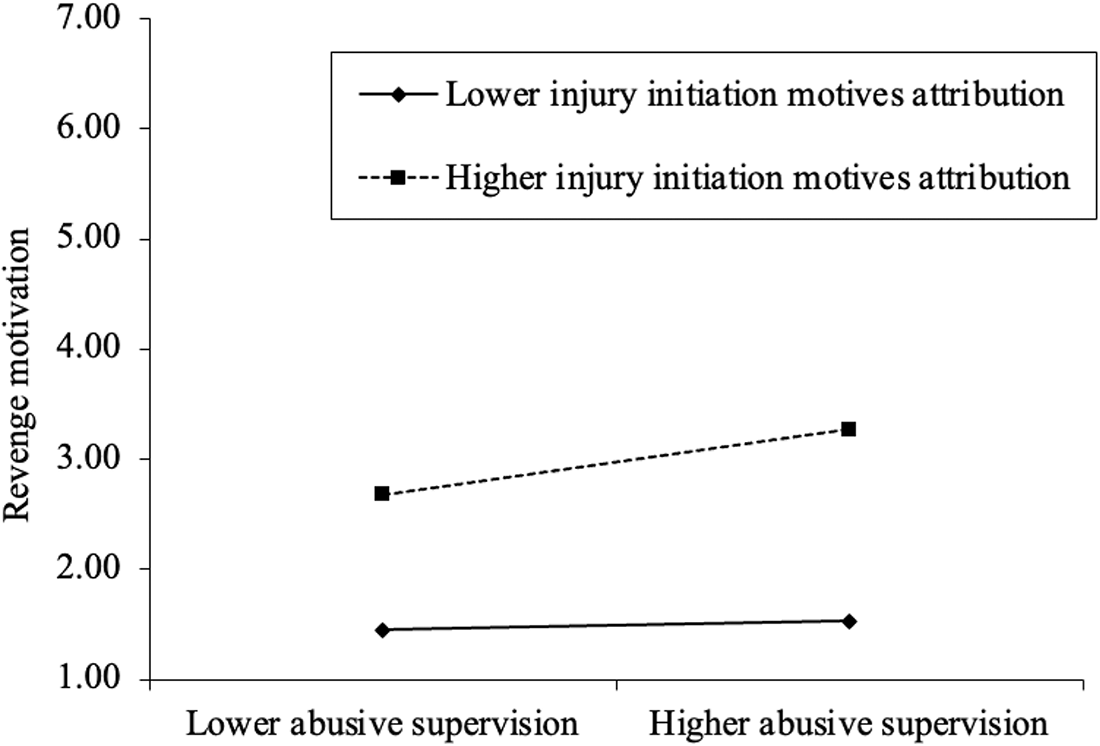
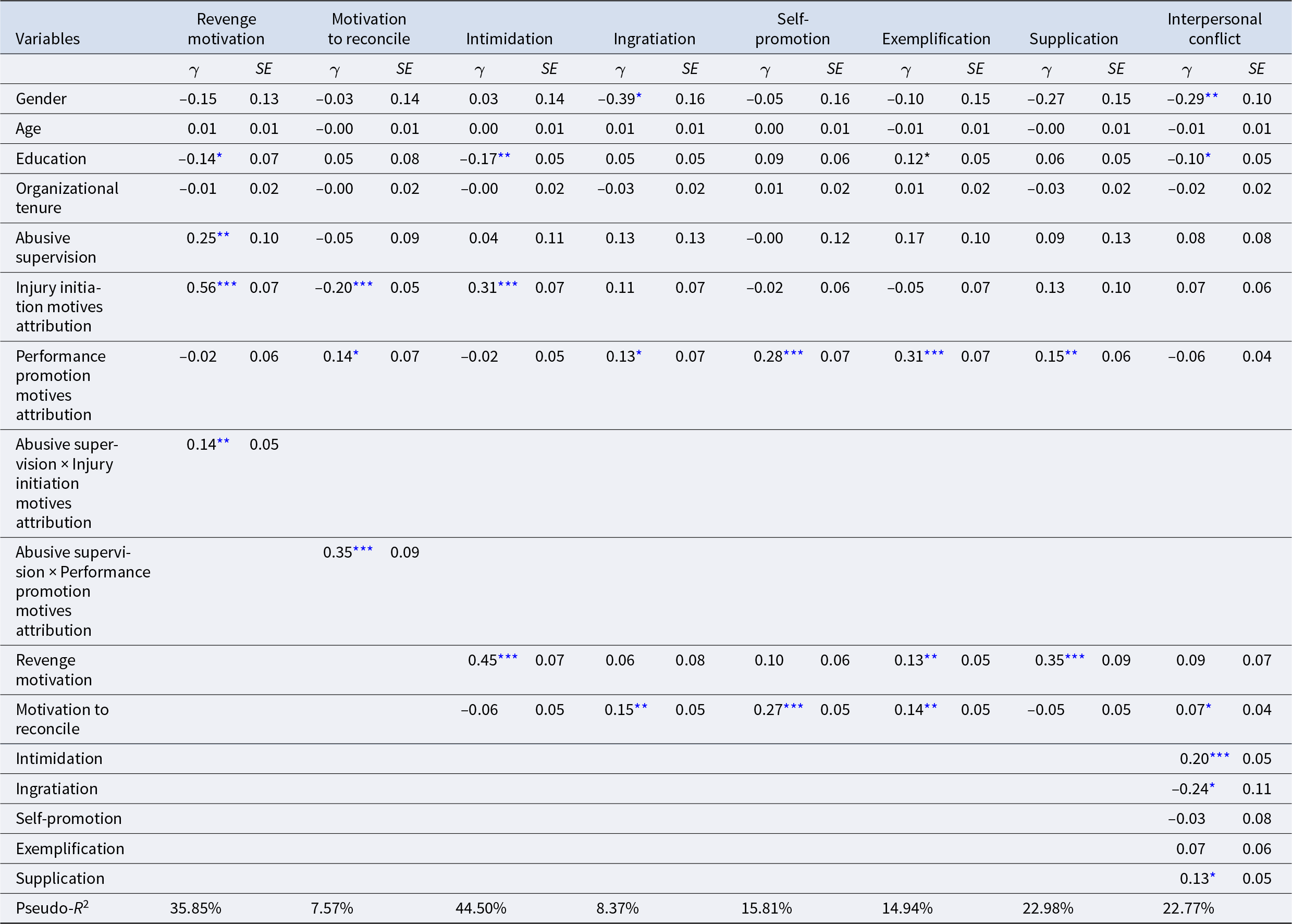
As shown in Table 2, the interaction term of injury initiation motives attribution and abusive supervision on revenge motivation was significant (γ = 0.14, SE = 0.05, p = 0.006). Figure 2 and slope tests indicate that with a higher level of injury initiation motives attribution, abusive supervision was positively related to revenge motivation (γ = 0.44, SE = 0.13, p = 0.001). Conversely, with a lower level of injury initiation motives attribution, abusive supervision was not significantly related to revenge motivation (γ = 0.06, SE = 0.10, p = 0.542). H1 was supported.
The moderation effect of injury initiation motives attribution on the positive relationship between abusive supervision and revenge motivation

The results of path analyses

* Notes: N = 444; Gender: 0 = male, 1 = female; Education: 0 = primary school, 1 = junior high school, 2 = high school, 3 = associate degree, 4 = bachelor’s degree, 5 = master’s degree. With and without control variables, we reached the same conclusions. *p < 0.05, **p < 0.01, ***p < 0.001.
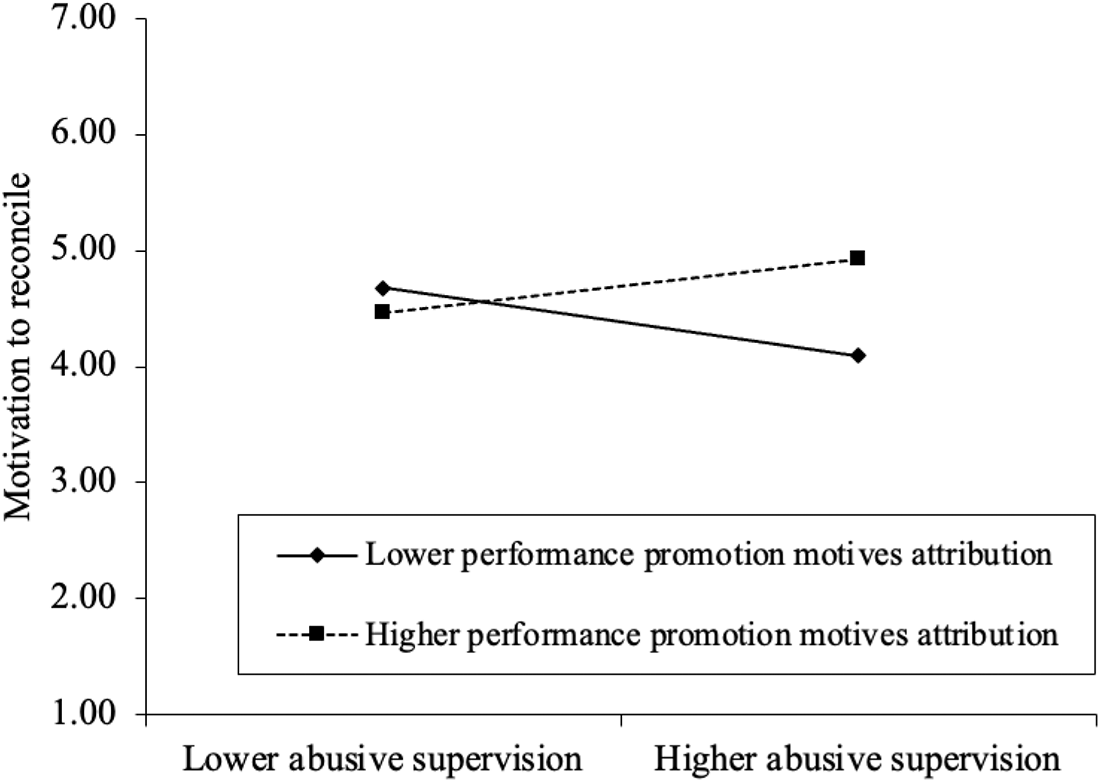
The interaction term of performance promotion motives attribution and abusive supervision on motivation to reconcile was significant (γ = 0.35, SE = 0.09, p < 0.001). Figure 3 and slope tests indicate that with a higher level of performance promotion motives attribution, abusive supervision was positively related to motivation to reconcile (γ = 0.34, SE = 0.13, p = 0.007). With a lower level of performance promotion motives attribution, abusive supervision was negatively related to motivation to reconcile (γ = –0.43, SE = 0.14, p = 0.002). Thus, H2 was supported.
The moderation effect of performance promotion motives attribution on the positive relationship between abusive supervision and motivation to reconcile

In addition, revenge motivation was positively related to intimidation (γ = 0.45, SE = 0.07, p < 0.001), exemplification (γ = 0.13, SE = 0.05, p = 0.006), and supplication (γ = 0.35, SE = 0.09, p < 0.001), but was not significantly related to ingratiation (γ = 0.06, SE = 0.08, p = 0.426) or self-promotion (γ = 0.10, SE = 0.06, p = 0.079). Hence, H3a and H3e were supported; H3b–3d were not supported. Additionally, motivation to reconcile was positively related to ingratiation (γ = 0.15, SE = 0.05, p = 0.006), self-promotion (γ = 0.27, SE = 0.05, p < 0.001), and exemplification (γ = 0.14, SE = 0.05, p = 0.003), but was not significantly related to intimidation (γ = – 0.06, SE = 0.05, p = 0.235) or supplication (γ = – 0.05, SE = 0.05, p = 0.353). Thus, H4b, H4c, and H4d were supported; H4a and H4e were not supported. Finally, we found that intimidation was positively related to interpersonal conflict (γ = 0.20, SE = 0.05, p < 0.001), ingratiation was negatively related to interpersonal conflict (γ = – 0.24, SE = 0.11, p = 0.022), and supplication was positively related to interpersonal conflict (γ = 0.13, SE = 0.05, p = 0.012). Self-promotion (γ = – 0.03, SE = 0.08, p = 0.648) and exemplification (γ = 0.07, SE = 0.06, p = 0.208) were not related to interpersonal conflict. Thus, H5a, H5b, and H5e were supported; H5c and H5d were not supported.
Supplemental Analysis
To exclude alternative explanations, we controlled for three individual differences – employee power distance, employee submissiveness, and dyadic fit with leaders – which were measured at Time 1. When we added these control variables, we still reached a consistent conclusion. Additionally, we included employee positive and negative emotions (measured at Time 3) as control variables to exclude the possibility that emotions explained why employees engage in certain coping strategies. Emotions have been identified as factors in previous studies on abusive supervision (Simon, Hurst, Kelley, & Judge, Reference Simon, Hurst, Kelley and Judge2015), especially those examining attributed motivations in abusive supervision (Yu & Duffy, Reference Yu and Duffy2021). After controlling for these two variables, we still reached a consistent conclusion.
Discussion
Theoretical Contributions
Our research contributes to the abusive supervision literature in multiple ways. First, this research adopts an employee actor–based perspective to examine when and how employees respond to abusive supervision in the workplace. Most research on abusive supervision has traditionally focused on the supervisor’s behavior and its negative effects on employees (Lian et al., Reference Lian, Ferris and Brown2012; Tepper, Reference Tepper2007; Tepper et al. , Reference Tepper, Mitchell, Haggard, Kwan and Park2015; Tepper et al., Reference Tepper, Simon and Park2017), often adopting a top-down perspective. By shifting the focus to an employee actor–based perspective, this study highlights employees as active agents rather than passive recipients of abusive supervision. This perspective allows for a deeper understanding of variations in employee responses and potential mitigation or reinforcement of abusive supervision effects. Although abusive supervision may be productive (Tepper, Reference Tepper, Ashkanasy, Bennett and Martinko2016) and has been embraced by some scholars (Bies, Tripp, & Shapiro, Reference Bies, Tripp, Shapiro, Ashkanasy, Bennett and Martinko2016), we lack much empirical evidence indicating that positive outcomes improve or adverse outcomes diminish as abusive supervision increases (Tepper et al., Reference Tepper, Simon and Park2017). Advancing this discussion, our study highlights that abusive supervision has a double-edged sword effect on interpersonal interactions between leaders and employees. Our findings indicate that employees’ selection of coping strategies depends on the attribution they make for the abusive supervision. This investigation is warranted by Tepper et al.’s (Reference Tepper, Simon and Park2017: 134) work, which encourages scholars to explore ‘under what conditions do abused employees select one coping strategy over another, and under what conditions are abused employees’ coping options more or less effective’.
Although employee attribution has been examined in the abusive supervision literature (Bowling & Michel, Reference Bowling and Michel2011; Chen & Liu, Reference Chen and Liu2019; Fiset, Robinson, & Saffie-Robertson, Reference Fiset, Robinson and Saffie-Robertson2019; Liao et al., Reference Liao, Lee, Johnson, Song and Liu2021; Martinko et al., Reference Martinko, Harvey, Sikora and Douglas2011; Yu & Duffy, Reference Yu and Duffy2021), prior research has mostly examined the moderating role of attribution in the relationships between abusive supervision and behavior-oriented outcomes, but ignored the potential psychological or more proximal processes involved (Bowling & Michel, Reference Bowling and Michel2011). Our research verifies the role of specific attributions in influencing employees’ psychological reactions and behavioral coping strategies. Departing from the existing studies, our work adopts a new perspective; that is, it examines the unique role of attribution in determining how employees manage abusive supervision through their psychological responses and impression management. This approach offers a more comprehensive understanding of the complex psychological and behavioral reactions of employees when coping with abusive supervision. In particular, going beyond the existing research (Yu & Duffy, Reference Yu and Duffy2021), our study explores the unique role of attribution in shaping employees’ motivational and coping reactions to abusive supervision.
Notably, despite the contingency perspective emphasized in this study, we found that abusive supervision was positively related to revenge motivation without considering attribution. This result is consistent with most previous findings, which have suggested that abusive supervision typically has a negative influence on employee outcomes (Tepper et al., Reference Tepper, Simon and Park2017). From a broader perspective, our examination shifts scholarly attention to the notion that employees actively cope with abusive supervision by engaging in impression management strategies. This idea is worthy of our attention because the potential role of employees in the reaction to abusive supervision has been emphasized in the past (Rasheed et al., Reference Rasheed, Zaheer and Manzoor2020; Tröster & Van Quaquebeke, Reference Tröster and Van Quaquebeke2021). That is, employees can take measures to deal with negative work events or experiences.
Second, our research thoroughly explores the motivations and five impression management strategies that employees use to cope with abusive supervision. This exploration serves as a significant addition to the existing literature on abusive supervision and impression management (Bolino et al., Reference Bolino, Long and Turnley2016; Lukacik & Bourdage, Reference Lukacik and Bourdage2019). Previous research has shed light on the relationships between abusive supervision and employees’ strategies or reactions, but the mechanisms underlying these processes have tended to be emotions or cognitive activities that have been able to predict individuals’ true inner state. Such activities offer real-time feedback that helps individuals understand their position in social roles, status, and relationships and, therefore, guides their behaviors (e.g., Liao et al., Reference Liao, Lee, Johnson, Song and Liu2021; Simon et al., Reference Simon, Hurst, Kelley and Judge2015; Tröster & Van Quaquebeke, Reference Tröster and Van Quaquebeke2021; Yu & Duffy, Reference Yu and Duffy2021). In comparison, impression management involves selectively presenting or manipulating information to create a desired impression. This impression may not necessarily align with the individual’s true feelings or intentions, but instead aims to influence others’ perceptions through strategic displays, and subsequently the focal individual’s interactions with those others.
Moreover, our work contributes to the impression management literature. While previous research has considered some coping strategies, it has not been as comprehensive in unpacking the role of impression management in coping. By examining and showcasing five distinct impression management strategies, we provide a fuller understanding of how abusive supervision influences employees’ coping strategies and their unique effectiveness. While including these five strategies in our model, we respond to Bolino et al.’s (Reference Bolino, Long and Turnley2016) call to consider previously overlooked negative strategies. Our research also analyzes these strategies independently, rather than as a whole (Lukacik & Bourdage, Reference Lukacik and Bourdage2019), providing a clearer understanding of which impression management strategies are more or less effective and which bring real benefits.
Finally, this research broadens the scope of our knowledge of the interpersonal outcomes of abusive supervision by adopting a bidirectional perspective. Previous research on abusive supervision has primarily focused on unidirectional behaviors – either employees’ reactions toward leaders (e.g., deviance toward the supervisor and supervisor-directed helping; Lian, Brown, et al., Reference Lian, Brown, Ferris, Liang, Keeping and Morrison2014; Liao et al., Reference Liao, Lee, Johnson, Song and Liu2021; Park et al., Reference Park, Hoobler, Wu, Liden, Hu and Wilson2019; Tröster & Van Quaquebeke, Reference Tröster and Van Quaquebeke2021; Zellars et al., Reference Zellars, Tepper and Duffy2002) or leaders’ subsequent reactions toward employees (e.g., abusive supervision; Chen et al., Reference Chen, Qin, Johnson, Huang, Yang and Liu2021; Wee et al., Reference Wee, Liao, Liu and Liu2017). Taking a different tack, our research focuses on interpersonal conflict, emphasizing the bidirectional negative interactions between leaders and employees. Interpersonal conflict can be seen as an escalation of abusive supervision, and our research suggests that if not properly managed, abusive supervision may evolve into more severe negative interactions, ultimately harming both employees and leadership effectiveness.
Our research does not merely reveal similar patterns to previous studies, but instead unveils an important new outcome. This exploration is crucial because if we consider only employees’ reactions to abusive supervision, we miss understanding how those reactions influence interactions between employees and leaders. Similarly, if we stop at examining leaders’ reactions toward employees, we will not appreciate the ongoing interactions between them. In both cases, the story remains incomplete. Our findings lead us to conclude that the ingratiation coping strategy (rather than self-promotion and exemplification) resulting from performance promotion motives attribution is more effective in alleviating interpersonal conflict. By comparison, the intimidation and supplication coping strategies resulting from injury initiation motives attribution are less effective. Our findings make a timely contribution by providing evidence that the five impression management strategies affect interpersonal conflict in different ways, thereby painting a more complete picture of the influence of abusive supervision.
Practical Implications
Our study has practical implications for both managers and employees. Our results indicate that employees’ different interpretations of abusive supervision lead them to adopt different coping strategies, which consequently yield different outcomes. Although abusive supervision intended to promote employees’ performance may reduce interpersonal conflict, managers need to avoid engaging in any form of abusive supervision given its many undesirable outcomes. When leaders rein in their abusive impulses, we can expect a more positive and respectful work environment.
More specifically, to improve employees’ positive reactions and relieve interpersonal conflict, managers should pay attention to how the purposes of their abusive behaviors are expressed, if they deem such behaviors to be necessary. Abusive supervision is basically harmful to employees, so leaders need to have a reasonable and acceptable reason for engaging in abusive behaviors (Liu et al., Reference Liu, Liao and Loi2012). Especially when pushing employees in a way that could be perceived as abusive in the interest of promoting their performance, leaders need to communicate their beneficial intentions to employees, thereby avoiding potential misunderstanding (Kim, Atwater, Latheef, & Zheng, Reference Kim, Atwater, Latheef and Zheng2019). Even so, leaders should be careful when meting out abusive treatments toward employees.
Furthermore, our findings highlight the need for employees to be aware of how their interpretation of leaders’ behavior affects their subsequent reactions and conflicts with those leaders. While sometimes there may truly be malice behind abusive supervision, it is also possible that employees may be biased in their attributions (Miller & Ross, Reference Miller and Ross1975). We encourage them to take the time to consult with managers and/or others and check whether they might have improperly interpreted the leaders’ motivations. Doing so will allow them to select more effective coping strategies to overcome the adverse situation, if it actually exists. However, if the leader proves to be malicious, employees may consider reporting the abuse to HR and law enforcement and seeking help from counselors inside and outside the company.
Our findings also indicate that employees’ psychological reactions to abusive supervision directly affect how they select coping strategies, which ultimately influences interpersonal conflict in different ways. We suggest that organizations pay attention to the feelings of employees who experience abusive supervision. In particular, organizations should make efforts to cultivate employees’ positive psychological states in the workplace. In addition, they can implement training courses to improve communication among leaders and employees and to reduce employees’ negative thoughts or feelings at work (Kim et al., Reference Kim, Atwater, Latheef and Zheng2019).
Similarly, organizations can offer interpersonal skills training programs to help employees enhance their awareness of the importance of social influence strategies for their interpersonal relationships in the workplace. For example, employees may be encouraged to adopt specific impression management strategies under certain conditions, prefer more positive tactics, and avoid using negative impression management strategies (Yagil et al., Reference Yagil, Ben-Zur and Tamir2011). Such practices are expected to enhance employees’ interpersonal relationships and diminish their interpersonal conflict. Our findings show that intimidation and supplication tend to exacerbate employees’ interpersonal conflict with leaders, whereas ingratiation reduces this kind of conflict. Thus, we suggest that employees learn to adopt more positive social influence strategies and try to avoid negative social influence strategies, as doing so may help to reduce interpersonal conflict (Lukacik & Bourdage, Reference Lukacik and Bourdage2019).
Limitations and Future Research Directions
We acknowledge that our study has several limitations, which in turn suggest future directions to explore. This study examined the psychological mechanisms between abusive supervision and those strategies. We encourage future research to examine other potential psychological mechanisms, such as psychological entitlement and psychological distress. Hence, a promising focus for future research is to delineate and test more sophisticated psychological responses to abusive behaviors, which could further clarify the essential processes between abusive supervision and distal outcomes.
Specifically, the effect of revenge motivation on ingratiation, self-promotion, and exemplification was not supported, while its positive effect on intimidation and supplication was supported. These findings suggest that revenge motivation does, indeed, encourage employees to pursue coping strategies that make them appear either threatening or helpless to manipulate leaders’ emotions. Yet, it is important to acknowledge that this relationship may be more complex than anticipated. It may vary depending on individual or contextual factors. For example, it is also plausible that revenge motivation may reduce the likelihood of supplication, particularly when employees possess characteristics such as high trait dominance or low agreeableness. Future research could explore the possibility of a negative relationship between revenge motivation and supplication from alternative theoretical perspectives. As for the insignificant effects, perhaps a motive for revenge tends to shift individuals’ focus toward past negative experiences and interactions (Bradfield & Aquino, Reference Bradfield and Aquino1999). The relatively negative coping strategies may play a more influential role than positive coping strategies in this process.
Additionally, the effect of motivation to reconcile on ingratiation, self-promotion, and exemplification was supported, while its effect on intimidation and supplication was not supported. These findings suggest that when employees seek to reconcile their relationship with the leader, they tend to adopt strategies that appear more positive – namely, either praising leaders or showcasing their own excellence and initiatives. As for those insignificant effects, the motivation to reconcile emphasizes understanding, cooperation, and trust-building (Tomlinson et al., Reference Tomlinson, Dineen and Lewicki2004), but intimidation contradicts this positive dynamic (Turnley & Bolino, Reference Turnley and Bolino2001) and supplication may trap individuals in a negative situation, hindering constructive communication (Chuang et al., Reference Chuang, Shih, Chen, Lin and Teng2018). Thus, relatively positive coping strategies are likely to play a more important role than negative coping strategies in this process.
Our study focused on interpersonal conflict with leaders as an indicator of the effectiveness of coping with abusive supervision, but we did not look at supervisors’ subsequent abusive supervisory behavior. For example, leader reconciliation (e.g., subsequent reduced abusive supervision) is effective in supporting relationship recovery (Andiappan & Treviño, Reference Andiappan and Treviño2011) after the initial abusive supervision. A promising avenue is to examine supervisors’ subsequent abusive supervisory behavior as the outcome (Wee et al., Reference Wee, Liao, Liu and Liu2017). Relatedly, in addition to interpersonal conflict, scholars can address other outcome variables, such as performance evaluation and career advancement opportunities. The specific impression management strategies may have unique influences on different outcomes.
From a theoretical perspective, we did not expect to find a cross-moderation effect of the injury initiation and performance promotion attributions on the relationship between abusive supervision and motivation. Nevertheless, we conducted additional analyses of these four moderation effects. The nonsignificant moderation effects of both of these attributions on the relationship between abusive supervision and revenge motivation could be caused by opposing influences that neutralize each other, leaving behind only the positive effect of abusive supervision on revenge motivation. Moreover, the moderation effect of promotion performance motive attribution on the relationships between abusive supervision on motivation to reconcile was significant as expected. The moderation effect of injury initiation motive attribution on the relationship between abusive supervision on motivation to reconcile was also significant, such that a lower level of injury initiation motive attribution strengthened the negative effect of abusive supervision on motivation to reconcile. When employees attach a lower level of injury initiation motivation to abusive supervision, they may see the leader’s behavior as unintentional or situational rather than deliberate. This reduces their motivation for reconciliation, as they believe the harm was not intentional, is unlikely to recur, and does not require a response. Consequently, the urgency to restore the relationship diminishes.
From a methodological perspective, this study adopted a three-wave design to mitigate common method bias, but conclusions of causality could not be made. In a series of supplemental analyses, we followed the recommendations of prior research (Angrist & Pischke, Reference Angrist and Pischke2014; Fischer, Reference Fischer2023) to control for employee power distance, employee submissiveness, dyadic fit with leaders, and emotions in the model, and also tested the reversed order. However, we could not exclude all alternative explanations. To address this issue, future research should adopt deconflated and configurational approaches – such as behavioral coding and qualitative comparative analysis (Fischer & Sitkin, Reference Fischer and Sitkin2023) – to reduce causal indeterminacy. It is also important to control for baseline levels of endogenous variables and account for relevant but unmeasured individual differences (Fischer et al., Reference Fischer, Tian, Lee and Hughes2021). More importantly, we urge scholars to adopt a sequential experiment design with active control conditions to establish the causal chains (Fischer, Reference Fischer2023; Fischer, Dietz, & Antonakis, Reference Fischer, Dietz and Antonakis2017; Fischer et al., Reference Fischer, Tian, Lee and Hughes2021). For example, they might first test the effect of manipulating abusive supervision on motivation, then the effect of manipulating motivation on impression management strategies, and subsequently the effect of manipulating those strategies on interpersonal conflict. Scholars also need to consider time by theoretically clarifying and empirically testing how abusive supervision effects unfold over time and space with repeated measures (Fischer et al., Reference Fischer, Dietz and Antonakis2017). By doing so, they can move us closer to more accurate models that demonstrate the temporality of the phenomenon of interest.
When we reviewed the literature, we noted that a measure of motivation to reconcile has been used in prior studies, such as the work of Iwai and Carvalho (Reference Iwai and Carvalho2022), Boonyarit, Chuawanlee, Macaskill, and Supparerkchaisakul (Reference Boonyarit, Chuawanlee, Macaskill and Supparerkchaisakul2013), and Thai, Wenzel, and Okimoto (Reference Thai, Wenzel and Okimoto2023). As such, we consider that this measure has been recognized by scholars. Although this item may not very clear, it inherently suggests a desire or willingness to restore the relationship. However, we agree that this item (How difficult would it be to rebuild your relationship with your leader back to the point where it was before he or she abused you?) may be not perfect and encourage future research to adopt alternative scales to measure it.
Lastly, we collected data from a high-tech company in southern China, which raises questions about the generalizability of our findings. Indeed, we are unsure whether our findings would apply to other cultures, industries, and jobs. Although we conducted additional analyses to control for power distance as a key cultural variable and found that it did not significantly affect our results, we suggest that future research collect data from multiple samples from different countries, industries, and jobs to verify the robustness of our research results.
Conclusion
Our examination emphasizes the important role of attribution in coping with abusive supervision and demonstrates the psychological mechanisms and effectiveness of specific coping strategies. In doing so, our research sheds new light on the phenomenon of abusive supervision. We call upon scholars to continue to take an employee actor–based perspective to advance the research in this area.
Data availability statement
The data that support the findings of this study are available from the corresponding author upon reasonable request.
Funding statement
This research was supported by a grant awarded to Dan Ni, Sun Yat-sen University, funded by National Natural Science Foundation of China (Grant No. 72202248) and to Xiaoming Zheng, Tsinghua University, funded by National Natural Science Foundation of China (Grant No. 72172074).
Dan Ni (nidan@mail.sysu.edu.cn) is an assistant professor in the Sun Yat-sen Business School, Sun Yat-sen University. She received her PhD from School of Economics and Management at Tsinghua University. Her research interests include leadership, mindfulness, and creativity. Her work has appeared in Journal of Applied Psychology, Journal of Management, Human Resource Management, Human Relations, Journal of Organizational Behavior, Journal of Business Research, Journal of Occupational and Organizational Psychology, among others.
Xiaoming Zheng (zhengxm@sem.tsinghua.edu.cn) is a full professor in the School of Economics and Management, Tsinghua University. He received his PhD from the Institute of Psychology at the Chinese Academy of Sciences. His research interests include mindfulness, work engagement, well-being, leadership, and creativity. His work has appeared in Academy of Management Journal, Strategic Management Journal, Journal of Applied Psychology, Journal of Organizational Behavior, Journal of Occupational and Organizational Psychology, Journal of Business Ethics, Human Resource Management, and Human Relations, among others.
Jiaxin Lin (jx-lin21@mails.tsinghua.edu.cn) is a PhD candidate in the School of Economics and Management, Tsinghua University. Her research interests include work meaningfulness and leadership. Her work has appeared in Journal of Business Research.
Yirong Guo (guoyr@xmu.edu.cn) is an associate professor in Center for Higher Education Development of Xiamen University, and Institute of Education at Xiamen University. Her research focuses on leadership and positive psychology. Her work has appeared in Studies in Higher Education, Learning and Instruction, Journal of Applied Psychology, Tourism Management, and International Journal of Hospitality Management, among others.
Lindie H. Liang (lliang@wlu.ca) is an associate professor in the Lazaridis School of Business and Economics at Wilfrid Laurier University. Her research focuses on leadership, self-regulation, emotions, conflict in the workplace, and workplace aggression. Her work has appeared in Academy of Management Journal, Journal of Applied Psychology, Organizational Behavior and Human Decision Processes, and Journal of Organizational Behavior, among others.