Introduction
Traditional shell morphometrics in molluscs is a common tool that has been used for various purposes: to show local or regional conchological variation (e.g. Chiu et al., Reference Chiu, Chen, Lee and Chen2002; Preston & Roberts, Reference Preston and Roberts2007; Lacerda et al., Reference Lacerda, Miyahira and Santos2011); to explore ecological relationships, usually linking morphological variation to a specific set of environmental conditions (e.g. Branch & Marsh, Reference Branch and Marsh1978; McMahon & Whitehead, Reference McMahon and Whitehead1987; Lam & Calow, Reference Lam and Calow1988; Matos et al., Reference Matos, Matthews-Cascon and Chaparro2020); to distinguish species, mainly in Gastropoda (e.g. Kristensen & Christensen, Reference Kristensen and Christensen1989; Rolán, Reference Rolán1991; Ward et al., Reference Ward, Goater and Mikos1997; Absalão & Santos, Reference Absalão and Santos2004; Miranda & Cuezzo, Reference Miranda and Cuezzo2014) and in Bivalvia (e.g. Kilgour et al., Reference Kilgour, Lynn and Mackie1990; Benaim & Absalão, Reference Benaim and Absalão2011; Viegas et al., Reference Viegas, Benaim and Absalão2014). The use of this approach applied to the class Scaphopoda has increased since Shimek (Reference Shimek1989) proposed the first indices based on measurements of the shell accompanied by statistical evaluation. Recent studies used the same or similar indices as a tool for the discrimination of scaphopod species, focusing on the comparisons of congeneric species of Gadilidae (Absalão et al., Reference Absalão, Silva and de Paula2005; Caetano & Absalão, Reference Caetano and Absalão2005; Scarabino & Caetano, Reference Scarabino and Caetano2008; Caetano et al., Reference Caetano, Scarabino and Absalão2010; Scarabino et al., Reference Scarabino, Caetano and Carranza2011). Groups of Dentaliida have rarely been studied using this combined approach, despite successful results within Fissidentalium P. Fischer, 1885 (Shimek & Moreno, Reference Shimek and Moreno1996; Shimek, Reference Shimek1997). The same type of data was not employed in the taxonomy of supraspecific groups of Scaphopoda.
Currently, two orders are well recognized in the class Scaphopoda: Dentaliida and Gadilida (Scarabino, Reference Scarabino and Bouchet1995; Reynolds & Steiner, Reference Reynolds, Steiner, Ponder and Lindberg2008). The order Dentaliida encompasses species with moderately large shells, usually characterized by a longitudinal sculpture, such as ribs or striae, and with the widest diameter at the anterior aperture (Lamprell & Healy, Reference Lamprell and Healy1998). Differently, members of the Gadilida regularly possess very small to medium-sized shells, which are polished and have the largest diameter around the mid-point (also called equator) or immediately next to it. The suborder Entalimorpha, included in Gadilida and constituted by the family Entalinidae, is an exception to these general shell features and is more similar to the Dentaliida (Steiner, Reference Steiner, Beesley, Ross and Wells1998b). Thus, to distinguish between the two orders is reasonably straightforward, with a few exceptions. Inside the orders, however, genera and species are usually classified based on limited informative conchological features, resulting in a tricky identification even for experts. Also, subjective terms such as ‘short’ and ‘long’ are frequent in the descriptions of species.
Scaphopods are commonly collected as empty shells, which hinders an integrative approach of anatomical and molecular data. Moreover, specimens with the soft parts are not always suitable for molecular analysis or the costs of analysis may be high (e.g. fixation in formaldehyde; old material from collections). Therefore, maximizing the usefulness of shell features could enhance the systematics of the taxon. Based on this scenario, the present study aims to test the morphometric approach to discriminate between taxa at interspecific (congeneric species) and supraspecific (genera and families) levels. Furthermore, the study at different taxonomic levels may reassess important morphometric variables of the shell for the taxonomy of Scaphopoda. The present study focuses on phenetics, and therefore, the morphometric data are not used to establish or relate to phylogeny.
Material and methods
The present study focuses on taxa occurring in Brazil and comprises 28 species classified in 12 genera, five families and two orders. Three families, seven genera and 16 species belong to the order Dentaliida: Dentaliidae: Paradentalium Cotton & Godfrey, 1933: P. gouldii (Dall, 1889), P. disparile (Orbigny, 1853) and P. infractum (Odhner, 1931); Antalis H. Adams & A. Adams, 1854: A. cerata (Dall, 1881), A. circumcincta (Watson, 1879) and A. taphria (Dall, 1889); Graptacme Pilsbry & Sharp, 1897: G. calamus (Dall, 1889), G. eborea (Conrad, 1846), G. perlonga (Dall, 1881) and G. semistriolata (Guilding, 1834); Fissidentalium P. Fischer, 1885: F. candidum (Jeffreys, 1877); Coccodentalium Sacco, 1896: C. carduus (Dall, 1889); Fustiariidae: Fustiaria Stoliczka, 1868: F. liodon (Pilsbry & Sharp, 1897) and F. stenoschiza (Pilsbry & Sharp, 1897); Gadilinidae: Episiphon Pilsbry & Sharp, 1897: E. sowerbyi (Guilding, 1834) and E. didymum (Watson, 1879). Two families, five genera and 12 species belong to the order Gadilida: Entalinidae: Entalina Monterosato, 1872: E. platamodes (Watson, 1879); Gadilidae: Striocadulus Emerson, 1962: S. magdalensis Gracia & Ardila, 2009; Polyschides Pilsbry & Sharp, 1898: P. tetraschistus (Watson, 1879), P. portoricensis (Henderson, 1920), P. xavante Caetano & Absalão, 2005 and P. noronhensis Simone, 2009; Cadulus Philippi, 1844: C. parvus Henderson, 1920 and C. nerta Caetano, Scarabino & Absalão, Reference Caetano, Scarabino and Absalão2006; Gadila Gray, 1847: G. braziliensis (Henderson, 1920), G. dominguensis (Orbigny, 1842), G. pandionis (Verrill & Smith in Verril, 1880) and G. simpsoni (Henderson, 1920).
The material examined was selected in an attempt to do a broad taxonomic sampling and based on the availability for study in the collections studied. The shells measured are related to previous taxonomic studies of scaphopods from Brazil (Absalão et al., Reference Absalão, Silva and de Paula2005; Caetano & Absalão, Reference Caetano and Absalão2005; Caetano et al., Reference Caetano, Scarabino and Absalão2006, Reference Caetano, Scarabino and Absalão2010; Scarabino & Caetano, Reference Scarabino and Caetano2008; Caetano & Santos, Reference Caetano and Santos2010; Scarabino et al., Reference Scarabino, Caetano and Carranza2011; Souza & Caetano, Reference Souza and Caetano2013), which is reflected in the geographic account of the dataset. The identifications of the specimens were based on the shell morphology with comparisons to the type material, based on original descriptions and illustrations. The dataset contains a total of 676 shells (Supplementary material S1). The list of vouchers examined is available in the Supplementary material (S2). For the congeneric analysis of Gadila, see Caetano et al. (Reference Caetano, Scarabino and Absalão2010); the data published by the latter authors were included here at other levels (i.e. genera, families).
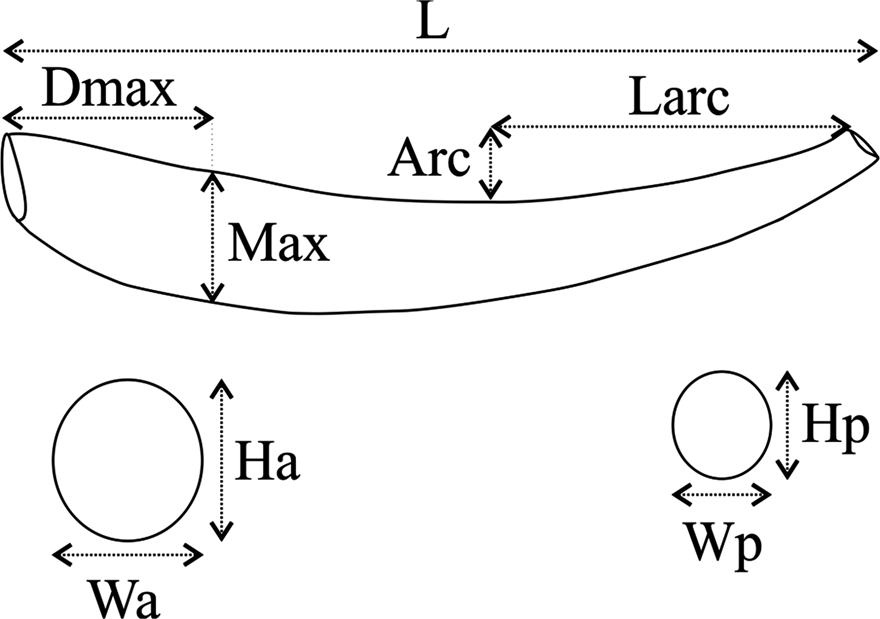
The shells studied were empty and undamaged to avoid imprecision. Morphometric variables were taken according to Caetano et al. (Reference Caetano, Scarabino and Absalão2010) (Figure 1). The variables measured are total length (L), maximum diameter (Max), the distance of the point of maximum diameter from anterior aperture (Dmax), maximum curvature (Arc), the distance of the point of maximum curvature from the apex (Larc), anterior aperture height (Ha), anterior aperture width (Wa), apical aperture height (Hp), apical aperture width (Wp) (Figure 1). We calculated ratios in order to assess the degree of shell slenderness (L/Max) and the shape of anterior and posterior apertures (Ha/Wa and Hp/Wp, respectively). See Absalão & de Paula (Reference Absalão and de Paula2004: 11) for further discussion regarding the use of these ratios. We compared congeneric species, genera and families in each order (Dentaliida and Gadilida).
Schematic representation of a scaphopod (adapted from Shimek, Reference Shimek1989) with the measurements used in the present study: total length (L); maximum diameter (Max); the distance of the point of maximum diameter from anterior aperture (Dmax); maximum curvature (Arc); the distance of the point of maximum curvature from the apex (Larc); anterior aperture height (Ha); anterior aperture width (Wa); apical aperture height (Hp); apical aperture width (Wp). Terminology follows Caetano et al. (Reference Caetano, Scarabino and Absalão2010).

The independence of the variables was tested by a preliminary correlation analysis among all variables and we excluded those that presented a strong correlation (r ≥ 0.8) from the subsequent analysis. A multivariate approach was carried out using Discriminant Function Analysis to integrate all morphometric data in a single analysis. For this step, we standardized the morphometric data following Romesburg (Reference Romesburg1984) and Vilela et al. (Reference Vilela, Souza and Caetano2019): the distribution mean and standard deviation was determined for each variable and later, the mean was subtracted from each variable value. All statistical procedures were performed using STATISTICA 7 by Statsoft, Inc, Tulsa, Oklahoma.
Results
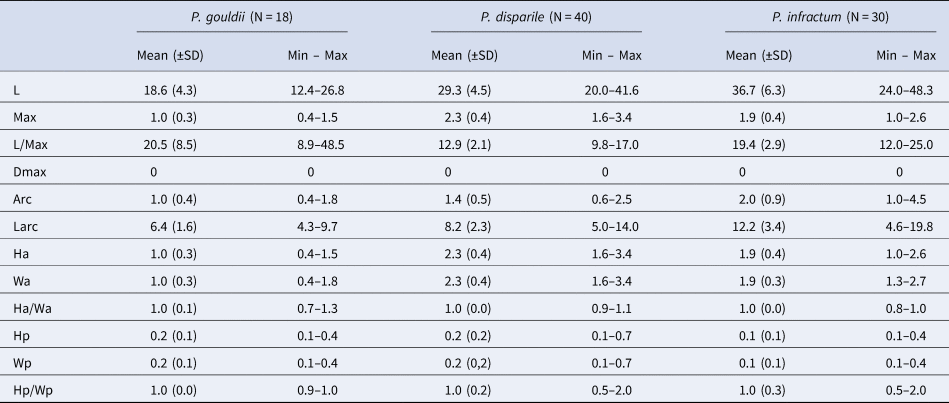
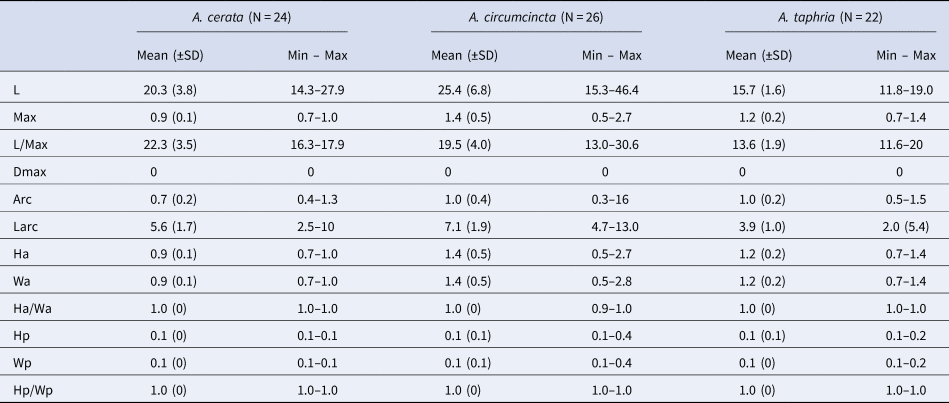
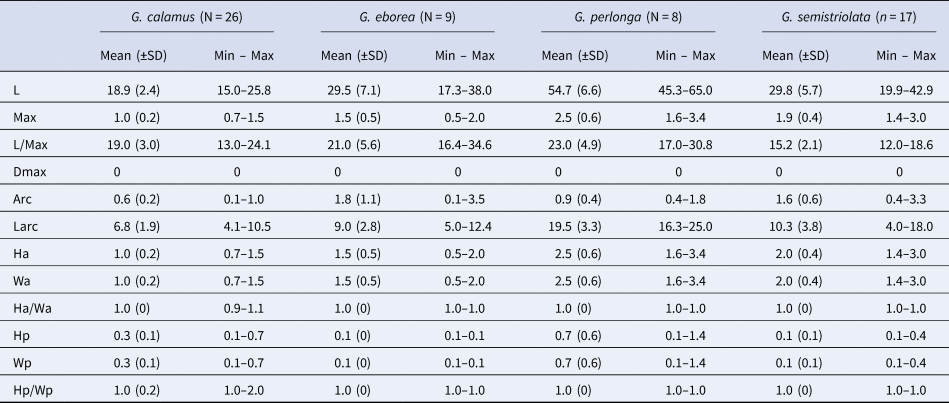
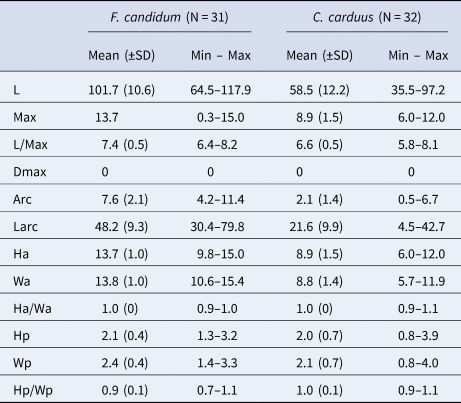
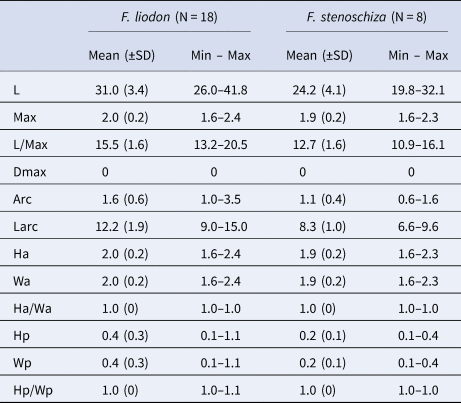
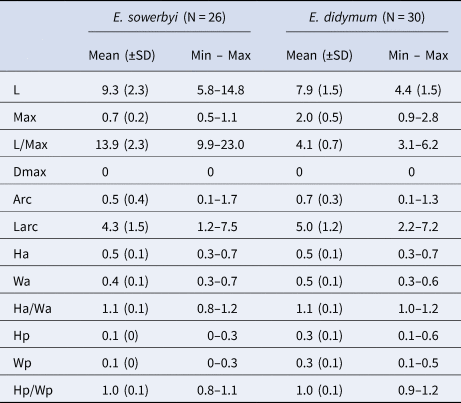
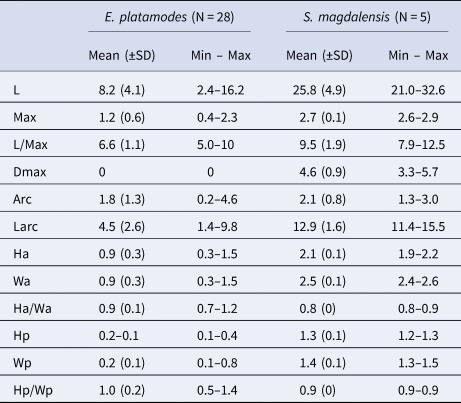
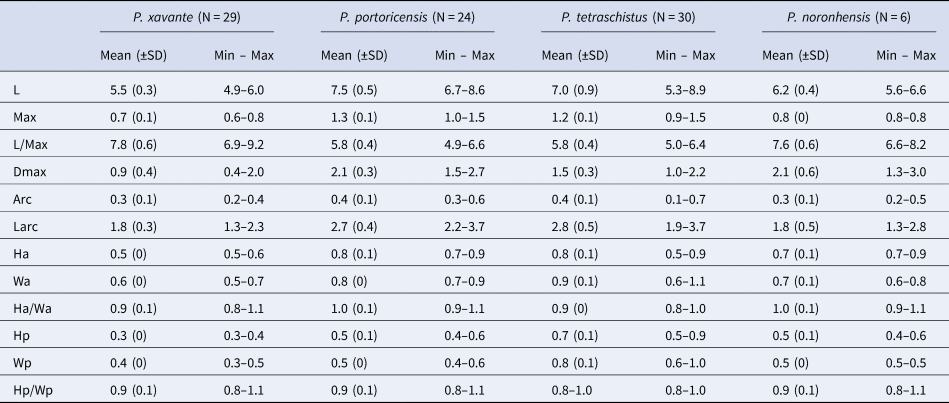
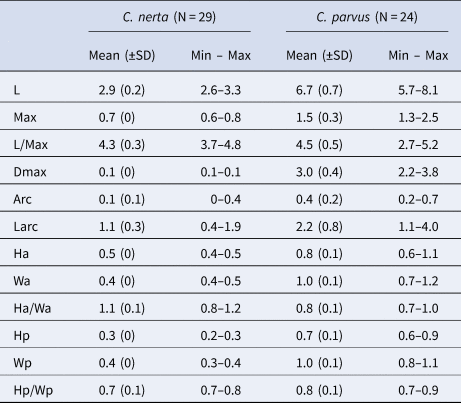
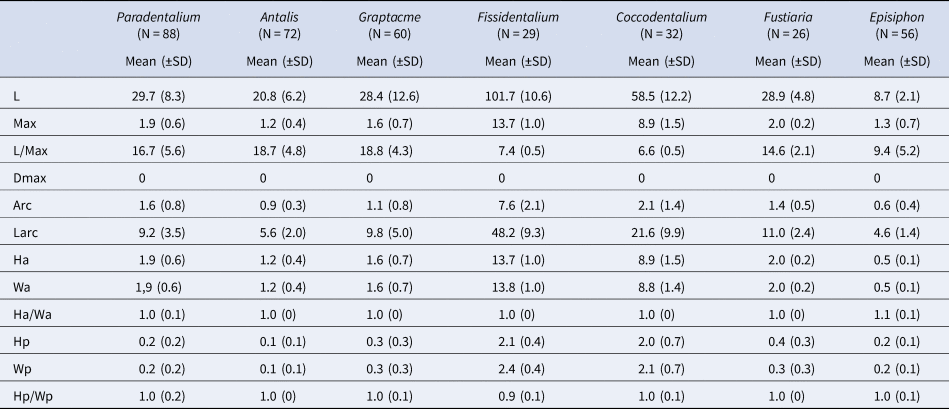
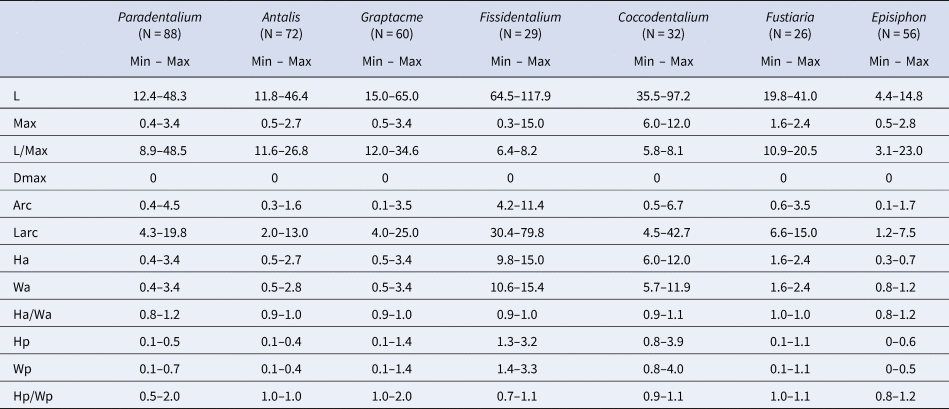
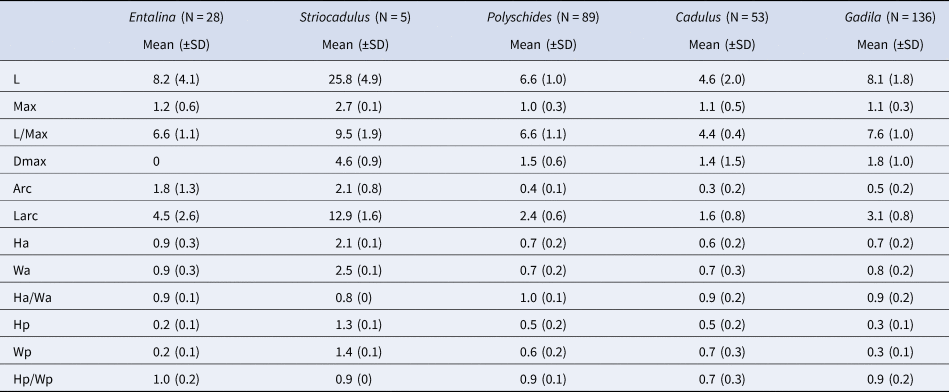
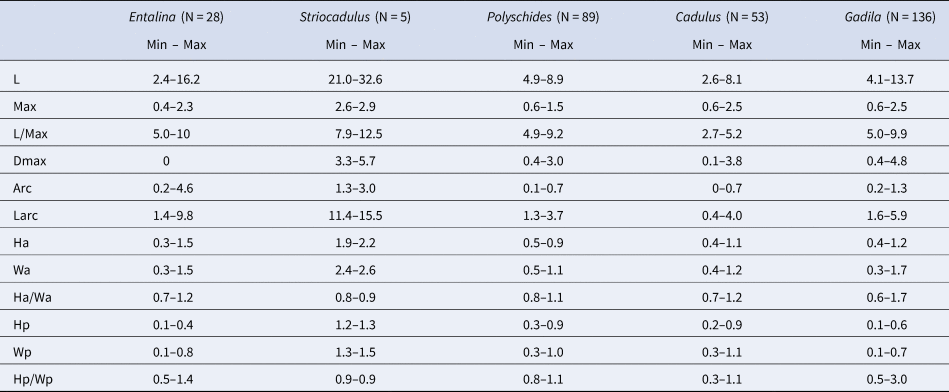
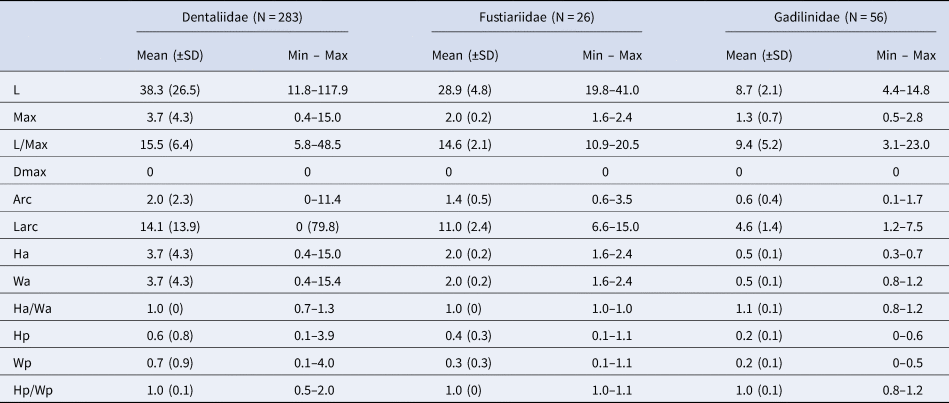
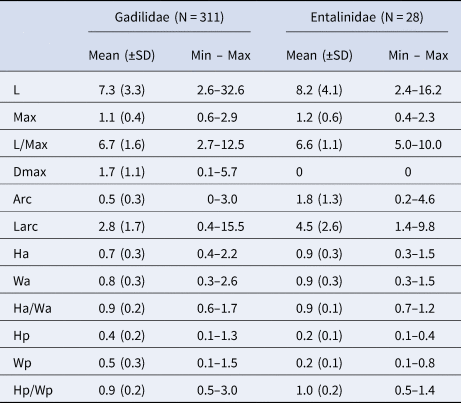
A total of 676 shells were measured, from which 12 Discriminant Function Analyses (DFA) were derived. A summary of the measurements is presented in Tables 1–15; details of each specimen are available in the Supplementary material (S1). For statistical data of the DFA, see the Supplementary material (S3: Tables 1–9).
Shell morphometric parameters with minimum (min), maximum (max), mean values and standard deviation (±SD) for the species studied in the genus Paradentalium

L, length; Max, maximum diameter; Dmax, the distance of the point of maximum diameter from anterior aperture; Arc, maximum curvature; Larc, the distance of the point of maximum curvature from the apex; Ha, aperture height; Wa, aperture width; Hp, apex height; Wp, apex width.
All values in millimetres, except ratios.
Shell morphometric parameters with minimum (min), maximum (max), mean values and standard deviation (±SD) for the species studied in the genus Antalis

L, length; Max, maximum diameter; Dmax, the distance of the point of maximum diameter from anterior aperture; Arc, maximum curvature; Larc, the distance of the point of maximum curvature from the apex; Ha, aperture height; Wa, aperture width; Hp, apex height; Wp, apex width.
All values in millimetres, except ratios.
Shell morphometric parameters with minimum (min), maximum (max), mean values and standard deviation (±SD) for the species studied in the genus Graptacme

L, length; Max, maximum diameter; Dmax, the distance of the point of maximum diameter from anterior aperture; Arc, maximum curvature; Larc, the distance of the point of maximum curvature from the apex; Ha, aperture height; Wa, aperture width; Hp, apex height; Wp, apex width.
All values in millimetres, except ratios.
Shell morphometric parameters with a minimum (min), maximum (max), mean values and standard deviation (±SD) for the species studied in the genera Fissidentalium and Coccodentalium

L, length; Max, maximum diameter; Dmax, the distance of the point of maximum diameter from anterior aperture; Arc, maximum curvature; Larc, the distance of the point of maximum curvature from the apex; Ha, aperture height; Wa, aperture width; Hp, apex height; Wp, apex width.
All values in millimetres, except ratios.
Shell morphometric parameters with a minimum (min), maximum (max), mean values and standard deviation (±SD) for the species studied in the genus Fustiaria

L, length; Max, maximum diameter; Dmax, the distance of the point of maximum diameter from anterior aperture; Arc, maximum curvature; Larc, the distance of the point of maximum curvature from the apex; Ha, aperture height; Wa, aperture width; Hp, apex height; Wp, apex width.
All values in millimetres, except ratios.
Shell morphometric parameters with a minimum (min), maximum (max), mean values and standard deviation (±SD) for the species studied in the genus Episiphon

L, length; Max, maximum diameter; Dmax, the distance of the point of maximum diameter from anterior aperture; Arc, maximum curvature; Larc, the distance of the point of maximum curvature from the apex; Ha, aperture height; Wa, aperture width; Hp, apex height; Wp, apex width.
All values in millimetres, except ratios.
Shell morphometric parameters with a minimum (min), maximum (max), mean values and standard deviation (±SD) for the species studied in the genera Entalina and Striocadulus

L, length; Max, maximum diameter; Dmax, the distance of the point of maximum diameter from anterior aperture; Arc, maximum curvature; Larc, the distance of the point of maximum curvature from the apex; Ha, aperture height; Wa, aperture width; Hp, apex height; Wp, apex width.
All values in millimetres, except ratios.
Shell morphometric parameters with a minimum (min), maximum (max), mean values and standard deviation (±SD) for the species studied in the genus Polyschides

L, length; Max, maximum diameter; Dmax, the distance of the point of maximum diameter from anterior aperture; Arc, maximum curvature; Larc, the distance of the point of maximum curvature from the apex; Ha, aperture height; Wa, aperture width; Hp, apex height; Wp, apex width.
All values in millimetres, except ratios.
Shell morphometric parameters with a minimum (min), maximum (max), mean values and standard deviation (±SD) for the species studied in the genus Cadulus

L, length; Max, maximum diameter; Dmax, the distance of the point of maximum diameter from anterior aperture; Arc, maximum curvature; Larc, the distance of the point of maximum curvature from the apex; Ha, aperture height; Wa, aperture width; Hp, apex height; Wp, apex width.
All values in millimetres, except ratios.
Shell morphometric parameters, mean values and standard deviation (±SD), for the genera studied in the order Dentaliida

L, length; Max, maximum diameter; Dmax, the distance of the point of maximum diameter from anterior aperture; Arc, maximum curvature; Larc, the distance of the point of maximum curvature from the apex; Ha, aperture height; Wa, aperture width; Hp, apex height; Wp, apex width.
All values in millimetres, except ratios.
Shell morphometric parameters with a minimum (min) and maximum (max) for the genera studied in the order Dentaliida

L, length; Max, maximum diameter; Dmax, the distance of the point of maximum diameter from anterior aperture; Arc, maximum curvature; Larc, the distance of the point of maximum curvature from the apex; Ha, aperture height; Wa, aperture width; Hp, apex height; Wp, apex width.
All values in millimetres, except ratios.
Shell morphometric parameters, mean values and standard deviation (±SD), for the genera studied in the order Gadilida

L, length; Max, maximum diameter; Dmax, the distance of the point of maximum diameter from anterior aperture; Arc, maximum curvature; Larc, the distance of the point of maximum curvature from the apex; Ha, aperture height; Wa, aperture width; Hp, apex height; Wp, apex width.
All values in millimetres, except ratios.
Shell morphometric parameters with a minimum (min) and maximum (max) for the genera studied in the order Gadilida

L, length; Max, maximum diameter; Dmax, the distance of the point of maximum diameter from anterior aperture; Arc, maximum curvature; Larc, the distance of the point of maximum curvature from the apex; Ha, aperture height; Wa, aperture width; Hp, apex height; Wp, apex width.
All values in millimetres, except ratios.
Shell morphometric parameters with a minimum (min), maximum (max), mean values and standard deviation (±SD) for the species studied in the families Dentaliidae, Fustiariidae and Gadilinidae

L, length; Max, maximum diameter; Dmax, the distance of the point of maximum diameter from anterior aperture; Arc, maximum curvature; Larc, the distance of the point of maximum curvature from the apex; Ha, aperture height; Wa, aperture width; Hp, apex height; Wp, apex width.
All values in millimetres, except ratios.
Shell morphometric parameters with a minimum (min), maximum (max), mean values and standard deviation (±SD) for the species studied in the families Gadilidae and Entalinidae

L, length; Max, maximum diameter; Dmax, the distance of the point of maximum diameter from anterior aperture; Arc, maximum curvature; Larc, the distance of the point of maximum curvature from the apex; Ha, aperture height; Wa, aperture width; Hp, apex height; Wp, apex width.
All values in millimetres, except ratios.
Congeneric species analysis
Order Dentaliida
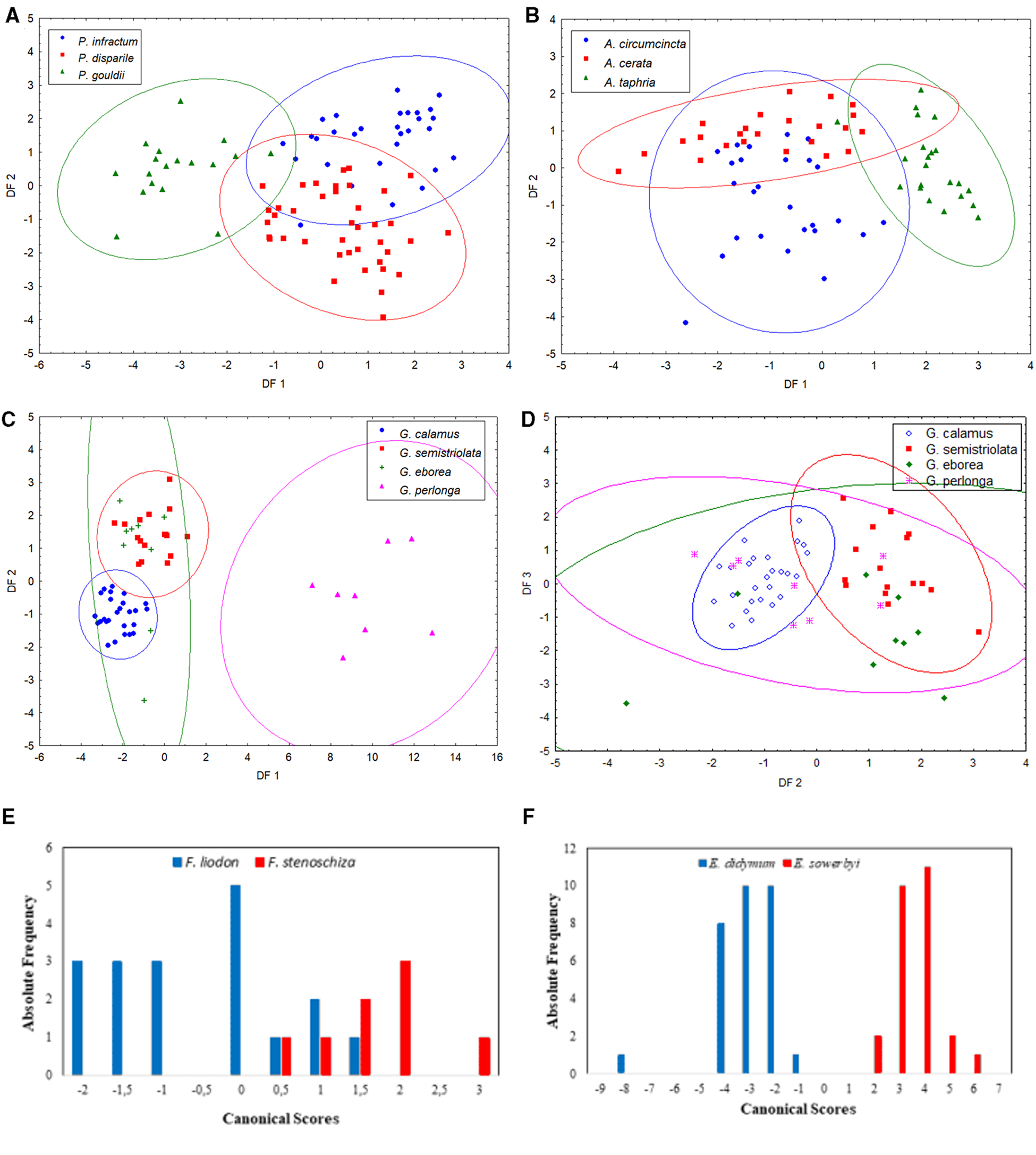
The DFA was able to distinguish between all the congeneric species within the genera Paradentalium, Antalis, Graptacme, Fustiaria and Episiphon (Figure 2A–F). The models were constructed with different numbers of variables, varying from three (genus Fustiaria) to nine (genus Episiphon) (Supplementary material S3) and the correct classifications varied from 83.3% (genus Antalis) to 100% (genus Episiphon) (Supplementary material S3).
Discriminant analysis of congeners in the order Dentaliida using morphometric data of the shells: (A) Paradentalium spp.; (B) Antalis spp.; (C–D) Graptacme spp.; (E) Fustiaria spp.; (F) Episiphon spp. DF, Discriminant function.

The DFA of Paradentalium (Figure 2A) was constructed with five variables (L; Arc; Ha; Ha/Wa; Wp) and was effective in 93.2% of the cases. Variables at DF1 discriminated between [P. disparile + P. infractum] and [P. gouldii] (Figure 2A) based mainly on L and Wp (Supplementary material S3). At DF2, the variables L and Ha were the most important to discriminate [P. gouldii + P. infractum] from [P. disparile] (Figure 2A).
The DFA of Antalis (Figure 2B) was constructed with seven variables (L; Max; L/Max; Arc; Larc; Ha/Wa; Hp) and was effective in 83.3% of the cases. Variables at DF1 discriminated almost all specimens of A. taphria from a group with [A. cerata + A. circumcincta] (Figure 2B) based mainly on L and Max. At DF2, there is a differentiation between A. cerata and A. circumcincta, although there is an overlap of some specimens (Figure 2B). The most significant variables at DF2 were the same as in DF1.
The DFA of Graptacme (Figure 2C, D) was constructed with six variables (L; L/Max; Arc; Ha/Wa; Wp; Hp/Wp) and was effective in 93.3% of the cases (Supplementary material S3). Variables at DF1 discriminated G. perlonga from the other species [G. calamus + G. eborea + G. semistriolata] (Figure 2C) based mainly on L and Arc. At DF2, the variables L and Wp were the most important to discriminate G. calamus from the group [G. semistriolata + G. eborea] (Figure 2C). Since G. semistriolata and G. eborea were not distinguished in the first two dimensions of the DFA, we proceeded with a new comparison using the DF2 and DF3 (Figure 2D). At DF3, these species were partially distinguished by the variables L and Hp/Wp, but the relative proportion of explicability of this axis is deficient.
The DFA of Fustiaria (Figure 2E) was constructed with three variables (L/Max; Arc; Larc) and was effective in 92.3% of the cases. Fustiaria liodon and F. stenoschiza were mainly discriminated from each other by Arc and Larc variables.
The DFA of Episiphon (Figure 2F) was constructed with nine variables (L; L/Max; Arc; Larc; Ha; Ha/Wa; Hp; Wp; Hp/Wp) and classified all specimens correctly. These species were discriminated mainly on the basis of the variables Hp and Wp.
Order Gadilida
In the same way as for the order Dentaliida, the DFA (Figure 3A, B) were able to distinguish between all the congeneric species within the genera Polyschides and Cadulus. The number of variables in the models varied from six (Cadulus) to eight (Polyschides) and the correct classification reached 100% in both genera (Supplementary material S3). The analysis of Gadila species performed by Caetano et al. (Reference Caetano, Scarabino and Absalão2010) reached 97% of correct classifications (Wilks' lambda = 0.01; F 27,362 = 69.87).
Discriminant analysis of congeners in the order Gadilida using morphometric data of the shells: (A) Polyschides spp.; (B) Cadulus spp. DF, Discriminant function.
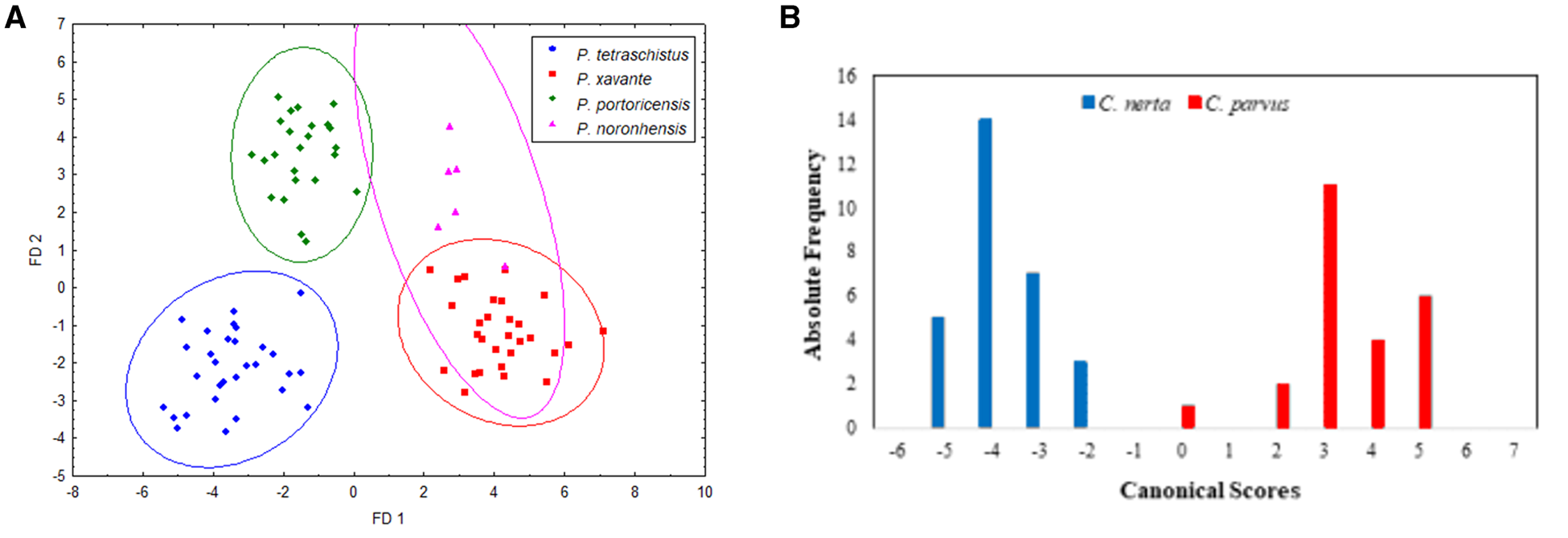
The DFA of Polyschides (Figure 3A) was constructed with eight variables (L/Max; Dmax; Arc; Larc; Ha; Ha/Wa; Hp; Hp/Wp). Variables at DF1 distinguished a group with [P. tetraschistus + P. portoricensis] from another group formed by [P. noronhensis + P. xavante] (Figure 3A) based mainly on L/Max and Hp. At DF2, the variables Dmax and Hp were the most important to distinguish [P. portoricensis + P. noronhensis] from [P. tetraschistus + P. xavante] (Figure 3A).
The DFA of Cadulus (Figure 3B) was constructed with six variables (L/Max; Arc; Larc; Ha; Ha/Wp; Hp/Wp). Cadulus nerta was discriminated from C. parvus mainly by the variables Ha and Ha/Wa.
Genera analysis
Order Dentaliida
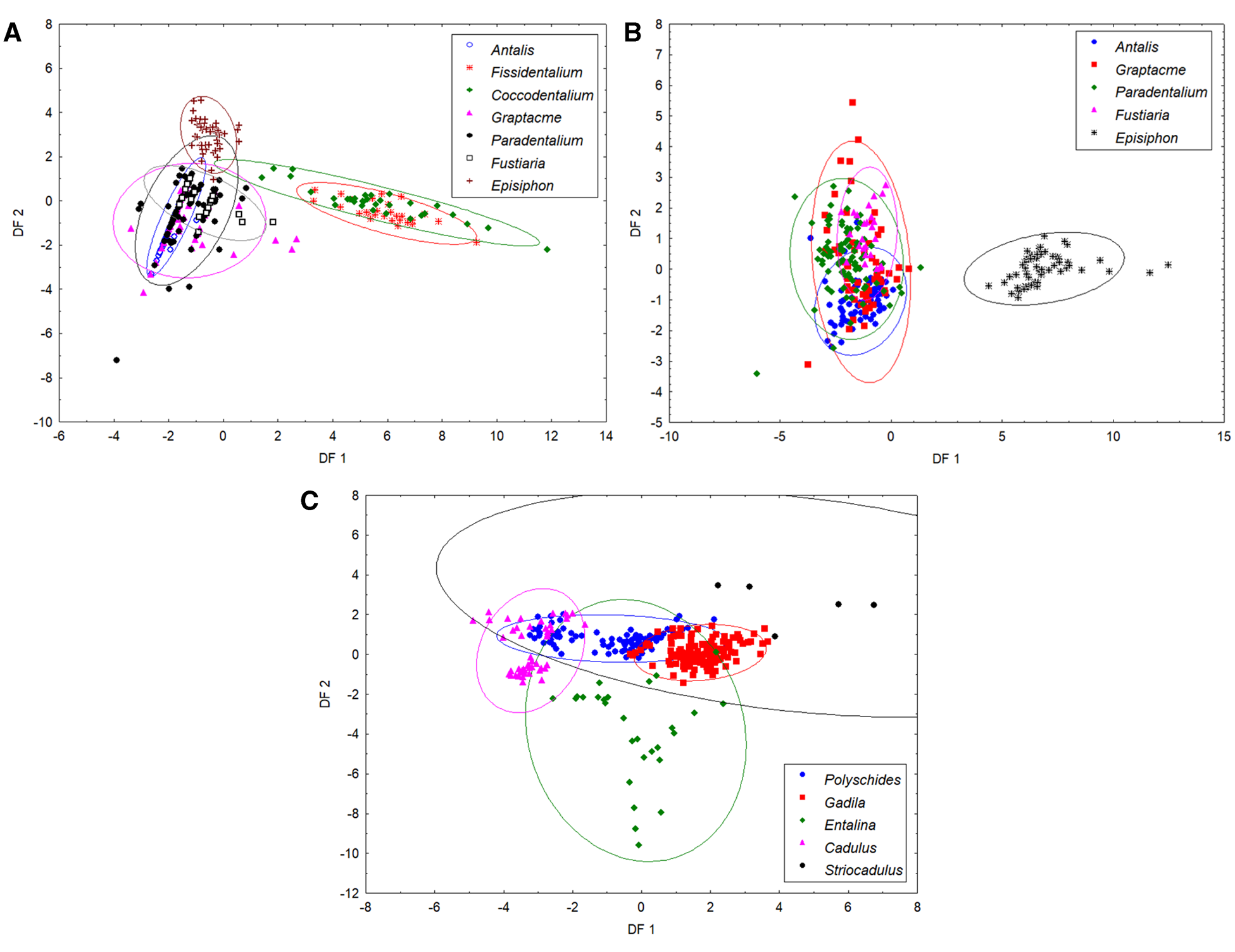
The seven genera studied in Dentaliida were poorly distinguished by the DFA (Figure 4A). Four variables were used in the discriminant model (L/Max; Ha/Wa; Hp; Hp/Wp) which was effective in 52.0% of the cases. Variables at DF1 discriminated two major groups, [Fissidentalium + Coccodentalium] and [Antalis + Graptacme + Paradentalium + Fustiaria + Episiphon], based mainly on L/Max and Hp. At DF2, the variables L/Max and Ha/Wa were the most important to discriminate [Episiphon] from the remaining genera.
Discriminant analysis of genera using morphometric data of the shells: (A) comparisons of the genera of the order Dentaliida; (B) comparisons of the genera of the order Dentaliida, except Fissidentalium and Coccodentalium; (C) comparisons of the genera of the order Gadilida. DF, Discriminant function.

A second step was taken in order to try to increase the resolution of this analysis, minimizing a shell length gradient. Therefore, we performed a new discriminant analysis without the data of Fissidentalium and Coccodentalium. These genera are represented by species with very large dimensions.
This second DFA increased the accuracy of classifications, but the distinction of the taxa remained weak, except for Episiphon (Figure 4B). The discriminant model was constructed with eight variables (Max; L/Max; Arc; Larc; Wa; Ha/Wa; Hp; Hp/Wp) and was effective in 67.0% of the cases.
Order Gadilida
The five genera studied in Gadilida were effectively discriminated by the DFA (Figure 4C). The discriminant model was constructed with seven variables (L/Max; Dmax; Arc; Wa; Ha/Wa; Wp; Hp/Wp) and was effective in 92.6% of the cases (Supplementary material S3). Variables at DF1 distinguished two main groups with a broad overlap in an intermediate position: [Striocadulus + Gadila] and [Cadulus + Polyschides + Entalina]. The DF1 was based mainly on Wp and Wa, while in the DF2, Arc and Wp were the most critical variables. The DF2 has a lower explicability for the discrimination of the genera, but it is possible to distinguish Striocadulus with positive scores and Entalina with predominantly negative scores (Figure 4C). The other genera in DF2 have a significant overlap in the score values (Figure 4C).
Family analysis
Order Dentaliida
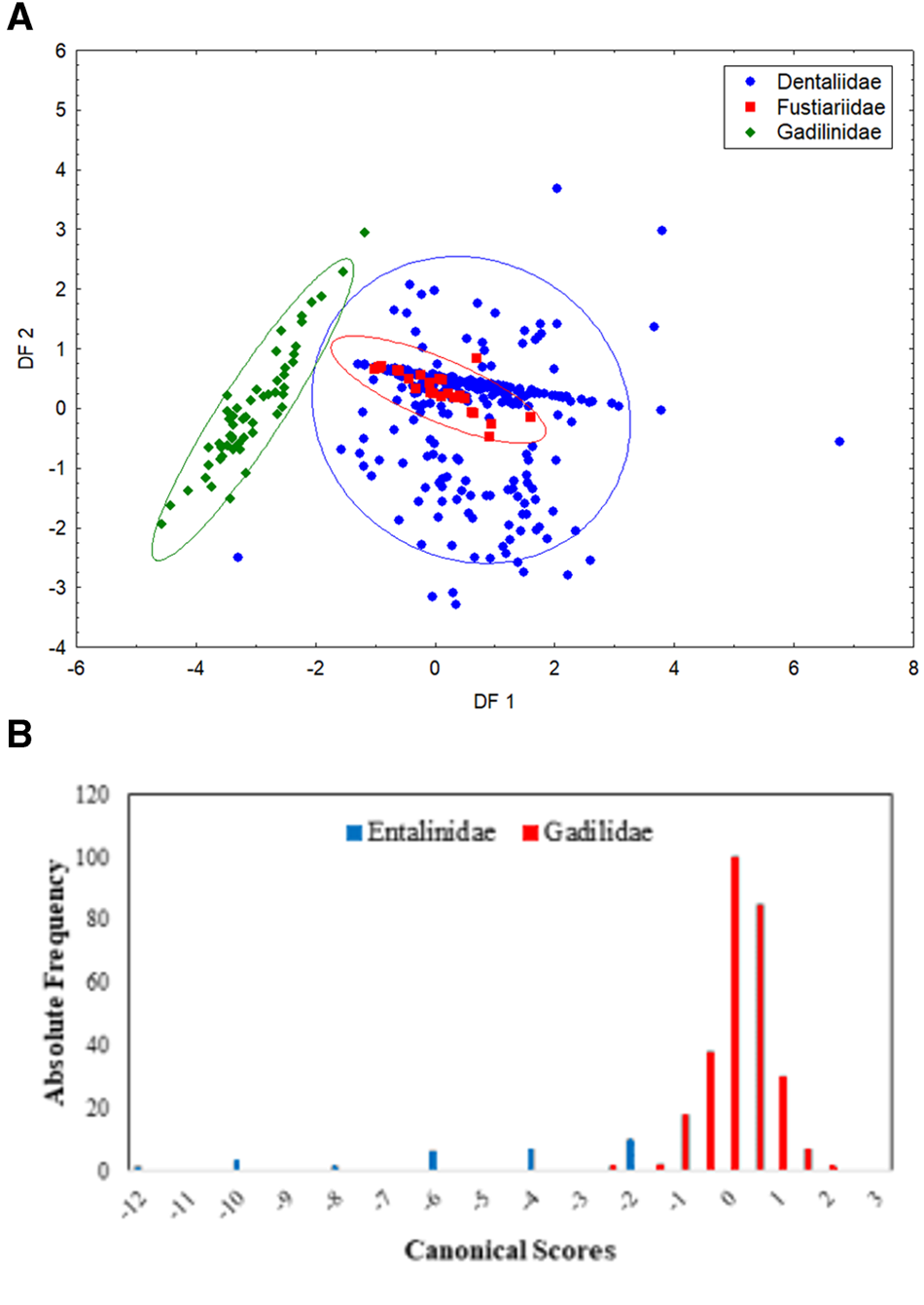
The three families in Dentaliida were reasonably distinguished by the DFA (Figure 5A). The discriminant model was constructed with five variables (L/Max; Arc; Ha/Wa; Hp; Hp/Wp) and was effective in 92.0% of the cases. Although the global number of correct classifications in this analysis was high, all the specimens of Fustiariidae were erroneously classified as members of Dentaliidae. At DF1, the family Gadilinidae is clearly distinguished from the group [Dentaliidae + Fustiariidae], in which the variables Ha/Wa and L/Max were the most critical for the discrimination. At DF2, the explicability was almost null and none of the families could be distinguished (Figure 5A).
Discriminant analysis of families using morphometric data of the shells: (A) families of the order Dentaliida; (B) families of the order Gadilida. DF, Discriminant function.

Order Gadilida
The two families in Gadilida were reasonably distinguished by the DFA (Figure 5B). The discriminant model was constructed with eight variables (Max; L/Max; Dmax; Arc; Larc; Ha/Wa; Wp; Hp/Wp) and was effective in 96.5% of the cases. Entalinidae presented negative scores and Gadilidae presented predominantly positive scores (Figure 5B). Some specimens of Entalinidae were classified in Gadilidae and present overlapping canonical scores (Figure 5B). The most important variables of this model were Arc and Dmax.
Discussion
Most of the previous studies integrating morphometry and multivariate statistics in scaphopods focused on comparisons of congeneric species as an additional tool for the descriptions of new species (Shimek & Moreno, Reference Shimek and Moreno1996; Caetano & Absalão, Reference Caetano and Absalão2005; Scarabino & Caetano, Reference Scarabino and Caetano2008; Scarabino et al., Reference Scarabino, Caetano and Carranza2011). The present study tested not only congeneric comparisons but also other taxonomic categories. Besides that, the present study also increased the number of analyses comparing congeners in Dentaliida, including genera in which the tool was never employed (Antalis, Episiphon, Fustiaria, Graptacme, Paradentalium).
The morphometric approach was efficient in discriminating congeners in both orders, while in generic comparisons, the robustness was drastically reduced in Dentaliida. Historically, the genera of Dentaliida were classified based mainly on the sculpture of the shell (Emerson, Reference Emerson1962). Since these features are usually present in Dentaliida, Palmer (Reference Palmer1974) proposed a generic classification using qualitative characters of the shell (e.g. presence or absence of ribs, number of ribs). Our results demonstrate that morphometrically, the majority of the genera in the order Dentaliida were not distinguished with confidence, and perhaps the meristic characters are the most appropriate to discriminate these genera by studying only the shell.
In contrast, the generic classification in Gadilida was based mainly on the general shape of the shell (Palmer, Reference Palmer1974), but without an objective approach with a basis on shell measurements. Cadulus, Gadila, Polyschides and Striocadulus were separated from Entalina by Palmer (Reference Palmer1974) on the basis of a constricted aperture. Among the genera with a constricted aperture, Cadulus have the maximum diameter on the median portion of the shell, while the others have it on an anterior portion (Palmer, Reference Palmer1974).
Entalina presented the highest number of incorrect classifications in generic comparisons of the order Gadilida. Regarding shell shape, species of Entalina are more similar to members of Dentaliida than to members of Gadilida, but anatomical and molecular data strongly suggest the relationship with members of the latter order (Steiner, Reference Steiner1992, Reference Steiner1998a; Reynolds, Reference Reynolds1997; Reynolds & Okusu, Reference Reynolds and Okusu1999; Steiner & Dreyer, Reference Steiner and Dreyer2003). Thus, a substantial distinction of Entalina specimens from the remaining Gadilida would be expected. However, the large differences in the size of the individuals may have influenced the analysis (Tables 7, 13). Young specimens of Entalina have similar dimensions of the aperture and curvature to other genera in Gadilida, which are elucidative variables in this DFA. Comparing with the other genera in Gadilida, Polyschides also scored lower values of classification and some specimens were classified as Cadulus and Gadila in the analysis. Indeed, Polyschides species have a similar shell shape to Gadila species, but the former has four slits on the apex of the shell, a meristic character that is conspicuous. Thus, even with a high percentage of correct classifications in generic comparisons in Gadilida, the qualitative characteristics are still crucial for the discrimination of groups.
In the comparisons of families within an order, the total value of correct classifications was high, and at first, it appears efficient. However, among the families of the order Dentaliida, Dentaliidae and Gadilinidae presented a high number of correct classifications while Fustiariidae had only incorrect classifications. All specimens of Fustiariidae were classified in Dentaliidae by the discriminant model. The high percentage of correct classifications for the analysis of Dentaliida families (92.1%) is an artifact caused by the imbalance in the number of shells measured in each family (Dentaliidae: N = 283; Fustiariidae: N = 26; Gadilinidae: N = 56). Dentaliidae presented only one incorrectly classified specimen in a total of 283 (= 99.6% correctly classified), and Gadilinidae, only two incorrectly classified specimens out of 56 (96.4% of correct classifications), which compensates for the incorrect classifications in Fustiariidae.
Our study demonstrated similar shell measurements in Dentaliidae and Fustiariidae, but species of Dentaliidae usually have shell ornamentations, while shells in Fustiariidae are commonly smooth. The family Gadilinidae encompasses, in general, species with cylindrical to subcylindrical shells, in contrast to the conical shells commonly present in Dentaliidae and Fustiariidae.
In the comparisons of families from the order Gadilida, Gadilidae presented perfect accuracy, with all specimens correctly classified, but Entalinidae achieved a smaller percentage of correct classifications (60.7%). The morphometric variable Arc was one of the most substantial variables in this analysis. Entalinidae presented a considerable variation at Arc values (Table 15), and this was probably the cause of the incorrect classification in Entalinidae. Members of this family have very arcuate shells, and the specimens with lower values of Arc were classified in Gadilidae. Even so, the analysis at the family level in Gadilida presented a high percentage of correct classifications (96.5%), but as in the order Dentaliida, the analysis in Gadilida also presented an imbalance in the number of specimens (Gadilidae: N = 311; Entalinidae: N = 28).
Taking into consideration the frequency of variables appearing as noteworthy to distinguish the groups cited above, we can suggest them as important features to assess during a taxonomic study. Among congeneric species, the variables L, Arc and Wp appear more frequently as important to distinguish groups in the Dentaliida. In the Gadilida, the variable Ha was the most frequent. Half of these variables are associated with the apertures and this should be investigated carefully in taxonomic studies at the species level.
At genera and family levels, only one discriminant function for each analysis was applied (except in the generic comparisons in Dentaliida) and it was not possible to observe the frequency of major contributing variables. At the genera level in Dentaliida, the variables Max, L/Max, Wa and Hp were the most significant while in Gadilida the most significant were Wa and Wp. At the family level, the essential variables for the discrimination were L/Max and Ha/Wa for Dentaliida and Dmax and Arc for Gadilida.
Lamprell & Healy (Reference Lamprell and Healy1998) included the strength of the shell curvature (herein named as Arc) and apertural shape (herein expressed by Ha, Wa, Hp, Wp and their ratios Ha/Wa, Hp/Wp) as conchological features that have been used extensively in the diagnosis of taxa in Scaphopoda. In this study, the importance of these variables was confirmed by the morphometric study.
The traditional morphometric approach, despite its disadvantages compared with more advanced techniques (i.e. geometric morphometrics; see Zelditch et al., Reference Zelditch, Swiderski, Sheets and Fink2004), is still a useful tool to distinguish many taxa in Scaphopoda. This is particularly true in comparisons of congeneric species in both orders and at the generic level in the order Gadilida. Currently, there is no study using geometric morphometrics in Scaphopoda, but we believe that this might be a useful tool. Burridge et al. (Reference Burridge, Goetze, Raes, Huisman and Peijnenburg2015) used an interesting approach in pteropods (Gastropoda) that can be applied in scaphopods.
The traditional morphometry of scaphopod's shells must be employed together with other methods (i.e. analysis of qualitative features, anatomy, molecular data) for high accuracy. The addition of other taxa (species, genera and families) to the present dataset may reveal other patterns.
Supplementary material
The supplementary material for this article can be found at https://doi.org/10.1017/S0025315420001216.
Acknowledgements
We are grateful to ZOOMAR staff and collaborators (Msc. Jessica Carneiro, Msc. Renato Dantas, Msc. Vanessa Fontoura-da-Silva) for the help with many aspects of this study; to Dr Alexandre Pimenta (MNRJ), Dr Natalia Benaim (Commonwealth of Learning) and Dr Igor Miyahira (UNIRIO) for valuable comments on an early version of this study. Our deepest gratitude to the researchers that lent material. We thank Thomas Sprengers for English review.
Financial support
This work was partially supported by ‘Fundação Carlos Chagas Filho de Amparo à Pesquisa do Estado do Rio de Janeiro’ (FAPERJ: E-26/111.030/2009).