I. Introduction
The Problem of Symmetrical Attackers is a problem for non-consequentialism because it results in a contradiction for forfeiture and waiver theories of rights. The most plausible non-consequentialist theories assume that people have rights and can lose them by forfeiting them (consider, for example, self-defence, punishment, and compensation) or waiving them (consider, for example, consent).
Competitor theories to right forfeiture are equally subject to the problem. As argued below, narrow scope theory and override theories produce the same contradiction. Narrow scope theory asserts that wrongdoers do not forfeit their rights, rather a right's narrow scope results in its not being infringed in the context of just self-defence, punishment, and compensation. Override theory asserts that wrongdoers do not forfeit their rights; rather another person's right overrides the wrongdoer's right.
At issue is whether consequentialism produces the same contradiction. If it does not, this favours it. The heart of morality is the ability to explain and justify how people change their moral relations when they cooperate and when they are in conflict. The contradiction thus goes towards the heart of morality.
The first section of the article sets out the Problem of Symmetrical Attackers for non-consequentialism. The second section considers whether consequentialism escapes this problem. The third discusses why these results matter.
II. The Problem of Symmetrical Attackers and non-consequentialism
II.1. Nonconsequentialism and rights
In this section, I argue that the Problem of Symmetrical Attackers plagues non-consequentialism. My argument has three parts. First, I argue that the most plausible versions of non-consequentialism depend on a theory of rights. Second, I argue that the problem of the symmetrical attacker applies to right-based theories of conflict (self-defence, punishment, and compensation for unjust harm) and cooperation (consent).Footnote 1 Third, I argue that purported solutions to this problem fail.
The most plausible versions of non-consequentialism presuppose rights. Consider the doctrines of doing and allowing, double effect, and causing and not causing. Consider, also, the harm principle. The doctrine of doing and allowing states that, other things being equal, it is worse to do something that infringes a moral norm than merely to allow it to happen. The doctrine of double effect states that, other things being equal, it is worse to intentionally infringe a moral norm than to non-intentionally do so (for example, merely foreseeably do something that infringes it). The doctrine of causing and not causing states that, other things being equal, it is worse to cause a moral norm to be infringed than not to cause it. Not causing can occur even when the agent performs a commission rather than an omission and intends rather than merely foresees the norm infringement. The harm principle states that, other things being equal, it is worse to harm someone than not to harm her.
These theories presuppose rights. Here a right is a claim. One person has a claim against a second just in case the second owes the first a duty. This is because rights set the boundaries of legitimate interest in the individual towards whom the agent acts. If the moral norm were not a right, then it would be unclear why an agent is not permitted to infringe it. Consider, for example, whether Paris Hilton's making love to Rick Salomon wrongs her heartbroken fans. On the doctrine of doing and allowing, the fans have a moral complaint only if they have a legitimate interest in her sex partner and her having the sex does something to them rather than merely allowing it to happen. The boundaries of their legitimate interest, though, just are the things to which they have a moral right. The same is true with regard to the doctrines of double effect and causing and not causing.
On the harm principle, not all harms are wrongs. A harm wrongs someone, other things being equal, only if it sets back a legitimate interest. Again, a person has a legitimate interest in something only if he has a moral right to it. For example, a property owner who locks up his belongings so a thief cannot steal them does not harm the thief in a wrong-making way even if the owner sets back the thief's interest by preventing him from gaining those goods. This is because the thief does not have a legitimate interest in them. Similarly, at Wimbledon, when the best tennis player in the world beats the second best and thereby sets back the second's interest in winning the tournament, the first does not harm the second in a wrong-making way because the second did not have a legitimate interest (one capable of making its setback wrong) in winning the tournament.
Even theories that focus on an attitude or virtue probably presuppose rights because it is the willingness to infringe another's right that usually, if not always, indicates an improper attitude or vicious character. For example, one person views a second merely as a means if the first does not properly value the second and the way in which he does so is to not properly consider the second's rights.
A critic might wonder what sets the boundaries of legitimate interests. It might be clear that one person has a claim against a second just in case the second owes the first a duty, so Paris Hilton's fans have a moral complaint only if they have a legitimate interest in her sex partner (intuitively, they don't) and her having sex does something to them rather than merely allowing it to happen (intuitively, it merely allows for their heartbreak). How then, the critic asks, does this relate to doctrines such as causing and not causing, doing and allowing, and double effect?Footnote 2
The boundary of legitimate interests depends on the best theory of a moral right. On a benefit theory, an individual's legitimate interest might depend on what makes her life go better or worse. On a will theory, an individual's legitimate interest might depend, at least in part, on what makes her have more or less autonomy (or, perhaps, freedom). Thus, the boundary of legitimate interests depends, at least in part, on the best theory of rights. These theories might have to be filled out in terms of how and why well-being or autonomy is connected to ownership. The best theory will probably have to address issues relating to whether people own their bodies or property and what it is to own something.
Hence, the best versions of non-consequentialism depend on rights. Specifically, they depend on rights being lost through waiver or forfeiture, not being infringed because of their narrow scope, or being permissibly overridden. They depend on this happening when moral relations between people change because of conflict or cooperation. An example of conflict occurs when a defender uses violence to prevent an unjust attack. Without such an attack, the violence would be wrong. An example of cooperation occurs when a husband is allowed to have sex with his wife who requested he do so. Without consent, the sex would be wrong.
II.2. Rights and forfeiture
Before setting out the Problem of Symmetrical Attackers, it is worth specifying the relevant concepts. One person is a threat if and only if he is all or part of a causal sequence that increases the risk of harm to another. An unjust threat is a threat that occurs via a right-infringement. An innocent threat is one who is innocent and a threat. An attacker is one who attacks someone. One person attacks a second if and only if the first tries to cause harm to another. An innocent attacker is innocent and an attacker (that is, not blameworthy for the attack). A violent attacker tries to cause harm to another's body or property. Violence is defensive when it responds in a relevant way to an unjust attack or perceived unjust attack. On a subjective account, it is intended to respond to a perceived unjust attack. On an objective account, it responds to an attack. There are also types of defensive violence that are intermediate between subjective and objective accounts.
On this account, someone forfeits if and only if he is an unjust threat. More specifically, necessarily, one person forfeits in relation to a second if and only if the first is an unjust threat in relation to the second.Footnote 3 There are puzzle cases that forfeiture has trouble handling, such as the issue of what happens to the rights of two qualitatively identical people who simultaneously launch unprovoked attacks against the other. In that case, you have an unstable scenario similar to a liar paradox. This is the Problem of Symmetrical Attackers. Each person either has or lacks the right to defend against the other. If one attacker has the right, then the other does not and vice versa. Yet the two are qualitatively identical so it is impossible for one to have the right if the other does not.Footnote 4 Here are some versions of the problem.
Case 1: Symmetrical Attacker Case (SAC)
Al and Bob are doppelgangers. They both attack the other for no good reason (for example, they love the same woman and wish to see a rival suitor dead).
Case 2: Misunderstood Symmetrical Attacker Case (M-SAC)
Al and Bob are doppelgangers. They both mistakenly but justifiably think that the other is about to attack him. They both respond with violence that is necessary and that they think is necessary to prevent the attack. As a result, neither is morally blameworthy for his violent response.
Here is the argument.
(P1) If forfeiture theory is true, then it explains what morally happens in the M-SAC.
(P2) Forfeiture theory does not explain what morally happens in M-SAC.
(C1) Hence, forfeiture theory is false. [(P1), (P2)]
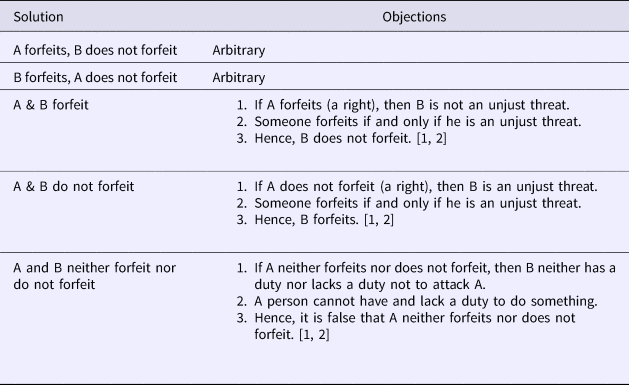
Premise (P2) rests on the notion that there are only five candidate solutions to the problem and none succeed. To see these, see Table 1 below.
No explanation

This problem is not confined to defensive violence. Specifically, there are other cases regarding compensatory justice and retributivism that involve the same pattern as M-SAC. Consider the following.
Case 3: Symmetrical Compensatory Justice
Same facts as M-SAC. Al and Bob are injured and demand compensation. If one person unjustly harmed a second, then the first owes the second compensation.
A similar problem occurs in the context of punishment. As a matter of justice, the state should punish a person if and only if he committed an unjust act of force, fraud, or theft and was blameworthy for doing so.
The Problem of Symmetrical Attackers equally plagues the override, narrow scope, and consent theories of permissible defensive violence. Consider override theory in M-SAC. Here the five candidate solutions are the same but the issue is whether one party but not the other has an all-things-considered right to use violence. Because each of the two parties is identically placed with regard to the other, the distribution of an all-things-considered right to defensive violence cannot be asymmetric. Nor can it be symmetric. The arguments are the same but have to be filled out in terms of being an all-things-considered unjust threat and having an all-things-considered right to defensive violence.
The narrow scope theory has similar problems. This time the notion of an unjust threat and a right to defensive violence gets translated into whether one party right is so narrow, rather than being forfeited or overridden, that it permits the other to use defensive violence.
These theories have other problems. Consider override theory. If the offender were to retain his right and just punishment were to override it, then the offender would have a claim, perhaps merely prima facie, to compensation or apology. Again, this is implausible.
Consider narrow-scope theory. If the offender were to have a complex right (for example, a claim not-to-be-punished-unless-he-unjustly-uses-force,-fraud,-or-theft), such a right would be equivalent to forfeiture in that it would make punishment permissible whenever additional conditions permit it (for example, unjust force). The narrow scope theory allows all and only the same acts that forfeiture theory allows. That is, it would not matter whether the offender's right is lost via forfeiture or inapplicable due to its narrow scope. Hence, narrow-scope theory is in practice equivalent to forfeiture theory.
The narrow scope theory has another problem. First, the narrow-scope theory prevents a right from explaining when punishment is just because its scope intuitively depends on when it is just. However, it intuitively seems that rights should explain such things rather than being explained by them.
Consider, next, consent theory. Consent theory asserts that unjust threats consent to defensive violence.Footnote 5 This is false. Most unjust threats do not intend to waive their rights or, perhaps, waive their complaint against defensive violence. Nor do they do so via a convention that communicates such a waiver. In fact, they do not communicate anything and on a plausible account of consent, one person consents to a second only if the first communicates to the second.Footnote 6 The consent requirement might occur because it allows the other person to understand that his moral situation has changed and, perhaps, because it allows the second to agree to (provide uptake) to the first. Also, if defensive violence, punitive violence, or compensation were to be justified by consent, there would be no proportionality requirement. This is because the just amount of violence, punishment, or compensation would depend on what the consenter agreed to rather than an independent limit.
Other theories of philosophy not only have to face the problem forfeiture theory addresses, but face additional problems. Consider three non-consequentialist theories of punishment. Retributivism asserts that the state should punish people because they deserve it.Footnote 7 Defence theory asserts that punishment is justified because it defends society against internal aggressors.Footnote 8 A distributive justice theory of punishment asserts that punishment is justified because it fairly distributes societal benefits and burdens.Footnote 9 All three theories have to address what happens to offenders’ rights after they commit a crime. They thus have to adopt forfeiture theory or one of its competitors in addition to the purported justification of punishment. This reintroduces the above problems for forfeiture, override, narrow scope, and consent theories.
The Problem of Symmetrical Attackers also plagues consent.
Case 4: Consent
Charlie consents to have sex with Darlene if and only if Darlene does not consent to have sex with Charlie and vice versa (for example, each believes the other is drunk as a skunk and announces that his or her consent hereby rests on the other being over a 0.2% blood alcohol content). Each believes the other has not consented and so they have sex. They're motivated by the sexual charge they get by having sex with a drunken person and then imagining the shame and degradation the drunken person will feel afterwards.
As mentioned above, the narrow scope theory faces the Problem of Symmetrical Attackers. Here one person's right permits defensive violence from a second when the first unjustly attacks the second. Again, the problem occurs because the two attackers are symmetrical and yet it cannot be the case that both their rights permit defensive violence or do not permit it. The problem is the same as that faced by forfeiture theory.
The override theory has the same problem in that the consequentialist gain required to override an attacker's right depends on whether the attack is just. This problem can also be seen in theories that assert that when the attacker is justified in acting his justification morally prevents him from being liable to defensive violence. That is, justification defeats liability.Footnote 10
The defence of forfeiture against a subjective-state theory of defence (given below) is an attempt to address an objection that invariably arises in response to the Problem of Symmetrical Attackers. The Problem of Symmetrical Attackers does not apply to a blame-based theory of forfeiture. On this theory, a person forfeits a right just in case he is blameworthy for an attack. He is blameworthy just in case he is in general morally responsible, acts voluntarily, and has evidence that the other is not an unjust threat. The specific demand of the evidence condition depends on whether the evidence required for blameworthiness requires the person be aware of the relevant evidence or merely should have been aware of it.
Case 5: Blame
Eric and Frank are symmetrically placed doppelgangers. Because of the evil machinations of a third party, each has very strong evidence that the other is unjustly attacking him. The evidence is strong enough to make each person blameless with regard to his defensive violence or, perhaps, attempted defensive violence.
On this account, both are innocent. As a result, each is permitted to use defensive violence. This eliminates the problem.
This theory, though, is implausible. It suggests that an innocent attacker (see, for example, Psychotic Aggressor) has a right to complete his attack.
Case 6: Psychotic Aggressor
A woman's companion in an elevator goes berserk and attacks her with a knife. There is no escape: the only way for her to avoid serious bodily harm or even death is to kill him with her gun. The assailant intends to kill her, but he is not responsible because he is mentally ill. If he were brought to trial for his attack, he would have a valid defence of insanity.Footnote 11
If the intended victim knows the attacker is innocent, then she is not permitted to defend herself. This is also counterintuitive.
The blame-based theory of forfeiture suggests that brains in vats with murderous intent can be killed by the person whom the brain imagines killing because he forfeits relative to the intended victim. This assumes that such brains voluntarily commit an act. Perhaps the act is deciding to kill someone and willing that it occur. By itself, a brain lacks the power to cause someone's death, but this is not required for blameworthiness.
The blame-based theory of justified violence is an internalist theory in that it depends on, and only on, intrinsic features of the agent. Its internalism undermines standard side-constraints on just defensive violence (for example, discrimination, imminence, necessity, and proportionality) because it is hard to see how these operate unless they also depend on internalist features, that is, the attacker's expectation about the events. The incorrect intuitions in the psychotic-aggressor and brain-in-vat cases as well as the poor fit with the standard side-constraints on just defensive violence make it likely that a purely subjective (sometimes referred to as ‘patient-centred’) theory of permissible defensive violence is false.
If the blame-based theory is combined with an externalist theory of side-constraints, then what justifies forfeiture is solely a matter of what's in the head, but the limits on forfeiture-permitted violence are, at least in part, outside the head. That is, they focus on external features. Among the external features might be whether, as an objective matter, an attacker is an unjust threat. This is implausible because it suggests that there are two different justifications for defensive violence: the internalist justification of forfeiture and the externalist justification of the side-constraints that limit it, with no clear explanation how to fit them together or, if they were to conflict, which one would win out.
Risk-based theories focus on whether an individual is responsible for imposing a risk on another even if he is not blameworthy for doing so. This type of theory is subject to the Problem of Symmetrical Attackers. This is because if the risk is justicized (that is, the focus is on the risk of unjust harm), then the problem reappears because forfeiture will in part explain when a risk is just. If the risk is not justicized, then the theory cannot explain why unjust attackers impose risks forfeit, but just ones do not.
If the argument in this section succeeds, then the Problem of Symmetrical Attackers falsifies forfeiture theory. This is a severe problem for the following reason. First, some defensive violence is morally permissible. Second, defensive violence is morally permissible only if the attacker's right is forfeited. Third, the Problem of the Symmetrical Attackers suggests that forfeiture theory is false.
The Problem of Symmetrical Attackers applies whether the consent, forfeiture, narrow scope, or override theory is true. The same problem even applies to other non-consequentialist theories of defensive violence, punitive violence, or just compensation. Consider virtue theory and desert-based theories.Footnote 12 These theories are in part externalist. They depend on whether the person in question engages in an unjust attack and this in turn depends on the status of the other attacker.
A theory of permissible defensive violence might be internalist, such as the blame-based theory of permissible violence. Internalist theories are implausible. This is because they generate counterintuitive results, allow people to kill brains in vats, and do not align with any of the plausible side-constraints on violence and compensation.
The problem also occurs with regard to some moralized versions of consequentialism. Consider right- or desert-adjusted consequentialism. Also, on this theory, offensive violence is permitted when it minimizes the number of right infringements or desert frustration. This might occur for example when a good guy tortures a child in order to prevent a bad guy from torturing five children. This minimization-based permission makes such consequentialist theories even less plausible.
The problem thus applies to every plausible non-consequentialist candidate theory of defensive violence. This leads to the following defence of forfeiture theory.
(1) If a problem is equally damaging to every plausible theory of permissible defensive violence, then it is not a reason to reject forfeiture theory.
(2) The Problem of Symmetrical Attackers is equally damaging to every plausible theory of permissible defensive violence.
(3) Hence, the Problem of Symmetrical Attackers is not a reason to reject forfeiture theory. [(1), (2)]
The Problem is not damaging to an internalist blame-based theory of defensive violence, but this theory is implausible. Because the forfeiture theory is the best non-consequentialist theory of defence, punishment, and compensation and better than a moralized consequentialist theory, this problem is challenging.
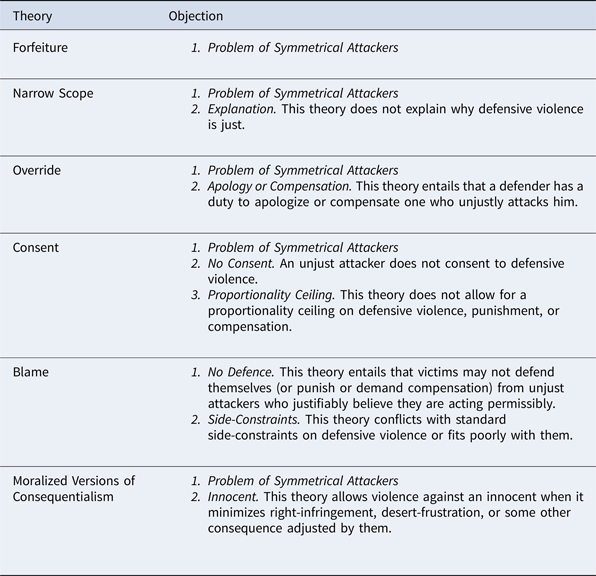
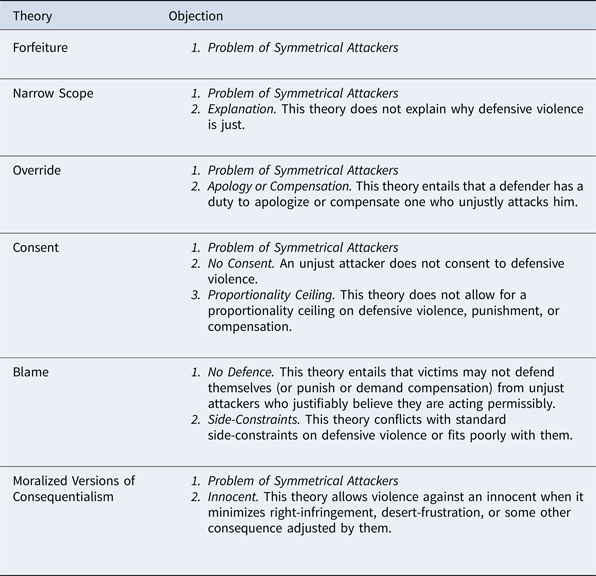
For a summary of the findings in this part of the article, see Table 2.
Theories of permissible defensive violence
An objector might note that the Problem of Symmetrical Attackers is a problem for non-consequentialism because it is said to result in a contradiction for forfeiture and waiver theories of rights in cases of defensive violence, compensatory justice, and retributivism. More generally, he notes, it generates a problem for rights-based theories of right action (particularly the permissibility of defensive violence). But, the objector asks, we can say that both Al's and Bob's actions are morally right given the incredibly unique circumstances. That is, he continues, we can say without contradicting ourselves: they were both permitted to use defensive violence. On this objection, the objector concedes, A and B neither forfeit nor not forfeit. Instead, each is permitted, but not morally required, to attack the other.Footnote 13
The objection does not succeed if we make several assumptions. First, it is impossible for someone to neither owe a duty to another nor not owe it. Second, if people have rights, then they affect permissibility. Third, the best versions of non-consequentialism include rights. They include rights because rights set the boundaries on one individual's legitimate interest regarding a second. Consider, for example, the doctrines of causing and not causing, doing and allowing, and double effect. On these doctrines, rights in part explain when a causing, doing, or intended result is wrongful.
The underlying assumption is that harm cannot explain this because it is permissible to harm another when the harming does not infringe on another's right. This might come about, for example, when one person wins his intended beloved's heart despite the fact that his doing so will cause her other suitor to be heartbroken. If refraining from benefitting someone is a harm, and this is controversial, then we often harm people when pursuing our own projects rather than helping another. Intuitively, such harms do not run afoul of these doctrines because they are not right-infringements. Nor can anything else besides rights and harm be used to fill out these doctrines. If on non-consequentialism people have rights, then something must happen to their rights in M-SAC. Non-consequentialism cannot explain what happens to them.
A second objection is that the Problem of Symmetrical Attackers does not apply to forfeiture theories that assert that permissible defensive violence occurs only when subjective and objective conditions are met.Footnote 14 For the subjective condition, consider, for example, when the person using violence believes it is necessary or is motivated to prevent an unjust attack. The problem with this objection is that in cases such as M-SAC, both people meet the subjective condition. Thus, Al is permitted to use defensive violence only if, on either the subjective or objective condition, Bob is not and vice versa. Thus, the problem reappears, this time dependent on both subjective and objective conditions.
On another theory of forfeiture, an attacker's having forfeited his right against defensive violence (liability) is not sufficient to permit the person being attacked to defend himself (standing to use violence).Footnote 15 On such an account, there is another condition such as the person subject to defensive violence deserving such violence or the state authorizing such violence. Forfeiture of a right against defensive violence does entail standing to use such violence if rights are two-person relations. More specifically, liability entails standing if one person forfeits a right with regard to a second when the first unjustly attacks the second. This is because the first person's loss of a claim against violence with regard to the second correlates with the second's permission to use violence with regard to the first. This is not true for defensive violence used to defend third parties (assuming the third party did not transfer her right to use defensive violence to the defender), but this is irrelevant to the problem of the symmetrical attackers. In addition, if blame were a necessary condition for standing to use defensive violence, counterintuitive results with psychotic-aggressor-type cases would occur. Also, if blame were necessary and sufficient, then the counterintuitive result would also occur with regard to brains in vats who will (in vain) to unjustly kill people.
On yet another theory, forfeiture occurs only if the defender uses the least harmful means of preventing the unjust attack. It is unclear whether this is different from the proportionality and necessary-violence conditions for forfeiture. If it is not different, this is consistent with what is argued above. In any case, the Problem of Symmetrical Attackers, as seen above, involves the least harmful means of preventing the unjust attack.
Whether it is equally damaging to a consequentialist theory of permissible defensive violence, though, is yet to be determined. We now turn to this issue.
III. The Problem of Symmetrical Attackers and consequentialism
If non-moralized consequentialism can avoid the contradiction that accompanies the Problem of Symmetrical Attackers, then it has an important advantage over non-consequentialism and moralized consequentialism. Non-moralized consequentialism is roughly the idea that the right maximizes the good and the good does not depend on other moralized notions such as desert, fairness, or justice. On some accounts, the good to be maximized depends at least in part on whether people get what they deserve. On some desert theories, desert-satisfaction enhances or discounts the value of people's well-being level. On other theories, desert-satisfaction is a separate good-making factor.
Consider first outcome consequentialism. It asserts the following.
(1) Outcome Consequentialism. An act is right if and only if it brings about at least as good an outcome as any other act available to the agent.
Consider Catapult.
Case 7: Catapult
A villain uses catapults to sling doppelgangers, Grant and Hal, towards each other with enough force so that if one hits the other, both will die. Each is innocent and knows this of himself and the other. Each has a ray gun capable of disintegrating the other. To prevent suicides, the gun is designed so that it cannot shoot the operator. Neither can communicate to the other. Nor do they have access to a random generator.Footnote 16
The situation is similar to Buridan's ass in that there is no reason to favour killing one person over the other and the people do not have a mechanism available that can randomly choose who should be killed.
Furthermore, consider when God rolls back what each person does 1,000 times: 500 times Grant shoots his ray gun, 500 times he doesn't.Footnote 17 The same is true for Hal. Hence, there is a 50% chance that Grant will shoot and a 50% chance that Hal will shoot. The consequentialist, then, cannot use probabilities to provide a solution. The consequentialist solution is for one person to disintegrate the other and not for them both to do so. The problem is that there is no reason for one person to do so and the other not.
On a side note, there is at least some reason to believe that libertarian free acts do not occur in a specific percentage in a scenario. This is because what explains the percentage (for example, 50%) would limit the agent's freedom (for example, limiting his agent-causal powers) in the same way. It is unclear if this is consistent with his having freedom, at least if freedom is inconsistent with contrastive explanations. Consider, for example, the luck problem and the libertarian's claim that he need not explain why someone acted one way in the actual world and differently in another qualitatively identical possible world. If there were no contrastive explanation for an action, it would preclude a percentage explanation of the sort that is claimed above for Grant and Hal.
The best outcome occurs when Grant shoots and Hal does not or vice versa. The concern is that, in Catapult, the right action will occur if and only if identical people in identical situations make different decisions. If Grant and Hal have access to a random or lucky procedure or, perhaps, libertarian free will, this is possible. If they lack them, then they must do the same thing. Depending on how one interprets the right side of a biconditional (an act is right if and only if it brings about an outcome at least as good as any other outcome that the agent can bring about), either a wrong act is not possible or neither a right nor a wrong act is possible. This is because only one outcome is possible: both die. This comes about if the two smash into or shoot one another. On the first interpretation, an act is right if and only if there is no action that has a better outcome. This could come about if there were no other available action or any other available action has a worse outcome. On the second interpretation, an act is right or wrong only if there is at least one other action to which the act in question can be favourably or unfavourably compared. On this second interpretation, rightness is comparative. The first interpretation is better because it allows for action-guiding morality even when the alternative outcomes are equally good.
If, instead, they have access to a random or lucky procedure or, perhaps, libertarian free will, they can act so that only one dies and, hence, both a right and a wrong act are possible. Neither is a contradiction. Hence, outcome consequentialism is compatible with the Problem of Symmetrical Attackers.
An objector might claim that in Catapult on a compatibilist account, both agents are determined to act in the same way, but could act differently in a relevant sense. If the two agents are determined to act in the same way (they are internally identical and acting in exactly the same situation), then given the past and laws of nature they must do the same thing and, thus, do not have a better act open to them. If the notion that the agents could have acted differently is filled out in terms of a different past or law of nature, then it is unclear how this alternative action makes what the agent actually did right or wrong. This is similar to the notion in the responsibility literature (specifically, Frankfurt-style counterexamples) that a person's praise- or blameworthiness for an act does not depend on what he does in another possible world or on whether he could have done otherwise. There is a vast literature on whether this type of counterexample works. If it does not (and attempts to reinterpret the notion that an agent could have done otherwise also fail), then compatibilism is false and this objection does not get off the ground.
Other types of consequentialism also do not produce a contradiction. Consider the following.
(2) Expected-Outcome Consequentialism. An act is right if and only if it brings at least as good an expected outcome as any other act available to the agent.
(3) Evidence-Based Expected-Outcome Consequentialism. An act is right if and only if, based on the evidence, it is likely to bring about at least as good an expected outcome as any other act available to the agent.
Expected-outcome consequentialism looks at the expected outcomes based on the metaphysical likelihood of various outcomes and value per outcome. The evidence-based expected-outcome consequentialism looks at the expected outcomes based on the epistemic likelihood of various outcomes and value per outcome.
This version of expected-outcome consequentialism might be tightened up by a decision-theoretic theory of expected-outcome consequentialism set out by Frank Jackson.Footnote 18 On this theory, the consequentialist criterion for what a person ought to do depends on what he ought to desire and believe. One reason for this revision is that it makes the right depend on what the agent actually knows (or, perhaps, should know) and, thus, makes consequentialism action-guiding in a relevant way. Even if expected-outcome consequentialism or evidence-based expected-outcome consequentialism is adjusted in the way that aligns with the decision-theoretic theory, this does not result in a different result with regard to the Problem of Symmetrical Attackers because the two people in these cases believe and desire the same thing. They also ought to believe and desire the same thing.
Consider a case similar to Catapult above except that each person has a 51% chance of shooting the other. Call this Catapult Two. In Catapult Two, the two people act in the right way only if they do the same thing because identical people in the same situation with access to the same expected outcomes and evidence of expected outcomes ought to act identically. The right act here might be to act randomly if such an action is available. Consider, again, Buridan's ass. If, under expected-outcome consequentialism, identical agents in identical situations ought to act in the same way, then in Catapult Two the right action produces a collectively worse outcome. This is not a contradiction because there is no guarantee in expected-outcome consequentialism that the set of right actions always produces the collectively best outcome.
Consider, next, if desert-adjusted consequentialism is true.
(4) Desert-Adjusted Consequentialism. An act is right if and only if it brings about as good an outcome as any other act available to the agent. Goodness is a matter of desert-adjusted well-being.
Let us assume this means that, other things being equal, priority should be given to the more deserving person. This is a type of outcome-consequentialism. If desert depends on whether one does the right thing, this produces a circular account because the right act would depend on desert and desert would depend on the right act. If desert depends on virtue, then, in Catapult, Grant and Hal are equally deserving. This produces the same outcome as would outcome-consequentialism above because the two have symmetrical virtue and thus equal desert.
The same is true for evidence-based-and-expected-outcome consequentialism. As with expected-outcome consequentialism, identical agents in the same situation with access to the same expected outcomes and evidence of expected outcomes ought to act identically. Again, this might involve acting randomly if such an action is available.
Rule-consequentialism asserts that what makes an act wrong is that it does not satisfy the rule or rules that would bring about the best results. The underlying idea is that morality consists of rules that govern types of acts or populations rather than duties or permissions that govern individual acts. This can be seen in the way people try to justify what they do by citing rules. It can also be seen in the way that many philosophers have viewed the demands of morality as universal rather than situation-specific. Consider, for example, the Golden Rule, Categorical Imperative, or John Rawls's original position. These are universal principles of morality, although perhaps not ones that are justified by rule-utilitarianism.
Versions of rule-consequentialism differ. On one account, an act is morally right if and only if it is permitted by rules the widespread acceptance of which would maximize the good. Other versions focus on what would maximize the expected good, focus on rule-compliance rather than rule–acceptance, and make adjustment for when there is more than one set of rules that has maximally good results.
Consider the rule An individual may kill a blameworthy lethal attacker. The critic's idea is that this rule, if it were accepted (or complied with) by all (or most) people, would produce better results than any alternative rule. More specifically, the rule is included in the set or sets of rules that would bring about the best results.
If rule-consequentialism fails, even on consequentialist grounds, then the solution does not get off the ground. There is a series of standard objections to rule-consequentialism that are fatal. First, rule-consequentialism is either extensionally equivalent to act-consequentialism or it is incoherent.Footnote 19 Two policies are extensionally equivalent if they always permit or require the same action. If they are not extensionally equivalent, then it is irrational to put a rule between the agent and what he knows to be the best outcome.
Second, rule-consequentialism addresses an epistemic issue (Given our limited knowledge, what procedure should we think is most likely to generate right acts?) rather than the metaphysical issue (What makes an act right?) and it is the latter that is central to moral theory.Footnote 20 This can be seen in that we want to know whether forfeiture theory is true, not whether it is epistemically justified given what else we know.
Third, rule-consequentialism cannot handle conflicts of rules.Footnote 21 If morality consists of rules and these rules conflict, then a rule-based system will have to explain what to do in the case of conflict. It is not clear that rule-consequentialism is always equipped to do this. There might not be a tie-breaker rule.
Fourth, the theory has to provide a non-arbitrary degree of compliance or acceptance and it is not clear that it has the resources to do so. A system that depends on a sufficient number of people accepting or complying with the rules will have to specify how many and to what degree they accept or comply with them for the rule to be correct. It is unclear whether rule-consequentialism can do so in a non-arbitrary manner.
Even if rule-consequentialism is true, there still needs to be an argument as to why the best rule would permit the killing of threats or attackers or, perhaps, merely, unjust ones. A concern is that on some accounts, the rule-consequentialist should not count the costs of getting people to move away from their current moral beliefs.Footnote 22 Without this condition, the moral rules that a population currently holds might be terrible but better than other sets because of the high cost of getting people to change how they think. In addition, failure to screen out this cost might result in relativism about moral codes as it would be more costly to move some societies to a new set of rules than to move others. If rule-consequentialism is correct, though, it is unclear whether this relativism is problematic.
Even if rule-consequentialism survives the above objections, the proponent of this view still needs to show that the optimal rule permits defensive violence when and only when the other person is not an unjust threat and that a person is an unjust threat if and only if he (defender) doesn't waive or forfeit his right to use defensive violence. That is, the theory must not include a forfeiture-like rule. A forfeiture-like rule is one that permits violence in most, if not all, of the situations in which forfeiture would permit violence.Footnote 23 It is plausible that a forfeiture-like rule would be present given that this rule is widely accepted and provides a disincentive for unjust aggression. It provides an incentive in that it acts like a tit-for-tat rule and such rules are efficient in cases of repeated interaction. The presence of a forfeiture-like rule reintroduces the Problem of Symmetrical Attackers.
A rule-consequentialist might note that this discussion of rule-consequentialism is underdeveloped because sophisticated versions of this theory, like Hooker's version, avoid Smart's exertional equivalence/incoherence objection. Perhaps these versions can even escape the other objections, although I doubt it. Still, if the above argument succeeds, then a sophisticated version of rule-consequentialism would still have to include a forfeiture-like rule and such a rule would reintroduce the Problem of Symmetrical Attackers.
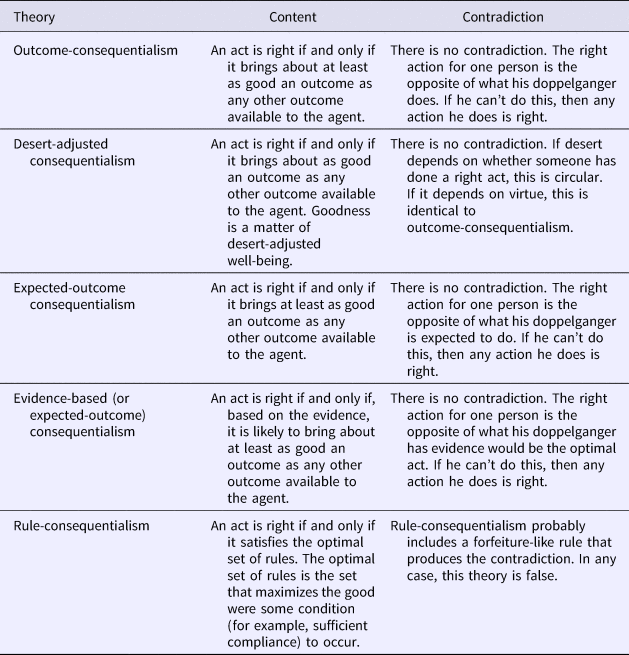
For a summary of these findings, see Table 3 below.
The Problem of Symmetrical Attackers and consequentialism
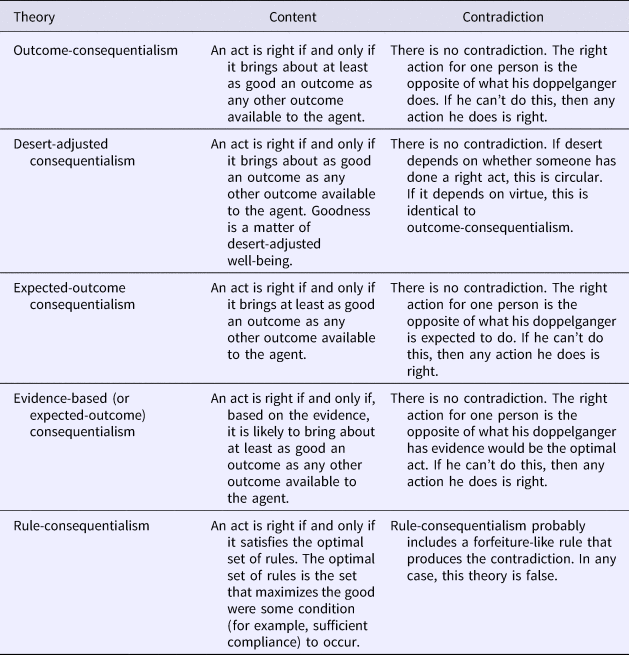
The conclusion, then, is that consequentialism escapes the Problem of Symmetrical Attackers. Rule-consequentialism does not escape it, but it is worse than other types of consequentialism.
There is also an issue whether consequentialism is plausible when issues of cooperation arise. Tom Regan argues that even if all agents always satisfy act-consequentialist requirements when they act, it is still possible that the class of all agents does not bring about the best consequences.Footnote 24 Regan defends a consequentialist theory that asserts that a person does the right thing only if she follows an appropriate decision procedure. This decision procedure involves coordinating with others so as to produce the best pattern of acts for a collection of people. There is a similar problem whether consequentialism gets the correct result when an agent acts at two different times such that whether he does the right thing at the earlier time depends on what he does at a later time and vice versa.Footnote 25
The decision procedure produces problems. Consider, for example, the case in which there is not enough time to go through the decision procedure. Consider, also, the case when one person will set off a bomb if another uses the appropriate decision procedure.Footnote 26
This issue raises a different issue than the one considered here. First, the problems do not parallel that faced by non-consequentialism as does the case of the symmetrical attackers. Second, coordination is wanted in the cooperation problem, but not in some of the symmetrical-attacker problems (for example, Catapult). Third, even if a decision procedure produces the best outcome in cooperation problems, such a decision procedure will not make the Problem of Symmetrical Attackers disappear. This is because the problem occurs if two identical parties in identical situations use the same decision procedure.
IV. Why this matters
This result matters. The Problem of Symmetrical Attackers is acute because it strikes at the heart of a moral theory. The heart of a moral theory is to explain what happens morally when people conflict or cooperate. It poses a difficulty when people conflict in that it applies to the involuntary change in moral boundaries that occurs via self-defence, punishment, and compensation. It poses a difficulty when people cooperate in that it applies to the voluntary change in moral boundaries that occurs via consent. The ability of consequentialism to avoid the contradiction and justify what usually happens in the case of conflict and cooperation is a serious advantage.
What causes the problem for non-consequentialism is its dependence on rights and the way rights work in the context of forfeiture and waiver. The dependence on rights can be seen in that the most plausible non-consequentialist theories (doing and allowing, double effect, causing/not causing, and the harm principle) depend on rights because they need to demarcate when someone has a legitimate interest in something. The problem with the way rights work results from the interdependence of people's rights. A person forfeits his right only if he is an unjust threat. Whether he is an unjust threat depends on whether the person towards whom he acts forfeits his right. Thus, one person forfeits if his opponent does not and vice versa. The interdependent forfeiture relation is similar to a two-sentence liar paradox in that each sentence can be meaningful and true, but both cannot. Here is the analogy. Compare (5) and (6) to (7) and (8).
(5) If A forfeits B does not and if B forfeits A does not.
(6) Either A and B forfeit or neither forfeits.
(7) The below sentence is true.
(8) The above sentence is false.
The problem also occurs with regard to non-forfeiture theories of conflict, such as narrow scope, override, and desert theories. Attempts to eliminate the interdependence fail because they rely on implausible theories of justified violence or coercion. Consider, for example, theories that focus on blameworthiness. It also applies to cooperation theories that focus on consent. Unlike the liar paradox, however, there is no analogous solution in terms of meta-meaning, sentences that only appear to be well-formed, and so on. One solution to the liar paradox is to claim that there is no paradox because the sentence that gives rise to the liar paradox is not well-formed (specifically, a language cannot have a truth predicate apply to itself). Regardless of whether this is a solution to the liar paradox, there is no such sentence at the heart of the Problem of Symmetrical Attackers.
A solution also does not rest in the notion that the scenario in question is self-referential or impossible. By analogy, consider a criticism of correspondence theories of well-being.Footnote 27 Examples of such theories are ones that assert that a person's life goes better because his desire is satisfied or has a true belief. Here a person's life goes better if the relevant mental state corresponds to a fact that is external to him.
Consider, for example, a person who desires that his life go poorly. For simplicity, assume this is his only desire and that how well someone's life goes depends on, and only on, desire-fulfilment. If this is correct, then if his life goes poorly, then it goes well. If it goes well, then it goes poorly.
On a knowledge-based theory of well-being, consider a case when a person believes his life goes poorly. Again, for simplicity, assume that how well his life goes is solely a function of the degree to which his beliefs are true and that this belief is his only belief. If this is correct, then if his life goes poorly, then it goes well. If it goes well, then it goes poorly.
This purported paradox for correspondence theories might be rejected because the desire or belief in question is self-referential. For example, in desiring that his life goes poorly he desires that his desires go unsatisfied including that higher-order desire. It is not clear such self-referential attitudes are possible, especially if it produces a conflicting world-to-mind fit.
Alternatively, such a desire might not be possible. It might be impossible, in some sense, to intrinsically want one's life to go worse. This is true even if one might want this instrumentally. For example, someone might want his life to go worse as a way of punishing himself for the terrible things he's done or as a way to benefit others, but not for it to go poorly simpliciter.
This can be seen in the fact that M-SAC does not include a sentence or proposition that is self-referential. The way the example works involves one person having a right (to defend himself) only if the second forfeited his right and the second person forfeiting his right only if the first has the relevant right. Metaphysical circularity might be a problem, but it is distinct from the problem of self-reference. Nor is the scenario impossible. Independent of the moral assumptions, the scenario does not involve any contradiction. In fact, it is easily imaginable.
The criticism of correspondence theories of well-being rests on such theories involving self-reference. Cases such as M-SAC and the more general operation of right-forfeiture do not involve self-reference. The discussion of this criticism and its comparison to how forfeiture works is designed to show that a self-reference-related objection does not dissolve the Problem of Symmetrical Attackers, whether in general or in the context of non-consequentialism.
Nor does the Problem of Symmetrical Attackers seem to be capable of being handled by an additional principle in the system. Consider, by analogy, the inability of induction to justify itself, at least without an infinite regress of inductive inferences. Consider, also, the impossibility of verifying verificationism. In these cases, the truth of induction might have a priori justification. Ditto for verificationism. Alternatively, on one account, the problem of induction can be solved by an unproblematic infinite regress.
Neither of these solutions is available to the non-consequentialist faced with the Problem of Symmetrical Attackers. Unlike the two-sentence liar paradox, there is no poorly formed statement. Nor is there a meta-language available. Unlike the objection to correspondence theory, the problem does not involve self-reference. Nor does it involve an impossible scenario. Unlike the problem of induction, it cannot be solved via an a priori justification or an infinite regress.
Consequentialism gets around the problem because there is a right action in the symmetrical-attacker-type cases. Expected-outcome consequentialism, whether metaphysical or epistemic, can produce a case when individual right acts do not produce the all-things-considered best outcome. This is not a problem, though, because the expected part creates space between a right action and an optimal outcome.
V. Conclusion
The forfeiture theory runs afoul of the Problem of Symmetrical Attackers. This is a cost of the theory, although perhaps not enough of a cost to make it untenable. The inability of act-consequentialism to cohere with widespread and deeply held intuitions about permissible defence, punishment, and compensation is a competing cost.
An objector might concede the above analysis is correct, but then ask, ‘So what?’ She might continue that these cases are problematic for particular kinds of non-consequentialists, but note that these cases are rare and all theories have problematic cases. She then asks, ‘Why turn to consequentialism when it fails to cohere with widespread and deeply held intuitions?’Footnote 28
The problem for non-consequentialism is that it produces a contradiction. This is a problem even if the case that generates it is rare. The contradiction results from non-consequentialism's connection to rights and forfeiture. Giving these notions up comes at a high price. If consequentialism can avoid this contradiction, especially when it comes to matters as central to morality as conflict (specifically, compensation, self-defence, and punishment), this is a big advantage over non-consequentialism.Footnote 29