INTRODUCTION
In all shallow environments, space is often a limiting resource in densely populated epibenthic communities, so hard living substrates of benthic plants and animals become important for epibiosis (Jackson, Reference Jackson, Keegan, Ceidigh and Boaden1977). Crabs belonging to the superfamily Majoidea, commonly called spider crabs, are slow moving, non-burrowing, slow growing animals with a long life span (Hartnoll, Reference Hartnoll1993). They act as substrata for communities of small marine organisms, carrying a variety of epibionts on their carapaces including diatoms, green algae, coelenterates, flatworms, mussels, oysters, annelids, barnacles, tunicates, bryozoans, isopods, amphipods, gastropods, pelecypods and polychaetes (McLay, Reference McLay1983; Sato & Wada, Reference Sato and Wada2000). Colonization by epibionts can be beneficial and have a protective value to brachyuran crabs via camouflage (Maldonado & Uriz, Reference Maldonado and Uriz1992). Most previous studies on spider crabs' epibiota have focused on the macro-epibionts in order to elucidate their masking behaviour (Wilson, Reference Wilson1987; Wicksten, Reference Wicksten1993; Woods & McLay, Reference Woods and McLay1994). The importance of epizoic growth of diatoms has been described for many animals including cladocerans (Gaiser, Reference Gaiser1991), copepods (Russell & Norris, Reference Russell and Norris1971; Gibson, Reference Gibson1978; Prasad et al., Reference Prasad, Livingston and Ray1989), and whales (Holmes, Reference Holmes1985) but there is no information on such growth in crabs.
The commencement of larval settlement and metamorphosis of some epibionts are possibly triggered by physical and biological stimuli. Several studies have suggested that the larval substratum choice for attachment is influenced by the bio-film on the substrate, which plays an important role in mediating settlement and metamorphosis (Rodriguez et al., Reference Rodriguez, Ojeda and Inestrosa1993; Maki, Reference Maki, Fingerman, Nagabhushanam and Thompson1999; Zhao & Qian, Reference Zhao and Qian2002). The bio-film is a complex network of microorganisms (bacteria, diatoms, protozoa and fungi) and their extracellular polymeric substances (Wahl, Reference Wahl1989). Diatoms are among the earliest eukaryotic colonizers of submerged surfaces and one of the most conspicuous organisms in bio-films (Cooksey et al., Reference Cooksey, Cooksey, Miller, Paul, Rubin, Webster, Costlow and Tipper1984; Wahl, Reference Wahl1989). Attachment of diatoms is a more complicated process than in bacteria (Cooksey & Cooksey, Reference Cooksey and Cooksey1995). In some of them, attachment is associated with the production of extracellular polysaccharides in the form of pads, envelopes, stalks or tubes (Chamberlain, Reference Chamberlain, Sharpley and Kaplan1976; Hoagland et al., 1993). Earlier studies revealed that the benthic diatom films induce and promote larval metamorphosis of fouling invertebrates (Crisp, Reference Crisp, Grant and Maclue1974; Brancato & Woollacott, Reference Brancato and Woollacott1982). The biochemical cues offered by benthic diatoms strongly depend upon their species composition and density in the films as well as the composition of their extracellular polymeric substances (Harder et al., Reference Harder, Cindy and Qian2002; Zardus et al., Reference Zardus, Nedved, Huang, Tran and Hadfield2008).
The spider crab Schizophrys dahlak Griffin and Tranter, Reference Griffin and Tranter1986, is a Red Sea species that is well established in the Suez Canal. It is heavily encrusted with a relatively dense cover of epibionts that helps it hide from predators (Morsy, Reference Morsy2007). Little work has been carried out to explain the masking or decorating behaviour of spider crab species of the Suez Canal (Sallam et al., 2007; Sallam & Wicksten, Reference Sallam and Wicksten2011). Sallam et al. (Reference Sallam, Madkour and Wicksten2007) was the single study to document the significance of micro-epibionts in the masking behaviour of the spider crab Hyastenus hilgendorfi inhabiting the Suez Canal recording 49 species of epiflora. However, nothing is known on the seasonality or the types of habitats in which epizoic diatoms occur on spider crabs from this area. In the present study, the epibiosis of S. dahlak (Brachyura: Majidae) from the Suez Canal was investigated. An attempt was made to use epizoic diatoms as a tool to elucidate their role in the masking behaviour or passive encrustation of S. dahlak. Identities and frequencies of occurrence of macro-epibionts and epizoic diatoms on the integuments of this species were assessed. Sex and size of the crabs was recorded and temporal differences in this epibiosis were established.
MATERIALS AND METHODS
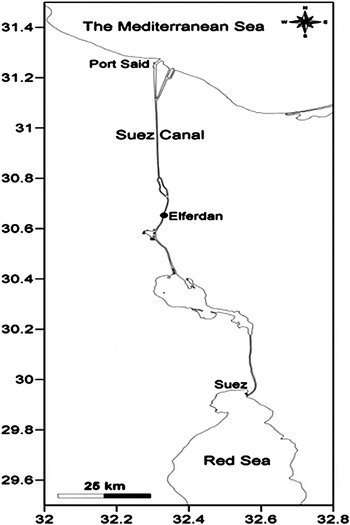
Specimens of Schizophrys dahlak were collected monthly between autumn 2008 and summer 2009 from Elferdan, at 68 km from the northern end of the Suez Canal (Figure 1). Crabs were obtained from fishermen using trammel nets with an approximate mesh size of 33.5 mm that are dropped at sunset and collected at dawn. They were preserved in 4% formalin for examination and enumeration of epibionts. Crabs were first sexed and then their moulting stage was determined. The carapace width (CW) and carapace length (CL) of each crab was measured with a Vernier caliper. Maturity of males and females was determined based on morphological examination of the size of the chelae and abdomen width, respectively. All sampled individuals were examined visually to assess the degree of coverage by macro-epibionts. Each individual was placed in one of the following 5 step scales: 0%, 5–25%, 25–50%, 50–75%, 75–100%.
Map of the Suez Canal showing sampling site.

Specimens (four/sex/month), free or almost free of macro-epibionts, were chosen for the evaluation of diatom communities. Since the carapace (dorsal side) of S. dahlak was uneven, the total area was measured by marking it into the nearest geometric figure (4 triangles), then summing their areas. Quantification of diatoms was carried out by scraping the entire carapace with a brush into a known volume of filtered seawater and preserving in 4% formalin. Diatoms were examined prior to and after cleaning with H2O2 and K2Cr207 to oxidize organic material under an inverted microscope at 100 × and 400 × and identified to species using primary references for identification (Hendey, Reference Hendey1964; Tomas, Reference Tomas1996). Representative samples of diatoms were enumerated by the sedimentation technique (Hasle, Reference Hasle and Sournia1978). Since verifying the abundance of various diatom species on the crabs was too labour-intensive for this study, seasonal average density for all species was expressed as number of cells dm−2/sex.
The total macro-epibiont percentage coverage was subjected to two-way analysis of variance (ANOVA) (Sokal & Rohlf, Reference Sokal and Rohlf1981) in order to evaluate the differences with respect to seasons, sex and the interaction of seasons and sex. To compare the abundance of epizoic diatoms among seasons and sexes, the presence/absence of epizoic diatoms, the diversity (Shannon–Wiener diversity index, H′) and evenness (J′) of the diatom community were used. The log (x + 1) transformed values of generic diatom abundance were further analysed using cluster analysis. The dissimilarity levels were measured through squared Euclidean distance and group average method as described by Pielou (Reference Pielou1984) using Primer Package V.5.
RESULTS
A total of 406 specimens were collected: 302 males (74.4%) and 104 females (25.6%). All individuals were in intermoult condition except four males observed in April and August and two females observed in February and May. These were all postmoult and were totally devoid of covering material. Twenty-eight ovigerous females (27%) were observed between May and August. Males had a larger size-range (CW: 28.2–73.3 mm; mean 53.9 ± 8.8 mm) than females (CW: 34.6–64.7 mm; mean 45.9 ± 6.3 mm). Males were found mature at the minimum size of 37.3 mm CW while females with 34.6 mm CW were mature. The percentages of mature specimens in the samples were 95% for males and 100% for females.
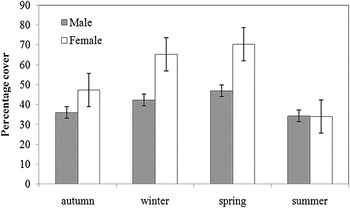
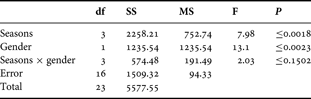
Of all collected crabs, 78 (56 males; 22 females) comprising 19.2% of the total, had no macro-epibionts on their integuments. The recorded macro-epibionts included the tube worm Hydroides elegans (Haswell, 1883), the barnacle Balanus amphitrite Darwin, 1854 and Balanus eburneus Gould, 1841, the bivalve Brachidontes variabilis (Krauss, 1848) and the tunicate Styela plicata (Lesueur, 1823). Total coverage of macro-epibionts was greater on females' carapaces than those of males with apparent seasonal variations. The highest coverage was recorded in spring (70.3% and 46.9%) and winter (65.3% and 42.3%) for females and males, respectively (Figure 2). The total coverage of macro-epibionts (including all forms recorded), when subjected to two-way ANOVA, revealed a significant variation between sexes and seasons (Table 1).
Schizophrys dahlak: seasonal variations in the percentage cover of macro-epibionts on males and females' carapaces. Error bars indicate standard errors.

Schizophrys dahlak: results of two-way analysis of variance comparing macro-epibiont coverage between sexes and seasons.

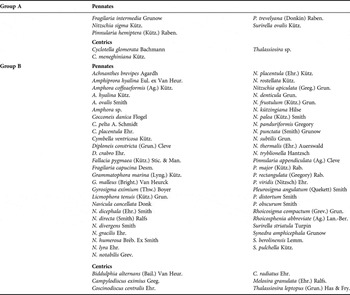
Ninety-six individuals were examined for epizoic diatoms, three of which were totally bare. Sixty-five diatom taxa were recorded (56 pennates and 9 centrics) belonging to 25 genera (19 pennates and 6 centrics). The dominant genera, in terms of the number of species, were Nitzschia (11 species), Navicula (10 species) and Pinnularia (6 species). The taxa, listed in Table 2, can be divided into two groups on the basis of their frequency of epizoic occurrence on all crab specimens. The first group (A) consists of eight diatoms with frequency ranging between 20% (Cyclotella glomerata) and 55% (Cyclotella meneghiniana). The remaining 57 species (group B) had frequencies less than 20%. The most abundant were species of Cocconeis, Amphora, Fragilaria, Nitzschia and Naviculla. Planktonic diatoms such as C. meneghiniana and Nitzschia sigma were observed throughout the year. The benthic diatoms Pinnularia trevelyana and Surirella ovalis also existed in all seasons.
Epizoic diatoms on the integument of Schizophrys dahlak divided into two groups according to their frequency on the crab (see text for groups' denotation).

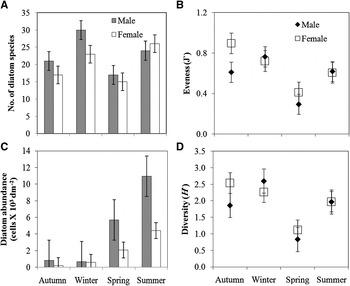
The epizoic diatom species number, according to their presence/absence, and abundance (cells dm−2) were higher for males than for females (Figure 3A, B). The maximal total average of cells was noticed during summer and spring with the highest average of 10.9 and 4.4 × 10³ cells dm−2 for males and females, respectively. Minimal values were observed during autumn and winter with the lowest average of 0.67 and 0.21 × 10³ cells dm−2 for males and females, respectively. In terms of density, pennate diatoms dominated the epibiotic community with dominance that reached 96%. In summer, many species displayed high density. Some of them were confined to males only such as Amphora coffeaeformis and Cocconeis placentula (36% and 24% of the total average density, respectively), whereas others such as Navicula placentula and Nitzschia kutzingiana occurred abundantly on both males and females' carapaces. Fragilaria intermedia (comprising 73.5% of the total average) appeared to be the most dominant during spring for males and females. Speciation provided a different picture than counting with irregular seasonal pattern. Identified species fluctuated between 17 and 30 taxa in spring and winter, respectively for males, and between 15 and 26 taxa during spring and summer, respectively for females.
Schizophrys dahlak comparison of: (A) diatom species number; (B) cell abundance (cells × 103 dm−2); (C) diatom evenness (J′); and (D) Shannon–Wiener diversity index (H′) in males and females during the different seasons. Error bars indicate standard errors.

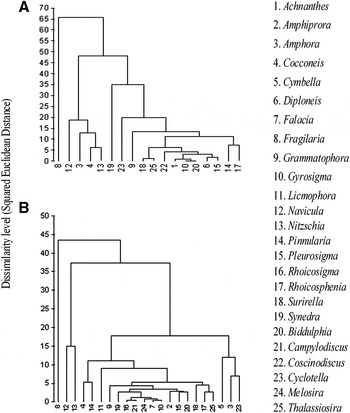
Epizoic diatom assemblages displayed indistinctly higher values of diversity index (H′) and evenness (J′) for females than for males in most occasions (Figure 3C, D). Significant seasonal difference was found when values for males and females were averaged. Epizoic diatom were more diverse in winter (average H′ = 2.43) and less in spring (average H′= 0.97). A clear seasonal difference was found for evenness values, the lowest (J′= 0.84) was in autumn and the highest (J′= 1.74) in summer. The dendrograms (Figure 4A, B) are derived from a matrix of 4 samples (representing seasonal average counts of epizoic diatoms on examined crabs) × 25 species (representing epizoic diatoms genera) on both males and females. The dendrograms separated genus Fragilaria at the greatest dissimilarity level (65% and 44%) in males and females, respectively. Two additional distinct clusters could be distinguished for both sexes with different samples merging at a greater dissimilarity level in males (47%) than females (37%). The higher dissimilarity levels in the case of males indicate the greater abundance of species in males than females. The first cluster consisted of two genera, Navicula and Nitzschia in females in addition to Amphora and Cocconeis in males. The rest of genera constituted the second group and displayed little dissimilarity.
Schizophrys dahlak: generic cluster dendrograms of the epizoic diatom community from (A) males and (B) females.

DISCUSSION
Five species of macro-epibionts and 65 species of diatoms (micro-epibionts) were recorded as epibionts on the integument of Schizophrys dahlak inhabiting the Suez Canal. In the study area, where soft sediments dominate the bottom substrate, slow moving spider crabs could provide a substrate for the settlement and colonization of benthic diatoms and encrusting filter feeding organisms. Substrates and microhabitats provided by crabs and associated epibionts greatly influence the community structure by increasing the species richness of the benthic assemblages. Recorded epizoic diatoms were mostly pennates that are typically benthic taxa that commonly grow attached to animal substrates. Madkour et al. (Reference Madkour, Dorgham, Hanafi and Holligan2007) in their study on the phytoplankton of the Suez Canal observed the predominance of benthic pennate diatoms particularly in the middle region of the Canal. The higher frequency and density of some pennate taxa in the benthic forms could be attributed to their ability to attach to substrates by gelatinous stalks or pads (Cooksey et al., Reference Cooksey, Cooksey, Miller, Paul, Rubin, Webster, Costlow and Tipper1984; Hoagland et al., 1993). However, centric forms (e.g. Cyclotella and Biddulphia), which are usually common members of the planktonic communities, may get entangled with attached forms or trapped by the setae on the crab. The range of Shannon–Wiener diversity index (average H′: 0.97–2.43) recorded in the present study was more or less close to the value observed by Margalef (Reference Margalef1978) for the actively growing coastal populations. Seasonal patterns of diatoms diversity indices with the highest values (evenness: 1.74 and Shannon–Wiener index: 2.43) recorded in summer and winter, respectively, reflect the equitability of the dominant group complex in summer and the diversity of the assemblages on S. dahlak in winter.
There was a clear seasonal trend in the abundance of benthic diatoms with the maximum in spring and summer. This is consistent with the pattern described by Round (Reference Round1960). Although the abundance and species composition of benthic diatoms are controlled by water quality, substratum and level of disturbance (Round, Reference Round1981), it is more difficult to determine which of these factors had an impact in the case of S. dahlak. While the recorded diatoms were diversified (65 species), only a few species had high abundance. Fragilaria intermedia represented the only abundant epizoic diatom which dominated the community during spring in both sexes. This was supported by the results of the cluster analysis which revealed that the genus Fragilaria was the most dissimilar species in terms of abundance on carapaces of both sexes compared to other recorded diatoms (Figure 4A, B). The high abundance of a sole species is unusual because, although diatoms are sensitive to environmental conditions on very small scales, typically, not one, but many taxa occur together and are characteristic of a particular microhabitat. As shown by the cluster analysis, there was a variation in the association of the dominant diatoms in summer. The abundance of Amphora coffeaeformis and Cocconeis placentula on males' carapaces only indicates that some factors, often undetermined, are operating to prevent the occurrence of particular species on females. The present data on presence/absence and abundance of diatoms show that males were more hospitable for epizoic diatoms than were females.
Benthic diatoms particularly pennate forms are able to excrete a copious amount of extrapolymeric substances (Hoagland et al., Reference Hoagland, Rosowski, Gretz and Roemer1993) that provides a food source for other organisms (Middelburg et al., Reference Middelburg, Barranguet, Boschker, Herman, Moens and Heip2000). Benthic diatom films and their components play an important role in inducing larval metamorphosis and providing cues to invertebrate larvae. The cues offered by benthic diatoms can also mediate invertebrate larval metamorphosis (Crisp, Reference Crisp, Grant and Maclue1974; Brancato & Woollacott, Reference Brancato and Woollacott1982). In the present study, the high density of epizoic diatoms assemblage on the carapace of S. dahlak in summer might act as a substrate for larval settlement. Observations of the macro-epibionts' seasonality on S. dahlak revealed that their lowest density was in summer and the highest in spring. During the winter and spring, adult forms of epibionts were seen in high densities, perhaps due to the settlement of larvae that underwent metamorphosis. Seasonal variations in the macro-epibiont density could be due to the facilitation of larval settling by the cues from benthic diatoms.
Macro-epibionts recorded on the integument of S. dahlak were the same as those reported for Hyastenus hilgendorfi from the Suez Canal (Sallam et al., Reference Sallam, Madkour and Wicksten2007; Sallam & Wicksten, Reference Sallam and Wicksten2011). This indicates that epibionts are generalists and not species-specific, due to the wide diversity of basibionts on which they are settled. In contrast to benthic diatoms, macro-epibiont coverage was denser on the carapaces of females. This finding is similar to that reported for Hyastenus hilgendorfi from the Suez Canal (Sallam & Wicksten, Reference Sallam and Wicksten2011). Intra-specific difference in the decoration pattern where adult males decorate less than females has been previously reported (Wicksten, Reference Wicksten1993; Berke & Wooden, Reference Berke and Wooden2009). A similar pattern has been reported for the deep-sea crab Bathynectes piprritus (Abelló et al., Reference Abelló, Villanueva and Gili1990; Gili et al., Reference Gili, Abelló and Villanueva1993). The higher density of epibionts on females than males reported for portunid crabs (Overstreet, Reference Overstreet and Provenzano1983; Key et al., Reference Key, Volpe, Jeffries and Voris1997) could also support the conclusion that females of S. dahlak harboured more epibionts.
Fernández et al. (Reference Fernández, Parapar, González-Gurriarán and Muíño1998) concluded that the degree of incidence of epibiosis and self-decoration varies depending on different environmental factors, such as habitat and season, and on factors linked to the biology of the species such as the size of the individual, moult frequency, and the time elapsed from the terminal moult. Consequently, the duration of the intermoult period of S. dahlak in which individuals maintained their hard carapaces could have assisted the density of epibiont settlement. The rate of moulting in spider crabs tends to slow as they approach maturity, at which time it stops (Hartnoll, Reference Hartnoll2001). On maturity, the carapace would remain as a stable substrate, on which epibiota could grow and flourish. The minimum size of maturity of S. dahlak was 37.3 mm CW for males and 34.6 mm CW for females but according to Morsy (Reference Morsy2007) any female above 34 mm in size could be mature. Since all of the crabs we collected ranged from 28.2 to 73.3 mm CW, we suspect that any over-estimate of the percentage of mature females is low. On the other hand, crustaceans inhabiting the Suez Canal are seasonal breeders; they have been reported to be sexually active during June to November and have a well-defined resting phase between January and March (Sallam, Reference Sallam2000; Morsy, Reference Morsy2007). We saw no evidence of seasonality of moulting among our crabs.
Motion during mating may increase the mechanical abrasion on the carapace, which could dislodge attached organisms. Barnacles and tube-building polychaetes, which are common epibionts of the crabs, are cemented to the carapaces and cannot easily be removed. We suspect that, if any surface abrasion takes place during mating, ascidians would be the most likely organisms to be dislodged. Although there are no observations for the mating behaviour of S. dahlak in the Suez Canal, it could be postulated that it has an influence on the pattern and density of distribution of epibionts on the integument of this species. DeGoursey & Auster (Reference DeGoursey and Auster2001) observed a variety of mating postures for some spider crab species. Of these, one took place with the male lying on its carapace with the female on top. If this is the case for S. dahlak, then this posture could help make the undisturbed surface availability for macro-epibionts less on males by the increased mechanical abrasion on their carapaces while the whole of the female's carapace is exposed for epibiont settlement. On the other hand, ovigerous females are known to remain motionless in their position for some time until egg hatching. This could increase the surface availability of females' carapaces rather than for males.
For spider crabs, coverage by epibionts has been reported as a defence mechanism against visually hunting predators or a food store (Wicksten, Reference Wicksten1980, Reference Wicksten1993; Sato & Wada, Reference Sato and Wada2000). In the present study, most of the recorded macro-epibionts were organisms that must have settled on the carapace of S. dahlak as larvae. This indicates that S. dahlak of the Suez Canal acquires its cover by passive acquisition of certain epipionts. Similar encrustation has been reported for Hyastenus hilgendorfi from the same area (Sallam & Wicksten, Reference Sallam and Wicksten2011). The differential distribution of epibionts over the carapaces of both sexes and in the different seasons seems to be a result of differential recruitment of diatoms and other epibionts to male and female carapaces. A combination of biological factors influencing the recruitment and survival of epibionts include carapace properties, crab behaviour patterns and interactions among epibionts.