Introduction: The Golden Triangle of Art
In the last decade, the main museums in Madrid have undergone extensive renovation, taking advantage of an economic boom in Spain at the start of the twenty first century. The first was the Museo Nacional Centro de Arte Reina Sofía (MNCARS) that opened in October 2005 an extension designed by the French architect Jean Nouvel, with a specific wing for the library. The Museo Nacional del Prado (MNP) was also substantially enlarged between 2001 and 2007, but the library was transferred to a renovated historical building nearby: the Casón del Buen Retiro, inaugurated in April 2009. In 2004, the Museo Nacional Thyssen-Bornemisza (MTB) opened a new wing for housing the collection of Carmen Thyssen-Bornemisza, but for practical reasons the library remained in an attic section of the historical building. These three museums create the famed Golden Triangle of Art. Footnote 1
The new buildings and refurbishments have had a very positive impact on the development of the museums and their libraries. There are now more opportunities to open the libraries to the general public and new innovative services to offer to that public.
A new building for a new library: The Museo Nacional Centro de Arte Reina Sofía (MNCARS)
The Museo Nacional Centro de Arte Reina Sofía was created by Royal Decree in 1988. The collection was made up of works conserved at that time by the Spanish Museum of Contemporary Art. The MNCARS opened its doors to the public in 1990. Its permanent collection currently comprises over 21,000 artworks that show the transformation of Spanish art in its international context, from the late nineteenth century to the present day. The world-famous Guernica by Picasso is the unquestionable jewel in the museum's crown.Footnote 2
The construction of the historic building started in 1758 following the plans of architect José de Hermosilla (1715–1776), though the architects Francisco Sabatini (1722–1797) and Juan de Villanueva (1739–1811) subsequently took over the project. Due to its large scale, it was left unfinished — only two-fifths of the initial projects were ever completed.
The Golden Triangle of Art, Madrid.

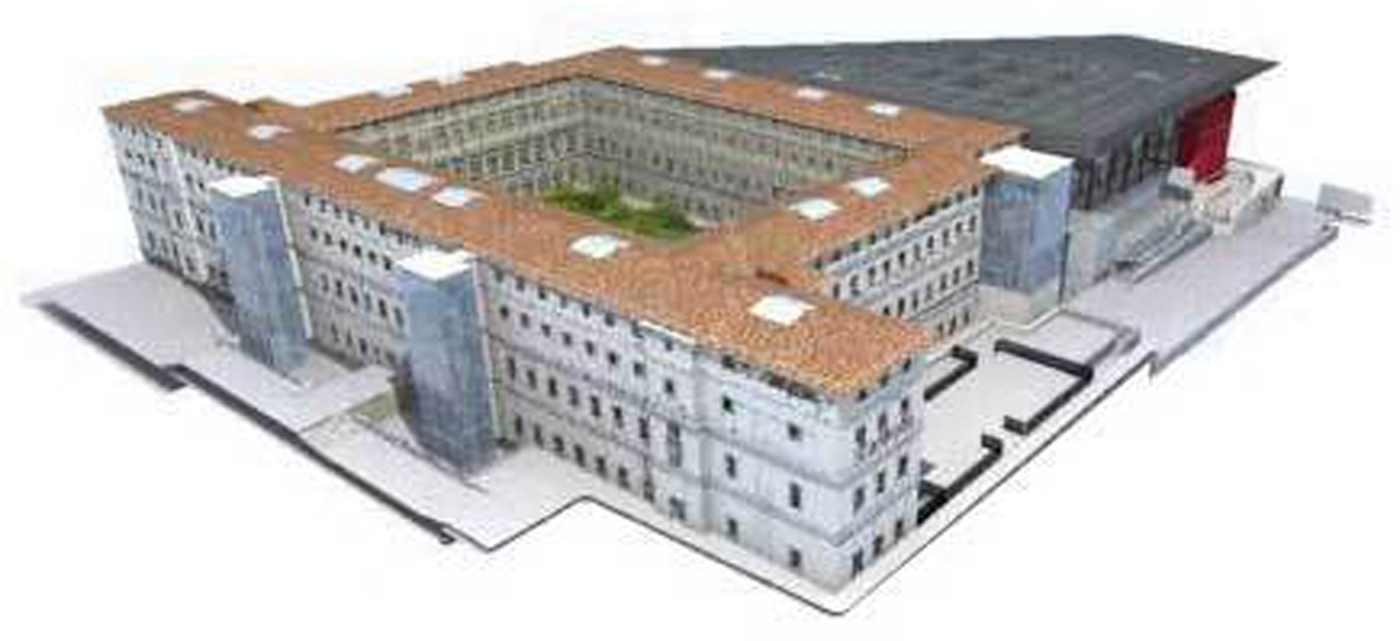
Despite having a total area of 54,622 square meters (179,206 sq. ft.) over six floors, with a workable area of 36,700 square meters (120,406 sq. ft.), in 1999 the Royal Museum Board approved an international contest to construct an extension to the museum. In that year, the French architect Jean Nouvel won the competition. His proposal consisted of the creation of three new buildings in the southern part of the old hospital that would comprise a library and documentation center, two auditoria, two extensive exhibition spaces, a room for internal meetings, offices, and a bookshop.
In the construction, Jean Nouvel used both new materials and techniques, such as a composite material that covers the building, both inside and out, with a very distinctive reddish hue; the use of rolled steel for the library and the exhibition building was another singular use of new materials. The new spaces represent an increase of over 60% of the surface area of the old building. Currently the MNCARS covers 86,000 square meters (282,152 sq. ft.). The Nouvel extension was inaugurated in June 2005.
The library
The library constitutes a singular architectural space. It is a reference resource for researchers of contemporary art and is one of the most important in Europe in terms of the number of volumes and specialized material (over 135,000 monographs, 2,270 serials, 2,800 audiovisuals, and other library resources). It also houses an extensive collection of documents from 1900 to the present day, as well as works dating back to the 19th century.Footnote 3
Virtual image of the old building and the expansion, Museo Nacional Centro de Arte Reina Sofía, Madrid.

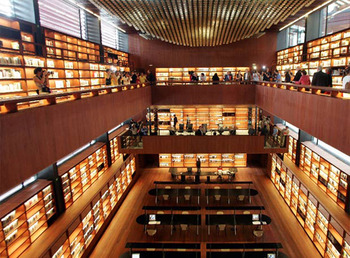
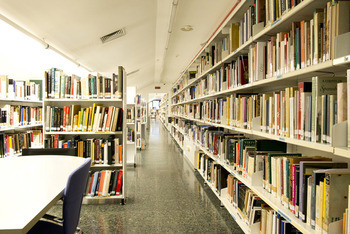
The area of the new building is about 2,500 square meters (8,202 sq. ft.) and is spread over three floors. Large windows and Jatoba wooden shelves produce an impressive combination of beauty, elegance and spaciousness.
Wood panels cover the walls, floors and the ceilings throughout the library, which at first glance might catch one's attention due to its apparent high fire risk. However, the use of fire resistance wood makes this material suitable for the coating of interior spaces. The effect is comfortable and warm, despite the dry environment. The library has no windows, so the interior cannot be ventilated with fresh air.
A vertical “light fall” floods natural light through the building, down from the first floor of the library to the lower level. In addition to the natural light, each shelf has a rigid LED light bar to illuminate the books below, which makes it easier to browse and produces quite a dramatic overall visual effect. However, from the librarian's point of view, these lights, seemingly practical, are a problem. They are not cold lights and consequently heat up the books, discolor the spines and help to detach the spine labels. As a result of this, the warm lights are currently being replaced by colder ones.
Although the LED lit shelves and the table lights create a luminous contrast of great beauty with the wooden walls and floor, as winter evenings fall no natural light makes its way in the library and some areas remain in darkness. This results in unnerving situations when moving through parts of the library cast in deep shadow.
In the ceiling of the reading room there is an immense molded glass lamp designed by Nouvel himself. It was made at the Royal Glass Factory of La Granja (Segovia). This impressive lamp is not particularly practical in terms of energy consumption, so it is only used for important official events.
At the very back of the large reading room there is a separate space called the Bounded Periodicals Room, which was originally used by researchers to display rare material and special collections. Rolling shelves on tracks have been installed at the back of the room.
There is also a meeting room on the ground floor with a capacity of 14 people. Formerly used for reprography but now used by researchers and library staff. This room also serves as an exhibition space for comprehensive displays of books and library materials. The idea was to create a multipurpose space for exhibition display but also a space for individual workplaces or collaborative learning with multifunctional furniture that can be easily moved.
The library of the Museo Nacional Centro de Arte Reina Sofía, Madrid.

The library has three storage rooms, two of them with compact storage areas, metal shelving, and flat storage drawers. The fire control system that is used in the storage rooms is fitted with FE-13 gas.
Some of the current problems of the library are its limited number of electrical power points and its limited storage capacity.
Since the library opened its doors in the Nouvel building in 2005, new and re-used existing spaces must be used to accommodate the needs of staff and users. The remodeling of existing spaces must take into account the new functional needs of the library as well as its aesthetic design, without rejecting the original designs that combine harmoniously with the whole of the museum.
Refurbishing a historical building: The Casón del Buen Retiro and the Museo Nacional del Prado (MNP)
The Museo Nacional del Prado was founded in 1819 to house the magnificent collection of paintings that the Monarchs of Spain had assembled since the 15th century. The MNP collection has grown considerably since then, through purchases and bequests and today it is the most important Spanish museum and indeed one of the finest in the world. It features one of the world's most outstanding collections of European paintings, dating from the 12th to the late 19th century, specializing in Spanish, Italian and Flemish paintings, but also containing important collections of sculptures, drawings, prints and decorative arts.Footnote 4
Since its foundation, the collections of the MNP have been located in a building designed by the architect Juan de Villanueva in 1785 to house the Real Gabinete de Historia Natural. In 2007 the museum completed the most important extension to its building with the opening of a new wing by the acclaimed Spanish architect Rafael Moneo. The project adds more than 22,000 square meters (72,178 sq. ft.) of surface area (an increase of more than 50% to the existing size). The available surface area has been used in a striking and innovative way, with three floors used for public access connected by a double escalator, and a further five mezzanine floors for internal usage.
The present project involved the restoration and amalgamation of the adjacent Monastery of San Jerónimo Cloister (dating from the 17th century).
The Casón del Buen Retiro originally formed part of the collection of buildings that comprised the Buen Retiro Palace, of which only the Casón and the Salón de Reinos now survive. The complex of the four buildings now forms the Prado Campus.
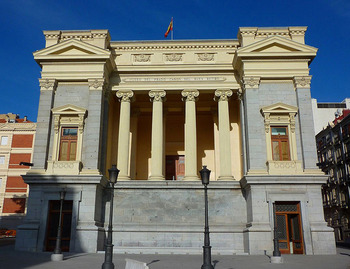
The Casón was designed by Alonso Carbonel (1583–1660), Chief Master of Works of the Buen Retiro Palace, who had completed the plans by 1637. In the 1690s the Neapolitan painter Luca Giordano (1634–1705) painted the vault of the central hall with a representation of the Spanish monarchy.
Casón del Buen Retiro. Photo by Javier Docampo.

Restoration work on the Casón was completed in October 2007. The project consisted of excavating two new floors and consolidating the entire structure of the building. The addition of these two new floors resulted in a further 3,157 square meters (10,357 sq. ft.) of floor space, almost doubling the pre-existing surface area. The Casón has a total surface area of 8,233 square meters (27,011 sq. ft.).Footnote 5
While the Casón was being redesigned, the MNP decided to create the Centro de Estudios (Study Center), to combine the research and educational activities of the museum; and to create a new library, archive and documentation area. At the end of 2008, both of these spaces were installed in the Casón del Buen Retiro.
The library
The library is one of the best yet least known art libraries in Madrid. It specializes in painting and sculpture from the Middle Ages to the 19th century and also contains an important collection of books on drawings, prints, classical sculpture and the decorative arts. The library has 80,000 books, 1,200 periodical titles, as well as audiovisual works and manuscripts. It is particularly rich in foreign publications including exhibition catalogues, museum catalogues, monographs of artists etc., and it also has an important collection of auction catalogues. The museum makes a considerable investment in the acquisition of important private libraries with rare holdings.Footnote 6
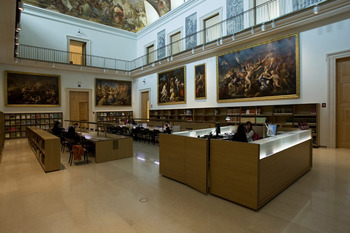
The library occupies various floors in the Casón. The main floor includes the reading room in the Salón de Baile (Ballroom). It has 36 seats and a reference library of 4,000 volumes, organized by subject, following a classification system based on the Universal Decimal Classification. The main problem with this space is that the structure of the building necessitates that it also substitutes as a staff thoroughfare, consequently disturbing readers.
In the side gallery, there is are computer terminals that allow access to the databases of the library, archive and documentation services and reprographic equipment. This floor also houses the offices for the library staff.
The book storage facilities are located on the lower ground floors; they are equipped with state of the art environmental and security measures. In the first basement, there are five storage areas, one central with modern monographs in open shelves and four on the side with compact shelves for rare books, periodicals, documentation material and archives. In the second basement, there is also a large storage area (more than 300 sq. m. or 984 sq. ft.) to house some of the private libraries that were recently acquired.
Library reading room, Museo del Prado. Photo by José Baztán.

Adapting museum spaces for library use: The Museo Nacional Thyssen-Bornemisza (MTB)
The story of the museum's library runs parallel to the museum's opening in Madrid in 1992. In that year, a total of 775 masterpieces from the Thyssen-Bornemisza Collection in Lugano (Switzerland) were moved to Madrid under a temporary loan agreement that the Baron Hans Heinrich Thyssen-Bornemisza and his wife Carmen had reached with the Spanish government in 1988. Their collection had been considered the most important private collection in the world before it was acquired by the Spanish state in June 1993 for 350 million U.S Dollars.
Since then, the collection housed in the MNTB holds a mirror to the tastes and preferences of the two people principally responsible for its existence, Baron Heinrich Thyssen-Bornemisza (1875–1947) and Baron Hans Heinrich Thyssen-Bornemisza (1921–2002). The permanent collection offers at least a sample of all the major periods and pictorial schools of European painting dating from the 13th century to the late 20th century. In addition, it boasts an exceptional collection of late 18th- to early 20th-century American paintings not found in any other European museum.Footnote 7
In 2004, the Carmen Thyssen-Bornemisza Collection was also added to MNTB. It contains more than 200 artworks, and augments the representation of styles and genres already present in the permanent collection. Both collections comprise almost 1,000 works of art, mainly paintings — the MNTB offers a fundamental overview of the entire history of European painting.
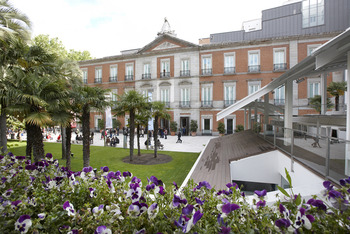
The building chosen to host the Baron's Collection was the Villahermosa Palace. It was built at the beginning of the 19th century by Antono López Aguado (1764–1831), devotee of Juan de Villanueva. However, the origins of the palace date back to the early 17th century. In 1989, the Spanish architect Rafael Moneo began a deep transformation of the Villahermosa Palace, respecting the structure of the neoclassical façade but completely changing the interior, creating a sober succession of rooms.Footnote 8
The library
During its first years, a reference library was created essentially for the curatorial departments, museum educators and other staff members to assist with the preparation of temporary exhibitions and related activities. It was an embryonic, small and unpretentious library. The books acquired were mainly monographs of artists represented in the collection, catalogues of temporary exhibitions, and works of reference; history of art and museum studies as well as catalogues of national and international collections.Footnote 9
In late 1999, a holding of about 8,500 titles was added to the library on a long-term loan basis from the art library of the Thyssen-Bornemisza family, on the expressed wish of Baron Hans Heinrich. These books came from the family residence at Villa Favorita in Lugano. In addition, the library also has a small selection of publications from Baroness Thyssen-Bornemisza.
Museo Nacional Thyssen-Bornemisza. Facade Photo by ABB Fotógrafos.

From its outset, the library has been located on the third floor of the Palacio de Villahermosa in a long, narrow gallery under the eaves, between the façades facing the Paseo del Prado and the Carrera de San Jerónimo. It was not a space initially perceived to host a library, or any other department of the museum, since during its early years the museum did not need any additional space.
The physical ordering and classification of the holdings has been adapted in response to the needs of the curators, and the books are organized by subject matter according to the Universal Decimal Classification, arranged over five rooms, each with its own name: New Titles, Reference Books, Public and Private Collections, Historical Periods, Artists’ Monographs and Journals and Newspapers.
The total surface of the library is 377 square meters (1,236 sq. ft.) and comprises of 770 linear meters of shelving. The library has over 30,100 volumes in circulation. The holdings also include over 140 ongoing periodical publications and a small collection of audiovisual material.
The shelves run around the perimeter of the rooms. In recent years, the library has grown significantly so that new cross shelves have been added along the walls of each room. The reading tables are distributed between these cross shelves.
As a safety measure, a new automatic fire extinguishing system was installed. It includes two Siemens Auxiliary Control units with nine crossed detectors with manual call points and prevention signals.
The first goal of the library is to upload the catalogue onto the library website and to incorporate it into the Spanish Museum Libraries Network, BIMUS, an online collective catalogue providing access to the libraries of 20 state-owned museums, managed directly by the Ministerio de Educación, Cultura y Deporte. A digitization project for the temporary exhibition catalogues held by the National Thyssen-Bornemisza Museum (about 120 publications) is currently being evaluated.
The library, the National Thyssen-Bornemisza Museum, Madrid. Photo by Hélène Desplechin, Museo Nacional Thyssen-Bornemisza.

Conclusions
These three different examples of museum libraries in Madrid allow us to review the advantages and disadvantages of each one. The refurbishment of historical buildings is imperative when the institution is housed in a particularly significant building with no plans to relocate. In Spain, with such a huge architectural heritage to preserve, it is important to give new life and purpose to historical buildings. This is the best way to lengthen their lives. Of course, there are complex issues, such as in the case of the Casón del Buen Retiro, where the reading room and the main storage room endure the constant traffic of the museum's staff.
The newly restored buildings could be more suitable to the needs of staff and readers. The librarian should always be consulted in the early stages of the planning process, which rarely happens. Sometimes architects, particularly if they are very famous, impose their own views which are frequently more attentive to aesthetic criteria rather than practical needs. As we have seen in the MNCARS reading room, these spaces are usually very beautiful, but further adaptations are needed to meet the everyday requirements of the use and preservation of library collections.
A version of this article was presented as a paper at the IFLA Art Libraries Section Satellite Conference in Chicago, 9–11, August 2016.