Introduction
Nasopharyngeal carcinoma (NPC) is a complex disease involving genetic predisposition, infection with Epstein-Barr virus and environmental factors. Reference Zhu, Zhao and Li1 Globally, a total of 129,079 cases of NPC were reported in 2018, accounting for only 0·7% of all types of cancers diagnosed in 2018. Reference Zhu, Zhao and Li1 NPC is usually treated only using radiotherapy in the early stage, whereas it is combined with chemotherapy in the advanced stage. Reference Perri, Scarpati and Caponigro2 The advanced radiotherapy treatment planning techniques, such as intensity-modulated radiation therapy (IMRT) and volumetric modulated arc therapy (VMAT) are now widely used to treat NPC because of better improvement in the dose delivery compared to conventional and conformal planning techniques. Reference Zhang, Ou and Peng3 However, the VMAT technique is more complex compared to conventional radiotherapy due to the continuous change of the multi-leaf collimator (MLC), gantry angle and dose rate during the treatment delivery. The inaccurate positioning of the gantry angle and MLC might lead to the failure of the treatment dose delivered to the patient. For instance, the healthy organs surrounding the target volume might receive excessive radiation doses, which might develop into a radiation-induced malignancy.
Due to the complexity of the VMAT technique, a pre-treatment patient-specific quality assurance (PSQA) is performed prior to the treatment delivery. This procedure is carried out to ensure the treatment provided to the patient is in line with the treatment plan performed on the treatment planning system (TPS) and the patient’s safety by preventing the normal organs from receiving excessive radiation dose. Reference Thiyagarajan, Nambiraj and Sinha4–Reference Li, Wang and Zhang6 One of the methods that are widely used in the PSQA procedure is gamma index (GI) analysis. Reference Hussein, Clark and Nisbet7 The GI analysis is a quantitative method that uses the gamma criteria (DD/DTA) to compare the measured dose distribution with the calculated dose distribution, where the DD is the dose difference and DTA is the distance-to-agreement. Reference Sarkar, Pradhan and Ganesh8 According to the America Association of Physicists in Medicine (AAPM), Task Group 119 recommended gamma criteria of 3%/3 mm, whereas the gamma criteria of 2%/2 mm can provide better sensitivity in determining the occurrence of the error in the VMAT treatment plan. Reference Kim, Park and Kim9
The commercially available dosimetry systems, such as ionisation chamber, film and PSQA phantom, can be used for the PSQA procedure. Reference Paudel, Narayanasamy and Han10 These dosimetry systems are integrated with software that analyses the outcome with TPS dose calculation in three-dimension is now widely used in the PSQA of VMAT. These dosimetry systems have been recommended by the AAPM Task Group 218. Reference Miften, Olch and Mihailidis11 However, the uses of these dosimetry systems are time-consuming, and they increase the financial burden of hospitals since they have to be purchased separately, apart from the LINAC. The additional time required to perform this pre-treatment PSQA increased the workload of the medical physicist and reduced the efficiency of the treatment delivery from the day-to-day workflow. Reference Agnew, Irvine and McGarry12 An EPID system has the potential in becoming an alternative to the PSQA dosimetry system to overcome the problems of time, cost and efficient workflow in radiotherapy centres. The set-up of the EPID was simpler as compared to the other dosimetry systems, and there was no additional system required as the EPID was attached to the LINAC.
This study was aimed to investigate the efficiency of the EPID as a PSQA tool for the VMAT planning technique for NPC treatment. The gamma passing rate of the VMAT in NPC treatment by using the EPID and conventional PSQA phantom with the gamma criteria of 3%/3 mm, 2%/2 mm and 1%/1 mm was obtained and evaluated. Moreover, the misalignment was introduced to test the sensitivity of the EPID system in measuring the gamma passing rate to further analyse the competency of the EPID as a PSQA tool for the VMAT technique.
Methods
NPC VMAT Treatment Planning
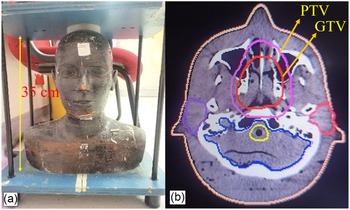
A head and neck anthropomorphic Rando phantom (Phantom Laboratory, Salem, NY, USA) (Figure 1a) was scanned using the Phillips Brilliance CT Big Bore 32 slices (version 3.6 Oncology). The computed tomography (CT) images were imported to an Eclipse TPS (version 13.6, Varian Medical Systems, Palo Alto, CA) for contouring, planning and dose calculation. A 6-MV VMAT plan of the NPC was created based on the Radiation Therapy Oncology Group (RTOG) 0615 protocol. The organs at risk (OARs) were contoured, followed by defining the gross tumour volume (GTV) and the planning target volume (PTV). The GTV was defined at the nasopharynx region, while the PTV was defined by adding a 5-mm margin in all directions of the GTV (Figure 1b). The prescribed dose for the PTV was 212 cGy for 33 fractions and the source-to-axis distance (SAD) technique was applied by placing the isocentre at the centre of the PTV. Anisotropic Analytic Algorithm (AAA) was the algorithm used for the dose calculation. At least 95% of the PTV was covered with the 70 Gy, whereas less than or equal to 5% of the PTV volume received a minimum of 80·5 Gy.
(a) Showed the Rando phantom with the measurement of height. (b) The cross-sectional view of the OARs and target volume contouring in Eclipse TPS. The PTV was contoured by adding 5 mm margin from GTV.

PSQA for the NPC VMAT
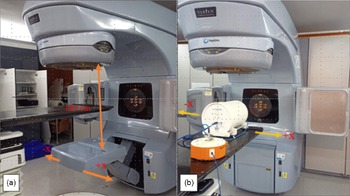
The PSQA test of the VMAT was carried out by using an aS1000 EPID of the Varian Clinac iX LINAC (Varian Medical Systems, Palo Alto, CA) and an ArcCHECK phantom (SunNuclear Corporation, Melbourne, FL). The ArcCHECK phantom is the standard tool practiced in the centre for the PSQA test, and it was used as a reference to compare the result of the EPID system. The set-up of the EPID and the ArcCHECK phantom is shown in Figure 2. A constancy test of the EPID was performed before the PSQA test based on the manufacturer’s recommendation. The non-transit dosimetry was performed on the EPID system, and the distance between the source and the surface of the EPID (SSD) was 140 cm. The EPID was positioned in the centre, which is also known as the reference position, while the acquisition mode was set at integrated mode. The global GI analysis was performed using the Portal Dosimetry software (version 13.6), and the gamma criteria (DD %/DTA mm) used were 3%/3 mm, 2%/2 mm and 1%/1 mm. The MLC ‘complete irradiated area outline’ (CIAO) was set at 1 cm.
Apparatus set-up for the pre-treatment PSQA of NPC VMAT: (a) EPID and (b) ArcCHECK. The direction of the EPID and ArcCHECK phantom for the sensitivity test shown by the arrow for positive and negative direction.

The PSQA test was carried out using the ArcCHECK phantom, which was positioned at the centre of the LINAC’s couch (performed couch accuracy), ensuring all the lasers were aligned to the corresponding reference line on the phantom (reference position) and used spirit level to check the phantom stability on the couch. A cylindrical ionisation chamber (PTW-Freiburg, Semiflex IC 31010, sensitive volume of 0·125 cm3) was inserted into the centre of the phantom to verify the NPC VMAT treatment plan. After warming up, the phantom was irradiated for the NPC VMAT treatment plan in a 3D mode delivery. The global GI analysis was performed using the SNC Patient software (version 6.7.2.17915), and the gamma criteria were 3%/3 mm, 2%/2 mm and 1%/1 mm, respectively, with a low-dose threshold of 10% to remove the noise in the SNC Patient software. Each measurement was repeated in three consecutive weeks.
Misalignment Test
A misalignment error was introduced to the EPID and ArcCHECK phantom to determine the sensitivity of both systems. The misalignment of the EPID system was performed by shifting the EPID from its reference position to 1 mm, 2 mm, 3 mm, 4 mm, 5 mm, 10 mm and 15 mm to both left and right directions, and the NPC VMAT plan on the EPID was irradiated. The same misalignment step was executed for the ArcCHECK phantom by shifting the couch from its reference position. Furthermore, the global GI analysis was performed for the gamma criteria of 3%/3 mm, 2%/2 mm and 1%/1 mm. These measurements were repeated for three consecutive weeks.
GI Analysis
The efficiency of the EPID system in the reference position was analysed by comparing the gamma passing rate of the ArcCHECK phantom. Initially, the graph of the mean gamma passing of the EPID and ArcCHECK systems with the gamma criteria of the 3%/3 mm, 2%/2 mm and 1%/1 mm were plotted with an error bar of ±5% of variation at the reference position. The recommended gamma passing rate for the gamma criteria 3%/3 mm was 95%, while that of the 2%/2 mm was 90%. Reference Heilemann, Poppe and Laub13–Reference Maraghechi, Davis and Mitchell15 Thereafter, the sensitivity of the EPID and ArcCHECK systems was determined using simple linear regression analysis. This test was performed to obtain the gradient of the best-fit line for the graph of gamma passing rate versus misalignment distance from the reference position (0 mm). The gradient of the best-fit line was interpreted as the average reduction of the gamma passing rate per unit error, and it was used to determine the sensitivity of the dosimetry system in detecting the misalignment error. The difference in the gamma passing rate of the misalignment from the reference position of the EPID and ArcCHECK systems was calculated using equation 1:
 $$\matrix{
{{\rm{Difference}}\left( \% \right) = \;{\rm{GI}}\;{\rm{passing}}\;{\rm{rate}}\;({\rm{reference}}\;{\rm{position}}{\mkern 1mu} - } \hfill \cr
{\quad \quad \quad \quad \quad \quad \quad \quad {\rm{misalignment}}\;{\rm{position}})\% } \hfill \cr } $$
The gamma passing rate differences for the gamma criteria of 3%/3 mm, 2%/2 mm and 1%/1 mm were compared between the EPID and ArcCHECK systems. The best gamma criteria for error detection by the EPID and ArcCHECK systems were determined. A larger deviation of the gamma passing rate from the reference position indicates better detectability of the dosimetry system on the misalignment errors.
Results
Dose Evaluation of NPC VMAT Planning Technique
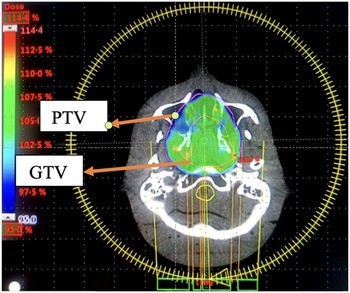
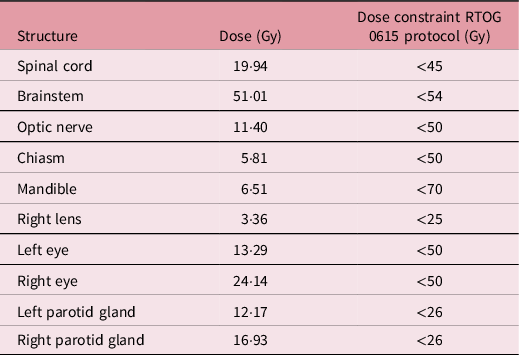
The isodose distribution of the VMAT plan is shown in Figure 3. The PTV was covered with more than 95% of the prescribed dose, and the maximum dose received by the PTV was 80·03 Gy. The maximum dose received by the PTV was within the range stated in the RTOG 0615 protocol, which is less than 5% of the volume of PTV received below 80·5 Gy. The dose received by all the OARs for this study were within the acceptable range as shown in Table 1.
Isodose distribution at the isocentre CT slice of the NPC VMAT plan.

Radiation dose received by the OARs from the NPC VMAT based on RTOG 0615 protocol

GI Passing Rate Analysis between the EPID and ArcCHECK Phantom
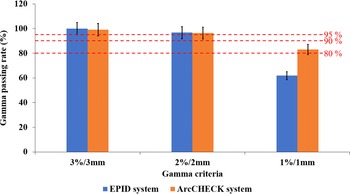
Figure 4 shows the mean gamma passing rate of both EPID and ArcCHECK systems for three consecutive weeks for the gamma criteria of 3%/3 mm, 2%/2 mm and 1%/1 mm. The gamma criteria of 3%/3 mm, the ±5 % of variation error bars overlapped between the EPID and ArcCHECK systems, indicating there were no significant difference in the mean gamma passing rate between the EPID (99·90% ± 0%) and the ArcCHECK (99·03% ± 0·23%) systems. Both systems showed an excellent agreement with the TPS because their mean gamma passing rates were above 99%, which was beyond the 95% action level in the centre.
Mean gamma passing rate of EPID and ArcCHECK systems with the gamma criteria of 3%/3 mm, 2%/2 mm and 1%/1 mm. Error bar showed 5% of the variation from the mean gamma passing rate.

In addition, the analysis for the gamma criteria of 2%/2 mm for both systems showed there was no significant difference in the mean gamma passing rate between the EPID (96·67% ± 0·68%) and the ArcCHECK (96·37% ± 1·27%) systems. Both systems showed an excellent agreement with the TPS because their mean gamma passing rates were above 96%, which was beyond the 90% action level.
On contrary, the analysis of gamma criteria of 1%/1 mm, the 5% percentage of variation error bars for both systems were not overlapped showed there was a significant difference in the mean gamma passing rate between the EPID and the ArcCHECK systems. The mean gamma passing rate of the EPID system was 61·80% ± 2·01% had significantly lower than the mean gamma passing rate of the ArcCHECK system, which was 83·03% ± 1·53% with a difference of 21·23%, which shows the highest incompatible result between these two systems for gamma criteria of 1%/1 mm.
Sensitivity of EPID and ArcCHECK
The sensitivity between the EPID and ArcCHECK systems for the gamma criteria of 3%/3 mm, 2%/2 mm and 1%/1 mm was determined using the linear regression test. The best-fitted lines with the gradient negative sign indicated an increase in the misalignment distance from the reference point caused a decrease in the gamma passing rate.
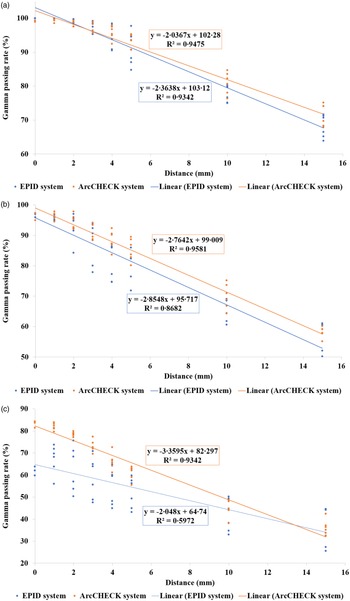
The gradient of the EPID and ArcCHECK systems for the gamma criteria of 3%/3 mm was −2·3638 and −2·0367, respectively (Figure 5a). EPID had a higher gradient than the ArcCHECK, indicating the sensitivity of the EPID system was higher compared to that of the ArcCHECK system in the gamma criteria of 3%/3 mm. The results at the misalignment distances of 1 mm, 2 mm and 3 mm showed that the gamma passing rates were within the 95% action level for the EPID system. Furthermore, the misalignment distance beyond the 4-mm distance detected the passing rate below the 95% action level by the EPID system (94·83% ± 3·63%). Meanwhile, for the ArcCHECK system, the results at the distance of 1 mm, 2 mm, 3 mm and 4 mm misalignment were within the 95% passing rate. The misalignment distance beyond 5 mm was detected below the 95% action-level threshold by the ArcCHECK system (93·05% ± 1·99%).
GI passing rate for the gamma criteria of (a) 3%/3 mm, (b) 2%/2 mm and (c) 1%/1 mm by using the EPID and ArcCHECK systems for the misalignment at 1 mm, 2 mm, 3 mm, 4 mm, 5 mm, 10 mm and 15 mm.

Using the gamma criteria 2%/2 mm, the gradient of the EPID and ArcCHECK systems was −2·8548 and −2·7642, respectively (Figure 5b). Likewise, the higher gradient of the EPID system revealed that its sensitivity was higher than that of the ArcCHECK system. For the 2%/2 mm gamma criteria, the distance beyond the 3 mm detected below the 90% action level for the EPID system (87·12% ± 6·65%). Meanwhile, for the ArcCHECK system, it was beyond the 4-mm distance with a mean gamma passing rate of 88·45% ± 3·13%.
The gradient of the EPID using 1%/1 mm was −2·048, while that of the ArcCHECK was −3·3595 (Figure 5c). Given the lower gradient of the EPID system compared to that of the ArcCHECK system, the EPID had a lower sensitivity than the ArcCHECK. The ArcCHECK system had better detection of error when the gamma criterion of 1%/1 mm was applied. When the 80% gamma passing rate acted as the action level, none of the misalignment could be detected below the action level by using the EPID because the gamma passing rate at the reference position was 61·80% ± 2·01%. However, the result at the distance of 1 mm by using the ArcCHECK phantom was within the action level. The misalignment distance beyond 2 mm was detected below the 80% action-level threshold by the ArcCHECK system (78·57% ± 0·96%).
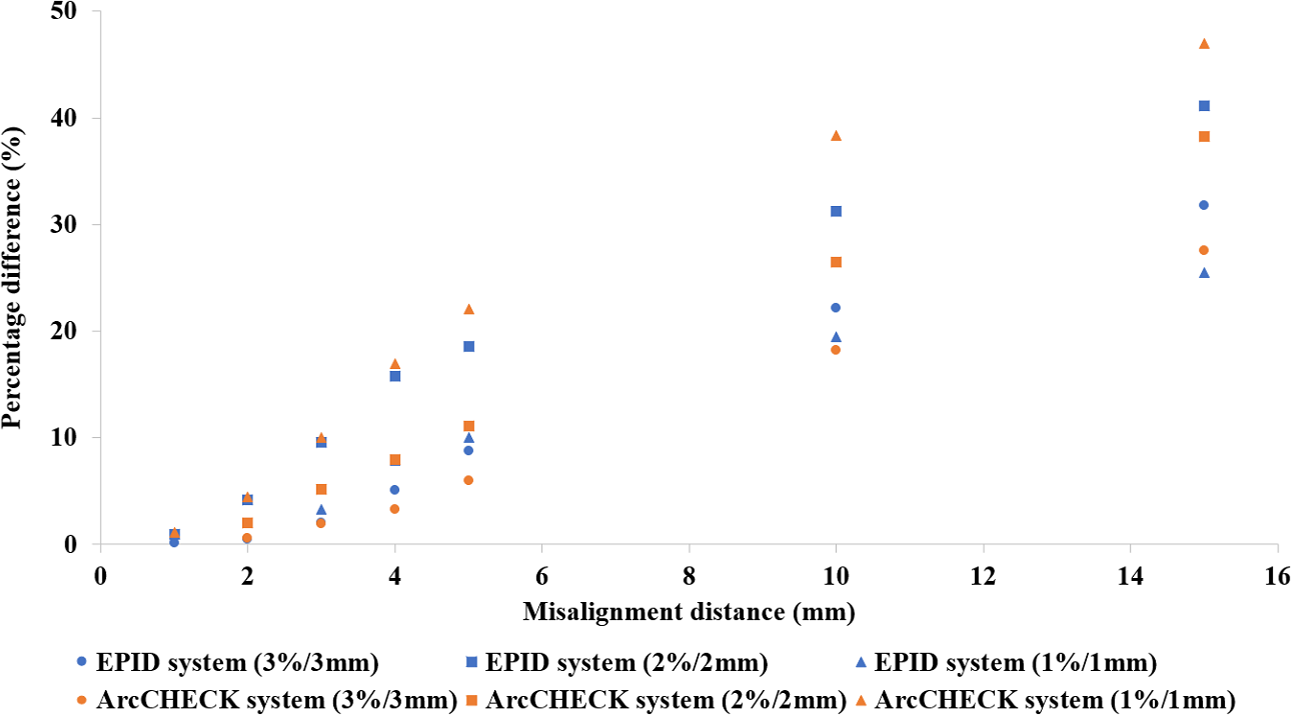
The gamma passing rate between the reference position and the misalignment distance (1 mm, 2 mm, 3 mm, 4 mm, 5 mm, 10 mm and 15 mm) was compared for the gamma criteria of 3%/3 mm, 2%/2 mm and 1%/1 mm, respectively, as shown in Figure 6. The larger the magnitude of the misalignment implemented to the detector system, the larger the difference to the gamma passing rate of the reference position.
The percentage difference of the gamma passing rate of the misalignment from the reference position with the gamma criteria of 3%/3 mm, 2%/2 mm and 1%/1 mm.

In the EPID system, the gamma criteria of 2%/2 mm showed the largest deviation (41·14%) of the gamma passing rate compared to gamma criteria of 3%/3 mm (25·45%) and 1%/1 mm (31·78%), when all the misalignment distances were implemented from the reference position. The gamma criteria of 3%/3 mm had a smaller deviation in the gamma passing rate from the reference position than the gamma criteria of 1%/1 mm when the distances of misalignment were less than 5 mm. Meanwhile, the deviation of the gamma passing rate for the gamma criteria of 3%/3 mm was larger than the gamma criteria of 1%/1 mm at misalignment distances beyond 10 mm and 15 mm.
Discussion
In this study, there was no significant difference between the gamma passing rate of the EPID and the ArcCHECK systems when the gamma criteria of 3%/3 mm and 2%/2 mm were applied at the reference position. Both EPID and ArcCHECK systems showed an excellent agreement to the calculated dose from the TPS for the gamma criteria of 3%/3 mm (>90%) and 2%/2 mm (>95%), respectively. For the gamma criteria of 1%/1 mm, the EPID system had a lower agreement to the TPS compared to the ArcCHECK system. This was because the PSQA measurement of EPID in gamma criteria of 1%/1 mm was more susceptible to set-up uncertainty, statistical fluctuation, and systematic errors compared to the ArcCHECK system. Reference Kim, Park and Kim9 For the EPID system, the standard deviation in the gamma criteria of 1%/1 mm (2·01%) was higher than the gamma criteria of 3%/3 mm (0%) and 2%/2 mm (0·68%). Meanwhile, for the ArcCHECK system, the SD in the gamma criteria of 1%/1 mm (1·53%) was also higher than the gamma criteria of 3%/3 mm (0·23%) and 2%/2 mm (1·27%). This indicated that the measured gamma passing rate in the gamma criteria of 1%/1 mm was less consistent than the gamma criteria of 3%/3 mm and 2%/2 mm.
The larger the distance of the misalignment error, the larger the deviation of the gamma passing rate from the reference position. Similarly, the larger the shift of the EPID and the ArcCHECK phantom, the larger the shift of the fluence detected by the EPID and ArcCHECK phantom. Hence, more of the evaluated dose point exceeds the DD and DTA criteria away from the reference dose point and forms the gamma failing point. Reference Templeton, Chu and Turian16
In this study, the EPID system showed higher sensitivity than the ArcCHECK system in detecting misalignment errors in the gamma criteria of 3%/3 mm and 2%/2 mm. This indicated that the EPID system detects smaller misalignment error (>3 mm) with the gamma passing rate below the action level than the ArcCHECK system (>4 mm) in the gamma criteria of 3%/3 mm and 2%/2 mm. The EPID system also showed a lower gamma passing rate than the ArcCHECK system when the same misalignment was applied in the gamma criteria of 3%/3 mm and 2%/2 mm. In contrast, the EPID system had a lower sensitivity than the ArcCHECK system in detecting the misalignment errors with gamma criteria 1%/1 mm. When the misalignment position occurred during the PSQA, the EPID system had a smaller deviation in the gamma passing rate from the reference position compared to the ArcCHECK system in the gamma criteria of 1%/1 mm.
EPID system had the largest deviation (41·14%) of the gamma passing rate from the reference position in the gamma criteria of 2%/2 mm compared to gamma criteria of 3%/3 mm and 1%/1 mm. This indicated the EPID system had the highest sensitivity to the misalignment error in the gamma criteria of 2%/2 mm compared to the gamma criteria of 3%/3 mm and 1%/1 mm.
Several reasons were responsible for the difference in the sensitivity between the EPID and ArcCHECK systems. One of the reasons was due to the geometry difference between the EPID and ArcCHECK systems as the layouts of the detectors between both systems were different. Reference Maraghechi, Davis and Mitchell15 The detectors of the EPID were arranged on a flat panel while that of the ArcCHECK system were arranged on the cylindrical surface. Reference Hussein, Rowshanfarzad, Ebert, Nisbet and Clark17 Therefore, the section of the dose distribution measured by the EPID system differed from the ArcCHECK system. Reference Li, Bai and Chen18 The second reason was the different types of dosimetric verification performed by using EPID and ArcCHECK systems. The EPID system results in 2D gamma analysis, whereas the ArcCHECK system performed 3D gamma analysis. The gamma parameters, such as DD and DTA, were defined differently by both systems. For example, the DTA of the EPID system was defined as the distance between each 2D portal dosimetry plane, whereas the DTA for the ArcCHECK phantom was defined as the search range on the 2D unfolded surface of the phantom. These events might cause a different impact on the gamma passing rate when the errors were applied. Reference Liang, Liu, Zhou, Yin and Wu19
The EPID systems can be efficiently used as a PSQA tool for the NPC VMAT with the gamma criteria of 3%/3 mm and 2%/2 mm because the gamma passing rate of the EPID had good agreement with the ArcCHECK system. Furthermore, the EPID had a higher sensitivity than the ArcCHECK system with the gamma criteria of 3%/3 mm and 2%/2 mm. The best gamma criteria used to perform the PSQA of VMAT was 2%/2 mm because it had the highest sensitivity to the misalignment error compared to the gamma criteria of 3%/3 mm and 1%/1 mm. Meanwhile, the gamma criteria of 1%/1 mm were not suitable to be used in performing the PSQA with the EPID system, which was less consistent compared to the gamma criteria of 3%/3 mm and 2%/2 mm.
Conclusion
The EPID system is suitable to be a PSQA tool for the NPC VMAT plan using the gamma criteria of 3%/3 mm and 2%/2 mm, since the EPID showed a similar agreement with the ArcCHECK system with comparable calculated dose from the TPS. Furthermore, the EPID system had the highest sensitivity in the gamma criteria of 2%/2 mm compared to 3%/3 mm and 1%/1 mm. Thus, the EPID was efficient to be used as a PSQA tool for the VMAT planning technique for NPC treatment delivery with 3%/3 mm and 2%/2 mm gamma criteria but inefficient to be used with 1%/1 mm gamma criteria.
Acknowledgements
We would like to thank the staff of the School of Health Sciences and Hospital Universiti Sains Malaysia for their support and provision of equipment used in his study. This work was also supported by the Universiti Sains Malaysia [304/PPSK/6315497].
Financial support
This work was supported by the Universiti Sains Malaysia [304/PPSK/6315497].
Conflict of interest
No potential conflict of interest was reported by the authors.