INTRODUCTION
The spinetail devilray Mobula japanica (Müller & Henle, Reference Müller and Henle1841) (Rajaformes: Myliobatidae) is a pelagic species that is believed to have a circumglobal distribution in tropical and warm temperate waters of the Atlantic, Pacific and Indian Oceans (Last & Stevens, Reference Last and Stevens2009). Confirmed sightings over this range are limited, resulting in many parts of the presumed range yet to be confirmed. In Australia, previous records of this species are restricted to the east coast, where there have been relatively few (N = 13) confirmed sightings (Townsend & Kyne, Reference Townsend and Kyne2010). Sightings in eastern Australia have been within the latitudinal range of 14–33°S.
This paper records the first confirmed sighting of M. japanica in the western waters of Australia. The appearance of this fish along the southern coast of Western Australia in March 2013 followed a period of pronounced physical changes in local marine waters, including unprecedented warming of shelf waters and changes in the strength and seasonality of prevailing ocean currents. Continental shelf waters around south-western Australia are strongly influenced by the tropical Leeuwin Current, which flows southward along the west coast throughout the year. In autumn/winter (April–August), the current typically strengthens and extends southwards along the full length of the west coast and then eastwards along the south coast (Smith et al., Reference Smith, Huyer, Godfrey and Church1991). During these months, the Leeuwin Current transports warmer water and various pelagic species to the more temperate region of the south coast (Maxwell & Cresswell, Reference Maxwell and Cresswell1981; Caputi et al., Reference Caputi, Fletcher, Pearce and Chubb1996; Gopurenko et al., Reference Gopurenko, Hughes and Bellchambers2003; Smith et al., Reference Smith, Hammond and Close2010). The annual transport of the current varies according to substantial interannual variations in current velocity. The Leeuwin Current is typically stronger during a La Niña period and weaker under El Niño conditions (Feng et al., Reference Feng, Meyers, Pearce and Wijffels2003).
For the past three years (2011–2013), the Leeuwin Current velocity has been high and, unusually, the onset of high flow commenced during summer rather than autumn, and then continued through until winter. As a consequence of high levels of heat advection by the Leeuwin Current and air–sea heat flux, ocean temperatures around south-western Australia reached record high levels during the ‘heat wave’ conditions of 2011 (Feng et al., Reference Feng, McPhaden, Xie and Hafner2013; Pearce & Feng, Reference Pearce and Feng2013), and surface temperatures along the south coast were also anomalously high in the summers of 2012 and 2013. These marine ‘heat wave’ events occurred against a background of gradual, long-term ocean warming in this region over the several decades (Pearce & Feng, Reference Pearce and Feng2007). Numerous range extensions involving tropical and subtropical species shifting to higher latitudes have been reported in this region, particularly since 2011 (Pearce et al., Reference Pearce, Lenanton, Jackson, Moore, Feng and Gaughan2011; Wernberg et al., Reference Wernberg, Smale, Tuya, Thomsen, Langlois, de Bettignies, Bennett and Rousseaux2013; Caputi et al., Reference Caputi, Jackson and Pearce2014; www.redmap.org.au). The M. japanica observed in 2013 is an addition to this suite of range extensions.
MATERIALS AND METHODS
Oceanographic data
Regional ocean temperatures since 1982 were available from satellite-derived monthly mean sea surface temperature (SST) for the 1-degree latitude × 1-degree longitude block containing Cheynes Beach (i.e. 34–35°S and 118–119°E) (Reynolds & Smith, Reference Reynolds and Smith1994). Average summer SSTs were calculated by averaging over the three months December to February, and SST anomalies were derived by subtracting the long-term mean annual cycle for 1982 to 2008 (to avoid bias from the unusually high temperatures of 2009, 2012 and 2013).
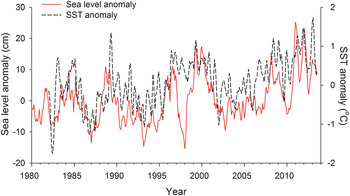
Monthly mean sea level at Fremantle (near Perth, Figure 1) was used as an index of the strength of the Leeuwin Current, as there is a strong linear relationship between Leeuwin Current volume transport and sea level deviation at Fremantle (Feng et al., Reference Feng, Meyers, Pearce and Wijffels2003). Monthly sea levels were obtained from the University of Hawaii Sea Level Center (website ftp://ilikai.soest.hawaii.edu/woce/m175.dat, accessed November 2013). Monthly sea level anomalies were derived by subtracting the long-term mean annual cycle and removing the long-term rising trend, and a three month moving average filter was applied to reduce small-scale variability (as in Pearce & Feng, Reference Pearce and Feng2013).
Map of southern Western Australia. Arrow indicates location of Cheynes Beach, where Mobula japanica was found.

Environmental conditions
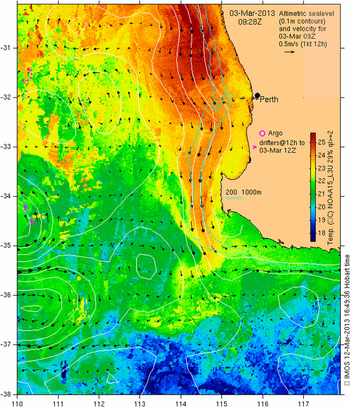
The average SST off Cheynes Beach in February 2013 (the month immediately prior to the M. japanica sighting) was 22.0°C which was almost 2°C above the long-term average for that month. This was the highest summer temperature ever recorded at this location and followed the second highest summer temperature recorded in 2011/2012. These unprecedented high temperatures occurred during relatively strong summer-time flow by the Leeuwin Current, indicated by a high sea level anomaly (Figure 2). 2012/2013 was the third in a succession of years with abnormally high summer flow, including the strongest recorded Leeuwin Current in early 2011 (Pearce & Feng, Reference Pearce and Feng2013). Two weeks before the M. japanica sighting, satellite altimetry indicated that the Leeuwin Current was flowing strongly southwards along the continental shelf off the west coast, then pivoting at Cape Leeuwin and flowing eastwards past Cheynes Beach (Figure 3). In addition to the warm water being transported by the Leeuwin Current, it is also likely that there was strong heat flux into the coastal ocean at this time, as occurred off the west coast during the 2010/2011 ‘heat wave’ event (Pearce & Feng, Reference Pearce and Feng2013).
Monthly values of the detrended Fremantle sea level anomaly and the sea surface temperature (SST) anomaly for the 1 × 1 degree ocean block off Albany from 1982 to mid-2013. All values have been smoothed by a 3-point moving average to reduce small-scale variability.

Satellite-derived sea surface temperature (SST) on 3 March 2013, with overlaid sea level contours (white) and surface current vectors (black arrows) derived from satellite altimetry (http://oceancurrent.imos.org.au/CLeeu/2013030309.html), courtesy CSIRO. The Leeuwin Current is evident as the band of warm (red/orange) water flowing southwards down the edge of the continental shelf then cooling as it continues eastward along the south coast (note: SST scale on the right).

Fish identification
On 13 March 2013, a single spinetail devilray (Mobula japanica) was observed at Cheynes Beach (latitude 34.8811°S, longitude 118.4079°E), near Albany on the southern coast of Western Australia (Figure 1). Disc width and length were measured, the fish was photographed and a muscle tissue sample was extracted and preserved in 95% ethanol.
There are currently nine recognized species of Mobula (Notarbartolo-di-Sciara, Reference Notarbartolo-di-Sciara1988; Couturier et al., Reference Couturier, Marshall, Jaine, Kashiwagi, Pierce, Townsend, Weeks, Bennett and Richardson2012). The fish observed at Cheynes Beach was identified as M. japanica from descriptions in Notarbartolo-di-Sciara (Reference Notarbartolo-di-Sciara1988) and Last & Stevens (Reference Last and Stevens2009). Key characters which distinguished it from other Mobula species included: white tip on dorsal fin; single dorsal spine; very long tail (longer than disc length); and straight edge to anterior disc margin (contrasting with M. thurstoni which has a curved edge). Mobula japanica is externally similar to M. mobular. However, the latter species is believed to be restricted to the Mediterranean Sea and eastern Atlantic (Couturier et al., Reference Couturier, Marshall, Jaine, Kashiwagi, Pierce, Townsend, Weeks, Bennett and Richardson2012).
DNA barcoding was also used to confirm the identification of the fish. DNA was extracted from approximately 5 mm3 of muscle tissue using the FavorPrep™ Tissue Genomic DNA Extraction Mini Kit according to the manufacturer's instructions (Favorgen). DNA was eluted in a final volume of 100 µl of elution buffer. PCR was conducted using 1 µl template DNA in a final reaction volume of 25 µl which contained 2.5 µl 10 × DNA PCR buffer (Fisher Biotech), 1 U Taq DNA Polymerase (Fisher Biotech), 2.5 µl 25 mM MgCl2, 1.25 µl dNTPs (1 mM each) and 1 µl each primer (2.5 µM stock). Primers used for amplification were those previously reported for use in barcoding of fish as follows: FOR 5′ TCA ACC AAC CAC AAA GAC ATT GGC AC 3′ and REV 5′ TAG ACT TCT GGG TGG CCA AAG AAT CA 3′ (Ward et al., Reference Ward, Zemlak, Innes, Last and Hebert2005). PCR was conducted on an Applied Biosystems Thermal Cycler 2720 programmed to conduct the following cycling regime: 94°C 1 min (× 1); 94°C 40s, 45 °C 40s, 72°C 1 min (× 5); 94°C 40s, 51°C 40s, 72°C 1 min (× 35). Products were visualized under UV light following electrophoresis and staining with ethidium bromide.
Polymerase chain reaction products were sent for commercial sequencing (AGRF Perth) which was conducted in forward and reverse orientations using the same primers used for original PCR. Forward and reverse sequences were aligned using the program Sequencher 4.8 (Gene Codes) to generate a consensus CO1 sequence for each of the duplicate specimens analysed. The final consensus sequences representing 655 bp of the CO1 gene were used to interrogate the Barcode of Life database (http://www.boldsystems.org).
RESULTS
The fish was first observed at Cheynes Beach by commercial fishers on 11 March 2013. The fish was reported to be swimming in shallow water near the beach ‘in an orange plankton bloom’. The composition of this plankton bloom was not investigated and so its significance is unclear. On 12 March 2013, the fish reportedly exhibited signs of stress, then became stranded and died during the evening. Sea and weather conditions were calm over this period and so rough seas were unlikely to have contributed to the stranding. The fish was examined by researchers on 13 March 2013. It had no external signs of injury. The fish was identified as a male Mobula japanica with a disc width (DW) of 257 cm.
Interrogation of the Barcode of Life Database identified the species as Mobula japanica with 100% probability of placement to the species level. Hits were generated with 16 independently sequenced and museum vouchered specimens (e.g. GenBank Accession number KC175452) at 100% nucleotide similarity and provided an unequivocal DNA-based identification.
Several days after the initial sighting, a further nine individuals of the same species were reportedly found dead on an adjacent beach approximately 2 km from Cheynes Beach. The identification of these fish as M. japanica was not confirmed by the authors of this paper.
DISCUSSION
Mobula japanica attains maturity at 205–215 cm DW and reaches a maximum size of at least 310 cm DW (Notarbartolo-di-Sciara, Reference Notarbartolo-di-Sciara1988; White et al., Reference White, Giles, Dharmadi and Potter2006). The 257 cm M. japanica observed at Cheynes Beach was therefore a mature male. A preliminary size–age relationship (yet to be validated) was recently developed for this species, which suggests maturity occurs at age 5–6 years, and longevity is >14 y (Cuevas-Zimbrón et al., Reference Cuevas-Zimbrón, Sosa-Nishizaki, Pérez-Jiménez and O'Sullivan2013). Based on this relationship, the M. japanica at Cheynes Beach was estimated to be >10 y old.
This is the first record of M. japanica in western Australian waters. It is also the southernmost record of this species in Australian waters. The nearest known population of M. japanica to Western Australia is located in Indonesia (White et al., Reference White, Giles, Dharmadi and Potter2006). If the individual found in Western Australia originated in Indonesia and travelled southwards along the Western Australian coastline, it would have moved a distance of at least 3000 km. This is possible, given that individuals of this species are known to undertake long distance movements, e.g. >1000 km in 2–3 months (Croll et al., Reference Croll, Newton, Weng, Galván-Magaña, O'Sullivan and Dewar2012). However, although capable of a long distance migration, it is likely that any southwards movement along the west coast by the fish found at Cheynes Beach was assisted by the southwards flow of the tropical Leeuwin Current. Atypically strong current flows in 2011, 2012 and in early 2013, provided opportunities for this fish to travel southwards.
Mobula japanica is typically associated with warm (>20°C) surface waters (Croll et al., Reference Croll, Newton, Weng, Galván-Magaña, O'Sullivan and Dewar2012). Along the west coast of Australia, surface temperatures generally remain above 20°C throughout the year southwards to approximately 29°S. Further south, favourable temperatures for M. japanica normally exist only during the summer and autumn months (the period diminishing with latitude), and along the south coast the environment would be marginal as the monthly mean SST only approaches 20°C in February/March. However, inter-annual variations in water temperatures (related to fluctuations in the strength of the Leeuwin Current and in changing air–sea heat flux) can lead to elevated water temperatures along the south coast temporarily suitable for M. japanica (Feng et al., Reference Feng, McPhaden, Xie and Hafner2013; Pearce & Feng, Reference Pearce and Feng2013). For example, at the peak of a marine ‘heat wave’ event in February/March 2011, nearshore temperatures exceeded 20°C along the south coast to beyond Esperance (Pearce & Feng, Reference Pearce and Feng2013).
In February/March 2013, the flow of the Leeuwin Current was relatively strong and well above average for that time of year. With alongshore surface currents exceeding 0.5 m/s at this time, the M. japanica found at Cheynes Beach could have rapidly travelled from the west coast to the south coast. Sea surface temperatures of 20–22°C would then have provided favourable thermal conditions during this journey.
Elsewhere M. japanica is known to make seasonal incursions into higher latitudes, associated with warm water currents. For example, the distribution of M. japanica off northern New Zealand extends southwards to at least 38°S latitude during summer, following the seasonal flow of the warm East Auckland Current (Duffy & Abbot, Reference Duffy and Abbot2003). Typical surface temperatures at this current's northern reaches are 20–22°C in summer.
Little is known about the migratory habits of M. japanica. Limited observations suggest that individuals undertake large scale seasonal movements, within a preferred temperature range of 20–30°C, seeking zones of high productivity where their primary prey (zooplankton) can be found (Notarbartolo-di-Sciara Reference Notarbartolo-di-Sciara1988; Croll et al., Reference Croll, Newton, Weng, Galván-Magaña, O'Sullivan and Dewar2012). Mobula japanica feeds primarily on euphausids (Notarbartolo-di-Sciara, Reference Notarbartolo-di-Sciara1988). Despite an apparently suitable thermal environment along the west coast of Australia southwards to at least 29°C, the lack of previous sightings of M. japanica suggests that incursions into this region have been rare (or absent) to date. A lack of zooplankton prey, due to the low productivity of western Australian waters, offers an explanation for the low abundance of M. japanica (Pearce et al., Reference Pearce, Helleren and Marinelli2000; Koslow et al., Reference Koslow, Pesant, Feng, Pearce, Fearns, Moore, Matear and Waite2008; Molony et al., Reference Molony, Newman, Joll, Lenanton and Wise2011).
The first observation of M. japanica along the south-western coast of Australia recorded here is part of a suite of southward range extensions by tropical and subtropical species recently reported from this region (Pearce et al., Reference Pearce, Lenanton, Jackson, Moore, Feng and Gaughan2011; Wernberg et al., Reference Wernberg, Smale, Tuya, Thomsen, Langlois, de Bettignies, Bennett and Rousseaux2013; Caputi et al., Reference Caputi, Jackson and Pearce2014; www.redmap.org.au). These extensions have followed some pronounced environmental changes in marine waters around south-western Australia over recent years, including a strengthening of the Leeuwin Current and an increase in ocean temperatures. If these environmental trends continue, additional seasonal sightings of M. japanica in this region may occur.
ACKNOWLEDGEMENTS
Thanks to Peter Kyne for assisting with fish identification and confirming this as a first sighting in Western Australia. Reynolds SST data were kindly provided by Ken Suber (CSIRO Marine and Atmospheric Research, Hobart), and the satellite image in Figure 3 was created by the Integrated Marine Observing System (IMOS). Thanks to Mike Snow for assistance with the DNA analysis. Thanks to three anonymous referees for their contributions to this paper.