INTRODUCTION
One of the more significant ways in which the complex relationship between religion and American politics has played out, both at the elite and mass levels, has been through collective action (Conger Reference Conger2009; Djupe and Lewis Reference Djupe and Lewis2015; Guth et al. Reference Guth, Kellstedt, Smidt and Green1993a; Reference Guth, Smidt, Kellstedt and Green1993b; Hertzke Reference Hertzke1988; Reference Hertzke2006; Hofrenning Reference Hofrenning2002; Morris Reference Morris1984). Organized political activity by religious people often manifests itself, as it does in the secular world, through social movements and the interest groups that double as SMOs on the ground. For at least a half-century (Hunter Reference Hunter1991; many historians would say much longer, e.g., Porterfield Reference Porterfield2012), progressive and conservative interfaith coalitions — the “religious left” and “religious right” — have been the principal religious antagonists exercising (varying levels of) political clout in the United States.
The by-now entrenched nature of these two broad religio-political movements speaks clearly to the declining political (and sociological) relevance of denominationalism, a hallmark of religious change in the United States since the mid-20th century (Wuthnow Reference Wuthnow1988; Reference Wuthnow1993). Americans for whom faith-based priorities are highly politically salient increasingly have been drawn to working in coalition with others who share their views on secular issues, often without regard for theological differences. Thus on the right, for example, we have seen conservative Catholics working side-by-side with evangelical Protestants and Mormons in opposition to same-sex marriage (Campbell, Green, and Monson Reference Campbell, Green and Monson2014; Fleischmann and Moyer Reference Fleischmann and Moyer2009), while on the left coalitions of white mainline Protestants, Jews, and African-American Protestants join in demanding social justice (Findlay Reference Findlay1993).
For at least two decades (the 1980s and 1990s), the religious right had the clear upper hand over the religious left, which itself had been the dominant religious voice in American politics for much of the earlier 20th century (Putnam and Campbell Reference Putnam and Campbell2010; Wuthnow Reference Wuthnow1988). The religious right's sustained political influence was a direct result of a high level of commitment among its activists to a relatively narrow — and thus effective — agenda (Wilcox and Robinson Reference Wilcox and Robinson2010). In recent years, some observers have suggested that the religious left might be ready to resurge in light of various demographic, political, and cultural changes since the turn of the century (e.g., Dionne Reference Dionne2009; Jones et al. Reference Jones, Cox, Navarro-Rivera, Dionne and Galston2013; Sullivan Reference Sullivan2008). Whether such resurgence is a viable possibility, however, is an open question. Olson (Reference Olson2011) has argued that the religious left is best characterized as a diverse, loosely knit web of religious people who do not just tolerate, but celebrate, differences in opinion, and a range of scholars has hedged on its potential for political success (see also Alpert Reference Alpert2000; Kellstedt et al. Reference Kellstedt, Smidt, Green, Guth and Campbell2007; Olson Reference Olson and Matthew2007).
In this article, I compare progressive and conservative religio-political activists' commitment to their movements (the religious left and right, respectively). As social psychological work on social movements contends, successful movements tend to be those in which activists demonstrate high levels of unity and commitment to the cause (Cohen Reference Cohen1985; Gamson Reference Gamson, Morris and Mueller1992; Hunt and Benford Reference Hunt, Benford, Snow, Soule and Kreisi2004). Two concepts from this literature are especially relevant to my enterprise. Collective identity refers to “how individuals' sense of who they are becomes engaged with a definition shared by co-participants in some effort at social change” (Gamson Reference Gamson, Morris and Mueller1992, 55; the notion of “group consciousness” is relevant here as well: Miller et al. Reference Miller, Gurin, Gurin and Malanchuk1981). Movement solidarity concerns “how individuals develop and maintain loyalty to … groups or organizations [that] act as carriers of social movements” (Gamson Reference Gamson, Morris and Mueller1992, 55). If religio-political progressivism is poised to increase its political influence during the 21st century, we should expect to see evidence of collective identity and solidarity among its adherents that might outstrip that of its rival movement, the religious right.
My inquiry is guided by three empirical questions that point toward one general contention. First, do progressive and conservative religio-political activists actually say they identify with the movement with which pollsters assume them to affiliate? If a movement has substantive integrity, individuals who meet reasonable screening criteria for inclusion in a sample of that movement's activists ought to be highly likely to say that they do, in fact, identify with the movement. Such identification is one of the most basic building blocks of collective identity (Miller et al. Reference Miller, Gurin, Gurin and Malanchuk1981). Second, belief in a movement's potential for efficacy also speaks to collective identity. Thus, how influential do religious left and right activists perceive their movements to be? Third, to what extent do activists demonstrate movement solidarity, as measured by support for social movement organizations (SMOs) affiliated with their movement? This question is another way of asking about the depth and strength of individuals' identification with a movement; presumably members of the religious left and right strongly support their own SMOs. Finally, my general contention is straightforward: despite an increasingly advantageous political zeitgeist, religio-political progressivism in the United States lacks influence because its activists tend not to be unified behind strong SMOs. I cannot directly test this hypothesis with available data, but I will be able to make inferences about the viability of the hypothesis based on the empirical questions I can ask and answer.
DATA AND METHOD
The analyses that follow rely on data gathered in 2009 by the Public Religion Research Institute (PRRI). For its Conservative and Progressive Religious Activists study, PRRI undertook two separate mail surveys (using a nearly uniform instrument) of individuals they identified as religious left activists (n = 1,886) and religious right activists (n = 1,123). The data-gathering strategy began with the development of lists of core religious left and religious right SMOs. PRRI then generated random samples from membership lists of six progressive organizations and four conservative ones.Footnote 1 They augmented these samples with random samples of (1) clergy/religious professionals who made financial contributions to federal campaigns in 2008 and (2) publicly available lists of leaders of local faith-based advocacy groups.Footnote 2 I analyze each dataset separately, using parallel items from the two survey instruments to address the three questions proposed above.
First, do progressive and conservative religio-political activists say they identify with “their” movement? To answer this question, I rely on a dichotomous item in the PRRI survey instrument that asks respondents “Do you consider yourself to be part of the [progressive/conservative] religious movement?” I recognize that this item does not ask about affiliation with a religio-political movement per se, but it is couched in the context of a variety of other survey items that do ask specifically about politics.
Second, how influential, and potentially influential, do activists perceive their movement to be? PRRI asked both sets of activists how much influence they felt “religious progressive groups” and “religious conservative groups” had “on the 2008 election results.” Separately, the progressive sample was asked whether “political action by religious people can help establish justice in American society,” and the conservative sample was asked whether “political action by religious people can help restore traditional morality in America.” The first item is a measure of electoral influence, while the second is a much broader indicator of the respondent's feelings of external political efficacy with regard to their movement's most central advocacy priority. I use the latter measure as the dependent variable in multivariate analyses.
Third, to what extent does each set of activists support SMOs affiliated with their own movement — and those of the “other side?” Respondents were asked their opinions about groups typically identified with the movement to which they (supposedly) belong.Footnote 3 Progressives were asked about the American Civil Liberties Union, Bread for the World, the Human Rights Campaign, the Interfaith Alliance, the NAACP, and Sojourners. Conservatives were asked about the American Center for Law and Justice, Christian Coalition, Concerned Women for America, the Family Research Council, Focus on the Family, National Right to Life, and Prison Fellowship. Respondents on each side also were asked about one or two groups commonly identified with the other movement; progressives were asked about Focus on the Family and Prison Fellowship while conservatives were asked about Bread for the World. First, I explore activists' evaluations of each SMO descriptively; then I calculate each respondent's average evaluation of same-movement SMOs for use as the dependent variable in a multivariate analysis.Footnote 4
In each of the analyses that follow, I include several religious and political independent variables alongside a set of standard demographic controls. I chose the independent variables as the most obvious hypothetical predictors of affiliation with each of the two movements. In analyses for progressives, I include dummy variables for identification as an observantFootnote 5 mainline Protestant or observant Catholic; for conservatives, I use dummies for identification as an observant evangelical Protestant or observant Catholic. Mainline Protestants historically have been associated with the religious left, or at least not with the religious right; evangelicals have been the backbone of the religious right; Catholics have fitted themselves into both movements depending on contextual factors (Putnam and Campbell Reference Putnam and Campbell2010).Footnote 6 The political independent variables include political ideology, partisanship, and a seven-point measure of support for religio-political activism for which respondents answered the question “Some religious leaders have argued that religious people should withdraw from politics and rededicate themselves to non-political pursuits. What is your view on this matter?” The demographic controls include gender, region (with the West as the excluded group), community size, age, education, and income.
COLLECTIVE IDENTITY I: MOVEMENT IDENTIFICATION
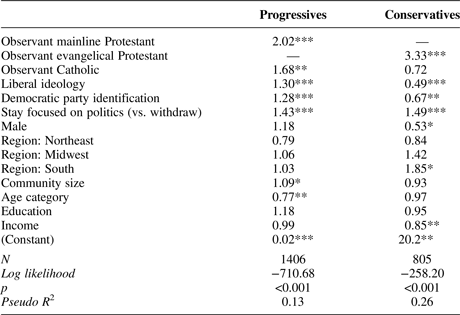
In purely descriptive terms, respondents in the religious left sample are fully 10 percentage points less likely than religious right respondents to say they identify with “their” movement: 74.1% of the religious left sample say they “consider [themselves] a part of the progressive religious movement,” as compared to 84.5% of the religious right sample who identify with “the conservative religious movement.” Separate logistic regression analyses of movement identification are presented in Table 1. The religious and political independent variables discussed above are included, as are demographic controls.
Logistic regression analysis of identification with movement

Note: Figures reported are odds ratios.
* p < .05; **p < .01; *** p < .001.
The religion variables are strong predictors in both models. Being an observant Catholic predicts identification with the religious left but with not the religious right, which supports the frequent assumption that Catholics in the aggregate lean very slightly to the left. As expected, being an observant mainline Protestant predicts religious left identification while being an observant evangelical drives religious right identification. The results for ideology and partisanship also are as expected. Meanwhile, living in a more densely populated community and being older both predict identification with the religious left, while being female, living in the South, and having a lower income all boost identification with the religious right. Above all, the fact that the model for conservatives is quite a bit better specified than the one for progressives squares with the assertion that religious progressives are difficult to characterize (Olson Reference Olson and Matthew2007; Reference Olson2011) and lends support to my underlying contention that the religious left lacks unity.
COLLECTIVE IDENTITY II: PERCEPTIONS OF MOVEMENT INFLUENCE
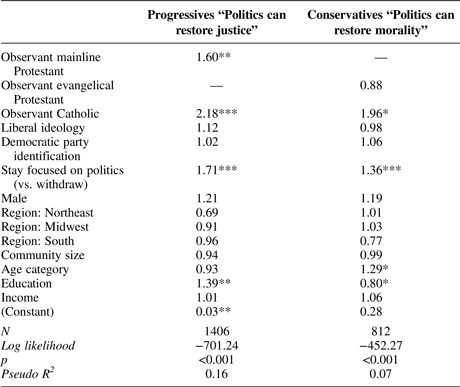
To what degree do religious left and religious right activists believe their movements are influential? Both groups of activists were asked how influential each movement was in the 2008 elections. Progressives were more than three times as likely as conservatives (10.6% versus 3.4%) to perceive their movement as having had “great influence” on the elections. This result is unsurprising considering that a Democrat, Barack Obama, was elected to the presidency and Democrats posted net gains in the U.S. Senate, House of Representatives, and governors' mansions. However, both sets of activists rated the opposite group's influence almost equally: 7.9% of progressives thought the religious right had “great influence,” while 7.6% of conservatives said the same of the religious left. The two groups also registered similar levels of belief in the potential efficacy of their movements' main advocacy priority. Among progressives, 69.6% agreed with the statement “politics can restore justice,” whereas 71.9% of the conservative sample concurred with the assertion “politics can restore morality.” Table 2 presents the results of logistic regression analyses of activists' belief in the plausibility of their movement's main advocacy priority (progressives: “politics can restore justice”; conservatives: “politics can restore morality”). I include the same independent variables and controls as in the Table 1 models.
Logistic regression analysis of attitudes about movement influence

Note: Figures reported are odds ratios.
* p < .05; ** p < .01; *** p < .001.
Table 2 indicates that many of the same factors predict externally efficacious feelings among adherents of both movements. Observant Catholics and those who prefer religious actors to “stay focused on politics” are significantly more likely to believe in the viability of their movement's cause in both models. Being an observant mainline Protestant drives efficacious attitudes in the progressive model, as does older age in the conservative model. Surprisingly, the observant evangelical dummy variable is not significant in the conservative model, but notice that this model is not especially powerful; perhaps this is a function of the fact that a large majority (71.9%) of religious left activists do believe that politics can restore morality. Neither ideology nor party identification is significant in either model. Education is significant in both models, but works in opposite directions: better-educated progressives are more efficacious, while better-educated conservatives are less so. Especially when compared with Table 1, Table 2 suggests that progressive religio-political activists do share a certain degree of collective identity revolving around belief in the viability of their cause. The roots of such identity seem to lie more in individual religious characteristics than in political orientation.
MOVEMENT SOLIDARITY: SUPPORT FOR SOCIAL MOVEMENT ORGANIZATIONS
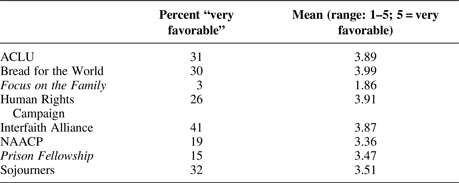
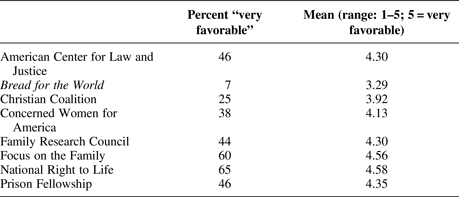
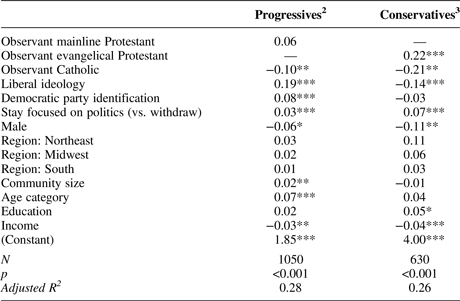
Do religio-political activists register movement solidarity through support for the SMOs most commonly identified with the religious left or right? Table 3a provides descriptive data about progressive respondents' attitudes toward various SMOs, while Table 3b does the same for conservatives' attitudes. Generally speaking, larger percentages of conservatives register support for same-movement SMOs; not one religious left SMO receives a “very favorable” rating from more than half of the progressive respondents. This result might indicate that progressive SMOs in general lack unity and strength, or at least are perceived as such. It may also be the case that because religio-politically progressive SMOs tend to focus on a broad swath of issue concerns (Olson Reference Olson2011), they have a harder time being effective (see Gamson Reference Gamson1990). Mean evaluation scores among conservatives are uniformly more positive as well. Distaste among progressives for the more prominent of the two religious right SMOs about which they were asked — Focus on the Family — is palpable, with a mean evaluation of 1.86, suggesting that the religious left might know more about what it stands against (the religious right) than what it stands for. Table 4 presents multivariate (ordinary least squares regression) analyses of average support for one's “own” SMOs conducted separately using the progressive and conservative samples. Again, independent variables and controls are the same as in the previous multivariate analyses (Tables 1 and 2).
Support for movement SMOs among progressives

Note: Opposite-movement SMOs are noted in italics.
Support for movement SMOs among conservatives

Note: Opposite-movement SMOs are noted in italics.
OLS regression analysis of average support for movement SMOs1

Notes: Figures reported are standardized regression coefficients (beta).
1 The dependent variable is a ratio of (summed ratings of SMOs) to (total SMOs rated).
2 Progressive SMOs: ACLU, Bread for the World, Human Rights Campaign, Interfaith Alliance, NAACP, Sojourners.
3 Conservative SMOs: American Center for Law and Justice, Christian Coalition, Concerned Women for America, Family Research Council, Focus on the Family, National Right to Life, Prison Fellowship.
* p < .05; ** p < .01; *** p < .001.
Several findings stand out in Table 4. Being an observant Catholic reduces support for both sets of SMOs, but as expected, being an observant evangelical increases support for religious right SMOs. Indeed, both models might offer evidence of the cross-pressures observant Catholics encounter in sorting out their political allegiances (Hussey and Layman Reference Hussey and Layman2014). Ideology is a strong predictor of support as well, working in the expected direction in each model. Party identification is highly significant in the progressive model but not the conservative model; clearly religious orientation trumps partisanship in shaping activists' support for their movement's SMOs. Notice that the values of R 2 are very similar in these two models as well, suggesting that the net hypothesized influences of religious and political orientations on movement solidarity are roughly the same for the religious left and the religious right.
DISCUSSION AND CONCLUSION
This brief comparative exploration of factors that might shape collective identity and movement solidarity among activists of the religio-political left and right shows that both movements enjoy sources of deep commitment among their activists — but also face potential challenges with regard to mobilization. Religious left activists seem less willing to be labeled as adherents of a “progressive religious movement” than their conservative counterparts are to claim affiliation with a “conservative religious movement.” Perhaps this reluctance is due to lack of clarity about what such a movement entails in comparison with the religious right. Another challenge for the religious left is that observant mainline Protestants and observant Catholics exhibit collective identity — but not movement solidarity — with the movement. Religiously progressive SMOs also might lack clarity of purpose because they focus on so many issues, which might lead even sympathetic observers to evaluate them less positively. None of the same cannot be said of evangelicals and the religious right, which is one explanation of its enduring political clout.
The underlying contention framing this inquiry was that the religious left lacks influence because of lack of unity among its activists. The empirical results do not, however, indicate that this is straightforwardly true. Mainline Protestant, Catholic, liberal respondents clearly believe in the viability of the religious left's traditional objective of promoting justice. My results suggest that a much greater challenge than fostering collective identity for the religious left is increasing favorable views of its SMOs. There may be willing activists on the ground, but without prominent national-level organizations to take advantage of the present American political zeitgeist, the religious left's prospects for future success are no brighter than they have been since roughly 1980. The religious right, on the other hand, might face a crisis with regard to its activists' belief in the efficacy of working to promote traditional values. It is important to note that these data were collected shortly after Barack Obama was first elected to the presidency, a time when activists might have been distracted by the more secular concerns of an election season. Replication might reveal somewhat different results. Nevertheless, in recent years the political climate in the United States has remained somewhat more favorable to liberals than it has to conservatives (for instance, the Affordable Care Act has been passed and upheld as constitutional, and same-sex marriage is now legal across the country). How the religious left and religious right will adapt to the opportunities and challenges presented by these circumstances will remain to be seen.