Introduction
The treatment of adult laryngotracheal stenosis represents a challenge for the surgeon. It is a relatively rare condition in which the airway is narrowed between the vocal folds and the carina. The aetiology of laryngotracheal stenosis is varied, and includes prolonged intubation, tracheostomy, neoplasm, airway trauma and idiopathic cases.Reference Pitkin, Gleeson, Browning, Burton, Clarke, Hibbert and Jones1 Laryngotracheal stenosis can be asymptomatic; however, it more frequently presents with dyspnoea, dysphonia, chronic cough, a globus sensation, or, in more severe cases, stridor and respiratory distress.
The primary aim of treatment is to establish a patent airway, whilst maintaining an adequate voice and avoiding tracheostomy if possible. Many surgical techniques have been described for the management of laryngotracheal stenosis, both open and endoscopic, each with their own advantages and disadvantages. At present, the most commonly employed therapies are balloon dilatation, laser radial incisions, intraluminal stenting, and open resection or reconstruction of the airway, with or without topical and/or injected anti-fibrotic agents.Reference Pitkin, Gleeson, Browning, Burton, Clarke, Hibbert and Jones1 However, re-stenosis rates post-intervention remain significant, ranging from 20 to 40 per cent following open procedures and from 40 to 70 per cent following endoscopic techniques.Reference Andrews, Graham, Ross, Barnhart, Ferguson and McLennan2
Radiofrequency coblation (often considered synonymous with ‘controlled ablation’) is a plasma-based technology, first utilised in orthopaedics. Its use in otolaryngology, and head and neck surgery is increasing.Reference Carney, Evans, Mirza and Psaltis3–Reference Carney, Timms, Marnane, Krishnan, Rees and Mirza7 In a direct response to surgeons' requests, a dedicated laryngeal coblation wand was introduced onto the market in 2004; the success of this wand for the treatment of laryngeal pathology has since been established.Reference Carney, Evans, Mirza and Psaltis3, Reference Gonik and Smith4 However, as yet, there has been no published data on its use for the treatment of laryngotracheal stenosis. This study aimed to review and present our experience in using coblation for the treatment of adult laryngotracheal stenosis.
Materials and methods
Study design
Ethical approval for the study design was obtained from the Southern Adelaide Clinical Human Research Ethics Committee. A retrospective case note review was performed on consecutive patients from both the public and private sector who were treated in the southern Adelaide region. All patients who underwent radiofrequency coblation for the treatment of laryngotracheal stenosis between January 2007 and December 2011 were identified from ENT databases.
Patient data
Demographic characteristics, including data related to age, gender, presenting symptoms, aetiology, the nature and extent of stenosis, clinical severity, the diagnostic imaging techniques employed, and available imaging scans were collected. Clinical records of out-patient consultations and follow up were also collated.
Surgical technique
Suspension laryngoscopy was performed under general anaesthetic with a Storz B laryngoscope (Karl Storz, Tuttlingen, Germany), which was inserted into the supraglottis, and a 4 mm rigid 0° or 30° endoscope for video monitoring. Anaesthesia was maintained using rocuronium (paralysis was reversed with sugammadex if required) and jet ventilation, with oxygen received only through the laryngoscope or via a Hunsaker Mon-Jet catheter (Medtronic-Xomed, Jacksonville, Florida, USA) placed into the trachea. Routine intravenous dexamethasone was administered at induction. The stenosis was documented with video-endoscopy.
A coblation PROcise LW Plasma Wand (Arthrocare, Austin, Texas, USA), with an ablate setting of 7 and coagulation setting of 3, was utilised with chilled saline to ablate the stenotic segment over the anterior 270° of the trachea. Caution was used posteriorly to avoid circumferential wounds or damage to the trachealis muscle. In contrast to radial incision techniques, complete ablation of stenotic soft tissue was performed down to the normal tracheal rings, including the ablation of cartilage when it protruded into the lumen anteriorly following tracheostomy. For more distal stenoses, the malleable coblation wand was straightened then re-angled nearer the rigid handle to allow the distal electrodes to reach the middle third of the trachea. In selected revision cases, controlled radial expansion balloon dilatation was then applied to the ablated segment in increasing sizes until normal radius of the airway was achieved. Mitomycin C was used as an adjunct treatment in one selected case.
Surveillance
On completion of surgery, patients were routinely admitted to the high-dependency or intensive care unit for overnight monitoring. Further intravenous dexamethasone was given frequently and supplemental oxygen was administered if required. Patients were discharged the following day, once they were deemed to be safe from airway compromise; they continued to receive proton pump inhibitor therapy as a prophylaxis.
Patients were routinely followed up in out-patient clinics at one week post-operatively by the performing surgeon. Ongoing out-patient clinic appointments were scheduled based on the clinical progress of the patient. Patients that required re-intervention were considered based on their clinical presentation. Those who required immediate intervention for clinically assessed potential urgent airway compromise proceeded directly to laryngoscopy. Otherwise, patients were investigated using pre-operative computed tomography, in an attempt to assess stenosis severity. Nevertheless, formally documented stenosis severity was based on findings at laryngoscopy, rather than those from imaging.
Study end points
Primary end points were death from airway compromise, an airway emergency requiring unplanned tracheostomy or intubation, rates and degree of re-stenosis in an airway requiring re-intervention, and resolution of presenting symptoms (stridor, reduced exercise tolerance, dyspnoea at rest) as described by the patient. The time between interventions and the aetiology of stenosis were analysed using Fisher's exact test.
Results
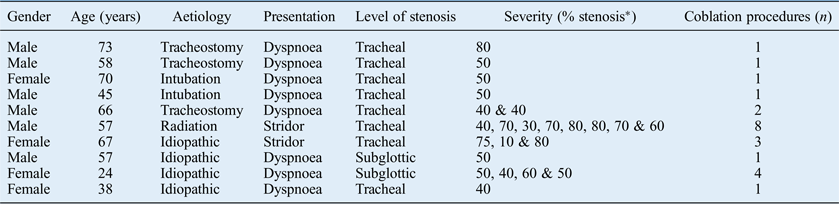
A total of 10 adult patients were identified from hospital databases and included in this retrospective review (Table I). There were 3 female patients and 7 male patients, with a mean age of 55.5 years (standard deviation (SD) = 15.6). All patients presented with a degree of dyspnoea; two presented with marked stridor. Idiopathic stenosis was the most common cause of pathology (40 per cent), followed by previous tracheostomy (30 per cent), intubation (20 per cent) and radiation therapy (10 per cent). All stenoses were less than 1 cm in length and were thus classified as McCaffrey stage I stenoses.Reference McCaffrey8
Patient presentation and intervention details

*Patents with laryngotracheal stenosis presented with severity ranging from 40 to 80 per cent. For patients that required multiple interventions, the degree of stenosis at the time of re-intervention is listed after the initial degree of stenosis.
All cases of laryngotracheal stenosis during the study period were treated primarily with coblation. Visiting specialists used balloon dilatation in selected cases as an adjunct treatment technique, but not as a primary intervention. Laser was not used for the treatment of laryngotracheal stenosis during this period.
A total of 23 surgical procedures were performed on the 10 patients, with a mean follow-up duration of 46.6 months (SD = 25.8). Mean total procedural time (including anaesthesia) was 47 minutes (SD = 21). For patients who required multiple coblation procedures, the mean time between interventions was 173 days (SD = 115).
Minor haemorrhage was occasionally encountered, but was easily managed with the coagulation pedal of the coblation system. Post-operative imaging was performed when the airway was poorly visualised or when patients developed recurrent symptoms. Repeat procedures were performed for symptomatic recurrences as required. Six patients required only a single intervention; the remaining four patients required multiple interventions (two, three, four and eight procedures). Three of these four patients also received further treatment for laryngotracheal stenosis that did not involve coblation: two patients received balloon dilatation treatment and one patient required tracheobronchial stenting and mitomycin C injection. The single case of radiation-induced stenosis required seven coblation procedures, one more with just balloon dilatation, and one with balloon dilatation with mitomycin C. This patient subsequently elected to receive a stent as he was deemed too high a risk for an open resection because of cardiovascular co-morbidities.
Using Fisher's exact test, we found no significant correlations between the anatomical site, or aetiology of stenosis, and the probability of requiring more than one intervention (p = 0.99 and 0.52 respectively). There were no complications in this study group other than re-stenosis. All patients reported resolution of their presenting symptoms following the coblation procedure. All patients were alive and symptom-free at the time of writing. None have required open reconstructive procedures.
Discussion
Laryngotracheal stenosis is a condition associated with morbidity and is surgically difficult to manage. Historically, the aetiology of most cases of acquired adult laryngotracheal stenosis has been secondary to infection and external trauma.Reference Lorenz9 However, in more recent times there has been an observed shift in aetiology, with cases now being predominantly iatrogenic in origin. Prolonged endotracheal intubation, ‘high’ tracheostomy and airway instrumentation are associated with a higher risk of laryngotracheal stenosis.Reference Lorenz9–Reference Yamamoto, Kojima, Tomiyama, Nakamura and Hayashino15 The reported incidence of tracheal stenosis following tracheostomy ranges from 0.6 to 21 per cent, compared to 6 to 21 per cent following prolonged intubation.Reference Sarper, Ayten, Eser, Ozbudak and Demircan10
Various treatment modalities have been used to manage laryngotracheal stenosis. Severe, long or recurrent stenotic segments require external surgical treatments, including tracheal resection and anastomosis or laryngotracheal reconstruction.Reference Herrington, Weber and Andersen13 For stenoses smaller than 1 cm in length with no circumferential scarring or loss of cartilaginous support, less invasive techniques have emerged as the modality of choice.Reference Sarper, Ayten, Eser, Ozbudak and Demircan10 In 1955, JathoReference Jatho16 employed elastic, hollow-groove bougies to manage laryngotracheal stenosis. In1972, Strong and JakoReference Strong and Jako17 were the first to describe endoscopic management of laryngotracheal stenosis with the carbon dioxide (CO2) laser. Since then, endoscopic techniques have subsequently evolved to include: controlled radial expansion balloon dilatation, microdebridement, cryotherapy and intraluminal stenting.Reference Herrington, Weber and Andersen13–Reference Yamamoto, Kojima, Tomiyama, Nakamura and Hayashino15 More recently, laryngotracheal stenosis has even been managed in the out-patient setting, using office-based laser surgery conducted under local anaesthetic only, with promising results.Reference Koufman, Rees, Frazier, Kilpatrick, Wright and Halum18, Reference Belafsky and Kuhn19 Yet, despite technical and surgical advances, the management of laryngotracheal stenosis remains associated with high rates of re-stenosis. The incidence of recurrence has been reported in the literature to range from 20 to 40 per cent following open procedures and from 40 to 70 per cent following endoscopic techniques.Reference Andrews, Graham, Ross, Barnhart, Ferguson and McLennan2
The mechanism of re-stenosis following treatment of laryngotracheal stenosis is thought to be related to secondary tissue damage caused by surgical intervention, which is only partially dependent on the treatment modality. This damage initiates an inflammatory cascade that ultimately leads to fibroblast proliferation and scar formation. As a means of inhibiting this cascade, injection with antifibrotic agents such as mitomycin C has been advocated as an adjunct to primary interventions, with varying degrees of success described. In 2003, LorenzReference Lorenz9 reported that the application of the antifibrinolytic increased the success rate of endoscopic laser treatment of acquired upper airway stenosis from less than 20 per cent to 75 per cent.
Balloon dilatation, pioneered by Cohen et al.,Reference Cohen, Weber and Rao20 has the advantage of maximising the radial direction of dilatation, whilst minimising damage to surrounding healthy tissues.Reference Lee and Rutter21 However, when only balloon dilatation is used to treat laryngotracheal stenosis, multiple repeat procedures and/or luminal stenting are usually required to maintain patency.Reference Andrews, Graham, Ross, Barnhart, Ferguson and McLennan2 Thus, balloon dilatation is often used in addition to incision or ablation of the stenotic segment, most commonly performed with a laser. Use of the CO2 laser combined with airway dilatations is now a popular means of treating laryngotracheal stenosis (since 1972, following Strong and Jako'sReference Strong and Jako17 experience). Radial incisions are made at the level of the stenosis; this is followed by dilatation to re-open the lumen. Yet, even this combination technique has disadvantages. Bakthavachalam and McClayReference Bakthavachalam and McClay22 reported a decline over time in the use of the CO2-laser in their own study of endoscopic treatment of subglottic stenosis. This decline was primarily a result of the effect of re-scarring and the need for repeat procedures. In addition, with lasers operating in the presence of high concentrations of inspired oxygen (used in jet ventilation) and at temperatures upwards of 400–600°C, there is a real risk of airway fire associated with laser resection.Reference Stimpson and Kotecha23 Such a complication is associated with severe morbidity and mortality.Reference Smith and Roy24–Reference Leemann, Heidegger, Grossenbacher, Schnider and Gerig26
Jet ventilation was introduced in 1970 as an alternative to traditional tracheal tube ventilation in microlaryngoscopy. It has since become the preferred method of ventilation in procedures involving the larynx or trachea.Reference Rezaie-Majd, Bigenzahn, Denk, Burian, Kornfehl and Grasl27–Reference Bourgain, Desruennes, Fischler and Ravussin29 However, this ventilation technique is associated with known complications including: hypoxaemia, hypercarbia, airway obstruction and barotrauma (pneumothorax, pneumomediastinum and surgical emphysema).Reference Bourgain, Desruennes, Fischler and Ravussin29 In the setting of airway stenosis, these risks are further increased; therefore, any technique that reduces the time required for ventilation is desirable.
Coblation represents an alternative adjuvant endoscopic technique. It is fast, safe, haemostatic and minimally invasive, with the potential to reduce recurrence because of its unique ablative properties (outlined below). Having been initially used for tonsillectomy,Reference Magdy, Elwany, el-Daly, Abdel-Hadi and Morshedy5 the use of coblation now extends to surgery of the turbinates, soft palate and tongue.Reference Kezirian, Powell, Riley and Hester6 In the larynx and trachea, the technology has also been used for the treatment of recurrent laryngotracheal papillomatosis, laryngeal cysts and malignancy.Reference Carney, Evans, Mirza and Psaltis3, Reference Gonik and Smith4, Reference Carney, Timms, Marnane, Krishnan, Rees and Mirza7
Coblation technology is based on bipolar radiofrequency, with the addition of saline applied over the electrodes. This produces a localised, high-energy plasma field, which ablates tissue into low-molecular weight gases and seals blood vessels at the same time, with minimal adjacent thermal effect.Reference Strong and Jako17, Reference Koufman, Rees, Frazier, Kilpatrick, Wright and Halum18 Coblation operates at temperatures of 40–70°C, which is considerably cooler than the above-mentioned 400–600°C for monopolar cautery and the CO2 laser.Reference Divi, Benninger, Kiupel and Dobbie30 The use of coblation thereby reduces the likelihood of collateral tissue damage, whilst also minimising or even eliminating the risk of airway fires.Reference Matt and Cottee31 Coblation has been shown to enhance the healing of long-standing cutaneous ulcers;Reference Lee, Warne, Mulder and Amiel32 this is thought to be due to an inhibition of fibroblast growth, and represents an additional benefit of the plasma field.Reference Kao, Li, Flynn, Qiao, Ruberti and Murphy33 In addition, in an unprotected airway, a rapid, haemostatic and precise resection of stenotic tissue reduces the risks of CO2 retention and barotrauma, and minimises anaesthetic morbidity and trauma associated with airway instrumentation.
In our department, coblation has been used as an alternative to the CO2 laser for a number of years for the management of laryngotracheal stenosis. It has been employed successfully in stenosis patients, even in those with relatively severe stenosis. In some cases, only a single treatment has been required (Figure 1). In recurrent cases, coblation has been used concurrently with both controlled radial expansion balloon dilatation and/or mitomycin C injection, potentially enhancing the efficacy of treatment. Whilst gaining experience with the coblation technique, we have not used the CO2 laser as a primary management technique. However, balloon dilatation has been used for mild or longer (McCaffrey grade II to IVReference McCaffrey8) stenoses.
Laryngoscopic views of the larynx in a patient who presented with stridor. (a) Shows the patient at rest (pre-coblation), with laryngotracheal stenosis severity of 80 per cent. (b) Shows the residual lumen following coblation treatment; the patient experienced immediate resolution of stridor post-operatively.
The spectrum of disease in our relatively small series was consistent with that described in the literature. To our knowledge, there is no validated, standardised measure of patient symptom severity in laryngotracheal stenosis; it is therefore difficult to directly compare severity at presentation with thresholds for re-intervention. Dyspnoea scales, utilised in chronic obstructive pulmonary disease, have been suggested as a means to quantify symptom severity in laryngotracheal stenosis.Reference Nouraei, Nouraei, Randhawa, Butler, Magill and Howard34 However, because of the retrospective nature of this study, no formal symptom scoring was applied to our patients. This could result in patient and surgeon bias, but in the absence of a validated symptom scoring measure, decision-making based on patient-reported symptoms likely reflects current clinical practice.
Overall, the rate of re-stenosis for the cohort was 40 per cent. The aetiology for the laryngotracheal stenosis was iatrogenic in four (66.7 per cent) of the remaining six patients who required only one procedure. Our group of patients, who have now been followed up for several years, did not have the high recurrence rates observed by other teams.Reference Andrews, Graham, Ross, Barnhart, Ferguson and McLennan2 This may add weight to the argument for aggressive ablative endoscopic intervention as the first-line treatment of short-segment, iatrogenic laryngotracheal stenosis, rather than moving straight to an open procedure.
• Acquired airway stenosis can be challenging to manage endoscopically because of difficult field visualisation, instrument limitations and laser airway fire potential
• The reported incidence of recurrence is 40–70 per cent following endoscopic techniques and 20–40 per cent following open procedures
• At our institution, radiofrequency coblation has been successfully used for resection of subglottic and tracheal stenosis in adults
• Efficacy is comparable to that of other contemporary techniques
• There is less risk of airway fire and local thermal tissue damage, and improved surgery time compared with conventional techniques (e.g. carbon dioxide laser)
• Coblation is an attractive adjuvant endoscopic treatment modality for management of laryngotracheal stenosis
The procedures were tolerated well by all participants, with immediate resolution of symptoms post-operatively. With an average procedural time of 48.1 minutes, we feel that coblation offers a relatively fast surgical option. In addition, it is not only cost-effective, but potentially minimises patient morbidity. However, the relatively small numbers of patients described in this study, without a comparator arm or control group, limits any further conclusions we can make. A multi-centre, randomised, controlled trial is planned, to establish if coblation is more effective than laser treatment.
Conclusion
No surgical treatment has as yet proven to be the ‘gold standard’ for the endoscopic treatment of laryngotracheal stenosis, with each technique having both advantages and disadvantages. Coblation is an attractive adjuvant endoscopic treatment modality in the management of laryngotracheal stenosis. It has a similar efficacy and safety profile to other contemporary treatment options, with the additional benefits of lower ablation temperature, excellent haemostasis, decreased collateral tissue damage, short procedural times and reduced risk of airway laser fire. However, a well-powered, multi-centre, randomised, controlled trial that compares coblation to other treatment modalities will be required before firmer conclusions can be drawn regarding the efficacy of this endoscopic technique for the management of airway stenoses. In addition, animal studies will help to establish the exact healing process that occurs following coblation treatment of laryngotracheal stenosis. Nevertheless, our experience has demonstrated that even patients with severe stenosis have the potential to be successfully cured with a single coblation intervention.