I. INTRODUCTION
Passive radar systems make use of broadcast or communication transmitters, also referred to as illuminators of opportunity (IO), in order to accomplish target detection and tracking. As a matter of fact, this system concept is of great interest to both civilian and military scenarios. This is especially due to a number of advantages in comparison with active radars including: the lack of a dedicated transmitter that potentially implies low cost, low weight, and low probability of intercept. These are combined with the great advantage of not requiring any dedicated frequency band and the benefit of an enhanced target radar cross section, thanks to the bistatic configuration. Dealing with these kinds of radar systems, the choice of the IO used as a reference signal is a key point for obtaining desired radar performance. A number of systems making use of FM radio signals [Reference Howland, Maksimiuk and Reitsma1, Reference Di Lallo, Farina, Fulcoli, Genovesi, Lalli and Mancinelli2], analog and digital television transmitters [Reference Poullin3–Reference Raout6], Global System for Mobile Communications (GSM) and Universal Mobile Telecommunications System (UMTS) signals [Reference Tan, Sun, Lu, Lesturgie and Chan7–Reference Petri, Berizzi, Martorella, Dalle Mese and Capria10] have been developed. The performance of a passive radar system mainly depends on the transmitted power and on the characteristics of the exploited IO. Since the range coverage strongly depends on the transmitted power level, high-power transmitters, such as FM radio, Digital Audio Broadcasting (DAB) radio, and analog or digital video broadcasting (DVB) television transmitters are preferred. Regarding the waveform suitability for radar purposes, the ambiguity function (AF) provides a mathematical tool for radar designers to identify resolution and ambiguities in both delay time and Doppler [Reference Howland, Maksimiuk and Reitsma1, Reference Baker, Griffiths and Papoutsis11, Reference Howland12]. It is worth noting that the AF of analog sources (e.g. FM radio or analog TV) cannot be predicted when related to a time-varying signal structure, which typically produces a content-dependent signal bandwidth. In contrast, digital waveforms exhibit an AF with a thumb-tack shape and a bandwidth that is constant in time. Furthermore, in many countries, the analog radio and TV transmissions are scheduled to be dismissed and to be replaced by digital ones. Consequently, DVB-terrestrial (DVB-T) transmitters are certainly good candidates for passive radar purposes, thanks to the high level of radiated power and the good waveform performances in terms of range and Doppler resolution. Ongoing research field into passive radar systems concerns the theoretical range resolution improvement by using multiple FM channels [Reference Olsen and Woodbridge13, Reference Bongioanni, Colone and Lombardo14] and DVB-T channels [Reference Olsen and Woodbridge13]. For example Olsen and Woodbridge [Reference Olsen and Woodbridge13] give a mathematical framework to deal with equally and not-equally spaced FM radio or DVB-T channels. In previous research [Reference Conti, Berizzi, Petri, Capria and Martorella15], two approaches to achieve high-resolution exploiting multiple adjacent DVB-T channels of the same transmitter have been presented. This paper analyzes the application of one of these techniques to real data. Moreover, preliminary detection results in an air surveillance scenario will be shown. This paper is organized as follows: in Section II a comparison between single-channel DVB-T AF and multichannel DVB-T AF is presented and analyzed. Then, in Section II.A a pre-processing technique capable of reducing the side peaks of the single- and multichannel DVB-T AF is introduced and explained. Furthermore, the acquisition system and the experimental scenario are described. Finally, real data results are presented and discussed in order to focus on the enhancement of the radar range resolution.
II. MULTICHANNEL DVB-T SIGNAL: AMBIGUITY FUNCTION ANALYSIS
A multichannel DVB-T signal can be analytically modeled as
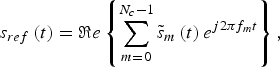
where N c is the number of channels, f m is the carrier frequency for the mth channel, and  is the complex envelope of the mth channel. Under the assumption that the N c channels are equally spaced, it is possible to write f m as f 0 + mΔf, where Δf represents the channel bandwidth. If s ref (t) is downconverted with respect to f 0, it is possible to write the complex envelope of the signal as
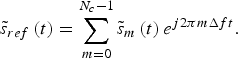
The DVB-T multichannel AF of the signal  can be written as
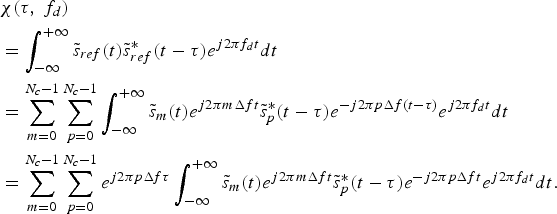
Under the following assumptions:
–
 is a bandwidth-limited signal (with bandwidth equal to 2B);
– the signal bandwidth is always smaller than the channel bandwidth, Δf ≥ 2B (i.e. the channels do not overlap);
– the Doppler frequency is negligible with respect to the signal bandwidth, f d ≪ 2B;
 is a bandwidth-limited signal (with bandwidth equal to 2B);
it is possible to rewrite equation (3) as

where AF p (τ, f d) is the AF of a single DVB-T channel. Under the realistic assumption that the auto-AF of a generic single DVB-T channel exhibits the same main characteristics, equation (4) can be simplified to

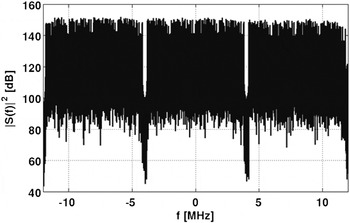
From equation (5) it can be observed that the range resolution is improved by a factor of N c with respect to the single DVB-T channel usage. Moreover, the AF relative to one channel represents the envelope of the multichannel AF. The number of channels N c and the value of Δf influence the range resolution and the sidelobe level. As a preliminary step, three adjacent DVB-T channels have been acquired through an SDR (Software Defined Radio) board, then analyzed and processed to obtain the AF of the DVB-T multichannel waveform. The central frequency is 754 MHz and the whole analyzed signal shows about 24 MHz of bandwidth (Fig. 1).
DVB-T multichannel spectrum.

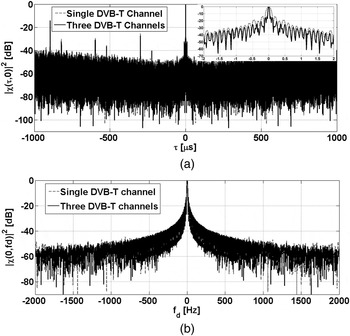
In this case, the AF has been computed and compared with the one obtained for a single DVB-T channel. Plots of the AF along time delay (range) and Doppler frequency are represented in Fig. 2. It is worth noting that the range resolution is improved by N c times with respect to the single DVB-T channel, while the Doppler profile maintained the same behavior.
Multichannel AF from real data: (a) range profile and (b) Doppler profile.

A) Pre-processing technique
The AF presents unwanted deterministic side peaks due to the known structure of the DVB-T signal, which includes pilots, guard intervals, and the guard band between adjacent channels. To reduce the unwanted side peaks on the AF, a pre-processing technique has been proposed. The method described here is an improved version of the pre-filtering approach presented in [Reference Conti, Petri, Capria, Martorella, Berizzi and Dalle Mese16]. The goal of the filter proposed here is to reduce the side peaks in the range Doppler map working on the whole Doppler frequency domain. It should be noted that the DVB-T ambiguities appear each T U/12 along the time-delay domain and each 1/4(T U + T G) along the Doppler domain, where T U is the Orthogonal frequency-division multiplexing (OFDM) symbol duration and T G is the guard interval duration [Reference Harms, Davis and Palmer17].
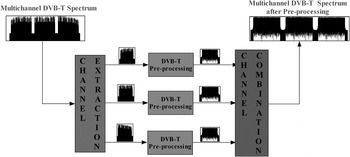
Figure 3 presents the pre-processing block scheme. A wideband receiver can be used to acquire the reference signal, and then each DVB-T channel is extracted and filtered. The pre-processing filter is based on the estimation of the power spectral density (PSD) of the DVB-T signal and of the PSD of a simulated DVB-T signal composed by random components.
DVB-T multichannel processing.

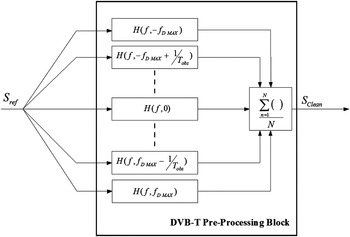
It is possible to mitigate the effect of the time-delay/Doppler ambiguities by applying a pre-processing filter composed by a filter bank as shown in Fig. 4.
Pre-processing filter bank.

Each filter has a frequency response given by
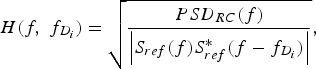
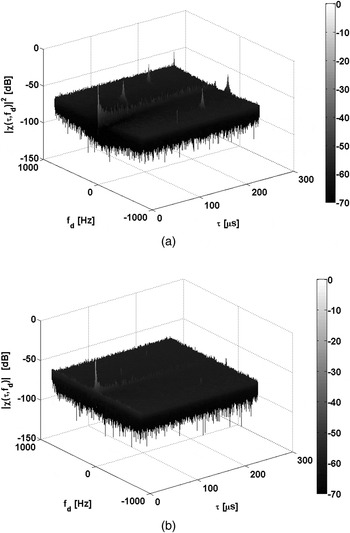
where PSD RC (f) is the PSD composed by the reference channel only, S ref (f) is the Fourier transform of the reference signal, and S ref(f − f D i) is Fourier transform of the reference signal shifted by f D i. For every channel the DVB-T signal is pre-filtered as presented in Fig. 4, and then combined in order to form a pre-processed multichannel signal with a flat spectrum (Fig. 3). In Fig. 5 AFs before and after pre-processing are shown. Figure 5(b) presents the range Doppler ambiguities strongly attenuated. To quantify this attenuation it is possible to consider the SPR index (side peaks reduction) as defined in [Reference Conti, Petri, Capria, Martorella, Berizzi and Dalle Mese16] and here briefly recalled:
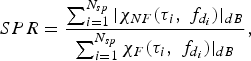
where χNF is the not filtered AF, χF is the filtered AF, N sp is the number of side peaks of the AF, and (τi, f d i) is the Doppler-delay position of the ith side peak in the Doppler-delay map. For the here-proposed multichannel pre-processing technique, the SPR value is about 25 dB.
AF 3-D views: (a) AF without pre-processing and (b) AF after pre-processing.

III. EXPERIMENTAL SET UP
The equipment that has been used in this experiment is composed of commercial off-the-shelf low-cost TV antennas, two synchronized Ettus Research USRP2 board equipped with a RF front-end tunable from 800 to 2400 MHz. The main technical specifications of the USRP2 are:
– FPGA Xilinx Spartan 3-2000 EP1C12 Q240C8 “Cyclone”;
– two high-speed analog-to-digital converters operating at 14 bits with a sampling rate of 100 mega-samples per seconds (100 MS/s);
– two high-speed digital-to-analog converters operating at 16 bit with a sampling rate of 400 MS/s;
– gigabit Ethernet interface.
The antenna used during preliminary measurements and the experiment for the target channel is a Yagi-Uda antenna with a receiving gain equal to 18 dB and a half power beam width of 20° in the horizontal plane. On the reference channel, a Yagi-Uda antenna with a gain of 15 dB has been used.
IV. EXPERIMENTAL RESULTS
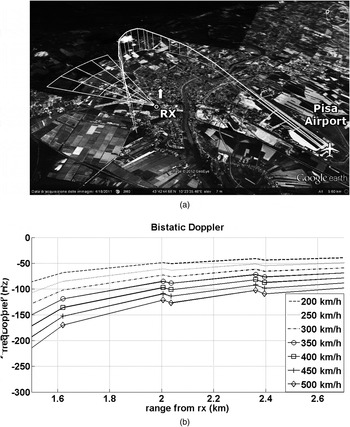
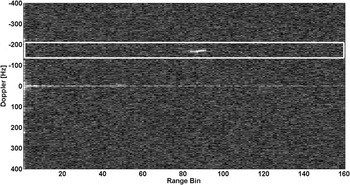
The experiment scenario geometry is shown in Fig. 6(a). Specifically, the receiver was located at the Department of Information Engineering in Pisa and the DVB-T transmitter was 14 km away from the receiver at 36° north-east as indicated by the white arrow in Fig. 6(a). Moreover, the surveillance antenna was pointed at 15° of azimuth and 30° of elevation. The targets of interest were airplanes taking off from the nearby Pisa airport. Figure 6(a) shows the trajectory of the considered target. The expected Doppler frequencies for the target in the surveillance area are shown in Fig. 6(b). The reference and surveillance channels have been simultaneously acquired with the equipment presented in Section III. Then the pre-processing technique has been applied and finally the cross-ambiguity function (CAF) relative to three adjacent DVB-T channels has been evaluated (Fig. 7). The peak due to the target echo, specifically a Boeing 737-400, is clearly visible at the 87th range bin (i.e. around 1700 m for the geometry considered in Fig. 6(a)). A Doppler frequency value of −169 Hz is in accordance with the expected velocity (more than 450 km/h).
(a) Experiment scenario geometry and target trajectory and (b) expected Doppler frequencies for a target that is moving between the two red dots of the left side figure.

CAF of the surveillance area.

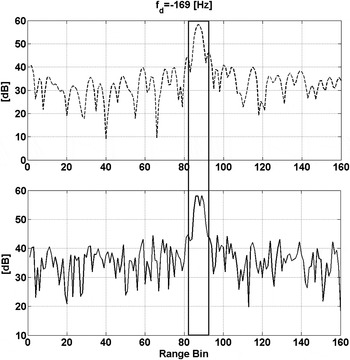
In order to better evaluate the range resolution improvement, the CAF has been calculated both for one and three DVB-T channels. Particularly, Fig. 8 presents the range profile along the Doppler frequency relative to the airplane echo (i.e. −169 Hz). Considering the geometry in Fig. 6(a), the bistatic range resolution achievable [Reference Griffiths and Baker18] by using a single channel is around 57 m, whereas exploiting three adjacent channels is around 18 m. It is worth noting by looking at the target echo peak, that the range resolution relative to three DVB-T channels (solid line) is improved with respect to the single DVB-T channel (dashed line). As a matter of fact, the blue line range profile shows only one main peak whereas two peaks are clearly visible on the red line.
Target range profile for a single DVB-T channel (blue line on the top) and for three adjacent DVB-T channels (red line on the bottom).

V. CONCLUSION
In this paper, the exploitation of multiple DVB-T channels for a passive radar system has been considered in order to improve the radar range resolution. This paper demonstrates the possibility of achieving a range resolution enhancement exploiting a multichannel DVB-T signal. The theoretical study has been supported by preliminary measurements relative to three adjacent DVB-T channels. Experimental results in aerial scenario have been carried out and discussed. Furthermore, an effective preprocessing technique for single- and multichannel DVB-T signals has been proposed and preliminarily tested on real data.
 Dario Petri received the Italian Laurea degree (M.S.) in Telecommunication Engineering in April 2007 from the University of Pisa, Italy. In March 2011 he received the Ph.D. in Remote Sensing at the University of Pisa. He is currently a CNIT researcher under contract. His major research interests are in the field of passive radar and synthetic range profile reconstruction.
 Amerigo Capria was born in Pisa, Italy in June 1977. He received the Italian Laurea degree (M.S.) in Telecommunication Engineering in March 2004 from the University of Pisa, Italy. In March 2008 he received the Ph.D. in Remote Sensing at the University of Pisa. He is currently a CNIT researcher under contract. His major research interests are in the field of OTH radar systems, passive radar, neural network applications in target classification, and synthetic range profile reconstruction.
 Michele Conti was born in Livorno, Italy in March 1983. He received the (M.Sc.) in Telecommunication Engineering in April 2009 from the University of Pisa, Italy. In January 2010, he started his Ph.D. in Remote Sensing at the University of Pisa. He is currently working on passive radar systems and Software-Defined Waveform as part of his Ph.D. work.
 Marco Martorella was born in Portoferraio (Italy) in June 1973. He received the Telecommunication Engineering Laurea (cum laude) and Ph.D. degrees from the University of Pisa (Italy) in 1999 and 2003, respectively. He is an associate professor of University of Pisa. He has co-authored about 25 journal papers and 50 conference papers. He has organized Special and Invited sessions at international conferences and workshops and organized a Special Issue on Inverse Synthetic Aperture Radar for the Journal of Applied Signal Processing (Hindawi). He received the Australia-Italy award for young researchers in 2008 and IEEE GRSL Best Reviewer in 2010. His research interests are mainly in the field of radar imaging, including passive, multistatic, and polarimetric imaging radar.
 Fabrizio Berizzi received the Electronic Engineering Laurea and Ph.D. degrees from the University of Pisa (Italy) in 1990 and 1994, respectively. He has been a Full Professor of the University of Pisa since November 2009. He teaches “Radar techniques”, “Signal Theory” at the University of Pisa”, and “Digital signal processing” at the Italian Navy Academy. He has been an IEEE Senior Member since 2006. He has been working on ISAR, SAR and radar systems since 1990. He has published more than 100 papers and three book chapters. Since 1992 Prof. Berizzi has been involved in several scientific projects as a Principal Investigator funded by University Ministry, Defence Ministry, Italian and European Space Agencies, Industries, Tuscany region, ESA (European Space Agency), European Defence Agency. Prof. Fabrizio Berizzi is currently the vice-director of the (Radar and Surveillance Systems) National Laboratory of CNIT since December 2010.
 Enzo Dalle Mese graduated in Electronic Engineering in 1968 at the University of Pisa. Now he is Full Professor of “Radar Theory” at the Faculty of Engineering of the University of Pisa. He spent time as visiting professor at Universities and research centers in different countries (Australia, China, and UK) and worked as consultant for a number of national industries in the field of radar and telecommunications. He has co-authored more than 200 scientific papers. During 1993–1995 he was the Director of the Department of Information Engineering of the University of Pisa. He is the chairman of the Ph.D. postgraduate course on “Remote Sensing” of the University of Pisa and the chairman of the Laurea course in Telecommunication at the University of Pisa. From January 2011 he is the Director of the RaSS (Radar and Surveillance Systems) National Laboratory of CNIT. He is a life member of IEEE. His major fields of interest are: radar systems, remote sensing, and radar signal processing.