Health care facility surge capacity has received significant planning attention recently, fueled by events such as the September 11, 2001 terrorist attacks, the spread of severe acute respiratory syndrome, and Hurricane Katrina, and by grants such as the US Department of Health and Human Services Hospital Preparedness Partnership funding to states.1
Despite multiple articlesReference Kaji, Koenig and Bey2–Reference Kelen and McCarthy8 and checklists 9–11 relating to hospital surge capacity, there are few good benchmarks or planning frameworks for health care facilities to use when assessing and reporting resources available to provide care for a specific surge quantity of patients. Too often, this capacity is reported as the number of beds that could be made available, which encompasses too many variables to be useful.
It is extremely difficult in the absence of consistent definitions to obtain data from hospitals regarding surge capacity that can be compared. Some hospitals consider cots placed in ancillary areas to be “surge beds” and others count only actual hospital bed locations. Some hospitals include potential discharges from usual beds; others do not. The lack of consistent definitions has led to variable data collection, making system capacity unclear. Reference Schultz and Koenig12–Reference McCarthy, Aronsky and Kelen14
There is a significant difference in a health care facility’s ability to accommodate patients on a daily basis compared with when their disaster plans are activated, regardless of how many beds are actually occupied at the time.Reference Davidson, Koenig and Cone13, Reference McCarthy, Aronsky and Kelen14 As an example, when the Interstate 35 West bridge collapsed in August 2007, Hennepin County (Minnesota) Medical Center had 3 intensive care beds available, but with activation of their disaster plan 25 beds were opened within 30 minutes and an additional 12 to 18 could have been opened.Reference Hick, Chipman and Loppnow15
This article proposes a taxonomy for surge capacity patient care that may aid hospitals in surge capacity planning and result in more consistent and reliable data for hospital, health care system, and public health planners.
SURGE CAPACITY FOUNDATIONS
Surge capacity generally refers to the ability to manage a sudden, unexpected increase in patient volume (ie, numbers of patients) that would otherwise severely challenge or exceed the present capacity of the facility. There are many definitions that have been proposed and no commonly accepted definition, meaurement, or trigger distinguishes surge capacity from daily patient care capacity.Reference Barbisch and Koenig3–Reference Kelen and McCarthy8,Reference Schultz and Koenig12,Reference McCarthy, Aronsky and Kelen14
This article examines surge capacity primarily in the context of responses within the hospital’s physical structure or on its grounds that are managed and staffed by the hospital (ie, do not rely on outside supplies or assistance). However, local and regional hospital partners in aggregate provide much greater capacity than single facilities; thus, in an area with intact infrastructure it may be appropriate to transfer patients to other facilities/regions rather than continue unconventional patient care surge strategies. Nonhospital alternate care locations are additional important factors in the hospital and community ability to create or maintain surge capacity but are not discussed.
There are 4 key interdependent factors that contribute to effective surge response: system, space, staff, and supplies. Work continues to define and refine the subcomponents of these factors and the framework of surge capacity.Reference Barbisch and Koenig3,Reference Hanfling6,Reference Kelen and McCarthy8,Reference Hick, Koenig and Barbisch10 Although each of the 4 factors is important, there is broad expert agreement that without the underlying system components the other variables cannot be appropriately managed. Some of these components include the following:
• Command—A practiced and robust incident command system 16–18 should provide overall management of the event. The incident command system is part of an overall emergency management plan,19 at the facility and the surge capacity plan is part of the all-hazards response plan.
• Control—The facility has the ability to control its infrastructure through building access controls, changes in ventilation systems/air intake, and other capabilities that allow incident command personnel to prevent an incident from expanding or at least minimize impact on the facility.
• Communication—Robust internal and external communications technologies and strategies should be in place.
• Coordination—The facility should understand its role in the overall community response to a disaster and how it integrates with the response of other health care entities and public safety agencies.Reference Burkle, Hsu and Loehr20, Reference Rubinson, Hick and Hanfling21 Coordination of hospital response with other hospitals, alternate care sites, outpatient facilities, emergency medical services, home care agencies, long-term care, assisted living, and special needs populations planners is often limited, but such integration is critical to both augment hospital capacity (eg, by supporting early discharges) as well as prevent undue strain on the hospital if one of these partners is unable to cope with incident demands, or has inadequate emergency operations plans in place. Coordination is especially important in larger incidents that affect multiple facilities and agencies.
• Continuity of operations—Planning and resources devoted to continuing hospital operations in the face of system or utility failures.
• Community infrastructure—Functioning prehospital emergency medical services systems, communications infrastructure, government institutions (eg, public health agencies, public safety agencies), and private infrastructure (supply chains, utilities, transportation assets) may have significant impact on the ability of an institution to maximize its surge capacity. Even in the absence of such infrastructure, the hospital must be prepared to continue its services to existing patients, new patients, and staff for a period of several days following an event. The specific timeline may depend on local hazard vulnerability analysis and gap analysis but expert consensus and new Joint Commission guidance recommend plans for not fewer than 96 hours of independent operation.22
The system components outlined above are not generally included in measurements used to gauge a quantifiable component (eg, bed capacity) that are often sought from health care facilities as surrogate markers for preparedness. This article attempts to define parameters for space, staff, and supplies that may result in more consistent use of terminology and more useful data collection and assumes that the facility has the above critical system components in place.
CONVENTIONAL, CONTINGENCY, AND CRISIS CAPACITY TAXONOMY
We propose that patient care space generation, staffing, and supply discussion and measurements reflect 3 strata that are subsets of overall surge capacity:
• Conventional capacity—The spaces, staff, and supplies used are consistent with daily practices within the institution. These spaces and practices are used during a major mass casualty incident that triggers activation of the facility emergency operations plan.
• Contingency capacity—The spaces, staff, and supplies used are not consistent with daily practices but maintain or have minimal impact on usual patient care practices. These spaces or practices may be used temporarily during a major mass casualty incident or on a more sustained basis during a disaster (when the demands of the incident exceed community resources).
• Crisis capacity—Adaptive spaces, staff, and supplies are not consistent with usual standards of care but provide sufficiency of care in the setting of a catastrophic disaster (ie, provide the best possible care to patients given the circumstances and resources available).
The same event can result in radically different effects on an institution depending on the size of the institution (an 8-victim motor vehicle crash may be conventional for a level 1 trauma center but a contingency or even crisis for a small rural facility), its role in the community (many pediatric victims arriving at a children’s hospital may be conventional, but could represent a contingency or crisis for a hospital that does not usually provide pediatric services), and the degree to which the infrastructure is functioning (a hospital evacuating in advance of a hurricane may be a conventional event, whereas an evacuation when the power is out may push the institution into crisis mode due to the increase in staff requirements to carry patients down stairwells, among other effects).
Finally, an incident does not have to overwhelm assets in all of the categories to result in contingency or crisis care. For example, a hospital that receives multiple critical burn patients that does not have a burn unit is already by definition in a contingency staffing situation and should be planning patient transfer to a higher level of care if possible. The existence (or anticipation) of a contingency or crisis in any of the categories should prompt facility incident management to ensure that appropriate resources are mobilized or patient transfers made to return the facility to conventional mode as soon as possible.
Space Considerations
Physical space creation in many hospitals is difficult and depends on flexibility of space because little reserve space is available. The facility should examine its entire campus to determine the resources and contributions of each area to the surge capacity plan and in what preferred sequence these spaces will be used depending on the ease and rapidity of mobilization. As hospitals remodel or expand, construction of spaces as “dual purpose” is critical; examples include placing couches in hospital rooms that can fold into daybeds for family but also for disaster patients, ensuring adequate suction and oxygen ports in private rooms to accommodate another patient, and ensuring that adequate electrical power, ventilation, and if possible oxygen is supplied to flat space areas (eg, classrooms) that may be used for congregate care.
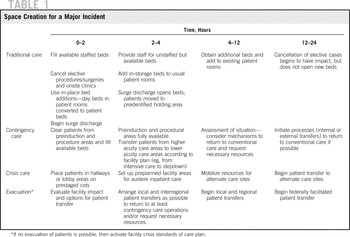
For any area that may be planned as a patient care area many considerations (ground fault interrupter outlets, emergency lighting, evacuation, fire safety planning, ventilation capacity, restroom and shower facilities, and privacy) should be addressed in the planning process to avoid unforeseen compromises when the space becomes functional. Unfortunately, most federal grant (including the Hospital Preparedness Program)1 funding typically restricts funding for new construction, but because these modifications can be relatively low cost, they often can be integrated into new projects, provided that there is early and consistent advocacy for these changes from administration and project planners. Table 1 describes the process of space creation.
Space Creation for a Major Incident

Conventional Patient Care Space
Conventional patient care spaces are standard inpatient units, and the staffing and resources are generally consistent with daily practices at the facility. Use of these areas requires minimal provider training or adjustments and should not result in a change to the usual standards of patient care. Activation of this level of capacity should not require evacuation of incident patients to other facilities unless the patient requires specialty (eg, burn) care not provided at the present facility.
Conventional capacity includes the following:
• Using all available staffed beds
• Mobilizing staff so that any unstaffed inpatient beds can be used
• Adding beds to usual patient rooms and mobilizing appropriate staff to maintain reasonable staff-to-patient ratios
• Canceling elective procedures to free up beds in intermediate or long-term timeframe (note that this action, although commonly part of hospital disaster plans, does not generate early-phase surge capacity for inpatient beds although it may create early operating room capacity)
• Using observation beds for inpatient care
• Activating surge discharge plans: Health care facilities should have a preplan (and ideally prospective categorization) for patients so that those who can safely be discharged home, to alternate care, or to skilled nursing facilities can be identified and their discharge process expedited. Plans should provide guidance for caregivers and processes for identifying patients, moving these patients to a holding area (or even to designated hall or lobby areas on a unit), and expediting pharmacy, transportation, and social work arrangements as needed to facilitate timely and safe discharge.Reference Davis, Poste and Hicks23, Reference Kelen, Kraus and McCarthy24 Liaison with home health care agencies and long-term care facilities is crucial to success of these early discharges. There is likely substantial variability between institutions in the percentage of patients appropriate for surge discharge, and although 20% is a commonly used figure, it is critical that hospitals evaluate these measurements on the basis of exercises at their institution.Reference Hick, Hanfling and Burstein5
• Canceling onsite clinic appointments to free up clinic space and staff for either overflow outpatient care or augmented inpatient staffing
Contingency Patient Care Space
Contingency care involves providing inpatient care in areas that have appropriate medical infrastructure but are not typically used for this purpose, or providing a higher level of care than usual on inpatient units—(eg, managing ventilated patients on monitored stepdown units when no intensive care beds are available).
Typical contingency care adaptations comprise the following:
• Using postanesthesia and preinduction areas for inpatient care (particularly recovery beds in outpatient surgery and procedure areas)
• Using procedural suites (eg, endoscopy, cardiac) for inpatient care
• Using stepdown, observation, or floor beds for higher acuity care (often moving more stable intensive care patients to stepdown or other beds to make room for incident-related patients)
A plan should be in place for activating these areas that involves the incident commander or designee obtaining event information that suggests a need and notifying the units sequentially based on institutional plans. These units should then clear available beds and implement any other mobilization measures (eg, obtain select supplies, call back staff) necessary.
Contingency care locations are commonly activated during a disaster response, but usually on a temporary basis—in particular the use of pre- and postanesthesia care areas until conventional care locations can be opened via discharges and patient movement. Longer term use of these areas if no alternatives exist (>12 hours may be a reasonable threshold) should prompt consideration for patient transfer to other facilities for ongoing care, if this is an option.
Because conventional plus contingency capacity provides an estimate of the number of inpatients that can receive care at the facility while maintaining the usual standards of care, it is the authors’ belief that this combination generally should be the number sought for data comparisons, with crisis space numbers reflected separately.
Crisis Patient Care Space
Crisis care involves providing inpatient care in areas that are not usually used for patient care. The institution should identify areas both within the walls of the facility or, in some cases, located on the complex but not in the facility proper (eg, tenting, office space) that could be used for temporary patient care.
These locations may include the following:
• Facility flat space areas—conference rooms, hallways, physical therapy gym area
• Adjacent flat space areas—areas appropriate for tenting, adjacent physician office space, etc
• Alternate care site—offsite location for nonambulatory care (These numbers should not be included in measurements of facility surge capacity because they are not actually part of the health care facility [although they may be a component of the facility plan].) 25–27
Plans for crisis care must involve the following:
• Pre-event safety planning to include evacuation, slip/trip/fall hazards, and so forth
• A triage plan (similar to early discharge criteria) to select both current inpatients and disaster patients for referral to the crisis care areas (considering for example: requirements for interventions, oxygen, or frequency of intravenous medications)
• A plan to evacuate critical patients from the facility (especially when the facility infrastructure or utilities are compromised)
• A transportation plan to crisis care sites (both on campus and in community as applicable)
• Adequate staff for these areas; staffing requirements may be greater than planned for these areas due to the need for increased lifting or transfers (eg, especially for toileting, rolling, and positioning to avoid decubitus ulcers) and the need for closer physical monitoring of patients absent usual central monitoring equipment
• Supplies for patient care at these sites (adequate number of cots, mattress pads, sheets, recordkeeping, and patient care supplies)
• A plan to track patients in these areas
• A plan to integrate laboratory and other ancillary services in these areas
• A mobilization plan for these areas
• A crisis standard of care plan at the facility that will address the possibility of transferring patients to other facilities, coordinating with other facilities, and if this is not possible, then adapting patient care at the home facility to ensure that the best care possible is provided given the circumstancesReference Hick and O’Laughlin28–Reference Hick and O’Laughlin31
Outpatient care within the hospital may follow similar conventional, contingency, and crisis taxonomy, with an emphasis on using spaces adjacent to present emergency department and clinic locations that can easily be co-opted and including these considerations when these spaces are built or remodeled (eg, building office space adjacent to clinic that can be converted within hours to examination rooms, triage locations in lobby and other adjacent flat-space areas for patient screening and minor complaints).
The goal of any facility that must activate crisis capacity to cope with incident demands is to return to contingency or conventional footing as soon as possible by a combination of patient discharges, patient transfers, or the import of staff and supplies. This emphasizes the importance of having a strong incident management framework and community partnerships. When this is not possible, having an institutional plan for triage of resources and crisis standards of care is critical, and this plan must be consistent with the ethicalReference O’Laughlin and Hick29 and conceptual frameworks used within the region. These regional frameworks are operational only in a fraction of communities in the United States, and development and refinement of such regional constructs should be a priority to ensure maximal efficiency of health care system response to any incident.
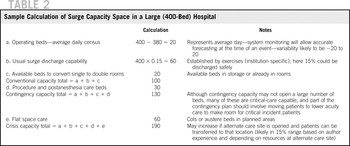
Use of a standard framework for evaluating, activating, and reporting surge capacity may assist preparedness efforts by providing a more standard set of data (Table 2) and by supplying an operational context to surge capacity at health care facilities that can facilitate mobilization of adequate facility resources and consideration of the need to divert or transfer patients depending on the level of surge capacity activated.
Sample Calculation of Surge Capacity Space in a Large (400-Bed) Hospital

Staffing Considerations
Hospitals must have a plan to mobilize appropriate numbers and categories of staff depending on incident demands. For example, select staff (emergency management, security, general surgery, anesthesia, emergency medicine, critical care, central supply, radiology, and laboratory) may be notified by group paging when the facility emergency plan is activated, with subsequent staff groups notified according to incident demands or requests. Notifications may be sorted and limited to staff living within a certain geographic distance from the facility in the event of partial disaster plan activation.
In most disasters, excess staff report to the hospital compared with incident demands.Reference Milsten32, Reference Auf Der Heide33 In the early phase of a no-notice incident,Reference Qureshi, Gershon and Sherman34 an incident when staff have difficulty accessing the hospital (roadway damage, flooding), or during a protracted incident (particularly an infectious incident that sickens staff and potentially staff family members) staff available may be inadequate to meet demand. In addition, staff may decline to report due to concerns about contracting an illness or because of the disaster’s impact on home and family.Reference Qureshi, Gershon and Sherman34
In this setting, changing shift length and responsibilities may be necessary. The incident commander should approve modifications to usual work practices and schedules appropriate to the scope and duration of the event. Charting, administrative responsibilities, and certain patient cares (bathing, hygiene) may be deferred or reduced in scope, and assessments (vital signs, other) may be reduced in frequency.30, Reference Rubinson, Nuzzo and Talmor31 Usual nurse-to-patient ratios may be changed in conjunction with changes in responsibility.
Conventional Staffing
Conventional staff are those who are credentialed and if necessary privileged at the institution before an event. This may include staff who usually have administrative responsibilities (nursing supervisors, nurse managers) but who are fully trained and able to fulfill clinical roles. Nursing, physician, laboratory, radiology, pharmacy, health care assistant, respiratory therapist, and behavioral health personnel should be considered in planning. In addition, administrative and support service (eg, food and beverage, facilities management, laundry, central and sterile supply) personnel are needed to support clinical operations.
Staff at an institution may be assigned in their usual area or assigned to other patient care areas, yet remain conventional staff as long as their skill set is consistent with the duties assigned.
Contingency Staffing
Contingency staff may be staff from within the institution assigned to duties that they can safely perform with supervision or outside staff imported to meet clinical demands. This includes situations in which staff are providing care for which they are trained but require oversight by consultants for specialty aspects of patient care; for example, a floor nurse provides basic nursing care for a burn patient, whereas a burn unit nurse and physician provide oversight and perform dressing changes, or a stepdown nurse provides the majority of care for a critical patient with supervision by a critical care nurse and/or attending critical care physician.Reference Rubinson, Hick and Hanfling21, Reference Rubinson, Nuzzo and Talmor31
Contingency staffing may also involve provider “extension” by having lesser or untrained personnel assume noncritical responsibilities (eg, freeing up respiratory therapist time to manage ventilators by having nursing staff administer inhaled medications or having administrative personnel serve meals to free up nursing time).
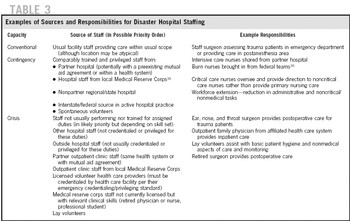
The hospital should have in place policies and procedures for importation of external staff if this becomes necessary to provide adequate staffing. Emergency credentialing and privileging mechanisms should be in place. Sources of outside staff should be identified and prioritized in advance of an event. 35–Reference Schultz and Stratton37 Sample prioritization for contingency staff are noted in Table 3.
Examples of Sources and Responsibilities for Disaster Hospital Staffing

Use of outside personnel requires a significant commitment including credentialing, issuing appropriate identification, orientation, just-in-time training, assignment of mentors or supervisors on each shift, and potential liability, workers’ compensation, billeting, and staff support issues. Lack of familiarity with medical records, ordering systems, and equipment may significantly reduce the efficiency and safety of temporary workers despite appropriate medical knowledge base and skill set. For this reason, the use of any outside clinical personnel within the facility during a disaster should be considered contingency staffing regardless of the staff member’s qualifications. Use of contingency staff should prompt consideration of the ratio of risk-to-benefit to the patient of importing staff to provide care compared with evacuation of the patient to another facility with adequate resources, if this is an option.
Crisis Staffing
Catastrophic incidents may require the hospital to use staff to perform clinical duties that they do not usually perform to provide the greatest good for the greatest number of the overwhelming number of patients (eg, using housekeepers to provide bag-valve-mask ventilation).Reference Dacey38 Whenever staff must perform clinical care that is outside the scope of their usual responsibilities or training, this should be considered crisis care unless it carries negligible risk to the patient (eg, taking vital signs).
Staff–demand mismatches may occur temporarily after event recognition, but usually these can be corrected rapidly with mobilization of qualified staff. If the staff–demand mismatch continues, then the incident commander should have a plan to recruit the best qualified staff available for the duties. As with contingency staffing, sources and priority for crisis staffing should be identified in advance of an incident as suggested in Table 3. Ideally, these plans should be consistent with other regional health care facility plans and with the regional assumptions for catastrophic response.
Just-in-time training may be prepared in advance for certain noncritical duties (eg, assisting patients with oral medications, administering an inhaler with use of a spacer) that can be assumed by people with minimal training and risk, but may be inappropriate except in extreme situations for other duties (eg, ventilator management).
The use of crisis staffing should be part of a systematic process by the institution to concentrate all institutional resources on urgent patient careReference O’Laughlin and Hick29 and in parallel with a process to both obtain better qualified staff and conduct patient transfers to facilities with better patient care capacity (unless this is impossible due to a nationwide pandemic).
Supply Considerations
Hospitals require a wide variety of supplies to maintain operations. This section is concentrated on patient care supplies such as oxygen, pharmaceuticals, and biomedical equipment. Patient linens, assessment and hygiene supplies, food, water, and diagnostic supplies (eg, radiology, laboratory) must also be considered.
The present business model of health care discourages surplus inventory and duplication of suppliers and services. Consolidation of suppliers has also occurred and suppliers also maintain stocks sufficient only to meet anticipated orders. Both of these factors contribute to a fragile supply chain and little additional capacity. Even if redundant vendors are available they may be relying on the same regional suppliers or manufacturers, further limiting options. For these and other reasons, select antibiotics and other patient care supplies are stockpiled by the Centers for Disease Control and Prevention’s Strategic National Stockpile program (http://www.bt.cdc.gov/Stockpile) but are not considered a first-response asset because their arrival to the hospital may take hours to days.
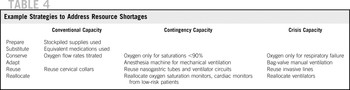
Six options exist to mitigate or remediate a supply shortage (in rough order of preference—for further examples see http://www.health.state.mn.us/oep/healthcare; Table 4)Reference Rubinson, Hick and Hanfling21:
Example Strategies to Address Resource Shortages

• Prepare—stockpile necessary items or their equivalents before the event
• Substitute—use a clinically equivalent item (substitute benzodiazepine sedation for usual agents such as propofol)
• Adapt—use items or technologies to provide sufficient care (use transport ventilators or anesthesia machines instead of full-featured ventilators)
• Conserve—use less of a resource by lowering dosage or changing utilization practices (administer oxygen only for documented oxygen saturations <90%)
• Reuse—after appropriate disinfection or sterilization, reuse supplies (nasogastric feeding tubes)
• Reallocate—removing therapy or a monitor from one patient to give to another with a higher chance of benefit or greater need (reallocation of ventilator)
Conventional Supplies
Preparedness is critical to maintaining adequate quantities of disaster supplies. Hospitals should identify critical supplies that are needed to provide patient care for 96 hours (or longer, depending on hazard vulnerability analysis) and attempt to stockpile or ensure sources of sufficient quantities of usual or equivalent materials. Supplies for special populations (eg, pediatric, geriatric, burn) should be addressed. In addition, supplies to provide crisis space care (eg, cots, linens, blankets, egg-crate mattresses) must be stocked or be easily available. Staff personal protective equipment and patient masks for infectious events should be stocked consistent with the facility’s needs and plan. It should be emphasized that the more robust the stockpiling, the longer the facility can remain in “conventional” operational mode. Supply augmentation that can be maintained by rotation through usual use is optimal because it results in little ongoing cost, although it may require storage space and the labor to perform the checks and rotation.
Conventional supplies may also be obtained from other facilities and suppliers. These should be preplanned and their limitations noted (eg, distance, number of other hospitals relying on single supplier) before the event.
Contingency Supplies
A present or anticipated supply shortage requires conservation, substitution, adaptation, and potentially reuse and reallocation strategies. A contingency supply state exists when usual supplies cannot be obtained, but an acceptable substitute can be used that accomplishes the objective without significant risk to the patient. Examples may include the following:
• Adaptation of oximeters with high/low heart rate alarms for dysrhythmia monitoring on patients at low risk, allowing reallocation of cardiac monitors to critical care
• Substitution of spot, rather than continuous, oximetry for patients with stable respiratory physiology
• Substitution of volume-cycled multifeatured transport ventilators with alarms (similar to those in the Strategic National Stockpile) rather than full-feature ventilators
• Reuse after disinfection and cleaning of certain disposable patient care items (eg, cervical collars, basins)
Crisis Supplies
In catastrophic situations, additional compromises may have to be made because of supply shortages, allowing for the provision of sufficient care to an overwhelming number of patients (eg, bag-valve ventilation if no ventilators are available) that introduce risk for morbidity or mortality. This involves extensions of the above processes, including more strict conservation (eg, only providing oxygen to patients with saturations <90%), aggressive adaptation, and additional reuse and reallocation. The extreme end of this spectrum is the reallocation of lifesaving therapies to patients with the best chance of a good outcome, Reference Hick, Rubinson and O’Laughlin28,39,40 which represents the limit of surge capacity.
CONCLUSIONS
Surge capacity is affected by many variables. Systems and processes are critical to support surge capacity decision making. The use of conventional, contingency, and crisis capacity strata advances our surge capacity planning by allowing the consistent use of terminology and calculations as well as creating a framework around which hospitals may create worksheets and job aids that may facilitate a safe and phased expansion of capacity. These may also prompt command staff to consider options to reduce patient volume by diversion or transfer when prolonged use of contingency or crisis capacity is anticipated.
Application and refinement of this framework is required to determine its relative contribution to planning and response. This taxonomy does not address the need for common terms across health care, emergency management, emergency medical services systems, and other agencies that reflect the scope of an incident. Although some agencies and systems describe the scope according to whether an incident requires local assets, regional assets, or state or federal assistance to meet the communities’ needs, there is no consistent use of such terms. This terminology, although hospital specific for purposes of this article, may at least be adaptable to other medical care and long-term care settings and allow for a common planning and response framework among health care partners.
Continuing efforts to standardize data, definitions, and terminology within health care and supporting agencies are encouraged because they contribute to effective communications and a common operating picture during all phases of the emergency management process.
Authors' Disclosures
The authors report no conflicts of interest.