Introduction
It is becoming increasingly clear that many terrestrial invertebrates resident in the Antarctic and Arctic are remarkably heat tolerant. Block et al. (Reference Block, Webb, Coulson, Hodkinson and Worland1994), Hodkinson et al. (Reference Hodkinson, Coulson, Webb and Block1996), Deere et al. (Reference Deere, Sinclair, Marshall and Chown2006), Everatt et al. (Reference Everatt, Convey, Worland, Bale and Hayward2013), Sinclair et al. (Reference Sinclair, Terblanche and Scott2006) and Slabber et al. (Reference Slabber, Worland, Leinaas and Chown2007) have shown survival above 30 °C in a number of polar Collembola and Acari, including ‘model’ polar species, such as Cryptopygus antarcticus, Megaphorura arctica and Alaskozetes antarcticus. In the Antarctic, typical summer microhabitat temperatures range between 0 and 10 °C, whereas in the Arctic, the temperature range is slightly higher (Davey et al., Reference Davey, Pickup and Block1992; Coulson et al., Reference Coulson, Hodkinson, Webb, Block, Bale, Strathdee, Worland and Wooley1996; Hodkinson et al., Reference Hodkinson, Coulson, Webb and Block1996; Block et al., Reference Block, Smith and Kennedy2009). Temperatures above 30 °C have been recorded, but are rare, occurring only in certain microhabitats for brief periods of minutes to hours and not consistently between years (Smith, Reference Smith and Glime1988; Convey, Reference Convey1996; Hodkinson et al., Reference Hodkinson, Coulson, Webb and Block1996; Everatt et al., Reference Everatt, Convey, Worland, Bale and Hayward2013). It is generally assumed that invertebrates respond behaviourally to such temperatures, and rapidly relocate if or when they become stressful (Hayward et al., Reference Hayward, Worland, Convey and Bale2003). Polar Collembola and Acari therefore have ample capacity to tolerate current conditions. Annual mean temperatures have risen by over 2 °C in parts of the polar regions in the last 50 years and similar, possibly more extreme, increases are predicted to occur over the next half century (Convey et al., Reference Convey, Bindschadler, di Prisco, Fahrbach, Gutt, Hodgson, Mayewski, Summerhayes and Turner2009; Turner et al., Reference Turner, Bindschadler, Convey, Di Prisco, Fahrbach, Gutt, Hodgson, Mayewski and Summerhayes2009). Such warming is within the physiological thresholds of the resident Collembola and Acari (Block et al., Reference Block, Webb, Coulson, Hodkinson and Worland1994; Hodkinson et al., Reference Hodkinson, Coulson, Webb and Block1996; Deere et al., Reference Deere, Sinclair, Marshall and Chown2006; Sinclair et al., Reference Sinclair, Terblanche and Scott2006; Slabber et al., Reference Slabber, Worland, Leinaas and Chown2007; Everatt et al., Reference Everatt, Convey, Worland, Bale and Hayward2013).
The capacity of polar invertebrates to tolerate future warming is in line with Deutsch et al. (Reference Deutsch, Tewksbury, Huey, Sheldon, Ghalambor, Haak and Martin2008), who suggested that the sensitivity of terrestrial invertebrates to a temperature change decreases with increasing latitude (see also Addo-Bediako et al., Reference Addo-Bediako, Chown and Gaston2000). It has even been suggested that climate warming might alleviate the stresses of living in a low-temperature environment and benefit some polar species (Convey, Reference Convey, Bergstrom, Convey and Huiskes2006, Reference Convey2011; Bale & Hayward, Reference Bale and Hayward2010). This proposal is consistent with the results of some climate manipulation studies which have shown warming to increase populations of invertebrates in Antarctic communities (Convey & Wynn-Williams, Reference Convey and Wynn-Williams2002; Convey et al., Reference Convey, Pugh, Jackson, Murray, Ruhland, Xiong and Day2002; Day et al., Reference Day, Ruhland, Strauss, Park, Krieg, Krna and Bryant2009). Convey et al. (Reference Convey, Pugh, Jackson, Murray, Ruhland, Xiong and Day2002) and Day et al. (Reference Day, Ruhland, Strauss, Park, Krieg, Krna and Bryant2009), however, highlighted that continued water availability during warming is crucial, and some Arctic studies have shown declines or no change following artificial increases in temperature alone (Coulson et al., Reference Coulson, Hodkinson, Webb, Block, Bale, Strathdee, Worland and Wooley1996; Webb et al., Reference Webb, Coulson, Hodkinson, Block, Bale and Strathdee1998). Manipulation studies should therefore be treated with care for they are complex in their effects and often inconsistent in the consequences identified, emphasizing that the changes observed are strongly influenced by the specific microhabitat characteristics and invertebrate populations investigated, as well as the seasonal timing and duration of the study (Convey et al., Reference Convey, Pugh, Jackson, Murray, Ruhland, Xiong and Day2002, Reference Convey, Block and Peat2003; Bokhorst et al., Reference Bokhorst, Huiskes, Convey, Sinclair, Lebouvier, Van de Vijver and Wall2011, Reference Bokhorst, Huiskes, Aerts, Convey, Cooper, Dalen, Erschbamer, Gudmundsson, Hofgaard, Hollister, Johnstone, Jónsdóttir, Lebouvier, Van de Vijver, Wahren and Ellen Dorrepaal2013). Climate manipulation studies also lack an assessment of the potential impact of possible new colonists as a result of climate change.
The first studies investigating heat tolerance in polar terrestrial invertebrates concentrated on Arctic species, including three species of Collembola (M. arctica, Onychiurus groenlandicus and Hypogastrura tullbergi) and four species of mite (Camisia anomia, Diapterobates notatus, Hermannia reticulata and Ceratoppia hoeli) (Block et al., Reference Block, Webb, Coulson, Hodkinson and Worland1994; Hodkinson et al., Reference Hodkinson, Coulson, Webb and Block1996). The current study also uses M. arctica and, although it revisits this collembolan's short- and long-term tolerance to heat, the methods used here take into account more ecologically relevant rates of warming and cooling. The ability of the collembolan to acclimate using rapid heat hardening (RHH) is also investigated for the first time. M. arctica (formerly Onychiurus arcticus) is a pale yellow collembolan found in the palaearctic regions (Fjellberg, Reference Fjellberg1994). This collembolan is common under rocks and within moss beneath bird cliffs, where it commonly aggregates in groups of 100 or more individuals (Worland, Reference Worland1996). Partly because of its ability to cryoprotectively dehydrate, M. arctica is considered a ‘model’ in Arctic terrestrial invertebrate ecophysiological research (Worland et al., Reference Worland, Grubor-Lajsic and Montiel1998).
Previous Antarctic studies have examined heat tolerance in Collembola and Acari (Deere et al., Reference Deere, Sinclair, Marshall and Chown2006; Sinclair et al., Reference Sinclair, Terblanche and Scott2006; Slabber et al., Reference Slabber, Worland, Leinaas and Chown2007; Everatt et al., Reference Everatt, Convey, Worland, Bale and Hayward2013), but have given little attention to Antarctic Diptera. In this study, the capacity of the midge, Eretmoptera murphyi, to respond to high temperature is investigated, including an assessment of its CTmax, and its ability to recover from heat stress. E. murphyi is native and endemic to the sub-Antarctic island of South Georgia (55°S, 37°W). Likely as a result of plant transplant experiments in the 1960s, this midge was accidentally transferred to maritime Antarctic Signy Island (60°S, 45°W) and is now established as a non-native species there (Block et al., Reference Block, Burn and Richard1984; Convey & Block, Reference Convey and Block1996). The species has since spread to cover an area >2000 m2 and is now having a significant impact on the local environment (Hughes et al., Reference Hughes, Worland, Thorne and Convey2013). E. murphyi is closely related to the endemic Belgica antarctica of the maritime Antarctic (Allegrucci et al., Reference Allegrucci, Carchini, Convey and Sbordoni2012). While heat tolerance has received some attention in the latter species, the subject has not been explored in detail (Hayward et al., Reference Hayward, Rinehart, Sandro, Lee and Denlinger2007; Benoit et al., Reference Benoit, Lopez-Martinez, Elnitsky, Lee and Denlinger2009a ).
Materials and methods
Invertebrate collection and storage conditions
Summer-acclimatised individuals of M. arctica were collected from moss-covered slopes at Krykkefjellet and Stuphallet, near Ny-Ålesund, Spitsbergen, Svalbard (78°55′N, 11°56′E) between 14 and 24 August 2011. Summer-acclimatised larvae of E. murphyi were collected from soil and moss on Signy Island (60°S, 45°W) near to the British Antarctic Survey Signy Research Station between January and March 2012. These were subsequently transported to the University of Birmingham under refrigerated conditions and held in plastic boxes containing substratum from the site of collection at 4–5 °C (0:24 L:D). The duration of travel was approximately 2 days from the Arctic and 2 months from the Antarctic. Numbers of M. arctica were limited, and as a result this species was not assessed for the effect of recovery or heat coma (‘Activity thresholds’ and ‘The effect of recovery on heat tolerance’ sections).
Microhabitat temperatures
The thermal regime experienced by M. arctica during the summer was measured at four different sheltered sites (laid on surface, but covered by rocks), two at Krykkefjellet and two at Stuphallet, between 17 and 24 August 2011. Temperature was measured at each site using a Tinytag Transit 2 Datalogger, and data were uploaded using Tinytag Explorer Software (Gemini Data Loggers, Chichester, UK). Fieldwork was not conducted on Signy Island as part of this study and microhabitat temperature data for E. murphyi are inferred from previous studies.
Upper lethal temperatures (ULTs)
The upper temperature at which a species is no longer able to survive (ULT) was determined for M. arctica and E. murphyi by warming individuals at 0.2 °C min−1 from 4 °C (rearing temperature) to progressively higher temperatures (30–36 °C for M. arctica and 35–39 °C for E. murphyi). Individuals were subsequently held at the target temperature for 1 h, before being cooled back to 4 °C at the same rate. Three replicates of ten individuals of each species were placed in Eppendorf tubes, inserted into glass test tubes that were then plugged with sponges, and placed inside an alcohol bath (Haake Phoenix II C50P, Fisher Scientific UK Ltd, Loughborough, UK), prior to each experimental treatment. Control groups were handled, and exposed, in the same way at 4 °C. The temperature experienced by the invertebrates was measured by placing a thermocouple within an identical Eppendorf tube into one of the glass test tubes. Humidity typically remains high within this experimental setup, and is assumed not to impact survival based on previous findings (Everatt et al., Reference Everatt, Convey, Worland, Bale and Hayward2013). At the end of experimental treatments, individuals were rapidly transferred (over ice) from the Eppendorf tubes into plastic universal tubes containing substratum, and returned to the rearing conditions (see also Everatt et al., Reference Everatt, Convey, Worland, Bale and Hayward2013). Survival, defined by individuals moving either spontaneously or in response to gentle contact stimulus, was assessed 72 h after treatment.
Activity thresholds
Activity thresholds were assessed for E. murphyi only, within an aluminium block arena. The temperature within the arena was regulated using an alcohol bath, and activity monitored using a digital video camera with a macro lens (see Hazell et al., Reference Hazell, Pedersen, Worland, Blackburn and Bale2008). Thirty larvae in groups of ten were transferred into the arena and allowed to settle before video recording (Studio Capture DT, Studio86Designs, Lutterworth, UK) and the alcohol bath programme began. The temperature of the arena was raised from 4 to 40 °C at two different rates, 0.2 and 0.1 °C min−1. The temperature at which each individual larva last moved its body was recorded.
Long-term heat tolerance
Five replicates of ten individuals of M. arctica and E. murphyi were transferred to either 4, 9 or 15 °C for up to 210 days. Individuals were held in universal tubes with a base of moist plaster of Paris and a small amount of substratum within an incubator or temperature controlled room (9 °C). The temperature inside the incubators and room was checked using a Tinytag Transit 2 Datalogger. Survival was assessed every 7 days (see also Everatt et al., Reference Everatt, Convey, Worland, Bale and Hayward2013).
The effect of recovery on heat tolerance
To test the effect of recovery at cooler temperatures on heat tolerance, three replicates of ten individuals were exposed to one of three treatments: (i) 25 °C for 10 days, (ii) ten 24 h exposure periods at 25 °C, each separated by 1 h recovery at 4 °C and (iii) ten 24 h exposure periods at 25 °C, each separated by 2 h recovery at 4 °C. Larvae were kept in plastic universal tubes with a base of moist plaster of Paris and substratum. Transfer from and to 25 °C was followed and preceded by 1 h at 15 °C to avoid cold and heat shock. Survival was assessed after each day (treatment (i)) or 24 h exposure period (treatment (ii) and (iii)).
Rapid heat hardening
Determination of the discriminating temperature
The discriminating temperature is defined as the temperature at which there is 10–20% survival (Lee et al., Reference Lee, Chen and Denlinger1987). Three replicates of ten individuals of M. arctica were exposed directly (without ramping at 4 °C) to progressively higher temperatures (30–36 °C) for 1 h, before cooling to 4 °C at 0.2 °C min−1. Invertebrate collection and handling, controls, thermocouple use, recovery and survival assessment were as described in section ‘Upper lethal temperatures (ULTs)’. Preliminary trials on E. murphyi suggested that the midge did not show RHH (data not shown) and so RHH was only assessed in M. arctica.
Induction of RHH
To test for the RHH response, three replicates of ten individuals were warmed to the discriminating temperature at three different rates, 0.5, 0.2 and 0.1 °C min−1. As before, samples were held for 1 h at the discriminating temperature and then cooled back to 4 °C at 0.2 °C min−1.
Statistical analyses
The Kolmogorov–Smirnov test was used to confirm whether survival and heat coma data were normally distributed. Normally distributed data were analysed using analysis of variance (ANOVA) and Tukey's multiple range test and non-normally distributed data were analysed using either the Mann–Whitney U test or the Kruskal–Wallis test.
Results
Arctic site microhabitat temperatures
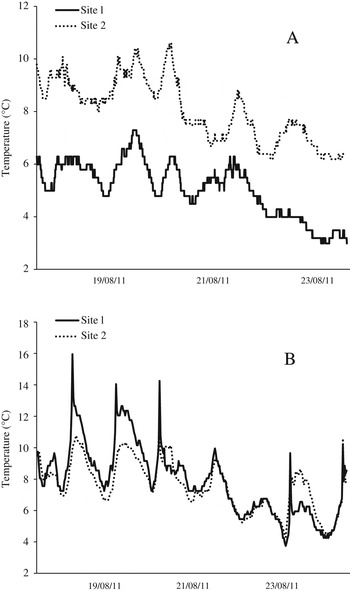
Temperatures remained above 3 °C throughout the period 17–24 August 2011 (fig. 1) at both locations. At Stuphallet, temperatures averaged 6.6 °C when combining data from both Tinytag sites and at Krykkefjellet, 7.8 °C. Temperatures deviated considerably from these averages, rising as high as 16 °C at Krykkefjellet. The first 3 days were noticeably warmer, averaging 0.8 and 1.3 °C higher than over the whole period in Stuphallet and Krykkefjellet, respectively. The time at which these temperatures were recorded also coincided with the warmest period on Svalbard to date (Coulson, S.J., personal communication).
Surface temperature at four sites, two at Stuphallet (A) and two at Krykkefjellet (B), near Ny-Ålesund, Svalbard, between 17 and 24 August 2011.

Upper lethal temperatures
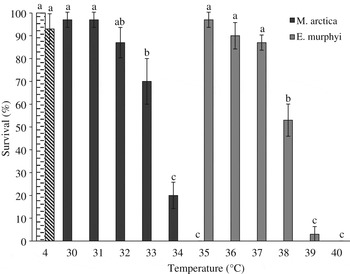
Individuals of M. arctica survived up to 35 °C, while larvae of E. murphyi survived up to 39 °C (fig. 2). The difference in survival between the two species at 35 °C was significant (F 1,4=841.000, P<0.05 one-way ANOVA, variances not equal). Survival in both species declined rapidly, falling by >80%, within 2–3 °C as they approached the ULT.
Survival (%) of Megaphorura arctica and Eretmoptera murphyi following exposure to progressively higher temperatures (30–35 °C for M. arctica, 35–40 °C for E. murphyi) for 1 h. Controls (4 °C) are represented by dashed (M. arctica) and diagonally lined bars (E. murphyi). Means±SEM are presented for three replicates of ten individuals. Survival was assessed 72 h after treatment. Means with the same letter are not significantly different within each species group at P<0.05 (Tukey's multiple range test, variance not equal for M. arctica).

Heat coma
The point at which E. murphyi larvae no longer showed signs of movement (heat coma) occurred above 31 °C under two different rates of warming, 0.1 (31.4±0.14 °C) and 0.2 °C min−1 (32.3±0.18 °C). The heat coma temperature was significantly higher under faster warming (F 1,52=18.523, P<0.05 one-way ANOVA).
Long-term heat tolerance
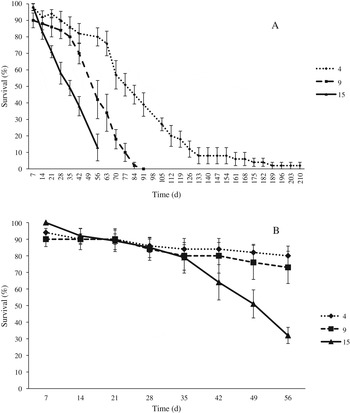
Survival of both species was greatest at 4 °C (fig. 3). M. arctica tolerated 9 °C for 91 days, while survival of E. murphyi was still above 75% following 56 days, when the experiment finished. Both species tolerated a 15 °C exposure for at least 56 days (fig. 3), at which point survival was greater in E. murphyi (32%) than in M. arctica (13%). Survival of E. murphyi larvae at all temperatures was not significantly different after 35 days (P>0.05 Tukey's multiple range test, variances not equal in some cases). However, survival after 56 days was significantly lower for larvae exposed to 15 °C compared to 4 or 9 °C (P<0.05 Tukey's multiple range test). Survival of E. murphyi at 9 or 4 °C did not differ significantly for any of the durations tested (P>0.05 Tukey's multiple range test).
Survival (%) of M. arctica (A) and E. murphyi (B) at 4, 9 and 15 °C over a period of up to 210 days. Means±SEM are presented for five replicates of ten individuals.

Effect of recovery on heat tolerance
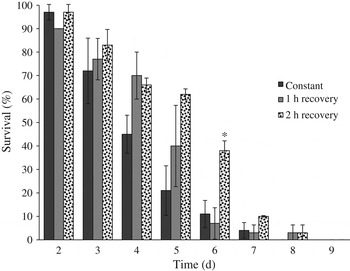
Constant exposure to 25 °C was lethal after 8 days, but survival increased with the introduction of daily recovery periods of 1 or 2 h at 4 °C (fig. 4). This was significant overall (F 2=9.064, P<0.05 two-way ANOVA), but the interaction between time and recovery was not significant (F 14=1.849, P>0.05 two-way ANOVA). Survival following a daily 2 h recovery period at 4 °C was greater than survival without recovery over the course of the entire experiment (days 2–8), though the difference in survival was only significant after 6 days (P<0.05 Tukey's multiple range test). A 1 h recovery period also gave greater survival for days 3–5 and day 8, but none of these differences were significant when analysed individually.
Survival (%) of E. murphyi at 25 °C over a period of 9 days. Larvae were either given no recovery period, 1 h at 4 °C after each 24 h period or 2 h at 4 °C after each 24 h period. Means±SEM are presented for three replicates of ten individuals. Asterisks indicate a recovery treatment significantly different from the constant treatment at P<0.05 (Tukey's multiple range test, variances not equal).

Rapid heat hardening
Determination of the discriminating temperature
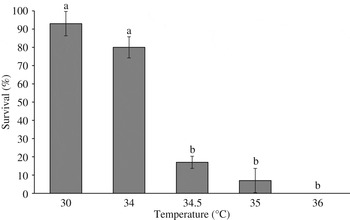
The discriminating temperature was determined to be 34.5 °C for M. arctica (17% survival, fig. 5).
Survival (%) of M. arctica following direct exposure (without ramping) to progressively higher temperatures (30–35 °C) for 1 h. Means±SEM are presented for three replicates of ten individuals. Survival was assessed 72 h after treatment. Means with the same letter are not significantly different at P<0.05 (Tukey's multiple range test).

RHH induction
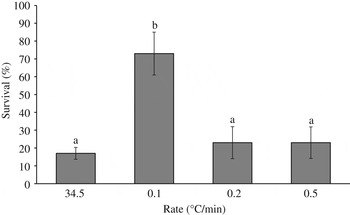
Mean survival was significantly higher following warming at a rate of 0.1 °C min−1 (73%), compared with survival after direct transfer (17%) to the discriminating temperature (P<0.05 Tukey's multiple range test, variances not equal, fig. 6). Survival was also raised following warming at a rate of 0.2 and 0.5 °C min−1, but this was not significant (P>0.05 Tukey's multiple range test, variances not equal).
Survival (%) of M. arctica, following exposure to the discriminating temperature (34.5 °C) for 1 h, after being warmed to the discriminating temperature at one of three rates (0.5, 0.2 or 0.1 °C min−1). Survival following these three rates is shown in comparison to direct transfer, which is denoted as 34.5. Means±SEM are presented for three replicates of ten individuals. Survival was assessed 72 h after treatment. Means with the same letter are not significantly different at P<0.05 (Tukey's multiple range test).

Discussion
As poikilothermic ectotherms, invertebrate body temperatures are determined by, and vary with, the external environment (Speight et al., Reference Speight, Hunter, Watt, Speight, Hunter and Watt2008). Invertebrates are therefore susceptible to injuries, and impaired development and reproduction, resulting from exposure to temperature alterations, such as those that may result from climate change (Bale & Hayward, Reference Bale and Hayward2010). Changes in temperatures due to climate warming are already known to affect invertebrate population dynamics and distribution (Parmesan, Reference Parmesan1996; Walther et al., Reference Walther, Post, Convey, Menzel, Parmesank, Beebee, Fromentin, Ove and Bairlein2002). For example, climate warming has led to the occurrence of extreme heat events, which have resulted in the mass mortality of tropical species, such as corals (Walther et al., Reference Walther, Post, Convey, Menzel, Parmesank, Beebee, Fromentin, Ove and Bairlein2002). Tropical species are particularly vulnerable to temperature change as the upper temperatures they are able to tolerate lie very close to the upper temperatures experienced in their environment (Somero, Reference Somero2010). Indeed, in some cases, tropical species live at temperatures which exceed their physiological optima (Somero, Reference Somero2010). The current study considers whether polar species are also vulnerable to climate warming, by examining the heat tolerance and activity thresholds of the dipteran, E. murphyi, from the Antarctic, and further examining the heat tolerance capacity of the Arctic collembolan, M. arctica.
Basal tolerance
Both study species demonstrated considerable heat tolerance and showed survival above 34 °C for a period of 1 h (fig. 2.). The heat coma temperature of E. murphyi was also very high, averaging above 31 °C following warming at 0.1 or 0.2 °C min−1. Correspondingly, Everatt et al. (Reference Everatt, Convey, Worland, Bale and Hayward2013) demonstrated survival up to 37 °C in the collembolan, C. antarcticus and survival up to 40 °C in the mite, A. antarcticus, with similar results also being demonstrated in other Antarctic species (Deere et al., Reference Deere, Sinclair, Marshall and Chown2006; Sinclair et al., Reference Sinclair, Terblanche and Scott2006; Slabber et al., Reference Slabber, Worland, Leinaas and Chown2007). Block et al. (Reference Block, Webb, Coulson, Hodkinson and Worland1994) and Hodkinson et al. (Reference Hodkinson, Coulson, Webb and Block1996) likewise demonstrated high-temperature survival in Arctic Acari and Collembola, including in M. arctica. The survival of M. arctica in this study was almost identical to that found by both Block et al. (Reference Block, Webb, Coulson, Hodkinson and Worland1994) and Hodkinson et al. (Reference Hodkinson, Coulson, Webb and Block1996), with all three studies showing virtually 100% survival after a 1 h exposure at 30 °C and an ULT of 35 °C. Extending the exposure time to 3 h shifted survival downwards, but still gave survivorship above 30 °C (Block et al., Reference Block, Webb, Coulson, Hodkinson and Worland1994; Hodkinson et al., Reference Hodkinson, Coulson, Webb and Block1996). These temperatures are considerably higher than the temperatures experienced throughout the year in both the Antarctic and Arctic, including in summer and short duration extreme maxima. Temperature conditions varied across small spatial scales at both the Stuphallet and Krykkefjellet sites (fig. 1), and microhabitat buffering would further protect terrestrial invertebrates from temperature extremes. M. arctica and E. murphyi therefore have considerable capacity to tolerate current summer conditions, including conditions that are unusually warm. These species also have the capacity to tolerate the much higher temperatures that will likely occur as a result of climate warming (Arctic Council, 2005; Convey et al., Reference Convey, Bindschadler, di Prisco, Fahrbach, Gutt, Hodgson, Mayewski, Summerhayes and Turner2009; Turner et al., Reference Turner, Bindschadler, Convey, Di Prisco, Fahrbach, Gutt, Hodgson, Mayewski and Summerhayes2009), further consolidating the hypothesis set out by Deutsch et al. (Reference Deutsch, Tewksbury, Huey, Sheldon, Ghalambor, Haak and Martin2008).
In addition to the well characterised cellular damage inflicted during acute exposure to temperature extremes, injury can also occur following long-term exposure to more moderate temperatures (e.g. Czajka & Lee, Reference Czajka and Lee1990). To assess this, in the current study, both M. arctica and E. murphyi were exposed to 9 and 15 °C for several weeks. Although mortality occurred at these temperatures, both species survived well for the first 4 weeks, particularly at 9 °C (fig. 3). The collembolan survived until 91 days at 9 °C and 56 days at 15 °C and, while the experiment was only carried out over 56 days for E. murphyi, mean survival at 9 °C was still above 70%. Hodkinson et al. (Reference Hodkinson, Coulson, Webb and Block1996) showed similarly good survival in M. arctica at 10 °C, with the collembolan surviving up to 196 days, with less than 50% mortality after 140 days, in that instance. Some individuals were also able to survive up to 68 days at 25 °C. Such tolerance is notable when compared with their Arctic microhabitat temperatures where, for only a few periods of no more than 24 h, did temperatures exceed 9 °C, and at only one point did they exceed 15 °C (fig. 1). Likewise, maximum temperatures 3 cm below the soil surface recorded between 1991 and 1993 did not exceed 14 °C (Hodkinson et al., Reference Hodkinson, Coulson, Webb and Block1996). Temperatures above 9 °C are even more unusual on Signy Island or more generally in the maritime Antarctic (Davey et al., Reference Davey, Pickup and Block1992; Bokhorst et al., Reference Bokhorst, Huiskes, Convey, van Bodegom and Aerts2008).
Physiological plasticity
Polar terrestrial invertebrates are exposed to a highly variable climate. At the extreme, temperatures can vary seasonally by up to 100 °C and daily by as much as 50 °C (Convey, Reference Convey1996). Even in buffered microhabitats, there can be considerable variation. Terrestrial invertebrates will therefore not be exposed to either constant low or high temperatures, and will also be exposed to milder transitional temperatures, giving them an opportunity to recover from thermal injuries. It has already been shown in a number of invertebrates, including the firebug, Pyrrhocoris apterus (Koštál et al., Reference Koštál, Renault, Mehrabianová and Bastl2007), the beetle, Alphitobius diaperinus (Renault et al., Reference Renault, Nedvěd, Hervant and Vernon2004; Koštál et al., Reference Koštál, Renault, Mehrabianová and Bastl2007; Colinet, Reference Colinet2011; Lalouette et al., Reference Lalouette, Williams, Hervant, Sinclair and Renault2011), the parasitic wasp, Aphidius colemani (Colinet et al., Reference Colinet, Lalouette and Renault2007) and the flesh fly, Sarcophaga crassipalpis (Dollo et al., Reference Dollo, Yi and Lee2010), that pulses at warmer temperatures allow recovery from chilling injury. However, few studies have looked at analogous recovery from higher temperatures. In the current study, larvae of E. murphyi exhibited improved survival following daily recovery of 1 h, but particularly following 2 h, at 4 °C (fig. 4). Greater survival with increasing duration of recovery has also been demonstrated in A. diaperinus (Colinet et al., Reference Colinet, Lalouette and Renault2011). The lethal time (LT50) of the beetle increased significantly from a 0.5 to 4 h recovery period. We speculate that longer recovery times than used in the current study would further enhance survival of E. murphyi larvae. Recovery from, and repair of, chilling injury has been shown to involve ion gradient homeostasis (Koštál et al., Reference Koštál, Renault, Mehrabianová and Bastl2007), induction of antioxidants (Lalouette et al., Reference Lalouette, Williams, Hervant, Sinclair and Renault2011) and the up-regulation of key proteins (Colinet et al., Reference Colinet, Lalouette and Renault2007). Analogous responses during recovery from high-temperature injury may also occur. The up-regulation of heat shock proteins (HSPs), for example, is a common response to stressful conditions and is known as the ‘heat shock response’ because of its role in repair of heat shock injuries (Clark & Worland, Reference Clark and Worland2008). HSPs help refold and stabilise proteins and other macromolecules during stress (Clark & Worland, Reference Clark and Worland2008), and may also be involved with the recovery of microfilament dynamics (Tammariello et al., Reference Tammariello, Rinehart and Denlinger1999) and the regulation of apoptosis (Yi et al., Reference Yi, Moore and Lee2007).
A further means by which terrestrial invertebrates show physiological plasticity to high temperatures is through acclimation. However, the benefits of long-term acclimation (weeks to months) have so far been shown to be slight in polar terrestrial invertebrates. Following long-term acclimation, the widespread collembolan, C. antarcticus and mite, A. antarcticus, were shown to either exhibit no improvement in their survival or reduced survival, at high temperatures (Slabber et al., Reference Slabber, Worland, Leinaas and Chown2007; Everatt et al., Reference Everatt, Convey, Worland, Bale and Hayward2013). Acclimation to higher temperatures can also occur over shorter timescales in the form of RHH, which is defined as the rapid induction of heat tolerance over minutes to hours (Benoit et al., Reference Benoit, Lopez-Martinez, Teets, Phillips and Denlinger2009b ). Unlike rapid cold hardening, which has now been demonstrated in an increasing number of species (e.g. Kelty & Lee, Reference Kelty and Lee1999; Powell & Bale, Reference Powell and Bale2004; Lee et al., Reference Lee, Elnitsky, Rinehart, Hayward, Sandro and Denlinger2006; Owen et al., Reference Owen, Bale and Hayward2013) including E. murphyi (Everatt et al., Reference Everatt, Worland, Bale, Convey and Hayward2012), RHH has been little explored. In polar terrestrial invertebrates, there is evidence for the effect only in C. antarcticus and A. antarcticus (Everatt et al., Reference Everatt, Convey, Worland, Bale and Hayward2013). The current study also showed an RHH response in M. arctica (fig. 6). Following a warming rate of 0.1 °C min−1, survival of M. arctica at 34.5 °C was increased by 56%, compared with survival after a direct transfer to the same temperature. However, survival was not raised at 34.5 °C following a rate of 0.2 or 0.5 °C min−1. Greater survival at a rate of 0.1 °C min−1 can be explained by an increased time being available for M. arctica to respond physiologically. Greater time at protection-inducing temperatures has also been shown to give greater survival at lower temperatures, including in the western flower thrips, Frankliniella occidentalis (McDonald et al., Reference McDonald, Bale and Walters1997). While 0.1 °C min−1 is a slow rate compared with other studies, rates will be slower still in nature (Convey & Worland, Reference Convey and Worland2000, also see fig. 1). It is therefore speculated that, with more time to acclimate, M. arctica will show an even greater RHH response and thereby possess an additional mechanism improving its tolerance of temperature change.
Water availability and alien species in an era of climate warming
Although the direct impacts of high temperature are important, climate warming in the polar regions is also associated with changes in water availability and a heightened threat of alien species establishment. As climate warming intensifies, precipitation is predicted to increase at mid-high latitudes (Walther et al., Reference Walther, Post, Convey, Menzel, Parmesank, Beebee, Fromentin, Ove and Bairlein2002; Ávila-Jiménez et al., Reference Ávila-Jiménez, Coulson, Solhøy and Sjöblom2010). Under conditions of increased water availability, Antarctic invertebrates have been shown to thrive under warming, with increases in both Collembola and mite numbers (Convey et al., Reference Convey, Pugh, Jackson, Murray, Ruhland, Xiong and Day2002; Schulte et al., Reference Schulte, Elnitsky, Benoit, Denlinger and Lee2008; Day et al., Reference Day, Ruhland, Strauss, Park, Krieg, Krna and Bryant2009). However, rising temperatures are also expected to reduce snow cover and thaw ice earlier in the season, in turn resulting in the earlier evaporation of meltwater during the summer, which may instead leave invertebrates susceptible to desiccation (Callaghan et al., Reference Callaghan, Sonesson, Somme, Walton, Christensen and Block1992; Walther et al., Reference Walther, Post, Convey, Menzel, Parmesank, Beebee, Fromentin, Ove and Bairlein2002; Ávila-Jiménez et al., Reference Ávila-Jiménez, Coulson, Solhøy and Sjöblom2010). Under this scenario, polar terrestrial invertebrates have been shown to fare less well. Block et al. (Reference Block, Webb, Coulson, Hodkinson and Worland1994) and Hodkinson et al. (Reference Hodkinson, Coulson, Webb and Block1996) demonstrated the heat tolerance of collembola, including M. arctica, to be reduced when desiccated, as compared to those which were hydrated, while Coulson et al. (Reference Coulson, Hodkinson, Webb, Block, Bale, Strathdee, Worland and Wooley1996), Convey et al. (Reference Convey, Pugh, Jackson, Murray, Ruhland, Xiong and Day2002) and Day et al. (Reference Day, Ruhland, Strauss, Park, Krieg, Krna and Bryant2009) showed decreasing numbers of Collembola under field conditions. Even so, because the heat tolerance of polar terrestrial invertebrates far exceeds buffered microhabitat temperatures, as shown in the current study, and because their heat tolerance still remains high under desiccation (Block et al., Reference Block, Webb, Coulson, Hodkinson and Worland1994; Hodkinson et al., Reference Hodkinson, Coulson, Webb and Block1996), we speculate that changes associated with climate warming will result in a positive change to the invertebrate fauna.
The probability of alien species establishment is also predicted to increase with climate warming. As temperatures rise, areas which were previously too stressful for invading organisms are beginning to open up (Frenot et al., Reference Frenot, Chown, Whinam, Selkirk, Convey, Skotnicki and Bergstrom2005; Chwedorzewska, Reference Chwedorzewska2009). Increasing human activity, as a result of scientific research and, more recently, tourism is also aiding the transfer of alien species by allowing them to bypass geographical and environmental barriers, particularly in the Antarctic (Frenot et al., Reference Frenot, Chown, Whinam, Selkirk, Convey, Skotnicki and Bergstrom2005; Chown et al., Reference Chown, Lee, Hughes, Barnes, Barrett, Bergstrom, Convey, Cowan, Crosbie, Dyer, Frenot, Grant, Herr, Kennicutt, Lamers, Murray, Possingham, Reid and Riddle2012). Events in the sub-Antarctic provide a glimpse into what might happen, with native flora and invertebrate fauna of many islands suffering in the presence of invasive alien species (Frenot et al., Reference Frenot, Chown, Whinam, Selkirk, Convey, Skotnicki and Bergstrom2005; Chwedorzewska, Reference Chwedorzewska2009).
Conclusion
As with the polar Collembola and Acari that have been studied to date, the Antarctic midge, E. murphyi, possesses considerable heat tolerance that equips it to survive current and predicted future environmental conditions. This species and the Arctic collembolan, M. arctica, also demonstrate physiological plasticity with respect to recovery from high temperature, and RHH, respectively. Polar terrestrial invertebrates may therefore be protected from the harmful consequences of a temperature rise that may result from climate change, at least at a physiological level (Addo-Bediako et al., Reference Addo-Bediako, Chown and Gaston2000; Deutsch et al., Reference Deutsch, Tewksbury, Huey, Sheldon, Ghalambor, Haak and Martin2008). However, to identify likely consequences at the community level, it is imperative that this is also balanced with other factors, including changes in water availability and competition from alien species, and that the sub-lethal characteristics of invertebrates, including development and reproduction, are also considered.
Acknowledgements
MJE was funded by the Natural Environment Research Council (RRBN15266) and was supported by the British Antarctic Survey and the University of Birmingham. This paper contributes to the BAS ‘Polar Science for Planet Earth’ and SCAR ‘Evolution and Biodiversity in Antarctica’ research programmes.