Introduction
Owing to its nutritional benefits, medicinal value, ease in cultivation and adaptability, okra (Abelmoschus esculentus L. Moench) has emerged as an important vegetable crop in recent years (Reddy et al., Reference Reddy, Haribabu, Ganesh, Begum, Babu and Reddy2013). It is extensively cultivated in warm, moderate, tropical and subtropical areas across the globe. The cultivated species of okra is an amphidiploid of A. tuberculatus (2n = 58) and an unknown species with 2n = 72. The genome of the Abelmoschus genus is quite complex and there is a wide variation in the chromosome number. Datta and Naug (Reference Datta and Naug1968) reported that the chromosome numbers – 2n = 72, 108, 120, 132, and 144 are in a regular series of polyploids (n = 12). The highest chromosome number reported for A. manihot var. caillei is approximately 200, and the lowest chromosome number reported for A. angulosus is 2n = 56.
India is globally the largest okra producer; however, the biotic and abiotic stresses pose a major hindrance to the enhanced productivity of the crop. The yield and quality of fruits are significantly threatened by enation leaf curl virus (ELCV) and yellow vein mosaic virus (YVMV) (Ayam et al., Reference Ayam, Swadesh, Praveen, Tridip, Jamir, Saumitra, Asit, Subrata and Arup2018). The colossal loss (ranging from 17 to 96%) is attributed to the growth stage of crops during which the infection takes place (Jamir et al., Reference Jamir, Mandal, Devi, Bhattacharjee, Maurya, Dutta, Chattopadhyay, Pramanik and Banik2020). Resistance breeding is a dependable and feasible approach (Senjam et al., Reference Senjam, Senapathi, Chattopadhyay and Datta2018). However, breeding for disease resistance is quite a daunting task because of the complex genome of the crop (Mishra et al., Reference Mishra, Singh, Seth, Singh, Halder, Krishnan, Tiwari and Singh2017) less understood genetics of inheritance of diseases, and lack of potential sources of resistance in cultivated species (Ayam et al., Reference Ayam, Swadesh, Praveen, Tridip, Jamir, Saumitra, Asit, Subrata and Arup2018). The availability of stable and potential sources of resistance in cultivated species is meager (Sastry and Zitter, Reference Sastry and Zitter2014). However, wild species such as A. tetraphyllus, A. pungens, A. panduraeformis, A. tuberculatus, A. vitifolius, A. crinitus, A. angulosus and A. manihot have been reported to be the potential sources of YVMV and ELCV resistance (Singh et al., Reference Singh, Rai, Kalloo, Satpathy and Pandey2007). A number of characters have been transferred from these crop wild relatives to cultivated types through wide hybridization, at the intergeneric or interspecific levels (Nomura and Makara, Reference Nomura and Makara1993). Samarajeeva et al. (Reference Samarajeeva, Attanayake and Gamage1998) reported the variation in the magnitude of sexual compatibilities of wild relatives with cultivated okra. Several pre-fertilization and post-fertilization barriers exist and the crossability index varies with the species. Crosses involving A. tetraphyllus, which has medium crossability with the cultivated species, have been attempted but hybrid sterility is the bottleneck (Singh et al., Reference Singh, Rai, Kalloo, Satpathy and Pandey2007). It is sometimes possible to attain first-generation hybrids in crosses between A. tetraphyllus and A. esculentus; however, the process is blocked at the second generation (Hamon, Reference Hamon1988). Sureshbabu and Dutta (Reference Sureshbabu and Dutta1990) used colchicine treatment and produced completely fertile amphidiploid A. tetraphyllus × A. esculentus.
However, durability of resistance transferred from the wild species is not exemplary. The resistant varieties developed by interspecific hybridization have succumbed to diseases, probably due to new virus strains or due to the ineffective contribution of the resistant genes transferred from the wild species because of the lack of adapted gene complexes, which exist in the wild species (Prabu and Warade, Reference Prabu and Warade2013). This study attempts to identify the latent source of resistance for YVMV and its subsequent transfer into cultivated background through wide hybridization and ways to overcome the hybrid sterility which is the major hindrance in the gene transfer process.
Materials and methods
Screening for YVMV and ELCV
Screening
The wild and cultivated species of Abelmoschus were screened for their reaction to YVMV and ELCV. Screening was taken up at Nutakki village, Mangalgiri, Guntur district of Andhra Pradesh, which is considered as the hotspot for both YVMV and ELCV. The humid nature of the location is favourable for the multiplication of the white flies, which serve as a vector for these viruses. Screening of 120 accessions from NBPGR and USDA was done in the summer and rainy seasons of 2019 to see the reactions of accessions in different climatic conditions.
The experimental material was evaluated in two replications with a spacing of 45 × 30 cm. The susceptible accession (PI 370028) was sown 15 days prior to the test entry along the border of the screening plot and it was sown after every 10 rows of test accessions to ensure uniform distribution of the inoculum. Precautions were taken to avoid the insecticide sprays that affect the vector population in the field. The crop was maintained by following all the agronomic practices mentioned in the standard package of practices (DoH and TNAU, 2019).
Scoring
Okra plants were scored for the incidence of both ELCV and YVMV separately, but plants with combined symptoms were counted for both the diseases. Plants were scored for virus incidence at 30, 60 and 90 days after sowing. The number of infected plants was recorded during the scoring. Per cent disease index was calculated after the scoring, the reaction was categorized based on 1–4 scale, and the severity was scored on the 0–7 ratings given by Das et al. (Reference Das, Chattopadhyay, Chattopadhyay, Dutta and Hazra2013).
YVMV severity was assessed using the following scoring pattern (Das et al., Reference Das, Chattopadhyay, Chattopadhyay, Dutta and Hazra2013).

Incidence of the disease was calculated by:
PDI (%) = (Number of infected plants/Total number of plants observed) × 100
YVMV disease was scored in a scale of PDI values (Das et al., Reference Das, Chattopadhyay, Chattopadhyay, Dutta and Hazra2013).

PDI was calculated for ELCV using the formula as mentioned below and the reaction was categorized based on 1–6 scale used for tomato leaf curl virus by Kuldeep (Reference Kuldeep2014).
PDI (%) = (Number of infected plants/Total number of plants observed) × 100

The severity of the ELCV was graded by a scale suggested by Alegbejo (Reference Alegbejo1997) and Jamir et al. (Reference Jamir, Mandal, Devi, Bhattacharjee, Maurya, Dutta, Chattopadhyay, Pramanik and Banik2020).

After calculating the PDI for both diseases, accessions that showed resistance to both viruses were considered as resistant accessions because only virus symptoms were considered for scoring.
Parental material selection
The inbred line NBO-9, which was found to be superior in all horticultural traits except YVMV and ELCV susceptibility was selected as the recipient parent. The obtained resistant wild accessions at the end of the screening were used as the donor parent for interspecific hybridization and for the transfer of virus resistance.
Interspecific hybridization
Hybridization between the recipient parent NBO-9 (superior horticulturally, but susceptible to ELCV and YVMV) and YVMV and ELCV-resistant donor parent (Abelmoschus tetraphyllus) was carried out during the post rainy season of 2019 at Research Station, Bangalore. Ten A. esculentus flowers were used each for both direct and reciprocal crosses to study the difference in the fruit set. Hand emasculation and pollination were followed for hybridization. In order to avoid the contamination of pollen, the flower buds of A. esculentus (supposed to open next day) were hand emasculated and covered with butter paper. Hand pollination was carried out the morning after. Butter paper was used to cover cross-pollinated flowers for avoiding out-crossing. Harvesting of dry and fully mature crossed fruits, extraction of F1 hybrid seeds, and counting of the number of seeds set on A. esculentus was carried out at 35 days after pollination. Seed germinability was studied in F1 seeds.
Germination and dormancy of interspecific F1 hybrid seed
One hundred seeds collected from crosses were sun dried and the seed germination was studied using the paper towel method. The following formula was used to compute the germination percentage.
Germination percentage = (Number of seeds germinated/Number of seeds kept for germination) × 100.
Colchicine treatment in interspecific F1s to overcome sterility
Fully mature and properly dried F1 hybrid seeds, obtained from the crosses between A. esculentus and A. tetraphyllus, were collected and sown in the germination trays to raise seedlings of F1 hybrids for colchicine treatment during the summer season of 2020. Cotton swab method was used to treat the seedlings of interspecific crosses at the pseudocotyledonary (two-leaf) stage with 0.1% colchicine on apical meristem four times in a day, from the fourth day to the seventh day after germination, at a 3 h interval (from 9.00 a.m. to 6.00 p.m.) (Reddy, Reference Reddy2015). The seedling mortality was observed.
Results and discussion
The frequent breakdown in the resistance for YVMV and ELCV has raised a serious concern in ensuring the enhanced productivity of okra. The scarce availability of resistance sources in the cultivated species has led to the use of wild relatives for resistance transfer (Reddy, Reference Reddy2015). Hardiness and profuse branching are other desirable traits that can be transferred along with resistance. However, fertilization barriers, which obstruct interspecific hybridization, are a setback for resistance transfer (Dutta, Reference Dutta1984; Jambhale and Nerkar, Reference Jambhale and Nerkar1981; Sureshbabu, Reference Sureshbabu1987; Hamon, Reference Hamon1988; Rajamony et al., Reference Rajamony, Chandran and Rajmohan2006; Jatkar et al., Reference Jatkar, Prabu and Warade2007). Fertile F1 progenies are the prerequisite for resistance transfer from the wild species. It would be difficult to carry out backcross and produce the subsequent generations, if sterility is encountered at the F1 level (Joshi and Hardas, Reference Joshi and Hardas1976; Singh and Bhatnagar, Reference Singh and Bhatnagar1976; Siemonsma, Reference Siemonsmo1982a, Reference Siemonsmo1982b; Hamon and Yapo, Reference Hamon and Yapo1986; Hamon, Reference Hamon1988). However, the crossability index was found to be satisfactory as most of the cultivated and well-adapted genotypes of okra were crossable with the wild species. The present study results highlight the possibility of overcoming the major hurdle of hybrid sterility and thereby the possibility of successful transfer of resistance from A. tetraphyllus.
YVMV and ELCV screening
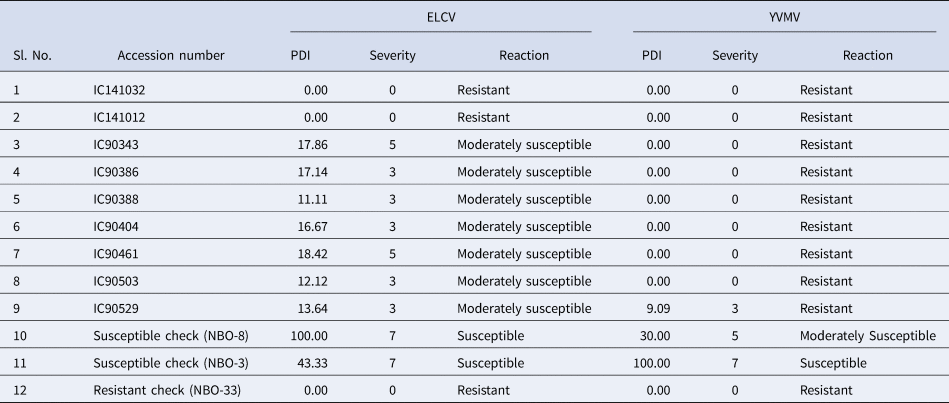
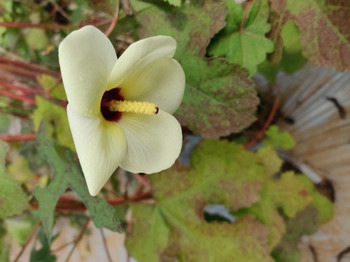
YVMV and ELCV incidence and severity were observed at 30-day intervals up to 90 days. Susceptible accessions, i.e., NBO-3 (for YVMV) and NBO-8 (for ELCV), showed 100% disease incidence with high severity and suggest the adequate inoculum level in the field. Resistant check NBO-33 was completely free from both viruses. Testing of 120 accessions of United States Department of Agriculture and National Bureau of Plant Genetic Resources belonging to A. esculentus and A. tetraphyllus species was done for disease reaction. Out of these, only two accessions IC141032 and IC141012 belonging to A. tetraphyllus were found to be completely free from both diseases (Fig. 1). Apart from these two accessions, seven other accessions were identified to be free from YVMV, but were moderately susceptible to ELCV (11–18%) with moderate severity (Table 1). Resistance nature of A. tetraphyllus was also described by Shetty et al. (Reference Shetty, Singh and Dhirendra2013). Singh et al. (Reference Singh, Rai, Kalloo, Satpathy and Pandey2007) reported that about 57% accession of A. tetraphyllus was found to be free from YVMV and 29 accessions of A. tetraphyllus were completely free from ELCV. Manjua et al. (Reference Manjua, Vijaya Lakshmia, Sarath Babub and Anithab2018) reported that wild accession IC344598 and two cultivated accessions, viz., PSRJ-12952 and RJR-124, did not show any signs of YVMV infection throughout the crop period and exhibited immune reaction. They opined that the incidence of less YVMV was probably due to the less population of whiteflies in these accessions. These results suggest that A. tetraphyllus accessions are a source of YVMV and ELCV resistance and our results are in accordance with these reports.
Abelmoschus tetraphyllus accession IC141032.

Reaction of okra wild accessions for YVMV and ELCV

Interspecific hybridization
Hybridization between in-house developed line NBO-9 and wild accessions IC141032 and IC141012 of A. tetraphyllus was successful with a crossability index of 80% (eight pods were set out of 10 pollinated flowers). The utilization of A. esculentus as a female parent resulted in this higher per cent (Fig. 2). This result is in line with the study conducted by Teshima (1933) and Sujatha (Reference Sujatha1983), who found that the cross was compatible only when A. manihot was used as a male parent and A. esculentus was used as a female parent. The successful F1s were obtained in both direct cross and reciprocal cross between A. tetraphyllus var. tetraphyllus and A. esculentus cultivars by Jambhale (Reference Jambhale1980) and Sheela (Reference Sheela1986). This high crossability index is because A. tetraphyllus and A. esculentus belong to ploidy level 3: 2n = 120–140 (Sutar et al., Reference Sutar, Patil, Aitawade, John, Malik, Rao, Yadav and Bhat2013).
Pollen load in A. tetraphyllus accession.

Germination and dormancy
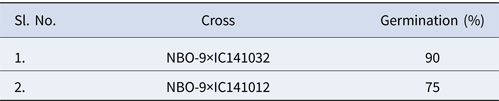
Out of the 100 seeds kept for germination from each cross, slight differences were observed in the germination percentage. Higher germination percentage (90%) was observed in the cross NBO-9 × IC141032 (Table 2). Dormancy was not observed in seeds obtained from either of the crosses. High percentage of germination was also observed in the study conducted by Reddy (Reference Reddy2015).
Germination percentage in different crosses

Hybrid sterility associated with interspecific hybridization
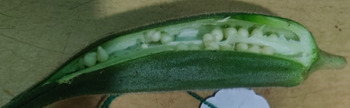
The interspecific F1s exhibited normal growth and flowering, and the fruit formation was normal, but the hybrids were completely sterile. In some fruits, seed set was observed but they were shrivelled and abortive (Fig. 3). The fertility behaviour in F1s is decided by chromosome homology, which is primarily measured by the frequency of bivalent formation. Meshram and Dhapake (Reference Meshram and Dhapake1981) reported that meiosis was abnormal in F1 between A. esculentus and A. tetraphyllus and it showed an average 37 bivalent and 55 univalents at metaphase I. Sterility in the interspecific hybrid can be attributed to this abnormal meiotic behaviour.
Shrivelled seeds in untreated F1.

Colchicine treatment to overcome the hybrid sterility
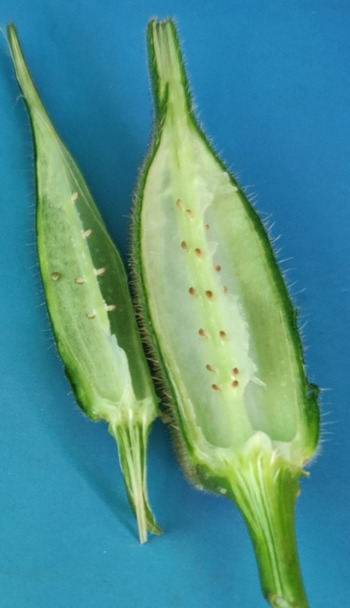
The interspecific hybrids were sterile and the seed set was not observed. Restoration of fertility is a prerequisite for advancing interspecific hybrids to further generations and colchicine treatment was done at the two-leaf stage to accomplish this. The seedlings exhibited scorching symptoms on the apical region after the colchicine treatment, but mortality of seedlings was not observed. The interspecific F1s exhibited vigorous sideward growth with normal fruit set (95%) and only a partial seed set (15%) was found (Fig. 4). The obtained fertile F1s were further used for the backcross programme to transfer resistance and other desirable traits.
Partial seed set in colchicine-treated F1.

Backcrossing raw colchiploids to the recurrent parent
Raw colchiploids were used as a pollen parent and NBO-9 was used as a female parent. Normal seed set (around 90%) was observed when raw colchiploids were used as a male parent, whereas a seed set of around 52% was observed when untreated interspecific F1 was used as a male parent. The seed set in the backcross was satisfactory, thus the raw colchiploids can directly be used for backcrossing instead of stabilized colchiploids.
Conclusion
The scarce availability of resistance sources in cultivated okra has led to the search for potential donors in the wild species and its subsequent transfer to the cultivated background. In virus hotspot screening, two A. tetraphyllus accessions resistant to both YVMV and ELCV were found and the resistance transfer was initiated. The interspecific crosses attempted for A. esculentus × A. tetraphyllus were successful. Hybrid breakdown and hybrid lethality were not encountered in F1 hybrid plants. However, the problem of hybrid sterility was identified in the interspecific F1 hybrid plants of A. tetraphyllus and A. esculentus. The problem of sterility in the interspecific F1 hybrid plants was partially overcome by resorting to colchiploidy. The colchiploids obtained by treating the interspecific F1 seedlings were partially fertile. These colchiploids have to be selfed to ensure complete fertility. Since a good seed set is observed in the first backcross between raw colchiploids and A. esculentus, we can initiate backcrossing at this level only if we can ascertain that there is no difference in the seed set using raw colchiploids and stabilized colchiploids by conducting further studies. This study represents the preliminary step in transferring the resistance from wild species A. tetraphyllus. Backcrossing followed by generation advancement will be carried out further for the transfer of resistance.