Introduction
Catheter-associated urinary tract infections (CAUTIs) are common healthcare-associated infections mandated for reporting to the National Health and Safety Network (NHSN) as an indicator of hospital quality. There is increasing recognition that some CAUTIs that meet the NHSN surveillance definition may not be clinically significant, as urine culturing is not able to distinguish between true infection and asymptomatic catheter-related bacteriuria. Reference Whelan, Nelson and Kim1,Reference Nicolle, Gupta and Bradley2 This is particularly salient in the setting of a general fever evaluation among hospitalized patients, for whom catheter-associated bacteriuria is usually indicative of asymptomatic colonization and is less commonly the cause of fever or infection. Reference Kizilbash, Petersen, Chen, Naik and Trautner3,Reference O’Grady, Barie and Bartlett4
Multiple approaches have been reported with variable success to improve the diagnostic accuracy of urine cultures among patients with urinary catheters. Reference Mullin, Kovacs and Fatica5–Reference Ling, Seidelman and Dodds-Ashley8 Pre-analytic interventions to reduce the collection and/or culturing of low-risk urine samples are one approach to diagnostic stewardship. Leveraging national guidelines for evaluation of fever in critically ill populations, Reference O’Grady, Barie and Bartlett4 one academic medical center previously implemented a successful multifaceted CAUTI reduction intervention. Reference Mullin, Kovacs and Fatica5 They obtained consensus among intensive care unit clinicians to obtain urine cultures only from patient populations at high risk of invasive infection, including those who had neutropenia, history of kidney transplantation, recent urologic surgery, or radiologic evidence of urinary tract obstruction.
Accurate diagnostics are a critical part of safe patient care, with both over-testing and under-testing potentially resulting in patient harm. Reference Madden, Weinstein and Sifri9 Providers may be triggered to order urine cultures in response to nonspecific symptoms when evaluating patients for suspected infection, such as fever or change in the character of the urine, even when the pretest probability of CAUTI is low. Reference Advani, Gao and Datta10 In such situations, potential harms of over-testing would include misdiagnosis of urinary tract infection as a cause of fever or overuse of antibiotics. Conversely, urine culture under-testing could risk complications related to untreated urinary tract infections. Reference Madden, Weinstein and Sifri9 Diagnostic stewardship interventions have generally demonstrated safety and efficacy in ecologic (ie, unit-level or facility-level) analyses Reference Kalorin, Dixon and Fike6,Reference Trautner, Grigoryan and Petersen11 but have not been stratified at the patient-level for whom the test was prevented and thus are at highest risk for untreated infection. Reference Madden, Weinstein and Sifri9
We evaluated the impact of a computerized diagnostic stewardship intervention to improve appropriateness of urine culture testing among adult patients with indwelling urinary catheters at our tertiary care hospital. The goal of our study was to evaluate whether our intervention, in addition to existing CAUTI prevention strategies, would improve appropriateness of urine culture orders for patients with urinary catheters. We evaluated the impact of the intervention on hospital-level CAUTI rates and patient-level harms.
Methods
We performed a retrospective study at a 697-bed academic tertiary care hospital, Rush University Medical Center, in Chicago, Illinois, with the purpose of analyzing the impact of a clinical decision support tool for urine culture orders placed for patients with indwelling urinary catheters. In February 2021, we implemented a computerized clinical decision support tool (Best Practice Advisory) to promote adherence to our internal urine culture criteria. Institutionally appropriate criteria for collection of a urine culture from a patient ≥18 years of age, on hospital day 3 or later, with an indwelling urinary catheter or within 24 hours after urinary catheter discontinuation included (1) neutropenia (absolute neutrophil count <100 cells/μl), (2) kidney transplant, (3) urologic surgery within the prior 30 days, or (4) radiologic evidence of urinary tract obstruction (eg, hydronephrosis). We divided the study period into the baseline (April 2018 to January 2021, no decision support) and intervention (February 2021 to July 2023, computerized clinical decision support) periods. The intervention was conducted under a quality improvement initiative. This retrospective study was reviewed by our institutional review board and determined to be exempt.
During the intervention period, a computerized clinical decision support tool was implemented that required ordering providers to select an institutionally appropriate indication for the urine culture or obtain infectious diseases specialist approval to order a urine culture from a patient with an indwelling urinary catheter (Figure 1). Infectious diseases specialists, in the context of a formal consultation, used clinical judgment in approving testing outside of institutional guidelines. The indications for urine culture selected by ordering providers were reviewed by the infection prevention team; if the order did not adhere to institutional guidelines, then the ordering provider was contacted by e-mail using a standardized audit feedback message explaining the policy (Figure S1). We excluded a 2-month intervention wash-in period (February–March 2021) from our comparative analyses.
Diagnostic stewardship intervention clinical decision support tool. During the intervention period, a computerized clinical decision support tool was implemented that required ordering providers to select an institutionally appropriate indication for the urine culture or obtain infectious diseases specialist consultation for approval to order a urine culture from a patient with an indwelling urinary catheter.

The primary outcome was a change in the facility-wide CAUTI rate (events per 1000 catheter-days), excluding neonatal and pediatric units, from the baseline to intervention period. CAUTI events were identified by the infection prevention team as defined by National Healthcare Safety Network (NHSN) criteria. 12 Adjusted negative binomial models compared baseline and intervention periods, controlling for time (month) and number of Covid-19 hospitalizations per month (calculated by creating a ranked variable of 4 groups, from 0 [mean, 0 hospitalizations] to 4 [mean, 230.7 hospitalizations]) (Table S1).
During the intervention period, we retrospectively analyzed urine culture indications, patient outcomes, and adverse events in relation to the diagnostic stewardship intervention. Some patient admissions had more than 1 stewardship intervention; thus, only the first instance per admission was selected for analysis. First, we evaluated the proportion of urine culture orders flagged by the clinical decision support alert that were collected or averted, based on the culture indication selected by the ordering provider. Next, we evaluated the patients affected by the intervention using two approaches. First, we performed a descriptive analysis of all patients with a urine culture averted during the intervention period, including demographic variables (ie, age, sex, race, and ethnicity), medical comorbidities (ie, presence of invasive medical devices and wounds), timing of the first diagnostic stewardship intervention (ie, day of hospital stay), and patient disposition at the time of hospital discharge (ie, discharged to home, discharged to other facility, admitted to hospice, or expired in hospital). Second, we performed more in-depth medical record review for the subset of consecutive patients who had a urine culture averted during the first year of the intervention, to clinically evaluate for outcomes of harm. An infectious diseases clinician (S.S.) reviewed electronic medical records. Secondary review of abstracted data and clinical summaries was performed by additional coauthors (M.Y.L. or J.S.).
We evaluated potential harms among patients who had a urine culture averted, including rate, timing, and outcomes of subsequent urine and blood culture testing after the initial diagnostic stewardship intervention. Potential harm was broadly defined as (1) collection of a urine culture within 7 days of the intervention that resulted in a change in clinical management; or (2) delayed treatment for an invasive infection from a potential urinary source.
Statistical analyses were performed using SAS version 9.4 (Cary, NC). We used a time series analysis approach with a negative binomial model offset by log-transformed urine catheter-days (1,000 days was selected due to the low frequency of CAUTI outcomes). We tested for interactions of intervention phase with time (month) and level to analyze differences in our primary outcome of CAUTI rate across intervention periods. Because the time slope did not differ between intervention phases, this parameter was removed from the model. For all calculations, statistical significance was defined as a two-tailed P value of <.05.
Results
Baseline assessment was performed over 34 months, including 358,670 patient-days. Intervention assessment was performed over 30 months, including 316,612 patient-days (20,265 wash-in days excluded; 296,347 intervention days analyzed). In unadjusted analyses, the mean monthly incidence of CAUTIs per 1000 catheter-days did not change significantly from baseline to intervention periods (P = .09). There were no significant monthly differences observed in urine catheter-days per 1000 patient-days (Table 1). The most notable difference during the baseline and intervention periods was the onset of the Covid-19 pandemic, which arrived in Chicago in March 2020 during the late baseline period (median Covid-19 hospitalizations per month 0 during baseline period vs 84 during intervention period, P < .01).
Unadjusted metrics during baseline and intervention periods

* Means for normally distributed data compared by t test. Medians for non-normal data compared by Wilcoxon test. Abbreviations: CAUTI, catheter-associated urinary tract infection; IQR, interquartile range, NHSN, National Healthcare Safety Network; SD, standard deviation.
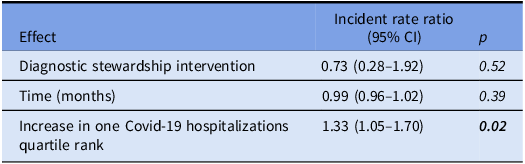
In unadjusted negative binomial models, the CAUTI rate decreased from 1.21 to 0.73 per 1,000 urine catheter-days during the baseline and intervention periods (P = .05). The models were then adjusted for time and Covid-19 hospitalizations. Covid-19 hospitalizations, but not time, were significant covariates in the multivariate model (P = .02 and P = .39, respectively). In negative binomial models, adjusting for ranked average number of Covid-19 hospitalizations, the CAUTI rate did not change significantly (1.03 per 1,000 catheter-days during the baseline period to 0.75 per 1,000 catheter-days during the intervention period, P = .52). (Figure 2, Table 2).
CAUTI rate per 1,000 catheter-days at baseline and during intervention period. In negative binomial models adjusting for time and number of Covid-19 hospitalizations, the predicted CAUTI rate decreased from 1.03 to 0.75 per 1,000 urinary catheter-days during the baseline and intervention periods, respectively. Implementation of the diagnostic stewardship intervention was associated with a non-significant decreased incident rate ratio of CAUTI per 1,000 patient-days (0.73, P = .52).

Variables included in multivariable model evaluating the effect of a diagnostic stewardship intervention on hospital-wide CAUTI rate

Abbreviations: CAUTI, catheter-associated urinary tract infection; CI, confidence interval.
We selected the first diagnostic stewardship intervention event, if present, during each unique hospital admission for further analyses. There were 598 patients during the intervention period with at least one diagnostic stewardship intervention. Of these, there were 284 (47.5%) urine cultures collected that were documented to meet institutional appropriateness criteria. Providers reported the following appropriateness criteria: 107 (38%) recent urologic surgery, 67 (24%) radiologic evidence of urinary tract obstruction, 61 (21%) neutropenia, 42 (15%) infectious diseases approval, and 7 (2%) kidney transplant. Among those encounters with urine culture testing approved by an infectious diseases consultant, 15/42 (36%) of approvals were the result of a new infectious diseases consultation triggered by the alert; the remaining approvals were provided by infectious diseases consultants already involved in the patient’s care. Provider-selected indications were reviewed by the infection prevention team, with an average of 3.75 false indications identified per month (eg, the provider-selected neutropenia, but the patient was not neutropenic) during the first year of the intervention after the wash-in period. The remaining 314 (52.5%) provider-initiated urine culture orders did not meet institutional criteria, and urine culture testing was averted.
We examined clinical characteristics and disposition at hospital discharge among patients for whom urine culture testing was averted (n = 314). Mean age was 64 years (standard deviation [SD] 17 years), 53% were male, and the first diagnostic stewardship intervention occurred on median hospital day 5 (interquartile range [IQR] 3–10 d). Patients had high rates of invasive medical device use in addition to urinary catheters, including 140 (45%) with central venous catheters and 89 (28%) requiring mechanical ventilation. One-hundred and seventy-eight (57%) had documented presence of wounds. At the time of hospital discharge, 129 (41%) were discharged to another healthcare facility, 90 (29%) were discharged to home, 65 (21%) expired in the hospital, and 30 (9%) were transitioned to hospice care.
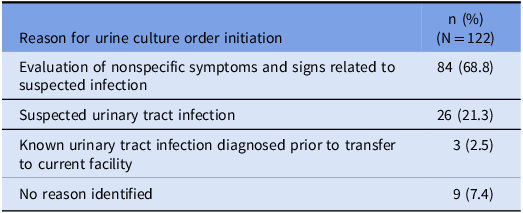
To understand the reasons for urine culture order initiation, we next performed medical record review of consecutive patients who had ≥1 urine culture order initiated and then averted during the first year of the intervention (n = 122). Evaluation for suspected infection based on nonspecific symptoms and signs was the most common reason for initiating a urine culture order (n = 84, 68.8%), followed by evaluation for urinary tract infection (n = 26, 21.3%). In 7.4% of admissions, no clear reason for initiation of the urine culture order could be identified (Table 3).
Reason for initiation of urine culture orders that were averted during the first year of a diagnostic stewardship intervention

We then evaluated patients who had a urine culture averted for potential harms related to the intervention. Among the 314 patients for whom urine culture testing was initially averted, 44 (14%) had a urine culture collected within the subsequent 7 days of hospitalization (median 1 day, IQR 0 – 1 day, Table S2). At the time of subsequent urine culture collection, 17/44 patients had met the internal facility criteria for urine culture (14 urinary catheters removed >24 hours prior to collection, 2 new radiologic evidence of urinary tract obstruction, and 1 infectious disease approval) and 27/44 did not meet criteria. There were 2/44 patients (<1%) for whom a subsequent urine culture resulted in a change in clinical management by prompting change in antimicrobial therapy. There were an additional 2/44 patients (<1%) with diagnoses of bacteremia from suspected urinary source, but the intervention did not result in any delays in effective treatment. No other bacteremia of suspected urinary source was identified within 7 days of the intervention. There was 1/44 patient for whom antimicrobial-resistant organism colonization was identified that was not otherwise known (NDM1-carbapenemase-producing Klebsiella pneumoniae), but identification of this organism did not result in change in clinical management.
Discussion
A computerized diagnostic stewardship intervention using clinical decision support was associated with an approximately 50% reduction in urine culture testing for hospitalized patients with an indwelling urinary catheter. However, the overall CAUTI rate did not decrease significantly. Importantly, we did not observe evidence of patient-level harms in our evaluation, including missed infection from a urinary source or delay in appropriate antimicrobial therapy.
A common reason that urine cultures are obtained from hospitalized patients is for the evaluation of new fever, which may be an indicator of infection. Catheter-associated bacteriuria, candiduria, and pyuria have poor diagnostic value to identify infection among patients with urinary catheters. Recognizing this limitation, the 2008 Society of Critical Care Medicine (SCCM) and Infectious Diseases Society of America (IDSA) guidelines for evaluating new fever in adult patients in the intensive care unit recommended obtaining urine cultures from catheterized patients at high risk of invasive infection. Reference O’Grady, Barie and Bartlett4 SCCM/IDSA 2023 guidelines substantially revised this recommendation, eliminating the assessment of invasive infection risk. Rather, the 2023 guidelines recommended obtaining specimens from a newly replaced urinary catheter from all intensive care unit patients with pyuria and in whom urinary tract infection is suspected, regardless of risk of invasive infection. Reference O’Grady, Alexander and Alhazzani13 Although both approaches have merit, our findings support the safety of the 2008 guidance, which prioritizes culture evaluation among high-risk individuals.
We observed a trend of decreased CAUTI rate that preceded our diagnostic stewardship intervention. This trend may be attributable to other CAUTI prevention initiatives that predated, or were concurrent with, our intervention. In 2018, prior to the onset of our intervention, the introduction of female external urinary catheters allowed less indwelling urinary catheter use. In 2019, we added cleansing the perineum and first 6 inches outward from the insertion site of the urinary catheter with 2% chlorhexidine gluconate-impregnated cloths to routine catheter care protocols. Additionally, we expanded nursing education initiatives, such as regular e-mails with CAUTI prevention tips, teaching CAUTI prevention during new nursing hire skills days, and including CAUTI prevention in annual nursing educational modules. Thus, the observed secular decrease limited our ability to detect a significant decrease in CAUTI rate related to our intervention.
The timing of our intervention overlapped with the onset of the Covid-19 pandemic in our region, with an increased number of Covid-19 hospitalizations associated with higher incident rate ratio of CAUTI. This association is consistent with prior published reports identifying increased CAUTI rates during the onset of the Covid-19 pandemic, Reference Sands, Blanchard, Fraker, Korwek and Cuffe14,Reference Baker, Sands and Huang15 likely due to major strain and resource limitations on the healthcare system. Reference Krauss, Molefe and Hung16 Our models were designed to control for effects of the Covid-19 pandemic on CAUTI rates by accounting for the number of Covid-19 hospitalizations at our facility. Inclusion of Covid-19 hospitalizations into our models attenuated the intervention effect, particularly during the initial peak of hospitalizations.
Our study has several limitations. The study was performed at a single tertiary care center, which may limit the generalizability of our findings. We observed lower CAUTI rates than those previously reported in similar study designs, Reference Mullin, Kovacs and Fatica5 potentially limiting our ability to detect incremental improvement in CAUTI rate. Additionally, our study was not designed to assess the impact of the diagnostic stewardship intervention on antimicrobial use. Others have demonstrated that avoidance of unnecessary urine culturing is associated with decreased antibiotic use. Reference Sloane, Kistler, Reed, Weber, Ward and Zimmerman17–Reference Coffey, Morgan and Claeys19
Our study evaluated potential harms of the intervention stratified to the patient level, rather than the aggregate population level. We prioritized evaluating potential harms among individuals who had a urine culture prevented and thus were presumed to be at highest risk of untreated urinary tract infection. These safety measures have been limited in evaluation of diagnostic stewardship interventions in prior work. Reference Madden, Weinstein and Sifri9 For example, in a large academic medical center, a multifaceted approach with emphasis on stewardship of urine culturing was associated with reduced CAUTI rate, Reference Mullin, Kovacs and Fatica5 with hospital-acquired bloodstream infection rates leveraged to demonstrate safety. Similarly, a midwestern hospital system extended those findings by integrating a urine culture electronic order alert into the electronic health system. Safety was demonstrated by monitoring for change in hospital-onset sepsis, length of stay, and mortality rates. Reference Kalorin, Dixon and Fike6 Our findings further support the safety of clinical decision support interventions to promote urine culture diagnostic stewardship.
Conclusion
A diagnostic stewardship intervention was associated with an approximately 50% decrease in urine culture testing for individuals with a urinary catheter. Adverse outcomes were rare among patients who had a urine culture averted. A computerized clinical decision support tool may be safe and effective as part of a multimodal program to reduce unnecessary urine cultures in patients with indwelling urinary catheters.
Supplementary material
The supplementary material for this article can be found at https://doi.org/10.1017/ice.2024.209
Acknowledgments
Financial support for this project was provided by the Rush University Cohn Foundation through the Cohn Research Scholar Pilot Grant. No authors report relevant conflicts.
We acknowledge our outstanding infection prevention team members (listed in alphabetical order) Sreya Alex RN CIC, Jessica Brudnicki MSN, APRN, AGCNS-BC, Kathleen Posa-Kearney MSN, APRN, ACCNS-AG, CCRN, Alina Stancovici BSN, RN, CIC, Marcelina Wawrzyniak MSN, RN, CIC and Lindsay Westphal, MPA, BSN, RN-BC who provided nursing leadership and support in implementing the diagnostic stewardship intervention.