1. Introduction
The International Criminal Court (the ICC or the Court) uses the methodology in Articles 31–33 of the VCLT to interpret the Rome Statute. According to Trial Chamber II of the Court, the VCLT provides ‘a method of interpretation which is both circumscribed and rigorous and which leaves little scope for any risk of misinterpretation of the Statute’.Footnote 1 The method is probably more well-known for its flexibility and judicial subjectivity, however, than for its circumscription and rigour.Footnote 2 There is neither hierarchy nor prioritization (other than a focus on text), for instance, among the VCLT’s Article 31 interpretative elements (good faith, ordinary meaning, etc.); there is no requirement as to the order in analysing the elements; the broad category quality of most of the elements provides significant leeway in selection; and although the VCLT appears to require consideration of all Article 31 elements, in practice – at least from the analyses apparent in judicial decisions – this appears to almost never happen. This flexibility makes sense because interpretation is not a purely mechanical exercise.Footnote 3 It is as much an art as a science.Footnote 4 And judges are selected precisely for their good judgment.
But too much flexibility can be problematic, especially when it comes to interpreting criminal statutes. International criminal courts and tribunals have a unique constraint imposed on them by the principle of legality, which among other things prohibits retroactive criminalization and requires the descriptions of proscribed acts to be sufficiently precise. The ICC’s predecessor international criminal tribunals – the International Criminal Tribunal for the former Yugoslavia (ICTY) and the International Criminal Tribunal for Rwanda (ICTR) – which also applied the VCLT, have been roundly criticized for their ‘adventurous interpretations’.Footnote 5 Indeed, constraints on the ICC made explicit in Articles 21–24 of the Rome Statute are seen as direct responses to the ad hoc tribunals’ creative interpretation and application of lawFootnote 6 and to the VCLT’s lack of special rules for penal statutes.Footnote 7 Article 22 provides, for instance, that definitions of crimes ‘shall be strictly construed’ and ambiguities in definitions ‘shall be interpreted in favour of the person being investigated, prosecuted or convicted’.
Has the ICC been following in the ad hoc tribunals’ overly creative footsteps? Ohlin, van Sliedregt and Weigend observe, at least in 2013, that ‘judicial practice at the ICC, at least so far, has demonstrated a penchant for judicial activism and creativity’.Footnote 8 The ten case studies of interpretation examined in this article indicate similar concerns. The decision over the alleged deportation of the Rohingya people of Myanmar to Bangladesh was called a ‘misinterpretation’ and ‘built on faulty premises’.Footnote 9 The decision to refuse authorization to commence an investigation in AfghanistanFootnote 10 was characterized by legal commentators as ‘most likely ultra vires’,Footnote 11 a clear error,Footnote 12 and ‘legally wrong’.Footnote 13 A 2014 interpretation in a Democratic Republic of the Congo (DRC) case, according to one legal scholar, led to an implication that ‘stands in contrast to the wording of the Statute and the intended will of the drafters’Footnote 14 while another distinguishing between principal and accessorial liability, in another academic’s view, ‘suffer[ed] from ambiguities and wrongful assumptions’.Footnote 15
The contrast between Trial Chamber II’s proclamation about the rigour and low risk of misinterpretation, on one hand, and the charges of misinterpretation by legal scholars, on the other, provoked the research questions underlying this study: How can the ICC’s application of the VCLT elements be analysed systematically? What does this analysis demonstrate about the looseness and flexibility inherent in the VCLT methodology? Is this flexibility consistent with the constraints of strict construction under Article 22 of the Rome Statute?
The article attempts to answer the first question by empirically observing the identity and sequence of each VCLT element used in ten ICC case studies, and measuring the amount of text used by the Court in applying each element. These data are then depicted in graphs and analysed comparatively across interpretations. Concerns raised by the individual case studies are also discussed briefly. In response to the second question, the results demonstrate that, at least across these ten instances, the application of the VCLT is markedly inconsistent and, in some instances, opaque and arguably unjustifiable. There were nevertheless some instances when the Court transparently explained its use of elements and, unexpectedly, even mentioned legal authorities that did not support its eventual interpretation. These instances can serve as models for an improved approach. The interpretation mapping suggests, in response to the third question, that applying the highly-flexible VCLT to resolve indeterminacies (this article uses the term ‘indeterminacy’ to refer to the separate concepts of vagueness and ambiguity)Footnote 16 in the Rome Statute may erode core underlying values provided by legality’s principle of strict construction – in particular, the need for sufficient legal clarity. The article proposes, in sum, that the Court more systematically and thoroughly explain its reasoning behind the selection and application of the VCLT elements.
Section 2 of this article discusses the place of legality in the Rome Statute, with a focus on strict construction, and reviews some of the academic literature regarding the impact of strict construction on the application of Articles 31–33 of the VCLT. Section 3 introduces the VCLT’s interpretative method and discusses how some other international courts have applied it. Section 4 explains the methodological approach used for this article’s interpretation mapping and the selection of case studies. The data coding – identifying the VCLT elements, their order, and the amount of text used to apply each element – is at the heart of the mapping and thus most of Section 4 addresses the coding’s value and limitations. Section 5 shifts to the empirical results, first providing summary graphs of the mapping and then highlighting some of the concerns raised by the case studies. Section 6 suggests that the ICC can increase clarity, predictability, rigour and respect for strict construction by being more transparent and complete in explaining its application of the VCLT elements.
2. Strict construction in interpreting the Rome Statute
The ICC has explained that it ‘must draw on the method of interpretation laid down in the Vienna Convention on the Law of Treaties, specifically articles 31 and 32’ to ‘interpret the relevant provisions of the Statute and the Elements of Crimes’.Footnote 17 There are a number of compelling reasons to turn to the VCLT to understand the Rome Statute and resolve indeterminacies that arise. The Rome Statute does not provide its own method of interpretation, so the Court must look elsewhere for guidance.Footnote 18 The Rome Statute is a treaty, making it eligible for interpretation by the VCLT rules.Footnote 19 The VCLT rules are the most well-known and widely-used method of interpretation of international law and are part of customary international law, and thus binding on international organizations like the ICC.Footnote 20 The ICTY, the ICTR and the Special Tribunal for Lebanon (STL), whose subject matter jurisdiction overlaps with the ICC’s, have also used the VCLT for interpretation.Footnote 21 The VCLT has proved useful to international courts generally, which have used them as guidance, to build credibility, achieve accountability, structure their reasoning process, and help make their decisions understandable.Footnote 22
While Articles 31–32, and to a certain extent Article 33, of the VCLT are used to interpret the Rome Statute and the Elements of Crimes, Article 21 of the Rome Statute provides a hierarchy of sources of law that the ICC must apply.Footnote 23 First in this hierarchy are the Rome Statute, the Elements of Crimes and the Rules of Procedure and Evidence. Only when there is a lacuna in these first three sources can the Court turn to the subsidiary sources in Article 21(1)(b) and (c) (treaties, principles and rules of international law, and general principles of law).Footnote 24 One way of understanding the relationship between these provisions in the Rome Statute and Articles 31–33 of the VCLT is that the Court must first turn to Article 21 to determine which source of law must be applied to a particular legal issue before it, and then to understand that source of law in instances when its meaning is not self-evident, the Court must then apply Articles 31–32 of the VCLT. There is overlap between the two. For instance, Article 21 of the Rome Statute provides that the Rome Statute itself is the primary source of applicable law and it is also an essential element – arguably the most important – of interpretation in Article 31 of the VCLT (the ‘text’ of the treaty itself). Thus, when appropriate, the Rome Statute should be used to interpret the Rome Statute. As another example of overlap, Article 21 of the Rome Statute provides for the application of ‘the principles and rules of international law’ while Article 31 of the VCLT provides for the consideration of ‘[a]ny relevant rules of international law applicable in the relations between the parties’ in interpretation. The rules of international law, in other words, are used both in application (when there is a lacuna in the Rome Statute, the Elements of Crimes and the Rules of Procedure and Evidence) and in treaty interpretation (together with the context of the treaty terms).
Using the VCLT to interpret the Rome Statute, however, is different from using it to understand non-criminal treaties. The Rome Statute is not only a treaty but also a criminal statute, making the application of the VCLT’s method at times awkward because some of its provisions apply directly to interstate disputes.Footnote 25 For instance, the consideration in Article 31(3)(b) of ‘[a]ny subsequent practice in the application of the treaty which establishes the agreement of the parties regarding its interpretation’ makes little sense in the context of the Rome Statute, which for the most part is applied and interpreted by a court rather than through the practice of states parties. Similarly, that the VCLT would be used to interpret the Rome Statute in adjudicating criminal cases, rather than limited to playing a role in resolving disputes between states parties, is not self-evident. Additionally, there are express constraints of legality built into the Rome Statute that are not present in other treaties, are much more extensive than in the statutes of the ICTY, ICTR, and STL, and directly impact its interpretation. The Statute’s emphasis on legality has been called ‘unprecedented’Footnote 26 and its exceptional detail, especially on the definitions of crimes (Article 6–8) and general principles (Articles 22–24),Footnote 27 reflects a ‘veritable obsession with the principle of legality’.Footnote 28 Legality requires, among other things, that definitions of crimes be strictly construed and not applied retroactively so that defendants receive fair notice and the ‘arbitrary exercise of coercive power’ is curbed.Footnote 29 A key limitation is that legality only applies to substantive rules of criminal law, i.e., rules that affect a defendant’s substantive human rights such as liberty, propriety or privacy. Footnote 30 In the Rome Statute, this means the definitions of crimes and their corresponding penalties, and arguably to the modes of liability.Footnote 31 Importantly, the principle of legality thus does not extend, for instance, to procedural or jurisdictional questions.Footnote 32
The interpretation and application of law are also constrained by the standards established in internationally recognized human rights via Article 21(3) of the Rome Statute, such as the limitation of the Court’s jurisdiction to individuals who could reasonably expect to face prosecution under national or international law.Footnote 33 For an ex post facto case involving crimes committed in the territory, or by nationals, of non-states parties, for instance, the Court would have to determine whether and to what extent the alleged criminal acts, at the time of their commission, were criminalized under national law or international customary law.Footnote 34 Importantly, legality under the Rome Statute is stricter than under international human rights treaties and customary international law, where laws need not necessarily be in writing and strict construction is not required.Footnote 35
The use of the VCLT to resolve indeterminacies in meaning intersects most significantly with Rome Statute Article 22’s requirement of strict construction: ‘The definition of a crime shall be strictly construed and shall not be extended by analogy. In case of ambiguity, the definition shall be interpreted in favour of the person being investigated, prosecuted or convicted’ (emphasis added). The three principles enumerated in Article 22 – strict construction, no extension by analogy and lenity (interpreting ambiguities in favour of the accused) – operate in tandem and cover different aspects of interpretation when enumerated separately. Strict construction assists in resolving vagueness (more common) while lenity applies to ambiguities (less common).Footnote 36
In the context of the Rome Statute, Davidson proposes that strict construction means construing with three considerations in mind: interpreting in a manner that increases clarity in international criminal law, avoiding unfairly surprising defendants and avoiding usurping the authority of states.Footnote 37 Articulating why an interpretation in international criminal law differs from or is consistent with, for instance, international human rights and humanitarian law norms, is one way of adding clarity.Footnote 38 Increasing clarity not only refers to clarity of the content of a judicial explanation of interpretation but also, crucially, involves the process of clarifying.Footnote 39 Put another way, clarity of law is improved when judicial decisions contain more explanations, made in greater detail and made systematically. Transparency, explicit reasoning and care of explanation are crucial to clarity.Footnote 40 In this vein, Merkouris for instance argues:
[A more detailed explanation of the application of the VCLT elements] gently forces courts and tribunals (both international and domestic) to give more substantiated and clearly argued judgments. This, in turn, helps to hold these courts and their judgments accountable to a higher standard of reasoning and to a methodological coherence that is necessary for our discipline, thus contributing to the further refinement of the language and tools to be employed in the application of international rules, whatever their source.Footnote 41
When an indeterminacy is identified in a definition of an ICC crime or a mode of liability, strict construction therefore should compel the Court to articulate in detail its interpretative reasoning and its grounding in the VCLT. In addition to improving clarity, giving reasons also can counteract biases and self-interest.Footnote 42 It improves consistency, discourages abuse of power, facilitates better quality decisions by encouraging careful thought and improves accountability by allowing errors in reasoning to be rectified on appeal.Footnote 43 Samuels sums it nicely: ‘The more exposure of the system there is, especially the decision-making process, the better.’Footnote 44 Given these benefits, it would behove the Court to detail its reasoning through a methodical, transparent and thorough application of the VCLT elements even outside the areas where strict construction is mandatory, such as in procedural or jurisdictional questions. Clarity in international law, after all, is beneficial for all legal issues.
Does legality, and in particular strict construction, impact the manner of applying the VCLT, such as its non-hierarchical process? Does strict construction require giving even greater priority to the text of the provision being interpreted than is already given under conventional practice? Does legality de-prioritize consideration of the object and purpose of the treaty? Does it proscribe the use of the VCLT altogether? There is support in the scholarly literature to some degree for all these propositions. Grover, for example, argues that Article 22 acts as a ‘guiding interpretive principle’, meaning among other things that textual primacy and coherence take precedent over the intent of the drafters or a teleological approach (discerning drafter intent as reflected in the text is conventionally the ultimate aim). Giving priority to the text would mean, for instance, that an interpretation supported by one VCLT element – such as applicable rules of international law – cannot be accepted unless also sufficiently supported by the text.Footnote 45 Akande has pointed out that the application of lenity requires the Court, once it identifies an ambiguity – which, significantly, has a low threshold of simply ‘a plausible difference of interpretation or application’ – to adopt the meaning most favourable to the accused. He also observes that the Special Court for Sierra Leone has appeared to acknowledge that it even can override provisions in its statute that violate legality.Footnote 46 Appazov suggests that ‘[t]he VCLT, after all, with its contextual, teleological, and purposive interpretative prescriptions has never been intended for the straightforward application to a criminal law treaty’.Footnote 47 Jacobs argues that use of the VCLT in the international criminal law context should at least be significantly qualified due to legality’s requirements, and (taking probably the most extreme position) at most, ‘the Vienna Convention should in fact be excluded as a[n] interpretative tool for Statutes of international criminal tribunals’.Footnote 48 As proposals that can be implemented into actual court decisions, Grover suggests that strict construction should encourage courts to elaborate on and provide lists of elements of crimes and illustrations.Footnote 49 De Souza Dias proposes that the impact of Article 22(2) on interpreting the phrase ‘interests of justice’ in Article 53 of the Rome Statute should include the consideration of factors that would relate to the rights and interests of the accused and the judicial creation of a list of factors as possible ‘interests of justice’.Footnote 50
This article’s proposals are similar to Grover’s and De Souza Dias’ in that, rather than making broad normative claims about the impact of legality on interpretation, they more modestly advocate that the Court produce more extensive, detailed and complete justifications of its application of the VCLT, and that this would be an important step in increasing clarity in the Rome Statute and international criminal law more broadly. The final section of this article lobbies more ambitiously, however, for a broad scope of implementation. This is to say, there is no compelling reason (that would outweigh the benefits discussed above, such as clarity, accountability and opinion quality) why judicial explanations should not also be improved for all legal issues, even those that do not technically trigger legality.
3. The practices of using the VCLT to interpret law
Trial Chamber II explained, consistent with the conventional manner of applying the VCLT by international courts, that Articles 31 and 32 set forth one general rule of interpretation; namely, that ‘a treaty shall be interpreted in good faith in accordance with the ordinary meaning to be given to the terms of the treaty in their context and in light of its object and purpose’.Footnote 51 This rule refers to a ‘holistic approach’ in which ordinary meaning, context, and object and purpose are to be considered together, at the same time, rather than in a hierarchical or chronological order.Footnote 52 The VCLT rules thus do not prescribe the process of interpretation but instead ‘designate the elements to be taken into account’ and their relative weight.Footnote 53 The text, meaning the text of the provision at issue, is generally considered the principal element but all – the text, the context and the object and purpose – ‘must be applied in a single combined operation’.Footnote 54
Articles 31–32 provide in full:
Article 31. GENERAL RULE OF INTERPRETATION
1. A treaty shall be interpreted in good faith in accordance with the ordinary meaning to be given to the terms of the treaty in their context and in the light of its object and purpose.
2. The context for the purpose of the interpretation of a treaty shall comprise, in addition to the text, including its preamble and annexes:
(a) Any agreement relating to the treaty which was made between all the parties in connexion with the conclusion of the treaty;
(b) Any instrument which was made by one or more parties in connexion with the conclusion of the treaty and accepted by the other parties as an instrument related to the treaty.
3. There shall be taken into account, together with the context:
(a) Any subsequent agreement between the parties regarding the interpretation of the treaty or the application of its provisions;
(b) Any subsequent practice in the application of the treaty which establishes the agreement of the parties regarding its interpretation;
(c) Any relevant rules of international law applicable in the relations between the parties.
4. A special meaning shall be given to a term if it is established that the parties so intended.
Article 32. SUPPLEMENTARY MEANS OF INTERPRETATION
Recourse may be had to supplementary means of interpretation, including the preparatory work of the treaty and the circumstances of its conclusion, in order to confirm the meaning resulting from the application of article 31, or to determine the meaning when the interpretation according to article 31:
(a) Leaves the meaning ambiguous or obscure; or
(b) Leads to a result which is manifestly absurd or unreasonable.
Article 33 adds that, unless otherwise agreed to, a treaty authenticated in multiple languages is equally authoritative in each, the terms in each are presumed to have the same meaning and, if a comparison between the different versions reveals a difference in meaning that cannot be resolved by Articles 31–32, ‘the meaning which best reconciles the texts, having regard to the object and purpose of the treaty, shall be adopted’. The authenticated versions of the Rome Statute are in Arabic, Chinese, English, French, Russian and Spanish.
A discussion of the vast literature explaining each of the interpretative elements in detail is beyond the scope of this article but a couple features are worth briefly noting.Footnote 55 ‘Ordinary meaning’ is the way a term, a group of words or a sentence are commonly understood. These words or phrases – what could be called the ‘text’ – must be interpreted in their context. Context includes, among other things, what could be called ‘treaty text’, which encompasses the entire treaty including appendices and the preamble, and refers to structure as much as meaning.Footnote 56 The difference between ‘text’ and ‘treaty text’ is not only important in prioritizing interpretative elements (with ‘text’ more important) but also in applying other elements. For instance, the contextual element of ‘object and purpose’ may refer to the object and purpose of the treaty generally or the object and purpose of the particular text at issue. Additionally, the generally-accepted view is that there is a strict hierarchy between Articles 31 and 32, meaning supplementary means are given less value than the elements in Article 31.Footnote 57 The precise scope of supplementary means other than preparatory work, however, remains uncertain,Footnote 58 resulting in ‘scarcely any clear limits’ on the consideration of materials that might assist in establishing the meaning of a treaty.Footnote 59
The manner in which other international courts have applied the VCLT (how thoroughly the elements are addressed, which elements are most frequently used, whether Article 32 sources are used in practice as primary or supplementary means, etc.) can provide an indication of how the ICC might also employ the VCLT and what the empirical results of this study might show. Though studies that examine VCLT application in this very granular way are rare, there is evidence from the studies described below that other international courts and tribunals make some effort to appear to apply the elements holistically but do not engage in a systematic application of all elements in a particular order. They often do not ground their use of authorities in specific sections of the VCLT or transparently justify their use of the elements. They also frequently do not discuss interpretative elements that do not support the eventual interpretation. And they often do not restrict their use of authorities under Article 32 as a subsidiary way to confirm an interpretation or determine meaning when an Article 31 analysis leaves the meaning ambiguous or leads to an absurd result (but instead use them as primary sources of interpretation).
Popa, for instance, found in her study that the International Court of Justice (ICJ) applies the VCLT elements holistically by using more elements than necessary – she calls this ‘overbuilding’ – but does not apply the elements mechanically, does not feel compelled to use the same order of elements even when the interpretative problems are similar in nature and often emphasizes some interpretative elements over others (without suggesting that any element is more important than another).Footnote 60 Gardiner similarly describes how international courts and tribunals often give a ‘mere nod’ to the Vienna rules, referring to them briefly or reproducing them verbatim but not always applying them systematically.Footnote 61 Popa does not point to instances where the ICJ noted a particular element unhelpful or contrary to its eventual interpretation. She also found evidence that the ICJ was first making a ‘normative judgment and balancing’ before the ‘firm grounding on rules of interpretation’.Footnote 62
In his study of 98 decisions by tribunals of the International Centre for Settlement of Investment Disputes (ICSID), Fauchald observed frequent use of the VCLT elements generally but also found a dearth of in-depth explanations about how the elements were selected and used.Footnote 63 He notes that the explanations of the application of the VCLT were usually very brief with only general arguments of support for the tribunals’ interpretative approaches while actual integration of interpretation into the reasoning was exceptional. In applying ‘object and purpose’, for instance, ‘tribunals often simply referred to the argument without explaining explicitly how it was used … The extent to which ICSID tribunals found it unnecessary to indicate how they established the object and purpose is remarkable’.Footnote 64 As another example, Fauchald found a thorough analysis of customary international law in seven decisions, a summary analysis in eight and no analysis in 13. Similarly, none of the four decisions using general principles of law thoroughly explained the content of the principles. Turning to Article 32, ‘few cases’ involving preparatory work explained the work with specificity or detail, with its supplementary nature rarely mentioned. Instead, tribunals ‘frequently resorted to preparatory work as the starting point for their analysis or as an essential argument’.Footnote 65 Interestingly, legal doctrine (usually books and articles authored by legal experts) was often (in 73 decisions) used as Article 32 supplementary means; in a majority of these cases, it was employed as an essential argument and in more than half was used as a starting point for legal analysis.
The authors of this article did not find empirical studies detailing the use of the VCLT elements at international criminal tribunals similar in detail to Popa’s and Fauchald’s. There is evidence that the ad hoc criminal tribunals have had little regard for strict constructionFootnote 66 and that ‘[l]awmaking under the guise of purposive interpretation has been a common feature of the ICTY’s reasoning’.Footnote 67 In a moment of revealing honesty, Antonio Cassese, former President of the ICTY, conceded that:
out of nothing – very few cases – you have to create a new law, and you have to say something new … particularly in the area of criminal law, where we normally tend to stick to the principle of nullum crimen sine lege, but sometimes, you have to find a new principle.Footnote 68
The interpretative practices at the ICJ and the ICSID tribunals, and the creativity observed at the ad hoc tribunals, suggest that if the ICC follows in their footsteps, it would likely not regularly engage in systematic, methodical and thorough analysis of the VCLT elements. Indeed, manifestation of strict construction in applying the VCLT at the ICC, at least as of 2011, has been rare.Footnote 69 Goy observed that the ICC has ‘not always been very technical’ when interpreting the Rome Statute.Footnote 70 On the other hand though, no one, including the ICC, has suggested that the VCLT should be applied without considering the constraints established by Articles 22–24 of the Rome Statute.Footnote 71 This article’s findings indicate that the impact of Article 22, and in particular strict construction, has not resulted in noticeable systematicity in the application of the VCLT, but that the Court’s approach varies significantly across case studies; often, the use of Article 32 supplementary means is insufficiently justified; and three instances of the Court explaining that some VCLT elements did not support its eventual interpretation were unexpectedly found.
4. Methodology, case selection, and limitations
The methodology used in this article – content analysis – systematically analyses documents and text with the aim of quantifying content into categories.Footnote 72 Content analysis can be used in both quantitative and qualitative research designs. Patterns and themes emerge from the data and importance is placed on the context in which the content appears. Emphasis is not placed on meaning, as in doctrinal analysis; instead, content analysis views court judgments and legislation as text, quantifies the words and then examines the language.Footnote 73
The features of the text that were examined for this study were: the identity of 11 of the elements of interpretation in Articles 31 and 32 of the VCLT; the number of lines of text used for each element’s application; and the order in which the elements were applied. ‘Elements of interpretation’ refer to the following 11 means of interpretation: (i) good faith (Article 31(1)); (ii) ordinary meaning (Article 31(1)); (iii) object and purpose (Article 31(1)); (iv) context – text of the treaty (Article 31(2)); (v) context – agreement relating to the treaty which was made between all parties in connexion with the conclusion of the treaty (Article 31(2)(a)); (vi) context – instrument which was made by one or more of the parties in connexion with the conclusion of the treaty and accepted by the other parties as an instrument related to the treaty (Article 31(2)(b)); (vii) subsequent agreement between the parties regarding the interpretation of the treaty or the application of its provisions (Article 31(3)(a)); (viii) subsequent practice in the application of the treaty which establishes the agreement of the parties regarding its interpretation (Article 31(3)(b)); (ix) relevant rules of international law applicable in the relations between the parties (Article 31(3)(c)); (x) supplementary means – preparatory work of the treaty and the circumstances of its conclusion (Article 32); (xi) supplementary means – other supplementary means (Article 32).Footnote 74 These elements, in the order in which they appear in the VCLT, are depicted in Figure 1.
11 VCLT Elements.

At first blush, collecting this type of data may seem too mechanical and the data might appear too simplistic to provide meaningful insight into something as complex and nuanced as legal interpretation. Subjecting legal interpretation to this type of granular empirical probing, however, can lead to insights otherwise obscured. Though observing the constituent parts of Vincent van Gogh’s paintings, for instance, misses the painting’s beauty, much can still be learned from the gritty streaks, flakes and splotches.Footnote 75 Similarly, in disassembling the art that is legal interpretation, empirical observation looks at judicial decisions with a magnifying glass. The brush strokes observed in this article are:
Elements of interpretation – Identifying which elements are applied reveals the nature of the approaches that the Court takes to resolve indeterminacies. Which elements are invoked most and least often? Just as importantly, which are never invoked? What do these decisions say about the application of Articles 31 and 32 in the international criminal law context?
Order of elements – Which elements are prioritized in the ICC’s interpretations and which more often play supporting roles? Which elements are often placed first and which last? Research has shown that in argumentation, the strongest argument is most persuasive when placed first (at least in one-sided arguments like a court’s)Footnote 76 although sequencing can be counterintuitive and is context-specific.Footnote 77 Discussing what he calls ‘the architecture of interpretation’, Samaha cautions against applying research outside the field of law to court decisions but suggests that if order matters at all, first or last can matter most.Footnote 78 Although the VCLT does not require or prohibit any particular order among the contextual elements, patterns in the order of elements – and more significantly, a lack of a pattern – across multiple interpretations may reflect to some degree an arbitrariness and unpredictability. Additionally, the application of strict construction arguably requires at least prioritizing the text, de-prioritizing object and purpose, and limiting the use of Article 32 supplementary means.
Amount of text – In their study of the length of US Supreme Court opinions, Black and Spriggs contend that ‘while an opinion’s length is ultimately just a simple number, this simplicity conceals a very rich and complicated story about how that number was created’.Footnote 79 They found that opinion length increased when the Supreme Court confronted legally complicated or politically salient cases and also increased when the majority of the Court was smaller (which encouraged compromise and negotiation, and thus longer decisions).Footnote 80 A number of studies have also shown that longer arguments tend to be more persuasive.Footnote 81 Arguments that present both sides and refute opposing arguments (and thus are usually longer) are also often stronger than one-sided or two-sided non-refuting arguments.Footnote 82 A category-based induction argument experiment adds nuance, indicating that there may be a relationship between persuasiveness, validity of argument and argument length: longer valid arguments appear to be weaker than shorter ones, while longer invalid arguments appear to be stronger than shorter ones.Footnote 83 One may infer from these findings that judges who understand the art of persuasion (which they certainly do) will likely write their strongest arguments more concisely but elaborate for their more questionable arguments in an attempt to persuade their readers.
In light of only limited evidence that stronger arguments come first and longer arguments are often the result of complex issues, this article uses element order and argument length primarily as a comparative tool. In observing a single interpretation, one can only say with certainty that some arguments come before others and that longer arguments required more text than shorter ones (for whatever reason, be it the complexity of the issue, the anticipation of resistance from colleagues on the bench, the number of supporting authorities, a desire to strengthen the argument, etc.). Patterns of order and length across multiple interpretations, in contrast, have greater potential to yield insight.
Data on these three textual features were collected from ten ICC case studies – each an attempt to resolve a vague phrase in the Rome Statute – related to three ICC situations (Bangladesh/Myanmar, Afghanistan, and two judgments involving defendants from the DRC). Although numerous cases apply the VCLT, to be manageable, any qualitative study must select only a few of these instances. The first consideration for this selection was whether the interpretation was exceptionally controversial (based on the amount of critical academic commentary that arose after its release). Controversial cases attract attention and criticism, making them an ideal target of study and, considering the heightened pressure, should reflect the ICC at its most careful, thorough and diligent. When judges know that their decisions involve particularly controversial matters, especially when accompanied by amicus curiae submissions, Footnote 84 commentary from the academic community and disagreement from colleagues on the bench, Footnote 85 one should expect them to take great care to make sure their research, logic and analysis are as unassailable as possible. Footnote 86
These particular case studies were also selected because they reflect diversity in their subject matter (the Myanmar/Bangladesh and Afghanistan decisions address jurisdiction while the DRC decisions address individual criminal responsibility), geography (Southeast/South Asia, Central Asia and Africa) and level of ICC chamber (all three chambers – Pre-Trial, Trial and Appeals). This diversity provides insight into how different chambers address different types of legal issues that have arisen in different parts of the world. Diversity of selection, however, also has its drawbacks. Differences in interpretative approach should not be surprising, for instance, when comparing the resolution of jurisdictional issues with those involving criminal responsibility, in particular because the constraints of legality differ between them.
Other limitations must be considered. In applying a holistic methodology such as that of the VCLT, undue emphasis must not be placed, for example, on the order in which interpretation elements appear. After all, a court must order its paragraphs in some fashion even though it may have considered them equally and contemporaneously. Sequence does not necessarily (though it might) reflect importance.Footnote 87 Similarly, the amount of text that a chamber dedicates to any particular element does not necessarily reflect that element’s importance. Sometimes an interpretative source (like ordinary meaning analysis from a dictionary) may be clear and will not need great explanation. Likewise, it is not possible to know about the unhelpful elements that were considered but never made it into the written opinion.Footnote 88 The fact that they are absent does not mean they were not consulted. Court opinions also rarely indicate, and thus interpretation maps do not reflect, the important influence of the Prosecutor’s, defence counsel’s and victim representatives’ arguments on the Court’s reasoning and research. In sum, the data from interpretation maps must be viewed with care.
The sample size of only ten case studies in three ICC situations, moreover, is small. A broader study would provide greater insight into trends across chambers and cases but would also limit the ability to dig deep into the ICC’s reasoning and decisions. Ultimately, sacrifices as to the breadth and scope of the quantitative aspect of the study were made to provide additional qualitative insight into the possible content in each interpretation. Additionally, the study only examines majority opinions. There is some evidence that separate opinions often cite more and different authorities than majority opinions,Footnote 89 perhaps indicating a certain freedom for an author who does not need to compromise. Future work could include these opinions.
5. Interpretation mapping
The empirical results and analysis are divided into two parts. The first part approaches the data from a bird’s-eye view, presenting figures that graphically depict all the data collected and providing key takeaways. The second part drills down into the individual case studies, providing brief descriptions of the case facts (including the statutory indeterminacies raised) and key points of interest.
5.1 Combined figures
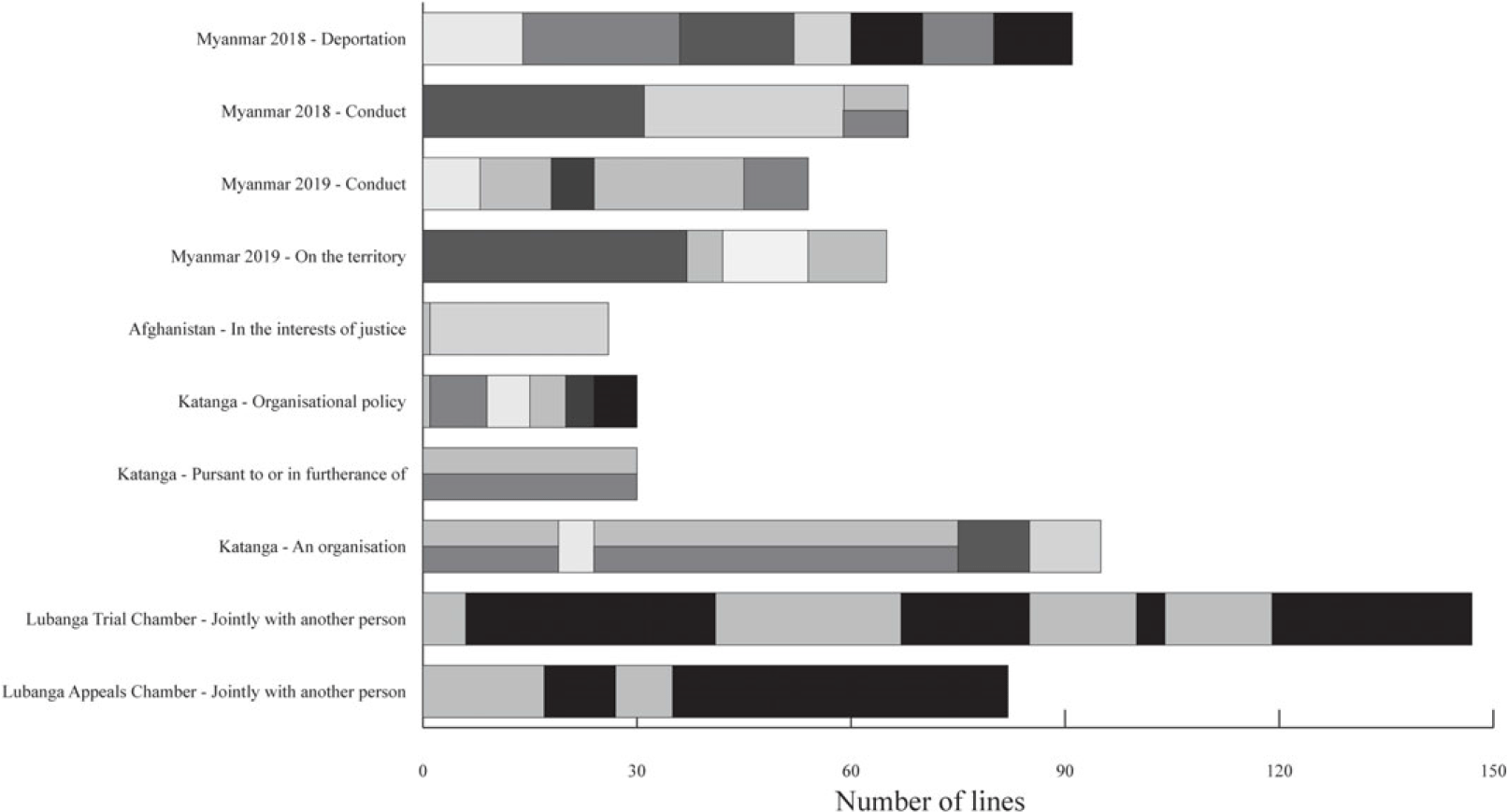
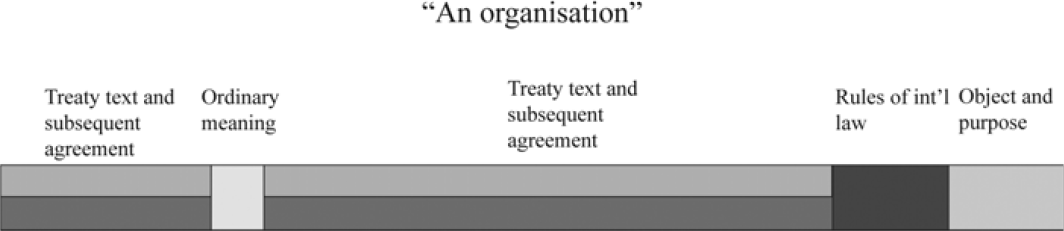
Figure 2 below is an amalgamation of the ICC’s use of the VCLT elements across all ten case studies, each bar representing one interpretation. The name of the ICC situation or defendant and the phrase being interpreted accompanies each bar. A bar depicts the elements of interpretation in the order in which they appear in the court judgment. Each shade is a different element. The length of each shade in the bar indicates the length of the opinion text (in number of lines) that the application of the element occupies. Lines are counted from where the text begins to where it ends, meaning a partial line is counted as one line (number of lines, rather than number of words, was selected to mitigate any skewing caused by an abundance of short or long words). The precise numbers of lines have been omitted from the figures to emphasize the types of elements and proportionality among them rather than the (arguably less significant) exact amount of text. The order of the segments of each bar represents the order of the elements used in the interpretation. A segment of a bar that is divided into two equal parallel parts, depicting two elements aligned vertically (such as at the end of the second bar from the top in Figure 2), reflects that the Chamber dealt with the two elements at the same time. For convenience, Figure 1 (the legend) is included below Figure 2 to help identify the VCLT elements.
10 Interpretations Combined.

The primary visual characteristic of Figure 2 to which the reader is directed is that there is no apparent pattern, structure or method across the ten case studies. The shades vary in order and length. The number of shades vary. The bars vary in length. Some bars contain high amounts of dark shades; others, none. No bar includes even near all eleven elements. This is the striking observation that only an empirical approach can detect and arguably leads to at least a preliminary conclusion that there is an apparent arbitrariness – or at least a lack of uniform methodology – in the ICC’s application of the VCLT.
Figure 2 makes clear that the VCLT approach, at least in these ten case studies, leads to a disorderly amalgam of interpretative elements. This alone does not suggest a problem, of course, because interpretation is necessarily (and rightfully) tailored to the peculiarities and intricacies of the issues before the Court and the authorities available to resolve the indeterminacy. Digging deeper, however, reveals concerns. For instance, the extensive resort to other ‘supplementary means’ (the black portions) in the Lubanga cases (the bottom two bars) dealing with the adoption of the German-derived control theory indicates that this interpretation in particular led the ICC to reach for arguably questionable means to resolve the indeterminacy. Also noticeable from Figure 2 is how some interpretations drew from numerous elements (e.g., the first bar depicting the interpretation of ‘deportation’ in the Myanmar/Bangladesh Situation) while others drew from very few elements (e.g., the Afghanistan Situation (the fifth bar), Trial Chamber II’s interpretation of ‘pursuant to and in furtherance of’ (the seventh bar) and the Lubanga cases (the bottom two bars)). The use of few elements could merely be a sign that the indeterminacy was easily and quickly resolved. Equally plausible, however, is that the Court in these instances was unable to find support from the other omitted elements or, even more troubling, did not bother to evaluate whether these elements were helpful. Notable as well is that the interpretation of ‘in the interests of justice’ by Pre-Trial Chamber III in the Afghanistan Situation almost completely ignored the treaty text of the Rome Statute, and completely ignored the ordinary meaning of the words at issue and principles of international law.
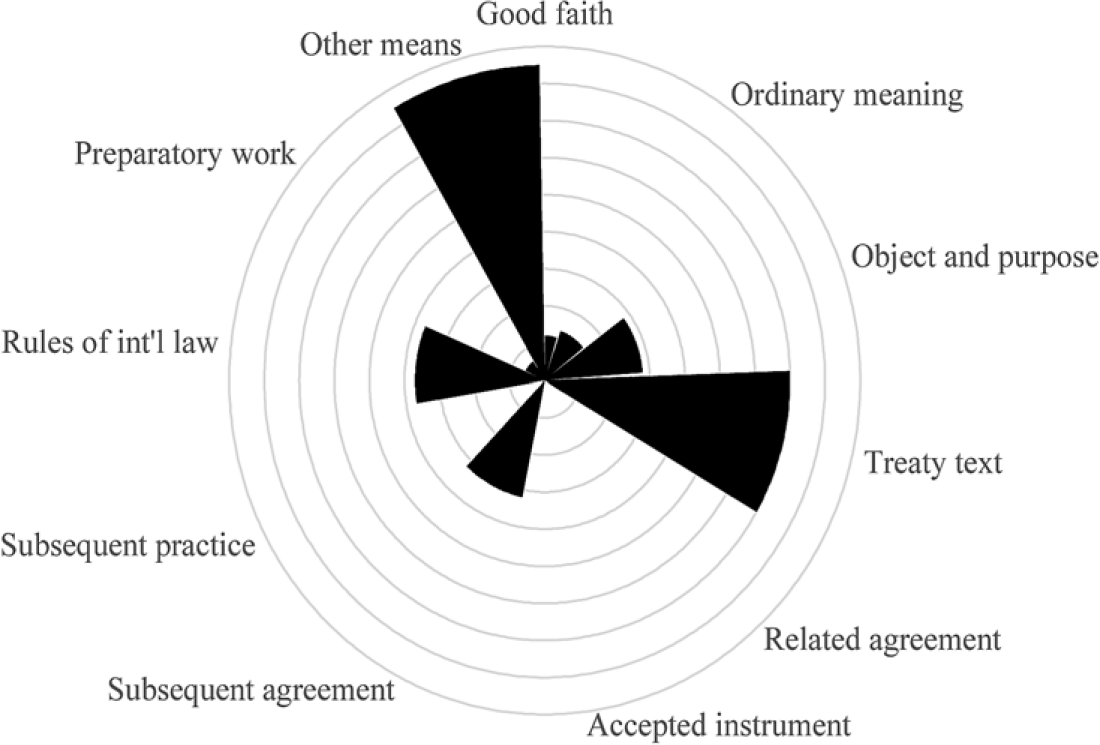
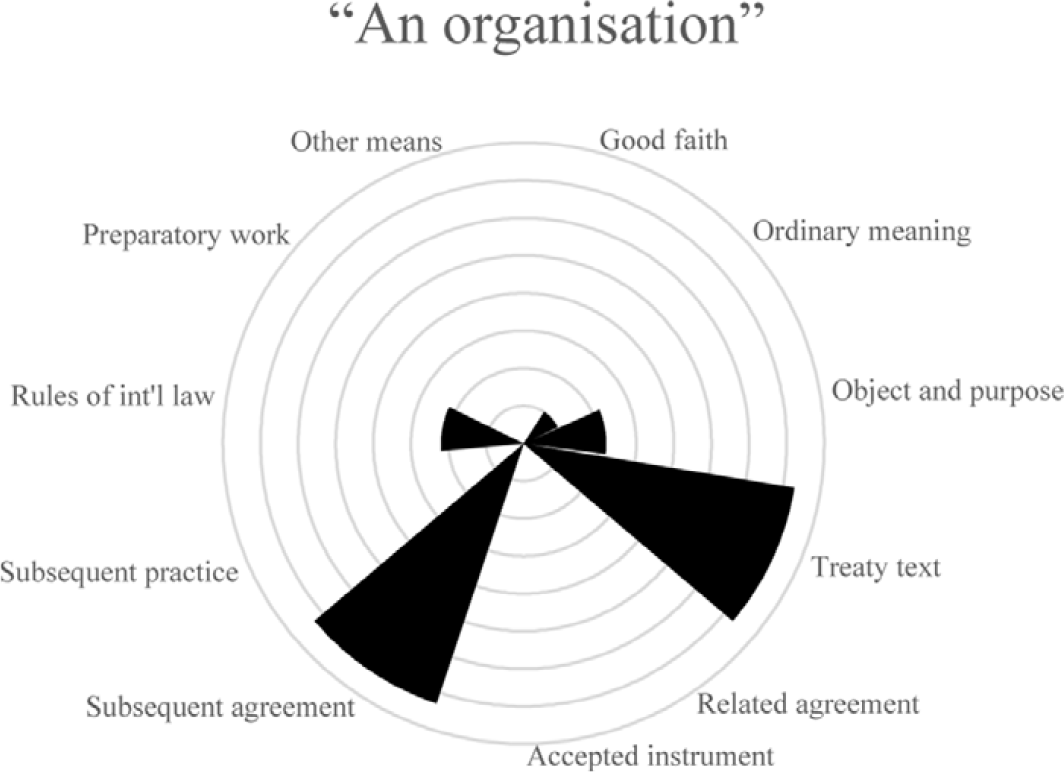
Figure 3 below depicts the same data but in the form of a wood rose radar graph. A wood rose radar graph represents how the elements used by the Court align (or do not) with the VCLT elements, which are plotted as equidistant points around the outer edge of a circle. The amount of text dedicated to each category is then depicted within the circle, with larger amounts of text reaching closer to the edge. The size of the areas of data therefore reflects the amount of text (again, measured in lines) used by the Court for each category and, importantly (in contrast to the bar graphs), the elements that are not referenced in the decisions.
10 Interpretations Combined.

Figure 3 demonstrates that in these ten case studies, the amount of text dedicated to ‘supplementary means’ other than preparatory work pursuant to Article 32 (in the figure, labelled ‘other means’ for brevity) was the highest among all elements, even exceeding the amount dedicated to treaty text. Also notable is that ordinary meaning and preparatory work comprised a very small percent of the text used. The relatively small amount of text devoted to ordinary meaning may simply reflect that the Court easily discerned the ordinary meaning, though it could also indicate that ordinary meaning was quickly recognized as un-useful, that determining ordinary meaning is particularly tricky in a treaty with six official language versions or that the significant importation of language from human rights law and humanitarian law into the Rome Statute raises unique challenges. Less text was used to apply the Elements of Crimes (categorized as a subsequent agreement between the parties) than for the text of the Rome Statute and for other relevant rules of international law (for the latter, perhaps surprisingly because the Elements of Crimes are the primary interpretative tool tailored especially for the Rome Statute). Three elements – related agreements, accepted instruments and subsequent practice – were not consulted because they arguably do not exist for the Rome Statute, demonstrating the awkwardness in applying the VCLT to the Statute. Viewing Figure 3 in toto makes clear that the ICC in these instances dedicated far more text to certain elements than others. Assuming that more text means more explanation, the judges of the ICC appear, for instance, to feel the need to justify at length their use of other ‘supplementary means’ but not so much, for example, to discern ordinary meaning. The use of treaty text to resolve indeterminacies often involves comparing various provisions of the Rome Statute which also, in line with Figure 3, requires significant explanation. Other relevant rules of international law, used in only three case studies, comprise the third-largest piece of the Figure 3 pie, again implying that the ICC chambers go to great lengths to justify their use of this element. These observations indicate that the ICC judges, at least in these case studies, felt the need to provide more detailed explanations of their use of the elements near the end of the VCLT element spectrum than for those at the beginning.
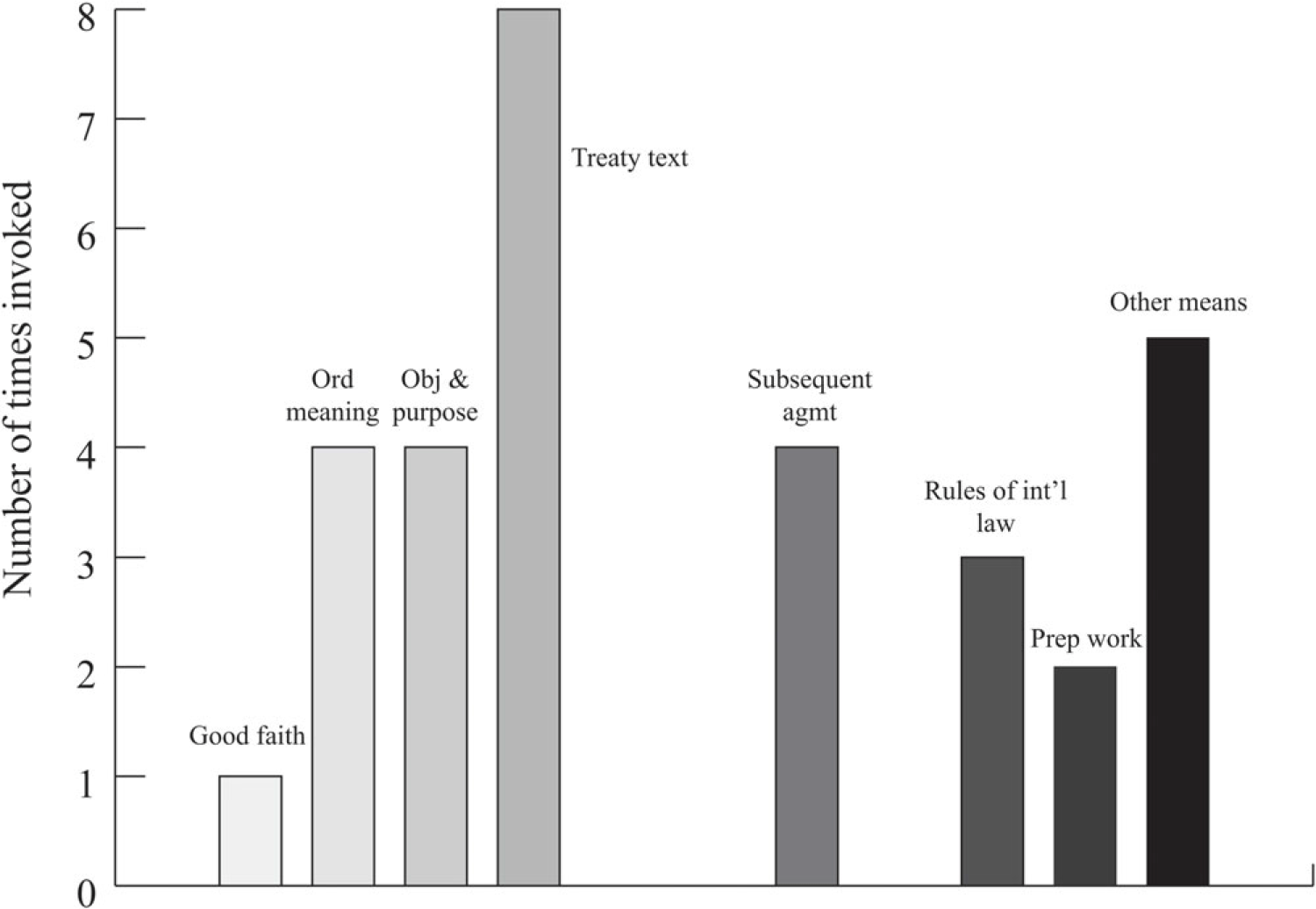
Figure 4 depicts the number of times each element was used without considering the amount of text. When an element was used more than once in a single interpretation, it has been counted only once to avoid the skewing that occurs when a chamber alternates back and forth between elements. The blank spaces between treaty text and subsequent agreement (in the middle of the figure), and between subsequent agreement and rules of international law, represent the non-use of three elements: related agreement, accepted agreement, and subsequent practice.
VCLT Elements – Number of Times Invoked across 10 Interpretations (without repeats).

Figure 4 demonstrates that the ICC refers most often to the text of the Rome Statute. Other supplementary means were invoked five times while ordinary meaning, object and purpose and subsequent agreement were each invoked four times (half as frequently as statutory text). By disregarding the amount of text dedicated to each element, the elements of Article 32 are less prominent and there is increased emphasis on the statutory text. Still, that the Court did not invoke the text of the Rome Statute on two occasions – to interpret ‘deportation’ and ‘the State on the territory of which the conduct in question occurred’, both in the Myanmar/Bangladesh Situation – even if only to declare that the text was unhelpful, is noteworthy. Similarly, that the Court only invoked ordinary meaning and object and purpose in four of the case studies raises the question of what factors help the Court determine when these elements are appropriate. Does the Court look at dictionaries for every indeterminacy but only mentions their effort sometimes? (In the Katanga case, the Chamber looked up ‘organization’ only to find the definition too general.) What triggers a chamber to invoke the object and purpose of the Rome Statute or of the textual provision at issue? When the text is not already clear, are object and purpose not always relevant or at least worth addressing? Admittedly, empirical results alone cannot fully explain the reasons behind the Court’s interpretative decisions as embodied in its judgments, although they can sometimes, when combined with qualitative analysis, reveal some clues.
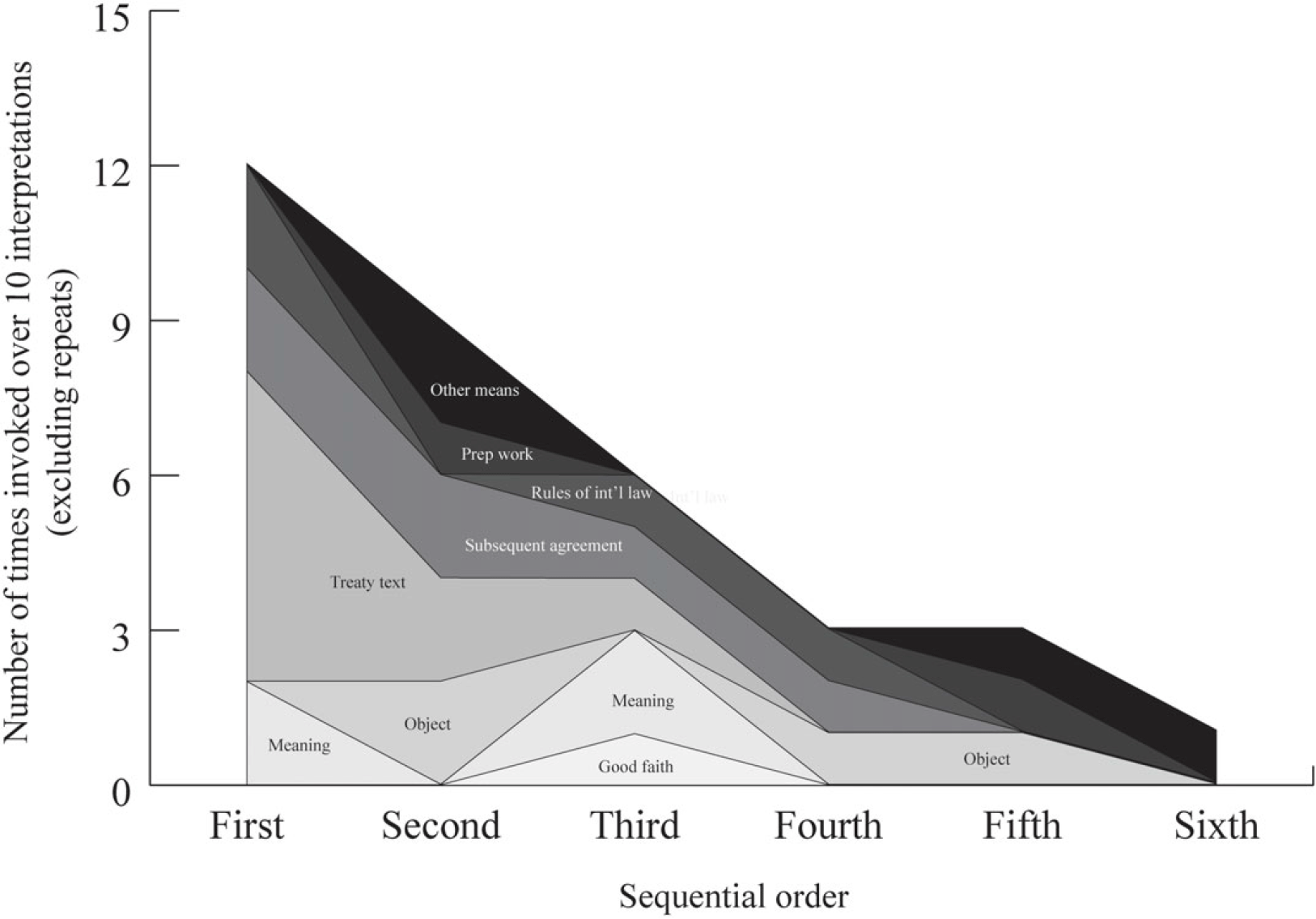
Figures 5 and 6 depict the order in which the VCLT elements were used. Figure 5 is an area graph that shows how the Court prioritizes elements by indicating the number of times that a particular element was placed first, second, third, fourth, fifth or sixth (no interpretation included more than six). Like in Figure 4, the graph excludes repeats because its purpose is to show the first priority that a particular element is given (the first time the element is used shows priority; subsequent instances do not).
Element Sequencing.

Elements Before and After.

Figure 5 demonstrates how treaty text is most often the first element invoked, with ordinary meaning, subsequent agreement (the Elements of Crimes) and other relevant rules of international law also invoked first but to a lesser degree. The Rome Statute and Elements of Crimes were rarely invoked as a later element, but both ordinary meaning and relevant rules of international law were. Notably, preparatory work and other ‘supplementary means’ appear to be invoked sometimes at an earlier stage than should be expected given their last resort status.
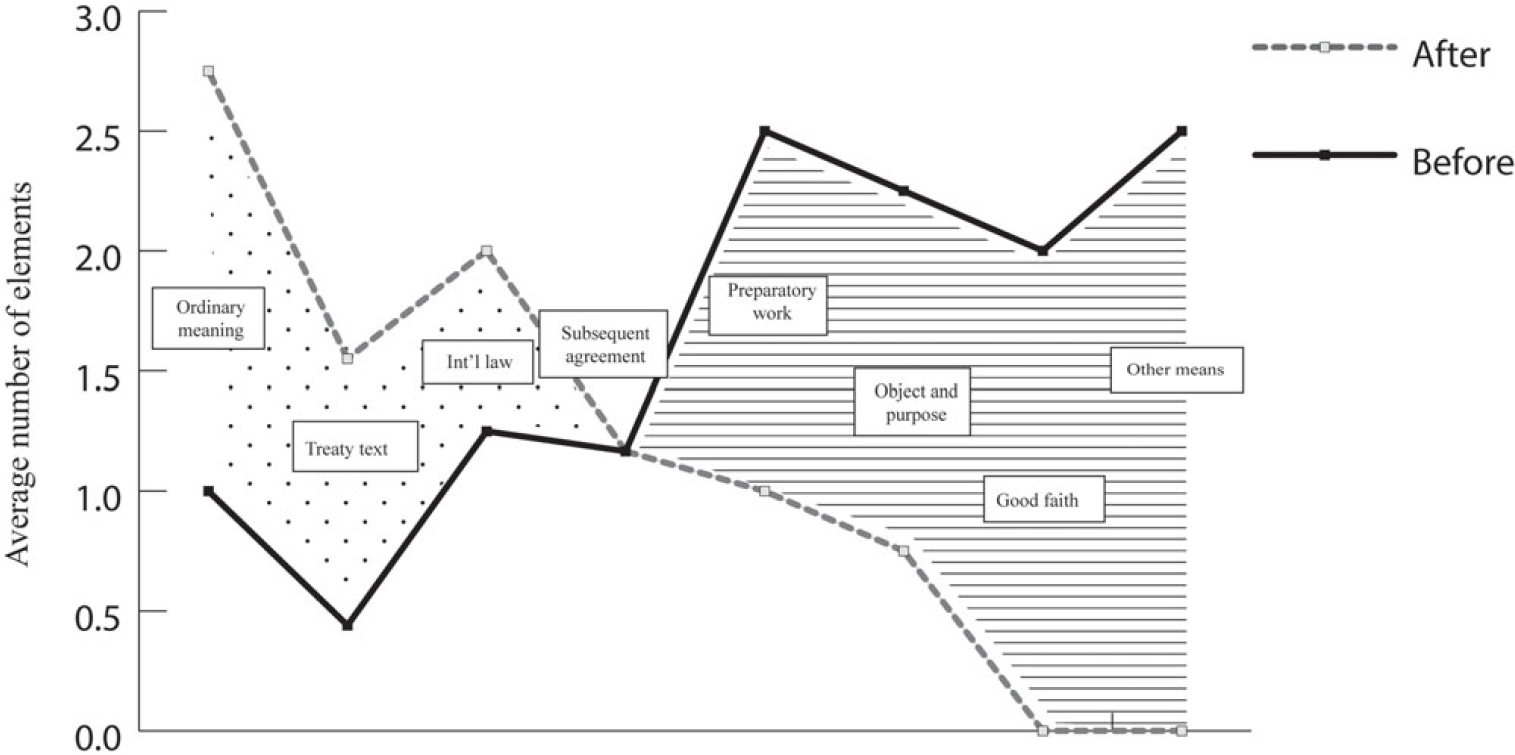
Figure 6 shows the average number of other elements placed before and after each element and provides more detail than Figure 5. To explain, Figure 5 illustrates the placement of each element regardless of how many elements came before or after. Thus, for instance, an element that is the second of only two elements is treated the same as an element that is the second of five elements. In the former, the element is both second and last, indicating that its priority within that sequence was not particularly high compared to the latter, which in contrast was prioritized over three other elements. A good example is the use of ‘supplementary means’ other than preparatory work – labelled in the graphs as ‘other means’. In Figure 5, ‘supplementary means’ is used as the second element in two case studies, giving the impression that the Court is at times prioritizing it. Figure 6, however, corrects this impression by showing that ‘supplementary means’ did not in any instance have an element after it (other than repeats), thus placing ‘supplementary means’ in its proper sequence as an element of lower priority.
In Figure 6, the grey dashed line labelled ‘After’ reflects the average number of elements after, and the solid black line the average number of elements before, a particular element. As an example, looking at ‘treaty text’, on average slightly more than one and a half elements came after treaty text and almost one-half element came before. Treaty text, therefore, can be said to be generally placed before other elements. This generalization applies to all elements in the left-side of Figure 6, indicated by the spotted area (treaty text, ordinary meaning and rules of international law). Subsequent agreement, located in the middle, was on average exactly in the centre of other elements. The remaining elements to the right – object and purpose, preparatory work, good faith and other means – were all generally located in the later part of interpretations, with the average number of elements before them greater than the average number of elements after.
Figure 6 is also useful to measure the average number of other elements that accompany each element. This measurement can be detected by adding the average elements before and after. For example, an average of around one-half element precedes and one and a half elements succeed treaty text, totalling approximately 2; in contrast, an average of 1 element precedes ordinary meaning and 2.75 come after, totalling 3.75. This difference indicates that more elements on average accompany ordinary meaning than treaty text. Arguably, therefore, the Court may perceive more of a need to buttress ordinary meaning with support from other elements than for treaty text.
Another point worth noting from Figure 6 is the gap between the upper and lower points (the ‘before’ and ‘after’ lines). For instance, the distance between the points for relevant rules of international law is clearly less than the distance between the points for ordinary meaning. For subsequent agreements, the space of the gap is zero. The smaller the gap, the more often the element is in the middle of the interpretation sequence. The greater the gap, the more often the element is located either in the first half or second half of the interpretation sequence. Other relevant rules of international law (at least in these ten case studies) are more frequently nearer to the centre position than ordinary meaning. The elements with the largest gaps – good faith and other supplementary means – are more frequently in later positions than object and purpose and preparatory work (and in fact were located in the final position excluding repeats).
The sequencing of the elements reveals that the ICC often begins its resolution of indeterminacies by turning to ordinary meaning and then to treaty text and the rules of international law. It seems logical and consistent with the application of the principle of strict construction and the principle’s impact on Articles 31–33 of the VCLT that the remaining elements – good faith, preparatory work, object and purpose, and other supplementary means – would be introduced in the later stages of the Court’s interpretative work.
5.2 Bangladesh/Myanmar
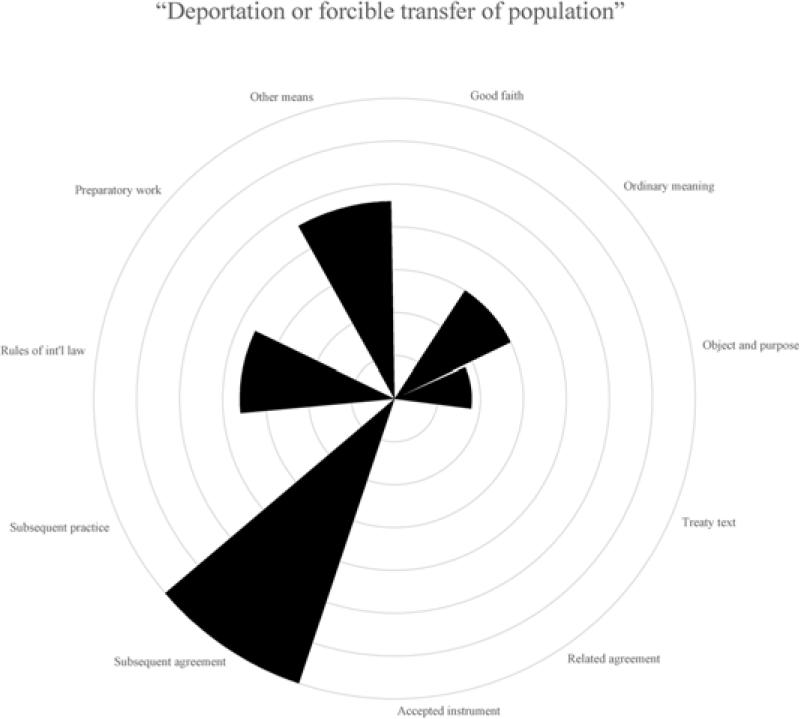
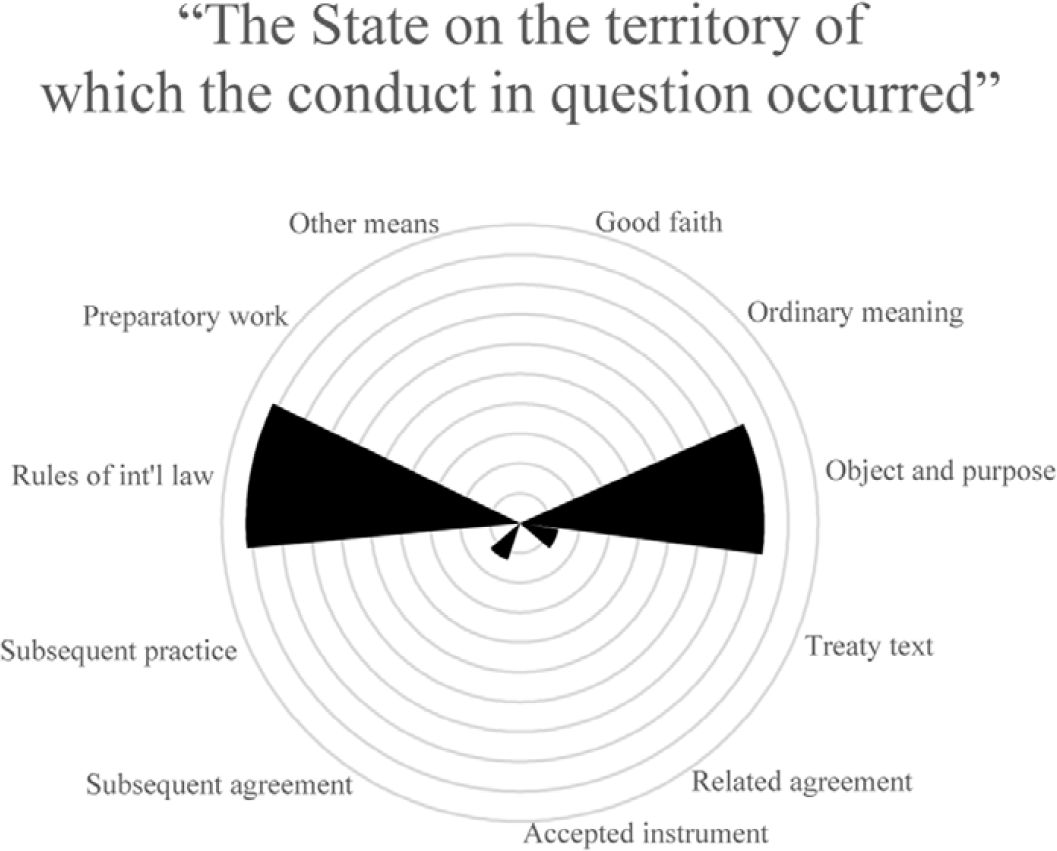
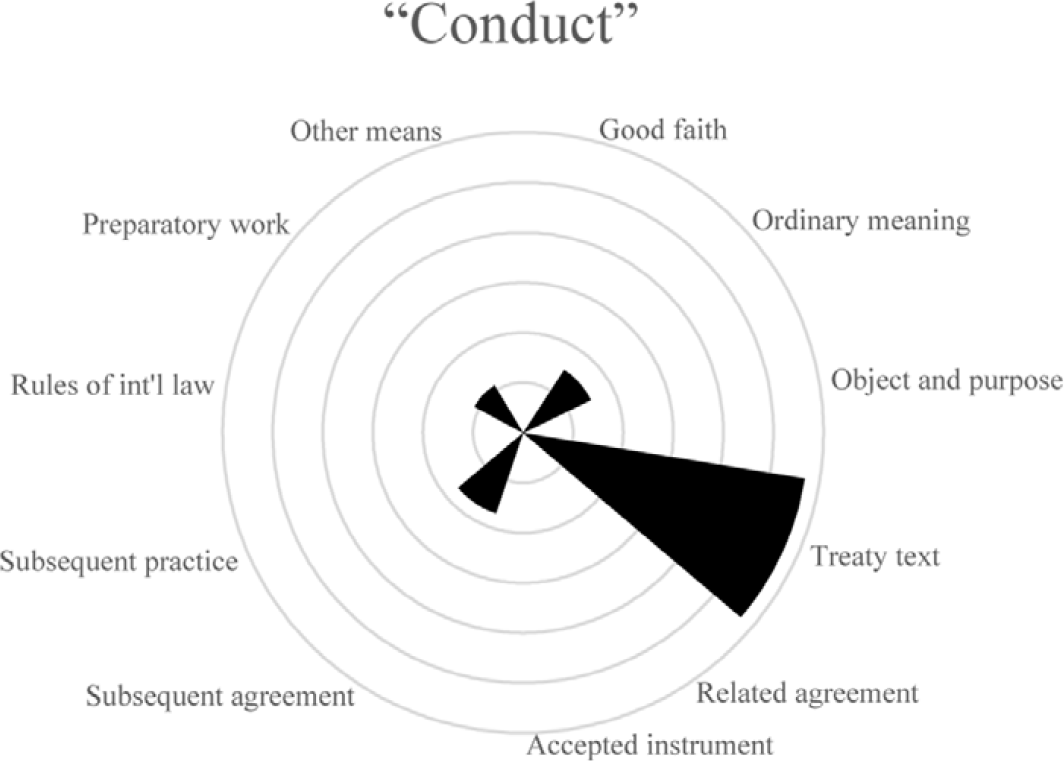
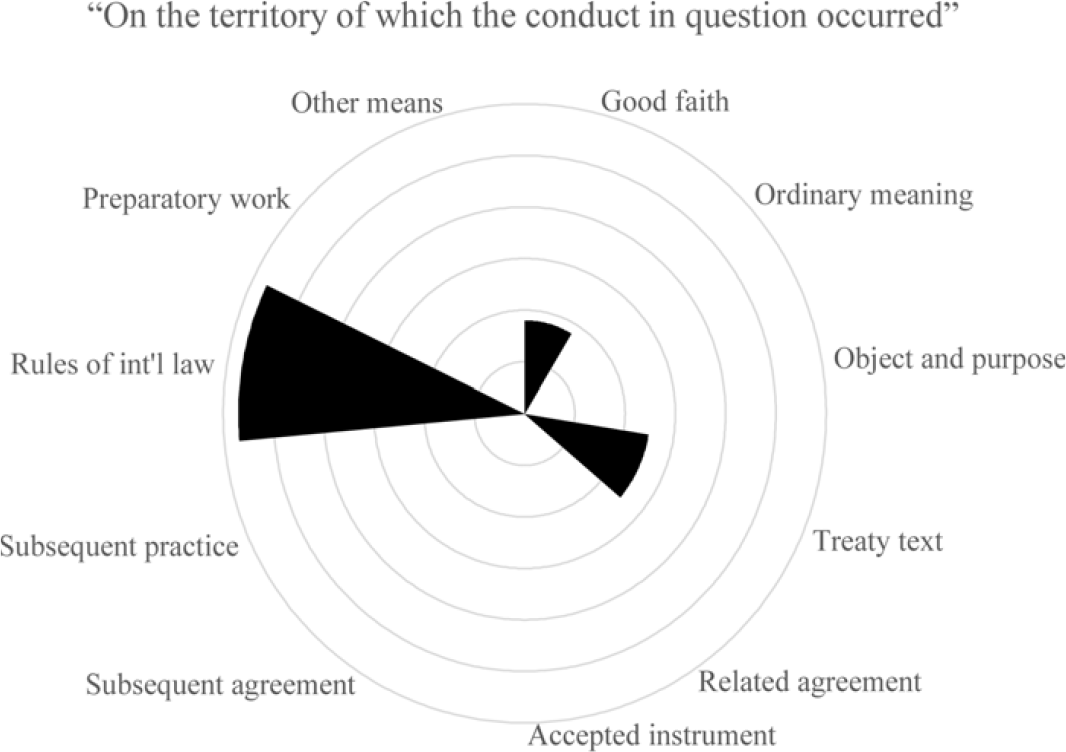
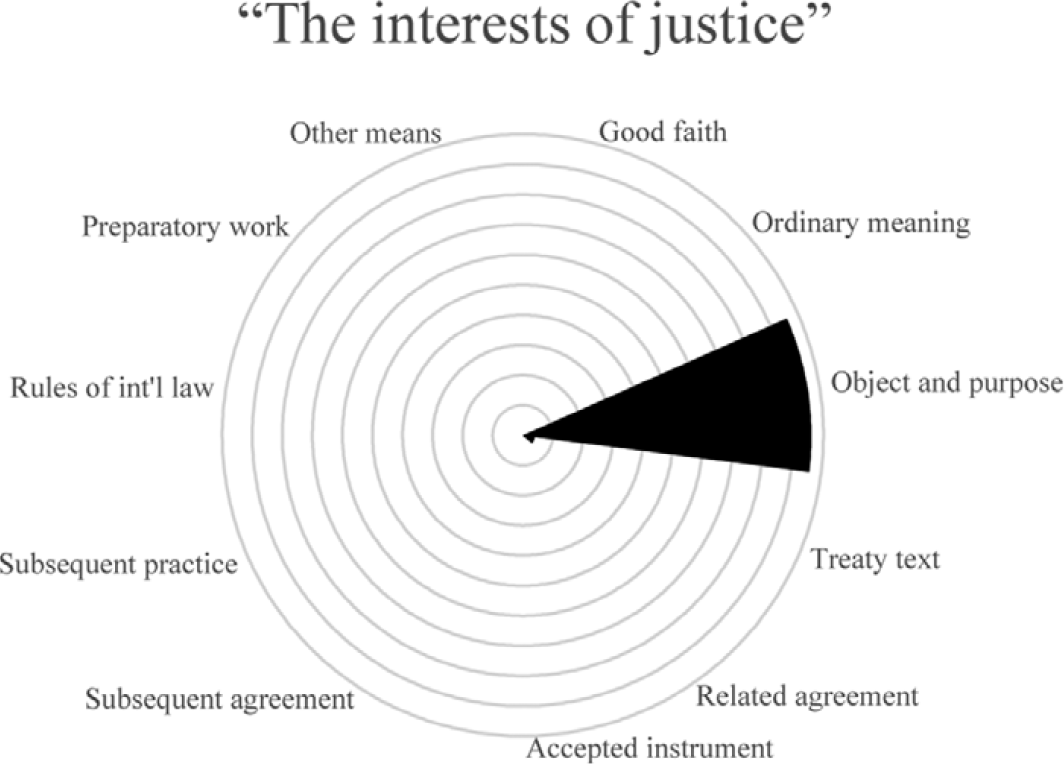
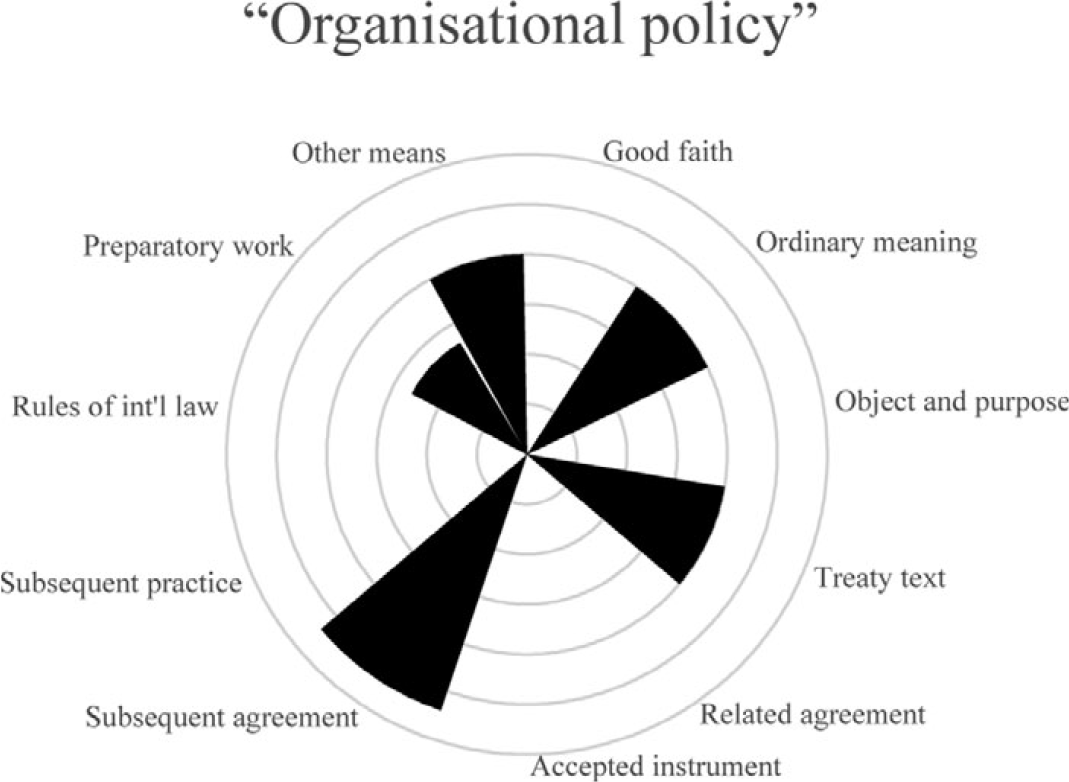
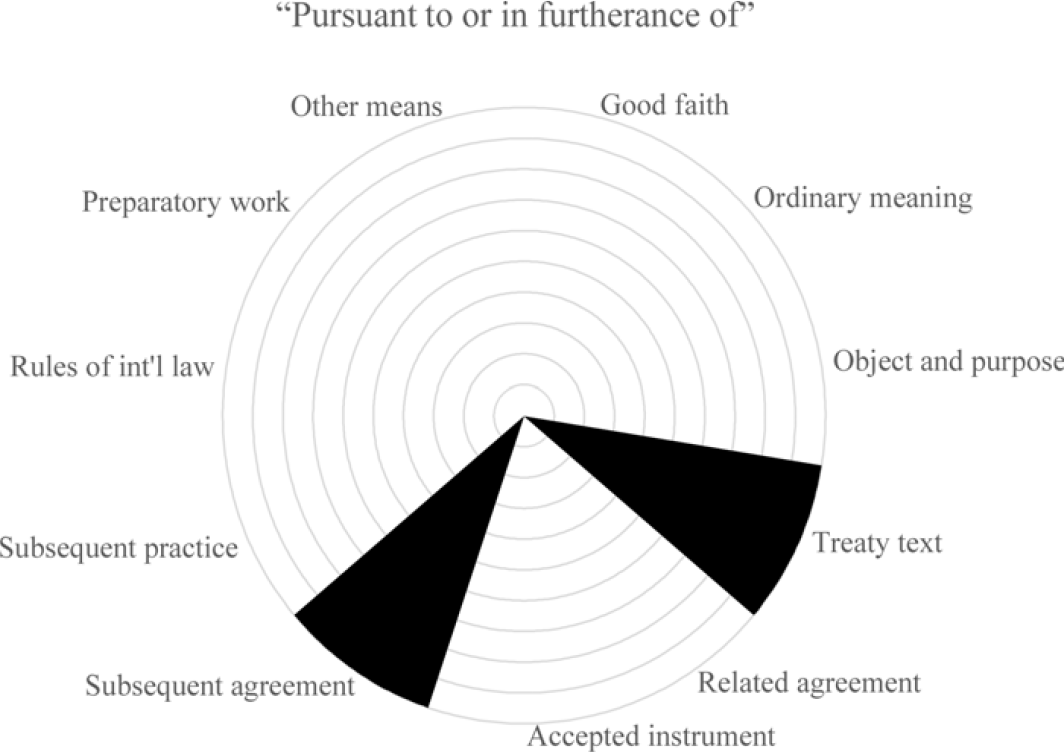
The purpose of this second part of the empirical results, which shifts focus to the individual case studies, is not solely to build on the argument that the ICC’s interpretation methodology is overly flexible and its application inconsistent but to also explain some concerns raised by an objective yet still critical closer qualitative reading of the interpretations and, where identified, instances in which the Court is to be commended for its transparency and thoroughness. For ease of reading and because the Court’s explanations rather than the bar and radar graphs are the focus of this section, figures for the individual case studies can be found in Appendix 1. References to some of the figures are made in the text.
On 9 April 2018, the ICC Prosecutor requested a ruling from Pre-Trial Chamber I on whether the Court has jurisdiction over the alleged crime of deportation of the Rohingya by the Myanmar government. The Rohingya are a Muslim minority whose ancestral home is in Rakhine State, Myanmar. Footnote 90 Years of simmering tensions between the Rohingya and the Burman majority culminated in the August 2017 attacks on border police by Rohingya militants. Footnote 91 The military retaliated, causing more than 700,000 Rohingya to flee into neighbouring Bangladesh. Footnote 92 Myanmar is not a party to the Rome Statute; Bangladesh is. The issue before the Court, therefore, was whether it has jurisdiction over the crime against humanity of ‘deportation’ that began in the territory of a non-state party and arguably ended in a state party. The indeterminacies requiring resolution were, from Article 7(1)(d) (crimes against humanity) of the Rome Statute, ‘[d]eportation or forcible transfer of population’ and, from Article 12(2)(a) (preconditions to the exercise of jurisdiction), ‘[t]he State on the territory of which the conduct in question occurred’. Pre-Trial Chamber I ruled that it did have jurisdiction.Footnote 93 In 2019, the case progressed from a preliminary question of jurisdiction to a request by the Prosecutor to commence an investigation. On 14 November, Pre-Trial Chamber III granted the request. Footnote 94 Figures 7–14 in the Appendix depict the four interpretations associated with both decisions.
In at least two regards, the Myanmar/Bangladesh situation case studies exemplify concerns. First, the two pre-trial chambers interpreted different words to resolve the same issue. Pre-Trial Chamber I decided that a key question was whether ‘deportation or forcible transfer of population’ in Article 7(1)(d) is a single or are separate crimes. To this end, it analysed the meaning of ‘or’ (as in ‘deportation or forcible transfer’) to determine that they are indeed separate. In contrast, the 2019 Pre-Trial Chamber III decision ignored 7(1)(d), instead turning to the word ‘conduct’ in Article 12(2)(a). Which way is correct? Why did Pre-Trial Chamber III not explain its reasons for abandoning the interpretation of ‘or’? It is not unusual for different courts to find different paths to a decision on the same issue, but for consistency in jurisprudence, this approach is concerning, particularly when the latter court does not explain the change in route.
Second, when interpreting ‘on the territory of which the conduct in question occurred’, Pre-Trial Chamber III (Figures 13–14) hewed more closely to Pre-Trial Chamber I’s chosen elements of interpretation (Figures 9–10) but, notably, omitted the reference to the Statute’s object and purpose and instead looked to the requirement to interpret the Statute in good faith. From the perspective of conventional legal interpretation, there is nothing necessarily objectionable to different chambers using different elements of interpretation in a different order; after all, different judges have different ways of resolving indeterminacies. From a defendant’s perspective, however, this lack of uniformity (or at least lack of explanation about why a different chamber’s approach may have been mistaken) makes the law less predictable. Jurisdictional issues do not conventionally implicate legality and in the Myanmar/Bangladesh situation there are no accused yet to be unfairly surprised, but a future defendant’s ability to challenge the Court’s jurisdiction is hindered by these inconsistencies and, as discussed elsewhere in the article, even where legality does not apply, the Court should nevertheless strive for more robust, thorough explanations of its interpretative decisions.
Not all the results from the interpretation mapping and analysis deserve criticism. In three instances (two of them related to the Myanmar/Bangladesh situation), the ICC chambers deserve credit for their efforts at transparency. Pre-Trial Chamber III in its interpretation of ‘conduct’ (Figures 8 and 9), for instance, addressed both the plain meaning of ‘conduct’ and whether the preparatory works shed light on the term ‘conduct’, even though both of these elements were in fact unhelpful. This commendable divulgence increases transparency, adds credibility and may serve to defend against (not uncommon) accusations that courts select authorities favourable to – and ignore those adverse to – their desired interpretation.
Similarly commendable was Pre-Trial Chamber III’s efforts in interpreting ‘on the territory of which the conduct in question occurred’ (Figures 13 and 14). Here, the Chamber elaborated on the actual process of its detailed attempt to show the existence of customary law through both state practice and opinio juris. This type of analysis is useful in understanding the Chamber’s rationale behind its use of authorities in applying the VCLT and ideally should be conducted with much greater frequency across all VCLT elements.
5.3 Afghanistan: ‘the interests of justice’
The Situation in the Islamic Republic of Afghanistan addresses some of the alleged crimes against humanity and war crimes arising out of the decades-long conflict between and committed by organized armed groups including the Taliban, on one side, and the (former) Afghan government and international forces supporting it, on the other. The Afghanistan Situation is particularly fraught because it involves allegations against United States forces, the US Central Intelligence Agency and other international forces. Footnote 95
One of the factors that the Prosecutor must consider when deciding whether to initiate an investigation proprio motu (on their own initiative), as in the Afghanistan Situation, is whether ‘[t]aking into account the gravity of the crime and the interests of victims, there are nonetheless substantial reasons to believe that an investigation would not serve the interests of justice’. Footnote 96 In 2019, Pre-Trial Chamber III rejected the Prosecutor’s request for judicial authorization to commence an investigation because it would not ‘serve the interests of justice’ as too much time had elapsed between the alleged acts and the Prosecutor’s request, there was little likelihood of securing meaningful co-operation from authorities and the investigation would be too expensive. Footnote 97
The Appeals Chamber overturned this decision in March 2020, finding that in proprio motu situations the Court does not have the power to review the Prosecutor’s decision on whether there are substantial reasons to believe that an investigation would not serve the interests of justice. The Appeals Chamber also criticized the Pre-Trial Chamber’s reasoning as ‘cursory, speculative and [it] did not refer to information capable of supporting it’, and as having failed to consider the gravity of the crimes and the interests of the victims. Footnote 98 Although the Pre-Trial Chamber’s decision has been overturned, its application of Articles 31 and 32 nevertheless provides important insight into the process of interpretation. Figures 15 and 16 depict the unusual mapping of its interpretation of this indeterminacy. The Appeals Chamber decision has not been mapped because it did not engage in application of the VCLT.
In its application of the VCLT, the Pre-Trial Chamber noted only the ‘absence of a definition or other guidance in the statutory texts’ and, without further explanation, concluded that the meaning of ‘the interests of justice … must be found in the overarching objectives underlying the Statute’.Footnote 99 Thus, after cursorily dismissing the text of the Rome Statute as unhelpful, the only other VCLT element referenced was object and purpose. Resorting to a teleological approach – i.e., turning to the treaty’s object and purpose – to interpret a criminal statute may be appropriate for interpreting procedural issues such as whether an investigation should be authorized, but relying on the object and purpose of a treaty as the sole source of interpretative authority, regardless of the nature of the issue at stake, is clearly unusual – at least based on the results of this study – and thus a cause for concern. Indeed, even if the teleological approach was the only relevant and useful approach, this article suggests that at the very least the ICC should have indicated its efforts to consult other elements before reaching a decision.Footnote 100 Though the Appeals Chamber’s overturning of the decision was not based on method, the Pre-Trial Chamber arguably could have buttressed its decision against criticism by providing a more robust analysis that included resort to the full panoply of interpretative elements available. Indeed, perhaps its decision would have been different if it had engaged in such a process.
5.4 Katanga (DRC): ‘pursuant to or in furtherance of a State or organizational policy’
Germain Katanga was a senior commander of a militia group in the Democratic Republic of the Congo. In 2003, as part of a wider ethnic conflict, he allegedly led an attack on the village of Bogoro that involved the killing of at least 200 people, imprisoning of survivors, and sexually enslaving women and girls. Trial Chamber II held Katanga guilty, as an accessory, of one count of crimes against humanity (murder) and four counts of war crimes (murder, attacking a civilian population, destruction of property and pillaging). The Chamber found that Katanga assisted the members of a local militia to plan the attack and served as an intermediary between weapons and munitions suppliers and those who committed the attack.
Under the Rome Statute, a crime rises to the level of a crime against humanity if it is committed, among other requirements, ‘as part of a widespread or systematic attack directed against any civilian population’. Footnote 101 In turn, ‘attack directed against any civilian population’ means ‘a course of conduct involving the multiple commission of acts referred to in paragraph 1 against any civilian population, pursuant to or in furtherance of a State or organizational policy to commit such attack’. Footnote 102 It was this last phrase, ‘pursuant to or in furtherance of a State or organizational policy to commit such attack’, that needed interpretation. Katanga’s Defence argued that the Prosecution must prove that the attack was ‘launched pursuant to a State or organisational policy’ that ‘actively promot[ed] or encourage[ed] the commission of offences against the civilian population’. Footnote 103 The Chamber held to the contrary that, in essence, all that is needed is for an organization to have the ability to carry out an attack that meets the threshold requirements of a crime against humanity. Footnote 104
The identity of the elements, the order in which they were analysed, and the proportional amount of text among them, as depicted in Figures 17–22, appear generally in line with what a textual interpretation would be expected to look like. All rely heavily on the text of the Rome Statute and the Elements of Crimes, also from time to time making reference to ordinary meaning and briefly, object and purpose, and other relevant rules of international law. Figure 19 appears somewhat odd in that it reflects the application of only two elements, and the article suggests that even if this indicates that the Chamber was able to resolve the indeterminacy easily, it should explain this finding.
Rather than the results of the mapping, the concern with the Trial Chamber’s interpretation actually lies in what cannot be seen from the mapping. The judgment contains five paragraphs (paragraphs 1109–1113) in the interpretation of the term ‘policy’ with almost no citations to authorities. In these five paragraphs, one authority (a 1994 Report of the International Law Commission) was cited for the proposition that the widespread or systematic nature of the attack, rather than the policy, is the distinguishing feature of crimes against humanity, and four other authorities – previous ICC decisions that ‘policy’ means ‘regular pattern’ – were cited but the Chamber disagreed with them. In a bit over two pages of text, therefore, there was only one supporting citation for one point. The rest of the interpretation remained untethered to authority. Additionally, citing the ILC Report – preparatory work – without identifying that it is being used to support an Article 31 interpretation is inconsistent with both the principle of strict construction and Article 32 itself. The flexibility of the VCLT’s interpretative method is particularly evident in passages like this one and supports the article’s call for greater systematicity in applying the method.
5.5 Lubanga (DRC): ‘commits such a crime … jointly with another … person’
Thomas Lubanga Dyilo was the founder and leader of another rebel group involved in the Ituri conflict that allegedly killed hundreds of civilians, destroyed villages and conscripted child soldiers. In 2012, Trial Chamber I convicted him of ‘conscripting and enlisting children under the age of fifteen years and using them to participate actively in hostilities’. Footnote 105 Lubanga was the first person arrested under an ICC warrant, his trial was the ICC’s first, and he was the first to be convicted.
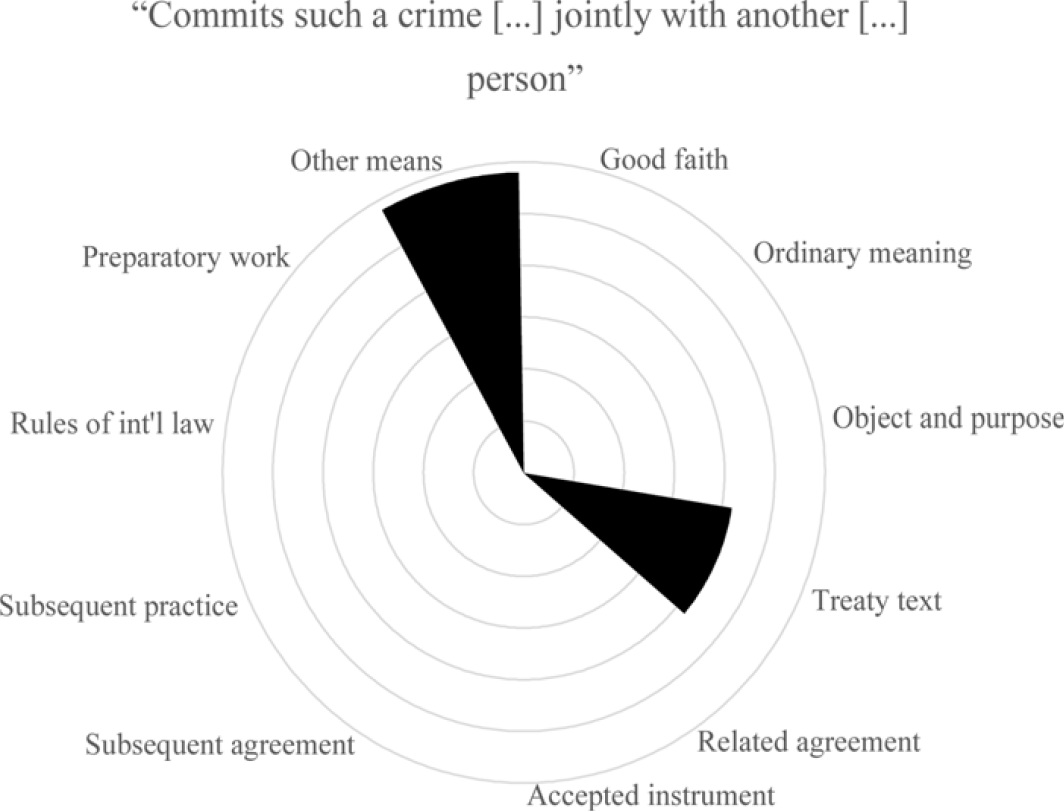
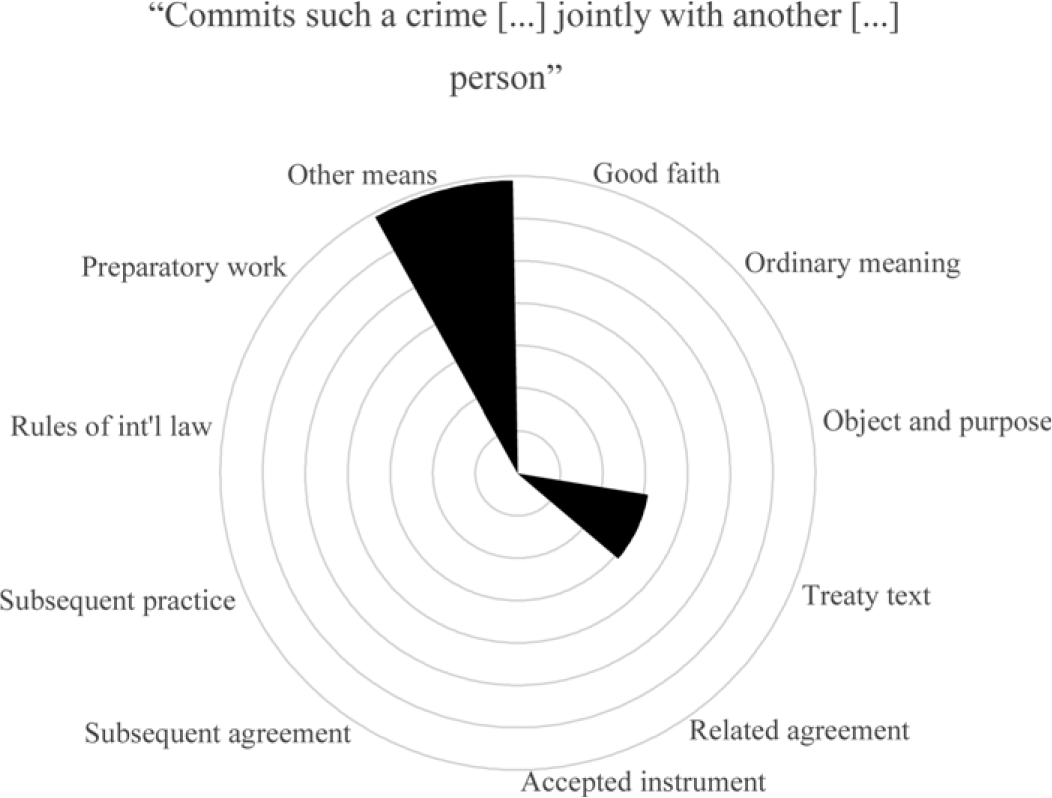
The Prosecutor had charged Lubanga as a co-perpetrator under Article 25(3) of the Rome Statute, which provides for criminal liability ‘whether as an individual, jointly with another or through another person, regardless of whether that other person is criminally responsible’. Although the key phrase for Lubanga’s criminal responsibility was ‘jointly with another’, the entire provision was relevant to the Chamber’s analysis. The interpretative issue was what kind of role was necessary for Lubanga to be held jointly responsible – did he have to play an essential, significant or merely de minimis role in the crime? The ‘control theory’ adopted by Trial Chamber I creates a distinction between principal and accessorial liability. The former, which includes joint liability, requires control over the crime (an ‘essential’ contribution); the latter does not. Footnote 106 In 2014, the Appeals Chamber upheld both Lubanga’s conviction and the Trial Chamber’s application of the control theory. Figures 23–26 depict the mapping of the Lubanga case studies from both chambers.
In coming to a crucial interpretation on criminal responsibility, Trial Chamber I and the Appeals Chamber notably used only two elements: treaty text and other supplementary means. The Court’s marked resort to Article 32 of the VCLT indicates that it was unable to resolve the indeterminacy by means of Article 31 (supplementary means can also be used to confirm a meaning reached through the application of Article 31, but this was not the case here), raising concerns over the inappropriate use of Article 32. In brief, Trial Chamber I cited ICTY, ICTR, and STL decisions, previous ICC decisions, seven textbooks, and three academic articles, while the Appeals Chamber cited numerous books, book chapters, academic articles and previous ICC decisions. These types of authorities may be characterized as Article 31 sources if they articulate, for instance, relevant rules of international law, but in this instance the ICC chambers made no attempt to show or establish that they did. Similarly, the chambers made no attempt to show that the use of publicists’ work and previous ICC decisions were – as required by Article 32 of the VCLT – used to confirm meaning established by Article 31, or to determine meaning if, after applying the means in Article 31, the meaning remains obscure or ambiguous, or leads to a result that is manifestly absurd or unreasonable.
Previous ICC decisions can also be invoked under Article 21(2) of the Rome Statute, which provides that the Court ‘may apply principles and rules of law as interpreted in its previous decisions’. Though it is unclear whether the Court in the Lubanga case studies was using this particular provision to invoke its own previous decisions, Article 21(2)’s main purpose appears to be to reject the doctrine of binding precedent (because it uses the word ‘may’)Footnote 107 rather than to allow reliance on previous decisions without restriction. Indeed, Article 21(2)’s reference to ‘principles and rules of law’ presumably refers to the principles and rules enumerated in Article 21(1)(b) and (c), and it is these principles and rules interpreted in previous decisions that may be applied. The upshot is that previous ICC decisions can be referenced to assist in interpreting indeterminacies by one of two means: first, the principles and rules of law as interpreted in previous ICC judgments can be applied pursuant to Article 21(2); or, second, the interpretations (not just of principles and rules of law but more broadly) articulated in previous ICC judgments can be used as tools of interpretation pursuant to Article 32 of the VCLT. For the purposes of this study, references to previous ICC judgments were coded as connected to Article 32 because there was no effort by the ICC to demonstrate that the references were to principles and rules of law as those terms are used in Article 21(1)(b) and (c) and their connection was not apparent.
As noted earlier, the shade of each bar segment corresponds to the order in which an element is found in Articles 31 and 32, with lighter shades indicating earlier elements and darker shades later elements. Hence, adjacent light and dark shaded segments indicate that the opinion evaluates elements that are not next to each other in Articles 31 and 32. Though acceptable given the non-hierarchical nature of Article 31 and its holistic methodology, such a pattern may nonetheless reflect a certain laxity in application when considering Article 32, which as noted can only be used in limited circumstances. The strict application of lenity would also arguably prevent the ICC from resorting to Article 32 sources, particularly to determine meaning that cannot be found by way of Article 31 (although the Court has clearly not taken this position). The order of these two elements – in darkest grey (preparatory works) and black (other supplementary means) – thus deserves special attention because they should only be utilized after the meaning of an indeterminacy has been thoroughly evaluated under Article 31. This thorough evaluation is notably absent from these case studies. Additionally, the application of Article 32, as of Article 31, is limited by the principle of strict construction.
Nevertheless, the Lubanga interpretations also contained one of the instances in which the Court demonstrated applaudable transparency. In its interpretation of the phrase ‘commits such a crime … jointly with another … person’ (Figure 25), the Appeals Chamber cited authorities that took positions contrary to the Court’s. This type of referencing adds to the Court’s credibility by creating a more transparent, and thus persuasive, justification.
In sum, the qualitative analysis of individual case studies supports the evidence from the combined figures in Part 5.1 that there is great flexibility and inconsistency in the application of the VCLT to the Rome Statute. There appears to be little or no systematic approach to the order of the analyses, the justification of referenced authorities, the thoroughness of reasoning or the use of Article 32 authorities.
6. Increasing methodological rigour
One way for the Court to strengthen its application of the VCLT interpretative methodology is to apply it more completely and systematically, at least for the cases involving more difficult interpretation. Others have similarly proposed. Gardiner, for instance, suggests that ICSID tribunals ‘could have been expected to find the right track if they had employed the rules systematically and produced arguments fully reflective of all the elements in the rules’.Footnote 108 Arguing that interpretations made by UN human rights treaty bodies have at times been unconvincing because they have failed to apply at least one interpretative aspect – text, context, and object or purpose – Mechlem urges ‘extensive argument and justification based on clear methodological grounds’.Footnote 109 Berman, in a dissenting opinion as a member of an ad hoc committee reviewing an ICSID tribunal decision, argued that just as important as applying the proper VCLT rules was whether the tribunal ‘adequately explained what they were doing in the interpretative process, and did so specifically with the very particular care needed’.Footnote 110 Merkouris argues that the ‘increased streamlining and complexity in interpretative argumentation’ has the benefit of providing more data for users to detect flaws in reasoning (to illustrate his point, he uses a detailed analysis of VCLT Article 31(3)(c) over ‘the course of several paragraphs’ in Vattenfall AB and Others v. Germany, an ICSID case – and then points out its flaws).Footnote 111 Importantly, all of these benefits apply equally to interpretations of procedural provisions (which do not trigger legality) as to interpretations of substantive provisions.
In line with these suggestions and based on the concerns raised by the empirical evidence, this article proposes the following improvements to the ICC’s engagement with the VCLT: (i) Address all elements of Article 31 and, if appropriate, Article 32, regardless of their usefulness to the issue at hand. If this is overburdensome, at least the Court should explain why it has decided not to address certain elements. In the course of preparing this article, the authors did not encounter any decisions from any international court addressing all VCLT elements, but the ICC is not like other courts: it is the only permanent international criminal court and the only one with the incorporation of detailed legality provisions. There seems to be no compelling reason why it could not – and should not – break new ground in raising the standard of interpretative reasoning. (ii) Explain the order in which the elements are addressed. The order of reasoning is almost always important. Strict construction arguably requires a certain order in which at a minimum the text comes first, then the context and finally supplementary means. The Court should justify the order it uses or at least explain that it has used no particular order. (iii) Explain the relation between the authorities relied upon and their corresponding elements, especially those that fall within Article 32. Legal authorities used to support an interpretation must fall into one of the VCLT elements but it is sometimes unclear which one a court is using. By clearly categorizing authorities, courts will be obliged to recognize the element and, if in Article 32, the corresponding conditions to their use. (iv) Discuss the authorities that were unhelpful or adverse to the ultimate interpretation reached. Courts are not advocates and must take an impartial position in interpretation. Thus, both supportive and undermining authorities should be provided transparently.
Given the high stakes, the ICC owes the parties before it and those who will in the future come before it this transparency and thoroughness. Requiring judges to justify decisions discourages idiosyncratic behaviour and increases systematicity.Footnote 112 Excessive reliance on one element of interpretation with little or no attention to the others is arguably ‘against the interpretative process envisaged’ by the VCLT.Footnote 113 The VCLT’s instruction to consider all of the elements in Article 31 – ‘A treaty shall be interpreted’ (emphasis added) – is mandatory, not optional.Footnote 114 Even Trial Chamber II, referring to the ‘General Rule’ that requires the VCLT elements to be applied holistically, explained that ‘a bench cannot decline to draw on a particular element of the General Rule because, as noted above, its ingredients form a whole’.Footnote 115
Increased transparency means more work for judges. Some may also point out that ICC judgments are already too verbose, that laypeople (an important target audience) will find lengthier, technical explanations inaccessible, or that engaging in a more granular examination of the VCLT’s application will overextend the duration of the judicial process. These are valid concerns but must be weighed against the crucial need for transparency, thoroughness, consistency and, at least in some cases, respect for legality.
At the end of the day, legal text ‘can never eliminate the necessity of good judgment in interpreting the law’.Footnote 116 Form and process cannot guarantee interpretations of rigour and intellectual depth without bias.Footnote 117 A more rigorous implementation of interpretation methodology cannot prevent judges from finding the authorities that support their idea of justice and ignoring contrarian voices. What it can do, however, is to force judges to confront, carefully consider and reflect upon their interpretative decisions, and let the rest of us know how they made these decisions. Surely, even for the most strident supporters of judicial creativity, these would be positive steps.
Appendix 1
Figures 7–26
2018 Myanmar/Bangladesh Decision

2018 Myanmar/Bangladesh Decision

2018 Myanmar/Bangladesh Decision

2018 Myanmar/Bangladesh Decision

2019 Myanmar/Bangladesh Decision

2019 Myanmar/Bangladesh Decision

2019 Myanmar/Bangladesh Decision

2019 Myanmar/Bangladesh Decision

Afghanistan

Afghanistan

Katanga (DRC)

Katanga (DRC)

Katanga (DRC)

Katanga (DRC)

Katanga (DRC)

Katanga (DRC)

Lubanga (DRC) – TrialChamber

Lubanga (DRC) - Trial Chamber

Lubanga (DRC) - Appeals Chamber

Lubanga (DRC) - Appeals Chamber