1 Introduction
A partition of a positive integer n is a non-increasing sequence of positive integers whose sum is
 $n.$
Let
 $p(n)$
be the number of integer partitions of a positive integer n and let
 $p(0):=1.$
Then the generating function for
 $p(n)$
is
 $$\begin{align*}\sum_{n\geq0}p(n)q^{n}=\frac{1}{(q;q)_{\infty}}, \end{align*}$$
where
 $(z;q)_{\infty }$
is the q-shifted factorial given by [Reference Gasper and Rahman10]
 $$\begin{align*}(z;q)_{\infty}:=\prod_{j\geq0}(1-zq^{j}),\;|q|<1. \end{align*}$$
The famous Ramanujan partition congruences state that
 $$ \begin{align} p(5n+4) & \equiv0\quad (\bmod\:5), \end{align} $$
 $$ \begin{align} p(7n+5) & \equiv0\quad (\bmod\:7), \end{align} $$
 $$ \begin{align} p(11n+6) & \equiv0\quad (\bmod\:11). \end{align} $$
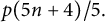
To explain Ramanujan’s partition congruences (1.1)–(1.3), Dyson [Reference Dyson7] introduced the rank of a partition as the largest part minus the number of parts. Furthermore, Dyson conjectured that the partitions of
 $5n+4$
classified by their rank modulo 5 will produce five sets with equal cardinality
 $p(5n+4)/5.$
He also conjectured that the partitions of
 $7n+5,$
classified by rank, will split into seven sets of equal cardinality
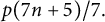 $p(7n+5)/7.$
Let
 $N(m,n)$
denote the number of partitions of n whose rank is
 $m.$
Then a generating function for
 $N(m,n)$
is as follows [Reference Dyson7]:
 $$\begin{align*}R(z,q):=\sum_{n\geq0}\sum_{m=-\infty}^{\infty}N(m,n)z^{m}q^{n}=\sum_{n\geq0}\frac{q^{n^{2}}}{(zq;q)_{n}(z^{-1}q;q)_{n}}, \end{align*}$$
where
 $$\begin{align*}(\zeta;q)_{0}:=1,\quad(\zeta;q)_{n}:=\prod_{k=1}^{n}(1-\zeta q^{k-1}),\;n\geq1. \end{align*}$$
If
 $z=1,$
then the above formula reduces to Euler’s celebrated generating function for
 $p(n):$
 $$\begin{align*}\sum_{n=0}^{\infty}p(n)q^{n}=\sum_{n=0}^{\infty}\frac{q^{n^{2}}}{(q;q)_{n}^{2}}. \end{align*}$$
Let
 $N(r,m,n)$
denote the number of partitions of n whose rank is congruent to r modulo
 $m.$
Later, these conjectures were proved by A.O.L. Atkin and H.P.F. Swinnerton-Dyer [Reference Atkin and Swinnerton-Dyer5] using the generating functions of the rank difference
 ${N(s,l,ln+d)-N(t,l,ln+d)}$
with
 $l=5,7$
and
 $0\leq d,s,t<l.$
They proved that
 $$\begin{align*}N(r,5,5n+4)=\frac{p(5n+4)}{5},\quad0\leq r\leq4, \end{align*}$$
and
 $$\begin{align*}N(r,7,7n+5)=\frac{p(7n+5)}{7},\quad0\leq r\leq6. \end{align*}$$
However, the rank cannot provide a purely combinatorial description of the Ramanujan congruence (1.3). In his paper [Reference Dyson7], Dyson also conjectured the existence of another partition statistics, the cranks of partitions, which gives a combinatorial interpretation of Ramanujan’s congruence for the partition function modulo 11. This partition statistics was later discovered by Andrews and Garvan in their paper [Reference Andrews and Garvan3]. For
 $n>1,$
let
 $M(m,n)$
denote the number of partitions of n whose crank is m while for
 $n\leq 1$
we set
 $$\begin{align*}M(m,n)=\begin{cases} -1, & \mathrm{if}\;(m,n)=(0,1),\\ 1, & \mathrm{if}\;(m,n)=(0,0),(1,1),(-1,1),\\ 0, & \mathrm{otherwise}. \end{cases} \end{align*}$$
The generating function for
 $M(m,n)$
is as follows:
 $$\begin{align*}C(z,q):=\sum_{m=-\infty}^{\infty}\sum_{n=0}^{\infty}M(m,n)z^{m}q^{n}=\frac{(q;q)_{\infty}}{(zq;q)_{\infty}(z^{-1}q;q)_{\infty}}. \end{align*}$$
Let
 $M(m,L;n)$
be the number of partitions of n with crank congruent to m modulo
 $L.$
In [Reference Andrews and Garvan3], Andrews and Garvan proved that
 $$\begin{align*}M(m,11;11n+6)=\frac{p(11n+6)}{11},\quad0\leq m\leq10. \end{align*}$$
A systematic account of ranks and cranks can be found in Chapters 2–4 of Ramanujan’s Lost Notebook [Reference Andrews and Berndt2].
Let
 $\mathrm {spt}(n)$
denote the total number of appearances of the smallest part in each integer partition of
 $n.$
A generating function for
 $\mathrm {spt}(n)$
is as follows:
 $$\begin{align*}S(q):=\sum_{n=1}^{\infty}\mathrm{spt}(n)q^{n}=\sum_{n=1}^{\infty}\frac{q^{n}}{\left(1-q^{n}\right)^{2}\left(q^{n+1};q\right)_{\infty}}. \end{align*}$$
In [Reference Andrews1], Andrews introduced the spt function
 $\mathrm {spt}(n)$
and proved three striking congruences:
 $$ \begin{align} \mathrm{spt}(5n+4) & \equiv0\quad (\bmod\:5), \end{align} $$
 $$ \begin{align} \mathrm{spt}(7n+5) & \equiv0\quad (\bmod\:7), \\ \mathrm{spt}(13n+6) & \equiv0\quad (\bmod\:13).\nonumber \end{align} $$
These congruences are reminiscent of Ramanujan’s partition congruences (1.1)–(1.3). In [Reference Andrews, Garvan and Liang4], Andrews, Garvan, and Liang introduced an spt-crank
 $N_{S}(m,t,n)$
and proved that
 $$\begin{align*}N_{S}(k,5,5n+4)=\frac{\mathrm{spt}(5n+4)}{5}\text{ for }0\leq k\leq4, \end{align*}$$
and
 $$\begin{align*}N_{S}(k,7,7n+5)=\frac{\mathrm{spt}(7n+5)}{7}\text{ for }0\leq k\leq6, \end{align*}$$
which provide new combinatorial interpretations of the congruences (1.4) and (1.5) of the spt function. They defined a two variable generalization of the spt function:
 $$\begin{align*}S(z,q):=\sum_{n=1}^{\infty}\sum_{m=-\infty}^{\infty}N_{S}(m,n)z^{m}q^{n}=\sum_{n=1}^{\infty}\frac{q^{n}\left(q^{n+1};q\right)_{\infty}}{\left(zq^{n};q\right)_{\infty}\left(z^{-1}q^{n};q\right)_{\infty}}. \end{align*}$$
It is obvious that
 $S(q)=S(1,q).$
Introducing an extra variable, they obtained a new statistic and refinement of the original counting function. In the same paper, by examining
 $S(\zeta _{5},q)$
and
 $S(\zeta _{7},q)$
with
 $\zeta _{5}=\mathrm {e}^{2\pi \mathrm {i}/5}$
and
 $\zeta _{7}=\mathrm {e}^{2\pi \mathrm {i}/7},$
Andrews, Garvan, and Liang reproved the congruences (1.4) and (1.5). Applying Bailey’s lemma to a Bailey pair, they deduced an interesting formula between
 $R(z,q),C(z,q)$
, and
 $S(z,q):$
 $$ \begin{align} (1-z)\left(1-z^{-1}\right)S(z,q)=R(z,q)-C(z,q). \end{align} $$
An overpartition is a partition in which the first occurrence of a part may be overlined. In 2014, Garvan and Jennings-Shaffer [Reference Garvan and Jennings-Shaffer8] applied Bailey’s lemma to four different Bailey pairs to obtain several new spt-crank functions and proved many congruences on three spt functions for overpartitions and the spt function for partitions with smallest part even and without repeated odd parts. Let
 $\overline {\mathrm {spt}}(n)$
denote the total number of appearances of the smallest parts among the overpartitions of n whose smallest part is not overlined and let
 $\mathrm {M2spt}(n)$
denote the number of smallest parts in the partitions of n without repeated odd parts and smallest part even. The generating functions for
 $\overline {\mathrm {spt}}(n)$
and
 $\mathrm {M2spt}(n)$
are as follows:
 $$ \begin{align*} \sum_{n=1}^{\infty}\overline{\mathrm{spt}}(n)q^{n} & =\sum_{n=1}^{\infty}\frac{q^{n}\left(-q^{n+1};q\right)_{\infty}}{\left(1-q^{n}\right)^{2}\left(q^{n+1};q\right)_{\infty}},\\ \sum_{n=1}^{\infty}\mathrm{M2spt}(n)q^{n} & =\sum_{n=1}^{\infty}\frac{q^{2n}\left(-q^{2n+1};q^{2}\right)_{\infty}}{\left(1-q^{2n}\right)^{2}\left(q^{2n+2};q^{2}\right)_{\infty}}. \end{align*} $$
In the same paper, they defined two variable generalizations for
 $\overline {\mathrm {spt}}(n)$
and
 $\mathrm {M2spt}(n)$
by
 $$ \begin{align*} \overline{\mathrm{S}}(z,q) & :=\sum_{n=1}^{\infty}\frac{q^{n}\left(-q^{n+1},q^{n+1};q\right)_{\infty}}{\left(zq^{n};q\right)_{\infty}\left(z^{-1}q^{n};q\right)_{\infty}},\\ \mathrm{S}2(z,q) & :=\sum_{n=1}^{\infty}\frac{q^{2n}\left(-q^{2n+1},q^{2n+2};q^{2}\right)_{\infty}}{\left(zq^{2n};q^{2}\right)_{\infty}\left(z^{-1}q^{2n};q^{2}\right)_{\infty}}. \end{align*} $$
Let
 $\overline {R}(z,q)$
denote the generating function for the Dyson rankFootnote
1
of an overpartition and let
 $R2(z,q)$
denote the
 $M_{2}$
-rankFootnote
2
of a partition without repeated odd parts. Applying Bailey’s lemma to two different Bailey pair, they [Reference Garvan and Jennings-Shaffer8] found two beautiful identities:
 $$ \begin{align*} (1-z)\left(1-z^{-1}\right)\overline{\mathrm{S}}(z,q) & =\overline{R}(z,q)-(-q;q)_{\infty}C(z,q),\\ (1-z)\left(1-z^{-1}\right)\mathrm{S}2(z,q) & =R2(z,q)-\left(-q;q^{2}\right)_{\infty}C\left(z,q^{2}\right). \end{align*} $$
These two formulas are very similar to (1.6).
Motivated by Andrews–Garvan–Liang [Reference Andrews, Garvan and Liang4] and Garvan–Jennings-Shaffer [Reference Garvan and Jennings-Shaffer8], Garvan and Jennings-Shaffer [Reference Garvan and Jennings-Shaffer9] studied a family of spt-crank-type functions with the form:
 $$\begin{align*}\frac{P(q)}{\left(z;q\right)_{\infty}\left(z^{-1};q\right)_{\infty}}\sum_{n=1}^{\infty}\left(z,z^{-1};q\right)_{n}q^{n}\beta_{n}, \end{align*}$$
where
 $P(q)$
is an infinite product and
 $\beta _{n}$
originates from a Bailey pair relative to
 $(1,q)$
and considered the Bailey pairs from group A in [Reference Slater13] as well as the Bailey pairs
 $C(1),C(5),E(2)$
, and
 $E(4).$
Given a Bailey pair
 $(\alpha ^{X},\beta ^{X}),$
they defined the corresponding two variable spt-crank-type function by
 $$\begin{align*}S_{X}(z,q):=\frac{P_{X}(q)}{\left(z;q\right)_{\infty}\left(z^{-1};q\right)_{\infty}}\sum_{n=1}^{\infty}\left(z,z^{-1};q\right)_{n}\beta_{n}^{X}q^{n}=:\sum_{n=1}^{\infty}\sum_{m=-\infty}^{\infty}M_{X}(m,n)z^{m}q^{n}. \end{align*}$$
In particular,
 $$ \begin{align*} \sum_{n=1}^{\infty}\sum_{m=-\infty}^{\infty}M_{A1}(m,n)z^{m}q^{n} & =\frac{(q;q)_{\infty}}{\left(z;q\right)_{\infty}\left(z^{-1};q\right)_{\infty}}\sum_{n=1}^{\infty}\frac{q^{n}\left(z;q\right)_{n}\left(z^{-1};q\right)_{n}}{(q;q)_{2n}}\\& =\sum_{n=1}^{\infty}\frac{q^{n}\left(q^{2n+1};q\right)_{\infty}}{\left(zq^{n},z^{-1}q^{n};q\right)_{\infty}},\\\sum_{n=1}^{\infty}\sum_{m=-\infty}^{\infty}M_{C1}(m,n)z^{m}q^{n} & =\frac{\left(q;q^{2}\right)_{\infty}(q;q)_{\infty}}{\left(z;q\right)_{\infty}\left(z^{-1};q\right)_{\infty}}\sum_{n=1}^{\infty}\frac{q^{n}\left(z;q\right)_{n}\left(z^{-1};q\right)_{n}}{\left(q;q^{2}\right)_{n}(q;q)_{n}}\\ & =\sum_{n=1}^{\infty}\frac{q^{n}\left(q^{2n+1};q^{2}\right)_{\infty}\left(q^{n+1};q\right)_{\infty}}{\left(zq^{n},z^{-1}q^{n};q\right)_{\infty}},\\\sum_{n=1}^{\infty}\sum_{m=-\infty}^{\infty}M_{C5}(m,n)z^{m}q^{n} & =\frac{\left(q;q^{2}\right)_{\infty}(q;q)_{\infty}}{\left(z;q\right)_{\infty}\left(z^{-1};q\right)_{\infty}}\sum_{n=1}^{\infty}\frac{q^{\frac{n^{2}+n}{2}}\left(z;q\right)_{n}\left(z^{-1};q\right)_{n}}{\left(q;q^{2}\right)_{n}(q;q)_{n}}\\ & =\sum_{n=1}^{\infty}\frac{q^{\frac{n^{2}+n}{2}}\left(q^{2n+1};q^{2}\right)_{\infty}\left(q^{n+1};q\right)_{\infty}}{\left(zq^{n},z^{-1}q^{n};q\right)_{\infty}},\end{align*} $$
and
 $$ \begin{align*} \sum_{n=1}^{\infty}\sum_{m=-\infty}^{\infty}M_{E2}(m,n)z^{m}q^{n} & =\frac{\left(q^{2};q^{2}\right)_{\infty}}{\left(z;q\right)_{\infty}\left(z^{-1};q\right)_{\infty}}\sum_{n=1}^{\infty}\frac{(-1)^{n}q^{n}\left(z;q\right)_{n}\left(z^{-1};q\right)_{n}}{\left(q^{2};q^{2}\right)_{n}}\\ & =\sum_{n=1}^{\infty}\frac{(-1)^{n}q^{n}\left(q^{2n+2};q^{2}\right)_{\infty}}{\left(zq^{n},z^{-1}q^{n};q\right)_{\infty}}. \end{align*} $$
They proved various congruences for these functions by using dissection formulas for
 $S_{X}(\zeta ,q)$
and found single series and product identities for
 $S_{A5}(z,q),S_{A7}(z,q), S_{C5}(z,q)$
, and
 $S_{E2}(z,q)$
as well as Hecke–Rogers type double sum formulas for
 $S_{A1}(z,q),$
 $S_{A3}(z,q),S_{C1}(z,q)$
, and
 $S_{E4}(z,q).$
At the end of their paper, they proposed the following conjecture suggested by numerical calculations.
Conjecture 1.1 For
 $m\in \mathbb {Z}$
and
 $n\in \mathbb {N}, M_{C1}(m,n)$
and
 $M_{C5}(m,n)$
are both nonnegativeFootnote
3
.
In [Reference Jang and Kim12], using Wright’s circle method [Reference Wright14], Jang and KimFootnote
4
derived asymptotic formulas for
 $M_{C1}(m,n)$
and
 $M_{C5}(m,n)$
and showed that
 $M_{C1}(m,n)$
and
 $M_{C5}(m,n)$
are both positive for a fixed integer m and large enough integers
 $n.$
As far as we are concerned, no complete proof of Conjecture 1.1 has been given so far. In this article, we shall supply a complete proof of this conjecture by applying the theory of lattice points. Our method is quite different from that of Jang and Kim [Reference Jang and Kim12].
Let us now briefly outline the key steps to prove Conjecture 1.1.
The nonnegativity of
 $M_{C1}(m,n)$
is more complicated than that of
 $M_{C5}(m,n).$
We first consider the nonnegativity of
 $M_{C1}(m,n).$
Recall the following generating function [Reference Jang and Kim12, Equation (2.1)] for
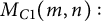 $M_{C1}(m,n):$
 $$\begin{align*}\sum_{n=1}^{\infty}M_{C1}(m,n)q^{n}=\frac{1}{(q^{2};q^{2})_{\infty}}\left(\sum_{n=1}^{\infty}\frac{(-1)^{n}q^{n(3n+1)+2|m|n}}{1-q^{2n}}-\sum_{n=1}^{\infty}\frac{(-1)^{n}q^{\frac{n(n+1)}{2}+|m|n}}{1-q^{n}}\right). \end{align*}$$
Let
 $$ \begin{align} \sum_{n\geq0}X^{(m)}(n)q^{n}:=\frac{1}{1-q^{2}}\left(\sum_{n=1}^{\infty}\frac{(-1)^{n}q^{n(3n+1)+2mn}}{1-q^{2n}}-\sum_{n=1}^{\infty}\frac{(-1)^{n}q^{\frac{n(n+1)}{2}+mn}}{1-q^{n}}\right),\;m\geq0. \end{align} $$
From the generating functions, we see that the nonnegativity of
 $X^{(m)}(n)$
implies that of
 $M_{C1}(m,n).$
In order to study the nonnegativity of
 $M_{C1}(m,n),$
we only need to consider the nonnegativity of
 $X^{(m)}(n).$
When n is even, we can relate the coefficient
 $X^{(m)}(n)$
to the numbers of lattice points in some region of
 $\mathbb {R}^{2}.$
With the help of an important theorem [Reference Hua11, Theorem 9.2, p. 123] due to the Czech mathematician M.V. Jarnik, we can get an estimate for the lower bound of
 $X^{(m)}(n).$
This, together with other results, allows us to obtain the nonnegativity of
 $X^{(m)}(n).$
The first result is as follows.
Theorem 1.1 Let m and n be two nonnegative integers and let
 $$ \begin{align} f(m):=\left(\frac{2\left(6+\sqrt{36+(m+2)\log2}\right)}{\log2}\right)^{2}. \end{align} $$
If n is odd, then
 $X^{(m)}(n)$
is nonnegative; if n is even, then
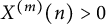 $X^{(m)}(n)>0$
for
 $n\geq f(m).$
In addition to this result, we also consider the case
 $0\leq n\leq 20m.$
Theorem 1.2 Let m and n be two nonnegative integers such that
 $n\leq 20m.$
Then
 $X^{(m)}(n)$
is nonnegative.
We next consider the nonnegativity of
 $M_{C5}(m,n).$
Recall the following generating function [Reference Jang and Kim12, Equation (2.2)] for
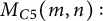 $M_{C5}(m,n):$
 $$\begin{align*}\sum_{n=1}^{\infty}M_{C5}(m,n)q^{n}=\frac{1}{(q^{2};q^{2})_{\infty}}\left(\sum_{n=1}^{\infty}\frac{(-1)^{n}q^{n(n+1)+2|m|n}}{1-q^{2n}}-\sum_{n=1}^{\infty}\frac{(-1)^{n}q^{\frac{n(n+1)}{2}+|m|n}}{1-q^{n}}\right). \end{align*}$$
Let
 $$ \begin{align} \sum_{n\geq0}Y^{(m)}(n)q^{n}:=\sum_{n=1}^{\infty}\frac{(-1)^{n}q^{n(n+1)+2mn}}{1-q^{2n}}-\sum_{n=1}^{\infty}\frac{(-1)^{n}q^{\frac{n(n+1)}{2}+mn}}{1-q^{n}},\;m\geq0. \end{align} $$
Then the nonnegativity of
 $Y^{(m)}(n)$
implies that of
 $M_{C5}(m,n).$
In order to prove the nonnegativity of
 $M_{C5}(m,n),$
we first study the nonnegativity of
 $Y^{(m)}(n).$
We convert the nonnegativity of
 $Y^{(m)}(n)$
to the consideration of the numbers of four sets in
 $\mathbb {N}^{2}.$
From this we can obtain the nonnegativity of
 $Y^{(m)}(n).$
Theorem 1.3 Let m be a nonnegative integer. Then
 $Y^{(m)}(n)$
is nonnegative for all
 ${n\geq 0.}$
Combining Theorems 1.1–1.3, we can confirm Conjecture 1.1 Footnote 5 .
Theorem 1.4 Conjecture 1.1 is true.
In the next section, we provide some auxiliary results, which are crucial to the derivation of Theorems 1.1–1.3. Section 3 is devoted to our proofs of Theorems 1.1–1.3. In Section 4, we show Theorem 1.4.
2 Auxiliary results
We begin this section by recalling the following result of Jarnik concerning the problem of the number of lattice points inside a closed curve.
Lemma 2.1 (Jarnik, see [Reference Hua11, Theorem 9.2, p. 123])
Suppose C is a rectifiableFootnote
6
simple closed curve. Let
 $l\geq 1$
be the length of C and let A be the area of the region bounded by the curve
 $C.$
If N is the number of lattice points inside the region, then
 $$\begin{align*}|N-A|<l. \end{align*}$$
The next result concerns the number of lattice points with y-coordinates being odd.
Lemma 2.2 Suppose B is a region bounded by a rectifiable simple closed curve C such that each vertical line segment with endpoints on C is in
 $B.$
Let N represent the number of lattice points in the region B and let M denote the number of lattice points within this region where the y-coordinates are odd. Then
 $$\begin{align*}\left|\frac{N}{2}-M\right|\leq\sup_{P,Q\in B}|x(P)-x(Q)|+1, \end{align*}$$
where
 $x(T)$
denotes the x-coordinate of
 $T.$
Proof Let
 $$\begin{align*}m_{1}:=\min\left\{ x|(x,y)\in B\;and\;(x,y)\in\mathbb{Z}^{2}\right\} \end{align*}$$
and
 $$\begin{align*}m_{2}:=\max\left\{ x|(x,y)\in B\;and\;(x,y)\in\mathbb{Z}^{2}\right\}. \end{align*}$$
For each
 $x_{0}\in [m_{1},m_{2}]$
and
 $x_{0}\in \mathbb {Z},$
let
 $N_{x_{0}}$
be the number of lattice points in
 $B\cap \{(x_{0},y)|y\in \mathbb {R}\}$
and let
 $M_{x_{0}}$
be the number of lattice points in
 $B\cap \{(x_{0},y)|y\in \mathbb {R}\}$
with the y-coordinates being odd. Then
 $N_{x_{0}}-M_{x_{0}}$
is the number of lattice points in
 $B\cap \{(x_{0},y)|y\in \mathbb {R}\}$
with the y-coordinates being even and so
 $$\begin{align*}\left|\left(N_{x_{0}}-M_{x_{0}}\right)-M_{x_{0}}\right|\leq1. \end{align*}$$
It is easy to see that
 $N-M$
is the number of lattice points in the region B with the y-coordinates being even. Thus,
 $$ \begin{align*} \left|\left(N-M\right)-M\right| & =\left|\sum_{\substack{x_{0}\in[m_{1},m_{2}]\\ x_{0}\in\mathbb{Z} } }\left(\left(N_{x_{0}}-M_{x_{0}}\right)-M_{x_{0}}\right)\right|\\ & \leq\sum_{\substack{x_{0}\in[m_{1},m_{2}]\\ x_{0}\in\mathbb{Z} } }\left|\left(N_{x_{0}}-M_{x_{0}}\right)-M_{x_{0}}\right|\\ & \leq m_{2}+1-m_{1}\\ & \leq\sup_{P,Q\in B}|x(P)-x(Q)|+1. \end{align*} $$
This implies that
 $$\begin{align*}\left|\frac{N}{2}-M\right|\leq\sup_{P,Q\in B}|x(P)-x(Q)|+1, \end{align*}$$
which finishes the proof.
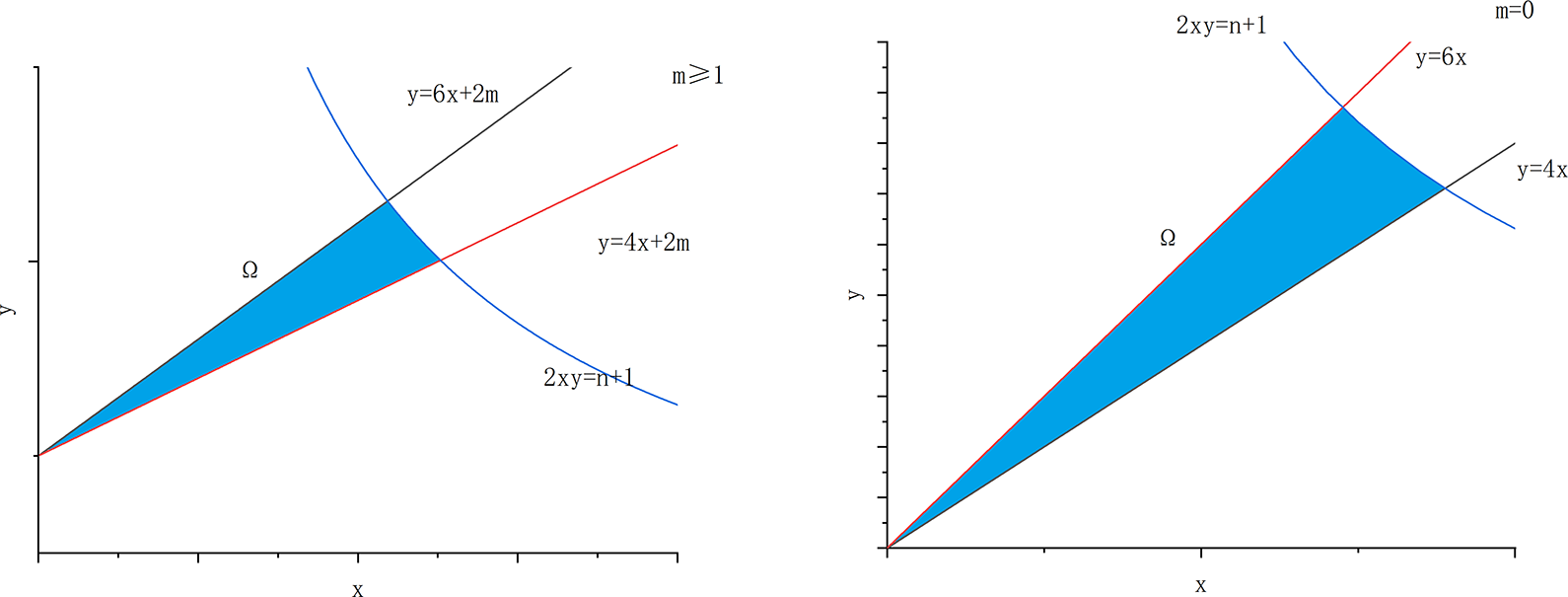
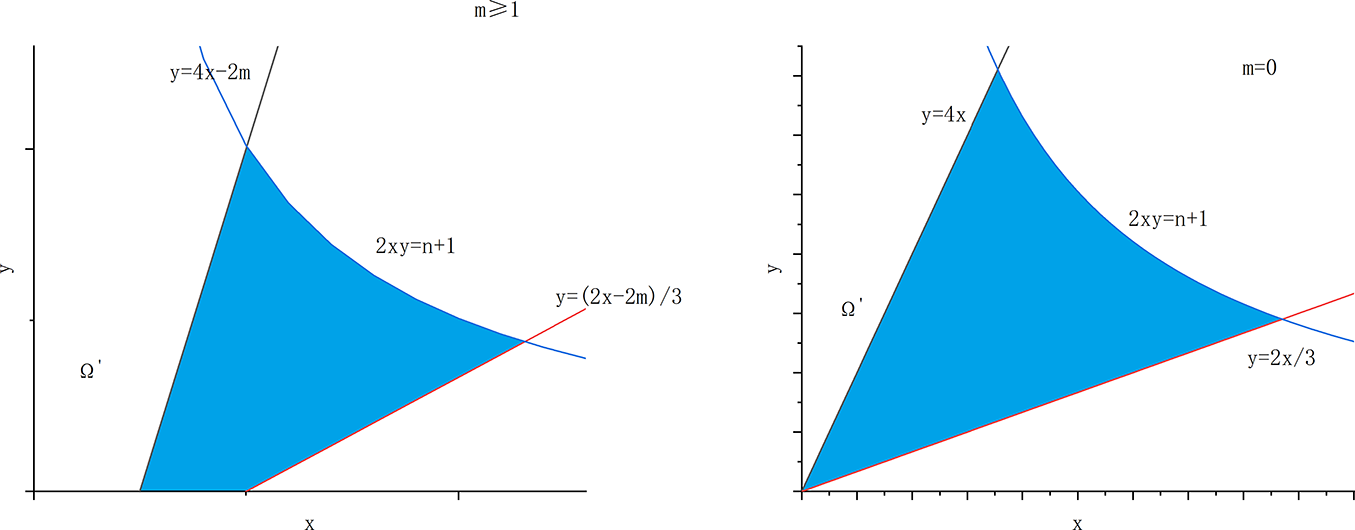
From Lemmas 2.1 and 2.2, we can derive the following results (see Figures 1 and 2 for diagram of
 $\Omega $
and
 $\Omega '$
below).
Lemma 2.3 Let m and n be two nonnegative integers and
 $$\begin{align*}\Omega:=\left\{ (x,y)\bigg|xy<\frac{n+1}{2},y-6x<2m,y-4x>2m,x>0,y>0\right\} \end{align*}$$
and let
 $M_{1}^{(m)}(n)$
denote the number of lattice points in
 $\Omega $
with odd y-coordinates. Then
 $$ \begin{align*} M_{1}^{(m)}(n) & <\frac{1}{4}(n+1)\left(\log\left(\frac{3\left(\sqrt{1+2t}-1\right)}{2\left(\sqrt{1+3t}-1\right)}\right)+\left(\frac{1}{\sqrt{1+3t}+1}+\frac{-1}{\sqrt{1+2t}+1}\right)\right)\\ & \quad+2.2\sqrt{n+1}+1, \end{align*} $$
where t is defined byFootnote 7
 $$ \begin{align} t=\frac{n+1}{m^{2}}. \end{align} $$
Schematic diagram of
 $\Omega $
.

Schematic diagram of
 $\Omega '$
.

Proof Let
 $A(\Omega )$
and
 $l(\Omega )$
denote the area of
 $\Omega $
and the length of the boundary curve of
 $\Omega $
, respectively. Set
 $$ \begin{align*} & x_{1}=0,\quad y_{1}=2m,\\ & x_{2}=\frac{-2m+\sqrt{(2m)^{2}+8(n+1)}}{8},\quad y_{2}=\frac{n+1}{2x_{2}},\\ & x_{3}=\frac{1}{12}\left(\sqrt{(2m)^{2}+12(n+1)}-(2m)\right),\quad y_{3}=\frac{n+1}{2x_{3}}. \end{align*} $$
Then
 $$ \begin{align} \begin{aligned}A(\Omega) & =\int_{y_{2}}^{y_{3}}\frac{n+1}{2y}dy+\frac{(y_{2}-y_{1})x_{2}}{2}-\frac{(y_{3}-y_{1})x_{3}}{2}\\ & =\frac{1}{2}(n+1)\log\left(\frac{3\left(\sqrt{(2m)^{2}+8(n+1)}-2m\right)}{2\left(\sqrt{(2m)^{2}+12(n+1)}-2m\right)}\right)\\ & \;-\frac{m}{24}\left(3\sqrt{(2m)^{2}+8(n+1)}-2\sqrt{(2m)^{2}+12(n+1)}-m\right)\\ & =\frac{1}{2}(n+1)\log\left(\frac{3\left(\sqrt{1+2t}-1\right)}{2\left(\sqrt{1+3t}-1\right)}\right)\\ & \qquad+\frac{1}{2}(n+1)\left(\frac{1}{\sqrt{1+3t}+1}+\frac{-1}{\sqrt{1+2t}+1}\right) \end{aligned} \end{align} $$
and
 $$ \begin{align} l(\Omega) & =\sqrt{(x_{3}-x_{1})^{2}+(y_{3}-y_{1})^{2}}+\sqrt{(x_{2}-x_{1})^{2}+(y_{2}-y_{1})^{2}}\nonumber\\& \qquad+\int_{y_{2}}^{y_{3}}\sqrt{1+\frac{(n+1)^{2}}{4y^{4}}}dy\nonumber\\& <\sqrt{(x_{3}-x_{1})^{2}+(y_{3}-y_{1})^{2}}+\sqrt{(x_{2}-x_{1})^{2}+(y_{2}-y_{1})^{2}}\nonumber\\& \qquad+(y_{3}-y_{2})\sqrt{1+\frac{(n+1)^{2}}{4y_{2}^{4}}}\nonumber\\& =\frac{m}{2}\sqrt{\frac{17}{2}}\sqrt{-\sqrt{1+2t}+t+1}+\frac{m}{6}\sqrt{37}\sqrt{-2\sqrt{1+3t}+3t+2}\nonumber\\& \qquad+m\left(\sqrt{1+3t}-\sqrt{1+2t}\right)\sqrt{\frac{\left(\sqrt{1+2t}-1\right)^{4}}{64t^{2}}+1}\\& =\frac{m}{2}\sqrt{\frac{17}{2}}\sqrt{1-\sqrt{1+2t}+t}+\frac{m}{6}\sqrt{37}\sqrt{2-2\sqrt{1+3t}+3t}\nonumber\\& \qquad+\frac{mt}{\sqrt{1+3t}+\sqrt{1+2t}}\sqrt{\frac{t^{2}}{4\left(\sqrt{1+2t}+1\right)^{4}}+1}\nonumber\\& <\frac{m}{2}\sqrt{\frac{17t}{2}}+\frac{m}{6}\sqrt{111t}+\frac{m\sqrt{t}}{\sqrt{3}+\sqrt{2}}\sqrt{\frac{1}{16}+1}\nonumber\\& =\sqrt{\frac{17}{8}}\sqrt{n+1}+\sqrt{\frac{37}{12}}\sqrt{n+1}+\sqrt{\frac{17}{16}}\frac{1}{\sqrt{3}+\sqrt{2}}\sqrt{n+1}\nonumber\\& <3.6\sqrt{n+1}. \nonumber \end{align} $$
It is easily seen that
 $$ \begin{align} \begin{aligned}\sup_{P,Q\in\Omega}|x(P)-x(Q)| & =x_{2}-x_{1}=\frac{1}{8}\left(\sqrt{(2m)^{2}+8(n+1)}-(2m)\right)\\ & =\frac{n+1}{\sqrt{(2m)^{2}+8(n+1)}+(2m)}\\ & <\frac{\sqrt{2(n+1)}}{4}. \end{aligned} \end{align} $$
Let
 $N(\Omega )$
denote the number of lattice points in
 $\Omega $
. Applying Lemmas 2.1 and 2.2, we get
 $$\begin{align*}M_{1}^{(m)}(n)&\leq\frac{N(\Omega)}{2}+\left|M_{1}^{(m)}(n)-\frac{N(\Omega)}{2}\right| \\& \leq\frac{A(\Omega)+\left|N(\Omega)-A(\Omega)\right|}{2}+\left|M_{1}^{(m)}(n)-\frac{N(\Omega)}{2}\right|\\& <\frac{A(\Omega)}{2}+\frac{l(\Omega)}{2}+\sup_{P,Q\in\Omega}|x(P)-x(Q)|+1. \end{align*}$$
Then the result follows readily by substituting (2.2)–(2.4) into the right side of the above inequality.
Lemma 2.4 Let m and n be two nonnegative integers and
 $$\begin{align*}\Omega':=\left\{ (x,y)\bigg|xy<\frac{n+1}{2},2x-3y<2m,4x-y>2m,x>0,y>0\right\} \end{align*}$$
and let
 $M_{2}^{(m)}(n)$
denote the number of lattice points in
 $\Omega '$
with odd y-coordinates. Then
 $$ \begin{align*} M_{2}^{(m)}(n) &>\frac{1}{4}(n+1)\left(\frac{1}{\sqrt{1+3t}+1}+\frac{-1}{\sqrt{1+2t}+1}+\log\left(\frac{2\left(\sqrt{1+3t}+1\right)}{\sqrt{1+2t}+1}\right)\right)\\ & \qquad-3.7\sqrt{n+1}-m-1, \end{align*} $$
where t is defined in (2.1).
Proof Let
 $A(\Omega ')$
and
 $l(\Omega ')$
denote the area of
 $\Omega '$
and the length of the boundary curve of
 $\Omega '$
, respectively. Set
 $$ \begin{align*} & x_{4}=\frac{m}{2},\quad y_{4}=0,\\ & x_{5}=m,\quad y_{5}=0,\\ & x_{6}=\frac{1}{8}\left(\sqrt{(2m)^{2}+8(n+1)}+2m\right),\quad \ \, y_{6}=\frac{n+1}{2x_{6}},\\ & x_{7}=\frac{1}{4}\left(\sqrt{(2m)^{2}+12(n+1)}+2m\right),\quad y_{7}=\frac{n+1}{2x_{7}}. \end{align*} $$
Then
 $$ \begin{align} \begin{aligned}A(\Omega') & =\frac{(x_{6}-x_{4})y_{6}}{2}+\int_{x_{6}}^{x_{7}}\frac{n+1}{2x}dx-\frac{(x_{7}-x_{5})y_{7}}{2}\\ & =\frac{1}{2}(n+1)\left(\frac{2m}{\sqrt{(2m)^{2}+12(n+1)}+2m}+\frac{-2m}{\sqrt{(2m)^{2}+8(n+1)}+2m}\right.\\ & \qquad\left.+\log2\left(\frac{\sqrt{(2m)^{2}+12(n+1)}+2m}{\sqrt{(2m)^{2}+8(n+1)}+2m}\right)\right)\\ & =\frac{1}{2}(n+1)\left(\frac{1}{\sqrt{1+3t}+1}+\frac{-1}{\sqrt{1+2t}+1}+\log\left(\frac{2\left(\sqrt{1+3t}+1\right)}{\sqrt{1+2t}+1}\right)\right) \end{aligned} \end{align} $$
and
 $$ \begin{align*} l(\Omega') & =\sqrt{(x_{6}-x_{4})^{2}+(y_{6}-y_{4})^{2}}+\sqrt{(x_{7}-x_{5})^{2}+(y_{7}-y_{5})^{2}}\\ & \qquad+x_{5}-x_{4}+\int_{x_{6}}^{x_{7}}\sqrt{1+\frac{(n+1)^{2}}{4x^{4}}}dx\\ & <\sqrt{(x_{6}-x_{4})^{2}+(y_{6}-y_{4})^{2}}+\sqrt{(x_{7}-x_{5})^{2}+(y_{7}-y_{5})^{2}}\\ & \qquad+x_{5}-x_{4}+(x_{7}-x_{6})\sqrt{1+\frac{(n+1)^{2}}{4x_{6}^{4}}}\\ & =\frac{1}{2}\left(\sqrt{\frac{17(n+1)^{2}}{\left(\sqrt{m^{2}+2(n+1)}+m\right)^{2}}}+\sqrt{\frac{13(n+1)^{2}}{\left(\sqrt{m^{2}+3(n+1)}+m\right)^{2}}}+m\right)\\ & \qquad+\frac{\lambda(m,n)}{4}\sqrt{\frac{64(n+1)^{2}}{\left(\sqrt{m^{2}+2(n+1)}+m\right)^{4}}+1}, \end{align*} $$
where
 $$\begin{align*}\lambda(m,n):=2\sqrt{m^{2}+3(n+1)}-\sqrt{m^{2}+2(n+1)}+m. \end{align*}$$
Note that
 $$ \begin{align*} & 2\sqrt{m^{2}+3(n+1)}-\sqrt{m^{2}+2(n+1)}\\& \quad =2\left(\sqrt{m^{2}+3(n+1)}-m\right)-\left(\sqrt{m^{2}+2(n+1)}-m\right)+m\\& \quad =\frac{6(n+1)}{\sqrt{m^{2}+3(n+1)}+m}-\frac{2(n+1)}{\sqrt{m^{2}+2(n+1)}+m}+m\\& \quad <\frac{4(n+1)}{\sqrt{m^{2}+2(n+1)}+m}+m\\& \quad \leq 2\sqrt{2(n+1)}+m. \end{align*} $$
With this inequality and (2.1), we deduce that
 $$ \begin{align} \begin{aligned}l(\Omega') & <\frac{\sqrt{17(n+1)}}{2}\sqrt{\frac{t}{\left(\sqrt{1+2t}+1\right)^{2}}}+\frac{\sqrt{13(n+1)}}{2}\sqrt{\frac{t}{\left(\sqrt{1+3t}+1\right)^{2}}}\\ & \quad+\frac{\sqrt{2(n+1)}}{2}\sqrt{\frac{64t^{2}}{\left(\sqrt{1+2t}+1\right)^{4}}+1}+m\\ & <\frac{\sqrt{17(n+1)}}{2}\sqrt{\frac{1}{2}}+\frac{\sqrt{13(n+1)}}{2}\sqrt{\frac{1}{3}}+\frac{\sqrt{2(n+1)}}{2}\sqrt{17}+m\\ & <5.5\sqrt{n+1}+m. \end{aligned} \end{align} $$
It can be easily deduced that
 $$ \begin{align} \begin{aligned}\sup_{P,Q\in\Omega'}|x(P)-x(Q)| & =x_{7}-x_{4}=\frac{1}{4}\sqrt{(2m)^{2}+12(n+1)}\\ & \leq\frac{\sqrt{3(n+1)}}{2}+\frac{m}{2}, \end{aligned} \end{align} $$
where in the last step, we have used the simple inequality:
 $$\begin{align*}\sqrt{a^{2}+b^{2}}\leq a+b,\quad a\geq0,b\geq0. \end{align*}$$
Let
 $N(\Omega ')$
denote the number of lattice points in
 $\Omega '.$
Using Lemmas 2.1 and 2.2, we derive that
 $$ \begin{align*} M_{2}^{(m)}(n) & =\left|\frac{N(\Omega')}{2}+\left(M_{2}^{(m)}(n)-\frac{N(\Omega')}{2}\right)\right|\\ & \geq\frac{N(\Omega')}{2}-\left|M_{2}^{(m)}(n)-\frac{N(\Omega')}{2}\right|\\ & \geq\frac{A(\Omega')-\left|N(\Omega')-A(\Omega')\right|}{2}-\left|M_{2}^{(m)}(n)-\frac{N(\Omega')}{2}\right|\\ &>\frac{A(\Omega')}{2}-\frac{l(\Omega')}{2}-\sup_{P,Q\in\Omega'}|x(P)-x(Q)|-1. \end{align*} $$
Substituting (2.5)–(2.7) into the right side of the above inequality we easily obtain the result.
3 Proofs of Theorems 1.1–1.3
In this section, we first prove Theorem 1.3 and then show Theorems 1.1 and 1.2.
Proof of Theorem 1.3. It is easily seen from (1.9) that
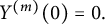 $Y^{(m)}(0)=0.$
We suppose
 $n\geq 1$
below. For any positive integer
 $n,$
we set
 $n=2^{e}\cdot N,$
where e is a nonnegative integer and N denotes an odd positive integer.
For convenience, we introduce four sets in
 $\mathbb {N}^{2}.$
Let
 $$ \begin{align} A_{1} & :=\left\{ (d_{1},d_{2})\in\mathbb{N}^{2}|d_{1}d_{2}=N,d_{2}-2^{e}d_{1}\geq2m+1\text{ is odd}\right\} ,\nonumber \\A_{2} & :=\left\{ (d_{1},d_{2})\in\mathbb{\mathbb{N}}^{2}|d_{1}d_{2}=N,d_{2}-2^{e+1}d_{1}\geq2m+1\text{ is odd}\right\} , \end{align} $$
 $$ \begin{align} B_{1} & :=\left\{ (d_{1},d_{2})\in\mathbb{\mathbb{N}}^{2}|d_{1}d_{2}=N,2^{e+1}d_{2}-d_{1}\geq2m+1\text{ is odd}\right\} , \\B_{2} & :=\left\{ (d_{1},d_{2})\in\mathbb{\mathbb{N}}^{2}|d_{1}d_{2}=N,2^{e}d_{2}-d_{1}\geq2m+1\text{ is odd}\right\} .\nonumber \end{align} $$
From (1.9), we deduce that
 $$ \begin{align} \begin{aligned}Y^{(m)}(n) & =\sum_{\substack{t(t+1)+2mt+2lt=n\\ t\geq1,l\geq0 } }(-1)^{t}-\sum_{\substack{t(t+1)+2mt+2lt=2n\\ t\geq1,l\geq0 } }(-1)^{t}\\& =\sum_{\substack{t(t+s)=n\\ t\geq1\\ s\geq2m+1\text{ is odd} } }(-1)^{t}-\sum_{\substack{t(t+s)=2n\\ t\geq1\\ s\geq2m+1\text{ is odd} } }(-1)^{t}. \end{aligned} \end{align} $$
Then
 $$ \begin{align} \begin{aligned}Y^{(m)}(n) & =\sum_{(d_{1},d_{2})\in A_{1}}1-\sum_{(d_{1},d_{2})\in B_{2}}1-\sum_{(d_{1},d_{2})\in A_{2}}1+\sum_{(d_{1},d_{2})\in B_{1}}1\\ & =\#A_{1}+\#B_{1}-\#A_{2}-\#B_{2}, \end{aligned} \end{align} $$
where
 $\#S$
denotes the number of the elements in a finite set
 $S.$
If
 $e=0,$
then
 $$\begin{align*}A_{1}=B_{2}=\varnothing \end{align*}$$
and
 $$\begin{align*}A_{2}\subseteq B_{1}. \end{align*}$$
This implies that
 $$\begin{align*}\#A_{1}=\#B_{2}=0 \end{align*}$$
and
 $$ \begin{align} \#B_{1}\geq\#A_{2}. \end{align} $$
Thus, from (3.4), we obtain
 $$\begin{align*}Y^{(m)}(n)=\#B_{1}-\#A_{2}\geq0. \end{align*}$$
If
 $e\geq 1,$
then
 $$\begin{align*}A_{2}\subseteq A_{1},\quad B_{2}\subseteq B_{1} \end{align*}$$
and so
 $$\begin{align*}\#A_{1}\geq\#A_{2},\quad\#B_{1}\geq\#B_{2}. \end{align*}$$
This, together with (3.4), gives
 $$\begin{align*}Y^{(m)}(n)\geq0. \end{align*}$$
This completes the proof of Theorem 1.3.
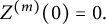
Proof of Theorem 1.1. From (1.7), we know that
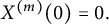 $X^{(m)}(0)=0.$
We now consider the case
 $n\geq 1.$
LetFootnote
8
 $$\begin{align*}\sum_{n\geq1}Z^{(m)}(n)q^{n}:=-\sum_{n\geq1}\frac{(-1)^{n}q^{\frac{n(n+1)}{2}+mn}}{1-q^{n}} \end{align*}$$
and let
 $A_{2}$
and
 $B_{1}$
be defined as in (3.1) and (3.2), respectively. Then
 $$ \begin{align} \begin{aligned}Z^{(m)}(n) & =-\sum_{\substack{t(t+1)+2mt+2lt=2n\\ t\geq1,l\geq0 } }(-1)^{t}\\ & =-\sum_{\substack{t(t+s)=2n\\ t\geq1\\ s\geq2m+1\text{ is odd} } }(-1)^{t}\\ & =\sum_{(d_{1},d_{2})\in B_{1}}1-\sum_{(d_{1},d_{2})\in A_{2}}1\\ & =\#B_{1}-\#A_{2}\geq0, \end{aligned} \end{align} $$
where in the last step, we have used the inequality (3.5).
When n is odd, since
 $$\begin{align*}\sum_{\substack{n\geq0\\ n\text{ is odd} } }X^{(m)}(n)q^{n}=\frac{1}{1-q^{2}}\sum_{\substack{n\geq1\\ n\text{ is odd} } }Z^{(m)}(n)q^{n}, \end{align*}$$
we deduce from (3.6) that
 $X^{(m)}(n)$
is nonnegative.
When n is even, it is easy to see that the coefficient of
 $q^{n}$
in the q-series expansion of
 $$\begin{align*}\sum_{n=1}^{\infty}\frac{(-1)^{n}q^{n(3n+1)+2mn}}{1-q^{2n}} \end{align*}$$
is equal to
 $$\begin{align*}\sum_{\substack{t(3t+1)+2mt+2lt=n\\ t\geq1,l\geq0 } }(-1)^{t}. \end{align*}$$
Since
 $$ \begin{align*} \sum_{\substack{t(3t+1)+2mt+2lt=n\\ t\geq1,l\geq0 } }(-1)^{t} & =\sum_{\substack{t(3t+s)=n\\ t\geq1\\ s\geq1+2m\text{ is odd} } }(-1)^{t}\\ & =\sum_{\substack{d_{1}d_{2}=n\\ d_{1}\geq1\text{ is odd},d_{2}\geq1\\ d_{1}-3d_{2}\geq1+2m } }1-\sum_{\substack{d_{1}d_{2}=n\\ d_{1}\geq1\text{ is odd},d_{2}\geq1\\ d_{2}-3d_{1}\geq1+2m } }1, \end{align*} $$
we know that the coefficient of
 $q^{n}$
in the q-series expansion of
 $$\begin{align*}\sum_{n=1}^{\infty}\frac{(-1)^{n}q^{n(3n+1)+2mn}}{1-q^{2n}} \end{align*}$$
is
 $$\begin{align*}\sum_{\substack{d_{1}d_{2}=n\\ d_{1}\geq1\text{ is odd},d_{2}\geq1\\ d_{1}-3d_{2}\geq1+2m } }1-\sum_{\substack{d_{1}d_{2}=n\\ d_{1}\geq1\text{ is odd},d_{2}\geq1\\ d_{2}-3d_{1}\geq1+2m } }1. \end{align*}$$
Then the coefficient of
 $q^{n}$
in the q-series expansion of
 $$\begin{align*}\frac{1}{1-q^{2}}\sum_{n=1}^{\infty}\frac{(-1)^{n}q^{n(3n+1)+2mn}}{1-q^{2n}} \end{align*}$$
equals
 $$\begin{align*}\sum_{\substack{1\leq k\leq n\\ 2|k } }\left(\sum_{\substack{d_{1}d_{2}=k\\ d_{1}\geq1\text{ is odd},d_{2}\geq1\\ d_{1}-3d_{2}\geq1+2m } }1-\sum_{\substack{d_{1}d_{2}=k\\ d_{1}\geq1\text{ is odd},d_{2}\geq1\\ d_{2}-3d_{1}\geq1+2m } }1\right). \end{align*}$$
It can be deduced from (3.6) that
 $$ \begin{align*} \sum_{\substack{1\leq k\leq n\\ 2|k } }Z^{(m)}(k) & =\sum_{\substack{1\leq k\leq n\\ 2|k } }\sum_{\substack{t(t+s)=2k\\ t\geq1\\ s\geq2m+1\text{ is odd} } }(-1)^{t+1}\\ & =\sum_{\substack{1\leq k\leq n\\ 2|k } }\left(\sum_{\substack{d_{1}d_{2}=2k\\ d_{1}\geq1\text{ is odd},d_{2}\geq1\\ d_{2}-d_{1}\geq2m+1 } }1-\sum_{\substack{d_{1}d_{2}=2k\\ d_{1}\geq1\text{ is odd},d_{2}\geq1\\ d_{1}-d_{2}\geq2m+1 } }1\right). \end{align*} $$
Then the coefficient of
 $q^{n}$
in the q-series expansion of
 $$\begin{align*}-\frac{1}{1-q^{2}}\sum_{n\geq1}\frac{(-1)^{n}q^{\frac{n(n+1)}{2}+mn}}{1-q^{n}} \end{align*}$$
is equal to
 $$\begin{align*}\sum_{\substack{1\leq k\leq n\\ 2|k } }\left(\sum_{\substack{d_{1}d_{2}=2k\\ d_{1}\geq1\text{ is odd},d_{2}\geq1\\ d_{2}-d_{1}\geq2m+1 } }1-\sum_{\substack{d_{1}d_{2}=2k\\ d_{1}\geq1\text{ is odd},d_{2}\geq1\\ d_{1}-d_{2}\geq2m+1 } }1\right). \end{align*}$$
In view of the above, we deduce that
 $$ \begin{align*} X^{(m)}(n) & =\sum_{\substack{1\leq k\leq n\\ 2|k } }\left(\sum_{\substack{d_{1}d_{2}=k\\ d_{1}\geq1\text{ is odd},d_{2}\geq1\\ d_{1}-3d_{2}\geq2m+1 } }1-\sum_{\substack{d_{1}d_{2}=k\\ d_{1}\geq1\text{ is odd},d_{2}\geq1\\ d_{2}-3d_{1}\geq2m+1 } }1+\sum_{\substack{d_{1}d_{2}=2k\\ d_{1}\geq1\text{ is odd},d_{2}\geq1\\ d_{2}-d_{1}\geq2m+1 } }1-\sum_{\substack{d_{1}d_{2}=2k\\ d_{1}\geq1\text{ is odd},d_{2}\geq1\\ d_{1}-d_{2}\geq2m+1 } }1\right)\\ & =\sum_{\substack{1\leq k\leq n\\ 2|k } }\left(\sum_{\substack{d_{1}d_{2}=k\\ d_{1}\geq1\text{ is odd},d_{2}\geq1\\ d_{1}-3d_{2}\geq2m+1 } }1-\sum_{\substack{d_{1}d_{2}=k\\ d_{1}\geq1\text{ is odd},d_{2}\geq1\\ d_{2}-3d_{1}\geq2m+1 } }1+\sum_{\substack{d_{1}d_{2}=k\\ d_{1}\geq1\text{ is odd},d_{2}\geq1\\ 2d_{2}-d_{1}\geq2m+1 } }1-\sum_{\substack{d_{1}d_{2}=k\\ d_{1}\geq1\text{ is odd},d_{2}\geq1\\ d_{1}-2d_{2}\geq2m+1 } }1\right)\\ & =\sum_{\substack{1\leq k\leq n\\ 2|k } }\left(\sum_{\substack{d_{1}d_{2}=k\\ d_{1}\geq1\text{ is odd},d_{2}\geq1\\ 2d_{2}-d_{1}\geq2m+1\\ d_{2}-3d_{1}<2m+1 } }1-\sum_{\substack{d_{1}d_{2}=k\\ d_{1}\geq1\text{ is odd},d_{2}\geq1\\ d_{1}-2d_{2}\geq2m+1\\ d_{1}-3d_{2}<2m+1 } }1\right). \end{align*} $$
From this, we obtain
 $$ \begin{align*} X^{(m)}(n) & =\sum_{\substack{d_{1}d_{2}\leq\frac{n}{2}\\ d_{1}\geq1\text{ is odd},d_{2}\geq1\\ 4d_{2}-d_{1}\geq2m+1\\ 2d_{2}-3d_{1}<2m+1 } }1-\sum_{\substack{d_{1}d_{2}\leq\frac{n}{2}\\ d_{1}\geq1\text{ is odd},d_{2}\geq1\\ d_{1}-4d_{2}\geq2m+1\\ d_{1}-6d_{2}<2m+1 } }1\\ & =\sum_{\substack{d_{1}d_{2}<\frac{n+1}{2}\\ d_{1}\geq1\text{ is odd},d_{2}\geq1\\ 4d_{2}-d_{1}>2m\\ 2d_{2}-3d_{1}<2m } }1-\sum_{\substack{d_{1}d_{2}<\frac{n+1}{2}\\ d_{1}\geq1\text{ is odd},d_{2}\geq1\\ d_{1}-4d_{2}>2m\\ d_{1}-6d_{2}<2m } }1\\ & =M_{2}^{(m)}(n)-M_{1}^{(m)}(n), \end{align*} $$
where
 $M_{1}^{(m)}(n)$
and
 $M_{2}^{(m)}(n)$
are defined in Lemmas 2.3 and 2.4, respectively.
It follows from Lemmas 2.3 and 2.4 that
 $$\begin{align*}M_{2}^{(m)}(n)-M_{1}^{(m)}(n)>\frac{\log2}{4}(n+1)-6\sqrt{n+1}-m-2. \end{align*}$$
Then
 $$\begin{align*}X^{(m)}(n)>\frac{\log2}{4}(n+1)-6\sqrt{n+1}-m-2. \end{align*}$$
When
 $n\geq f(m),$
we have
 $$\begin{align*}\frac{\log2}{4}(n+1)-6\sqrt{n+1}-m-2\geq0 \end{align*}$$
and so
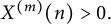 $X^{(m)}(n)>0.$
This finishes the proof of Theorem 1.1.
Proof of Theorem 1.2. Let
 $$\begin{align*}T(q):=\frac{1}{1-q^{2}}\left(\sum_{n=1}^{9}\frac{(-1)^{n}q^{n(3n+1)+2mn}}{1-q^{2n}}-\sum_{n=1}^{19}\frac{(-1)^{n}q^{\frac{n(n+1)}{2}+mn}}{1-q^{n}}\right). \end{align*}$$
If
 $n\leq 20m,$
then
 $X^{(m)}(n)$
is equal to the coefficient of
 $q^{n}$
in the q-series expansion of
 $T(q).$
We define that
 $$ \begin{align*} T_{1}(q) & :=\frac{1}{1-q^{2}}\left(\frac{q^{1+m}}{1-q}-\frac{q^{3+2m}}{1-q^{2}}-\frac{q^{4+2m}}{1-q^{2}}-\frac{q^{10+4m}}{1-q^{4}}+\frac{q^{14+4m}}{1-q^{4}}\right)\\ & \quad+\frac{1}{1-q^{2}}\left(\frac{q^{52+8m}}{1-q^{8}}+\frac{q^{200+16m}}{1-q^{16}}-\frac{q^{136+16m}}{1-q^{16}}-\frac{q^{36+8m}}{1-q^{8}}\right),\\ T_{3}(q) & :=\frac{1}{1-q^{2}}\left(\frac{q^{6+3m}}{1-q^{3}}-\frac{q^{21+6m}}{1-q^{6}}-\frac{q^{30+6m}}{1-q^{6}}-\frac{q^{78+12m}}{1-q^{12}}+\frac{q^{114+12m}}{1-q^{12}}\right),\\ T_{5}(q) & :=\frac{1}{1-q^{2}}\left(\frac{q^{15+5m}}{1-q^{5}}-\frac{q^{55+10m}}{1-q^{10}}-\frac{q^{80+10m}}{1-q^{10}}\right),\\ T_{7}(q) & :=\frac{1}{1-q^{2}}\left(\frac{q^{28+7m}}{1-q^{7}}-\frac{q^{154+14m}}{1-q^{14}}-\frac{q^{105+14m}}{1-q^{14}}\right),\\ T_{9}(q) & :=\frac{1}{1-q^{2}}\left(\frac{q^{45+9m}}{1-q^{9}}-\frac{q^{171+18m}}{1-q^{18}}-\frac{q^{252+18m}}{1-q^{18}}\right), \end{align*} $$
and
 $$ \begin{align*} T'(q) & :=\frac{q^{11(11+1)/2+11m}}{(1-q^{11})(1-q^{2})}+\frac{q^{13(13+1)/2+13m}}{(1-q^{13})(1-q^{2})}+\frac{q^{15(15+1)/2+15m}}{(1-q^{15})(1-q^{2})}\\ & \quad+\frac{q^{17(17+1)/2+17m}}{(1-q^{17})(1-q^{2})}+\frac{q^{19(19+1)/2+19m}}{(1-q^{19})(1-q^{2})}. \end{align*} $$
Then
 $$ \begin{align*} T(q) & =T_{1}(q)+T_{3}(q)+T_{5}(q)+T_{7}(q)+T_{9}(q)+T'(q). \end{align*} $$
Note that
 $$ \begin{align*} & \frac{q^{28+7m}}{1-q^{7}}-\frac{q^{105+14m}(1+q^{49})}{1-q^{14}}\\& \quad =\frac{q^{28+7m}}{1-q^{7}}-\frac{q^{105+14m}(1-q^{7}+q^{14}-q^{21}+q^{28}-q^{35}+q^{42})}{1-q^{7}}\\& \quad =\frac{q^{28+7m}-q^{105+14m}}{1-q^{7}}+q^{105+14m}(q^{7}+q^{21}+q^{35}) \end{align*} $$
and
 $$ \begin{align*} & \frac{q^{45+9m}}{1-q^{9}}-\frac{q^{171+18m}(1+q^{81})}{1-q^{18}}\\& \quad =\frac{q^{45+9m}}{1-q^{9}}-\frac{q^{171+18m}}{1-q^{9}}\left(1-q^{9}+q^{18}-q^{27}+q^{36}-q^{45}+q^{54}-q^{63}+q^{72}\right)\\& \quad =\frac{q^{45+9m}-q^{171+18m}}{1-q^{9}}+q^{171+18m}\left(q^{9}+q^{27}+q^{45}+q^{63}\right). \end{align*} $$
Since
 $$\begin{align*}\frac{x^{a}-x^{b}}{1-x}=\sum_{j=a}^{b-1}x^{j},\quad0\leq a<b, \end{align*}$$
we have
 $$\begin{align*}\frac{x^{a}-x^{b}}{1-x} \end{align*}$$
has nonnegative coefficients. From this we know that the coefficients of the q-series expansion in each of the q-series
 $$\begin{align*}\frac{q^{28+7m}-q^{105+14m}}{1-q^{7}} \end{align*}$$
and
 $$\begin{align*}\frac{q^{45+9m}-q^{171+18m}}{1-q^{9}} \end{align*}$$
are all nonnegative and so each of the q-series
 $$\begin{align*}\frac{q^{28+7m}}{1-q^{7}}-\frac{q^{105+14m}(1+q^{49})}{1-q^{14}} \end{align*}$$
and
 $$\begin{align*}\frac{q^{45+9m}}{1-q^{9}}-\frac{q^{171+18m}(1+q^{81})}{1-q^{18}} \end{align*}$$
has also nonnegative coefficients. This implies that the coefficients of
 $T_{7}(q)$
and
 $T_{9}(q)$
are all nonnegative.
Let
 $$\begin{align*}R_{1}(q):=T_{7}(q)+T_{9}(q)+T'(q). \end{align*}$$
It is easy to see that
 $T'(q)$
has nonnegative coefficients. Thus
 $R_{1}(q)$
has also nonnegative coefficients.
Note that
 $$\begin{align*}T(q)=T_{1}(q)+T_{3}(q)+T_{5}(q)+R_{1}(q). \end{align*}$$
After direct computations we find that
 $$ \begin{align*} T(q) & =\frac{1}{1-q^{2}}\left(\sum_{k=1+m}^{2+2m}q^{k}-q^{10+4m}\right)\\ & \quad+\frac{1}{1-q^{2}}\left(-q^{36+8m}-q^{44+8m}-q^{136+16m}-q^{152+16m}-q^{168+16m}-q^{184+16m}\right)\\ & \quad+\frac{1}{1-q^{2}}\left(\sum_{k=2+m}^{6+2m}q^{3k}+q^{24+6m}-q^{78+12m}-q^{90+12m}-q^{102+12m}\right)\\ & \quad+\frac{1}{1-q^{2}}\left(\sum_{k=3+m}^{10+2m}q^{5k}+q^{60+10m}+q^{70+10m}\right)+R_{1}(q). \end{align*} $$
Let
 $$ \begin{align*} R_{2}(q) & :=R_{1}(q)+\frac{1}{1-q^{2}}\left(q^{70+10m}+\sum_{1+m\leq k\leq1+2m}q^{k}\right.\\& \qquad\qquad\qquad\qquad\left.+\sum_{{2+m\leq k\leq6+2m\atop k\neq2+2m,4+2m,6+2m}}q^{3k}+\sum_{{3+m\leq k\leq10+2m\atop k\neq2+2m,4+2m,6+2m,8+2m}}q^{5k}\right). \end{align*} $$
We re-arrange the terms of
 $T(q)$
to get
 $$ \begin{align*} T(q) & =\frac{1}{1-q^{2}}\left[\left(q^{2+2m}-q^{10+4m}\right)+\left(q^{6+6m}-q^{36+8m}\right)+\left(q^{12+6m}-q^{44+8m}\right)\right.\\& \quad +\left(q^{18+6m}-q^{78+12m}\right)+\left(q^{24+6m}-q^{90+12m}\right)+\left(q^{60+10m}-q^{102+12m}\right)\\& \quad +\left(q^{20+10m}-q^{136+16m}\right)+\left(q^{10+10m}-q^{152+16m}\right)+\left(q^{30+10m}-q^{168+16m}\right)\\& \quad \left.+\left(q^{40+10m}-q^{184+16m}\right)\right]+R_{2}(q). \end{align*} $$
It is easy to see that
 $R_{2}(q)$
is a q-series with nonnegative coefficients. From this, we obtain that
 $T(q)$
has nonnegative coefficients and so
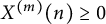 $X^{(m)}(n)\geq 0$
for
 $n\leq 20m.$
This concludes the proof of Theorem 1.2.
4 Proof of Theorem 1.4
Recall the following generating functions [Reference Jang and Kim12, Equations (2.1) and (2.2)] for
 $M_{C1}(m,n)$
and
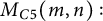 $M_{C5}(m,n):$
 $$\begin{align*}\sum_{n=1}^{\infty}M_{C1}(m,n)q^{n}=\frac{1}{(q^{2};q^{2})_{\infty}}\left(\sum_{n=1}^{\infty}\frac{(-1)^{n}q^{n(3n+1)+2|m|n}}{1-q^{2n}}-\sum_{n=1}^{\infty}\frac{(-1)^{n}q^{\frac{n(n+1)}{2}+|m|n}}{1-q^{n}}\right) \end{align*}$$
and
 $$\begin{align*}\sum_{n=1}^{\infty}M_{C5}(m,n)q^{n}=\frac{1}{(q^{2};q^{2})_{\infty}}\left(\sum_{n=1}^{\infty}\frac{(-1)^{n}q^{n(n+1)+2|m|n}}{1-q^{2n}}-\sum_{n=1}^{\infty}\frac{(-1)^{n}q^{\frac{n(n+1)}{2}+|m|n}}{1-q^{n}}\right). \end{align*}$$
From the above generating functions we know that
 $M_{C1}(m,n)$
and
 $M_{C5}(m,n)$
are both symmetric in
 $m.$
Namely,
 $$\begin{align*}M_{C1}(-m,n)=M_{C1}(m,n) \end{align*}$$
and
 $$\begin{align*}M_{C5}(-m,n)=M_{C5}(m,n). \end{align*}$$
Thus, we only need to consider the nonnegativity of
 $M_{C1}(m,n)$
and
 $M_{C5}(m,n)$
when
 $m\geq 0,n\geq 0.$
We first consider
 $M_{C5}(m,n)$
. Since
 $$\begin{align*}\sum_{n=1}^{\infty}M_{C5}(m,n)q^{n}=\frac{1}{(q^{2};q^{2})_{\infty}}\cdot\sum_{n\geq0}Y^{(m)}(n)q^{n}, \end{align*}$$
we deduce from Theorem 1.3 that
 $M_{C5}(m,n)$
is nonnegative for
 $m\geq 0,n\geq 0.$
We next consider
 $M_{C1}(m,n).$
Let
 $f(m)$
be defined as in (1.8). Note that
 $$\begin{align*}f(m)>20m \end{align*}$$
for
 $0\leq m\leq 120$
and
 $$\begin{align*}f(m)<20m \end{align*}$$
for
 $m\geq 121.$
In view of Theorems 1.1 and 1.2, to study the nonnegativity of
 $X^{(m)}(n),$
we only need to consider its nonnegativity for the case
 $0\leq m\leq 120$
and
 ${f(m)>n>20m.}$
With the help of the software Mathematica, we can verify the finite cases that
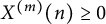 $X^{(m)}(n)\geq 0$
for
 $0\leq m\leq 120$
and
 $f(m)>n>20m.$
This implies that
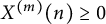 $X^{(m)}(n)\geq 0$
for all
 $m\geq 0,n\geq 0.$
Since
 $$\begin{align*}\sum_{n=1}^{\infty}M_{C1}(m,n)q^{n}=\prod_{j\geq2}\frac{1}{1-q^{2j}}\cdot\sum_{n\geq0}X^{(m)}(n)q^{n}, \end{align*}$$
we deduce from the nonnegativity of
 $X^{(m)}(n)$
that
 $M_{C1}(m,n)\geq 0$
for all
 $m\geq 0,n\geq 0.$
This completes the proof of Theorem 1.4.