Introduction
Lithium/thionyl chloride battery is a nonaqueous system battery and applied in many fields such as aerospace, military, armarium, and so on [Reference Gangadharan, Namboodiri, Prasad and Viswanathan1, Reference Jain, Nagasubramanian, Jungst and Weidner2, Reference Li, Yuan, Xu and Liu3, Reference Li, Dang, Sun and Li4, Reference Xu, Zhao, Li, Li, Cao and Lu5]. Li/SOCl2 battery has some unique advantages and is one of the most applied batteries in recent years. The advantages of Li/SOCl2 battery include high voltage, high specific energy, high energy density, few pollution, low price, and long life in the storage [Reference Jain, Nagasubramanian, Jungst and Weidner2, Reference Holmes6, Reference Iwamaru and Uetani7]. Like all batteries, this battery also include anode, cathode, and electrolyte [Reference Yan, Wang, He, Hou, Xia, Liu and Chen8, Reference He, Wang, Yan, Tian, Liu and Chen9, Reference Liu, Zhuang, Shi, Yan, Zhao and Chen10, Reference Shi, Sun, Liu, Cui, Zhuang and Chen11, Reference Wang, Zhuo and Zhao12, Reference Jing, Zhou, Li, Chen, Xu, Chen and Hou13]. The anode and cathode materials are composed of lithium metal and carbon, respectively. And the nonaqueous electrolyte is the mixture of SOCl2 and LiAlCl4. During the discharge process, lithium ion is obtained by losing electron of lithium metal and embedded in the anode material [Reference Bernstein and Lever14]. At the same time, SOCl2 is reduced, and the LiCl, SO2, and S appear during the reduction process [Eqs. (1)–(3)]. The LiCl leads to passive film formation on the surface of the cathode, and the production of S is deposited in the electrolyte. So the battery system has their limitations in practice, such as the actual voltage value and capacity value are less than the theoretical value [Reference Li, Huang, Gao, Zhang and Zhao15].
 $${\rm{Anode:}}\;{\rm{Li}} - {\rm{e}} \to {\rm{L}}{{\rm{i}}^ + }\quad ,$$
 $${\rm{Cathode:}}\;2{\rm{SOC}}{{\rm{l}}_2} + 4{{\rm{e}}^ - } \to {\rm{S}} \downarrow + {\rm{S}}{{\rm{O}}_2} \uparrow + 4{\rm{C}}{{\rm{l}}^ - }\quad ,$$
 $${\rm{Cell:}}\;2{\rm{SOC}}{{\rm{l}}_2} + 4{\rm{Li}} \to {\rm{S}} \downarrow + {\rm{S}}{{\rm{O}}_2} \uparrow + 4{\rm{LiCl}} \downarrow \quad .$$
In the 1990s, carbon nanotubes (CNTs) are first found by Lijima, their unique characters have drawn great attention [Reference Iijima16]. The CNTs have some advantages, such as high hydrogen storage capacity, good conductivity, and high specific surface area [Reference Gottschalk, Sonderer, Scholz and Nowack17, Reference Esawi, Morsi, Sayed, Taher and Lanka18, Reference Timur, Anik, Odaci and Gorton19]. In addition, CNTs have some special electrical properties due to their obvious conjugation effects. Recently, CNTs are widely researched to improve the performance of different battery systems [Reference Ren, Li, Chen, Chen, Cai, Qiu and Peng20, Reference Lee, Yabuuchi, Gallant, Chen, Kim, Hammond and Shao-Horn21, Reference Sakamoto and Dunn22]. Phthalocyanine compounds are a class of compounds of high chemical stability, and it has good resistance to high temperature, acid, alkali, and other properties [Reference Tsaur and Pollard23]. As well as, phthalocyanines possess excellent performance in electrical conductivity, chemical catalytic, photoelectric effect, liquid crystal display, gas sensitive effect, phototherapy drugs, and so on [Reference Zhao, Harnisch, Schröder, Scholz, Bogdanoff and Herrmann24, Reference Bao, Lovinger and Dodabalapur25]. In recent years, phthalocyanine compounds have unique structure that it can provide electron and accept electron, causing widely researched in batteries [Reference Abraham and Jiang26, Reference Wang, Wu and Yang27, Reference Chamberlain and Cooney28]. Ali Rıza Ozkaya has explored the effect of binuclear metallophthalocyanines to battery. They found that the binuclear phthalocyanine can greatly improve the performance of the zinc-air battery [Reference Özen, Doğan, Özer, Bekaroğlu and Özkaya29]. Jun Chen and coworker researched the performance of tetra-β-nitro-substituted phthalocyanines and they concluded that the phthalocyanine compounds have potential application in lithium battery [Reference Wang, Chen, Jiang, Ding, Wang, Li and Zhong30]. In the last few years, the effect of different phthalocyanines on Li/SOCl2 battery is studied by our group, and our experimental results show that the modified phthalocyanine derivatives have a positive impact on Li/SOCl2 battery [Reference Zhang, Wang, Xu, Huang, Xu and Zhao31, Reference Liu, Jiang, Zhang, Gao and Zhao32, Reference Gao, Li, Wang, Zhang, Zhang, Zheng and Zhao33, Reference Xu, Zhang, Cao, Zhao and Li34].
In this work, six new binuclear metal-substituted phthalocyanines are designed and prepared by microwave method. Then, the CNTs were connected to the phthalocyanine by chemical bonds to generate the modified CNTs as catalyst. The structure of target compounds is confirmed by the means of infrared, X-ray diffraction (XRD), and X-ray photoelectron spectroscopy (XPS). The test results of structure indicate that the binuclear metal-substituted phthalocyanines and the CNTs are connected by chemical bond, and the results of electrical performance measurement indicate that the catalysts can improve the performance of the Li/SOCl2 battery. In addition, possible catalysis mechanism for the great improvement for the performance of the catalysts is proposed.
Results and discussions
Fourier transform-infrared (FT-IR) spectra
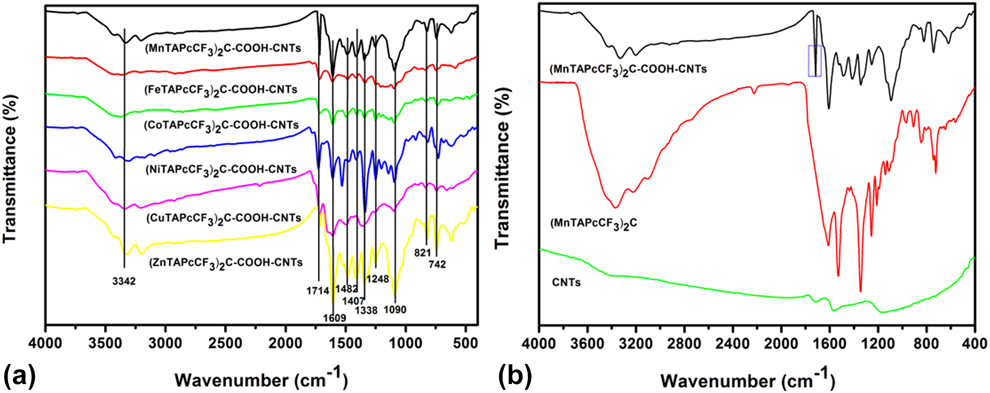
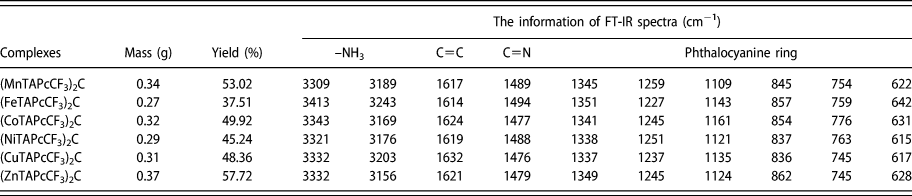
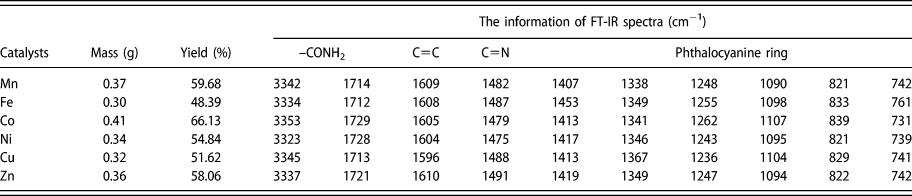
FT-IR analysis of all samples is performed to verify the structure of (MTAPcCF3)2C–COOH–CNTs. As showed in Fig. 1(a), characteristic peaks of metal phthalocyanine appeared in the spectrum. Phthalocyanine ring have six characteristic peaks which are appeared at 612 cm−1, 742 cm−1, 833 cm−1, 1090 cm−1, 1248 cm−1, and 1346 cm−1, respectively. The strong peaks at 1407 cm−1 are assigned to the C=N stretching, the peaks at 1609 cm−1 are attributed to the stretching vibration of C=C, and the peaks of amido group at 1716 cm−1 and 3330 cm−1 are clearly observed in the spectra. Compared with the pristine (MTAPcCF3)2C [Fig. 1(b)], a new peak appeared at 1716 cm−1, suggesting that the chemical bond is generated between (MTAPcCF3)2C and CNTs. In addition, the characteristic peaks of CNTs are not observed, which is consistent with the previous literature [Reference Snow, Griffith and Marullo35]. In conclusion, the test result of FT-IR shows that the target products (MTAPcCF3)2C–COOH–CNTs are synthetized.
FT-IR spectra of (a) (MTAPcCF3)2C–COOH–CNTs with different metals, (b) (MTAPcCF3)2C–COOH–CNTs, (MTAPcCF3)2C, and CNTs.

XRD analysis
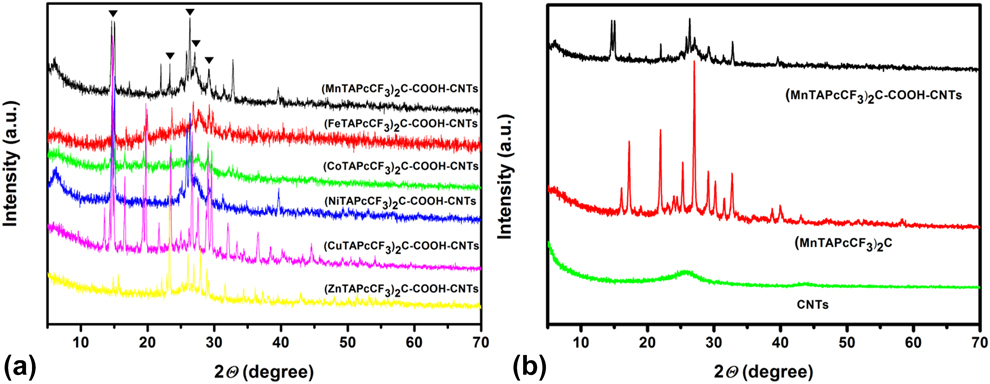
The XRD patterns for phthalocyanine catalysts over the CNTs are presented in Fig. 2(a). The main characteristic peaks of catalysts appeared at 14.9°, 23.5°, 16.4°, 27.2°, and 29.2°, assigning to the peaks of metal phthalocyanine. In addition, a weak and broad peak is observed at 27°, which is attributed to the existence of CNTs. That is, the diffraction peaks of (MTAPcCF3)2C–COOH–CNTs and CNTs are also appear in the XRD spectra of catalyst, which confirms that the (MTAPcCF3)2C–COOH–CNTs are generated by bonding (MTAPcCF3)2C to CNTs, and the catalysts also maintain the orderly structures of CNTs [Fig. 2(b)]. The Raghuram Chetty and coworker did some related research about the copper phthalocyanine-coated CNTs material. They also concluded that the XRD peaks of composite material includes the peaks of copper phthalocyanine and CNTs. And the characteristic peaks position of copper phthalocyanine and CNTs are consistent with our work. Overall, the result in this work is well consistent with previously reported [Reference Rajmohan and Chetty36].
X-ray diffraction spectra of (a) (MTAPcCF3)2C–COOH–CNTs with different metals, (b) (MnTAPcCF3)2C–COOH–CNTs, (MnTAPcCF3)2C, and CNTs.

XPS analysis
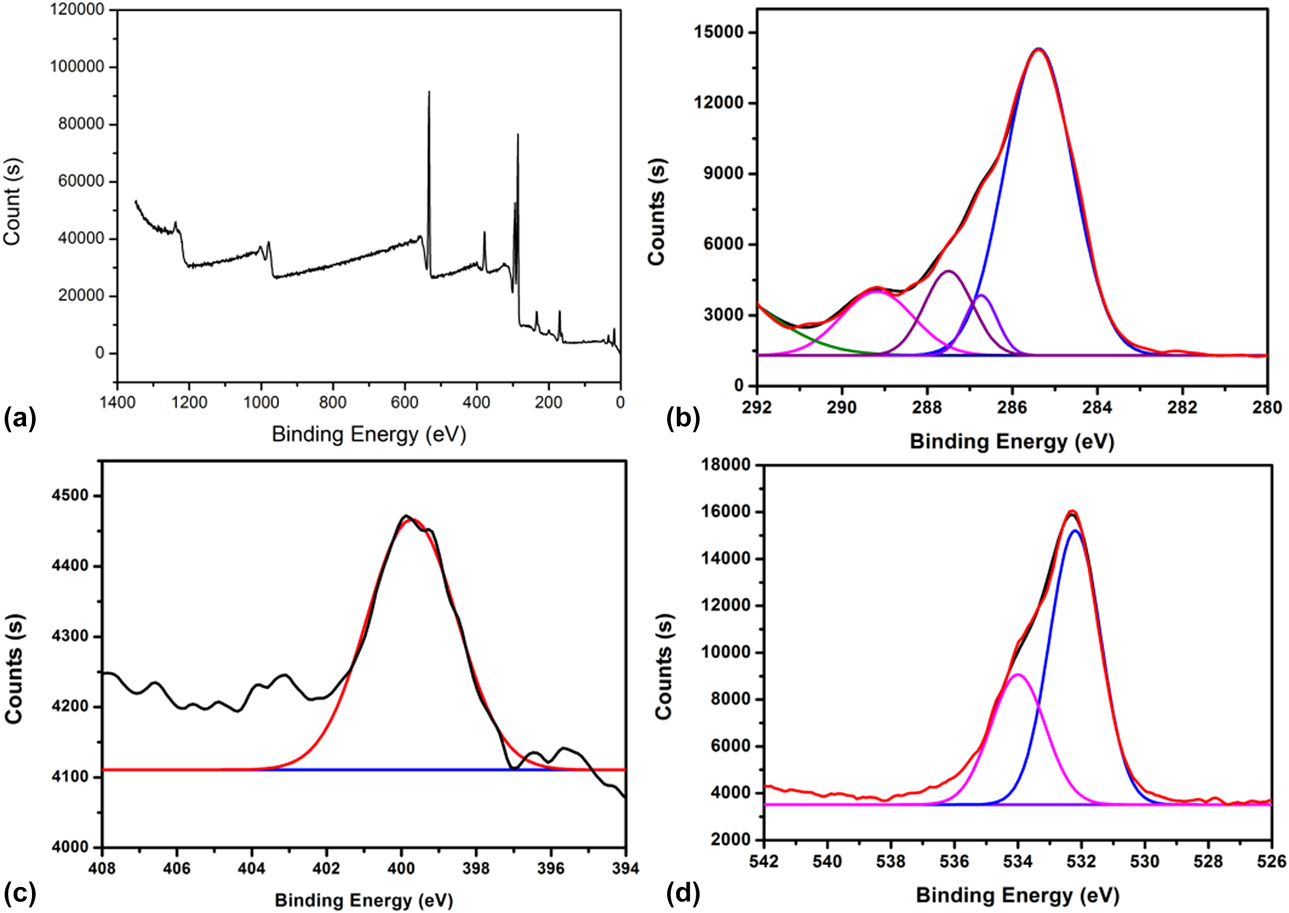
The XPS analysis of (MnTAPcCF3)2C–COOH–CNTs is executed to confirm the structure and composition. As can be seen from the survey spectra [Fig. 3(a)], the surface elements mainly include Mn, C, N, and O. The single element graph of C 1s, N 1s, and O 1s is listed in Figs. 3(b)–3(d). The peak of C 1s can be divided into four peaks locating at 289.3, 287.5, 286.7, and 285.4 eV, which are contributed to the sp 2 hybridization of CNTs and (MnTAPcCF3)2C [Fig. 3(b)]. The XPS spectrum of N 1s shows one characteristic peak after curve-fitting [Fig. 3(c)]. The broad peak located at 399.7 eV is assigned to the nitrogen atoms of metal phthalocyanine. Two peaks of the O 1s located at 532 and 534 eV are attributed to the –COOH and –CONH– [Fig. 3(d)]. The analysis reveals that the target material (MnTAPcCF3)2C–COOH–CNTs is obtained by bonding (MnTAPcCF3)2C with CNTs.
(a) XPS whole scanning spectra in (MnTAPcCF3)2C–COOH–CNTs, (b) core level spectra of C 1s, (c) core level spectra of N 1s, (d) core level spectra of O 1s.

Scanning electron microscopy (SEM) analysis
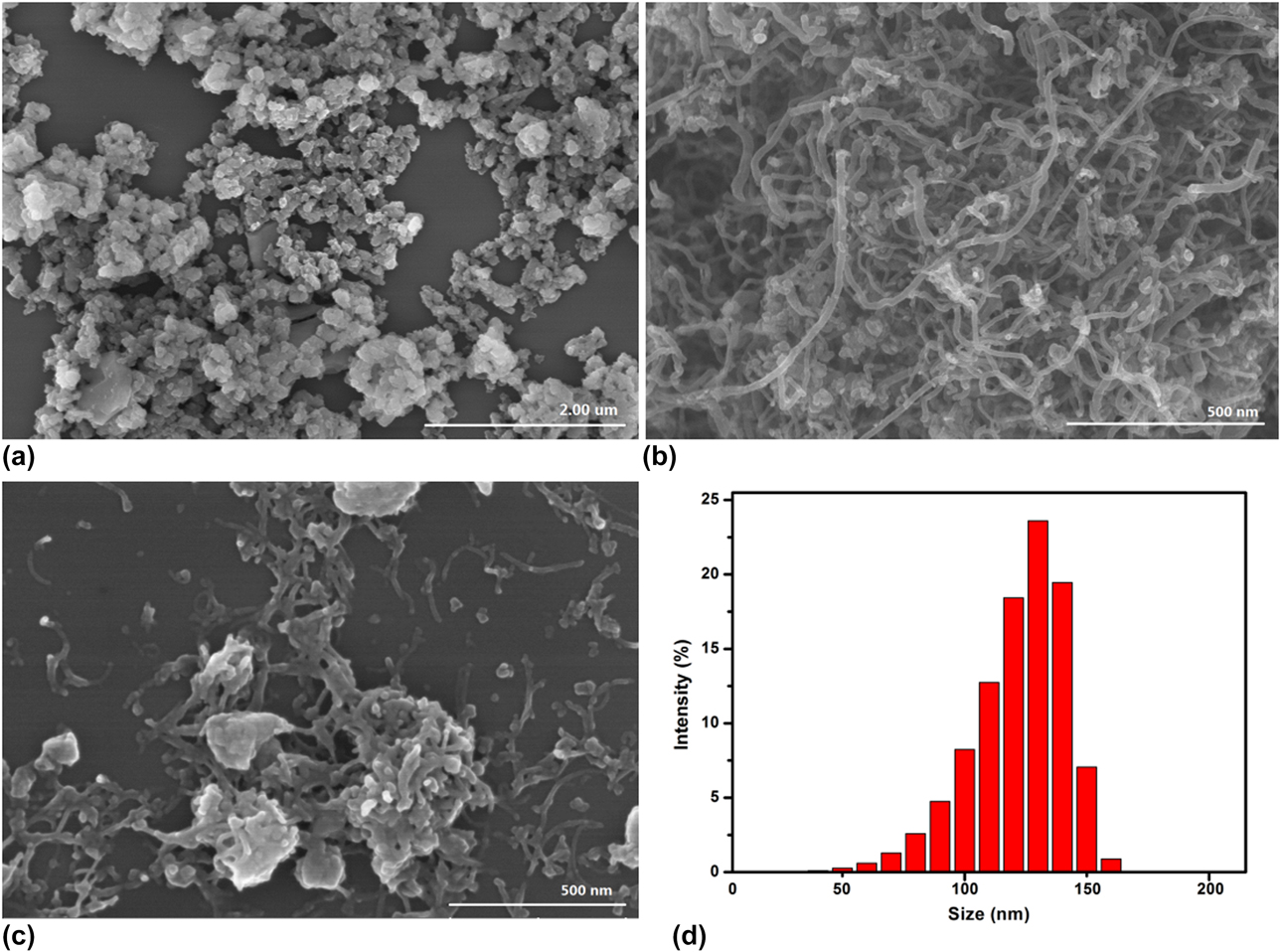
To observe the morphology of (MnTAPcCF3)2C pure CNTs and (MnTAPcCF3)2C–COOH–CNTs, SEM analysis is carried out by SEM. It can be seen that from the morphology of (MnTAPcCF3)2C [Fig. 4(a)], the particle size of pure (MnTAPcCF3)2C is uniform. Particle size of (MnTAPcCF3)2C is measured in distilled water [Fig. 4(d)]. The figure shows that most of the particles have particle sizes between 100 and 150 nm, which further conforms the particle is uniform. The surface morphology of (MnTAPcCF3)2C–COOH–CNTs demonstrates that the (MnTAPcCF3)2C is adhered on the surface of the CNTs, and the diameter of modified CNTs increased from 13.3 to 21.7 nm. The SEM analysis further manifests that the modified CNTs are obtained.
The SEM images of (MnTAPcCF3)2C (a), pure CNTs (b) (MnTAPcCF3)2C–COOH–CNTs (c), and the particle size histogram of (MnTAPcCF3)2C–COOH–CNTs (d).

Electrocatalytic performance
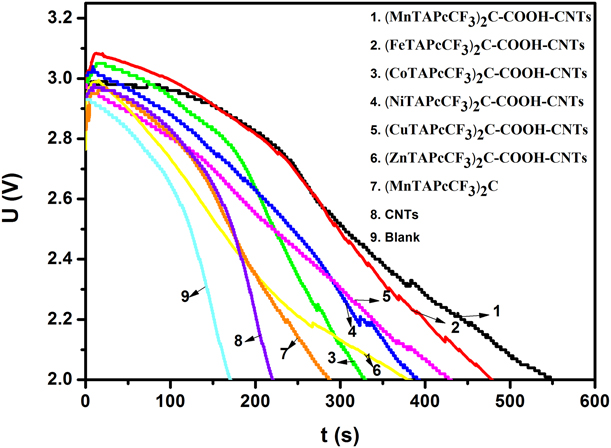
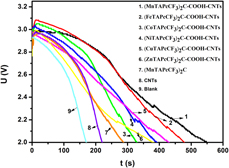
To evaluate the effect of catalyst on battery performance, the discharge curves are measured and displayed in Fig. 5.
The U–t curve of Li/SOCl2.

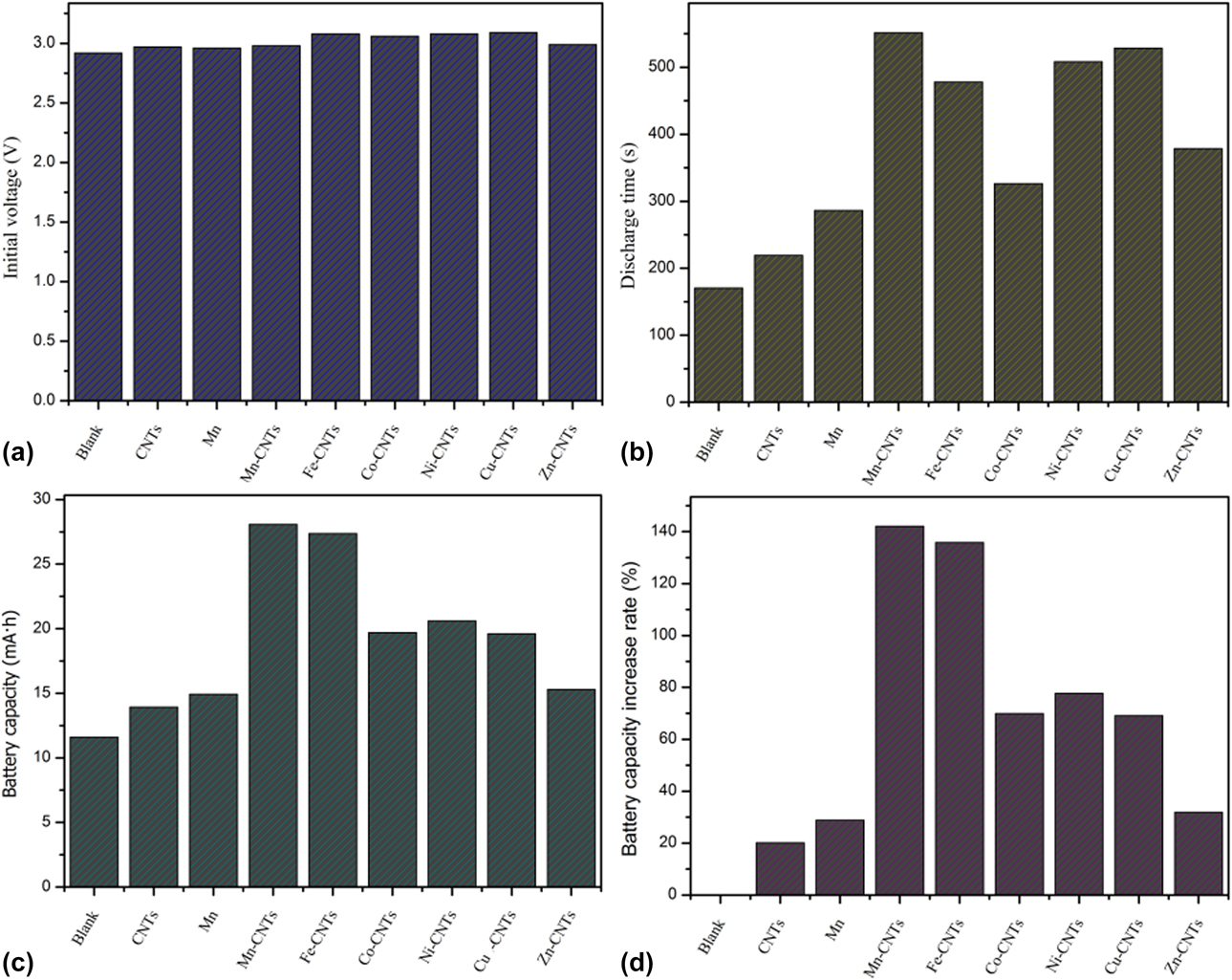
The blank experiment is tested without catalyst. Blank experimental result shows that the discharge time and the initial voltage are 170.5 s and 2.92 V, respectively. Compared with blank experiment, the data show that all catalysts possess positive impact to Li/SOCl2 battery. In series of (MTAPcCF3)2C–COOH–CNTs, the initial voltage increases to 2.98–3.09 V and the maximum voltage among them is (CuTAPcCF3)2C–COOH–CNTs [Fig. 6(a)]. The discharge time extends to 288–681 s and the longest is (MnTAPcCF3)2C–COOH–CNTs [Fig. 6(b)]. Simultaneously, the curves show that CNTs and (MnTAPcCF3)2C also have a certain positive effect on Li/SOCl2 battery. But contrasted with (MnTAPcCF3)2C–COOH–CNTs, the results indicate that the catalyst (MnTAPcCF3)2C–COOH–CNTs possesses excellent performance. That is, the catalyst performance of (MTAPcCF3)2C–COOH–CNTs is much better than that of (MTAPcCF3)2C and CNTs. There are two main causes for this consequence: the first is that the CNTs have good electrical conductivity and can promote electron transfer; the other is that the metallophthalocyanines possess good catalytic performance. The CNTs modified by (MnTAPcCF3)2C possess optimum property, because of the synergistic effect exist between the phthalocyanine and the CNTs.
Performance comparison of initial voltage (a), discharge time (b), cell capacity (c), and cell capacity increasing rate (d).

Battery capacity is an important index to appraise the performance of battery; therefore, corresponding numerical results are calculated by mathematical formulas [Figs. 6(c) and 6(d)].
The cell capacity of Li/SOCl2 battery is
 $$C = \int {I{\rm{d}}t = \int {{U / {{\mathop{\rm Re}\nolimits} \;{\rm{d}}t = \sum {{U / {{\mathop{\rm Re}\nolimits} \;{\rm{d}}t = {1 / {{\mathop{\rm Re}\nolimits} \sum {U\Delta t\quad .} }}}}} }}} }$$
The cell capacity increasing rate of Li/SOCl2 battery is
 $$X = {{\left( {C - {C_0}} \right)} / {{C_0}}} \times 100\% \quad .$$
Among them, C and C 0 are represent the capacity in the presence of catalyst and the capacity of blank test, I and Re are the discharge current and resistance, U and Δt stand for the output voltage and discharge time.
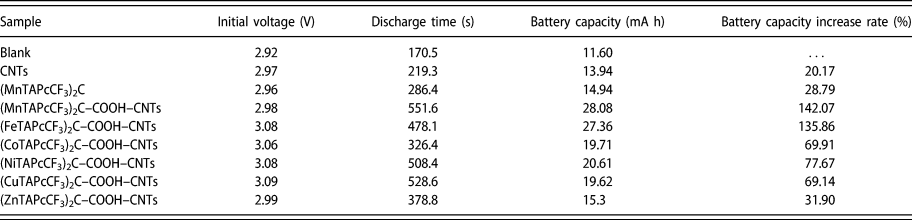
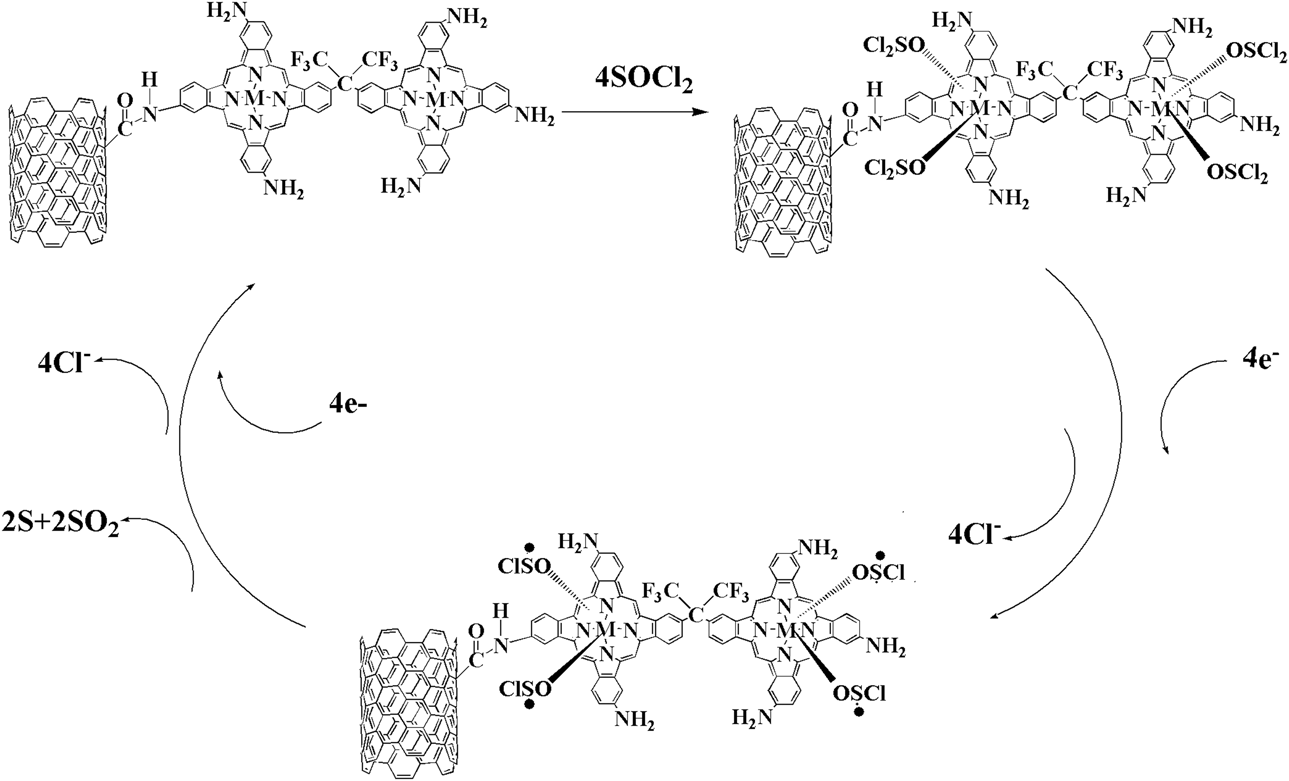
The data show that the cell capacity is improved with different degrees by adding various catalysts (Table I). The difference of the electron density of central metal ions leads to the different electrocatalytic activities of (MTAPcCF3)2C–COOH–CNTs. The cell capacity order of the (MTAPcCF3)2C–COOH–CNTs is labeled as the central metal: Mn > Fe > Ni > Co > Cu > Zn. The statistical results show that the cell capacities catalyzed by (MTAPcCF3)2C–COOH–CNTs have soared, rising by 20.17–142.07% over the blank experiment. Meanwhile, the maximum value of capacity can reach to 28.08 mA h, when (MnTAPcCF3)2C–COOH–CNTs are selected as catalyst. This is because that the central Mn2+ tends to adopt octahedral coordination for its 3 d 5 electronic configuration, and the distribution of five electrons is spherically symmetric. And the axial d orbital can participate in the formation of transient adduct [(MTAPcCF3)2C–COOH–CNTs·4SOCl2] when attached to active SOCl2, thus improving the catalytic exhibition.
The performance of (MTAPcCF3)2C–COOH–CNTs to Li/SOCl2.

Cyclic voltammetric analysis
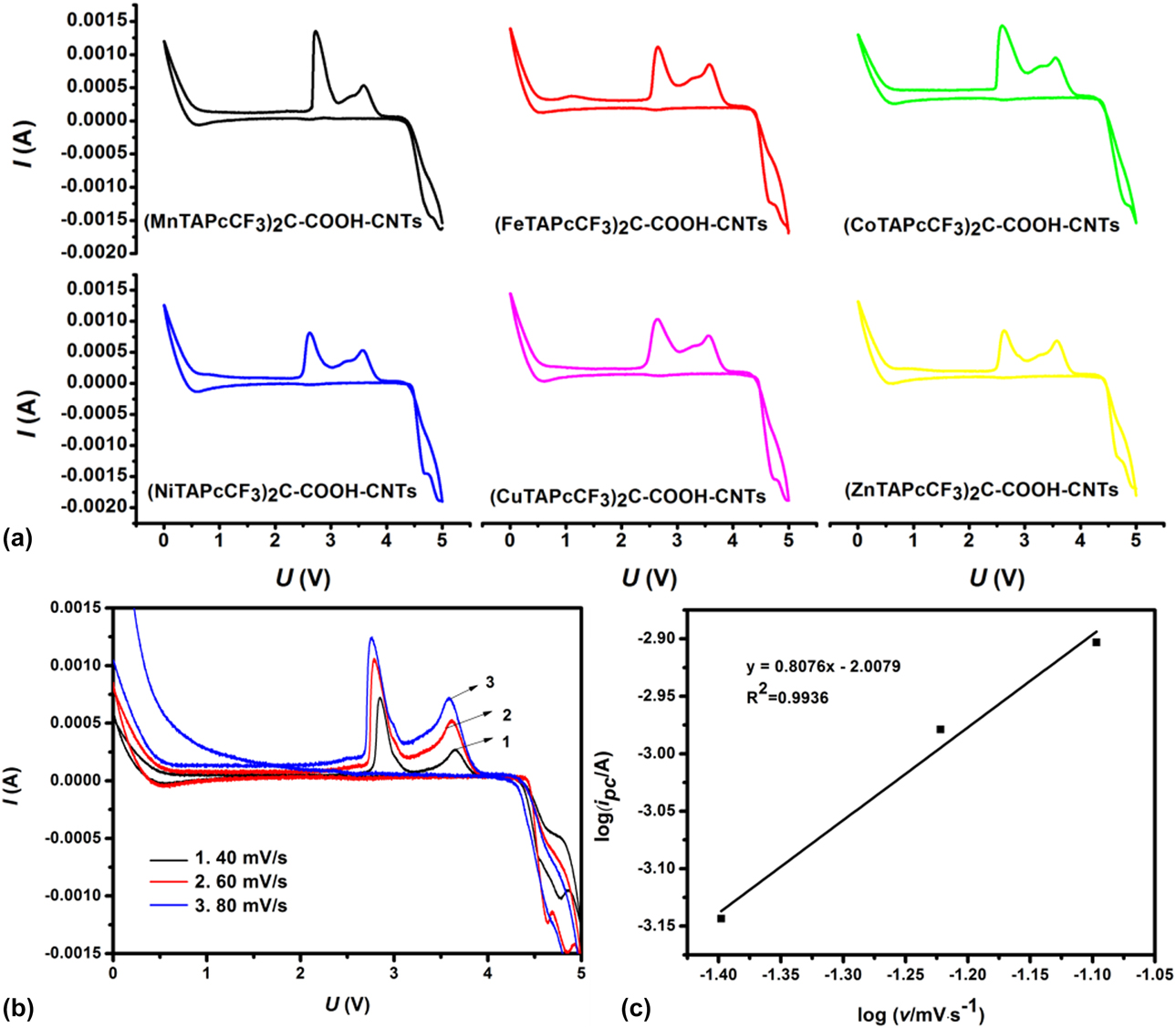
The electrochemical property of (MTAPcCF3)2C–COOH–CNTs is further researched through cyclic voltammetry (CV) methods [Fig. 7(a)]. It can be seen from CV curves that only the reduction peak are found and the reduction process of SOCl2 is irreversible. Two reduction peaks are located at 2.6 and 3.6 V, which indicate that the SOCl2 is reduced by two steps. The first step is that the SOCl2 gain one electron forming SCl2, then the SCl2 obtains another electron [Eqs. (6) and (7)]. The first process is the rate controlling step, and the second process is the fast reaction step.
 $$2{\rm{SOC}}{{\rm{l}}_2} + 2{\rm{e}} \to {\rm{SC}}{{\rm{l}}_2} + {\rm{S}}{{\rm{O}}_2} + 2{\rm{C}}{{\rm{l}}^ - }\quad ,$$
 $${\rm{SC}}{{\rm{l}}_2} + 2{\rm{e}} \to {\rm{S}} + 2{\rm{C}}{{\rm{l}}^ - }\quad .$$
Cyclic voltammogram of the Li/SOCl2 battery (a), cyclic voltammograms for (MnTAPcCF3)2C–COOH–CNTs at different scan rates (b), and plot of scan rate versus root of the sweep rate for (MnTAPcCF3)2C–COOH–CNTs (c).

The CV curves with different scanning rates are also carried out to study the impact of (MnTAPcCF3)2C–COOH–CNTs on the battery. As seen from Fig. 7(b), as the scanning rate increases, the current intensity of reduction peaks are enhanced and the peak potentials are decreased. The test results show that there is a direct linear relationship between log i pc and log v (i pc is the current intensity of rate-controlling step and v is the scan rate) [Fig. 7(c)]. The linear equation is y = 0.8076x − 2.0079, with the correlation coefficient more than 0.99. Based on the relation, several results are obtained, which show the action of electrode surface is used for diffusion.
Catalytic mechanism
According to the cyclic voltammetric analysis and the previous research, the possible mechanism of the catalysts on Li/SOCl2 battery is conducted. The catalyst, which has dual functions, plays a crucial role in the entire process. One of main functions is that the binuclear metal-phthalocyanine can unite with SOCl2 to form an adduct, and then the corresponding barrier height of the reaction is reduced. The other function is that the catalyst can provide many active sites. For (MTAPcCF3)2C–COOH–CNTs, there is favorable synergistic effect between CNTs and the phthalocyanine, making the catalyst having good catalytic effect.
The whole reaction is component of three processes: (i) the SOCl2 unite with (MTAPcCF3)2C–COOH–CNTs forming the adduct, (ii) the adduct resolves into (MTAPcCF3)2C–COOH–CNTs·4SOCl and Cl− by obtaining four electrons, (iii) the intermediate (MTAPcCF3)2C–COOH–CNTs·4SOCl gains another electrons to produce final products (S, SO2 and Cl−), and the (MTAPcCF3)2C–COOH–CNTs are returned (Fig. 8).
 $${\left( {{\rm{MTAPcC}}{{\rm{F}}_3}} \right)_2}{\rm{C}} – {\rm{COOH}} – {\rm{CNTs}} + 4{\rm{SOC}}{{\rm{l}}_2} \to {\left( {{\rm{MTAPcC}}{{\rm{F}}_3}} \right)_2}{\rm{C}} – {\rm{COOH}} – {\rm{CNTs}} \cdot 4{\rm{SOC}}{{\rm{l}}_2}\quad ,$$
 $${\left( {{\rm{MTAPcC}}{{\rm{F}}_{\rm{3}}}} \right)_2}{\rm{C}} – {\rm{COOH}} – {\rm{CNTs}} \cdot 4{\rm{SOC}}{{\rm{l}}_2} + 4{{\rm{e}}^ - } \to {\left( {{\rm{MTAPcC}}{{\rm{F}}_3}} \right)_2}{\rm{C}} – {\rm{COOH}} – {\rm{CNTs}} \cdot 4{\rm{SOCl}} + 4{\rm{C}}{{\rm{l}}^ - }\quad ,$$
 $${\left( {{\rm{MTAPcC}}{{\rm{F}}_3}} \right)_2}{\rm{C}} – {\rm{COOH}} – {\rm{CNTs}} \cdot 4{\rm{SOCl}} + 4{{\rm{e}}^ - } \to 2{\rm{S}} + 4{\rm{C}}{{\rm{l}}^ - } + {\rm{S}}{{\rm{O}}_2} + {\left( {{\rm{MTAPcC}}{{\rm{F}}_3}} \right)_2}{\rm{C}} – {\rm{COOH}} – {\rm{CNTs}}\quad .$$
The catalytic mechanism of (MTAPcCF3)2C–COOH–CNTs.

Conclusion
In summary, we rapidly prepared (MTAPcCF3)2C by microwave method, which greatly reduced the reaction time. Then, CNTs bonds with (MTAPcCF3)2C to form (MTAPcCF3)2C–COOH–CNTs, which is used to improve the performance of Li/SOCl2 battery. Test result indicates that the capacities of Li/SOCl2 battery catalyzed by (MTAPcCF3)2C–COOH–CNTs increase by 20.17–142.07%. Meanwhile, the maximum value of capacity catalyzed by (MnTAPcCF3)2C–COOH–CNTs can reach to 28.08 mA h. The result of electrocatalytic performance shows that the synergistic effect between two substances provides a positive impact on the catalytic performance. In addition, the catalytic mechanism of the Li/SOCl2 battery was verified by CV analysis.
Experimental section
Materials and apparatus
Carboxyl multiwall CNTs (purity: 95 wt%, –COOH content: 3.86 wt%) were bought from Chengdu Institute of Organic Chemistry, Chinese Academy of Sciences. 4-nitrophthalimide (98%) and 4,4′-(hexafluoroisopropylidene) diphthalic anhydride (98%) were obtained from Aladdin Reagent Co. Urea (99.5%), metal salt, ammonium molybdate (99.9%), and sodium sulfide (98%) were purchased from J & K Chemical Technology Company. All other necessary reagents such as ethanol, dimethylformamide (DMF), methanol, and thionyl chloride were purchased from Tianjin Kemiou Chemical Reagent Co., Ltd. All reagents used in this work were all of analytical grade.
The composition of the Li/SOCl2 battery including LiAlCl4/SOCl2 electrolyte, lithium foil, and C-film was battery grade and purchased from Xi’an Institute of Electrical and Mechanical Services Information.
FT-IR analysis was tested by using a Bruker VECT022 spectrophotometer. The catalysts to be analyzed were tabulated with the KBr powder and then recorded from 400 to 4000 cm−1. XRD patterns of all catalysts were carried out by Bruker D8 Advance diffractometer using Cu Kα radiation with the range from 5° to 70°. The surface analyses of the samples were performed on SEM (TM3000). Before the test, the samples were dispersed in ethanol and added in the conductive glass surface. XPS spectra were analyzed by the photoelectron spectrometer (PHI-1600).
The electrocatalytic performance was tested by RT5000 electrochemical workstation, and CV was conducted on RST5202 electrochemical workstation by three-electrode system.
Synthesis of catalysts
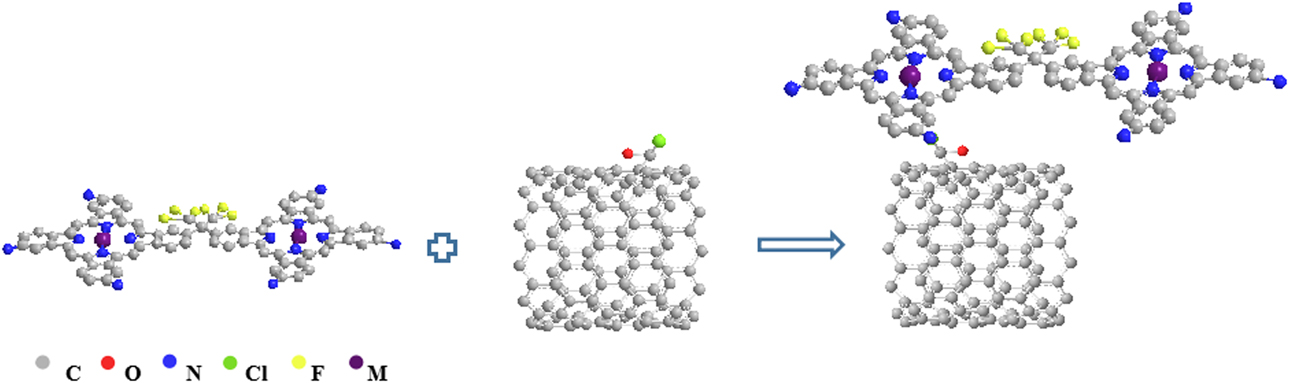
The catalysts (MTAPcCF3)2C–COOH–CNTs were synthesized according to the method described in Scheme 1.
The synthetic reaction of (MTAPcCF3)2C–COOH–CNTs.

Synthesis of (MTAPcCF3)2C
Binuclear hexamino-metallo phthalocyanines (MTAPcCF3)2C were designed and synthesized by microwave method and reduction method. The general synthesis procedure: 4-nitrophthalimide (0.4736 g), 4,4′-(hexafluoroisopropylidene) diphthalic anhydride (0.1885 g), NH4Cl (0.4270 g), urea (1.2200 g), and metal salt (0.8 mmol) were mixed in agate mortar and ground evenly. Then (NH4)2Mo2O7 (0.5272 g) was added to the mixture. Mixed all the ingredients and put them in the microwave reactor. The mixture was treated in microwave oven for 10 min at 400 and 800 W, respectively. When cooled to room temperature, the crude product was treated by washing with HCl solution (2%), petroleum ether, acetone, dichloromethane, deionized water, and absolute ethanol, respectively. Finally, the mixture was filtrated by G4 funnel and dried at 100 °C for 12 h. The dark blue powder was obtained. Then, the powder (0.62 g) and DMF (20 mL) were added into a three-necked bottle and heated to 60 °C under stirring constantly. In order to transform the nitro group to the amino group, sodium sulfide nonahydrate (9.00 g) was poured into reactor and stirred for 24 h. The mixture is then cooled down to room temperature and transferred to the beaker with 50 mL deionized water. After decompressional filtration, the powder was gained. The product was gained by washing with HCl solution (2%), NaOH solution (2%), and deionized water and dried for 8 h at 100 °C. The basic information was shown in Table II.
The basic information of (MTAPcCF3)2C.

Synthesis of (MTAPcCF3)2C–COOH–CNTs
The CNTs-COOH (0.20 g) was added to anhydrous DMF (10 mL) with stirring constantly. Heating the mixture to 76 °C, SOCl2 solution (5 mL) was then dropped into the reactor within 1 h. The mixture of all reactants was kept at 76 °C for 48 h, then steamed the residual SOCl2. After the temperature dropped to 60 °C, (MTAPcCF3)2C (0.42 g) and triethylamine (1 mL) were added to the flask in order and stirred for 48 h at 60 °C. At last, the hybrid material was obtained by filtration and then washed by acetone. Finally, the product was obtained by drying at 100 °C for 8 h and then drying at 60 °C for 24 h in vacuum. The basic information about structure is showed in Table III.
The basic information of (MTAPcCF3)2C–COOH–CNTs.

Note: The metal listed in the first column represents the catalysts (MTAPcCF3)2C–COOH–CNTs (M = Mn, Fe, Co, Ni, Cu, Zn).
Electrochemistry analysis
The electrochemistry testing system was consisted of simulative battery, constant resistance (40 Ω), and RST5000 electrochemical workstation. In addition, the simulative battery was composed of three parts: electrolyte, anode, and cathode. The material of cathode was prepared by fully blending acetylene black, conductive agent, and Teflon emulsion. Then the mixture was rolled into an established film and dried for 48 h at 150 °C.
Battery assemblies: carbon film, diaphragm, and lithium tablet were rested on the anode in turn which combine with cathode to form simulative battery. The electrolyte (1 mL) containing the catalyst (2 mg) was injected into the battery. At constant resistance, the effect of the samples on electrochemistry performance was tested. When the discharge voltage reaches to 2 V, the test was finished. It deserved to note that all operations were carried out in dry circumstance, in which the relative humidity of atmosphere was maintained below 2% and the temperature is kept at ambient temperature.
CV analysis
Electrochemical analysis of six catalysts was performed by RST5202 electrochemical workstation using three-electrode system. The three-electrode system was consist of glassy carbon electrode as working electrode, and two lithium foils as reference electrode and auxiliary electrode, respectively. Before each tests, the glassy carbon electrode was treated by polishing with Al2O3 powder and washing with distilled water. All tests were operated with the scanning range from 0 to 5 V. The experiment data were outputted by the workstation.
Acknowledgments
The authors thank the National Natural Science Foundation of China (Nos. 21371143, 21671157 and 21501139) for the financial support of this work.