


Does the threat of foreign intervention affect autocrats’ hold on to power? This foreign policy question has gained increasing relevance in an era where key political advisers advocate hawkish intervention in a number of countries and when there has been an overall decline in democratic governments worldwide.Footnote 1 Autocrats often encounter foreign threats from actors who use levers spanning from indirect sanctions to direct military involvement to exert influence (e.g., Carter Reference Carter2015; Chyzh and Labzina Reference Chyzh and Labzina2018; Ritter and Wolford Reference Ritter and Wolford2012; Spaniel and Smith Reference Spaniel and Smith2015; Wintrobe Reference Wintrobe1990; Reference Wintrobe2000). While direct military intervention is less common (only  $$ 5.3\% $$ of autocratic leaders are ousted by foreign intervention [Svolik Reference Svolik2009]), recent events in Iraq, Libya, and Syria show how the threat of international intervention is a pressing concern for many authoritarian leaders.Footnote 2
Autocratic leaders, however, not only have to guard themselves from foreign enemies; they must also defend themselves from domestic challenges. Despite not being subject to the kind of political accountability that arises from free, fair, and competitive elections, autocratic leaders face the risk of being unseated through irregular, often violent, means (Gandhi and Przeworski Reference Gandhi and Przeworski2007; Gehlbach, Sonin, and Svolik Reference Gehlbach, Sonin and Svolik2016). Specifically, domestic threats emerge either from elites plotting to launch a coup (e.g., Aidt and Leon Reference Aidt, Leon, Congleton, Grofman and Voigt2019; Leon Reference Leon2014; Little Reference Little2017), or opposition movements aiming to overthrow the regime through revolution (e.g., Finkel and Gehlbach Reference Finkel and Gehlbach2018; Little Reference Little2016; Shadmehr Reference Shadmehr2014; Shadmehr and Boleskavsky Reference Shadmehr and RaphaelForthcoming), and sometimes both (Bove, Platteau, and Sekeris Reference Bove, Platteau and Sekeris2017; Dorsch and Maarek Reference Dorsch and Maarek2018; Tyson Reference Tyson2018). Nearly two-thirds of autocratic leaders leave power via coup d’état, while an additional  $$ 10.6\% $$ fall in popular uprisings (Svolik Reference Svolik2009).
While an autocrat’s domestic and foreign threats may appear unconnected because they come from distinct political actors, such threats necessarily become entangled, since they target the same leader. That this constitutes a concern for policymakers is perhaps best illustrated by Senator John McCain, who in 2014 noted that “It’s obvious that Bashar al Assad’s strategy is to present us with a choice of ISIS or him so that eventually we will choose him.”Footnote 3 McCain’s view, and the policy discussions surrounding it, suggest that policymakers interpreted Assad’s tactics during the Syrian civil war as part of a broader strategy to use the rise of ISIS as a way of providing strategic security assurances against a possible direct intervention from the United States. This particular example highlights that foreign actors contemplating political intervention need to consider how political instability resulting from intervention might open the door for new, and perhaps equally undesirable, political actors to seize power. Similarly, domestic political elites or opposition groups considering challenging an autocrat also need to worry about how foreign actors would react to an abrupt change in leadership. These forces are core issues of autocratic governance; consequently, accounting for the strategic link between domestic political challenges and potential foreign threats is critical for a complete understanding of autocratic politics and its relationship with international relations.
In this article, we develop a theory of autocratic politics to study how the presence of foreign threats affects the nature of domestic political challenges as well as an autocratic leader’s survival strategy and tenure. We build a model focusing on the interaction between an autocratic leader, a domestic opposition, and a foreign actor who benefits from the autocrat’s removal from power.Footnote 4 In the first stage of the game, an incumbent autocrat chooses a level of domestic security, which increases the likelihood that an autocrat survives a pending domestic political challenge but also affects the quality of governance and overall economic well-being of her country. As a result, the autocrat in our model faces a trade-off between security and economic development, where increased security comes at the cost of reduced economic development.Footnote 5 After the level of domestic security has been determined, in the second stage, the domestic opposition can challenge the autocrat for power. After domestic political conflict has been resolved, in the third and final stage a foreign actor can intervene and remove whoever holds power (either the original leader or the opposition), but cannot completely dictate who will hold power following intervention. That is, intervention ensures a successful removal of an autocrat but may not necessarily result in better outcomes for a foreign actor.
To understand how foreign threats affect the domestic politics within an autocracy, we consider two distinct scenarios, which differ in terms of the relationship between the foreign actor and a domestic opposition. In the first case, the domestic opposition is aligned and shares policy goals or ideological values with the foreign actor, such as the United States and self-proclaimed president, Juan Guaidó, of Venezuela. In the second case, the domestic opposition is misaligned, either for ideological reasons or because of a lack of congruence in policy goals, such as the case of ISIS and the United States. These two cases allow us to identify two distinct mechanisms by which the presence of a foreign threat affects autocratic tenure.Footnote 6
We present two main results about the influence of foreign threats on autocratic politics. First, we show that foreign threats strengthen an autocrat’s hold on power, even when foreign actors desire the autocrat’s removal. More specifically, the equilibrium probability an autocrat retains power is higher when a foreign threat is present than in a benchmark where foreign actors are absent regardless of whether the domestic opposition is aligned or misaligned. When the domestic opposition is aligned, the presence of a foreign threat amplifies incentives to increase domestic security, and the overall effect is to bolster the autocrat’s hold on power. Instead, when the domestic opposition is misaligned, the threat of foreign intervention creates a deterrent effect, increasing the probability an autocrat keeps power. Our second result comes from comparing the equilibrium when the domestic opposition is aligned as opposed to misaligned. We show that a misaligned domestic opposition provides an autocrat with a tactical advantage. Because the threat of foreign intervention deters domestic challenges from misaligned opposition groups, an autocrat expends fewer resources on domestic security when the opposition is misaligned. By comparison of the aligned to misaligned equilibria, we show that autocrats benefit from misalignment of opposition groups, suggesting that autocrats have incentives to support, or even cultivate, more ideologically extreme actors, who are less likely to appeal to broader interests outside of their country.
As our primary contribution, we identify distinct mechanisms by which foreign threats influence the domestic politics within autocratic regimes.Footnote 7 The domestic motivation for removing a leader can be to achieve better policies or because of raw ambition (Aidt and Leon Reference Aidt, Leon, Congleton, Grofman and Voigt2019; Leon Reference Leon2013), and it can be substantially different from the motivation of outside actors to remove an autocrat, such as achieving better economic and trade opportunities (Aidt and Albornoz Reference Aidt and Albornoz2011; Eguia Reference Eguia2017). Our results complement other prevalent issues of autocratic tenure, including the guardianship dilemma (McMahon and Slantchev Reference McMahon and Slantchev2015; Svolik Reference Svolik2013), power sharing agreements (Svolik Reference Svolik2009; Reference Svolik2012), and satisfying (e.g., bribing) a domestic constituency (Bueno de Mesquita et al. Reference Bueno de Mesquita, Smith, Siverson and Morrow2003). An autocrat’s response to domestic political threats often relies on a variety of repressive tools including purges and lustration (Braithwaite and Sudduth Reference Braithwaite and Sudduth2016; Montagnes and Wolton Reference Montagnes and Wolton2019; Nalepa Reference Nalepa2008; Sudduth Reference Sudduth2017b), human rights abuses (Ritter Reference Ritter2014; Schnakenberg and Fariss Reference Schnakenberg and Fariss2014), and measures designed to prevent coordination among opponents (Dragu and Lupu Reference Dragu and Lupu2017; Tyson and Smith Reference Tyson and Smith2018).Footnote 8 However, the consequences of improving domestic security (especially via repressive measures) are not limited to the domestic political arena. Investments in domestic security also negatively affect a country’s economy (Besley and Persson Reference Besley and Persson2011; Grier and Tullock Reference Grier and Tullock1989), which in turn reduces the ability of the regime to invest in military prowess. Thus, while domestic security contributes to political stability, downstream economic losses and reduced military capacity limit a leader’s ability to project power beyond her country’s borders.
Our results highlight how the presence of a foreign threat can serve as a novel, and indirect, source of an autocrat’s strength. In our model, autocrats’ responses to foreign threats are not determined by uncertainty (Ramsay Reference Ramsay2017) or concerns from domestic political accountability, and there is no incentive for autocrats to attenuate their behavior in the international arena as a way of demonstrating competence (Schultz Reference Schultz1999) or generating audience costs (Ashworth and Ramsay Reference Ashworth and Ramsay2010; Fearon Reference Fearon1994). Our model does not rely on informational frictions that might give rise to signaling, either between the leader and the opposition or with foreign actors, to mitigate or exacerbate incentives for regime change (Schultz Reference Schultz2001). In our framework, an autocrat uses the threat of international conflict to coerce domestic support, essentially through deterrence. Although the autocrat in our model uses the threat of conflict to deter domestic challenges, the mechanism is distinct from diversion or “rallying around the flag” effects (Smith Reference Smith1996, Reference Smith1998; Snyder Reference Snyder1991); moreover, autocrats in our model do not benefit directly from conflict (Debs and Goemans Reference Debs and Goemans2010; Goemans Reference Goemans2000; Lai and Slater Reference Lai and Slater2006; Leeds and Davis Reference Leeds and Davis1997). Instead, we show how autocrats benefit when conflict with foreign actors remains off the path of play, serving instead to deter domestic challenges.
Finally, we also contribute to a growing literature on third-party intervention (Gleditsch and Beardsley Reference Gleditsch and Beardsley2004; Lyall and Wilson Reference Lyall and Wilson2009; Moore Reference Moore1995). While previous work has focused on international intervention in conflicts (Balch-Lindsay, Enterline, and Joyce Reference Balch-Lindsay, Enterline and Joyce2008; Regan Reference Regan2002), the development of nuclear weapons (Spaniel and Taylor Reference Spaniel and Smith2015), and democratization (Bueno De Mesquita and Downs Reference Bueno de Mesquita and Downs2006; Levitsky and Way Reference Levitsky2006), we consider intervention as a means to empower aligned actors to affect political change (Roessler and Verhoeven Reference Roessler and Verhoeven2017; Westad Reference Westad2005). Koga (Reference Koga2011) shows that democracies tend to intervene when there are existing ethnic ties whereas autocracies tend to intervene to loot natural resources. As a nice complement to our article, Chyzh and Labzina (Reference Chyzh and Labzina2018) focus on a scenario where a third party and leader are aligned with respect to the objective of preventing domestic challenges to the autocrat’s hold on power. Our article, by contrast, focuses on the scenario where a domestic opposition may be aligned or misaligned with a foreign actor, whose interests are misaligned with the autocrat.
The Model
In Home country ( $$ H $$), there is an incumbent Leader (
 $$ L $$) and an Opposition (
 $$ Z $$), potentially comprised of military officials, governing party elites, or an opposition party. Additionally, there is a third actor, Foreign (
 $$ F $$), who is not a member of country
 $$ H $$’s regime, but maintains an interest in who holds power in country
 $$ H $$.Footnote 9 Our model is a multistage game with three successive stages: (1) Leader’s choice of domestic security, (2) Opposition’s decision to challenge Leader, and (3) Foreign’s intervention decision.
Domestic Security
In the first stage, Leader chooses a level of domestic security,  $$ \operatorname{x}\in \left[0,X\right] $$. Depending on substantive characteristics of Leader’s opponents, domestic security in our model may correspond to different empirical measures, like physical suppression, the purging of opposition adherents from positions in state institutions, or the militarization of police forces (for more examples see, e.g., Quinlivan Reference Quinlivan1999).
Domestic Challenge
In the second stage, and after observing the level of domestic security,  $$ x $$, Opposition decides whether to challenge Leader for control of
 $$ H $$,
 $$ s=1 $$, or to support Leader,
 $$ s=0 $$, in which case Leader retains power in
 $$ H $$. Challenging
 $$ L $$ costs
 $$ c>0 $$ for
 $$ Z $$ and leads to a domestic political conflict, the outcome of which depends on
 $$ x $$ and on Opposition’s privately known type.
 $$ Z $$’s type, which we denote by
 $$ \tau \in {\mathbb{R}}_{+} $$, represents
 $$ Z $$’s military strength, command of resources, organizational capacity, as well as other factors that are not completely known by Leader. Formally, Opposition’s type is drawn from an absolutely continuous distribution function,
 $$ \varPsi $$, with full support on
 $$ {\mathbb{R}}_{+} $$ and density function
 $$ \psi $$. Following a challenge,
 $$ Z $$ successfully overthrows
 $$ L $$ with probability
 $$ \rho \left(\tau, x\right) $$, which is a smooth function that is strictly decreasing and convex in
 $$ x $$ and strictly increasing and concave in
 $$ \tau $$ (c.f., Skaperdas Reference Skaperdas1996). To keep our analysis simple, we assume that
 $$ \underset{\uptau \to 0}{\lim}\rho \left(\tau, x\right)=0 $$ and
 $$ \underset{\uptau \to \infty }{\lim}\rho \left(\tau, x\right)=1 $$, meaning that for every
 $$ x $$, there exist types that always lose power challenges and types who always win power challenges.
Foreign Challenge
After Opposition’s decision, either  $$ L $$ or
 $$ Z $$ holds power in
 $$ H $$, and we call this actor the ruler (denoted by
 $$ R $$). In the last stage of the game, Foreign chooses whether to intervene in
 $$ H $$’s domestic politics, labeled
 $$ w=1 $$, or to leave country
 $$ H $$ unaltered, labeled
 $$ w=0 $$. Intervention by
 $$ F $$ unseats the ruler, creating a power vacuum that gives an opportunity for another actor to gain control.Footnote 10 If Leader is the ruler, then, following intervention, Opposition gains power with probability
 $$ q $$, while with probability
 $$ \left(1-q\right) $$ a regime outsider from within
 $$ H $$ gains power.Footnote 11 If instead Opposition is the ruler, following intervention, a regime outsider gains power. The regime outsider is a nonstrategic actor, whose presence captures
 $$ F $$’s lack of control over who gains power in
 $$ H $$ following intervention.
Holding power at the end of the game is valuable to both Leader and Opposition. The value of holding power for  $$ i\in \left\{L,Z\right\} $$ is given by the smooth function
 $$ {B}_i(x) $$, which depends on the level of domestic security in
 $$ H $$ for each
 $$ i $$.Footnote 12 The payoff of not holding power is normalized to
 $$ 0 $$ for both
 $$ L $$ and
 $$ Z $$.Footnote 13 Using resources on domestic security disrupts economic activity through losses of productive labor and the destruction of physical capital, among other factors (e.g., Collier and Hoeffler Reference Collier and Hoeffler1998), and to reflect these features, the benefit of holding power,
 $$ {B}_i(x) $$, is strictly decreasing in
 $$ x $$ for both
 $$ L $$ and
 $$ Z $$. For convenience, we assume that holding power is always valuable for
 $$ Z $$—that is,
 $$ {B}_Z(X)>c $$, which means that even at the maximal level of domestic security (i.e.,
 $$ x=X $$), Opposition would still prefer to challenge Leader at cost
 $$ c $$ if she could depose Leader for sure.Footnote 14
To capture the idea that Foreign represents a threat to the current Leader, we assume that Leader and Foreign have misaligned interests, and we say that  $$ L $$ is misaligned. In contrast, Opposition can be either misaligned, designated as
 $$ M $$, or aligned,
 $$ A $$.Footnote 15 The alignment or misalignment between Opposition and Foreign, just like the misalignment between Leader and Foreign, is common knowledge.Footnote 16 Finally, regime outsiders are aligned with Foreign with probability
 $$ p $$ and misaligned with probability
 $$ \left(1-p\right) $$, where the parameter
 $$ p $$ reflects
 $$ F $$’s assessment of the alignment among other influential political actors in
 $$ H $$ and is influenced by the extent to which
 $$ F $$ monitors power balances in
 $$ H $$.
Foreign prefers an aligned actor to hold power in  $$ H $$ because a misaligned ruler imposes costs on
 $$ F $$. More specifically, Leader’s choice of domestic security can affect the economic prosperity of
 $$ H $$, reducing
 $$ R $$’s ability to affect
 $$ F $$. That is, high levels of
 $$ x $$ diminish the potential damage that a misaligned ruler in
 $$ H $$ can impose on
 $$ F $$. We model this substantive feature via the smooth, strictly decreasing, function
 $$ d(x)>0 $$, and we normalize Foreign’s payoff when an aligned actor rules
 $$ H $$ to
 $$ 0 $$.Footnote 17 To keep our analysis simple, we assume
 $$ \underset{\mathrm{x}\to 0}{\lim }d(x)=+\infty $$, and
 $$ \underset{\mathrm{x}\to \mathrm{X}}{\lim }d(x)=0 $$, which essentially ensures that
 $$ F $$ is always potentially interested in who controls
 $$ H $$. Finally, while intervention can bring about more aligned rulers in
 $$ H $$, it entails costs for Foreign, resulting from opportunity costs, the potential loss of life, or electoral consequences political actors in
 $$ F $$ might face from intervening, all of which are incorporated into the cost
 $$ k $$.
Leader’s payoff is given by,
 $$ {U}_L\left(x,\ \mathrm{s},w\right)=\underset{\mathrm{survival}}{\underbrace{\left(1-w\right)\left(\right.s\cdot \left(1-\rho \left(\tau, x\right)\right)+\left(1-s\right)\left)\right.}}{B}_L(x), $$
and Opposition’s payoff function is
 $$ {U}_Z\left(x,s,w;\tau \right)=s\underset{\mathrm{challenge}}{\underbrace{\left(\right.\rho \left(\tau, x\right)\left(1-w\right){B}_Z(x)+\left(1-\rho \left(\tau, x\right)\right) wq{B}_Z(x)-c\left)\right.}}+\left(1-s\right)\underset{\mathrm{support}}{\underbrace{w\left(q{B}_Z(x)\right).}} $$
 $$ F $$’s payoff depends on which actor is the ruler and on the alignment of
 $$ Z $$. When Leader is the ruler, then if Opposition is misaligned,
 $$ F $$’s payoff is
 $$ {U}_F\left(x,s,w;M;L\right)=w\underset{\mathrm{intervention}}{\underbrace{\left(\right.- qd(x)-\left(1-q\right)\left(1-p\right)d(x)-k\left)\right.}}-\underset{\mathrm{non}-\mathrm{intervention}}{\underbrace{\left(1-w\right)d(x),}} $$
whereas when Opposition is aligned,  $$ F $$’s payoff is
 $$ {U}_F\left(x,s,w;A;L\right)=w\underset{\mathrm{intervention}}{\underbrace{\left(\right.-\left(1-q\right)\left(1-p\right)d(x)-k\left)\right.}}-\underset{\mathrm{non}-\mathrm{intervention}}{\underbrace{\left(1-w\right)d(x).}} $$
Instead, when a misaligned Opposition is the ruler,  $$ F $$’s payoff is
 $$ {U}_F\left(x,s,w;Z\right)=w\underset{\mathrm{intervention}}{\underbrace{\left(\right.-\left(1-p\right)d(x)-k\left)\right.}}-\underset{\mathrm{non}-\mathrm{intervention}}{\underbrace{\left(1-w\right)d(x).}} $$
To summarize, the timing of our game is as follows:
1. Domestic Security: Leader chooses a level of domestic security,
 $$ x $$.
2. Domestic Challenge: Opposition, of type
$$ \tau $$, after observing the level of domestic security, $$ x $$, decides whether to challenge Leader for control of $$ H $$, which succeeds with probability $$ \rho \left(\tau, x\right) $$.3. Foreign Challenge: After seeing how the domestic political conflict in
$$ H $$ unfolded, $$ F $$ decides whether to intervene, which unseats whoever holds power in $$ H $$, and where the replacement process depends on who $$ F $$ unseated (Leader or Opposition).


A perfect Bayesian equilibrium in our model is (1) a domestic security strategy for  $$ L $$ given Opposition’s alignment; (2) a challenge strategy for
 $$ Z $$, which depends on
 $$ Z $$’s alignment,
 $$ L $$’s domestic security choice,
 $$ x $$, and
 $$ Z $$’s type,
 $$ \tau $$; and (3) an intervention strategy for
 $$ F $$, which depends on
 $$ Z $$’s alignment, the level of domestic security
 $$ x $$, and the alignment of the ruler of
 $$ H $$. To keep our analysis simple we assume that, when indifferent, Foreign does not intervene.
Comments on the Model
Before proceeding to our benchmark analysis, we first discuss the interpretation of some key aspects of our model. Our substantive focus is on the influence of the threat of foreign intervention, and not Foreign’s direct manipulation of domestic political conflicts. Consequently, in our model, Foreign moves after Leader and Opposition, which allows us to concentrate attention on how the potential of foreign intervention creates upstream incentives for domestic actors.
External Threats to the Regime
Misalignment between members of  $$ H $$ and
 $$ F $$ could arise for a variety of reasons related to geopolitical, religious, or ethnic concerns. Given that we are not interested in what motivates alignment or misalignment with
 $$ F $$ but on its consequences for
 $$ F $$’s willingness to intervene, we remain agnostic about the exact nature of policy disagreements between actors in
 $$ H $$ and
 $$ F $$. One important possibility is that
 $$ F $$ is interested in having access to some natural resources in
 $$ H $$, and while an aligned ruler would be willing to provide such access, a misaligned ruler would not.
Domestic Security and Economic Development
An important feature of our model is that higher investments into domestic security generate a trade-off for an autocrat. Specifically, although increased domestic security increases Leader’s ability to maintain power, the measures that are adopted also reduce the benefit of keeping power.Footnote 18 Repressive tactics such as establishing parallel security forces to counterbalance the military directly impede opposition challenges, but they are economically costly for Leader and can reduce the rents he is able to enjoy when in power (Leon Reference Leon2013). Similarly, removing rivals from state institutions may reduce an autocrat’s risk of forcible removal, but, conditional on surviving a challenge, it entails sacrificing the expertise and connections those individuals may have brought to the leader’s benefit (Rose-Ackerman Reference Rose-Ackerman2013). The suppression of opposition factions, parties, or militias reduces productive capacity, and hence, economic prosperity (Grier and Tullock Reference Grier and Tullock1989). For example, Ugandan president Idi Amin purged ethnic Lango and Acholi people from government, believing they supported former president Obote. This caused “immense gaps in the army’s hierarchy and rank and file,” which Amin had “constant difficult[y] controlling,” (Decalo Reference Decalo1976, 165–166). This type of elite discrimination often has broader social costs, particularly in cases where exclusion is based on ethnic lines (Roessler Reference Roessler2016).
Though the relationship between repressive measures and other domestic factors, such as economic activity and state capacity, is complex and difficult to disentangle, there is considerable empirical evidence of a robust negative relationship between measures of repression and the health and prosperity of a country’s economy as well as state capacity more broadly (Besley and Persson Reference Besley and Persson2011; Kormendi and Meguire Reference Kormendi and Meguire1985). This negative relationship could be the direct result of coup-proofing, whereby a leader intentionally constrains the effectiveness of state actors and institutions (Casper and Tyson Reference Casper and Tyson2014; Quinlivan Reference Quinlivan1999) by placing restrictions on media freedom (Gehlbach and Sonin Reference Gehlbach and Sonin2014), inhibiting collective action among members of society (Gehlbach Reference Gehlbach2006; Gehlbach and Keefer Reference Gehlbach and Keefer2012), or influencing the health of a country’s economy (Acemoglu, Egorov, and Sonin Reference Acemoglu, Egorov and Sonin2010; Lorentzen, McMillan, and Wacziarg Reference Lorentzen, McMillan and Wacziarg2008; Sonin Reference Sonin2003).
Lowered economic development unavoidably restricts $$ H $$’s capacity to affect the interests of
 $$ F $$, possibly by reducing the amount of resources that the ruler of
 $$ H $$ can devote to militarization efforts or the competence of state officials who oversee the implementation of policies affecting
 $$ F $$. A large empirical literature has demonstrated that higher levels of economic development, and the military investment it enables, correspond with interstate disputes (Boehmer and Sobek Reference Boehmer and Sobek2005; Bremer Reference Bremer1992; Gilpin Reference Gilpin1981; Wayman, Singer, and Goertz Reference Wayman, Singer and Goertz1983). Because an increase in a country’s level of repression depresses state capacity, the actual level of repression carried out by an autocratic regime is an important concern for foreign actors who might contemplate intervention. Taken together, these considerations suggest that autocrats face a trade-off when deciding how to invest in domestic security and suggest that foreign actors are more concerned with leaders who control more resources, have better functioning state institutions, and whose policy goals conflict with their interests.
Foreign Intervention
We focus on a scenario where Foreign is able to unseat  $$ H $$’s ruler with certainty. At the same time,
 $$ F $$ is unable to control the outcome of domestic rulership struggles that follow foreign intervention. For example, even though the US-led coalition experiences in Libya, Iraq, and Afghanistan have demonstrated the ability of powerful foreign opponents to force regime change, these interventions have also exposed the inability of foreign actors to control perfectly the political process following regime change (Sudduth and Bell Reference Sudduth and Bell2018). We stress that our results are not affected when we include the possibility that
 $$ F $$ could fail to remove
 $$ H $$’s ruler.Footnote 19 Moreover, the outcome where
 $$ F $$ intervenes and fails to remove a misaligned ruler is essentially the same as an intervention that replaces the ruler with a new actor who is misaligned—an event that occurs with probability
 $$ \left(1-q\right)\left(1-p\right) $$ when Leader is the ruler or with probability
 $$ \left(1-p\right) $$ when Opposition is the ruler. We also note that
 $$ p $$ is influenced by the level of intelligence
 $$ F $$ has regarding the inner workings of
 $$ H $$’s government.
Multiple Foreign Actors
We have restricted attention to cases where there is only one foreign actor with an interest in the domestic politics of country H. The primary reason for this choice is that another foreign actor would raise potential issues related to coalitional politics, thus preventing us from understanding clearly the mechanism linking the presence of foreign threats to autocratic survival. Moreover, introducing another foreign actor in the model would not yield new insights into the mechanisms we highlight. If additional foreign actors have the same incentives—that is, the same alignment or misalignment vis a vis the factions composing country  $$ H $$, then the logic of our results will be the same. Instead, if another foreign actor has opposing incentives (a problem that eventually arose as the Syrian crisis evolved), then the model would resemble one of proxy wars and deterrence, which is distinct from what we study.
Methodological Approach
We focus on a game-theoretic model to understand the relationship between autocratic politics and foreign threats, with the goal of maintaining consistency with prominent research traditions in international relations and autocratic politics. One of the most important functions of a theory (formal or otherwise) is to isolate and articulate a specific substantive mechanism. Consequently, a formal model should be relatively specific to the mechanism of interest, as it is important to maintain a deep conceptual connection between the theoretical model and the substantive mechanism the model is meant to represent. A theoretical model then connects to an empirical target according to the concept of similarity, which is when learning about the driving forces of the model allows one to learn about the corresponding mechanisms in the real world (Giere Reference Giere1988; Reference Giere2004).Footnote 20 To ensure conceptual clarity, it is critical to study our mechanisms in isolation, highlighting the all-else-equal role of our mechanisms while effectively holding fixed other factors that might also be present.
The Domestic Dilemma
To isolate the effect of foreign threats on the domestic politics within autocracies, we first need to consider a benchmark where Foreign is explicitly absent, focusing solely on the domestic politics of  $$ H $$. That is, this stylized baseline enables us to make all-else-equal claims when we compare the benchmark presented here with the behavior of Leader and Opposition under the shadow of a foreign threat, which we present in subsequent sections.Footnote 21
In this benchmark, the domestic challenge stage is the last stage of the game. Proceeding backward, we consider Opposition’s decision to challenge, at a fixed level of domestic security equal to x. Without the possibility of intervention by Foreign, Opposition’s payoff simplifies to
 $$ {U}_Z\left(x,s,w;\tau \right){\mid}_{w=0}=s\left(\right.\rho \left(\tau, x\right){B}_Z(x)-c\left)\right.. $$
Since support of Leader yields Opposition a payoff normalized to 0, Opposition challenges Leader for control of Home if and only if
 $$ \rho \left(\tau, x\right){B}_Z(x)-c\ge 0.\kern1.00em $$
If Opposition’s type is sufficiently low ( $$ \tau \to 0 $$), challenging
 $$ L $$ is not worthwhile since she is not likely enough to succeed in a power struggle, and hence, condition (1) cannot hold. In contrast, when Opposition’s type is sufficiently high (
 $$ \tau \to +\infty $$), condition (1) is strictly satisfied because the probability of success outweighs the cost of challenging, and
 $$ Z $$ finds challenging worthwhile. This argument leads to the following:
Lemma 1 There exists a type,  $$ {\tau}_0^{\ast }(x) $$, which is a smooth function of
 $$ x $$such that Opposition challenges Leader if and only if
 $$ \tau \ge {\tau}_0^{\ast }(x) $$and supports otherwise. Moreover, Opposition challenges become more likely—that is,
 $$ {\tau}_0^{\ast }(x) $$decreases as the level of domestic security,
 $$ x $$, decreases, as the cost of challenging,
 $$ c $$, decreases, and as the benefits of power,
 $$ {B}_Z(x) $$, increase (pointwise).
Our benchmark generates a few intuitive implications about when more types of regime opponents are willing to attempt to take power. As challenging Leader for control of  $$ H $$ becomes costlier—that is, as
 $$ c $$ increases—or as Leader steps up his repressive effort—that is, as
 $$ x $$ increases—fewer types of Opposition are willing to challenge. The unsurprising nature of these results is reassuring. Since we are primarily interested in assessing the effect of foreign threats on the domestic politics of authoritarian regimes, a relatively straightforward representation of domestic politics is a desirable feature of our theory.
An increase in the benefits of holding power (at a fixed level of domestic security)—that is, a pointwise increase in  $$ {B}_Z\left(\cdot \right) $$, can be interpreted as a change from an actor more driven by obtaining the spoils of office to one that is more concerned with “ego rents.” Moving toward Opposition members less driven by the material benefits that come with holding power increases the set of Opposition types who challenge. This also suggests the empirical implication that autocracies where the primary benefit of holding power comes from ego rents (and who are immune to foreign threats) should be associated with more political instability.
We now move to the relationship between domestic security, domestic challenges, and the survival of autocratic leaders. When Leader considers how much to invest in increasing domestic security, he balances the benefit of holding power,  $$ {B}_L(x) $$, with the probability of keeping power, denoted in our benchmark by
 $$ {\lambda}_0(x) $$, both of which depend on the level of domestic security,
 $$ x $$.
Remark 1 In the absence of a foreign threat, the probability Leader retains power, as a function of the level of domestic security,  $$ x $$, is given by
 $$ {\displaystyle \begin{array}{cc}{\lambda}_0(x)=\varPsi \left(\right.{\tau}_0^{\ast }(x)\left)\right.+{\int}_{\tau_0^{\ast }(x)}^{\infty}\left(1-\rho \left(\tau, x\right)\right)\psi \left(\tau \right) d\tau, & \end{array}} $$
which is strictly increasing and differentiable in the level of domestic security  $$ x $$.
Remark 1 shows that, absent foreign threats, higher levels of domestic security have a positive effect on an autocrat’s likelihood of retaining power. The first term of (2) is the probability that Leader deters a challenge, while the second term is the probability that Leader defeats an Opposition that has chosen to challenge. Because increased domestic security decreases the set of Opposition types who challenge, by choosing a higher level of  $$ x, $$ Leader prevents some challenges from emerging—a deterrence effect. Domestic security also affects
 $$ L $$’s interaction with an Opposition who still prefers to challenge Leader—that is,
 $$ \tau \ge {\tau}_0^{\ast }(x) $$. Increased domestic security makes Leader better at withstanding challenges, implying that Opposition types who challenge are stronger on average, since only weaker types are deterred from challenging. This selection effect is outweighed by the deterrence effect, which when taken together, imply that investing in domestic security improves Leader’s durability to threats.
Having considered the trade-offs faced by Leader and Opposition, we can now state the following result detailing Leader’s choice of domestic security and summarizing the equilibrium in the benchmark model.
Proposition 1 There exists an equilibrium,  $$ \left({x}_0^{\ast },{\tau}_0^{\ast }(x)\right) $$, where Opposition challenges Leader if and only if her type is sufficiently high,
 $$ \tau \ge {\tau}_0^{\ast }(x) $$, and Leader’s choice
 $$ {x}_0^{\ast } $$solves
 $$ {\displaystyle \begin{array}{cc}\underset{x\in \left[0, X\right]}{\max }{\lambda}_0(x){B}_L(x).& \end{array}} $$
Moreover, the equilibrium probability that Leader retains power is strictly less than one—that is,  $$ 0<{\lambda}_0^{\ast}\left({x}_0^{\ast}\right)<1 $$.
Proposition 1, along with Lemma 1, fully characterize the equilibrium of our benchmark where Foreign is absent and cannot exert any influence on the domestic politics in Home. Because Leader’s objective function is differentiable, his domestic security choice, if interior, solves
 $$ {\displaystyle \begin{array}{ccc}{\mathbf{\mathcal{E}}}_{\lambda}\left({x}_0^{\ast}\right)\equiv \frac{d\ln \left({\lambda}_0\left({x}_0^{\ast}\right)\right)}{d\mathrm{ln}(x)}=-\frac{d\ln \left({B}_L\left({x}_0^{\ast}\right)\right)}{d\mathrm{ln}(x)}=-{\mathbf{\mathcal{E}}}_{B_L}\left({x}_0^{\ast}\right),\end{array}} $$
which represents Leader’s key trade-off. The left-hand side of (4),  $$ {\mathbf{\mathcal{E}}}_{\lambda}\left({x}_0^{\ast}\right) $$, is the elasticity of Leader’s survival probability resulting from a unit increase in the level of domestic security, while the right-hand side of (4),
 $$ -{\mathbf{\mathcal{E}}}_{B_L}\left({x}_0^{\ast}\right) $$, is the elasticity in the Leader’s benefit of holding power that follows from a unit change in the level of domestic security. Condition (4) shows that in the benchmark case, where there is no foreign threat, Leaders must balance using domestic security to improve the likelihood of political survival with ensuring that holding power is desirable.
Note that (4) can be rearranged to
 $$ \frac{d\ln \left({\lambda}_0\left({x}_0^{\ast}\right){B}_L\left({x}_0^{\ast}\right)\right)}{d\ln (x)}=0, $$
implying that at the equilibrium level of domestic security,  $$ {x}_0^{\ast } $$, Leader’s payoff is perfectly inelastic. Consequently, if ego rents become more important to
 $$ L $$, reflected by a pointwise decrease in the elasticity of
 $$ B $$, then the equilibrium level of domestic security would adjust so as to offset this decrease. Consequently, the level of domestic security will need to adjust to increase the elasticity of
 $$ {\lambda}_0(x) $$. Whether domestic security increases or decreases will depend on the functional form of
 $$ B $$ and the distribution of
 $$ \tau $$.Footnote 22
Because  $$ {\lambda}_0(x) $$ need not be strictly concave in
 $$ x $$, there are potentially several possible solutions to Leader’s problem, (3). For example, Leader may receive the same payoff from a case where the benefits of office are high and the probability of keeping power is low as from a case where the benefit of office is low and the probability of retaining power is high. Each of these cases correspond to a different value of
 $$ {x}_0^{\ast } $$ that yields the same payoff for Leader. This feature is not problematic for our main analysis, but to keep our presentation simple, we restrict attention to the case where
 $$ {x}_0^{\ast } $$ is the unique solution to (3) and devote attention to when (3) has multiple solutions to Supplemental Appendix D.
The Shadow of Foreign Threats
We now consider when Leader not only has to guard against domestic political challenges but also must fend off potential threats coming from outside of the regime. We are interested in comparing our main model with the benchmark from the previous section because this exercise isolates the all-else-equal effect of foreign threats on the domestic politics of Home. To ensure an apples-to-apples comparison, we leave all details of the model unchanged and introduce  $$ F $$ as an actor who chooses whether to intervene and overthrow the ruler after observing the outcome of domestic political struggles within
 $$ H $$. A desirable feature of conducting this comparison is that it holds fixed all other substantively important factors that might affect the domestic politics of
 $$ H $$, including factors that are not explicitly incorporated into our theoretical model.
Foreign is the last actor to make a choice, and so we begin our analysis from  $$ F $$’s intervention decision. Foreign is concerned with the outcome of a conflict within Home because whoever ultimately holds power in
 $$ H $$ can affect
 $$ F $$’s interests. Consequently,
 $$ F $$ may wish to facilitate a power transition in
 $$ H $$ if it anticipates that a new ruler might be better aligned with its interests. However, recall that even though Foreign can trigger a leadership change in Home,
 $$ F $$ is not able to control the succession process. Consequently, foreign intervention creates political instability that could backfire by opening the door for another misaligned actor to gain power.
Foreign’s decision depends on the alignment of the ruler in  $$ H $$, and on
 $$ F $$’s expectation about the possible future ruler’s alignment, if
 $$ F $$ were to intervene. This expectation depends on the probability a regime outsider gains power,
 $$ 1-q $$, and the probability that outsider is aligned,
 $$ p $$.
Lemma 2 Let  $$ j\in \left\{A,M\right\} $$be
 $$ Z $$’s alignment and
 $$ R\in \left\{L,Z\right\} $$be the ruler. There is a unique cutoff,
 $$ \overline{x}\left(j;R\right) $$, such that
 $$ F $$intervenes if and only if
 $$ x<\overline{x}\left(j;R\right) $$. Moreover,
 $$ 0=\overline{x}\left(A;Z\right)<\overline{x}\left(M;L\right)<\overline{x}\left(M;Z\right)<\overline{x}\left(A;L\right). $$
Leader’s domestic security choice affects the strategic calculus of Foreign by changing  $$ H $$’s ability to affect the interests of
 $$ F $$—that is, through factors related to economic development, which are captured by
 $$ d(x) $$. Specifically, increased domestic security hinders economic development, thereby reducing the ability of misaligned rulers to affect
 $$ F $$’s interests, thus dampening
 $$ F $$’s willingness to intervene.
To illustrate the intuition behind the effect of domestic security on foreign intervention, consider in detail the case where Leader has retained power and Opposition is aligned. In this case,  $$ F $$ intervenes if and only if
 $$ {\displaystyle \begin{array}{cc}\underset{\mathrm{intervene}}{\underbrace{-\left(1-q\right)\left(1-p\right)d(x)-k}}\ge \underset{\mathrm{not}\ \mathrm{intervene}}{\underbrace{-d(x)}}.& \end{array}} $$
If  $$ F $$ does not intervene, Leader remains in power, which imposes costs equal to
 $$ d(x) $$ on
 $$ F $$. Instead, if
 $$ F $$ intervenes, then with probability
 $$ q+\left(1-q\right)p $$, an aligned actor seizes power following
 $$ F $$’s intervention. Specifically, either Opposition gains power, which occurs with probability
 $$ q $$, or an aligned regime outsider gains power, which happens with probability
 $$ \left(1-q\right)p $$. In both cases,
 $$ F $$’s payoff is 0. Otherwise, with probability
 $$ \left(1-q\right)\left(1-p\right) $$, intervention creates an opportunity for a misaligned regime outsider to gain power, which imposes costs of
 $$ d(x) $$ on
 $$ F $$ (in addition to the cost of intervention).
The cutoff  $$ \overline{x}\left(j;R\right) $$ represents the level of domestic security that is necessary to prevent an intervention from Foreign, and it varies according to the alignment of Opposition as well as whether
 $$ L $$ or
 $$ Z $$ is the ruler of
 $$ H $$. When an aligned Opposition has unseated Leader,
 $$ F $$ has no reason to intervene, so
 $$ \overline{x}\left(A;Z\right)=0 $$. By contrast, Foreign is most willing to intervene when Leader has retained power and Opposition is aligned, represented by the highest cutoff
 $$ \overline{x}\left(A;L\right) $$, since in this case the probability that intervention will ultimately lead to an aligned actor gaining power is highest. When Opposition is misaligned, Foreign’s willingness to intervene depends on who holds power,
 $$ L $$ or
 $$ Z $$. The successful overthrow of
 $$ L $$ by Opposition alters the political environment within
 $$ H $$, since, following
 $$ L $$’s removal, intervention can only bring regime outsiders to power. Any regime outsider is more likely to be aligned with Foreign’s interests than the misaligned
 $$ Z $$. As a result,
 $$ \overline{x}\left(M;Z\right)>\overline{x}\left(M;L\right) $$, meaning that
 $$ F $$ is more willing to intervene when Opposition has taken power than when Leader has retained power.
Foreign Threats and Domestic Challenges
Having pinned down the determinants of  $$ F $$’s intervention decision, we continue backward and consider Opposition’s choice of whether to challenge
 $$ L $$ for power. Opposition’s benefit of trying to take power from
 $$ L $$ depends on whether she is aligned or misaligned, along with her type and the level of domestic security chosen by
 $$ L $$. Because Foreign’s intervention decision depends on
 $$ Z $$’s alignment with
 $$ F $$,
 $$ Z $$ anticipates that, if she is aligned,
 $$ F $$ prefers her as the ruler of
 $$ H $$ and may be willing to intervene to facilitate
 $$ Z $$’s attainment of power. But if Opposition is misaligned, then a successful challenge may lead
 $$ F $$ to intervene. Consequently, Leader can sometimes use the threat of foreign intervention to suppress domestic political threats. Leader’s ability to use
 $$ F $$ as a political tool depends on how foreign threats affect the nature of domestic political challenges within
 $$ H $$.
Proposition 2 For all  $$ x $$, there exists a type,
 $$ {\tau}_j^{\ast }(x) $$, with
 $$ j\in \left\{A,M\right\} $$, such that Opposition challenges Leader if and only if
 $$ \tau \ge {\tau}_j^{\ast }(x) $$and supports otherwise. Moreover, when Opposition is aligned,
(i) if
$$ x\ge \overline{x}\left(A;L\right) $$, then $$ F $$has no influence on Opposition challenges—that is, $$ {\tau}_A^{\ast }(x)={\tau}_0^{\ast }(x) $$;(ii) if
$$ x<\overline{x}\left(A;L\right) $$, then (a) if
$$ c\ge \left(1-q\right){B}_Z(x) $$, no type of $$ Z $$challenges (i.e., $$ {\tau}_A^{\ast }(x)=\infty $$);(b) if
$$ c<\left(1-q\right){B}_Z(x) $$, $$ F $$’s presence decreases challenges from $$ Z $$,$$ {\tau}_A^{\ast }(x)>{\tau}_0^{\ast }(x); $$


and when Opposition is misaligned,
(i) if
$$ x\ge \overline{x}\left(M;Z\right) $$, then $$ F $$has no influence on Opposition challenges—that is, $$ {\tau}_M^{\ast }(x)={\tau}_0^{\ast }(x) $$;(ii) if
$$ x<\overline{x}\left(M;Z\right) $$, then no type of $$ Z $$challenges (i.e., $$ {\tau}_M^{\ast }(x)=\infty $$).


High levels of domestic security in  $$ H $$ imply that misaligned rulers are less able to affect the interests of Foreign. This leads
 $$ F $$ not to intervene regardless of whether Opposition is aligned or misaligned. Thus, when domestic security is sufficiently high, the nature of domestic challenges remains unaffected by foreign threats:
 $$ {\tau}_j^{\ast }(x)={\tau}_0^{\ast }(x) $$. From an empirical perspective, this means that for countries with high levels of domestic security, the frequency and nature of Opposition challenges are observationally equivalent to cases like the benchmark, where
 $$ F $$ was explicitly absent.
When domestic security is relatively low, a foreign threat alters the nature of domestic political challenges within country  $$ H $$, and it does so in a way that depends on whether Opposition is aligned or misaligned with
 $$ F $$. If
 $$ Z $$ is aligned with
 $$ F $$, then the presence of a foreign threat reduces the set of Opposition types that challenge
 $$ L $$, provided that the cost of challenging
 $$ L $$ is not too high to discourage any attempt to challenge altogether. This is essentially a delegation effect similar to free-ridership, where
 $$ Z $$, anticipating that
 $$ F $$ will intervene, prefers to avoid the cost of challenging, instead relying on the possibility of coming to power from foreign intervention. When
 $$ Z $$ is misaligned with
 $$ F $$, taking power from
 $$ L $$ is followed by foreign intervention, thus removing any benefit
 $$ Z $$ would enjoy from taking power. Consequently, Opposition is unwilling to challenge, and the presence of a foreign threat generates a deterrent effect on domestic political challenges.
Having analyzed the influence of a foreign threat on the kinds of challenges Leader faces from Opposition, we turn attention to Leader and how the strategic forces we have identified affect  $$ L $$’s endogenous probability of retaining power.
Remark 2 Leader’s probability of keeping power, as a function of Opposition’s alignment,  $$ j\in \left\{A,M\right\} $$is given by
 $$ {\lambda}_j(x)=\left\{\begin{array}{cc}{1}_{\left\{x>\overline{x}\left(A;L\right)\right\}}\cdot {\lambda}_0(x)& \mathrm{if}\ j=A\\ {}{1}_{\left\{x\in \right[\overline{x}\left(M;L\right),\overline{x}\left(M;Z\right)\left)\right\}}+{1}_{\left\{x>\overline{x}\left(M;Z\right)\right\}}\cdot {\lambda}_0(x)& \mathrm{if}\ j=M.\end{array}\right. $$
Because  $$ F $$’s incentive to intervene depends on the alignment of
 $$ Z $$, the probability
 $$ L $$ retains power depends on the alignment of
 $$ Z $$ (fixing the level of domestic security). An immediate implication of Proposition 2 is that when domestic security is sufficiently high—that is,
 $$ x>\overline{x}\left(A;L\right) $$ or
 $$ x>\overline{x}\left(M;Z\right) $$—the probability
 $$ L $$ retains power is the same as in the benchmark. Differences arise when domestic security is low because
 $$ L $$ can lose power two different ways. First, Leader can be removed by Opposition, and if
 $$ Z $$ chooses not to challenge or if
 $$ Z $$’s challenge fails,
 $$ F $$ removes
 $$ L $$ from power. Consequently, Leader is incapable of retaining power when domestic security is too low, and this leads
 $$ L $$ to invest in higher levels of domestic security than he would pursue if there were no foreign threats.
Figure 1 illustrates the role of a foreign threat for the case of an aligned Opposition. The increasing dashed line represents Leader’s probability of retaining power in the benchmark,  $$ {\lambda}_0(x) $$, which increases continuously in the level of domestic security,
 $$ x $$. By contrast, the dotted line represents Leaders’ probability of retaining power under a foreign threat, which is zero for low values of domestic security (
 $$ x<\overline{x}\left(A;L\right) $$) but jumps discontinuously at
 $$ F $$’s cutoff strategy and then corresponds exactly to the probability from the benchmark,
 $$ {\lambda}_0(x) $$.
Probability Leader Retains Power

Foreign Threats and Domestic Security
In this section, we address Leader’s choice over the level of domestic security in the shadow of foreign threats. Domestic security affects both foreign and domestic threats, and the way Leader manages these dual threats depends on the alignment between Opposition and Foreign.
Proposition 3 For each  $$ j\in \left\{A,M\right\} $$, there is a unique perfect Bayesian equilibrium where
 $$ {x}_j^{\ast } $$solves Leader’s problem:
 $$ {\displaystyle \begin{array}{cc}\underset{x\in \left[0,X\right]}{\max }{\lambda}_j(x){B}_L(x).& \end{array}} $$
Opposition challenges Leader if and only if  $$ \tau \ge {\tau}_j^{\ast }(x) $$, and Foreign intervenes if and only if
 $$ R $$is misaligned and
 $$ x<\overline{x}\left(j;R\right) $$. Moreover,
(i) when Opposition is aligned (
$$ j=A $$), Leader chooses $$ {x}_A^{\ast }=\max \left.{x}_0^{\ast },\overline{x}\left(A;L\right)\right\} $$, and a foreign threat increases the level of domestic security: $$ {x}_A^{\ast}\ge {x}_0^{\ast } $$;(ii) when Opposition is misaligned (
$$ j=M $$), Leader chooses $$ {x}_M^{\ast }=\overline{x}\left(M;L\right) $$, and a foreign threat decreases the level of domestic security: $$ {x}_M^{\ast}\le {x}_0^{\ast } $$if and only if $$ \frac{k}{p\left(1-q\right)}\ge d\left({x}_0^{\ast}\right) $$.


Proposition 3 shows how the alignment of Opposition affects the level of domestic security pursued by an autocrat. As can be seen by the endogenous probability Leader retains power (Remark 2), the presence of a foreign threat effectively imposes a floor on the level of domestic security Leader is compelled to choose. For example, in the case of an aligned Opposition, if Leader chooses domestic security less than  $$ \overline{x}\left(A;L\right) $$, even if he were to survive a domestic challenge, he would nonetheless lose power at Foreign’s hand. Therefore, since being the ruler is always preferred to losing power, Leader will not choose a level of domestic security below the threshold
 $$ \overline{x}\left(A;L\right) $$.
Identifying the effect of foreign threats on domestic security, both when  $$ Z $$ is aligned and when
 $$ Z $$ is misaligned, comes from comparing the equilibrium in Proposition 3, which depends on whether
 $$ Z $$ is aligned or misaligned, with the equilibrium from our benchmark where
 $$ F $$ is absent (Proposition 1). Foreign’s effect on domestic security is illustrated in Figure 2. When Opposition is aligned, the level of domestic security is
 $$ {x}_A^{\ast }=\max \left.{x}_0^{\ast },\overline{x}\left(A;L\right)\right\} $$, where
 $$ {x}_0^{\ast } $$ is the optimal amount of domestic security when
 $$ F $$ is absent and
 $$ \overline{x}\left(A;L\right) $$ is the minimum level of domestic security that deters
 $$ F $$ from intervening. If, as in Figure 2a,
 $$ {x}_0^{\ast}\ge \overline{x}\left(A;L\right) $$,
 $$ F $$ has no effect on domestic security because
 $$ L $$ is already choosing a level high enough to prevent intervention. Instead, if
 $$ {x}_0^{\ast }<\overline{x}\left(A;L\right) $$, Figure 2b illustrates how foreign threats exert an upward pressure on domestic security, because Leader chooses a higher level of domestic security than he would if
 $$ F $$ were absent. Combining these cases shows that when Opposition is aligned with Foreign, the presence of a foreign threat leads to higher domestic security and, consequently, to decreased economic development.
Effect of Foreign Threats on Optimal Levels of Domestic Security

The second part of Proposition 3 shows how, when  $$ Z $$ is misaligned,
 $$ L $$ can exploit foreign threats to reduce domestic challenges. Specifically, as illustrated in Figure 2c,
 $$ L $$ recognizes that choosing domestic security lower than
 $$ \overline{x}\left(M;L\right) $$ implies losing power for sure at the hand of
 $$ F $$. On the contrary, choosing a level of domestic security in the range
 $$ \left[\overline{x}\left(M;L\right),\overline{x}\left(M;Z\right)\right) $$ allows
 $$ L $$ to keep power with certainty. In this range,
 $$ L $$’s choice of domestic security is just high enough to discourage Foreign from intervening were Leader to retain control but low enough that Foreign intervenes if Opposition becomes the ruler. If Opposition replaces Leader, the chances that an intervention might bring about a more aligned ruler in
 $$ H $$ increase, and thus, Foreign is more willing to intervene against a misaligned Opposition who has already overthrown Leader. Because of this, Opposition is completely deterred from challenging, allowing Leader to exploit Foreign’s willingness to intervene against Opposition and thus ensure an uncontested grip on power. Because
 $$ {B}_L\left(\cdot \right) $$ is strictly decreasing in
 $$ x $$,
 $$ L $$’s optimal choice of domestic security is exactly
 $$ \overline{x}\left(M;L\right) $$. Comparing
 $$ L $$’s choice with that in the benchmark reveals that, when
 $$ Z $$ is misaligned,
 $$ F $$’s presence not only ensures Leader’s survival but does so despite lower domestic security.Footnote 23
Recalling that changes in  $$ {B}_L $$, and in particular its elasticity, capture the relative importance of ego rents versus office spoils, Proposition 3 implies that changes to
 $$ {B}_L $$ can only affect domestic security in one circumstance—when
 $$ Z $$ is aligned and
 $$ \overline{x}\left(A;L\right) $$ is sufficiently small. Because
 $$ L $$ is essentially forced to choose a level of
 $$ x $$ that is at least as big as
 $$ \overline{x}\left(j;R\right) $$, and because
 $$ {B}_L $$ does not influence
 $$ F $$’s decisions in any way, the relative weight
 $$ L $$ assigns to ego rents relative to office spoils matters only where foreign intervention is not credible.
To illustrate the relationship between domestic and foreign threats when Opposition is aligned, consider Pol Pot’s tenure as leader of Democratic Kampuchea (Cambodia) from 1975–1979. Shortly after the Khmer Rouge completed their takeover of Cambodia, the regime faced growing foreign and domestic threats. In particular, throughout 1976 there were a number of suspected insurrections, including a coup attempt led by Chan Chakrey, army deputy chief of staff (Kiernan Reference Kiernan2002, 320–321). In addition, beginning in 1977, violent skirmishes along the border with Vietnam highlighted the misalignment of the Khmer Rouge and the Vietnamese government, creating a growing foreign threat to Pol Pot (Jackson Reference Jackson1989, 205). Domestic actors opposed to the Pol Pot regime were also ideologically aligned with the Vietnamese, stating “We had come to realize that it was impossible to overthrow Pol Pot on our own. We had to seek Vietnamese help” (Kiernan Reference Kiernan2002, 375).
In light of these dual threats, Pol Pot implemented increasingly radical measures to increase domestic security. The regime grew more nepotistic, appointing family members of the Central Committee to prominent posts (Short Reference Short2005, 347). The regime invested in the construction of the infamous Tuol Sleng prison to facilitate the purge of Khmer Rouge cadres. The effort to suppress domestic opposition and to impose complete Khmer Rouge control over the Cambodian population came at the expense of state capacity. The regime permitted the economy to collapse as it worked to hasten the process of collectivization (Slocomb Reference Slocomb2003, 92). These measures to increase domestic security deterred further domestic challenges, despite discontent from within the party and military. The dramatic increase in repression, however, made Cambodia far less capable of fighting a war against Vietnam (Morris Reference Morris1999, 89; Sihanouk Reference Sihanouk1980, 46).
The logic outlined in Proposition 3 explains why growing threats from within and outside of the Khmer Rouge regime coincided with increased repression. During this period Pol Pot was compelled, by domestic and foreign threats, to invest in high levels of domestic security or face foreign intervention. Arguably, this investment did stave off intervention from Vietnam, which initially sought peaceful relations with Democratic Kampuchea, despite the border clashes (Morris Reference Morris1999, 101). Further, misalignment with the Khmer Rouge was not sufficient for Vietnam to intervene, until 1978 when factors exogenous to the domestic politics of the Khmer Rouge motivated Vietnamese intervention.
Foreign Threats and the Fate of Autocrats
Having characterized the equilibria of our game, we now examine the effect of foreign threats, and the alignment or misalignment of Opposition with Foreign, on the tenure and welfare of autocrats. First, exploiting our benchmark, we consider how the presence of a foreign threat affects the probability that the autocratic leader retains power. Second, we evaluate whether Leader is better off facing an Opposition that is misaligned rather than aligned.
Foreign Threats and Autocratic Tenure
To isolate the effect of a foreign threat on autocratic tenure, we need to consider the comparison between the equilibrium probability Leader retains power for either aligned or misaligned  $$ Z $$ with the probability that
 $$ L $$ keeps power absent a foreign threat.
Proposition 4 Leader’s probability of retaining power (weakly) increases with the presence of a foreign threat—that is,
 $$ {\lambda}_j\left({x}_j^{\ast}\right)\ge {\lambda}_0\left({x}_0^{\ast}\right) $$
for all  $$ j\in \left\{A,M\right\} $$.
First, consider the case when  $$ Z $$ is aligned. The presence of a foreign threat pushes Leader to increase domestic security to avoid intervention by
 $$ F $$, in particular, at least up to
 $$ \overline{x}\left(A;L\right) $$, thus increasing the probability
 $$ L $$ retains power. Second, in the case where
 $$ Z $$ is misaligned,
 $$ L $$’s hold on power is perfectly secure because
 $$ L $$ uses the threat of foreign intervention as a deterrent against domestic challenges from Opposition. Combining these cases together shows that regardless of Opposition’s alignment with foreign actors, the presence of a foreign threat increases the likelihood that an autocrat keeps power. Surprisingly, our results suggest that the security of an autocrat increases as the threats an autocrat faces increase.Footnote 24
To illustrate the management of dual threats, consider the relations between the People’s Republic of China (China) and the Republic of China (Taiwan) following Lee Teng-hui’s accession to the Taiwanese presidency in 1988. Lee’s presidency faced external threats from Beijing, primarily because his position on cross-strait relations was fundamentally misaligned with that of Chinese president Jiang Zemin (Zhao Reference Zhao1999).Footnote 25 Lee also faced opposition from a competing faction within his own party, the Kuomintang (KMT), led by the military’s Chief of the General Staff, Hau Pei-tsun (Tan Reference Tan2002). Consistent with the case of a misaligned Opposition in our model, China did not find the opposition faction any more appealing than Lee, as many of its members were considered “mainlanders,” born in China and pro-independence due to their personal experiences in the Chinese civil war (Hu and Lin Reference Hu and Lin2002).
During his tenure in office, instead of co-opting the military, Lee began civilianizing the intelligence services and implementing military reforms (Croissant and Kuehn Reference Croissant and Kuehn2009), which arguably improved the professionalism and effectiveness of the military, thus increasing the damage Taiwan might impose on Beijing. China communicated, both to Taiwan and the international community, that it considered reunification of mainland China and Taipei by force a viable strategy if Taiwan took steps to declare independence (Wang Reference Wang2002). At the same time, Lee’s opposition advocated for the restoration of Sun Yat-sen’s governing principles, including the objective of recapturing mainland China (Hood Reference Hood1996), a position aggressively opposed by China, implying that Hau would have likely faced intervention by Beijing were he to overthrow Lee’s government. In the end, China did not intervene in Taiwan and Hau never directly challenged the new government. Instead, Lee retained the presidency until 2000. How did Lee retain power with lower domestic security than previous Taiwanese regimes? Our results suggest that Lee held onto power not in spite of facing domestic and foreign threats but because of how those threats interact. By exploiting the presence of a misaligned opposition, and the threat of Chinese intervention, Lee effectively balanced each threat, thus maintaining power and avoiding intervention.
Before moving on, it is worth stressing that since foreign threats improve the survival prospects of autocrats, these leaders might resort to propaganda in an effort to “engineer” the presence of a foreign threat. In fact, propaganda is a common weapon in the toolkit of many authoritarian leaders, and the narrative about autocrats creating external enemies to achieve higher domestic cohesion is often mentioned by pundits and policymakers.Footnote 26 While propaganda is not available to the Leader in our model, the mechanism we highlight is consistent with an alternative account in which the foreign threat is pure propaganda. Indeed, if the leader’s propaganda effort is successful, the presence of a “made up” foreign threat produces the same domestic behavior and observable implications as those that we present.Footnote 27 We argue that our mechanism more directly applies to cases where Opposition is comprised of regime elites and thus are less likely to be susceptible to propaganda, as opposed to when Opposition reflects a collective resistance by citizens, who may be less politically savvy.
Benefits of Misaligned Opposition
We have exploited, in a number of ways, comparisons with our benchmark to identify the all-else-equal influence of foreign threats on autocratic politics. To complete our analysis, we contrast levels of domestic security between an aligned and misaligned Opposition.
Proposition 5 The level of domestic security is higher when Opposition is aligned rather than misaligned:  $$ {x}_A^{\ast }>{x}_M^{\ast } $$. The probability Leader retains power is higher, and Leader is better off, when Opposition is misaligned rather than aligned.
The first part of this result establishes that autocrats invest more into domestic security when their opposition is aligned with foreign interests as opposed to when the opposition has little support internationally. The optimal level of domestic security when Opposition is misaligned,  $$ {x}_M^{\ast } $$, is equal to
 $$ \overline{x}\left(M;L\right) $$, the threshold for foreign intervention. When Opposition is aligned, the level of domestic security,
 $$ {x}_A^{\ast } $$, is at least
 $$ \overline{x}\left(A;L\right) $$, and from Lemma 2, we know that
 $$ \overline{x}\left(A;L\right)>\overline{x}\left(M;L\right) $$. Consequently, Leader chooses lower levels of domestic security when Opposition is misaligned because he can exploit Foreign and its threat of intervention, thus deterring challenges from
 $$ Z $$. When
 $$ Z $$ is misaligned,
 $$ L $$ is ultimately protected by the (seemingly latent) threat of foreign intervention, and thus L need not rely on the domestic security apparatus to maintain power. In this case, a foreign threat both increases the likelihood an autocrat stays in power and makes retaining power more beneficial because domestic security is less necessary. Instead, when
 $$ Z $$ is aligned,
 $$ L $$ is motivated to increase domestic security to avoid foreign intervention, which deters some domestic challenges and makes
 $$ L $$ harder to defeat when challenged.
For the last part of Proposition 5, recall that the benefit of holding power is decreasing in the level of domestic security,  $$ x $$. Hence, when
 $$ Z $$ is misaligned, because the downstream threat of foreign intervention deters domestic challenges, Leader manages to retain power without being forced to rely directly on domestic security. As a result, Leader is strictly better off when Opposition is misaligned with Foreign (as opposed to aligned) and may even be willing to cultivate such attitudes among opposition members. Returning to the example from Taiwanese politics, President Lee Teng-hui appointed Hau Pei-tsun premier (head of government) and appointed members of his faction to prominent cabinet positions, thus empowering his faction in the government (Tsai Reference Tsai2005, 163, 178). As a result, intervention by China would likely have enabled Hau’s faction to take control of the government, many members of which had leading roles in the KMT.
Proposition 5 suggests that autocrats should repress opposition groups whose interests align with powerful foreign actors and empower more extremist opposition groups whose interests do not align with foreign interests. A misaligned opposition group effectively represents an insurance policy against foreign intervention, while at the same time, the threat of foreign intervention deters domestic challenges from such groups.Footnote 28 As an example, during 2015, official accounts, including reports from the U.S. Embassy in Syria, indicated that the Syrian regime was conducting air strikes that helped facilitate ISIS’s advance on Aleppo against forces loyal to the National Coalition for Syrian Revolutionary and Opposition Forces.Footnote 29 That is, Assad was essentially helping an opposition group misaligned with US interests, evaluating the possibility of US military intervention, and was repressing violently the opposition group aligned with the US. Although we do not consider formally the case in which a Leader faces multiple domestic opposition groups, Assad’s decisions were consistent with the implications of our mechanism. Namely, by increasing repression against the Syrian National Coalition, and surreptitiously supporting ISIS, Assad reduced the likelihood foreign intervention would lead to a more aligned Syrian ruler while increasing the likelihood that an intervention would allow misaligned factions to attain power.
Conclusion
We present a series of results derived from a theoretical model designed to isolate the impact of the presence of foreign threats on the domestic politics within an autocracy. By affecting who ultimately challenges an autocrat for power, foreign threats create upstream incentives that bolster autocratic power via mechanisms that depend on a domestic opposition’s alignment or misalignment with other countries. When a foreign actor and an opposition group have aligned interests, the presence of a foreign threat improves an autocrat’s survival by motivating increased domestic security. When the foreign actor and the opposition have misaligned interests, the leader can exploit the presence of foreign threats to deter domestic challenges—a strategic benefit of misaligned, politically extreme, opposition groups. Taken together, our main results show that foreign threats strengthen an autocrat’s hold on power, even when foreign actors would prefer to unseat the autocrat.
From the perspective of foreign policy, our results highlight how an aggressive foreign policy towards misaligned authoritarian regimes might be self-defeating. While the debate about the perils of direct military intervention is rich and lively in light of recent failures in Libya, Iraq, and Afghanistan, we point out that just the threat of a foreign intervention can improve the survival prospects of autocratic leaders and, additionally, lead to an increase in repression towards domestic factions friendly to foreign interests.
From an empirical point of view, our theory focuses on the endogenous link between a country’s level of domestic security, the set of challenges from domestic opposition groups, and the decision by foreign actors to intervene in a country’s politics. By showing that the mere threat of foreign intervention can alter the nature of domestic political challenges and, consequently, the tenure of autocratic rule, our results suggest that empirical studies focusing only on a single part of this relationship may suffer from severe challenges to inference—specifically, studies looking to uncover how factors (political, economic, or demographic) might influence domestic security (like a country’s level of repression) that do not account for latent foreign threats are missing an important and influential factor. This might explain, at least partially, why the repression literature has been plagued with inconsistent empirical results (Hill and Jones Reference Hill and Jones2014). Moreover, our results also suggest that studies looking to understand how different domestic factors might affect the nature and severity of international threats need to also consider potential domestic political challenges and the ideological alignment between a domestic opposition and a foreign country. In light of these empirical challenges, our theory elucidates and disentangles some of the strategic relationships underlying authoritarian governance, which may suggest new empirical approaches and identification strategies for future research.
Supplementary Materials
To view supplementary material for this article, please visit http://dx.doi.org/10.1017/S0003055420000489.
Appendix
Proof of Lemma 1: Opposition’s payoff to supporting Leader is normalized to zero, whereas the expected utility to taking power, as a function of her type, is given by  $$ \rho \left(x,\tau \right){B}_Z(x)-c $$. Thus, challenging is optimal if and only if
 $$ \rho \left(x,\tau \right){B}_Z(x)-c\ge 0. $$
The left-hand side is strictly negative as  $$ \tau \to 0 $$ and strictly positive as
 $$ \tau \to \infty $$. Since
 $$ \rho $$ is continuous and strictly increasing in
 $$ \tau $$ for every
 $$ x $$, by the Intermediate Value Theorem, a unique
 $$ {\tau}_0^{\ast }(x) $$ exists and is the solution to
 $$ {\displaystyle \begin{array}{cc}\rho \left(x,\tau \right){B}_Z(x)=c.& \end{array}} $$
Smoothness of the solution follows by the Implicit Function Theorem.
Consider a pair  $$ \left(x,\tau \right) $$, that solves (7). Now consider a change in
 $$ x $$ to
 $$ {x}^{\prime }>x $$. Since the left-hand side of (7) is strictly decreasing in
 $$ x $$, it must be that
 $$ \rho \left({x}^{\prime },\tau \right){B}_Z\left({x}^{\prime}\right)-c<0=\rho \left({x}^{\prime },{\tau}^{\prime}\right){B}_Z\left({x}^{\prime}\right)-c, $$
and since the left-hand side is strictly increasing in  $$ \tau $$, then
 $$ {\tau}^{\prime }>\tau $$. Consider next a change in
 $$ c $$ to
 $$ {c}^{\prime }>c $$. Since
 $$ \rho \left(x,\tau \right){B}_Z(x)-{c}^{\prime }<0=\rho \left(x,{\tau}^{\prime}\right){B}_Z(x)-{c}^{\prime }, $$
and since the left-hand side is strictly increasing in  $$ \tau $$, then
 $$ {\tau}^{\prime }>\tau $$.
Last, consider an upward pointwise shift of the benefit function from  $$ {B}_Z\left(\cdot \right) $$ to
 $$ {\hat{B}}_Z\left(\cdot \right) $$. This implies that
 $$ \rho \left(x,\tau \right){\hat{B}}_Z(x)-c>\rho \left(x,\tau \right){B}_Z(x)-c=0, $$
and since the left-hand side of (7) is strictly increasing in  $$ \tau $$, to establish equality,
 $$ {\tau}^{\prime }<\tau $$.
Proof of Remark 1: Direct computation yields the probability that Leader keeps power:
 $$ {\lambda}_0(x)=\varPsi \left({\tau}_0^{\ast }(x)\right)+\left(\right.1-\varPsi \left(\right.{\tau}_0^{\ast }(x)\left)\right.\left)\right.{\int}_{\tau_0^{\ast }(x)}^{\infty}\left(1-\rho \left(x,\tau \right)\right)\cdot \frac{\psi \left(\tau \right)}{1-\varPsi \left(\right.{\tau}_0^{\ast }(x)\left)\right.} d\tau, $$
and this can be simplified to obtain the expression in the text. Differentiability follows because it is the composition of differentiable functions. That  $$ {\lambda}_0(x) $$ is strictly increasing in
 $$ x $$ follows by Liebniz’s rule and simplifying:
 $$ \frac{d{\lambda}_0(x)}{dx}=-{\int}_{\tau_0^{\ast }(x)}^{\infty}\frac{\mathit{\partial \rho}\left(x,\tau \right)}{\mathit{\partial x}}\psi \left(\tau \right) d\tau +\rho \left(x,{\tau}_0^{\ast }(x)\right)\psi \left({\tau}_0^{\ast }(x)\right)\frac{d{\tau}_0^{\ast }(x)}{dx}>0. $$
Proof of Proposition 1: The Leader’s problem in the first stage is
 $$ {\displaystyle \begin{array}{cc}\underset{x\in \left[0,X\right]}{\max }{\lambda}_0(x){B}_L(x).& \end{array}} $$
Since  $$ \left[0,X\right] $$ is compact and
 $$ {\lambda}_0(x){B}_L(x) $$ is continuous in
 $$ x $$, the Extreme Value Theorem ensures that a solution exists. Moreover, the construction of
 $$ {\lambda}_0(x) $$ ensures sequential rationality, and hence, any solution to Problem (8), along with
 $$ {\tau}_0^{\ast }(x) $$, constitutes an equilibrium.
Because the objective function is differentiable, an interior solution to (8) is characterized by the first-order condition:
 $$ \frac{\partial {\lambda}_0(x)}{\mathit{\partial x}}{B}_L(x)+{\lambda}_0(x){B}_L^{\prime }(x)=0. $$
Rearranging and multiplying one side by  $$ \frac{x_0^{\ast }}{x_0^{\ast }} $$ yields
 $$ \frac{d\ln \left({\lambda}_0\left({x}_0^{\ast}\right)\right)}{d\ln (x)}=-\frac{d\ln \left({B}_L\left({x}_0^{\ast}\right)\right)}{d\ln (x)}, $$
giving the expression in the text.
For the last part, the equilibrium probability that Leader retains power in the benchmark is
 $$ {\lambda}_0^{\ast }={\lambda}_0\left({x}_0^{\ast}\right)=\varPsi \left({\tau}_0^{\ast}\left({x}_0^{\ast}\right)\right)+{\int}_{\tau_0^{\ast}\left({x}_0^{\ast}\right)}^{\infty}\left(\right.1-\rho \left({x}_0^{\ast },\tau \right)\left)\right.\cdot \psi \left(\tau \right) d\tau . $$
By inspection,  $$ 0<{\lambda}_0^{\ast }<1 $$.
Proof of Lemma 2: We begin with the following intermediate result:
Lemma A.1 Let  $$ \eta \in \left[0,1\right] $$, then for every
 $$ \eta $$, there exists a unique
 $$ \overline{x} $$such that
 $$ {\displaystyle \begin{array}{cc}\eta =\frac{k}{d\left(\overline{x}\right)}.& \end{array}} $$
Moreover,  $$ {\overline{x}}_{\eta } $$is strictly increasing in
 $$ \eta $$.
Proof: The left-hand side of (9) is constant in  $$ x $$, while the right-hand side of (9), which is the cost-benefit ratio of intervention, is increasing in
 $$ x $$. Since
 $$ \underset{x\to 0}{\lim}\frac{k}{d(x)}=0 $$ and
 $$ \underset{x\to X}{\lim}\frac{k}{d(x)}=+\infty $$, the Intermediate Value Theorem establishes existence and uniqueness of
 $$ {\overline{x}}_{\eta } $$. The last part follows by observing that for any
 $$ {\eta}^{\prime }>\eta, $$
 $$ \eta =\frac{k}{d\left(\overline{x}\right)}<{\eta}^{\prime }, $$
and to restore equality,  $$ \overline{x} $$ must increase.
From Lemma A.1, there are four cases to consider:
(1) Opposition is in power and aligned. In this case, Foreign has no incentive to intervene since a ruler change would only entail costs. Therefore, since when indifferent Foreign does not intervene, we write
$$ \overline{x}\left(A;Z\right)=0 $$.(2) Opposition is in power and misaligned. In this case,
$$ F $$ is indifferent between intervening and not if and only if$$ -\left(1-p\right)d(x)-k=-d(x), $$which rearranges to
$$ p=\frac{k}{d(x)}. $$Apply Lemma A.1 where
$$ \eta =p $$.(3) Leader is in power and Opposition is aligned. In this case,
$$ F $$ is indifferent between intervening and not if and only if(10)$$ {\displaystyle \begin{array}{ccc}-\left(1-q\right)\left(1-p\right)d(x)-k=-d(x).& & \end{array}} $$We can rearrange (10) to obtain
$$ q+p\left(1-q\right)=\frac{k}{d(x)}. $$Apply Lemma A.1 where
$$ \eta =q+p\left(1-q\right) $$.(4) Leader is in power and Opposition is misaligned. In this case,
$$ F $$ is indifferent between intervening and not if and only if(11)$$ {\displaystyle \begin{array}{cc}- qd(x)-\left(1-q\right)\left(1-p\right)d(x)-k=-d(x),& \end{array}} $$which after rearranging,
$$ p\left(1-q\right)=\frac{k}{d(x)}. $$Apply Lemma A.1 where
$$ \eta =p\left(1-q\right) $$.


For the last part, notice that  $$ q+p\left(1-q\right)>p>p\left(1-q\right) $$. Applying Lemma A.1, we have that
 $$ \overline{x}\left(M;L\right)<\overline{x}\left(M;Z\right)<\overline{x}\left(A;L\right) $$.
Proof of Proposition 2: We consider the case of an aligned Opposition and a misaligned Opposition separately. If the aligned Opposition challenges, her expected payoff is
 $$ \rho \left(\tau, x\right){B}_Z(x)+{1}_{\left\{x<\overline{x}\left(A;L\right)\right\}}\left(\left(1-\rho \left(\tau, x\right)\right)q{B}_Z(x)\right)-c, $$
while if she supports, she receives
 $$ {1}_{\left\{x<\overline{x}\left(A;L\right)\right\}}q{B}_Z(x). $$
Putting these together, the aligned opposition is indifferent between challenging and supporting if and only if her type,  $$ \tau $$, satisfies,
 $$ {\displaystyle \begin{array}{ccc}\rho \left(\tau, x\right)\left[1-{1}_{\left\{x<\overline{x}\left(A;L\right)\right\}}q\right]{B}_Z(x)=c.& & \end{array}} $$
To establish the existence of  $$ {\tau}_A^{\ast }(x) $$, note that since
 $$ \rho \left(\tau, x\right) $$ is strictly increasing in
 $$ \tau $$, and because
 $$ \underset{\tau \to 0}{\lim}\rho \left(\tau, x\right)=0 $$, the left-hand side is strictly below
 $$ c $$ as
 $$ \tau \to 0 $$. Next, since
 $$ \underset{\tau \to +\infty }{\lim}\rho \left(\tau, x\right)=1 $$, the left-hand side exceeds
 $$ c $$ if
 $$ \left[1-{1}_{\left\{x<\overline{x}\left(A;L\right)\right\}}q\right]{B}_Z(x)\ge c. $$
In this case, the Intermediate Value Theorem establishes existence and uniqueness of a finite  $$ {\tau}_A^{\ast }(x) $$. Instead, if
 $$ \left[1-{1}_{\left\{x<\overline{x}\left(A;L\right)\right\}}q\right]{B}_Z(x)<c, $$
then no Opposition type wants to challenge and  $$ {\tau}_A^{\ast }(x)=+\infty $$. For the remainder, there are two cases:
(1) if
$$ x\ge \overline{x}\left(A;L\right) $$, then (12) reduces to$$ \rho \left(\tau, x\right){B}_Z(x)=c, $$which is the same as (7) from the benchmark.
(2) If
$$ x<\overline{x}\left(A;L\right) $$, then (12) reduces to$$ \rho \left(\tau, x\right)\left(1-q\right){B}_Z(x)=c, $$which, in comparison with (7), the right-hand side is the same and the left-hand side is strictly less and strictly increasing in
$$ \tau $$, hence, $$ {\tau}_A^{\ast }>{\tau}_0^{\ast } $$.


Focusing on a misaligned Opposition, her expected payoff if she challenges is
 $$ {1}_{\left\{x\ge \overline{x}\left(M;Z\right)\right\}}\rho \left(\tau, x\right){B}_Z(x)+{1}_{\left\{x<\overline{x}\left(M;L\right)\right\}}\left(\left(1-\rho \left(\tau, x\right)\right)q{B}_Z(x)\right)-c, $$
while if she supports, she receives
 $$ {1}_{\left\{x<\overline{x}\left(M;L\right)\right\}}q{B}_Z(x). $$
Putting these together, the misaligned opposition is indifferent between challenging and supporting if and only if her type,  $$ \tau $$, satisfies,
 $$ {\displaystyle \begin{array}{cc}{1}_{\left\{x\ge \overline{x}\left(M;Z\right)\right\}}\rho \left(\tau, x\right){B}_Z(x)-{1}_{\left\{x<\overline{x}\left(M;L\right)\right\}}\rho \left(\tau, x\right)q{B}_Z(x)=c.& \end{array}} $$
Existence follows by an identical argument as in the aligned case. For the remainder, there are two cases:
(1) if
$$ x\ge \overline{x}\left(M;Z\right) $$, then (13) reduces to$$ \rho \left(\tau, x\right){B}_Z(x)=c, $$which is the same as (7) from the benchmark.
(2) If
$$ x<\overline{x}\left(M;Z\right) $$, then in (13) the left-hand side is bounded above by 0, and thus, $$ Z $$ strictly prefers to not challenge.


Proof of Proposition 3: The construction of  $$ \overline{x}\left(j;R\right) $$ and
 $$ {\tau}_j^{\ast }(x) $$ follow from Lemma 2 and Proposition 2, respectively. Hence, we need only consider Leader’s choice over the level of domestic security, taking into account the sequential best-responses of Opposition and Foreign, which is ensured by the construction of
 $$ {\lambda}_j(x) $$ in Remark 2.
Leader’s problem, then, is
 $$ {\displaystyle \begin{array}{cc}\underset{x\in \left[0,X\right]}{\max }{\lambda}_j(x){B}_L(x).& \end{array}} $$
Noting that  $$ {\lambda}_j(x) $$ is an upper semicontinuous function for each
 $$ j\in \left\{A,M\right\} $$, and hence, Leader’s objective function,
 $$ {\lambda}_j(x){B}_L(x) $$, is also upper semicontinuous, a solution to (14) exists by the Extreme Value Theorem.
To characterize the equilibrium when  $$ Z $$ is aligned, note that on a restricted domain
 $$ \left[\overline{x}\left(A;L\right),X\right] $$, we have that
 $$ {\lambda}_A(x) $$ and
 $$ {\lambda}_0(x) $$ are identical. This, together with the fact that for all
 $$ x<\overline{x}\left(A;L\right) $$,
 $$ {\lambda}_A(x)=0 $$, implies that if
 $$ {x}_0^{\ast }>\overline{x}\left(A;L\right) $$,
 $$ L $$ chooses
 $$ {x}_A^{\ast }={x}_0^{\ast } $$. If instead
 $$ {x}_0^{\ast }<\overline{x}\left(A;L\right) $$,
 $$ L $$ chooses
 $$ {x}_A^{\ast }=\overline{x}\left(A;L\right) $$ so as to ensure that
 $$ F $$ does not intervene. This means that
 $$ {x}_A^{\ast }=\mathrm{\max}\left\{{x}_0^{\ast },\overline{x}\left(A;L\right)\right\} $$, as required, and that
 $$ {x}_A^{\ast}\ge {x}_0^{\ast } $$, follows by inspection.
When  $$ Z $$ is misaligned, note that if
 $$ x $$ lies in the interval
 $$ \left[\overline{x}\left(M;L\right),\overline{x}\left(M;Z\right)\right) $$, we have that
 $$ {\lambda}_M(x)=1 $$. Since
 $$ {B}_L(x) $$ is decreasing in
 $$ x $$, Leader has no incentive to choose something larger than
 $$ \overline{x}\left(M;L\right) $$. Since for any
 $$ x<\overline{x}\left(M;L\right) $$ we have that
 $$ {\lambda}_M(x)=0 $$, Leader has no incentive to choose something smaller than
 $$ \overline{x}\left(M;L\right) $$. This means that
 $$ {x}_M^{\ast }=\overline{x}\left(M;L\right) $$, as required. From Lemma 2,
 $$ p\left(1-q\right)=\frac{k}{d\left(\overline{x}\left(M;L\right)\right)}. $$
From Proposition 1, notice that  $$ {x}_0^{\ast } $$ is independent of
 $$ p $$,
 $$ q $$,
 $$ d\left(\cdot \right) $$ and
 $$ k $$. Since
 $$ \frac{k}{d(x)} $$ is a strictly increasing function of
 $$ x $$, if
 $$ \frac{k}{d\left({x}_0^{\ast}\right)}<p\left(1-q\right) $$, then
 $$ {x}_M^{\ast }>{x}_0^{\ast } $$, and
 $$ {x}_M^{\ast}\le {x}_0^{\ast } $$ otherwise.
Proof of Proposition 4: The effect of Foreign’s presence on Leader depends on the alignment of Opposition, and we will consider these cases separately. First, when  $$ Z $$ is aligned, consider the difference
 $$ {\lambda}_0\left({x}_0^{\ast}\right)-{1}_{\left\{x<\overline{x}\left(A;L\right)\right\}}{\lambda}_0\left({x}_A^{\ast}\right), $$
which by Proposition 3, can be written as
 $$ {\lambda}_0\left({x}_0^{\ast}\right)-{1}_{\left\{x<\overline{x}\left(A;L\right)\right\}}{\lambda}_0\left(\max \left\{{x}_0^{\ast },\overline{x}\left(A;L\right)\right\}\right)\le 0, $$
where the last part follows by inspection.
Next, when  $$ Z $$ is misaligned, consider the difference
 $$ {\lambda}_0\left({x}_0^{\ast}\right)-{1}_{\left\{x\in \right[\overline{x}\left(M;L\right),\overline{x}\left(M;Z\right)\left)\right\}}+{1}_{\left\{x>\overline{x}\left(M;Z\right)\right\}}\cdot {\lambda}_0\left({x}_M^{\ast}\right), $$
which by Proposition 3, can be written as
 $$ {\lambda}_0\left({x}_0^{\ast}\right)-1<0, $$
and the last part follows by inspection.
Proof of Proposition 5: This result follows from combining Proposition 3 with Lemma 2—namely, that  $$ {x}_M^{\ast }=\overline{x}\left(M;L\right)<\overline{x}\left(A;L\right)\le {x}_A^{\ast } $$. Consider the effect of Opposition’s alignment on both Leader’s probability of survival and equilibrium payoff. The first part follows because
 $$ {\lambda}_A\left({x}_A^{\ast}\right)<1={\lambda}_M\left({x}_M^{\ast}\right), $$
and the second part follows by combining this with Proposition 5, establishing that
 $$ {\lambda}_A\left({x}_A^{\ast}\right){B}_L\left({x}_A^{\ast}\right)<{\lambda}_M\left({x}_M^{\ast}\right){B}_L\left({x}_M^{\ast}\right) $$
since  $$ {B}_L(x) $$ is decreasing.


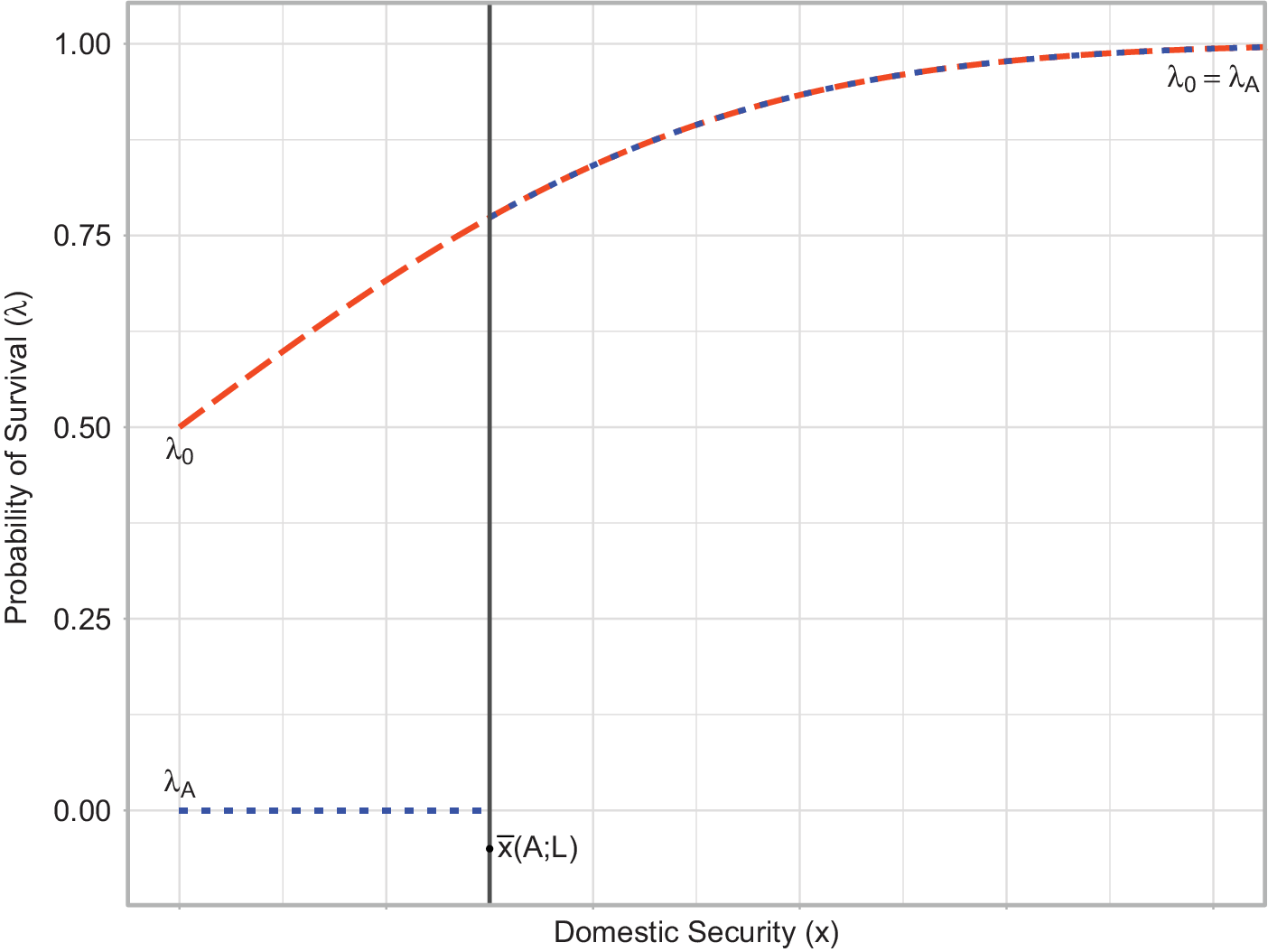
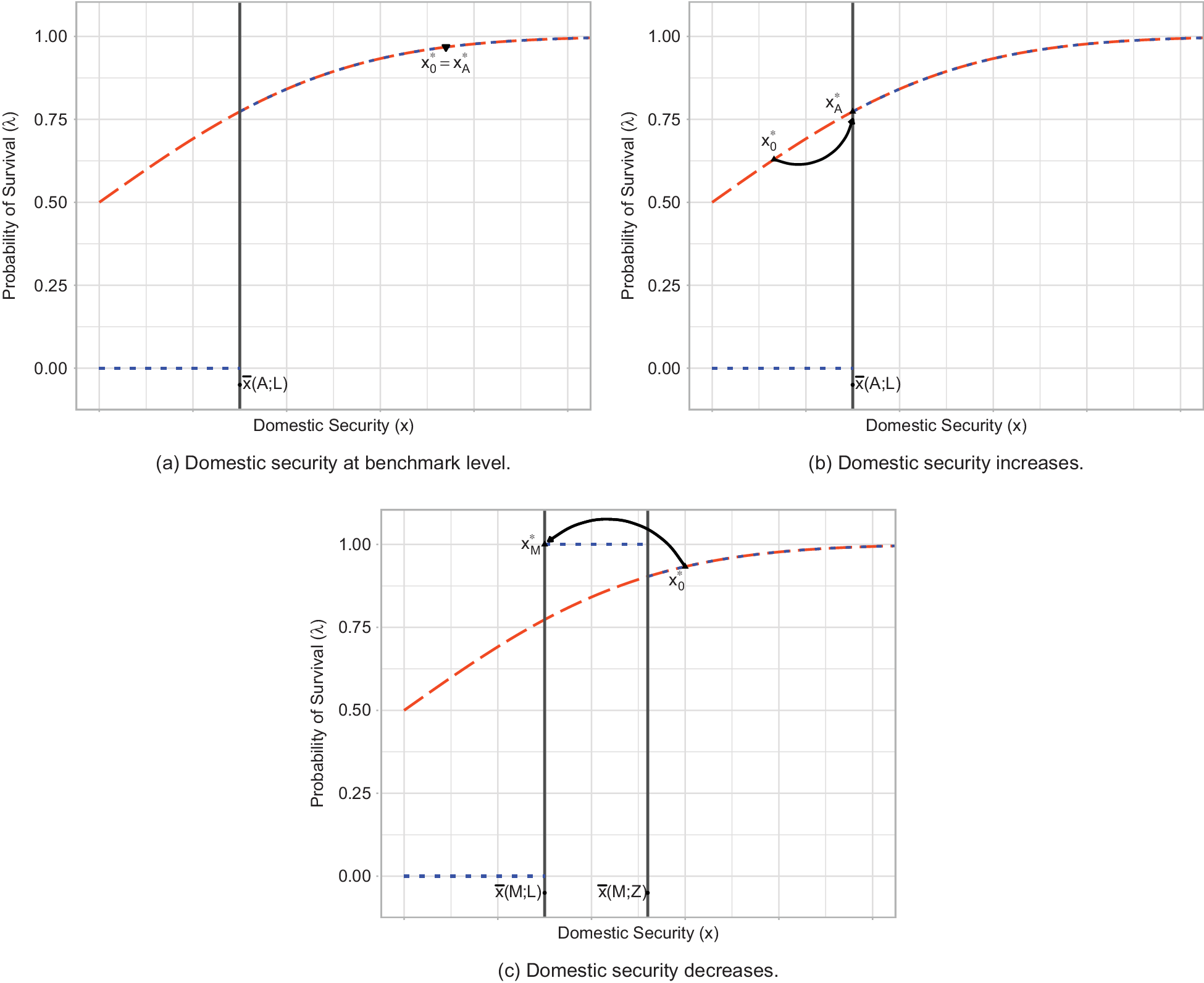




Comments
No Comments have been published for this article.