

“If Americans did not want to buy foreign goods, foreign goods could not be sold here even if there were no tariff. The efficient cause of the trade which our tariff aims to prevent is the desire of Americans to buy foreign goods, not the desire of foreign producers to sell them. Thus protection really prevents what the ‘protected’ themselves want to do. It is not from foreigners that protection preserves and defends us; it is from ourselves. […] protective tariffs are a means whereby nations attempt to prevent their own people from trading. What protection teaches us, is to do to ourselves in time of peace what enemies seek to do to us in time of war.”
Henry George, Protection or Free Trade, 1886.Footnote 1“Ladies and Gentlemen, it's time to declare our economic independence once again.”
Donald J. Trump, 2016.Footnote 21. Introduction
To many observers, the impact of possible political developments has become an important factor blurring macroeconomic prospects (e.g. Reference ChadhaChadha, 2017). In particular, a potential shift towards inward-looking policies has recently been deemed a major downside risk to the global outlook (International Monetary Fund, 2017a; European Central Bank, 2017). Moreover, there are concerns that persistent global imbalances may give rise to protectionist tendencies in key economies running current account deficits (International Monetary Fund, 2017b).
In this broader context, interest in the potential macroeconomic fallout from protectionist measures specifically in the US has risen, especially, but not exclusively, because of a debate on the introduction of border adjustments within a corporate tax reform (e.g. Reference Auerbach and Holtz-EakinAuerbach and Holtz-Eakin, 2016). Under the label ‘America First’, the current US administration has embarked on a comprehensive agenda including a reorientation of US trade policy by making use of existing legal frameworks and presidential authorities.Footnote 3 In particular, the Trump administration withdrew from the negotiations on the Trans-Pacific Partnership (TPP), has not resumed talks on the Transatlantic Trade and Investment Partnership (TTIP), initiated renegotiations of the North American Free Trade Agreement (NAFTA) and the US–Korea Free Trade Agreement (KORUS), and it has staved off the appointment of new members to the WTO's Appellate Body, thereby threatening to paralyse this part of the international settlement system for trade disputes (Reference Payosova, Hufbauer and SchottPayosova et al., 2018). Moreover, the administration initiated a series of trade investigations, which – amongst other things – led to the imposition of safeguard tariffs on imports of residential washing machines and solar cells and modules in January 2018.Footnote 4 In March, following an investigation under Section 232 of the Trade Expansion Act of 1962, a decision was made to levy duties upon steel and aluminium imports to protect national security interests. Even prior to its final announcement, this measure raised the prospect of an outright trade war, as calls for retaliation emerged.Footnote 5
According to textbook economics, an import tariff lowers global welfare. Nevertheless, a large country can improve its position at the expense of its trading partners by shifting the terms of trade in its favour.Footnote 6 This result, derived from a traditional perfect competition framework, holds in a macroeconomic model based on intertemporally optimising agents and market imperfections, as Reference Fender and YipFender and Yip (2000) as well as Reference Reitz and SlopekReitz and Slopek (2005) show. Contrary to traditional notions, however, Reference Reitz and SlopekReitz and Slopek (2005) highlight that the tariff reduces domestic output and creates a short-run deficit in the current account of the (large) country imposing the tariff. Reference Ganelli and TervalaGanelli and Tervala (2015) confirm this result in a similar New Keynesian model.Footnote 7 Using the IMF's Global Integrated Monetary and Fiscal Model (GIMF), Reference Anderson, Hunt, Kortelainen, Kumhof, Laxton, Muir, Mursula and SnuddenAnderson et al. (2013) find that a permanent increase in US import tariffs decreases real GDP and tends to worsen the current account balance in the US.
In a similar vein, we study the macroeconomic effects of imposing tariffs using the National Institute Global Econometric Model (NiGEM).Footnote 8 For illustrative purposes, we focus on the hypothetical case of a virtually global tariff on non-commodity imports in the US. In NiGEM, most of the OECD countries and major emerging markets are modelled separately and are linked to each other via foreign trade as well as the interest rate-exchange rate nexus. Thus, it is generally well suited for studying macroeconomic shocks with international repercussions. However, since NiGEM does not account for bilateral trade flows, it needs to be adjusted to the specific question at hand. Our modelling approach within the NiGEM framework builds upon Reference Ebell and WarrenEbell and Warren (2016) and Reference Ebell, Hurst and WarrenEbell et al. (2016) insofar as we also distinguish between export price equations for alternative destinations. We add to this literature by considering different assumptions regarding the long-run price setting behaviour of exporters.Footnote 9 Abstracting from any fiscal impact of the tariff, our simulations indicate that the macroeconomic implications of the tariff resemble the impact of a cost shock or adverse supply shock as prices increase while output declines. Moreover, we demonstrate that the size and persistence of the macroeconomic impact of new tariffs critically hinge upon the specific assumptions underlying the behaviour of export prices.
The illustrative and hypothetical focus on the US should not obscure the fact that protectionist tendencies may also loom elsewhere in the world. More generally, our simulations in NiGEM point to the possibility of considerable macroeconomic damage caused by the introduction of import duties, including in the initiator country. While additional government spending financed by tariff revenues could mitigate the adverse impact on the protectionist economy in the short run, retaliation by its trading partners would worsen the outcome. Moreover, in a scenario of higher government demand, the import tariff fails to reduce the current account deficit in the US. Thus, our simulations also raise doubts about the ability of protectionist measures to rein in global imbalances.
The remainder of our paper is based upon the following structure. Section 2 briefly outlines our modelling and simulation strategy. In Section 3, we explore the macroeconomic implications of the tariff under different price setting assumptions. Having chosen a plausible framework for the behaviour of export prices, we extend our analysis in Section 4 by taking fiscal effects of the tariff and retaliation by trading partners into account. The final section concludes with a discussion of our findings.
2. Imposing tariffs on US imports
In order to study price responses, we model the import tariff in the US as a surcharge on prices of exports to the US. By default, non-commodity export prices are not assumed to differ across destinations in NiGEM and are determined by an error correction mechanism with the price of exports in the long run depending on a weighted average of domestic consumer prices and competitors' export prices, thereby also accounting for strategic complementarities.Footnote 10 We follow Reference Ebell and WarrenEbell and Warren (2016) and Reference Ebell, Hurst and WarrenEbell et al. (2016) insofar as we differentiate the equations for prices of (non-commodity) exports to the US and for prices of exports to the rest of the world. The basic structure and the coefficients of the default equations are left unchanged.Footnote 11
In previous work, US import tariffs were introduced by applying endogenous or exogenous shocks directly to the price of exports to the US. By contrast, we let the standard behavioural equation only govern the price of exports to the US excluding any tariff and explicitly define the gross price as subject to an exogenous tariff rate. This differentiation of gross and net-of-tariff prices enables us to trace the transmission of (exogenous) import tariffs through the price systems under different assumptions.Footnote 12 In all our simulations, we assume that the US imposes a 20 per cent permanent tariff on non-commodity imports from its major trading partners.Footnote 13 We always incorporate endogenous monetary policy responses according to standard policy rules.
3. Macroeconomic impact under different pricing assumptions
To begin with, we assume that countries do not adjust the net prices of their exports to the US following an introduction of import tariffs. As a result, US import prices surge, while the US dollar appreciates strongly. Higher import prices raise inflation and reduce real private consumption, GDP, and imports. Abroad, lower export demand from the US weighs on local investment and output. At the same time, exchange rate movements fuel inflation, which restrains consumer spending. The contraction of output and demand in partner economies (in conjunction with the dollar appreciation) feeds back by lowering US exports. Overall, the macroeconomic implications of the tariff resemble the impact of a negative supply shock as prices increase while output declines. The magnitude of the adverse effects on US output is consistent with findings from previous simulations in NiGEM.Footnote 14
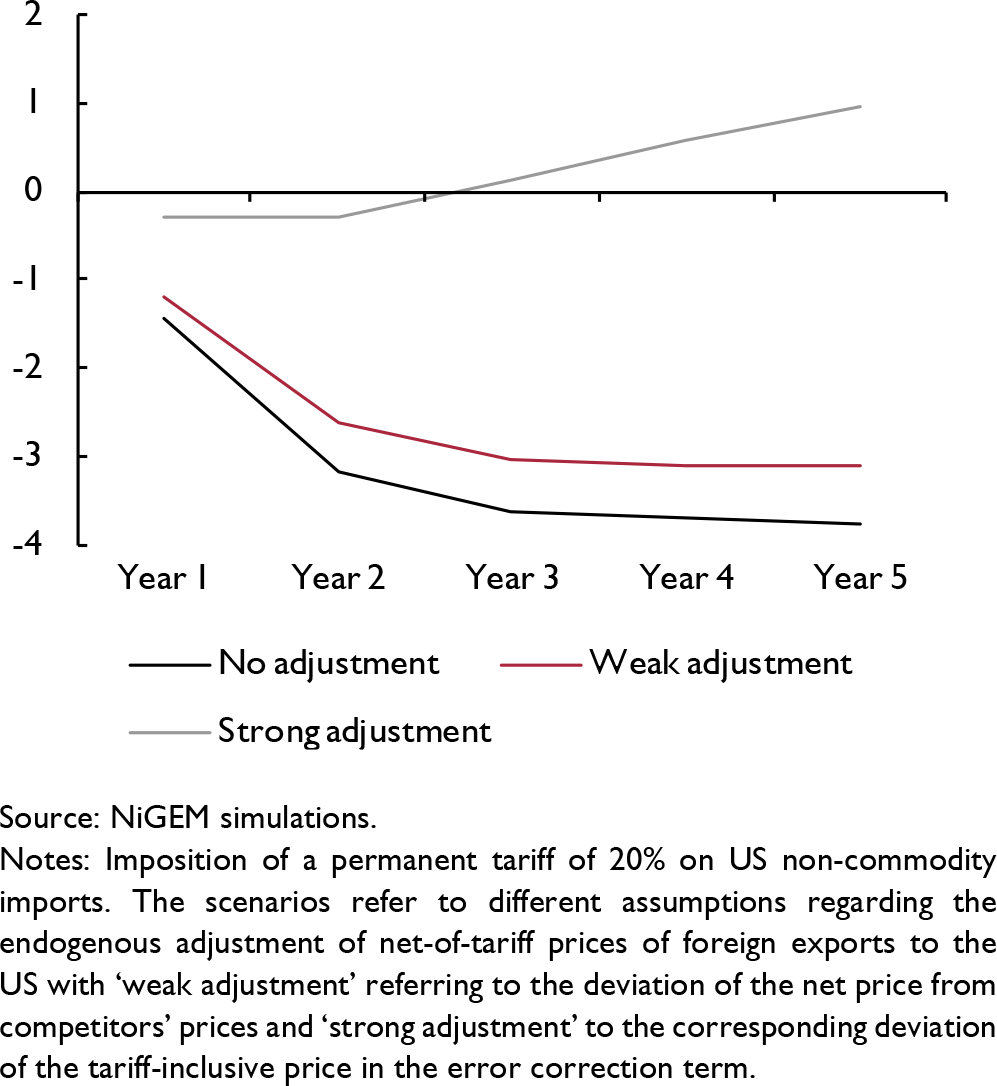
However, the suppression of any endogenous price adjustment appears very restrictive. If foreign exporters are concerned about their gross price (which includes the tariff) deviating from competitors' prices, they will respond by lowering their net-of-tariff prices gradually according to the model's correction mechanism. Thus, the negative supply shock will be offset by endogenous price reactions which spread through the entire price systems. Consequently, the adverse macroeconomic effects will also wane and eventually turn positive both in the US and abroad, with the former benefitting from a strong improvement in its terms of trade (measured net of tariff).
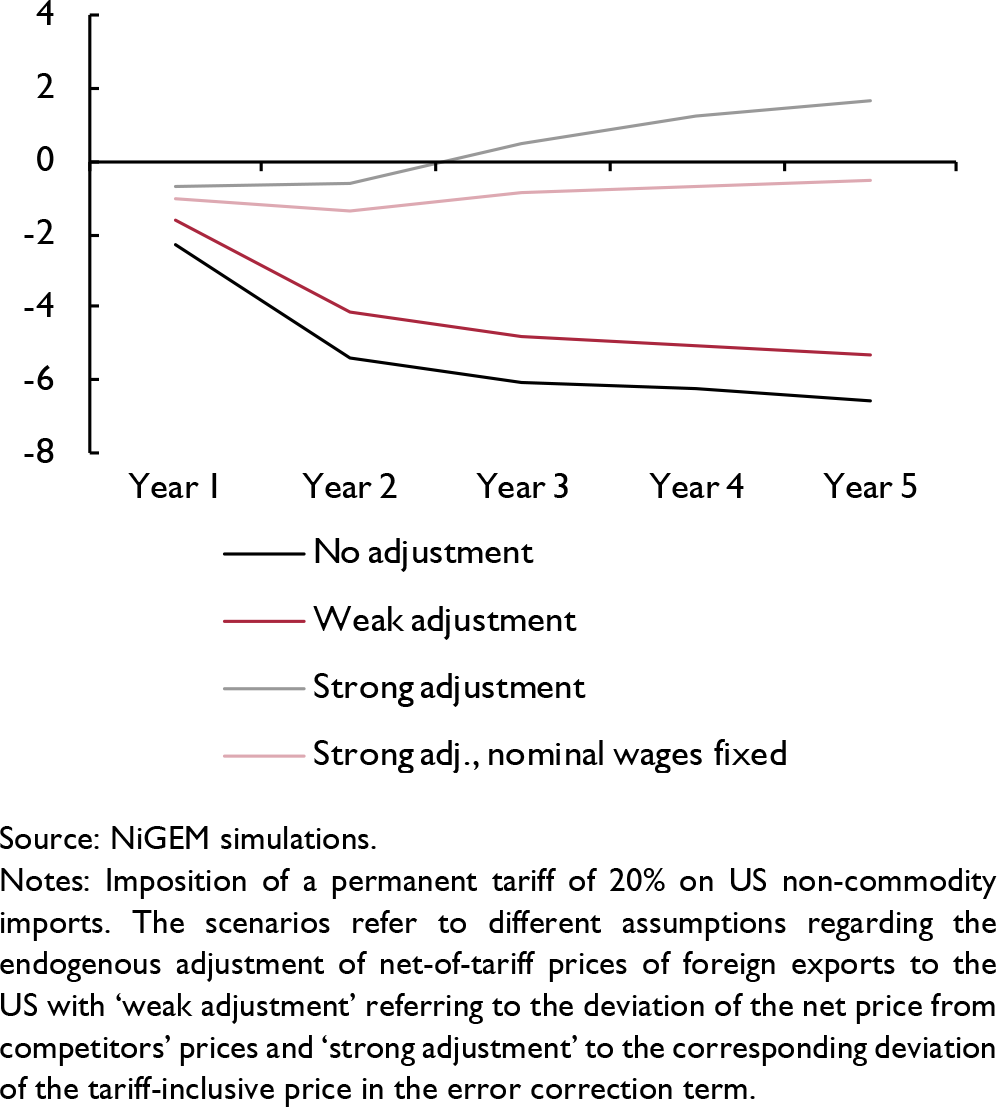
However, this benign outcome appears to rest on a frictionless adjustment in economies exporting to the US. For example, in the case of Canada, one of the main trading partners of the US, nominal wages would have to decline considerably from the baseline in order to reduce costs sufficiently. In economic practice, such cost cutting is likely to inflict severe economic pain not least in terms of employment losses. This is all the more so as nominal wages tend to be rigid downwards (Deutsche Bundesbank 2011, 2016). In order to illustrate the consequences of a less flexible adjustment process, we simulate the introduction of the import duty under the assumption that nominal hourly wages in the affected countries cannot change. As a result, Canadian output turns out markedly lower than in the previous simulation under flexible wages and is also subdued compared to the baseline (figure 2).
Impact of an import tariff on real GDP in the US (per cent difference from baseline)
Source: NiGEM simulations.
Notes: Imposition of a permanent tariff of 20% on US non-commodity imports. The scenarios refer to different assumptions regarding the endogenous adjustment of net-of-tariff prices of foreign exports to the US with ‘weak adjustment’ referring to the deviation of the net price from competitors' prices and ‘strong adjustment’ to the corresponding deviation of the tariff-inclusive price in the error correction term.

Impact of an import tariff in the US on real GDP in Canada (per cent difference from baseline)
Source: NiGEM simulations.
Notes: Imposition of a permanent tariff of 20% on US non-commodity imports. The scenarios refer to different assumptions regarding the endogenous adjustment of net-of-tariff prices of foreign exports to the US with ‘weak adjustment’ referring to the deviation of the net price from competitors' prices and ‘strong adjustment’ to the corresponding deviation of the tariff-inclusive price in the error correction term.

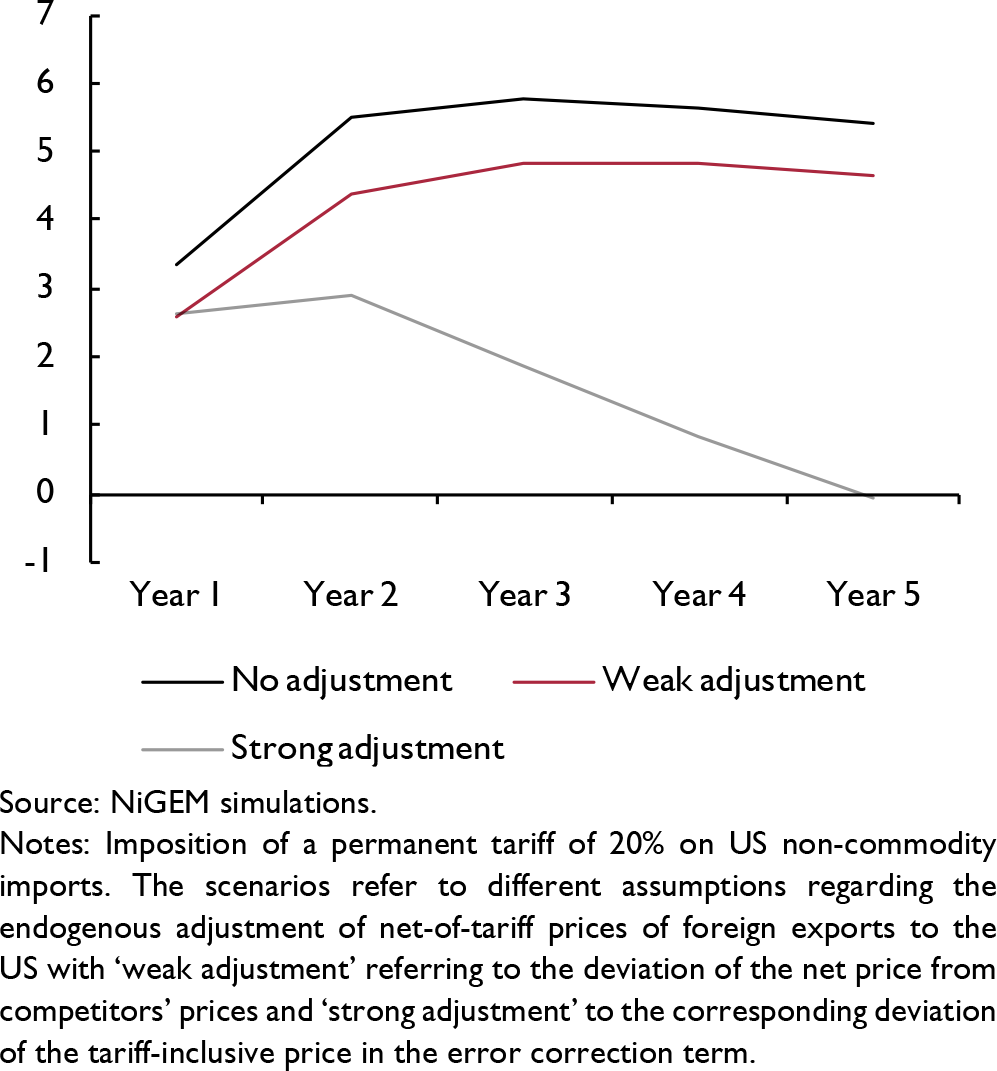
If foreign exporters are essentially concerned about their net-of-tariff prices, there will be little adjustment after the initial surge in gross export prices. As a result, the adverse macroeconomic impact will again be substantially larger and more persistent both in the US and abroad. In the third year, US real GDP will fall 3.0 per cent below the baseline (figure 1), while the level of consumer prices will be raised by 4.8 per cent (figure 3).
Impact of an import tariff on the level of consumer prices in the US (per cent difference from baseline)
Source: NiGEM simulations.
Notes: Imposition of a permanent tariff of 20% on US non-commodity imports. The scenarios refer to different assumptions regarding the endogenous adjustment of net-of-tariff prices of foreign exports to the US with ‘weak adjustment’ referring to the deviation of the net price from competitors' prices and ‘strong adjustment’ to the corresponding deviation of the tariff-inclusive price in the error correction term.

Due to the limited price responses of foreign exporters, these effects will ease to some extent in later years so that the difference compared to the more adverse scenario of no adjustment will increase in the long run.
The scenarios so far have focused on the choice of the foreign exporters' price variable (including or excluding the tariff), the deviation of which from competitors' prices governs the endogenous adjustment of the net price. However, one could also differentiate the measure of competitors' prices for different destinations.Footnote 15 Indeed, an import tariff may be an effective tool to segment markets internationally. Thus, it may be appropriate to define a specific measure of competitors' prices only for the US market. Provided that this measure accounts for the prices that included tariffs, foreign exporters would have little incentive to adjust their net prices in response to a general import duty, even if they were concerned about their gross prices in the US market. Against this background, our previous scenario of a strong endogenous adjustment of net prices appears less plausible. For this reason, we restrict extensions of our analysis to the setup featuring a weak endogenous price adjustment.
4. Extensions to the analysis
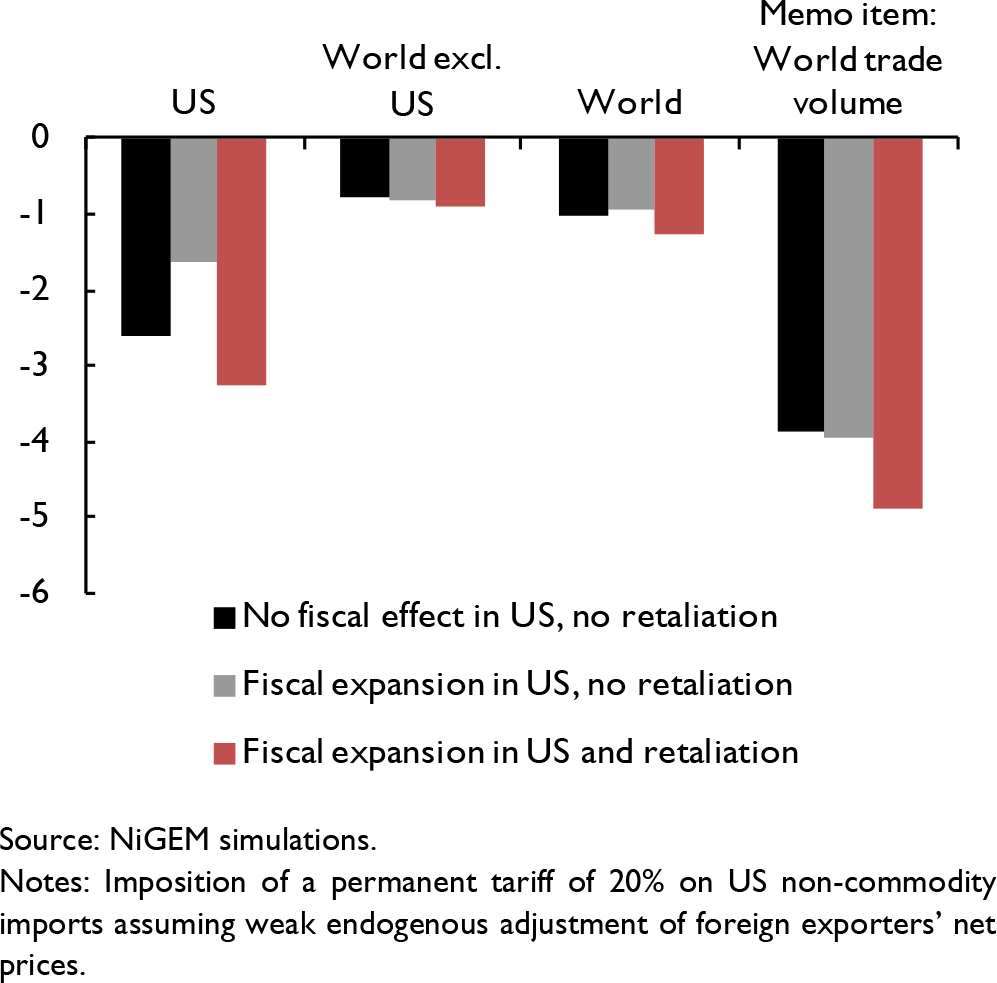
So far, we have modelled an introduction of an import tariff as a mere cost shock, which raises prices and dampens output. However, the tariff also generates additional revenues for the US government. In turn, higher receipts can be used to dampen the adverse impact on domestic demand in the US by lowering the tax burden or expanding public spending. Here, we assume that the tariff revenues are entirely spent on an increase in government consumption.Footnote 16 As a result, US real GDP is even lifted slightly above the baseline in the first year. Over time, the positive output effects of the (government) demand shock dissipate and can only mitigate the adverse impact of the cost shock on US GDP to some extent in the medium term (figure 4). However, higher public spending also affects the ratio of saving and investment in the US economy so that the current account balance fails to improve.
Impact of a US import tariff on real GDP (average per cent difference from baseline over first five years)
Source: NiGEM simulations.
Notes: Imposition of a permanent tariff of 20% on US non-commodity imports assuming weak endogenous adjustment of foreign exporters' net prices.

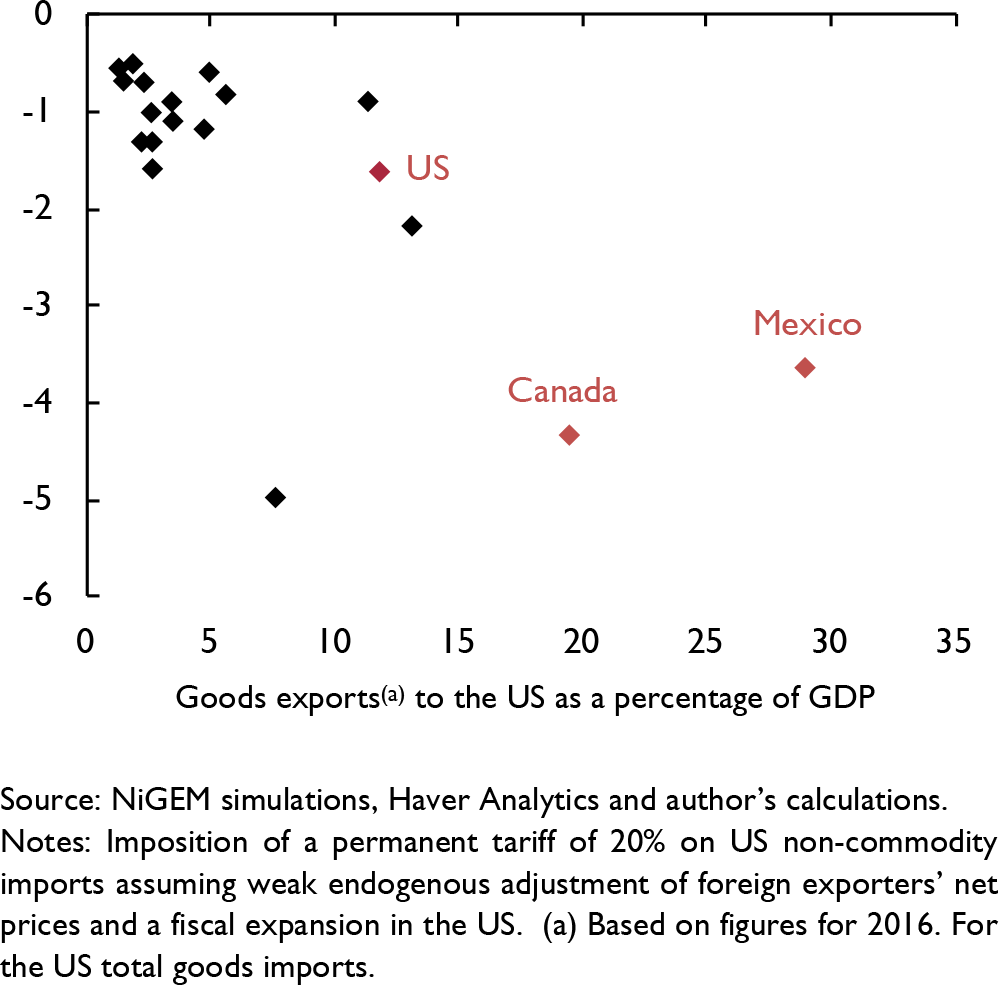
Despite the mitigating impact on US demand, the fiscal expansion even aggravates output losses in the rest of the world marginally. The reason is that stronger spending in the US and a further appreciation of the dollar raise price pressures and interest rates elsewhere, thereby weighing upon trading partners' domestic demand.Footnote 17 Nevertheless, the overall adverse effect of imposing the tariff on economic activity in the rest of the world is still just half the size of the negative impact on US output, measured in each case as the percentage deviation of GDP from the baseline. However, the magnitude varies greatly across countries, reflecting different degrees of trade integration with the US and the size of the economies. In general, the negative percentage deviation of GDP tends to be larger the more important exports to the US are relative to total output (figure 5). Thus, Canada and Mexico incur very high output losses (−4.3 per cent and −3.6 per cent, respectively, on average over the first five years) due to the importance of US trade for their relatively small economies. Owing to large domestic economies or weaker trade links to the US, the adverse effects on China (−1.1 per cent) or the Euro Area (−1.0 per cent) prove to be smaller, albeit still marked.
Impact of a US import tariff on real GDP in selected economic areas (average per cent difference from baseline over first five years)
Source: NiGEM simulations, Haver Analytics and author's calculations. Notes: Imposition of a permanent tariff of 20% on US non-commodity imports assuming weak endogenous adjustment of foreign exporters' net prices and a fiscal expansion in the US. (a) Based on figures for 2016. For the US total goods imports.

Given these adverse spillovers, trading partners may be tempted to retaliate against the import restrictions in the US. By imposing a retaliatory tariff of likewise 20 per cent on imports from the US, the rest of the world incurs marginal additional output losses in our simulations, as the punitive measure acts as a cost shock to domestic economies.Footnote 18 In the case of Canada and Mexico, the extra damage would be sizeable. However, while the retaliatory tariff usually affects only a fraction of trading partners' imports, it afflicts US exports in general. Hence, the volume of US exports drops steeply from the baseline and the decline in real GDP turns out to be twice as large as in the previous scenario without retaliation (−3.2 per cent on average over the first five years). Thus, in terms of output lost, trading partners would succeed in inflicting severe additional economic pain on the US. Moreover, the current account deficit of the US would widen on account of the sharp fall in exports and a smaller improvement in terms of trade. At the global level, the retaliation extends the loss in output from −0.9 per cent to −1.3 per cent over five years. As tariffs weigh down particularly on international trade flows, the volume of world trade is depressed by −4.9 per cent, as compared to −4.0 per cent in case of no punitive action.
5. Discussion of results
Our simulations in modified NiGEM show that the macroeconomic effects of an import tariff basically resemble those of a cost shock or adverse supply shock, raising prices while lowering output. The results are thus in line with other recent studies (e.g. Reference Barattieri, Cacciatore and GhironiBarattieri et al., 2018). However, we have also demonstrated that the ramifications from imposing a tariff can vary widely depending on the behaviour of export prices. Assuming that foreign exporters slowly adjust their prices excluding tariff, the levy would raise prices and reduce output persistently, particularly in the country restricting imports. An expansion in government spending financed by tariff revenues would only mitigate the shortfall in demand in the short and medium term. Due to exchange rate movements and changes in the prices of traded goods, prices and output in other economies tend to move in the same direction. Output losses – and the contraction of world trade – might be even more severe if trading partners resorted to retaliatory measures.
By contrast, in case of a strong adjustment of export prices excluding tariff, the cost shock is countered by endogenous price declines which would eventually more than offset the dampening impact on output. However, we consider this setup as less relevant to economic practice for several reasons. In particular, exporters may have little incentive to compensate for the tariff by lowering their net prices, if the tariff were to be equally applied to imports from all countries. The protectionist measure may induce profound structural changes and trigger painful cost adjustment processes which (including distributional effects) are not captured by standard models. Indeed, we have demonstrated that a small modification in the simulation setup may exacerbate the economic pain inflicted upon other economies considerably. Moreover, it should be borne in mind that we have retained the behavioural coefficients from standard NiGEM in our modified price equations, which are all expressed in US dollar terms. However, Reference BuiterBuiter (2017) shows the role of specific assumptions on price stickiness regarding the inclusion of taxes and the currency chosen in determining the effects of taxes on international trade flows. He also stresses the necessity (and scarcity) of empirical evidence of such rigidities in the context of taxes.
Other caveats may apply to our analysis. The homogeneity of behaviour on which NiGEM rests may be a significant limitation, since a tariff (or tax changes in general) can provoke very different responses across firms and private households. Furthermore, international linkages are modelled via the demand side in NiGEM; ripple effects through supply chains are not taken into account. Import demand depends on relative prices and the level of total demand, whereas differences in import content do not play a role. Given the strong dampening impact of the levy on export and investment, which are characterised by a high import content, the size of the international spillovers may be underestimated.Footnote 19
Our analysis has focused on a hypothetical scenario in which the US imposes a levy on non-commodity imports from most of its trading partners. We do believe that protectionist tendencies also loom elsewhere in the world and that general conclusions on the macroeconomic effects of tariffs can be drawn from our exercise. Nevertheless, some specific remarks with respect to US trade policy appear warranted. In particular, our simulations highlight the danger that the US could inflict severe economic harm on itself in particular by raising import tariffs. The goal of reducing the US current account deficit may prove elusive, especially in conjunction with a more expansionary fiscal policy stance. Moreover, our result that trading partners would suffer additional economic pain from retaliation does not necessarily imply that they would be deterred from such measures. In our setup, retaliation also increases economic losses incurred by the US substantially.