Introduction
In post-independence India, as in many developing post-colonial nations, the capitalist class was dependent on the state to discipline the laborforce, and the rapid uptake of capitalist production methods prompted the new government to intervene aggressively in industrial labor relations.Footnote 1 The main goal of postcolonial labor policy was to maintain peaceful labor relations at any cost in order to foster economic development.Footnote 2 The newly elected government failed to help capitalists increase their profits through productivity growth, so the way forward was to impose restrictions on labor.Footnote 3 Pro-capital labor legislation initially enabled capitalists to curb the mobility and resistance of workers.Footnote 4 In due course, however, irrespective of how consistently or effectively labor regulations and repressive measures were enforced, the reaction of the working class heightened its political consciousness, and thus aggravated frictions between capital and labor.Footnote 5 When the state resorted to labor welfare laws as a new strategy to reduce these conflicts, employers often fragmented production among smaller units (such as workshops and households) in order to dodge labor regulations.Footnote 6 As a reaction to this production decentralization, the working-class movement created impediments to the process of continual capital accumulation.
In an attempt to control the militancy of the working class and secure the political support of trade unions, the ruling Indian National Congress (INC) party formed a new trade union—the Indian National Trade Union Congress (INTUC)—by splitting up the communist-dominated All India Trade Union Congress (AITUC). According to Jawaharlal Nehru, India's first prime minister, INTUC, as the official trade union of the Congress Party, was to be given support by both federal and state governments to ensure that industrial discipline was maintained and communist militancy among laborers was held in check.
In postcolonial Malabar,Footnote 7 trade unions played a crucial role in social and political transformation.Footnote 8 After the creation of the state of Kerala in 1956, “the incipient forms of craft- or industrial-based unionism were, from the outset, absorbed into a more encompassing and more politicized project of challenging the traditional social order and its despotic regime.”Footnote 9 This was possible because “in industry, social legislation and pro-labor governments have provided the working class with an exceptionally high degree of mobilizational capacity.”Footnote 10 One significant change that occurred after independence was that the working class increasingly bargained with employers on legal terms. This was an outcome necessitated by legislative interventions of the state in labor disputes. Trade unions were informed of the legalities of labor relations due to frequent interaction with the labor department and participation in adjudication processes. They began to pressure the state to take a seat at the negotiating table, a demand legitimized by the fact that, by this time, the direct link between employer and employee was rapidly vanishing. In Malabar, this was true of traditional industries such as handloomed textiles and beedi manufacture.Footnote 11
Beedi making had been an essential economic activity in Malabar since the 1920s. As in other parts of the country, beedi workers in Malabar came primarily from economically and socially backward groups, including Thiyya Footnote 12 and Muslim communities. As the industry grew, beedi workers from Malabar came to be known for their superior skill in beedi rolling, and beedi company owners from other parts of India employed them in factories established in Malabar.Footnote 13 Malabar's beedi workers were also better organized and more politicized in comparison with their peers in other sectors and with beedi workers in other parts of the country.
This article raises two important questions about the state's labor regulation and welfare policies, and the success of the working-class movement. In the first three sections, it addresses the crucial question of why state regulation and working-class resistance could not prevent the closing of production units, capital flight and decentralization of production in Malabar's beedi industry. The first section examines this question by reviewing the course of the working-class movement during the period from Indian independence to the creation of Kerala state (1947–1956). It reviews the atrocities committed by the state against trade unions in the early stages of independence, and the weakened bargaining power of the working class and its revival. The second section details Kerala's initial attempts to pass industry-specific laws, and their inadequacy (1957–1965). In the third section, the paper explores the link between enactment and enforcement of industry-specific, all-India legislation, and the impact of this law on the organization of production. This section also discusses the introduction of state-led cooperativization of production as a remedy to capital flight from Malabar to other Indian states (1966–1970). The fourth and final section considers why the legislative interventions of the state failed to raise the living standards of workers by improving wages and employment opportunities in factories.
The Working-Class Movement Between Indian Independence and State Reorganization (1947–1956)
Beedi rolling was initially household-based and for personal and local consumption; it transitioned to factories when increased consumption led to industrial production.Footnote 14 Since its inception as an industrial undertaking, beedi rolling took place in both households and factories. In Malabar, however, the greater part of production occurred in factories prior to 1937. In that year, beedi factories came under the purview of the Factories Act of 1934, and this led to a decentralization of production to smaller units called workshops or branches (employing twenty or fewer workers). Although much of the industry transitioned from factory production to the branch system, both systems continued to coexist in Malabar.
As shown in Figure 1, the branching out of factories into small workshops began toward the end of the 1930s and continued well into the 1950s.Footnote 15 This was a profitable system for the employers as they did not need to abide by the labor welfare clauses of the Factories Act because the law only applied to businesses that employed more than twenty workers (e.g., regarding health and child labor). On the other hand, this law evasion strategy used by the employers was a matter of concern for the state and for Malabar's beedi workers. Struggles intensified as trade unions adopted various strategies to resist decentralization.
Timeline of Major Events in the History of the Malabar's Beedi Industry
Source: Prepared by the author.

In the period immediately following independence, the Congress government in Madras state (Malabar was then a part of Madras) adopted a repressive attitude toward working-class struggles in order to ensure uninterrupted production. This was necessitated by the fact that the Congress Party was backed by many of the big business power houses in India. Economic development through capital investment was the motto of the government, so creating an investment-friendly economy was a priority. Unions, with the exception of those affiliated with the Congress Party and the Muslim League, faced attacks from the police.Footnote 16 The terror unleashed by the police against beedi workers affiliated with communist trade unions weakened their unity and collective bargaining power. One of the most influential communist trade union leaders in Malabar, C. Kannan, recalls the atrocities committed by both the state and employers during those years:
Beedi workers were attacked both inside factories and in lock-ups by the Malabar Special Police (MSP). Further, union offices were raided and often burned. Until 1951, it was not even possible for union members to enter union offices as they were under the control of the police. There was a complete ban on trade union activities. Further, workers were treated inhumanely, with hundreds being jailed or attacked. Workers belonging to other unions were forced to resign from them and join INTUC, the Congress Party's trade union wing.Footnote 17
In 1951, communist trade union leaders began to reorganize the beedi workers under a common name, Tobacco Workers Union (TWU).Footnote 18 Even after formation of the TWU, the decentralization of production continued to weaken the bargaining power of workers, and they were still under threat of unemployment and physical violence (see Figure 1). In 1951, there were fifty-two unions with a total membership of five thousand, of which only a few were registered and functioned effectively.Footnote 19 Even existing union members did not regularly pay subscription fees, so these organizations lacked funds for activities. By then, it had become evident to the beedi workers that they could not enforce their rights as workers without the ability to bargain legally.
Most beedi production units operated without being formally registered under the Factories Act. Wages, work schedules, holidays, and working conditions were not consistent with the legislated norms, so trade unions demanded the formulation of industry-specific legislation for beedi workers. This was a revolutionary move on the part of the beedi workers; their main tactic to achieve this goal was to strike. Wage reductions, nonpayment of bonuses, managerial misconduct, layoffs, increased working hours, and factory closures without notice were the major issues raised by workers.Footnote 20 Moreover, the wages paid to beedi workers barely met their minimum living expenditures. According to one report, a beedi worker's average living expenses were 47 percent higher than his income.Footnote 21 And because beedi rollers were paid at a piece-wage rate, the loss of even one day of work could lead to a drastic shortfall in earnings.
It was a common strategy among beedi workers to resort to strikes once discussions with management on issues such as wages, hours of work, and worker retrenchment failed. In one such incident, managers at the T. P. K. beedi factory in Badagara issued a notice to inform employees of the closure of the company from July 18, 1953, citing high production costs and resultant losses.Footnote 22 The workers’ negotiations with management failed to dissuade them from the intended closure, so the workers began a sit-in strike and satyagraha. Footnote 23 Many workers were arrested and made to appear before the Sub Magistrate. The strike was eventually called off on August 1, 1953. Later, in a meeting conducted in the presence of the Labor Officer of Calicut, the company's management agreed to pay a gratuity of fifteen days’ wages, plus leave with wages, to the workers who became unemployed due to the closing of the factory.
In a similar series of events, the workers of the Kondotty Yogi Beedi Company went on strike. The strike started on September 10, 1953, when the company owner announced that he was closing down the factory to avert further losses. The owner argued that a wage reduction was necessary for the company to resume operations. Workers dissented and called for a strike. On September 13, 1953, following a new agreement between the owner and protesting workers, the strike was called off. The owner decided to engage the workers on a commission basis until the stock of tobacco leaves was exhausted and afterward at the rate of one rupee and ten annasFootnote 24 per day.Footnote 25 The employer was adamant that the workers were not to be paid for the days of the strike. Having agreed on a rate of one rupee and ten annas, the company owner reopened the factory. However, after some time, he reduced the wages to one rupee and eight annas, again pointing out that the company was running at a loss and would not be able to pay anything more than that. Workers who disagreed with the reduced rate were banned from the premises.Footnote 26 By employing new workers from nearby areas, production continued without delay. Employees started protesting against the management and asked the replacement workers to leave the factory. While the Communist Party of India (CPI) supported the struggle, the Congress Party and the Muslim League opposed the workers’ demands. Later, the issue was settled between trade union leaders and the company management.Footnote 27
These examples illustrate the general pattern of strike activities during the 1950s and the attitude of the management, police, and government toward workers’ issues. The common outcome of the two above-mentioned strikes for wage increases was the loss of employment for workers, along with management's acceptance of some of their demands. In the first instance, the employer was forced to recognize the workers’ right to paid leave under the Factories Act. Although police intervention led to the strike being called off, the workers received a bare minimum compensation for their job loss through government-mediated negotiations. The second instance exemplifies the adamant attitude of many employers, which led, in this case, to the workers losing their wages for the days they were on strike and their employment itself. These examples point out how the strikes failed to achieve any significant improvement in the economic rights of the workers. However, strikes had a positive impact on the political maturity of the working class in Malabar.
Apart from resorting to strikes and satyagraha, workers also engaged in legal means to resolve their immediate concerns, which then became a reference point for long-term demands. This can be seen in an incident in 1956, when a loophole in the welfare legislation ultimately defeated the purpose of the law and prevented it from being enforced properly. A petition was filed in the High Court of Judicature at MadrasFootnote 28 by the owner of Raja Beedi Company (Chowghat) for an exemption that would allow him not to grant a wage increase.Footnote 29 The court declared his case was valid by citing a technicality as per the Industrial Dispute Act of 1947, ruling that there was no direct relationship between the company management and the beedi workers. The court noted that the workers were contracted through a third party, and therefore were not formally employees of Raja Beedi Company. The workers were left with no further legal options as they could not be identified as employees according to the law. Such incidents intensified workers’ efforts to push for comprehensive, industry-specific legislation that would afford them the protection of the state.
Legislative Interventions in the Beedi Industry After the Formation of Kerala State (1957–1965)
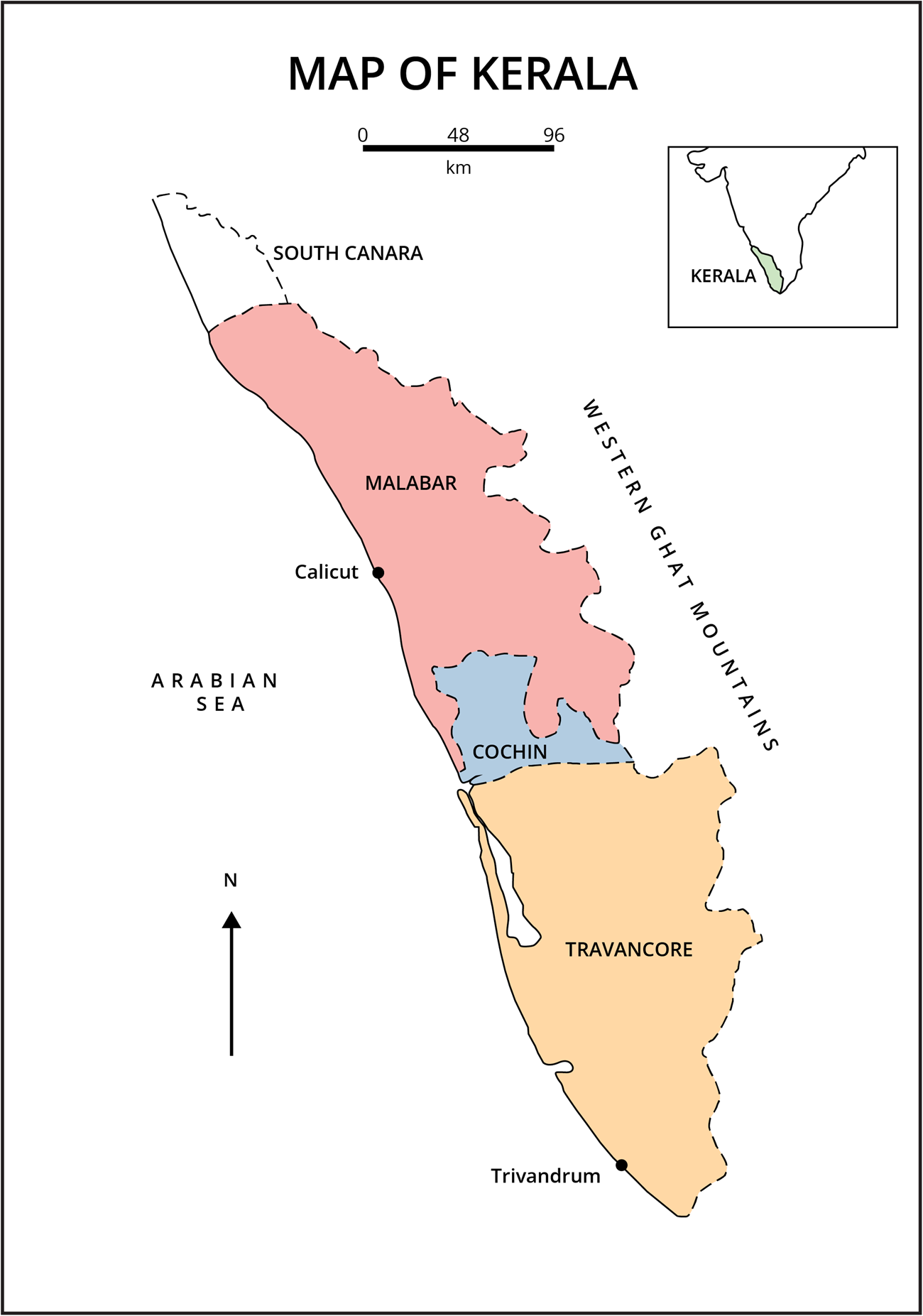
As per the States Reorganization Act of 1956, Kerala state came into existence through the merger of the British administrative district of Malabar and the princely states of Travancore and Cochin (see Figure 2). Following statewide elections, the first democratically elected Communist government in India took office in 1957 with E. M. S. Namboodiripad as chief minister. The Communists came to power “on the strength of a clearly defined class base and the basis of radical redistributive demands.”Footnote 30 They were at the forefront of working-class struggles and raised workers’ hopes with pre-election promises. Their manifesto contained plans for the development of agriculture, small-scale industries, and plantations.Footnote 31
Map of Kerala
Source: Map of Kerala showing constituent regions. Modified by Adithya Appu from Humanity Development Library

The new government issued several ordinances, bringing about far-reaching changes in labor protection. Although implementing a wage increase policy in private industries and the agricultural sector was a herculean task, the Minimum Wages Act of 1948 was extended to industries that were previously outside the ambit of the law. Lieten observes that “though the percent increase over the existing wage scale was small, the total increase resulted in an additional flow of money from the employer's pocket to that of his workers.”Footnote 32 As a result of the efforts and awareness campaigns of CPI organizations such as the AITUC and Karshaka Sangham,Footnote 33 workers in Kerala became increasingly aware of their legal rights. This resulted in workers pressuring their employers to implement the legislation, which in turn helped them benefit from government policies, but it created discontent among employers.
As part of the Communist theory of “peaceful transformation to communism,”Footnote 34 working-class strikes were promoted as an industrial dispute mechanism, with the state acting as a mediating entity in tripartite negotiations. During the rule of the first CPI government (1957–1959), workers’ strikes were increasingly frequent.Footnote 35 Trade unions affiliated with both the ruling party and others resorted to strikes on various workers’ issues. The police force was generally instructed not to intervene in these capital–labor conflicts.Footnote 36 Thus, scholars like Lieten have seen this period as one of “police neutralization,” though this argument has been countered by scholars who point to instances where the police force intervened and resorted to violence against workers, such as the events at Chandanathope (July 1958) in Quilon district, which resulted in the death of two persons and the wounding of many others.Footnote 37
The first Communist government also witnessed critical moments in the history of labor legislation and the labor movement in Malabar, especially in traditional industries like beedi rolling (see Figure 1). The government introduced many welfare policies in the beedi sector, such as a minimum wage, dearness allowance, and bonuses. This was to be expected, as the beedi workers had played a key role in building the Communist movement in Malabar. Previously, beedi workers had not been entitled to a dearness allowance, so they were vulnerable to sudden price increases.Footnote 38 Fear of losing their livelihoods often led them to continue in their jobs despite the low wages. One of the primary causes of the abysmal conditions endured by beedi workers in Malabar was the branch system. A tripartite committee was appointed in 1957 to study and submit a report on the nature and scope of legislation to be enacted for the protection of beedi and cigar workers, and reorganize the industry in factories. Employers opposed the implementation of assured minimum wages in the state, whereas workers demanded that the minimum wage be fixed at two rupees and eight annas per 1,000 beedis.Footnote 39 These tripartite discussions underscored the wide differences between the needs of beedi workers and their employers in Kerala, the resultant tension between capital and labor, and the necessity for government mediation.
In 1957, the government of Kerala extended the minimum wages that existed in the Travancore–Cochin region to Malabar by an ordinance. The measure was to increase the minimum wage from one rupee and ten annas to one rupee and fourteen annas per 1,000 beedis to bring about wage parity across these three regions.Footnote 40 The Kerala High Court nullified the move by validating the beedi company owners’ case for maintaining the status quo.Footnote 41 Partly in response to this, the government issued the Kerala Minimum Wages Rules in 1958, which encompassed the whole of Kerala. The subsequent discussion on the implementation of minimum wages alarmed beedi factory owners in Malabar, many of whom closed their production units. As per government records, the year 1957 saw the closure of 228 beedi branches in the districts of Palakkad, Calicut, and Cannanore.Footnote 42 Thousands of workers found their employment threatened by the possibility of their companies moving to the neighboring states of Mysore (present-day Karnataka) and Madras (present-day Tamil Nadu). To address this issue, the government organized an interstate summit with Madras and Mysore, which took place in Aluva, Kerala, in 1958.Footnote 43 The outcome was a decision to standardize the minimum wages in these three neighboring states with immediate effect in the bordering areas. Although this was agreed in principle, it never materialized.
The Kerala government attempted to counter the closure of beedi factories by promoting the restructuring of the industry into cooperatives. As a result, around twenty-six hundred beedi workers were organized under twenty-three cooperatives in Kerala, thirteen of which were in Malabar.Footnote 44 The initiative, however, had limited success. The cooperatives failed due to a lack of professionalism in marketing, the absence of proper quality control, insufficient working capital, lack of commitment from the trade unions, the inability to take advantage of economies of scale, and inherent financial problems.Footnote 45 Reflecting on the inability of the state to sustain these cooperatives, the then labor minister, T. V. Thomas, opined the following:
Only the combined efforts of the public, trade unions, workers and progressive employers could bring about change within the industry. In the specific case of Malabar, the assistance of the states of Madras and Mysore, which shared a border with Malabar, is also critical to ensuring the rights and welfare of the workers. Footnote 46
Building upon the theory of a “peaceful transition to communism,” Thomas argued that legislation alone was not enough to resolve the workers’ plight. The government formulated plans to enact separate legislation for the industry, which were taken forward by the subsequent government led by the Congress Party.
The historical events discussed above suggest that the years immediately after the formation of Kerala (1957–1959) was a period of political experimentation. The ruling Communist Party promoted the workers’ movement with pro-labor legislative measures to improve the economic conditions and political bargaining power of workers. History shows that this strategy had an immediate, positive impact on workers’ lives, but whether this impact was sustained is a crucial question. It can be answered only through an analysis of important industry-specific legislative measures, employers’ law evasion strategies, and the impact of working-class movements in the years that followed.
In the 1960 Kerala Legislative Assembly (KLA) election, the alliance of Congress Party and Praja Socialist Party (PSP) won a majority and formed a government with Pattom Thanu Pillai as Chief Minister. Later that year, the government introduced the Kerala Beedi and Cigar Industrial Premises (Regulation of Conditions of Work) Bill in the Legislative Assembly.Footnote 47 The government saw it as an opportunity to win the support of beedi workers, who formed the backbone of the CPI in Malabar. In introductory remarks, the minister for transport and labor, K. T. Achuthan, detailed the conditions of the beedi industry in the state and highlighted the unorganized nature of beedi production. He emphasized that Kerala was home to nearly seventy-five thousand beedi workers, only five thousand of whom were organized under fifty-odd trade unions. Likewise, nearly sixty factories were employing fewer than one thousand workers each, while the bulk of beedi production occurred in fragmented production units.Footnote 48 Disagreeing with the arguments of his predecessor, Achuthan held that in this scenario, the workers themselves were unable to organize and bargain for their rights. He argued in favor of introducing an industry-specific bill. The resulting discussion of the bill in the Assembly revealed the limitations of the proposal.Footnote 49 The main concerns were that factories could escape the provisions of the bill by migrating out of the state, issues such as child employment (workers below the age of fourteen), quality and standardization, and the exploitation of women employed in the industry. Other pressing concerns were the nature and structure of the industry, including decentralization (branch system and household production) and informalization. Many members across the political spectrum, though supportive of the spirit of the bill, were doubtful that it could be implemented effectively.
The bill was discussed in the Assembly again after consideration by the Select Committee; it was passed into law with amendments in 1961. The scope of the act's implementation was all the beedi and cigar production premises in the state of Kerala. The main provisions of the act specified that all beedi and cigar industrial premises must obtain a license—to be renewed annually—from the competent authority.Footnote 50 The significant provisions regarding working hours were as follows: nine hours of work per day, forty-eight hours of work per week, a rest interval of one hour after every five hours of work, and employment hours between 7 a.m. and 7 p.m.Footnote 51 The working hours of women and the legally recognized category of children (between the ages of fourteen and seventeen) were restricted to between 8 a.m. and 5 p.m. The act also prohibited children below fourteen years of age from working in beedi factories. Other provisions included compulsory weekly holidays, the provision of one month's notice to any worker prior to dismissal, canteens for units with 150 or more workers, urinals and latrines in units employing 50 or more workers, washing facilities, clean workspaces, ventilation, and protection from fire hazards. The enforcement authority was to be the chief inspector of police. True to the fears of many legislators in the Assembly, the provisions of the act, although formulated with the best of intentions, proved inadequate. As predicted, many factories migrated to neighboring states.
This shows that the political will of a government to pass laws was not enough to ensure the welfare of workers. Decentralization and capital flight became inevitable outcomes of the legislative efforts in the beedi industry, and the workers’ resistance added to this process. A legislative attempt triggered the employers to devise strategies that kept their production units out of the purview of law. The workers’ response was to force the employers to abide by the law by threatening disruption of the production process. When workers realized the inadequacy of their reaction, they pressured the state to come up with stronger legislation devoid of loopholes. One response fed on to the other, and it became a vicious circle. In order to break this circle, an external solution was needed, such as an alternative production method.
Employers’ Law Evasion Strategies and State-Supported Worker Cooperatives (1966–1970)
A. K. Gopalan advocated the enactment of industry-specific central legislation for beedi workers. He was a member of Parliament from Cannanore and the first opposition leader in the Lok Sabha (the lower house in India's Parliament). He introduced the Beedi and Cigar Labor Bill in Parliament on November 22, 1957,Footnote 52 in order to “organise the beedi and cigar industry on a factory basis and secure for the workers certain minimum conditions of work.”Footnote 53 Despite his efforts, the bill failed to pass. In 1962, he introduced a similar bill that fared no better. Only in 1966 did the central government recognize the importance of passing national legislation for the beedi and cigar workers and enact the Beedi and Cigar Workers (Conditions of Employment) Act. But its loose provisions and weak enforceability allowed state governments to ignore it.Footnote 54
In 1967, a United Front coalition that included both communist parties, the CPI and the CPI(M), came to power in Kerala with E. M. S. Namboodiripad as chief minister once again. The new state government initiated a discussion on central legislation—the Beedi and Cigar Workers (Conditions of Employment) Act of 1966—in the KLA.Footnote 55 Many members were of the opinion that the act should be implemented in cooperation with Karnataka and Tamil Nadu. They believed that only then could it be applied effectively. Members were also concerned about the implementation of the act while the branch system was in place.Footnote 56 They argued that government should abolish the branch system and reorganize workers in factories.Footnote 57 The state labor minister, Mathai Manjooran, raised a concern—shared by most members of the KLA—about the migration of industries to other states once the act was implemented. However, he promised the Assembly that his government would take all the measures necessary to prevent the migration of beedi companies.Footnote 58
In the year 1968, the beedi rolling industry in Kerala entered a new phase in the organization of production. Kerala became one of the first states to implement the Beedi and Cigar Workers (Conditions of Employment) Act of 1966, which was considered the “Magna Carta” for the beedi workers of Kerala, especially Malabar.Footnote 59 All beedi establishments in the state came under the purview of this act. Its welfare provisions, aimed at regulating the conditions of work, hours of employment, and wages in the industry, went against the interests of employers. The implementation of the act impaired employers’ ability to cut costs, so the contract system was abolished. This pro-labor legislation was challenged by beedi company owners in court, but the verdict proved unfavorable to them.Footnote 60 Understanding that evading the provisions of the new legislation would prove difficult, some of Cannanore's major beedi companies relocated to Mangalore, where labor laws were more lenient.Footnote 61 Around twelve thousand workers in the Cannanore region alone became unemployed because of the shutting down of branches of beedi companies like Ganesh and Bharath. Another strategy adopted by employers was to further shift production from branches to households. This was done in an attempt to weaken the bargaining power of the workers by circumventing the law. Household beedi production in the 1960s was a result of the threat of legislation, and it pushed the industry to further unorganization. A large portion of beedi production shifted to households, where female workers began to be more numerous.
The companies that migrated to Mangalore carried with them a considerable amount of raw material, and there was no legal way for the Kerala state government to stop them. All tripartite discussions failed, as most employers did not attend and the issue came under the aegis of the industrial tribunal.Footnote 62 Beedi company owners stated that they were ready to reopen the factories only if the state government removed the clauses in the act that they deemed harmful.Footnote 63 Owners were prepared to restart the factories by writing off all the benefits and balances that were owed to employees, as this meant an additional 120,000 rupees of profit.Footnote 64 At the tripartite meeting that took place at Mercara, in Karnataka state, on November 12, 1968, a representative of the owners informed participants that the companies were ready to resume production by employing workers under the passbook system.Footnote 65 They claimed that there was a provision in the Beedi and Cigar Workers Act for conducting production under the passbook system, and that this system would ensure all the benefits workers could claim under any other system. But the government was not ready to accept the implementation of the passbook system and argued that it would cause further decentralization.
Trade union representatives were divided on this point. Some unions were ready to settle the matter by accepting the option given by the company owners, while unions like the AITUC were strongly against the implementation of the passbook system. Meanwhile, contractors had started to collect rolled beedis from home-based workers at very low prices with the assistance of Rashtriya Swayamsevak Sangh (RSS) cadres.Footnote 66 RSS cadres aimed to gain the support of the capitalist class in Malabar while simultaneously expanding their activities through direct contact with workers. They acted as middlemen and became the backbone of the contract system. This helped the RSS, as an organization, to gain a political foothold in Malabar, especially in Kasaragod and Cannanore.
Trade union politics then witnessed a polarization—left versus right. The RSS-affiliated trade union, Bharatiya Mazdoor Sangh (BMS), and the CPI(M)-affiliated Centre of Indian Trade Unions (CITU) often clashed on workers’ issues.Footnote 67 The contractors sold the beedis to the Ganesh Beedi Company, which had opened establishments such as Mahalakshmi Traders and Gurukripa Traders as fronts to conduct this operation in Cannanore under the passbook system. Impoverished workers were initially ready to sell their beedis to these contractors, but eventually they mobilized under the trade unions and resorted to violence, including burning down beedi depots.Footnote 68 TWU members marched to Mysore to conduct a sit-in strike in front of the Ganesh Beedi Company. This had no impact on the decentralization of production and capital flight in the industry, but it was a strong gesture of discontent and signaled unity among the working class.
To employ the workers who had lost their livelihoods, the government of Kerala initiated the Kerala Dinesh Beedi Workers Cooperative Society (KDBWCS, or KDB) in 1969. The KDB was made up of one central society and twelve primary societies in north Malabar, namely, Cannanore and Kasaragod districts.Footnote 69 Production was carried out in the primary societies, while the central society supplied raw materials and was in charge of marketing.Footnote 70 On February 15, 1969, KDB started producing beedis under its own brand name. Soon, KDB gained a foothold in the market and, initially, three thousand of the twelve thousand unemployed workers were accommodated in its cooperatives.Footnote 71 Within five years, KDB cooperatives employed almost all of the displaced workers.
In Kerala, as in other states, the cooperative sector marked a leap forward in terms of securing workers’ rights. The KDB, where workers were share owners, represented a genuine industrial democracy. Each worker, irrespective of the number of shares they owned, was entitled to one vote. Workers were paid better wages and they were free from unjust “deductions” that were common in private enterprises. Supervisors were drawn from among the workers themselves and were in turn overseen by directors elected by the workers. Workers were entitled to stipulated working hours, clean and ventilated workspaces, latrines, washing-up faucets, a canteen, and bamboo benches with cement backrests. They also received Sunday and holiday wages, thrift loans, and retirement and death benefits—all concepts unheard of in the pre-KDB era. Women workers, who constituted more than 50 percent of the KDB workforce, were entitled to maternity benefits and job assurance once they returned to work. The reach of these cooperatives, however, was limited to the districts of Cannanore and Kasaragod, and this raised questions about the effectiveness of this alternative production system in Malabar as a whole.
The above three sections on the legislation and working-class resistance against capitalist strategies of decentralization of production and dislocation and closure of production units shows the failure of state and trade unions to ensure workers’ rights. Even when the political rights of the workers were guaranteed, their economic rights were not protected. The founding of cooperatives as an alternative production system had limited success in terms of their reach. In order to examine the effectiveness or failure of each industry-targeted labor regulation, an analysis of wage and employment figures in the beedi factories is needed.
Impact of Regulations on Employment and Wages in the Beedi Industry
Industry-specific welfare legislation proposed by state and central governments was meant to improve the living conditions of beedi workers. Many of the regulations outlined above were intended to reorganize the decentralized industry into a factory system, through which minimum wages and decent work conditions could be ensured. But on the ground, these regulations caused further decentralization and disintegration of the industry, with employers shifting their production to workers’ households and compelling them to accept harsh terms and conditions.
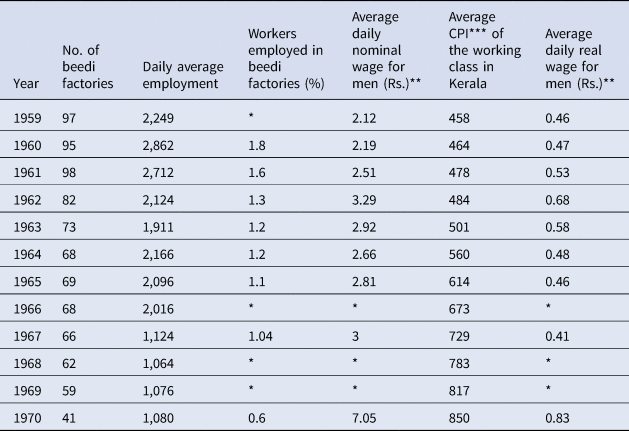
Table 1 illustrates the declining trend in the number of beedi factories in the register and in average daily employment in factories during the period spanning from 1959 to 1970. Three targeted laws played key roles in these developments: the Kerala Minimum Wages Rules, which was extended to the beedi industry in 1958; the Kerala Beedi and Cigar Industrial Premises (Regulation of Conditions of Work) Act of 1961; and the Beedi and Cigar Workers (Conditions of Employment) Act of 1966 (implemented in Kerala in 1968). The previous sections of this paper detailed how these acts led to the closing of factories, migration of factories to nearby states, and decentralization of production to workers’ households. Of the 98 factories operating in the state in 1961, only eighty-two were still operational a year later, probably as a result of the implementation of the Beedi and Cigar Industrial Premises Act. The year 1966 was also a turning point in the history of the beedi industry in Kerala, as the enactment of the Beedi and Cigar Workers Act by the central government caused renewed migration of factories and, consequently, massive unemployment in the industry. It is evident in the following figures: in 1966, the average daily employment in beedi factories was 2,016; it decreased steeply to 1,124 in 1967.
Factories, Employment, and Wages in the Beedi Industry in Kerala

* Data not available.
** Data on the wages of women is not available, as they were not officially employed in factories until 1970. Only with the founding of KDB societies were women employed in factories.
*** CPI = Consumer Price Index
Source: Economic Review (1959–1971), Bureau of Economics and Statistics, Government of Kerala.
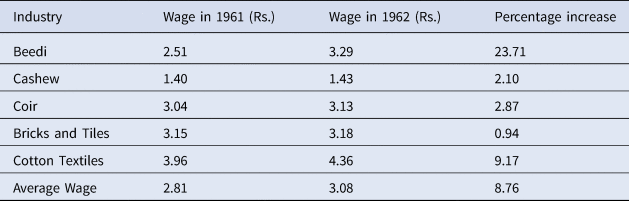
We can now analyze the pattern of wages paid after the implementation of some of the targeted legislation for the welfare of beedi workers. The enactment of the Beedi and Cigar Industrial Premises Act in 1961, for example, had an immediate impact on wages: nominal wages increased by around 24 percent and real wages by 23 percent compared to the previous year (Table 1). This can also be understood as a gradual impact of the Minimum Wages Rules of 1958. Table 2 underscores that this trend was particular to the beedi industry and absent in other traditional industries.
Average Daily Wages in Traditional Industries in Kerala, 1961–1962

Source: Economic Review (1962–1963), Bureau of Economics and Statistics, Government of Kerala.
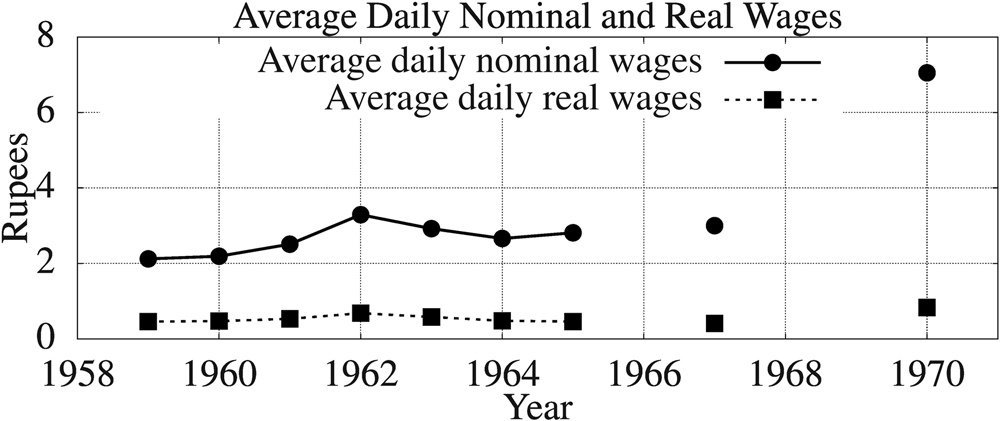
The impact of the Beedi and Cigar Workers Act of 1966 cannot be inferred directly from Table 1 due to a lack of data. However, comparing the entries for 1967, the year immediately before the enforcement of the Beedi and Cigar Workers Act of 1966 in Kerala, and 1970, the year after the formation of the KDB, reveals a considerable increase in nominal wages, but only a minor increase in real wages (see Figure 3). This once again highlights the reluctance of employers to pay inflation-corrected wages even when the law compelled them to do so. The increase in nominal wages witnessed in the industry could be a result of the KDB providing adequate wages to its employees. This set the norm for wages in Malabar's beedi factories.Footnote 72 However, the industry was largely decentralized to households and the government could not guarantee the wages stipulated by the law in this sector.
Average Daily Nominal and Real Wages per 1,000 Beedis Rolled in Kerala, 1958–1970
Source: Economic Review (1960–1971), Bureau of Economics and Statistics, Government of Kerala.

Overall, the decline and decentralization of the beedi industry in the 1960s resulted in a reduced standard of living for workers. Real and nominal wages are perhaps the best indicators of the standard of living, and the averages of these wages in the beedi industry fluctuated in the period from 1959 to 1970. As shown in Figure 3, in general there was a vast gap between real and nominal wages. Beedi company owners continued to set the nominal wages low without revising them to adjust for the high inflationary trends, so there was a steady decline in real wages in the 1960s (except for the spurt seen in 1962). Hence, in the long run, the government failed in both senses—it was unable to either strictly implement the existing Minimum Wages Rules or periodically revise the nominal minimum wages in line with inflationary trends.
Conclusion
The years immediately following Indian independence were a period of working-class repression by the state and employers in Malabar. The formation of Kerala state and the subsequent Communist ministry meant that the state government's approach to labor welfare was distinct from other states in India. The beedi industry was no exception to this rule, and trade union activities under the leadership of committed workers and political figures contributed to the enactment and enforcement of pro-labor legislation, such as the Kerala Minimum Wages Rules of 1958, the Kerala Beedi and Cigar Industrial Premises (Regulation of Conditions of Work) Act of 1961, and the Kerala Beedi and Cigar Workers (Conditions of Employment) Act of 1968. Thus, legislative interventions on Kerala's beedi industry in the early years of statehood were marked by both the state's and the trade unions’ determination to promote labor welfare.
The response of the employers to new welfare laws, government policies, and trade union activities was to close down factories, shift production units to other states, and decentralize production to workers’ households. Thus, though well-intentioned, these regulations ultimately had little impact. A large number of beedi workers lost their livelihoods, and trade unions lost their grip on the industry due to their weakened bargaining power. Further, the current investigation shows that, although there were short-term marginal improvements in the wages of a subset of workers due to labor regulation, the standard of living of workers as a whole did not increase significantly through a consistent and inflation-adjusted wage increase.
The emergence of alternative production systems, like the state-supported cooperativization of the industry, were successful but proved limited in reach. Hence, household production remained predominant in Malabar. The pro-capital activities of right-wing extremists like the RSS and the support of trade unions like the BMS aided the shift of production to households in Malabar. Thus, decentralization was resisted effectively by neither the workers nor the state.