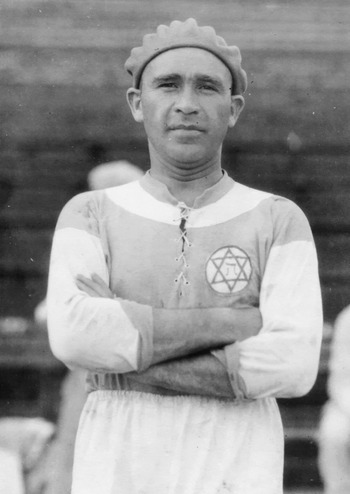
Hakoah Vienna was the most important Jewish sports organization in interwar Austria. Indeed, Hakoah, which means strength or power in Hebrew, was one of the most significant sports clubs on the continent of Europe during that period. This article examines the early history of Hakoah, its rise to international fame, and its demise in 1938 at the hands of the Nazis and their sympathizers in Austria.
Hakoah was founded in 1909, in the tumultuous last few years of the Austrian empire. Its founders were Jewish businessmen and figures from the entertainment world, such as Ignaz Körner, Fritz Löhner-Beda, and Robert Stricker.Footnote 1 They had several reasons for creating a Jewish sports organization in Vienna. First, they believed, following Max Nordau's famous muscular Judaism argument, that the city's Jewish citizens needed more physical activity and fitness.Footnote 2 In particular, they were concerned that eastern European Jews, who had flocked to the city in large numbers from places such as Galicia, Moravia, and Bohemia in the last decades of the nineteenth century, were in need of leisure and sporting opportunities.Footnote 3 Second, the model of Slavic and German sporting organizations in creating ethnic identity and cohesion had already been developed by 1909, and the organizers of Hakoah wanted to follow this nationalistic model and encourage a stronger sense of Jewish identity through participation in a sports club.Footnote 4 Finally, anti-Semitism in Vienna, a hallmark of the city that gave the modern world both Karl Lueger and Georg von Schönerer and helped to mold a young Adolf Hitler, made it increasingly obvious to some Jewish functionaries and athletes that they were not welcome in “Aryan” clubs.Footnote 5 Some clubs were beginning to adopt “Aryan” paragraphs as part of their rules and regulations or grew ever more anti-Semitic in their orientation.Footnote 6 This latter sentiment was given greater prominence as communal politics in Vienna and national politics in Austria became increasingly antagonistic and nasty in the late 1920s and early 1930s and then fell apart altogether in the mid to late 1930s.Footnote 7 For some Viennese Jews, participation in a club such as Hakoah was both an escape from the growing sense of discrimination and even hatred in the Austrian capital and a way to counter these sentiments.
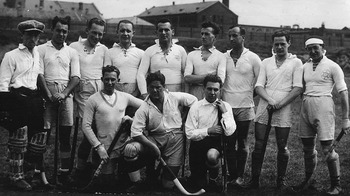
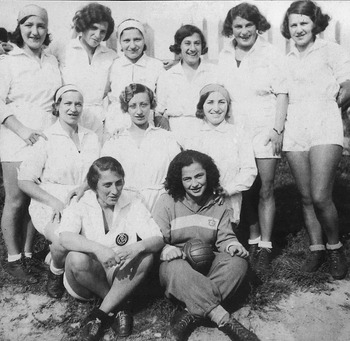
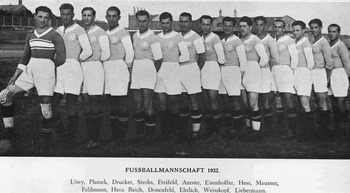
In the interwar years, Hakoah's membership grew and its divisions expanded. Hakoah's football players and swimmers were the most prominent divisions of the club and were most often mentioned in Vienna's newspapers in the 1920s and 1930s.Footnote 8 But Hakoah's athletes participated in a wide variety of sports, including wrestling, skiing, hiking, mountain climbing, handball, table tennis, field hockey, water polo, track and field, and fencing (see Photos 1, 2, and 3).Footnote 9 Women were also prominent athletes within the club, especially in its swimming division. Further, the club saw itself as providing social opportunities and leisure-time pursuits for Vienna's Jewish population. Thus, Hakoah also created sections for such activities as chess, which was also played competitively, and music. It organized dances and regular evenings of entertainment, many of which featured displays of athletic prowess. The club even created its own orchestra, which was reputed to be among the best amateur groups of its kind in the city and sponsored numerous balls said to be among the most sophisticated and sought-after in the city. Music, dancing, and other types of entertainment were an integral part of Hakoah's cultural life, a topic that has only recently been touched on by one scholar and that deserves far more treatment.Footnote 10
Men's Field Hockey Team. Source: Jewish Museum of Vienna.

Women's Handball Team. Source: Jewish Museum of Vienna.

Football Team, 1932. Source: Jewish Museum of Vienna.

To be sure, not all of Vienna's Jewish population rallied behind Hakoah's athletic banner, which featured the Star of David and blue and white colors. Some Jewish leaders and businessmen simply did not believe in encouraging athletic activities or thought they were at best a distraction or waste of time and energy. Some people were simply unaware of or did not care about athletic organizations in general.Footnote 11 On the other hand, some Jews worried that the creation of a self-conscious Jewish sports organization might even worsen the climate of anti-Semitism in Vienna.Footnote 12 Athletic Jews competing in their own sports club might counter the notion of assimilation and flew in the face of some pronounced stereotypes. Moreover, some Hakoah members were open Zionists and supported Jewish efforts in Palestine either directly or indirectly.Footnote 13 Still other Jews in Vienna participated in other sports clubs, such as Austria, that were not closed to them and that earned prominence and recognition in their own right.Footnote 14 Indeed, Vienna's Jews were heavily involved in the foundation and development of the city's sporting world as such. For example, as recently as October 2009, one booster of Rapid Vienna, long portrayed as the “workers' club” par excellence in the Austrian capital and therefore thought not to have had much contact with the local Jewish business community in its early years, has claimed that at least one wealthy Jew was among the club's founders.Footnote 15
In this context, one must remember just how large and significant the Jewish community was in Vienna in the last decades of the nineteenth and early decades of the twentieth century; Jews comprised on average between eight and twelve percent of the overall population of the city between 1880 and the 1930s. The population of the city itself grew dramatically between 1869 (607,510) to 1910 (more than 2 million) and then declined slightly in the 1920s and 1930s as some people, such as ethnic Czechs, Slovaks, Poles, and Hungarians repatriated to their newly created post-World War I countries.Footnote 16 Vienna was at the turn of the twentieth century a city undergoing dramatic economic, social, and cultural change and was under enormous demographic pressure, one component of which was the large influx of Jews to the Habsburg/Austrian capital on the Danube. One part of Vienna's evolving cultural scene was an explosion of interest in sports. In a city caught up in the interwar sporting craze, Hakoah still managed to stand out. In particular, it engaged in a wide variety of international events. On many levels, Hakoah's activities helped to make sports in interwar Austria more global. Analyzing Hakoah's role in this globalizing process is the focus of this article.
Hakoah's athletes participated in some of the best-known international competitions of the interwar era. The modern Olympics, reestablished in the last decades of the nineteenth century, had of course become a fixture in the global sporting world by the 1920s and 1930s, although they would not reach the popularity they achieved in the post-World War II period.Footnote 17 Hakoah wrestler Nikolaus (Micki) Hirschl was selected as a member of the Austrian Olympic team to compete in Los Angeles in 1932. Hirschl was by then one of the most popular and successful Hakoah athletes in any sport.Footnote 18 He and other wrestlers were well known for organizing themselves into a type of self-defense unit to travel to Hakoah events if trouble was suspected with anti-Semitic elements or ruffians of any kind. This was especially true if Hakoah's teams or athletes were competing away from their home grounds in Vienna or outside the city in Lower Austria, where anti-Jewish sentiment could be especially strong and its expression especially crude.Footnote 19
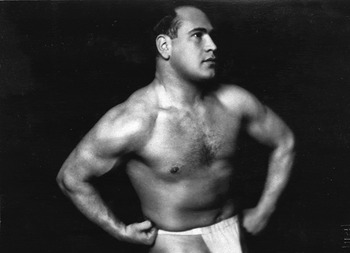
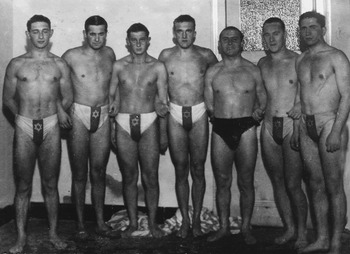
Hirschl did well in Los Angeles, winning the bronze medal in Greco-Roman and freestyle wrestling even though he had been slightly injured in preliminary matches leading up to the medal round. Years later he would claim that he could have won the competition and the gold medal if he had been in peak condition. Some athletic attitudes do not change across the generations. He also wrote that he believed that wrestling was the best test of one's athletic prowess as it combined strength, agility, stamina, and physical and mental courage.Footnote 20 Although Hirschl was a strong man and often appeared in photos as the quintessential “muscular Jew” (see Photo 4), he was smaller than many of his Greco-Roman opponents.Footnote 21 He prided himself on his quickness and his technique in being able to compete at the very height of international wrestling. The Austrian Olympic committee was pleased with his accomplishments, and he received press coverage in Vienna's sporting newspapers, which followed the Olympic events.Footnote 22
Nikolaus (Micki) Hirschl. Source: Jewish Museum of Vienna.

Four years later, the Berlin Olympics presented Hakoah's athletes with a challenge that went well beyond athletics. The games had been awarded to Berlin before the Nazi seizure of power in 1933.Footnote 23 Between 1933 and 1936, a systematic process had been put in place to discriminate against German Jews. This process, which included exclusion from certain professions, restrictions on joining so-called Aryan clubs and organizations, and attempts to regulate sexual activity and much more, has been as well documented as any event in modern European history.Footnote 24 For Europe's Jews outside Germany, including those in Austria, one troubling issue was how to react to this growing threat in their midst. Could and should Jewish athletes, for example, participate in the Berlin games, which the Nazis wished to use as a showcase for their political, economic, and social system and seemingly revitalized nation?
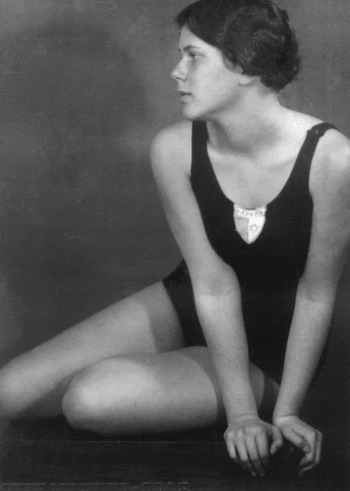
For three Hakoah swimmers, all of whom qualified for the 1936 Austrian Olympic team, the answer was no. Judith Deutsch (see Photo 5), Ruth Langer, and Lucie Goldner refused the invitation of the national Olympic team to train and compete for Austria. The three, all quite young, wrote letters expressing their views. In her letter, Deutsch referred specifically to the conditions for German Jews as grounds for her refusal to compete. She wrote that she could hardly swim in pools in a country in which signs had only recently been taken down—because of the upcoming Olympics—that had announced that certain locales were off limits to “Jews and dogs.” Langer, only fourteen years old at the time, followed suit. In refusing to join their national team to train for the 1936 Olympics, the swimmers abided by the directives coming from the Jewish Gymnastic and Sports Union of Austria, which stated that athletes from member clubs, which included Hakoah Vienna, should not participate in the Berlin games. Jewish athletes took note that the Austrian National Olympic Committee had not voted to boycott the games.Footnote 25
Judith Deutsch. Source: Jewish Museum of Vienna.

The three swimmers—Deutsch, Langer, and Goldner—would later remember vividly the penalty they paid for their decision not to join the Austrian Olympic team in training. Initially, the Austrian Swimming Union wanted to ban them for life from all international competitions. Reaction to such a draconian move, however, was strong enough that the union relented and changed the ban to two years.Footnote 26 The official change in policy did not mean much in the long run as the Nazi Anschluss or annexation of Austria took place in March 1938, within the two-year period of the ban, so that for all practical purposes Deutsch, Langer, and Goldner were excluded from national and international competitions for the rest of their lives. Each of them eventually fled the country, which also took the extra step of expunging their times from the record books. The swimmers believed that Austrian swimming officials were only too happy to delete Jewish athletes from their former places of honor.Footnote 27 Only many decades later did Austrian authorities address the swimmers' status and reinstate them officially and acknowledge the wrong that had been done to them in the run-up to the Berlin Olympics.Footnote 28
Hakoah athletes and officials were also involved in the development of the Maccabiah Games, which are sometimes referred to as the Jewish Olympic Games. Following the 1912 Olympiad in Stockholm, several Jewish organizations and individuals in Europe and the Middle East, including members of Hakoah Vienna, became interested in sponsoring a similar event that would be open primarily to Jewish athletes.Footnote 29 They agreed that the most appropriate site for such a Jewish Olympic Games was Palestine. Bringing an international Jewish sporting event to Palestine in the interwar period was, of course, loaded with difficulties, not the least of which was that such games would further complicate relations between Arab Palestinians, Jews in the region, and British officials.Footnote 30 After, however, more than fifteen years of work and fund-raising, Jewish sporting clubs, working with officials in Palestine, were able to arrange for the first Maccabiah games to be played in 1932.Footnote 31
Hakoah Vienna was well represented among the Austrian athletes at these games, and indeed the Austrian Jews enjoyed pride of place among the nations entering the stadium during the opening parade at the first Maccabiada. Alfred Guth, a Hakoah participant, remembered the event vividly and counted it among the highlights of his sporting career. He recalled later that it was “the most impressive thing in my life to that date. We gathered in the Herzl gymnasium and aligned ourselves in tight rows of four. We entered the stadium first behind the Herzl and national flags. The crowd went wild.”Footnote 32 In recalling his experience in 1932, Guth referred explicitly to sports as a method of creating solidarity among people from various countries. The model of the modern Olympic games—pregames' ceremonies, coordinated national dress, an athletes' parade around a track, the honor of place in the procession, and an ideology of and hope for international solidarity—was, therefore, reproduced at the first Maccabiah Games.
Although only a handful of Hakoah's best athletes were in Tel Aviv, the site of the games in 1932 and ever since, the club did well, especially in the swimming events in which the athletes took away several medals from the competition. Hedy Bienenfeld, Hansi Bratmann, Guth, and Fritzi Löwy won five swimming titles among them. The Sport-Tagblatt, one of the leading Viennese sports-based newspapers, followed the international event and reported on Hakoah's participation in and success at the first Maccabiah Games.Footnote 33
Attending the games was in itself an international undertaking as Hakoah's participants journeyed to Palestine via ship and made several ports of call, such as at Trieste, before reaching their destination. Coordinating the visit and raising funds for it occupied the club for several months leading up to spring 1932—the games were held in March and April of that year—and drew on the expertise and experience of Hakoah administrators from several of its sections. In particular, Zsigo Wertheimer, whose swimmers performed so well in Tel Aviv, had to arrange several of the traveling details and had to watch over his athletes while abroad. Valentin Rosenfeld, a leading functionary in the swimming section, also was heavily involved in preparations for the first Maccabiah Games.Footnote 34
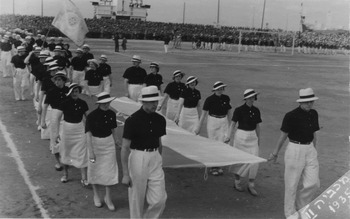
The second Maccabiah Games were held in 1935, and this time Hakoah Vienna was numerically better represented than in 1932. Hakoah athletes competed in Tel Aviv under the name “Maccabi-Austria.”Footnote 35 As in 1932, its athletes also managed to win or place in several competitions. Once again, the swimmers, along with the divers and water-polo players, performed particularly well. Bienenfeld, Löwy, and Deutsch managed to win individual or medley events in 1935. Indeed, in the twenty-nine events in which Hakoah swimmers and divers were entered, they managed to win, place, or show twenty-five times. In addition, the water-polo team finished second in the competition. In track and field, Hakoah athletes won the 400-meter, 4 by 100, and 4 by 400 races. They also finished second in the 200-meter and marathon competitions. All in all, the “Austrian,” that is the Hakoah team, scored 196 points, which was good enough for first place overall at the 2nd Maccabiah Games (see Photo 6).Footnote 36 The athletes' success thus further expanded the international sporting reputation of the club as one of, if not the, premier Jewish athletic organizations in Europe. In the post-World War II era, the number of participants and nations at the Maccabiah games would grow and Austria's success would diminish.Footnote 37 In the interwar years, however, Hakoah's athletes tended to dominate the first two Maccabiah games. In 1932 and 1935, a number of Hakoah's athletes remained in Palestine following the competitions or spoke highly of their experiences there upon returning to Austria, which further strengthened the relationship between the Viennese Jewish athletic community and “Erez Israel” (the “Land of Israel”).Footnote 38
Maccabiah Games, 1935. Source: Jewish Museum of Vienna.

The political events of the late 1930s, primarily the aggressive nature of Nazi Germany's foreign policy and its moves against Austria, Czechoslovakia, and eventually Poland, sparking the outbreak of World War II, overwhelmed Europe and its various Jewish communities. Given the immediate pressures and difficulties to be dealt with in the late 1930s, continuing to sponsor the Maccabiah games was impossible, and they, like the regular international games on which they were modeled, were suspended until after the war. The third Maccabiah Games were held in 1950 in the new state of Israel, namely in Tel Aviv, which has become the sporting center of the country in the twentieth century and beyond.Footnote 39 The most recent Maccabiah Games were held there in July 2009.
In addition to competitions such as the Olympics and the Maccabiah Games, Hakoah's athletes participated in a number of annual international sporting events. For example, the swimming division hosted teams from throughout central Europe in Vienna in a variety of competitions. Usually, these international matches were held in the Dianabad, which was one of the most famous and attractive pools in Austria.Footnote 40 Teams from Germany, Poland, Czechoslovakia, and Hungary would regularly appear at these competitions held in Vienna. Hakoah swimmers also traveled extensively to other countries to compete. For example, they journeyed to Leipzig and Prague in February 1927. In both of these locations, the club's water-polo team was also in action in several matches. In August 1929 the swimmers and water-polo players were at an international competition in Poland. Later that same year, they were in Budapest for a national competition against their archfoes, the Hungarians. In December, they hosted a competition against Czechoslovakia in the Dianabad. In May 1930, they sponsored a “Hakoah” swimming festival that attracted competitors from Hungary. Using numerous Hakoah players, the Austrian water-polo team managed to win third place at the European championships held in Paris in 1931. In August 1933, several Hakoah swimmers competed in the European version of the Maccabiah Games held that year in Prague. And in winter 1935, Hakoah again sponsored an international club competition that drew swimmers and divers from Hungary and Czechoslovakia. One could add many more examples of international competitions in the 1920s and 1930s involving Hakoah swimmers, either competing for their club or country.Footnote 41 By the interwar period, international competition was commonplace for a well-known and successful swimming club such as Hakoah Vienna.
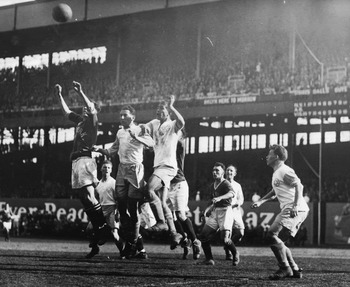
And the same pattern of international competition would hold for many, although not all, of Hakoah's other sporting divisions, especially for its football team. From 1909 to 1920, the club worked its way up from the fourth to the first division of football in Vienna. It won the city championship for the 1924/25 season, which for all practical purposes was the national championship of the day. It went on numerous international tours, including trips to Germany, Czechoslovakia, Poland, Yugoslavia, Romania, the Baltic states, France, north Africa, Luxembourg, Italy, Switzerland, England, Egypt, Palestine, Canada, and the United States. It was while touring the United States that many of Hakoah's star football players such as Bela Guttman decided to leave the team and play for New York-based teams, a blow from which the team never fully recovered (see Photo 7).Footnote 42 These trips were undertaken for a variety of reasons, including the desire to spread the name of Hakoah abroad, to show pride in and help to strengthen Jewish identity and athletics, to compete against some of the best club teams of the era, and, of course, to raise money; financial considerations were and are never far from any discussion of sports in the modern era. Touring became as central to Hakoah's football identity as competing at home in its domestic league.
Hakoah Football Team in the United States. Source: Jewish Museum of Vienna.

During their tours, Hakoah's football team was able to achieve a number of notable firsts that became part of club history. According to club sources, they were the first club team to play in Prague after World War I, at a time when the Fédération Internationale de Football Association (FIFA), the international governing body for soccer, was still trying to figure out how to deal with the new national associations emerging in the successor states from the old Habsburg empire. In Prague in May 1924, Hakoah beat Slavia, the perennial Czech master, which had not lost a home match in ten years. In the 1920s, Hakoah hosted Slavia in Vienna on several occasions, and the two teams often drew forty to sixty thousand spectators to their matches, which were attendance records for the day. Before its first trip to the United States in summer 1926, also a first for an Austrian club, the team played numerous friendlies to raise money to finance the trip. On the trip to North America, Hakoah stopped in Paris to play Racing Club, which, according to the club's supporters, was the first time any Austrian side had played under artificial lighting.Footnote 43 In the United States, the club played before large crowds and won six of ten matches, tied two others, and lost the remaining two games. As was stated above, many of its core club members, including most of its star players, asked for permission to leave the team and play in the United States. Several of these players stayed in the New York area and joined clubs there. Some of them even played against Hakoah the following summer (1927), when the team made its second trip to the United States. As part of this second tour, the U.S.-based ex-Hakoah players eventually were added to their old team, so that it had enough drawing power for several matches in Canada.Footnote 44
The most famous of Hakoah's international football matches, however, were undoubtedly its two games against Westham United from London. The English cup finalists came to Vienna in May 1923 for a contest against Hakoah that ended 1-1. It was witnessed by 40,000 fans, which was said to be a record to that point for any Austrian football match.Footnote 45 Hakoah won the return game at Upton Park in summer 1923 by 5-0. This result, perhaps not surprisingly, is viewed very differently in Vienna and London. In Vienna, it is cited as the first time any club team from the continent beat an English side on its home soil. In London, and sometimes in private conversations in Vienna as well, it will quickly and unfailingly be pointed out that the Westham United team that played that day was largely a reserve side.Footnote 46 Be that as it may, the two matches and many other international games (Hakoah played everyone from big club teams—MTK, Fiorentina, Olympique Marseille—and select sides to small Jewish or local sides in places such as eastern Poland and the Baltic states) garnered considerable international attention and press, both good and bad, for the club. In spring 1924, for example, the Munich-based Fussball, considered one of the leading German sports newspapers of the day, commented about Hakoah's performances in Berlin and Leipzig that the football team played with great calm, fairness, and ability. It went on to add that “Hakoah had helped to do away with the fairy tale about the physical inferiority [Minderwertigkeit] of the Jews.”Footnote 47 On the other hand, the Austrian-based workers' newspaper, the Arbeiterzeitung, wrote with near glee about the defection of the Hakoah “profis” from the team after its two America trips.Footnote 48 And after the club had become internationally well known, the German-national newspaper of Austria, the Deutsch-Österreichische Tageszeitung, sometimes reported Hakoah's domestic results, especially if they were positive, without comment: “Hakoah 5, Wacker 1.”Footnote 49
Unfortunately for Hakoah's football team, financial considerations came to dominate its international touring by the early to mid-1930s, and the club was forced to take several trips just to make ends meet and to support its participation in the professional league in Austria. By the 1930s, the football team was no longer what it once was, a challenger to Rapid and Austria in Vienna for preeminence, but it did manage to do well enough in many of its international matches and to promote Jewish identity or solidarity in many of the places it played.Footnote 50 In the 1930s, the club yo-yoed back and forth between the first and second or, as they were called by then, the “national” and “first” divisions. In spring 1938, it was atop the latter and on its way once again to promotion to the national league when the Nazi annexation came and wiped the team from the Viennese football scene. Its ground and gear were confiscated, its players scattered, and its history was seemingly frozen in time.Footnote 51
The emphasis on the politics surrounding the club—pro-Jewish beginnings, Aryan paragraphs, anti-Semitic encounters, the Anschluss of 1938, etc.—have tended in the limited literature on the club to obscure the degree to which Hakoah's athletes joined a sports club to engage in strenuous physical exercise, to train and condition their bodies, and to compete against other clubs in a variety of sports. In other words, Hakoah was first and foremost an athletic club. From the photographic evidence from the 1920s and 1930s, it is quite clear that they were very proud of the results of their efforts; they wanted to show off their muscular and toned bodies and to celebrate their athletic victories and accomplishments. That is, Hakoah's athletes also participated in the growing international cult of the body that was being firmly established in the 1920s and 1930s. Newspapers and magazines in the postwar era regularly featured pictures of athletes in action. Weekend results, accompanied by extensive pictures, were increasingly available for Monday reading.Footnote 52 More sophisticated photography aided this process. Sporting publications, including those of Hakoah, often carried advertisements for photography studios or cameras that could be taken to the next sporting event.Footnote 53 In fact, there is more surviving photographic evidence about Hakoah's activities than there is printed primary documentation, much of which was seemingly destroyed or lost after 1938. Members tended to take their photographs with them, even as they were forced to flee Vienna.
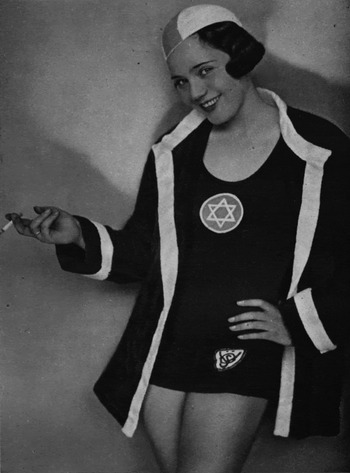
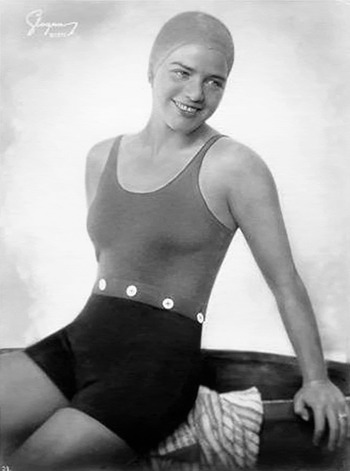
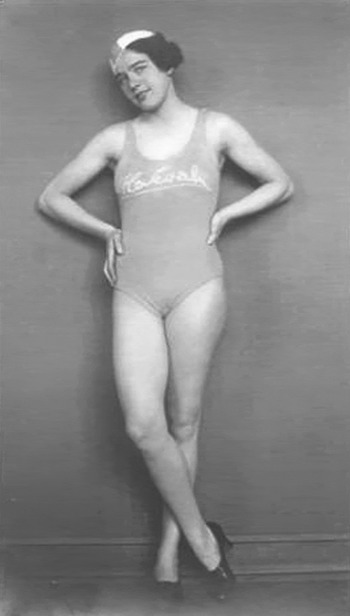
Hakoah athletes also sometimes crossed over into the world of commercial photography and became photo models. Hedy Bienenfeld, for example, the internationally renowned swimmer, posed for ads for cigarettes. She also modeled women's clothing. Even when she was not formally posing for commercial purposes, Bienenfeld, in her many photographs, often proved that she knew a lot about self-presentation (see Photos 8, 9, and 10). Hakoah athletes in general often look self-confident and proud in the many team photos that were taken in the 1920s and 1930s. They knew how to show off their bodies to optimal effect and adopted some of the classic athletic poses that featured the prominent display of muscle or were intended to demonstrate physical fitness or prowess. These photos do not differ in style from many others taken of athletes in the interwar period, but they do show to what extent Hakoah's members embraced the ideals of the cult of the body (see Photo 11). One Hakoah athlete, Franz Weiss, (Frank White after he emigrated to Los Angeles), even entered and won an Austrian “muscle beauty contest,” more or less a bodybuilding contest, for men in 1930 (see Photo 12).Footnote 54
Hedy Bienenfeld in a cigarette ad. Source: Jewish Museum of Vienna.

Hedy Bienenfeld modeling clothes. Source: Jewish Museum of Vienna.

Hedy Bienenfeld in a swimsuit. Source: Jewish Museum of Vienna.

Hakoah Swimmers. Source: Jewish Museum of Vienna.

Franz Weiss (Frank White). Source: Jewish Museum of Vienna.

The Nazis, of course, had their own ideas about the supposed inferiority of the Jewish body and its physical abnormalities.Footnote 55 This was another element of their warped ideology, which sometimes makes it difficult for modern-day scholars to analyze such topics as the self-presentation of Jewish athletes and their bodies in their original and proper historical context. Hakoah's athletes clearly understood that they were contradicting stereotypes about weak Jews by posing for photographs. But they also simply enjoyed demonstrating their strength and physical beauty in photographs. It is easy to see their posing for pictures as a reaction against negative ideas about the Jewish body; one should, however, also see it as a positive act of self-awareness and even an expression of joy.
Contemporary scholars may also view these photographs through the lens of the objectification of the male and female form in the twentieth century and a modern obsession with the human body. Such an interpretation of the photographic evidence is clearly possible. The photographs may ultimately have also played ironically into interwar stereotypes about Jewish sexuality. An anti-Semite could choose to view confident, physically powerful Jewish athletes as sexually promiscuous or even sexual predators. Nevertheless, for the Hakoah athletes who posed for these pictures, they represented an overwhelmingly positive self-image, especially against the prevailing ideas of that time about Jews. They were supposedly weak, unable to compete physically with Aryans, and afraid of the water. The photos of Hakoah's athletes stand in stark contrast to these prejudiced stereotypes.
In 1938, Hakoah, like all independent Austrian Jewish organizations, was suppressed and then disbanded.Footnote 56 Its athletes and functionaries fled abroad and helped to establish new or strengthen existing sports organizations in Tel Aviv, London, New York, San Francisco, Melbourne, and many other cities.Footnote 57 They also labored to establish and maintain contact among the now far-flung membership through the publication of newsletters and books written on important club anniversaries.Footnote 58 Through these latter activities, Hakoah's exiled members began the first draft of their own history.Footnote 59
Many of Hakoah's athletes and functionaries took advantage of the international contacts they had established during the interwar years to make their way out of Austria in the months following the Anschluss of March 1938. There was, however, not one typical path of emigration. Some Hakoah members were able to obtain documentation to emigrate to Palestine to join the Jewish efforts to establish a state there. Some members of Hakoah had already left Austria for what they referred to as Erez Israel prior to 1938. After the Anschluss, more simply went there without documents and stayed illegally, a circumstance that undoubtedly added to the growing tension with Palestinian Arabs and the problems of British authorities in the region.Footnote 60 Many of these individuals would become central figures in the founding or expansion of sports clubs in Israel in the post-1938 period. Some of the leading figures from Hakoah Vienna, such as Ignaz Körner and Arthur Baar, would settle there.Footnote 61
It should be noted that the Viennese Jewish community in general and not just Hakoah's athletes had little doubt about the intentions of the Nazi-led government in their country. Not only had they had a four-year prelude of authoritarian homegrown government prior to 1938 and the persecution that followed March 1938 before their eyes, but they also witnessed at close range the gradual dismemberment of interwar Czechoslovakia after the Munich agreement of late 1938.Footnote 62 Indeed, some Hakoah members first left Austria for Czechoslovakia following the Anschluss—the connections to Prague and sporting clubs (Hagibor, Slavia) in that city had been cultivated throughout the 1920s and 1930s—only to learn that it was not safe to stay in that part of central Europe, either.Footnote 63 Hakoah's athletes were not at all exceptional among Vienna's Jewish community in exiting the city in large numbers; their international connections and experiences during the interwar period, however, aided their exodus.
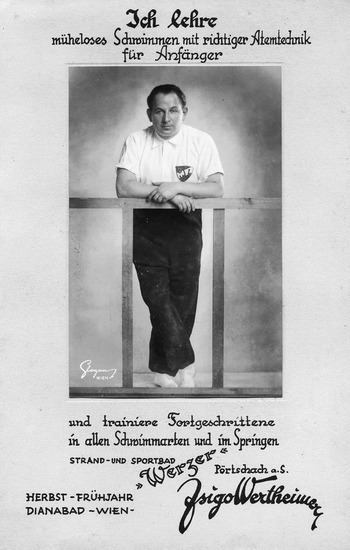
A significant number of Hakoah's swimmers left Austria in 1938 for England. Rosenfeld, a Viennese lawyer with connections to London, was extremely important in this process. According to one recent author, Rosenfeld was marginally successful at his profession, but took a keen interest in Hakoah's swimmers in the 1920s and 1930s, especially its female swimmers. He served for many years as one of the swimming section's executives and, apparently, was romantically linked to at least one of the club's well-known female swimmers, Fritzi Löwy. His wife, a friend of Sigmund Freud's family, also seemingly tolerated this situation.Footnote 64 Rosenfeld had been involved in arranging the participation of Hakoah's swimmers in several international swimming competitions in the interwar period in places such as Germany, Czechoslovakia, Poland, and Palestine. It should be remembered that Hakoah also frequently sponsored and hosted international swimming meets in Vienna. The success of its swimmers in these competitions was crucial to its international reputation and success; swimmers such as Deutsch; Goldner; Langer; Löwy; and Bienenfeld, the most celebrated Hakoah athlete of all, emerged from a well-developed and highly sophisticated training program led by Zsigo Wertheimer (see Photo 13). These competitions were in addition to and in preparation for the more significant participation of Hakoah's swimmers in international meetings such as the Olympics or the Maccabiah games.
Rosenfeld, Wertheimer, and others working in the swimming section, therefore, had extensive organizational and international experience to call on in the wake of March 1938. They quickly overcame the shock of the Anschluss and became quite active in a rescue effort of Hakoah's swimmers. With the help of Wertheimer, who by the late 1930s had become the swimming section's nearly legendary trainer, Rosenfeld sponsored several young swimmers' emigration to England. The youth of the swimmers was key as Rosenfeld was apparently able to convince British authorities that the athletes would be assets to their adoptive countries.Footnote 65 Not all of the Hakoah swimmers who came out of Austria via England remained there; some of them moved on to places such as Australia and the United States.
Zsigo Wertheimer. Source: Jewish Museum of Vienna.

In 1938, each of the three women swimmers who had boycotted the 1936 Berlin Olympic Games left Austria and established residence outside central Europe. Judith Deutsch went to Palestine and stayed there after World War II. She became something of a national icon.Footnote 66 Ruth Langer dyed her hair blond and escaped first to Italy with a false baptismal certificate. In 1939, she went to England.Footnote 67 Lucie Goldner also escaped in dramatic fashion. She was arrested by Nazi officials and was on a transport to be sent to a camp. She got away and hid for several days. She went by train to Berlin of all places and then flew to London on April 30, 1938. In England, she had no visa to allow her to stay, no money, and no real passport.Footnote 68 International connections developed before 1938 played a role in saving her life. Word of Goldner's refusal to participate in the 1936 Olympics had obviously reached London—Hakoah's international reputation was, of course, well established by 1938—and immigration officials there decided to allow her to stay. The intervention of two Jewish international sports figures, Pierre Gildesgame, after whom the international Jewish sports museum in Israel is now named, and Willy Meisl, a well-known sports journalist and brother of Hugo Meisl, the coach of Austria's famous football “wonder team” of the early to mid-1930s, helped Goldner in her plight.Footnote 69 Meisl himself had fled Germany for England after the Nazi seizure of power. Thereafter, he worked for the press department of the British Olympic committee in 1936 in the run-up to the Olympic Games in Berlin. Eventually, he joined the British army and then the foreign office. Meisl was therefore in a good position to aid Goldner in her escape from Austria and Germany and could clearly sympathize with her situation.Footnote 70
Many years later, reflecting on her escape from Austria, Goldner commented that it was ironic that she and her fellow swimmers, Deutsch and Langer, had all survived World War II, whereas many of their anti-Semitic adversaries in other Viennese and Lower Austrian sports clubs, such as the Erster Wiener Athletik und Sportklub (EWASK, the First Vienna Athletic and Sports Club), one of their main rivals, had not.Footnote 71 Many of the latter had either died in military campaigning or during the fighting in and around the Austrian capital at the end of the war. Goldner did not stay in London; she eventually moved to Melbourne, where she joined the Ajax Swim Club and eventually became secretary of Maccabi Australia, through which she stayed in contact with Jewish sporting clubs and athletes from around the world.Footnote 72 Like Goldner, many former Hakoah athletes helped to sponsor international athletic organizations in their adopted homelands; this was especially true in Palestine/Israel in the late 1930s and in the 1940s and 1950s.
Of course, not all of Hakoah's athletes were able to leave Austria. Some lacked the means to do so. A few, a distinct minority, might even have underestimated the threat of the situation after March 1938. Others fled Austria for countries that were eventually taken over by Germany, such as Czechoslovakia and France, and thus later came under Nazi anti-Semitic policies. Arthur Baar, one of the club's early functionaries and historians, listed the names of all the Hakoah members known to him who became victims of the Nazis during World War II. He counted no fewer than thirty-five individuals who were murdered outright or died in concentration camps. The murdered athletes came from virtually every division or section of Hakoah; former football, track and field, and handball athletes, along with swimmers, table-tennis players, and others died in the Holocaust.Footnote 73 One of the most famous cases of a Hakoah athlete to perish at the hands of the Nazis was that of Max Scheuer, a football player who had escaped to Marseille where he joined his former colleague Friedrich Donenfeld, who ironically had left a team in Palestine, Makkabi-Tel Aviv, to play for Olympique Marseille and was now trapped in France. Donenfeld got away, joined the French underground, the maquis; survived the war; played for Red Star Paris; and became a trainer first in Columbia and eventually took over the Dutch national team in 1954. Scheuer was not nearly as lucky. He was captured as he tried to make his way to Switzerland and was later killed by the Nazis.Footnote 74
In the post-World War II era, Hakoah Vienna became a shadow of its prewar self. The Viennese Jewish community had been decimated by the Holocaust, the war, and mass migration out of the city and country. Indeed, Jewish leaders in Vienna wondered whether communal organizations would survive. Hakoah did, however, reconstitute itself in the late 1940s and early 1950s and recreated some of its athletic divisions. After several decades of struggle and low membership, the club has done better in recent years and has lately reacquired part of its original club property in Vienna and created a new athletic and educational center in the city's second district, not far from the national stadium and on the northern edge of the famous Prater park in what is known as the Krieau. Within the new center, some of the history of the club is told through photographs and glass display cases.Footnote 75
Conclusion
Hakoah Vienna contributed in many ways and for several reasons to the international nature of sports in interwar Austria and Europe. As a Jewish sporting organization that placed great value on developing a strong sense of identity, the club naturally sought out connections with other Jewish clubs that had formed in Europe.Footnote 76 Hakoah Vienna was also an attractive organization for Jewish athletes not only from the Austrian capital but from other parts of the former Habsburg monarchy, such as Hungary, Czechoslovakia, and Poland. Several football players, for example, came to Hakoah from Budapest. Many of its swimmers came from families that had migrated to Vienna within a generation or two of the 1920s and 1930s. In this respect, they were not unlike the majority of Vienna's Jewish community. Hakoah's opponents, however, sometimes accused the club of recruiting its athletes from beyond Austria's borders. Hakoah did not so much recruit athletes to Vienna as it attracted them there and many followed natural lines of migration to the city that had been well established over the last decades of the nineteenth century and the first decade of the twentieth.
There are interesting life stories to analyze in looking at the individual career paths of Hakoah athletes, such as Bela Guttmann, who was born in Hungary, became well known in the ranks of Hakoah Vienna, left the club for the United States in the 1920s, and then became famous as the manager of numerous clubs throughout the world: Hakoah, Honved, Sao Paulo, Porto, Benfica, Milan, Servette, and Panathinaikos (see Photo 14).Footnote 77 Athletes such as Hedy Bienenfeld, Micki Hirschl, and Guttmann became internationally recognized sporting stars of the interwar period. They represented Jewish identity, athletic ability, and physical power and strength (hakoah) through their sporting activities.
Bela Guttmann. Source: Jewish Museum of Vienna.

Hakoah's athletes were well traveled and well seasoned by international competition in the 1920s and 1930s. They cultivated sporting contacts with a large number of organizations throughout Europe and to a lesser extent beyond. Tragically, their status as international sporting figures did not spare them from the prejudice and hatred sponsored by the Nazis and their followers in the 1930s and 1940s. In the bloodlust that was racial anti-Semitism, no Jew was exempt from Nazi persecution. Hakoah's international reputation and experience did aid, however, a number of its members in fleeing Austria and establishing themselves in other countries, where many of them continued to work for international sporting clubs, this time more often as organizers than as athletes.
Hakoah Vienna was part of the expanding and thickening nexus of global athletic competition in the 1920s and 1930s. It forged new ties or strengthened existing ones to clubs and competitors throughout Europe, the Middle East, and North America. Hakoah was involved in such interwar international sporting events as the Olympic and the Maccabiah Games, and it sponsored or took part in numerous international club competitions. Hakoah not only sent its athletes to these events, but it was also often part of the process that created new international patterns of sporting competition. The Maccabiah Games, while the work of many individuals and organizations, gained much popularity by the participation of Hakoah's athletes, especially its swimmers, divers, and track and field athletes, in the 1930s.Footnote 78
Hakoah Vienna's many athletic divisions were part of the globalization of sports in the interwar period. They traveled extensively, sought out international competition, and raised money for touring. Their activities were followed by an international press, and many of the athletes eventually willingly or unwillingly took up international careers. The club's demise in 1938 at the hands of the Nazis has largely obliterated this history. Austria's status as an international also-ran in most sports outside of skiing (and the occasional formula one driver and former California governor) has also not helped to include clubs such as Hakoah in the master narrative of the globalization of leisure-time activities in the twentieth century. Indeed, Austria's political position as a small, rump state in central Europe often dominated by its neighbors to the north also often obscures the role that a city such as Vienna played in many cultural developments, including the interwar evolution of sports. To borrow a saying from American sporting slang, Vienna was a player, at least until the 1930s, in the globalization of modern sports. And Hakoah, a club not well known today, was a critical part of Vienna's interwar sporting culture.