Introduction
The adequate, yet cost-effective, staffing of mass-gathering events is a dilemma that is regularly encountered by event and emergency planners worldwide. A mass-gathering event has been defined by some as any gathering of more than 1,000 persons at a specific location for a specific period of time.Reference Westrol, Koneru, McIntyre, Caruso, Arshad and Merlin 1 - Reference Michael and Barbera 4 An alternative definition by Arbon is, “a mass gathering is a situation (event) during which crowds gather and where there is the potential for a delayed response to emergencies because of limited access to patients or other features of the environment and location.”Reference Milsten, Maguire and Bissell 5 This definition tends to encompass more of the challenges that mass-gathering planners encounter which may affect resource utilization.
There are inherent properties of events which may result in increased patient encounters, and planners of these events may rely on anecdotal and historical evidence based on weather, location, or type of event. Little work, though, has been done on models to predict patient encounters. Comparisons have been performed on a predictive model versus retrospective review.Reference Milsten, Maguire and Bissell 5 - Reference Zeitz, Zeitz and Arbon 9 In addition, various case studies have been published on patient encounter rates of specific events or venues, sometimes over the period of several years.Reference Hartman, Williamson and Sojka 10 - Reference Grant, Nacca and Prince 16 For environmental factors, Perron et al. investigated the association between heat index and medical usage rates (MURs) at a college football stadium.Reference Locoh-Donou, Guofen and Welcher 17 Milsten et al. published an extensive analysis of multiple types of events held in three venues in Baltimore (Maryland USA), noting variables associated with increased MUR, mainly heat index and type of event (sporting vs concert).Reference Perron, Brady and Custalow 18 After the 2002 FIFA World Cup (Korea/Japan), Morimura et al. performed a retrospective regression model on the data and found correlations with temperature, ease of access, and total attendance.Reference Milsten, Seaman and Liu 19 A similar study performed by Bowdish et al. utilizing data from Indianapolis 500 auto races (Indiana USA) showed a correlation with dew point but no correlation with humidity, sunshine, race characteristics, or wind.Reference Morimura, Katsumi and Koido 20
Several of these studies have been very specific in venue or event type, making generalizability to the mass-gathering medicine realm difficult. However, the outdoor contemporary amphitheater music venue is a common location for mass gatherings and concerts, with over 130 locations across the country, not including open-air stadiums with similar characteristics.Reference Bowdish, Cordell and Bock 21 Spectators are subject to environmental and terrain hazards unlike indoor concerts. Medical usage rates expected with events at similar venues would be useful for future event planning across the country. The authors wished to examine the MUR according to music genre with controls for heat index, day of the week, presence of precipitation, and whether it was a music festival format. Similar studies looking at other variables have used a comparable study design, as noted above. Grange et al., for example, studied the effect of music genre as a binary value of rock music or non-rock music and found a significantly higher patient presentation rate for rock concerts when compared to non-rock concerts. 22 Using several years of data from an open-air, amphitheater music venue, analyses were performed to further examine which genres of music tend to particularly strain medical resources to aid in future planning.
Methods
The study was a retrospective review of patient logs from an open-air, contemporary amphitheater over a period of 10 years, from the summer of 2005 to 2014. The maximum capacity of the amphitheater is approximately 16,500 persons, depending on the set-up of the show and venue. The amphitheater is located in the New York (USA) metropolitan area within New Jersey (USA), with attendees generally residing in New Jersey and New York. Alcohol is sold within the venue, no outside drinks are permitted, and tailgating is significantly limited due to restricted parking lot hours. The Emergency Medical Services (EMS) system of New Jersey is two-tiered, including Basic Life Support (BLS) and Advanced Life Support (ALS). Onsite medical resources include a first aid station staffed by BLS emergency medical technicians (EMTs) providing general first aid and initial triage of any patients who present for assistance. The venue also is patrolled by mobile BLS EMTs able to identify patients and respond to any requests for aid within the venue and parking lots. In the event of an anticipated increased need of EMS resources, some concerts may have had a dedicated ALS unit, additional first aid stations, and even EMS physicians.
Variables recorded by the medical personnel for each concert included the attendance, description of the weather, and a patient log in which nature and outcome were recorded. The primary outcomes were associations of genres with the MUR. Secondary outcomes investigated were the association of confounders and the influences on the level of care provided, the transport rate, and the nature of medical complaint. All research methodology was approved by the Institutional Review Board of the host institution (Newark Beth Israel Medical Center; Newark, New Jersey USA – Protocol #2014.67) for retrospective chart review.
Study Design
The event medical logs at this venue were created for internal review and tracking. They evolved over the years to include more data points for review and future planning. In the event that a log was not fully filled out, records were reviewed to fill in missing data whenever possible. Those logs which could not be completed by the investigators were excluded from data analysis. Those individuals recording data on event medical logs in the past were never told of any potential research and were essentially blinded to the study, as this study was conceived after these internal review/tracking logs were completed.
Data abstractors were trained in the data review process prior to beginning, and their progress was monitored by the investigators. They were not blinded to the hypothesis of the study. Each concert was evaluated by one abstractor, one time; as a result, interrater reliability was not tested. Data from the event logs were abstracted and compiled into a spreadsheet with columns for the various variables defined (Microsoft Excel 2010; Redmond, Washington USA). Separate data forms were not used. The date of the concert was utilized to determine the day of the week of the event, which was coded into the spreadsheet. Weather data was obtained from the National Oceanic and Atmospheric Administration Climate Data Online23 for each date to determine the heat index. 24 The heat index was then utilized as a binary value for less than 90°F (32.2°C) and greater than or equal to 90°F (32.2°C) based on recommendations from the Occupational Safety and Health Administration (OSHA; Washington, DC USA) on when to implement additional measures for heat exposure. 25 Finally, the presence of precipitation during the event was coded as a binary value. Precipitation data were obtained from weather data, as well as event logs. Rainfall amounts totaling greater than 0.05 inches during the course of the event were considered sufficient to be a nuisance to spectators.
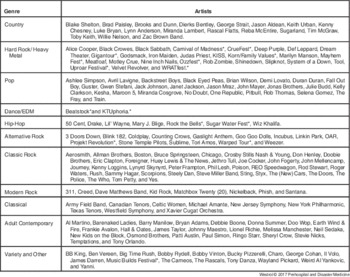
The genre of each artist was coded according to 11 categories of music prior to any data extraction in order to blind the researchers to any influence genre categorization of an artist may have on the data. The decision of which genre to assign to an artist was determined from referencing a common music catalog (iTunes Version 12; Cupertino, California USA) or the artist’s website (when possible). Artists were assigned into one of the following categories: country, hard rock/heavy metal, pop, dance/electronic dance music (EDM), hip-hop/rap, alternative rock, modern rock, classic rock, adult contemporary, classical/symphony, and variety/other (Table 1). In cases of conflicting categorization, the primary author (MSW) made an assignment based on best available information. For example, a popular artist from the 1960s may be categorized as “pop” on a music catalog, but their music in the modern day may best fit under “adult contemporary.”
Categorization of Artists (*Indicates Festival)

Attendance was obtained from concert organizers. The medical logs for each concert were referenced to provide total numbers of patients, numbers of patients transported, dispositions, level of care provided (ALS or BLS), and categories of chief complaint. Chief complaints were categorized as Medical, Trauma, or Drug/Alcohol. In cases where an intoxicated individual presented with another complaint (eg, head trauma or chest pain), the primary medical or traumatic complaint requiring assistance was recorded. Each concert was assigned a binary value according to whether it was a “music festival” or not. A music festival was defined as an event with multiple stages spread out over the venue; they often involve greater walking distances for spectators, increased mobility of the crowd increasing injury risk, worsened access for medical personnel, longer duration of the event, and an overall higher energy atmosphere. Finally, the duration of the event was recorded in hours. The duration corresponds to when the bulk of the crowd would be present, including time before the start of performances.
Data Analysis
The number of patients, attendees, and the duration of the event were utilized to determine the hourly MUR per thousand spectators for each event. The groups were described using estimates of central tendency (means) for continuous data and frequencies and percent for categorical data. All univariate analyses were performed using SPSS (IBM Version 22, 2013; Armonk, New York USA) and considered P value<.05 as significant. All tests were two-tailed. For normally distributed variables, Student t-test was used. For non-normally distributed variables, non-parametric tests were used. Variables with high correlation values were removed from the model. For multivariate analyses, all the variables were entered into a regression equation to test the univariate association P<.10. The likelihood ratio x2 was then used to determine which model was most appropriate for the data.
Results
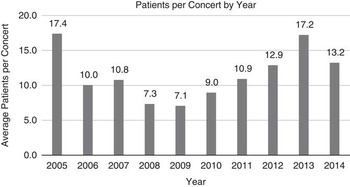
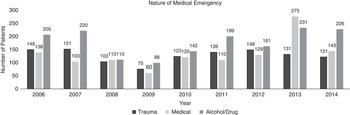
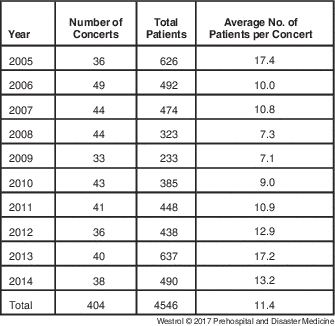
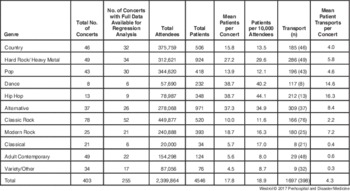
A total of 4,546 patients presented over the course of 403 concerts (Table 2). An average of 11.4 patients (annual range 7.1-17.4) presented to venue EMS each concert (Figure 1). A total of 2,399,864 concert attendees were included in statistical analyses. When analyzing transports of patients, a total of 1,697 patients (37.3%) were transported to area hospitals, resulting in an average of 4.3 transports per concert (annual range 2.5-7.1). One hundred five patients (2.3%) required ALS for their medical emergency. The analysis of the nature of emergency was performed only on the data from 2006 to 2014 due to missing natures in the 2005 data set. Of the 3,920 patients from 2006 to 2014, 1,140 (29.1%) were traumatic, 1,188 (30.3%) were medical, and 1,592 (40.6%) were alcohol- or drug-related (Figure 2).
Patients per Concert by Year.

Nature of Medical Emergency by Year.

Number of Concerts and Average Number of Patients

For the multivariate regression analysis, a total of 255 concerts had full data available for examination (Table 3). The years of 2006 and 2007 were excluded due to missing and unobtainable attendance data. Eighteen percent of the remaining concerts were missing at least one item of data. The genres with the most missing data were, in decreasing order: classical, adult contemporary, and variety/other. The years with the most missing data were 2014, followed by 2013. The most common reason for an event to be missing data was missing total concert attendance; without the total attendance, the MUR per 1,000 visitors could not be calculated.
Genre Analysis Study Characteristics

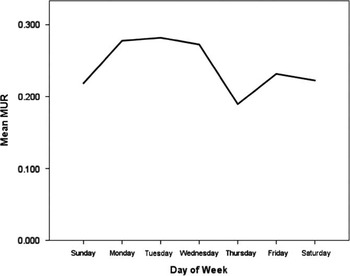
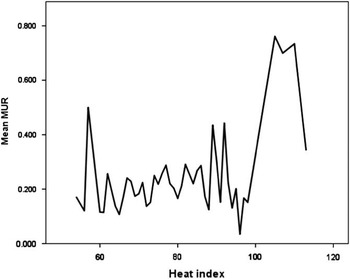
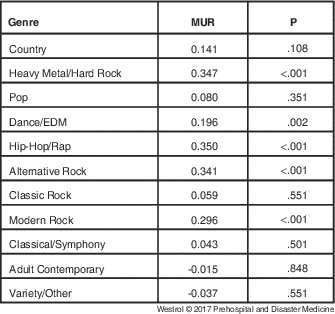
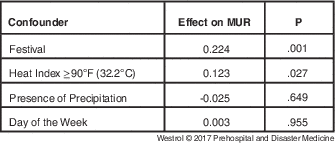
In an unadjusted univariate analysis of effect of genre on MUR, the categories of hip-hop/rap, heavy metal/hard rock, alternative rock, modern rock, and dance/EDM were significantly associated with an increase in MUR, in order from highest to lowest (Table 4). In an initial adjusted multivariate analysis of genres and confounders, only the binary variables of heat index and whether the event was a festival had a significant effect on MUR (Table 5). As a categorical value, the day of the week had no significant influence on the MUR (Figure 3). Furthermore, when the heat index was plotted as an integer value, an inflection point could be seen around 95°F (35°C; Figure 4), supporting the use of a binary value for heat index according to OSHA recommendations.
Influence of Day of the Week on MUR. Abbreviation: MUR, medical usage rate.

Impact of Heat Index on MUR. Abbreviation: MUR, medical usage rate.

Unadjusted Medical Usage Rate (MUR) by Genre

Note: MUR=number of patients per hour per 1,000 attendees.
Analysis of Confounders

Abbreviation: MUR, medical usage rate.
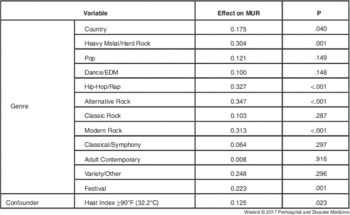
A modified multivariate analysis was performed utilizing only the significant confounders of heat index ≥90°F (32.2°C) and whether the event was a festival. The analysis was performed with the intention of developing an equation for predicting the MUR. When adjusting for only these confounders, the genres with significantly increased MUR in decreasing order were: alternative rock, hip-hop/rap, modern rock, heavy metal/hard rock, and country music (Table 6). These values can be utilized in the following formula:
 $${\it MUR\, {\equals}\, genre\plus F({\rm 0.223})\plus H({\rm 0.125})$$
Multivariate Analysis of Adjusted MUR by Genre with Significant Confounders

Abbreviation: MUR, medical usage rate.
In this equation, the MUR per hour per 1,000 patients is determined by entering the corresponding genre values. If the concert was a festival format, F=1; if the heat index was ≥90°F (32.2°C), H=1. Of course, those variables are zero if those conditions are not met.
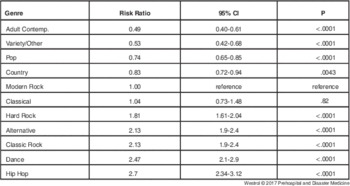
The genres were compared against each other to determine relative risk ratios. Because many of the adjusted values were not statistically significant, adjusted relative risk ratios were unable to be obtained. For comparison, unadjusted risk ratios were calculated using the median genre, modern rock, as the reference (Table 7).
Unadjusted Risk Ratios of MUR by Genre

Abbreviation: MUR, medical usage rate.
The secondary outcome investigations analyzed finer points of resource utilization at concerts. Only a heat index ≥90°F (32.2°C) was associated with an increase in ALS resource utilization (P=.023). Also, as the overall number of patients increased, the likelihood of requiring ALS also increased (P<.001). Medical complaints were significantly increased when the heat index was ≥90°F (32.2°C; P<.001) or the genre of music was alternative rock (P<.001). Traumatic injuries were significantly increased when the genres were alternative rock (P<.001), heavy metal/hard rock (P=.001), modern rock (P=.025), and dance/EDM (P=.038). Heat index had no impact on traumatic complaints. Patients presenting with a chief complaint of alcohol or drug intoxication were significantly more common, in decreasing order, when the genre was hip-hop/rap, alternative rock, dance/EDM, modern rock, pop, country (P<.001 for all preceding genres), and heavy metal/hard rock (P=.003).
In a multivariate analysis of transport rates, intoxicated patients were more likely to be transported to the hospital when compared to medical or trauma patients (P<.001). Traumatic injuries were the least likely to be transported (P=.004). The genres with significant effect on transport rates were alternative rock and country, both of which were negatively associated with patient transport (P=.017 and .033, respectively). The remainder of genres trended positively and negatively, but none were significant. A heat index ≥90°F (32.2°C) was associated with a decrease in transport rates (P=.008). Music festivals did not affect the transport rate significantly.
Discussion
To the authors’ knowledge, this is the largest and most in-depth study looking at individual music genres and their effect on the MURs at concerts. It is also the first study to use the data to perform a regression model to form a predictive equation. Prior studies have looked at music genres in a rock music versus non-rock music manner. 22 The analysis of non-rock genres previously had been limited, as have investigations into the effect of precipitation. The regression analysis provided an equation that could be used to predict numbers of patients in advance based on concert characteristics, expected attendance, and heat index.
Not surprisingly, the confounders of heat index and whether the concert was a festival-type of event were associated with increased numbers of patients. Heat index has been correlated previously with increased patient presentation rates at various types of mass gatherings; its association here was necessary to adjust for confounding effects. A possible limitation is the fact that the actual heat index at the time of the concert was ascertained from a combination of weather databases and employee-recorded event logs. It is possible that the heat index recorded for the day may not have been the actual heat index at the start of the event. Furthermore, the heat index would typically drop as the sun would set for evening concerts. High heat index also increased the number of medical-related patient presentations, as well as the need for ALS. Perhaps not surprisingly, the transport rate decreased significantly when the heat index increased. This is likely due to many patients improving with simple hydration and cooling measures, with subsequent refusal of transport to a hospital. This knowledge could be used to better allocate resources, such as additional workers for cooling stations without concomitant increases in expensive transport units.
For event planners, festival-style music events seem to require additional resources, and these results confirm the increase in MUR. Though impossible to determine the reason why the number of patients does not simply increase accordingly to attendance, it is likely that the crowd energy may be increased, the distance travelled within the venue is increased (leading to increased exhaustion or falls), and the increased duration of the event may result in increased fatigue and environmental exposure.
Somewhat surprisingly, the presence of precipitation during the event did not significantly affect the MUR, nor did the day of the week. Though the coefficient trended towards a negative value, the data were not significant. This may be related to the relative paucity of concerts with precipitation present. In addition, specific precipitation data were difficult to obtain due to the lack of hour-by-hour precipitation logs available in online weather databases. In addition, event logs were not always fully completed for the weather description. The decision to utilize 0.05 inches of precipitation as a cutoff was based on local climatologist expert opinion due to lack of research on such a topic; this may result in data adversely affected. Finally, it was a binary value; a light rain carried the same weight as a torrential downpour.
The study found that, after adjustment, the music genres with the highest utilization of resources were alternative rock, hip-hop/rap, modern rock, heavy metal/hard rock, and country music. Alternative rock was prominent amongst all subgroup analyses for the nature of the complaint as well, indicating that no specific type of complaint was particularly pronounced for alternative rock or responsible for its high MUR. Interestingly, these genres are also particularly diverse in their typical spectator demographics. Though the MUR was affected by genres, the transport rate was relatively unaffected across the board, with the exception of country music and alternative rock having slightly lower transport rates.
Limitations
There are some additional limitations with this study and its data. In particular, the data recorded for each event grew and changed over the years as more emphasis was placed on mass-gathering medicine. Initial logs were very basic; later logs had additional data points as attempts to internally analyze variables were beginning. Because of this, earlier concert logs were often incomplete, lacking attendance or natures of encounters. All attempts were made to complete the logs according to venue concert records or EMS agency records, but those logs which remained incomplete were excluded from data analysis. The cause of incomplete logs could not be ascertained. Generally, patients were recorded, but important details such as attendance (needed to calculate the MUR) might have been forgotten. Due to changes in the venue operator, records going back far enough to obtain the attendance in the early years were not available.
Furthermore, categorizing some artists proved particularly difficult, as many musicians do not fit nicely into a single box. Determinations on which category to assign some artists came down to consensus agreement of the researchers after consultation with numerous music catalogs. Among artists within the same genre, there may be significant variation in style of music or spectator demographics. This likely resulted in some effects on the data. For example, Pop Artist #1 may have a more mellow style with a low MUR, but Pop Artist #2 may be a bit more rowdy, which may translate into a higher MUR. The authors were somewhat surprised that pop music did not have a larger impact on MUR, but it was likely affected by the large variability of artists within that genre.
Some year-to-year variations may be the result of changes to policies, particularly alcohol and tailgating policies. Even within concert seasons, a particularly disorderly concert event may result in a curtailing of alcohol consumption and tailgating by law enforcement for the next few concerts. This was a random and very infrequent occurrence as far as effects on the MUR of the subsequent concerts, and it could not be controlled for in the data. Tailgating was generally limited at this venue by the fact that the parking lots did not open until shortly before the start of the event. Finally, these results may not be generalizable to all venues. While the outdoor concert amphitheater concert venue is common, it may not apply to other outdoor venues, such as stadiums or parks. Moreover, variations in local laws and policies may affect alcohol consumption, which has a large impact on MUR.
Conclusion
The data largely confirmed anecdotal reports and assumptions of factors affecting the MURs at outdoor concerts. Alternative rock, hip-hop/rap, modern rock, heavy metal/hard rock, and country music are genres of music that tend to produce higher numbers of patients. A heat index ≥90°F (32.2°C) and a festival format further increase the utilization of medical resources at these outdoor concerts. Event planners should anticipate and plan for larger numbers of patients in these situations. Accordingly, the organizer of an alternative rock music festival with an anticipated heat index ≥90°F (32.2°C) should plan for large numbers of patients. Future research efforts should be focused on comparisons between the predicted MUR according to the regression model and observed MUR. In addition, further validation with other venue types would be beneficial. As the knowledge base of mass gathering and event medicine grows, those individuals tasked with planning for such incidents will have more data and tools available to them for efficient preparation and resource utilization.
Author Contributions
MSW, ATC, FHA, and MAA conceived the study, obtained IRB approval, and designed the study. MSW and NM obtained and collected all data. FHA and MAA oversaw the study. SK performed data analyses. MSW, SK, and NM wrote the manuscript.